Ensemble optimal control for managing drug resistance in cancer therapies
Pith reviewed 2026-05-22 23:49 UTC · model grok-4.3
The pith
Ensemble optimal control on a Lotka-Volterra model yields an 'Off-On' adaptive therapy for managing cancer drug resistance.
A machine-rendered reading of the paper's core claim, the machinery that carries it, and where it could break.
Core claim
By placing a Lotka-Volterra model of sensitive and resistant cell competition inside the ensemble control framework, the authors obtain general theoretical results for cancer treatment and, in the specific case of androgen deprivation therapy for prostate cancer, a computed policy that resembles active surveillance and motivates the definition of 'Off-On' adaptive therapy.
What carries the argument
Ensemble control framework applied to the Lotka-Volterra competition model between sensitive and resistant subpopulations, used to derive dosing policies.
If this is right
- General results from the ensemble framework apply to treatment strategies for cancers other than prostate cancer.
- Numerical simulations produce a dosing policy reminiscent of the medical active surveillance paradigm.
- The 'Off-On' variant of adaptive therapy is offered as a concrete alternative to maximal tolerated dosing.
- The approach exploits competition between cell types rather than attempting complete tumor eradication.
Where Pith is reading between the lines
- The method might be tested by measuring time to resistance in models that include spatial tumor structure or immune effects.
- If the 'Off-On' schedule reduces total drug exposure while maintaining control, it could lower cumulative toxicity in clinical settings.
- Similar ensemble-control techniques could be applied to other resistance problems, such as antibiotic dosing or targeted therapies in different cancers.
Load-bearing premise
The Lotka-Volterra equations accurately capture how sensitive and resistant cell subpopulations compete for resources during androgen deprivation therapy.
What would settle it
A direct comparison, in either refined simulations or patient data, showing that the proposed 'Off-On' schedule does not delay the emergence of resistance longer than continuous maximal dosing would falsify the central claim.
Figures



read the original abstract
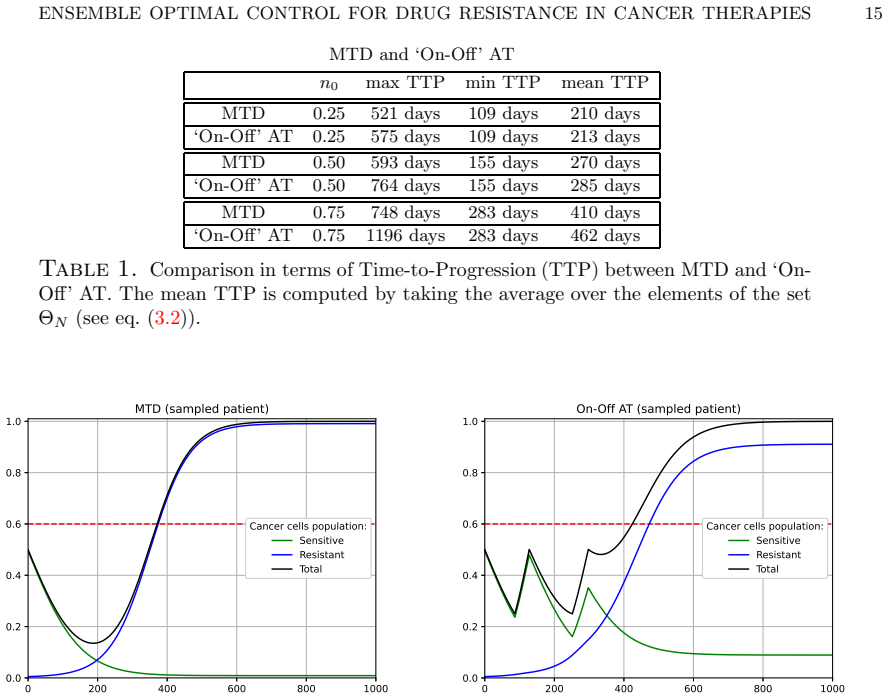
In this paper, we explore the application of ensemble optimal control to derive enhanced strategies for pharmacological cancer treatment, and we tackle the problem of the long-term management of the disease, i.e., when the complete eradication of the tumor is not achievable. In particular, we focus on moving beyond the classical clinical approach of giving the patient the maximal tolerated drug dose (MTD), which does not properly exploit the fight among sensitive and resistant cells for the available resources. Here, we employ a Lotka-Volterra model to describe the competing subpopulations, and we enclose this system within the ensemble control framework. In the first part, we establish general results suitable for application to various cancers. Then, we carry out numerical simulations in the setting of prostate cancer treated with androgen deprivation therapy, yielding a computed policy that is reminiscent of the medical `active surveillance' paradigm. Finally, inspired by the numerical evidence, we propose a variant of the celebrated adaptive therapy (AT), which we call `Off-On' AT.
Editorial analysis
A structured set of objections, weighed in public.
Referee Report
Summary. The paper applies ensemble optimal control to a Lotka-Volterra model of competing sensitive and resistant cancer cell subpopulations to derive long-term pharmacological treatment strategies that exploit resource competition instead of maximal tolerated dose (MTD). General theoretical results are established for various cancers; numerical simulations are performed for prostate cancer under androgen deprivation therapy, producing a policy reminiscent of active surveillance; and this evidence inspires the proposal of an 'Off-On' variant of adaptive therapy (AT).
Significance. If the numerical policies and derived 'Off-On' AT remain valid under the model, the work supplies a systematic optimal-control framework for designing intermittent therapies that manage drug resistance by leveraging subpopulation competition, with the ensemble formulation providing a route to handle parameter uncertainty. The bridge from general ensemble-control results to a concrete clinical-inspired schedule is a potential strength.
major comments (3)
- [Model formulation section, Lotka-Volterra system] Model formulation section, Lotka-Volterra system (presumably Eqs. (1)–(3)): the competition coefficients, growth rates, and carrying capacities are taken from prior literature without new calibration or out-of-sample validation against prostate-cancer time-series or mutation data; because the computed optimal policy and the subsequent 'Off-On' AT proposal are obtained by inspecting the numerical solution of this specific system, any mismatch between the LV functional forms and actual ADT biology (e.g., spatial effects, immune interactions, or differing resistant-cell carrying capacities) directly undermines the claimed clinical relevance.
- [Numerical simulations and ensemble-control results section] Numerical simulations and ensemble-control results section: the manuscript presents the ensemble-optimal-control formulation and the resulting policy but supplies no explicit description of ensemble size, the precise uncertainty set over parameters, or any sensitivity analysis with respect to the LV competition coefficients; without these, it is impossible to determine whether the 'Off-On' schedule is robust or an artifact of the chosen parameter values.
- [Proposal of 'Off-On' AT] Proposal of 'Off-On' AT (final section): the variant is described as 'inspired by the numerical evidence,' yet the paper provides neither a rigorous extraction of the schedule from the optimal-control solution nor a quantitative comparison (e.g., total tumor burden or time-to-resistance) against standard adaptive therapy under the same LV dynamics; this leaves the central claim that 'Off-On' AT is an improvement dependent on heuristic interpretation rather than demonstrated superiority.
minor comments (2)
- Notation for the control variable and the ensemble measure is introduced without a consolidated table of symbols, making cross-references between the general theory and the prostate-cancer numerics harder to follow.
- Figure captions for the simulated trajectories should explicitly state the parameter values, initial conditions, and ensemble bounds used, rather than referring only to the main text.
Simulated Author's Rebuttal
We thank the referee for the constructive and detailed comments on our manuscript. We address each major comment below and indicate the revisions we intend to make to strengthen the presentation and address the concerns raised.
read point-by-point responses
-
Referee: Model formulation section, Lotka-Volterra system (presumably Eqs. (1)–(3)): the competition coefficients, growth rates, and carrying capacities are taken from prior literature without new calibration or out-of-sample validation against prostate-cancer time-series or mutation data; because the computed optimal policy and the subsequent 'Off-On' AT proposal are obtained by inspecting the numerical solution of this specific system, any mismatch between the LV functional forms and actual ADT biology (e.g., spatial effects, immune interactions, or differing resistant-cell carrying capacities) directly undermines the claimed clinical relevance.
Authors: We agree that the model parameters are taken from prior literature without new calibration or validation performed in this work. The manuscript's focus is the methodological development of ensemble optimal control applied to an established competitive population model rather than biological parameter estimation. In revision we will expand the model formulation section with an explicit discussion of parameter provenance, their justification in the ADT literature, and the limitations of the Lotka-Volterra form (including omission of spatial structure and immune effects). This will better bound the clinical interpretation of the results. revision: yes
-
Referee: Numerical simulations and ensemble-control results section: the manuscript presents the ensemble-optimal-control formulation and the resulting policy but supplies no explicit description of ensemble size, the precise uncertainty set over parameters, or any sensitivity analysis with respect to the LV competition coefficients; without these, it is impossible to determine whether the 'Off-On' schedule is robust or an artifact of the chosen parameter values.
Authors: We accept that the current text lacks sufficient detail on the ensemble implementation. The revised manuscript will include a dedicated paragraph (or subsection) specifying the ensemble size, the precise uncertainty set over the parameters, and the outcomes of sensitivity analyses performed by varying the competition coefficients. These additions will allow assessment of whether the observed 'Off-On' policy is robust. revision: yes
-
Referee: Proposal of 'Off-On' AT (final section): the variant is described as 'inspired by the numerical evidence,' yet the paper provides neither a rigorous extraction of the schedule from the optimal-control solution nor a quantitative comparison (e.g., total tumor burden or time-to-resistance) against standard adaptive therapy under the same LV dynamics; this leaves the central claim that 'Off-On' AT is an improvement dependent on heuristic interpretation rather than demonstrated superiority.
Authors: The 'Off-On' variant is introduced as a schedule suggested by the shape of the computed optimal policy rather than as a claim of demonstrated superiority. To respond to the comment we will augment the final section with (i) a clearer, step-by-step description of which features of the optimal control trajectory motivate the 'Off-On' structure and (ii) quantitative comparisons, under the same Lotka-Volterra dynamics, of 'Off-On' AT against both standard adaptive therapy and MTD, using the metrics of cumulative tumor burden and time to resistance. These additions will place the proposal on a firmer quantitative footing. revision: yes
Circularity Check
No significant circularity; derivation self-contained given modeling assumptions
full rationale
The paper applies ensemble optimal control to a Lotka-Volterra competition model (explicitly adopted as the dynamical description), derives general results, runs numerical simulations for the prostate cancer/ADT case, and proposes the 'Off-On' AT variant as inspired by the resulting policy. No equations, fitted parameters, or self-citations are shown that reduce any prediction or central claim to its own inputs by construction. The LV model functions as an input assumption rather than an output derived from the control results, and the variant is presented as a new clinical suggestion rather than a renaming or self-definitional step. The chain remains independent of the target result.
Axiom & Free-Parameter Ledger
axioms (1)
- domain assumption The dynamics of sensitive and resistant cancer cells can be modeled by a Lotka-Volterra system.
Reference graph
Works this paper leans on
-
[1]
A. Abdel Wahab and P. Bettiol. Necessary optimality conditions fo r minimax multiprocesses. Applied Mathematics & Optimization , 91(1):15, 2025
work page 2025
-
[2]
G. Aguad´ e-Gorgori´ o, A. R. Anderson, and R. Sol´ e. Modelingtumors as species-rich ecological com- munities. bioRxiv, 2024
work page 2024
-
[3]
A. ´Alvarez-L´ opez, B. Geshkovski, and D. Ruiz-Balet. Constructive approximate transport maps with normalizing flows. arXiv preprint arXiv:2412.19366 , 2024
-
[4]
A. ´Alvarez-L´ opez, A. H. Slimane, and E. Zuazua. Interplay betweendepth and width for interpolation in neural ODEs. Neural Networks , 180:106640, 2024
work page 2024
- [5]
- [6]
- [7]
- [8]
-
[9]
G. Auricchio, Z. Wang, and J. Zhang. Facility location problems with capacity constraints: two facilities and beyond. In Proceedings of the Thirty-Third International Joint Confe rence on Artificial Intelligence, pages 2651–2659, 2024. 26 A. SCAGLIOTTI, F. SCAGLIOTTI, L.D. LOCATI, AND F. SOTTOTE TTI
work page 2024
-
[10]
G. Auricchio, J. Zhang, and M. Zhang. Extended ranking mecha nisms for the m-capacitated facility location problem in bayesian mechanism design. In Proceedings of the 23rd International Conference on Autonomous Agents and Multiagent Systems , pages 87–95, 2024
work page 2024
-
[11]
P. Bettiol and N. Khalil. Necessary optimality conditions for aver age cost minimization problems. Discete Contin. Dyn. Syst. - B , 24(5):2093–2124, 2019
work page 2093
-
[12]
P. Bettiol and N. Khalil. Average cost minimization problems subje ct to state constraints. SIAM J. Control Optim. , 62(3):1884–1907, 2024
work page 1907
-
[13]
A. Bressan and B. Piccoli. Introduction to the mathematical theory of control , volume 1. American Institute of Mathematical Sciences, Springfield, 2007
work page 2007
-
[14]
N. Bruchovsky, L. Klotz, J. Crook, S. Malone, C. Ludgate, W. J. Morris, M. E. Gleave, and S. L. Goldenberg. Final results of the canadian prospective phase ii tria l of intermittent androgen sup- pression for men in biochemical recurrence after radiotherapy fo r locally advanced prostate cancer: clinical parameters. Cancer, 107(2):389–395, 2006
work page 2006
-
[15]
F. C. Chittaro and J.-P. Gauthier. Asymptotic ensemble stabiliza bility of the Bloch equation. Sys. Control Lett., 113:36–44, 2018
work page 2018
-
[16]
C. Cipriani, M. Fornasier, and A. Scagliotti. From neurodes to au toencodes: A mean-field control framework for width-varying neural networks. European J Appl. Math. , 36(2):188–230, 2025
work page 2025
-
[17]
J. J. Cunningham, J. S. Brown, R. A. Gatenby, and K. Staˇ nko v´ a. Optimal control to develop ther- apeutic strategies for metastatic castrate resistant prostate cancer. Journal of Theoretical Biology , 459:67–78, 2018
work page 2018
-
[18]
H. Edduweh and S. Roy. A Liouville optimal control framework in p rostate cancer. Applied Mathe- matical Modelling, 134:417–433, 2024
work page 2024
-
[19]
E. A. Eisenhauer, P. Therasse, J. Bogaerts, L. H. Schwartz , D. Sargent, R. Ford, J. Dancey, S. Arbuck, S. Gwyther, M. Mooney, et al. New response evaluation criteria in so lid tumours: revised RECIST guideline (version 1.1). European Journal of Cancer , 45(2):228–247, 2009
work page 2009
-
[20]
R. A. Gatenby, A. S. Silva, R. J. Gillies, and B. R. Frieden. Adaptiv e therapy. Cancer Research, 69(11):4894–4903, 2009
work page 2009
-
[21]
M. Hern´ andez, M. Lazar, and S. Zamorano. Averaged obser vations and turnpike phenomenon for parameter-dependent systems. arXiv preprint arXiv:2404.17455 , 2024
-
[22]
M. U. Karim, S. Tisseverasinghe, R. Cartes, C. Martinez, B. Ba horic, and T. Niazi. Early versus delayed androgen deprivation therapy for biochemical recurrenc e after local curative treatment in non-metastatic hormone-sensitive prostate cancer: A systema tic review of the literature. Cancers, 17(2):215, 2025
work page 2025
-
[23]
U. Ledzewicz and H. Sch¨ attler. On the optimal control proble m for a model of the synergy of chemo- and immunotherapy. Optimal Control Applications and Methods , 45(2):575–593, 2024
work page 2024
-
[24]
Q. M´ erigot, F. Santambrogio, and C. Sarrazin. Non-asympto tic convergence bounds for wasserstein approximation using point clouds. Adv. Neur. Inf Process. Syst. (NeurIPS) , 34:12810–12821, 2021
work page 2021
-
[25]
B. S. Mordukhovich. Variational analysis and generalized differentiation I: Ba sic Theory, volume 330. Springer Berlin, Heidelberg, 2006
work page 2006
-
[26]
D. Morselli, M. E. Delitala, and F. Frascoli. Agent-based and cont inuum models for spatial dynamics of infection by oncolytic viruses. Bulletin of Mathematical Biology , 85(10):92, 2023
work page 2023
-
[27]
D. Morselli, M. E. Delitala, A. L. Jenner, and F. Frascoli. A hybrid d iscrete-continuum modelling approach for the interactions of the immune system with oncolytic v iral infections. arXiv preprint arXiv:2404.06459, 2024
work page internal anchor Pith review Pith/arXiv arXiv 2024
-
[28]
R. Murray and M. Palladino. A model for system uncertainty in re inforcement learning. Syst. Control Lett., 122:24–31, 2018
work page 2018
-
[29]
L. Norton and R. Simon. Tumor size, sensitivity to therapy, and design of treatment schedules. Cancer Treat Rep, 61(7):1307–1317, 1977. ENSEMBLE OPTIMAL CONTROL FOR DRUG RESISTANCE IN CANCER THER APIES 27
work page 1977
- [30]
-
[31]
F. Preisser, R. S. Abrams-Pompe, P. J. Stelwagen, D. B¨ ohme r, F. Zattoni, A. Magli, J. G. Rivas, R. V. Dilme, M. Sepulcri, A. Eguibar, et al. European association of ur ology biochemical recurrence risk classification as a decision tool for salvage radiotherapy—a mult icenter study. European Urology, 85(2):164–170, 2024
work page 2024
- [32]
-
[33]
D. Ruiz-Balet and E. Zuazua. Neural ODE Control for Classifica tion, Approximation, and Transport. SIAM Review , 65(3):735–773, 2023
work page 2023
-
[34]
J. Ruths and J.-S. Li. Optimal control of inhomogenous ensemb les. IEEE Trans. Aut. Control , 57(8):2021–2032, 2012
work page 2021
-
[35]
A. Scagliotti. A gradient flow equation for optimal control prob lems with end-point cost. Journal of Dynamical and Control Systems , 29(2):521–568, 2023
work page 2023
-
[36]
A. Scagliotti. Optimal control of ensembles of dynamical syste ms. ESAIM: Control Optim Calc. Var. , 29, 2023
work page 2023
-
[37]
A. Scagliotti. Minimax problems for ensembles of control-affine sy stems. SIAM J. Control Optim. , 63(1):502–523, 2025
work page 2025
-
[38]
H. Sch¨ attler and U. Ledzewicz. Optimal control for mathematical models of cancer therapie s. Springer New York, 2015
work page 2015
-
[39]
A. S. Silva, Y. Kam, Z. P. Khin, S. E. Minton, R. J. Gillies, and R. A. G atenby. Evolutionary approaches to prolong progression-free survival in breast canc er. Cancer Research, 72(24):6362–6370, 2012
work page 2012
-
[40]
M. A. Strobl, J. West, Y. Viossat, M. Damaghi, M. Robertson-T essi, J. S. Brown, R. A. Gatenby, P. K. Maini, and A. R. Anderson. Turnover modulates the need for a cost of resistance in adaptive therapy. Cancer Research, 81(4):1135–1147, 2021
work page 2021
-
[41]
C. Swanton. Intratumor heterogeneity: evolution through s pace and time. Cancer Research , 72(19):4875–4882, 2012
work page 2012
-
[42]
E. Tr´ elat and E. Zuazua. Turnpike in optimal control and beyo nd: a survey. arXiv preprint arXiv:2503.20342, 2025
-
[43]
J. B. West, M. N. Dinh, J. S. Brown, J. Zhang, A. R. Anderson, and R. A. Gatenby. Multidrug cancer therapy in metastatic castrate-resistant prostate cancer: an evolution-based strategy. Clinical Cancer Research, 25(14):4413–4421, 2019
work page 2019
- [44]
- [45]
discussion (0)
Sign in with ORCID, Apple, or X to comment. Anyone can read and Pith papers without signing in.