Optimizing the frequency positioning of tunable couplers in a circuit QED processor to mitigate spectator effects on quantum operations
Pith reviewed 2026-05-22 23:41 UTC · model grok-4.3
The pith
Flux-tunable couplers positioned at specific frequencies null residual ZZ and exchange couplings to reduce spectator effects on gates and readout, though not simultaneously.
A machine-rendered reading of the paper's core claim, the machinery that carries it, and where it could break.
Core claim
By adapting a transmon-like tunable-coupling element and optimizing its frequency, residual ZZ coupling as well as exchange couplings in the one- and two-excitation manifolds can be nulled, mitigating spectator effects on single-qubit gates, two-qubit gates, and readout, although the nulling conditions cannot be satisfied at the same time.
What carries the argument
The flux-tunable coupler, whose frequency is set to control and null specific coherent interactions between transmons.
Load-bearing premise
The coupler frequencies and pulsing scheme chosen in the three-qubit testbed will continue to suppress spectator errors without new dominant channels appearing when more qubits and couplers are added.
What would settle it
A scaling experiment in which the same optimized coupler frequencies produce rising error rates on target operations once additional qubits introduce interactions not captured in the three-qubit device.
Figures


read the original abstract
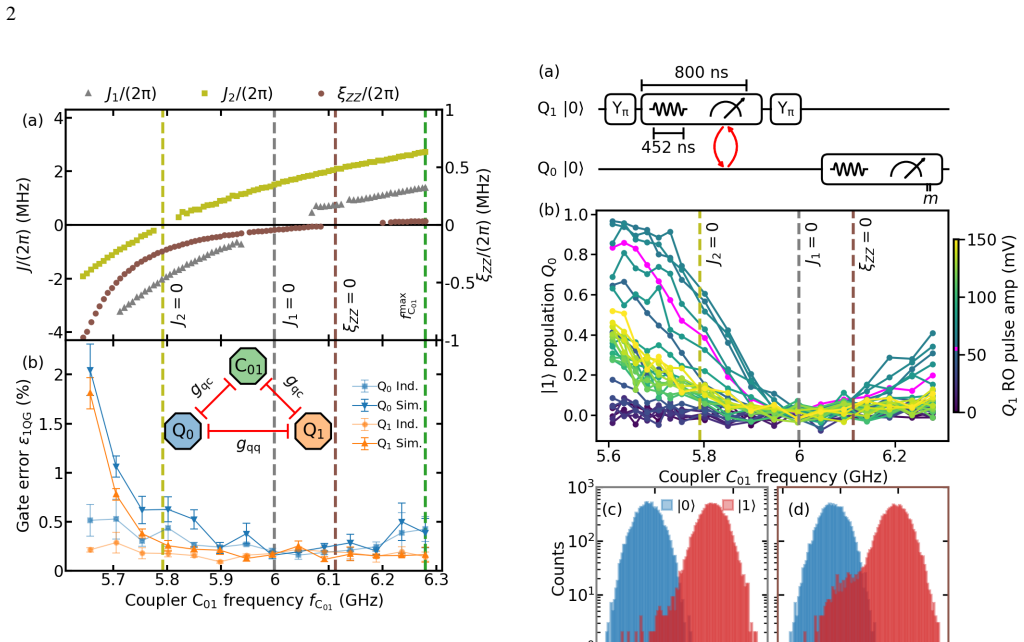
We experimentally optimize the frequency of flux-tunable couplers in a superconducting quantum processor to minimize the impact of spectator transmons during quantum operations (single-qubit gates, two-qubit gates and readout) on other transmons. We adapt a popular transmon-like tunable-coupling element, achieving high-fidelity, low-leakage controlled-$Z$ gates with unipolar, fast-adiabatic pulsing only on the coupler. We demonstrate the ability of the tunable coupler to null residual $ZZ$ coupling as well as exchange couplings in the one- and two-excitation manifolds. However, the nulling of these coherent interactions is not simultaneous, prompting the exploration of tradeoffs. We present experiments pinpointing spectator effects on specific quantum operations. We also study the combined effect on the three types of operations using repeated quantum parity measurements.
Editorial analysis
A structured set of objections, weighed in public.
Referee Report
Summary. The manuscript experimentally optimizes the frequency positioning of flux-tunable couplers in a superconducting circuit QED processor to mitigate spectator transmon effects during single-qubit gates, two-qubit CZ gates, and readout. Using a three-qubit testbed, the authors adapt a tunable-coupling element to achieve high-fidelity CZ gates via unipolar fast-adiabatic pulsing on the coupler alone; they demonstrate the ability to null residual ZZ coupling as well as exchange couplings in the one- and two-excitation manifolds (though not simultaneously), explore the resulting tradeoffs, and test combined impacts via repeated parity measurements.
Significance. If the reported nulling and tradeoff results hold under the stated conditions, the work supplies concrete experimental evidence for a practical frequency-based strategy to suppress spectator-induced coherent errors, which is relevant for improving gate and readout fidelity in scaled processors. The use of a simple unipolar pulsing scheme and the explicit mapping of effects onto specific operations constitute useful contributions; the experimental character of the demonstrations (nulling measurements and parity tests) is a strength.
major comments (1)
- [three-qubit experimental results and scalability discussion] The central claim concerns mitigation of spectator effects 'in a circuit QED processor,' yet all data, optimizations, and the combined parity-measurement test are confined to a three-qubit device. No modeling, simulation, or additional measurements are supplied to show that the same static frequency offsets continue to suppress ZZ and exchange terms when a fourth qubit is introduced through a second tunable coupler, nor that the chosen tradeoff point does not activate new leakage or dephasing channels. This assumption is load-bearing for the broader applicability asserted in the abstract and introduction.
Simulated Author's Rebuttal
We thank the referee for the positive evaluation of the work's significance and for the detailed feedback. We address the major comment below.
read point-by-point responses
-
Referee: The central claim concerns mitigation of spectator effects 'in a circuit QED processor,' yet all data, optimizations, and the combined parity-measurement test are confined to a three-qubit device. No modeling, simulation, or additional measurements are supplied to show that the same static frequency offsets continue to suppress ZZ and exchange terms when a fourth qubit is introduced through a second tunable coupler, nor that the chosen tradeoff point does not activate new leakage or dephasing channels. This assumption is load-bearing for the broader applicability asserted in the abstract and introduction.
Authors: We agree that all presented data and optimizations are from a three-qubit testbed and that no modeling or simulations for a four-qubit extension (with an additional tunable coupler) are included. The manuscript uses this device to demonstrate the frequency-positioning approach and the resulting tradeoffs for the listed operations. We will revise the abstract and introduction to state explicitly that the results constitute a three-qubit demonstration and to qualify statements about applicability to scaled processors as a suggested strategy rather than a verified result. A short paragraph will be added to the conclusions discussing the need for further characterization when additional couplers and qubits are present. These changes are textual only. revision: partial
Circularity Check
No circularity: experimental optimization with no derivation chain
full rationale
The paper describes experimental optimization of flux-tunable coupler frequencies on a three-qubit superconducting processor to minimize spectator effects on gates and readout. All claims rest on direct measurements of residual ZZ and exchange couplings under different frequency settings and pulsing schemes. No equations, predictions, or uniqueness theorems are invoked that reduce to fitted parameters, self-citations, or ansatzes; the work contains no derivation chain at all. The scalability concern raised by the skeptic is an external-validity issue, not a circularity issue.
Axiom & Free-Parameter Ledger
Lean theorems connected to this paper
-
IndisputableMonolith/Cost/FunctionalEquation.leanwashburn_uniqueness_aczel unclear?
unclearRelation between the paper passage and the cited Recognition theorem.
We demonstrate the ability of the tunable coupler to null residual ZZ coupling as well as exchange couplings in the one- and two-excitation manifolds. However, the nulling of these coherent interactions is not simultaneous
What do these tags mean?
- matches
- The paper's claim is directly supported by a theorem in the formal canon.
- supports
- The theorem supports part of the paper's argument, but the paper may add assumptions or extra steps.
- extends
- The paper goes beyond the formal theorem; the theorem is a base layer rather than the whole result.
- uses
- The paper appears to rely on the theorem as machinery.
- contradicts
- The paper's claim conflicts with a theorem or certificate in the canon.
- unclear
- Pith found a possible connection, but the passage is too broad, indirect, or ambiguous to say the theorem truly supports the claim.
Forward citations
Cited by 4 Pith papers
-
Scalable Fluxonium Quantum Processors via Tunable-Coupler Architecture
A tunable-coupler unit cell for fluxonium qubits delivers parallel single-qubit gate fidelities near 99.99% and two-qubit CZ fidelities around 99%, validated by generating up to 10-qubit GHZ states in a 22-qubit processor.
-
High-fidelity iSWAP gate with Double Transmon Coupler
A double transmon coupler enables a parametric iSWAP gate with 99.827% fidelity in 40 ns between transmon qubits.
-
Fast, High-Fidelity Erasure Detection of Dual-Rail Qubits with Symmetrically Coupled Readout
Symmetrically coupled dispersive readout achieves 384 ns single-shot erasure detection on dual-rail qubits with 6.0(2)×10^{-4} residual error per check and enables parallel erasure checks during single-qubit gates wit...
-
System-Level Design of Scalable Fluxonium Quantum Processors with Double-Transmon Couplers
A system-level design methodology for scalable fluxonium processors with double-transmon couplers that supports high-fidelity gates, fast reset, and dispersive readout through frequency partitioning under realistic co...
Reference graph
Works this paper leans on
-
[1]
J. F. Marques, B. M. Varbanov, M. S. Moreira, H. Ali, N. Muthusubramanian, C. Zachariadis, F. Battistel, M. Beek- man, N. Haider, W. Vlothuizen, A. Bruno, B. M. Terhal, and L. DiCarlo, Nat. Phys. 18, 80 (2022)
work page 2022
-
[2]
E. J. Zhang, S. Srinivasan, N. Sundaresan, D. F. Bogorin, Y . Martin, J. B. Hertzberg, J. Timmerwilke, E. J. Pritchett, J.-B. Yau, C. Wang, W. Landers, E. P. Lewandowski, A. Narasgond, S. Rosenblatt, G. A. Keefe, I. Lauer, M. B. Rothwell, D. T. Mc- Clure, O. E. Dial, J. S. Orcutt, M. Brink, and J. M. Chow, Sci. Adv. 8, eabi6690 (2022)
work page 2022
-
[3]
T. Hime, P. A. Reichardt, B. L. T. Plourde, T. L. Roberson, C.-E. Wu, A. V . Ustinov, and J. Clarke, Science314, 1427 (2006)
work page 2006
- [4]
-
[5]
A. O. Niskanen, K. Harrabi, F. Yoshihara, Y . Nakamura, S. Lloyd, and J. S. Tsai, Science 316, 723 (2007)
work page 2007
-
[6]
S. H. W. van der Ploeg, A. Izmalkov, A. M. van den Brink, U. Hübner, M. Grajcar, E. Il’ichev, H.-G. Meyer, and A. M. Zagoskin, Phys. Rev. Lett. 98, 057004 (2007)
work page 2007
- [7]
-
[8]
M. S. Allman, F. Altomare, J. D. Whittaker, K. Cicak, D. Li, A. Sirois, J. Strong, J. D. Teufel, and R. W. Simmonds, Phys. Rev. Lett. 104, 177004 (2010)
work page 2010
-
[9]
R. Bialczak, M. Ansmann, M. Hofheinz, M. Lenander, E. Lucero, M. Neeley, A. O’Connell, D. Sank, H. Wang, M. Weides, et al., Phys. Rev. Lett. 106, 060501 (2011)
work page 2011
-
[10]
S. Srinivasan, A. Hoffman, J. Gambetta, and A. A. Houck, Phys. Rev. Lett. 106, 083601 (2011)
work page 2011
-
[11]
Y . Yin, Y . Chen, D. Sank, P. J. J. O’Malley, T. C. White, R. Barends, J. Kelly, E. Lucero, M. Mariantoni, A. Megrant, C. Neill, A. Vainsencher, J. Wenner, A. N. Korotkov, A. N. Cle- land, and J. M. Martinis, Phys. Rev. Lett. 110, 107001 (2013)
work page 2013
-
[12]
B. Peropadre, D. Zueco, F. Wulschner, F. Deppe, A. Marx, R. Gross, and J. J. García-Ripoll, Phys. Rev. B 87, 134504 (2013)
work page 2013
-
[13]
I.-C. Hoi, A. F. Kockum, T. Palomaki, T. M. Stace, B. Fan, L. Tornberg, S. R. Sathyamoorthy, G. Johansson, P. Delsing, and C. Wilson, Phys. Rev. Lett. 111, 053601 (2013)
work page 2013
-
[14]
M. Pierre, I.-M. Svensson, S. Raman Sathyamoorthy, G. Jo- hansson, and P. Delsing, App. Phys. Lett. 104, 232604 (2014)
work page 2014
-
[15]
Y . Chen, C. Neill, P. Roushan, N. Leung, M. Fang, R. Barends, J. Kelly, et al., Phys. Rev. Lett. 113, 220502 (2014)
work page 2014
-
[16]
D. C. McKay, S. Filipp, A. Mezzacapo, E. Magesan, J. M. Chow, and J. M. Gambetta, Phys. Rev. App.6, 064007 (2016)
work page 2016
-
[17]
S. J. Weber, G. O. Samach, D. Hover, S. Gustavsson, D. K. Kim, A. Melville, D. Rosenberg, A. P. Sears, F. Yan, J. L. Yoder, et al., Phys. Rev. App. 8, 014004 (2017)
work page 2017
-
[18]
Y . Lu, S. Chakram, N. Leung, N. Earnest, R. K. Naik, Z. Huang, P. Groszkowski, E. Kapit, J. Koch, and D. I. Schuster, Phys. Rev. Lett. 119, 150502 (2017)
work page 2017
-
[19]
M. Kounalakis, C. Dickel, A. Bruno, N. K. Langford, and G. A. Steele, npj Quantum Inf. 4, 1 (2018)
work page 2018
-
[20]
J. Koch, T. M. Yu, J. Gambetta, A. A. Houck, D. I. Schuster, et al., Phys. Rev. A 76, 042319 (2007)
work page 2007
-
[21]
F. Yan, D. Campbell, P. Krantz, M. Kjaergaard, D. Kim, J. L. Yoder, D. Hover, A. Sears, A. J. Kerman, T. P. Orlando, S. Gus- tavsson, and W. D. Oliver, Phys. Rev. Lett.120, 260504 (2018)
work page 2018
-
[22]
S. Rosenblum, Y . Y . Gao, P. Reinhold, C. Wang, C. J. Axline, L. Frunzio, S. M. Girvin, L. Jiang, M. Mirrahimi, M. H. De- voret, et al., Nat. Commun. 9, 652 (2018)
work page 2018
-
[23]
Y . Y . Gao, B. J. Lester, K. S. Chou, L. Frunzio, M. H. De- voret, L. Jiang, S. Girvin, and R. J. Schoelkopf, Nature 566, 509 (2019)
work page 2019
-
[24]
P. Mundada, G. Zhang, T. Hazard, and A. Houck, Phys. Rev. Appl. 12, 054023 (2019)
work page 2019
- [25]
-
[26]
M. C. Collodo, J. Herrmann, N. Lacroix, C. K. Andersen, A. Remm, S. Lazar, J.-C. Besse, T. Walter, A. Wallraff, and C. Eichler, Phys. Rev. Lett. 125, 240502 (2020)
work page 2020
- [27]
-
[28]
Y . Xu, J. Chu, J. Yuan, J. Qiu, Y . Zhou, L. Zhang, X. Tan, Y . Yu, S. Liu, J. Li, F. Yan, and D. Yu, Phys. Rev. Lett. 125, 240503 (2020)
work page 2020
-
[29]
X. Li, T. Cai, H. Yan, Z. Wang, X. Pan, Y . Ma, W. Cai, J. Han, Z. Hua, X. Han, Y . Wu, H. Zhang, H. Wang, Y . Song, L. Duan, and L. Sun, Phys. Rev. App. 14, 024070 (2020)
work page 2020
-
[30]
X. Han, T. Cai, X. Li, Y . Wu, Y . Ma, Y . Ma, J. Wang, H. Zhang, Y . Song, and L. Duan, Phys. Rev. A102, 022619 (2020)
work page 2020
- [31]
-
[32]
Y . Sung, L. Ding, J. Braumüller, A. Vepsäläinen, B. Kannan, M. Kjaergaard, A. Greene, G. O. Samach, C. McNally, D. Kim, A. Melville, B. M. Niedzielski, M. E. Schwartz, J. L. Yoder, T. P. Orlando, S. Gustavsson, and W. D. Oliver, Phys. Rev. X 11, 021058 (2021)
work page 2021
-
[33]
J. Stehlik, D. M. Zajac, D. L. Underwood, T. Phung, J. Blair, S. Carnevale, D. Klaus, G. A. Keefe, A. Carniol, M. Kumph, M. Steffen, and O. E. Dial, Phys. Rev. Lett.127, 080505 (2021)
work page 2021
-
[34]
E. A. Sete, A. Q. Chen, R. Manenti, S. Kulshreshtha, and S. Po- letto, Phys. Rev. App. 15, 064063 (2021)
work page 2021
-
[35]
Y . Ye, S. Cao, Y . Wu, X. Chen, Q. Zhu, S. Li, F. Chen, M. Gong, C. Zha, H.-L. Huang, et al. , Chin. Phys. Lett. 38, 100301 (2021)
work page 2021
-
[36]
P. Zhao, Y . Zhang, G. Xue, Y . Jin, and H. Yu, App. Phys. Lett. 121, 032601 (2022)
work page 2022
-
[37]
I. N. Moskalenko, I. A. Simakov, N. N. Abramov, A. A. Grig- orev, D. O. Moskalev, A. A. Pishchimova, N. S. Smirnov, E. V . Zikiy, I. A. Rodionov, and I. S. Besedin, npj Quantum Inf. 8, 130 (2022)
work page 2022
- [38]
- [39]
- [40]
-
[41]
D. L. Campbell, A. Kamal, L. Ranzani, M. Senatore, and M. D. LaHaye, Phys. Rev. App. 19, 064043 (2023)
work page 2023
- [42]
-
[43]
L. Ding, M. Hays, Y . Sung, B. Kannan, J. An, A. Di Paolo, A. H. Karamlou, T. M. Hazard, K. Azar, D. K. Kim, et al. , Phys. Rev. X 13, 031035 (2023)
work page 2023
- [44]
-
[45]
K. Kubo, Y . Ho, and H. Goto, Phys. Rev. App. 22, 024057 (2024)
work page 2024
- [46]
- [47]
- [48]
- [49]
-
[50]
See supplemental material for additional information support- ing statements and claims made in the main text
-
[51]
V . Negîrneac, H. Ali, N. Muthusubramanian, F. Battistel, R. Sagastizabal, M. S. Moreira, J. F. Marques, W. J. Vlothuizen, M. Beekman, C. Zachariadis, N. Haider, A. Bruno, and L. Di- Carlo, Phys. Rev. Lett. 126, 220502 (2021)
work page 2021
-
[52]
E. H. Chen, T. J. Yoder, Y . Kim, N. Sundaresan, S. Srinivasan, M. Li, et al., Phys. Rev. Lett. 128, 110504 (2022)
work page 2022
-
[53]
D. I. Schuster, A. Wallraff, A. Blais, L. Frunzio, R.-S. Huang, J. Majer, S. M. Girvin, and R. J. Schoelkopf, Phys. Rev. Lett. 94, 123602 (2005)
work page 2005
-
[54]
T. Thorbeck, Z. Xiao, A. Kamal, and L. C. Govia, Phys. Rev. Lett. 132, 090602 (2024)
work page 2024
-
[55]
M. A. Rol, F. Battistel, F. K. Malinowski, C. C. Bultink, B. M. Tarasinski, R. V ollmer, N. Haider, N. Muthusubrama- nian, A. Bruno, B. M. Terhal, and L. DiCarlo, Phys. Rev. Lett. 123, 120502 (2019)
work page 2019
-
[56]
J. M. Martinis and M. R. Geller, Phys. Rev. A 90, 022307 (2014)
work page 2014
-
[57]
E. Magesan, J. M. Gambetta, and J. Emerson, Phys. Rev. A 85, 042311 (2012)
work page 2012
-
[58]
C. J. Wood and J. M. Gambetta, Phys. Rev. A 97, 032306 (2018)
work page 2018
-
[59]
A. G. Fowler, M. Mariantoni, J. M. Martinis, and A. N. Cleland, Phys. Rev. A 86, 032324 (2012)
work page 2012
- [60]
-
[61]
S. Krinner, N. Lacroix, A. Remm, A. Di Paolo, E. Genois, C. Leroux, et al., Nature 605, 669 (2022)
work page 2022
-
[62]
I. Besedin, M. Kerschbaum, J. Knoll, I. Hesner, L. Bödeker, L. Colmenarez, L. Hofele, N. Lacroix, C. Hellings, F. Swiadek, et al., arXiv:2501.04612 (2025)
-
[63]
L. Heunisch, C. Eichler, and M. J. Hartmann, Phys. Rev. App. 20, 064037 (2023). 7 SUPPLEMENTARY MA TERIAL FOR “OPTIMIZING THE FREQUENCY POSITIONING OF TUNABLE COUPLERS IN A CIRCUIT QED PROCESSOR TO MITIGA TE SPECTA TOR EFFECTS ON QUANTUM OPERA TIONS” This supplementary material provides additional informa- tion supporting the claims and figures of the mai...
discussion (0)
Sign in with ORCID, Apple, or X to comment. Anyone can read and Pith papers without signing in.