Neuromorphic Computing with Microfluidic Memristors
Pith reviewed 2026-05-22 23:31 UTC · model grok-4.3
The pith
Conical microfluidic channels with electrolytes can be wired into oscillators that perform XOR and NAND logic operations.
A machine-rendered reading of the paper's core claim, the machinery that carries it, and where it could break.
Core claim
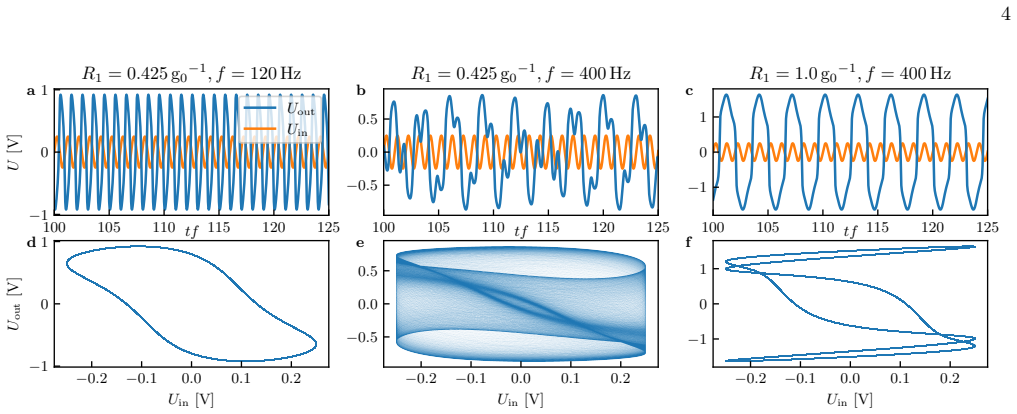
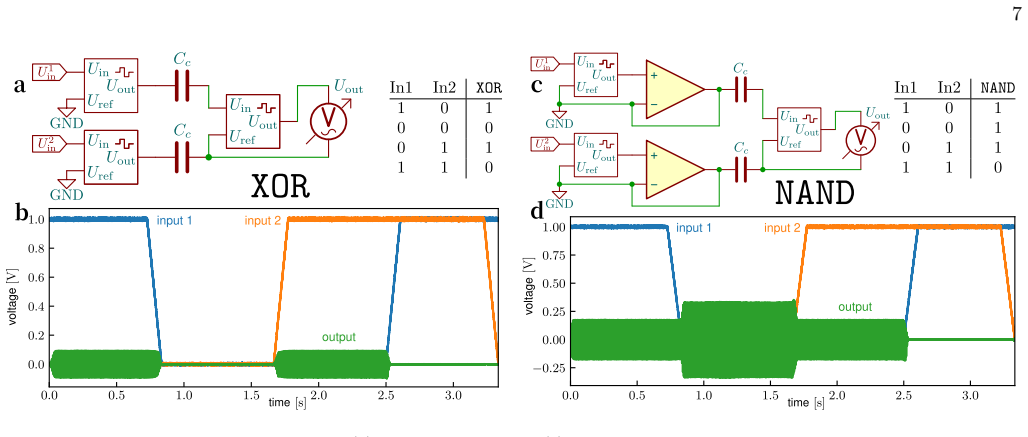
Conical microfluidic channels filled with electrolytes exhibit volatile memristive behavior. When placed as additional nonlinear elements inside Shinriki-inspired oscillators, the resulting Memriki oscillators display alternating chaotic and non-chaotic dynamics across a broad frequency range. Coupling three such oscillators yields functional XOR and NAND gates, and the full set of standard logic gates is obtained through combinations of NAND gates.
What carries the argument
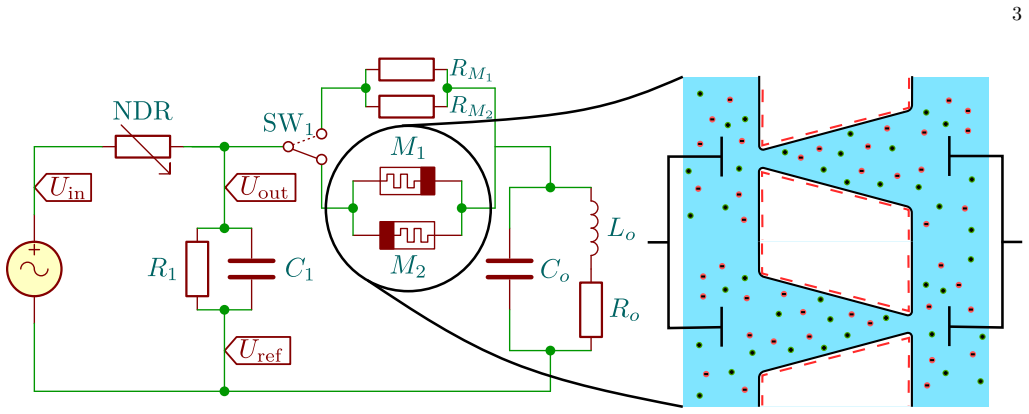
The Memriki oscillator, a Shinriki-inspired nonlinear oscillator that incorporates a conical microfluidic memristor as its nonlinear element to generate the chaotic-to-non-chaotic alternation used for logic.
If this is right
- XOR gates are realized by coupling three Memriki oscillators.
- NAND gates are realized by coupling three Memriki oscillators.
- All standard logic gates follow from combinations of the NAND gates.
- The alternating chaotic and non-chaotic dynamics persist across a broad frequency range.
- The construction opens a route to iontronic computing in microfluidic and bio-inspired systems.
Where Pith is reading between the lines
- Because the devices rely on electrolyte flow, they could interface directly with living cells or tissue without conversion layers.
- Standard microfluidic fabrication methods might allow many such gates to be printed together on one chip for parallel operation.
- A next test would be whether the same three-oscillator motif can be chained to produce an adder or other arithmetic circuit.
- Operation inside purely aqueous environments could remove the need for solid-state power supplies in some sensor applications.
Load-bearing premise
The volatile memristive response of the conical channels remains the dominant effect inside the oscillator circuit and does not get overridden by other physical interactions that would stop the gates from working.
What would settle it
An experiment in which three coupled Memriki oscillators are driven with the input combinations for XOR or NAND and the output voltages or currents fail to match the expected logic truth table.
Figures



read the original abstract
Conical microfluidic channels filled with electrolytes exhibit volatile memristive behavior, offering a promising platform for energy-efficient, neuromorphic computing. Here, we integrate these iontronic channels as additional nonlinear elements in nonlinear Shinriki-inspired oscillators and demonstrate that they exhibit alternating chaotic and non-chaotic dynamics across a broad frequency range. Exploiting this behavior, we construct XOR and NAND gates by coupling three Memriki oscillators, and we further realize the full set of standard logic gates through combinations of NAND gates. Our results establish a new paradigm for iontronic computing and open avenues for scalable, low-power logical operations in microfluidic and bio-inspired systems.
Editorial analysis
A structured set of objections, weighed in public.
Referee Report
Summary. The manuscript claims that conical microfluidic channels filled with electrolytes exhibit volatile memristive behavior that can be integrated as nonlinear elements into Shinriki-inspired oscillators (termed Memriki oscillators). These systems display alternating chaotic and non-chaotic dynamics over a broad frequency range. By coupling three such oscillators, the authors construct functional XOR and NAND gates, and demonstrate that NAND combinations suffice for the full set of standard logic gates, establishing a platform for iontronic neuromorphic computing.
Significance. If the experimental demonstrations hold, the work would be significant for introducing a microfluidic iontronic approach to neuromorphic logic that leverages chaotic dynamics for gate operations. Strengths include the reported provision of explicit circuit topologies, parameter values, and time-series data confirming the chaotic/non-chaotic alternation and gate truth tables, which support reproducibility and falsifiability of the central claims.
minor comments (3)
- [Abstract] The abstract states the frequency range is 'broad' but does not quantify it; adding the specific range (e.g., from the results section) would improve precision.
- [Results] Figure captions for the time-series data should explicitly note the sampling rate and any filtering applied to the chaotic signals to aid interpretation of the reported dynamics.
- [Methods] The description of the electrolyte and channel geometry parameters could be consolidated into a single table for easier reference when reproducing the Memriki oscillator behavior.
Simulated Author's Rebuttal
We thank the referee for their careful reading and positive evaluation of our manuscript. Their recommendation for minor revision is noted, and we appreciate the acknowledgment of the reproducibility aspects and potential significance for iontronic neuromorphic computing.
Circularity Check
No significant circularity detected
full rationale
The paper's core contribution is an experimental demonstration of integrating volatile memristive conical microfluidic channels into Shinriki-inspired oscillators, showing controllable chaotic/non-chaotic alternation and using three coupled units to realize XOR/NAND gates (with universality via NAND cascades). All load-bearing steps rest on physical ion-transport modeling, explicit circuit topologies, parameter values, and time-series validation of gate truth tables. No self-definitional quantities, fitted inputs renamed as predictions, or load-bearing self-citation chains appear; the derivation chain is self-contained and externally falsifiable via physical implementation.
Axiom & Free-Parameter Ledger
axioms (1)
- domain assumption Conical microfluidic channels filled with electrolytes exhibit volatile memristive behavior suitable for integration into nonlinear oscillators.
Reference graph
Works this paper leans on
-
[1]
Y. J. Chabal, ed., Fundamental aspects of silicon oxi- dation, Physics and astronomy online library (Springer, Berlin [u.a.], 2001)
work page 2001
-
[2]
G. W. Burr, R. M. Shelby, A. Sebastian, S. Kim, S. Kim, S. Sidler, K. Virwani, M. Ishii, P. Narayanan, A. Fu- marola, L. L. Sanches, I. Boybat, M. Le Gallo, K. Moon, J. Woo, H. Hwang, and Y. Leblebici, Neuromorphic com- puting using non-volatile memory, Advances in Physics: X 2, 89 (2016)
work page 2016
-
[3]
B. Rajendran, A. Sebastian, M. Schmuker, N. Srinivasa, and E. Eleftheriou, Low-power neuromorphic hardware for signal processing applications: A review of architec- tural and system-level design approaches, IEEE Signal Processing Magazine 36, 97 (2019)
work page 2019
- [4]
-
[5]
V. A. Baulin, A. Giacometti, D. A. Fedosov, S. Ebbens, N. R. Varela-Rosales, N. Feliu, M. Chowdhury, M. Hu, R. F¨ uchslin, M. Dijkstra, M. Mussel, R. van Roij, D. Xie, V. Tzanov, M. Zu, S. Hidalgo-Caballero, Y. Yuan, L. Cocconi, C.-M. Ghim, C. Cottin-Bizonne, M. C. Miguel, M. J. Esplandiu, J. Simmchen, W. J. Parak, M. Werner, G. Gompper, and M. M. Hanczyc...
work page 2025
-
[6]
D. Markovi´ c, A. Mizrahi, D. Querlioz, and J. Grollier, Physics for neuromorphic computing, Nature Reviews Physics 2, 499 (2020)
work page 2020
-
[7]
Chua, Memristor-the missing circuit element, IEEE Transactions on Circuit Theory 18, 507 (1971)
L. Chua, Memristor-the missing circuit element, IEEE Transactions on Circuit Theory 18, 507 (1971)
work page 1971
-
[8]
D. B. Strukov, G. S. Snider, D. R. Stewart, and R. S. Williams, The missing memristor found, Nature 453, 80 (2008)
work page 2008
- [9]
-
[10]
K. Jeon, J. J. Ryu, S. Im, H. K. Seo, T. Eom, H. Ju, M. K. Yang, D. S. Jeong, and G. H. Kim, Purely self-rectifying memristor-based passive crossbar array for artificial neu- ral network accelerators, Nature communications 15, 129 (2024)
work page 2024
-
[11]
H. Chun and T. D. Chung, Iontronics, Annual Review of Analytical Chemistry 8, 441 (2015)
work page 2015
-
[12]
G. Xu, M. Zhang, T. Mei, W. Liu, L. Wang, and K. Xiao, Nanofluidic ionic memristors, ACS Nano 18, 19423 (2024), pMID: 39022809, https://doi.org/10.1021/acsnano.4c06467
-
[13]
J. Feng, J. Liu, B. Wu, and G. Wang, Impedance char- acteristics of amine modified single glass nanopores, An- alytical Chemistry 82, 4520 (2010)
work page 2010
-
[14]
D. Wang, M. Kvetny, J. Liu, W. Brown, Y. Li, and G. Wang, Transmembrane potential across single conical nanopores and resulting memristive and memcapacitive ion transport, Journal of the American Chemical Society 134, 3651 (2012)
work page 2012
-
[15]
T. M. Kamsma, J. Kim, K. Kim, W. Q. Boon, C. Spi- toni, J. Park, and R. van Roij, Brain-inspired computing with fluidic iontronic nanochannels, Proceedings of the National Academy of Sciences 121, e2320242121 (2024)
work page 2024
-
[16]
T. Emmerich, Y. Teng, N. Ronceray, E. Lopriore, R. Chiesa, A. Chernev, V. Artemov, M. Di Ven- tra, A. Kis, and A. Radenovic, Nanofluidic logic with mechano–ionic memristive switches, Nature Electronics 7, 271 (2024)
work page 2024
-
[17]
W. Wang, Y. Liang, Y. Ma, D. Shi, and Y. Xie, Memristive characteristics in an asymmetrically charged nanochannel, The Journal of Physical Chemistry Letters 15, 6852 (2024)
work page 2024
-
[18]
I. W. Leong, M. Tsutsui, S. Murayama, T. Hayashida, Y. He, and M. Taniguchi, Quasi-stable salt gradient and resistive switching in solid-state nanopores, ACS Applied Materials & Interfaces 12, 52175 (2020)
work page 2020
-
[19]
S. N. Smirnov, I. V. Vlassiouk, and N. V. Lavrik, Voltage- gated hydrophobic nanopores, Acs Nano 5, 7453 (2011)
work page 2011
-
[20]
M. R. Powell, L. Cleary, M. Davenport, K. J. Shea, and Z. S. Siwy, Electric-field-induced wetting and dewetting in single hydrophobic nanopores, Nature nanotechnology 6, 798 (2011)
work page 2011
-
[21]
J. A. Tuszynski, D. Friesen, H. Freedman, V. I. Sbit- nev, H. Kim, I. Santelices, A. P. Kalra, S. D. Patel, K. Shankar, and L. O. Chua, Microtubules as sub-cellular memristors, Scientific reports 10, 2108 (2020)
work page 2020
-
[22]
X. Zhou, Y. Zong, Y. Wang, M. Sun, D. Shi, W. Wang, G. Du, and Y. Xie, Nanofluidic memristor based on the elastic deformation of nanopores with nanoparticle ad- sorption, National Science Review 11, nwad216 (2024)
work page 2024
- [23]
-
[24]
S. K. Bose, C. P. Lawrence, Z. Liu, K. S. Makarenko, R. M. J. van Damme, H. J. Broersma, and W. G. van der Wiel, Evolution of a designless nanoparticle network into reconfigurable boolean logic, Nature Nanotechnology 10, 1048 (2015)
work page 2015
- [25]
- [26]
- [27]
-
[28]
E. R. W. van Doremaele, T. Stevens, S. Ringeling, S. Spo- laor, M. Fattori, and Y. van de Burgt, Hardware imple- mentation of backpropagation using progressive gradient descent for in situ training of multilayer neural networks, Science Advances 10, 10.1126/sciadv.ado8999 (2024)
-
[29]
B. Sabbagh, N. E. Fraiman, A. Fish, and G. Yossifon, Designing with iontronic logic gates – from a single poly- electrolyte diode to an integrated ionic circuit, ACS Ap- plied Materials & Interfaces 15, 23361 (2023)
work page 2023
-
[30]
J. Li, M. Li, K. Zhang, L. Hu, and D. Li, High- performance integrated iontronic circuits based on single nano/microchannels, Small 19, 10.1002/smll.202208079 (2023)
- [31]
-
[32]
S. Portillo, J. Cervera, S. Mafe, and P. Ramirez, Re- versible logic with a nanofluidic memristor, Physical Re- view E 110, 065101 (2024)
work page 2024
-
[33]
Y. Ling, L. Yu, Z. Guo, F. Bian, Y. Wang, X. Wang, Y. Hou, and X. Hou, Single-pore nanofluidic logic mem- ristor with reconfigurable synaptic functions and des- ignable combinations, Journal of the American Chemical Society 146, 14558 (2024)
work page 2024
-
[34]
W. Liu, T. Mei, Z. Cao, C. Li, Y. Wu, L. Wang, G. Xu, Y. Chen, Y. Zhou, S. Wang, Y. Xue, Y. Yu, X.-Y. Kong, R. Chen, B. Tu, and K. Xiao, Bioinspired carbon nan- otube–based nanofluidic ionic transistor with ultrahigh switching capabilities for logic circuits, Science Advances 10, 10.1126/sciadv.adj7867 (2024). 10
- [35]
-
[36]
M. Shinriki, M. Yamamoto, and S. Mori, Multimode os- cillations in a modified van der pol oscillator containing a positive nonlinear conductance, Proceedings of the IEEE 69, 394 (1981)
work page 1981
-
[37]
M. G. Kitzbichler, M. L. Smith, S. R. Christensen, and E. Bullmore, Broadband criticality of human brain net- work synchronization, PLoS Computational Biology 5, e1000314 (2009)
work page 2009
-
[38]
Chua, Memristor, hodgkin–huxley, and edge of chaos, Nanotechnology 24, 383001 (2013)
L. Chua, Memristor, hodgkin–huxley, and edge of chaos, Nanotechnology 24, 383001 (2013)
work page 2013
- [39]
-
[40]
W. Q. Boon, T. E. Veenstra, M. Dijkstra, and R. van Roij, Pressure-sensitive ion conduction in a conical chan- nel: Optimal pressure and geometry, Physics of Fluids 34 (2022)
work page 2022
-
[41]
found that it is reasonable within the applied voltage range [35, 49]
This is only an approximation of the steady-state con- ductance, but Kamsma et al. found that it is reasonable within the applied voltage range [35, 49]
-
[42]
M. Holters and U. Z¨ olzer, A generalized method for the derivation of non-linear state-space models from cir- cuit schematics, in 2015 23rd European Signal Processing Conference (EUSIPCO) (2015) pp. 1073–1077
work page 2015
-
[43]
N. C. X. Stuhlm¨ uller, R. van Roij, and M. Dijkstra, Memriki-logic: Publication release (2025)
work page 2025
-
[44]
G. Stojanovi´ c, M. Paroˇ ski, N. Samardˇ zi´ c, M. Radovanovi´ c, and D. Krsti´ c, Microfluidics-based four fundamental electronic circuit elements resistor, inductor, capacitor and memristor, Electronics 8, 960 (2019)
work page 2019
-
[45]
E. Gallardo Hevia, C. M. McCann, M. Bell, N.-s. P. Hyun, C. Majidi, K. Bertoldi, and R. J. Wood, High-gain microfluidic amplifiers: The bridge between microfluidic controllers and fluidic soft actuators, Advanced Intelli- gent Systems 4, 10.1002/aisy.202200122 (2022)
-
[46]
M. Minsky and S. A. Papert, Perceptrons, reissue of the 1988 expanded edition with a new foreword by L´ eon Bot- tou: an introduction to computational geometry (MIT press, 2017)
work page 1988
-
[47]
W. Shockley, The theory of p-n junctions in semiconduc- tors and p-n junction transistors, Bell System Technical Journal 28, 435 (1949)
work page 1949
-
[48]
N. C. X. Stuhlm¨ uller, Iontronic memristor logic gate volt- age curves, 10.5281/zenodo.14924500 (2025)
- [49]
discussion (0)
Sign in with ORCID, Apple, or X to comment. Anyone can read and Pith papers without signing in.