Solovay Kitaev Algorithm and Randomized Compilation
Pith reviewed 2026-05-22 23:12 UTC · model grok-4.3
The pith
Randomized ensembles of Solovay-Kitaev decompositions reduce one-qubit rotation approximation error by at least a factor of two.
A machine-rendered reading of the paper's core claim, the machinery that carries it, and where it could break.
Core claim
An ensemble of Solovay-Kitaev sequences is generated for each target rotation; during compilation one sequence is drawn uniformly at random. In the absence of gate errors this procedure yields at least a twofold reduction in trace-distance error relative to a deterministic choice of a single decomposition. Under a simple coherent noise model the randomization further suppresses the accumulated error, and the same benefit is observed on the QSCOUT device under realistic noise.
What carries the argument
Ensemble of Solovay-Kitaev decompositions used for randomized compilation of one-qubit rotations.
If this is right
- Trace-distance error drops by at least a factor of two in ideal simulations.
- The same randomization mitigates coherent noise under the tested model.
- The benefit persists when the sequences are run on the QSCOUT trapped-ion hardware.
Where Pith is reading between the lines
- The technique could be applied to other gate sets or to approximate multi-qubit operations where SK-style synthesis is available.
- Combining randomized SK synthesis with existing dynamical-decoupling or zero-noise-extrapolation layers might yield additive error reduction.
- Systematic variation of the number of sequences in the ensemble could reveal an optimal ensemble size for given noise levels.
Load-bearing premise
The coherent noise model and the dominant error sources on the QSCOUT device are representative of the rotations and noise strengths examined.
What would settle it
A simulation in which the trace distance achieved by randomized SK selection is not at least half the trace distance of the best single decomposition would falsify the factor-of-two claim.
Figures


read the original abstract
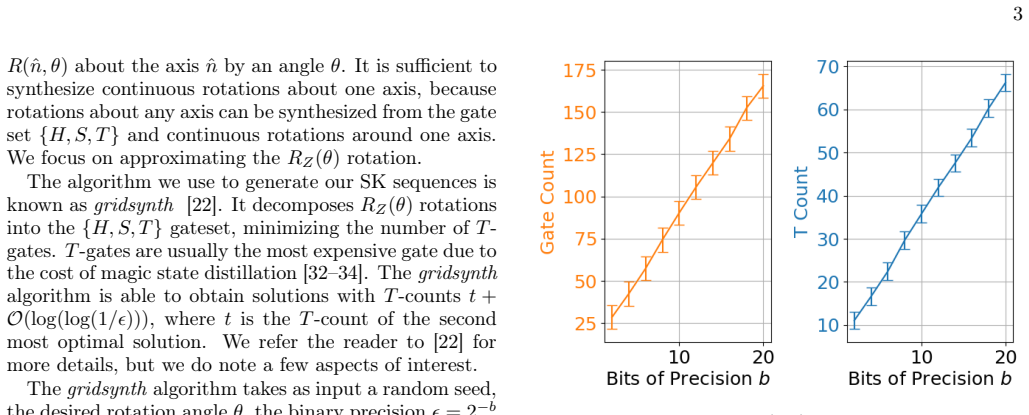
We analyze the use of the Solovay Kitaev (SK) algorithm to generate an ensemble of one qubit rotations over which to perform randomized compilation. We perform simulations to compare the trace distance between the quantum state resulting from an ideal one qubit $R_{Z}$ rotation and discrete SK decompositions. We find that this simple randomized gate synthesis algorithm can reduce the approximation error of these rotations in the absence of gate errors in simulation by at least a factor of two compared to a naive gate synthesis algorithm. We test the technique under the effects of a simple coherent noise model and find that it can mitigate coherent noise. We also run our algorithm on Sandia National Laboratories' QSCOUT trapped-ion device and find that randomization is able to help in the presence of realistic noise sources.
Editorial analysis
A structured set of objections, weighed in public.
Referee Report
Summary. The manuscript analyzes the Solovay-Kitaev algorithm for generating ensembles of one-qubit rotations to enable randomized compilation. Simulations compare trace distance to ideal R_Z rotations and claim that randomized SK decompositions reduce approximation error by at least a factor of two relative to a naive gate synthesis algorithm in the absence of gate errors. The work further tests the approach under a coherent noise model in simulation and on the QSCOUT trapped-ion device, reporting mitigation of coherent noise.
Significance. If substantiated with a clearly defined baseline, the approach would supply a simple, SK-based randomization technique that improves gate approximation accuracy and offers partial protection against coherent errors. This could be of practical value for compilation on near-term hardware, extending existing randomized compilation methods with an explicit algorithmic construction.
major comments (2)
- [Abstract] Abstract (and corresponding results sections): the central claim of 'at least a factor of two' trace-distance reduction is stated relative to an undefined 'naive gate synthesis algorithm.' No description is given of whether this baseline is a single fixed SK decomposition, a non-SK discretization, or another procedure; without this definition the numerical comparison cannot be reproduced or assessed.
- [Simulation and Hardware Results] Simulation and hardware sections: reported results lack essential methodological details required for verification, including the precise coherent noise model parameters, number of trials, data exclusion rules, and how error bars or statistical significance are computed. These omissions directly affect the soundness of the factor-of-two and noise-mitigation claims.
minor comments (1)
- Clarify in the text how the randomized ensemble is sampled from the SK decompositions and how the averaged channel is constructed.
Simulated Author's Rebuttal
We thank the referee for their careful review and constructive feedback. We address each major comment below and will revise the manuscript to enhance clarity and reproducibility.
read point-by-point responses
-
Referee: [Abstract] Abstract (and corresponding results sections): the central claim of 'at least a factor of two' trace-distance reduction is stated relative to an undefined 'naive gate synthesis algorithm.' No description is given of whether this baseline is a single fixed SK decomposition, a non-SK discretization, or another procedure; without this definition the numerical comparison cannot be reproduced or assessed.
Authors: We agree that the baseline must be explicitly defined to support reproducibility. In the manuscript the 'naive gate synthesis algorithm' denotes the use of one fixed Solovay-Kitaev decomposition (without ensemble randomization) to approximate the target rotation. We will revise the abstract and results sections to state this definition clearly, describe how the fixed decomposition is obtained, and specify the exact comparison protocol. revision: yes
-
Referee: [Simulation and Hardware Results] Simulation and hardware sections: reported results lack essential methodological details required for verification, including the precise coherent noise model parameters, number of trials, data exclusion rules, and how error bars or statistical significance are computed. These omissions directly affect the soundness of the factor-of-two and noise-mitigation claims.
Authors: We acknowledge the need for these details. The revised manuscript will specify the coherent-noise parameters (over-rotation angles and axes), the number of Monte-Carlo trials and experimental shots, any data-exclusion criteria, and the precise procedure used to compute error bars and assess statistical significance. These additions will allow independent verification of the reported error reductions. revision: yes
Circularity Check
No circularity; empirical simulation and hardware results are independent of any self-referential derivation.
full rationale
The paper reports direct numerical simulations of trace distance under SK decompositions versus a baseline, plus hardware runs on QSCOUT, with no equations, fitted parameters, or self-citations that reduce the central claims to inputs by construction. The comparison to a naive algorithm is presented as an empirical measurement rather than a derived identity, and no load-bearing uniqueness theorems or ansatzes from prior author work are invoked in the provided text. The derivation chain is therefore self-contained against external benchmarks.
Axiom & Free-Parameter Ledger
Forward citations
Cited by 1 Pith paper
-
Sub-Cubic Quantum Gate Synthesis via Stochastic Commutator Decomposition
Stochastic Commutator Synthesis integrates sub-cubic Solovay-Kitaev with Gibbs-sampled commutator selection and randomized compilation to cut T-counts by 10-25% and raise fidelity by up to 35% on Forrelation circuits.
Reference graph
Works this paper leans on
-
[1]
in Hamiltonian simulation. Randomized Compilation is a technique that has been used in the NISQ era [27–29] to tailor coherent quan- tum errors into stochastic errors. The idea of random- ized compilation is simple. A logical quantum circuit is duplicated r times, each copy being decomposed into a different random set of operations at the gate level. Give...
-
[2]
Quantum computing in the nisq era and beyond
John Preskill. Quantum computing in the nisq era and beyond. Quantum, 2:79, 2018
work page 2018
-
[3]
Nisq computing: where are we and where do we go? AAPPS bulletin , 32(1):27, 2022
Jonathan Wei Zhong Lau, Kian Hwee Lim, Harshank Shrotriya, and Leong Chuan Kwek. Nisq computing: where are we and where do we go? AAPPS bulletin , 32(1):27, 2022
work page 2022
-
[4]
Quantum error mitigation.Re- views of Modern Physics , 95(4):045005, 2023
Zhenyu Cai, Ryan Babbush, Simon C Benjamin, Suguru Endo, William J Huggins, Ying Li, Jarrod R McClean, and Thomas E O’Brien. Quantum error mitigation.Re- views of Modern Physics , 95(4):045005, 2023
work page 2023
-
[5]
Cambridge university press, 2013
Daniel A Lidar and Todd A Brun.Quantum error cor- rection. Cambridge university press, 2013
work page 2013
-
[6]
Fault-tolerantcontrolofanerror-correctedqubit
Laird Egan, Dripto M Debroy, Crystal Noel, Andrew Risinger, Daiwei Zhu, Debopriyo Biswas, Michael New- man, MuyuanLi, KennethRBrown, MarkoCetina, etal. Fault-tolerantcontrolofanerror-correctedqubit. Nature, 598(7880):281–286, 2021
work page 2021
-
[7]
Nature, 614(7949):676–681, 2023
Suppressingquantum errorsby scalinga surface code log- ical qubit. Nature, 614(7949):676–681, 2023
work page 2023
-
[8]
Logical quantum processor based on reconfigurable atom arrays
DolevBluvstein, SimonJEvered, AlexandraAGeim, So- phie H Li, Hengyun Zhou, Tom Manovitz, Sepehr Ebadi, Madelyn Cain, Marcin Kalinowski, Dominik Hangleiter, et al. Logical quantum processor based on reconfigurable atom arrays. Nature, 626(7997):58–65, 2024
work page 2024
-
[9]
Experimental fault-tolerant code switch- ing
Ivan Pogorelov, Friederike Butt, Lukas Postler, Chris- tian D Marciniak, Philipp Schindler, Markus Müller, and Thomas Monz. Experimental fault-tolerant code switch- ing. Nature Physics, pages 1–6, 2025
work page 2025
-
[10]
Early fault-tolerant quantum com- puting
Amara Katabarwa, Katerina Gratsea, Athena Caesura, and Peter D Johnson. Early fault-tolerant quantum com- puting. PRX Quantum, 5(2):020101, 2024
work page 2024
-
[11]
Clark, Daniel Lobser, Melissa C
Susan M. Clark, Daniel Lobser, Melissa C. Revelle, Christopher G. Yale, David Bossert, Ashlyn D. Burch, Matthew N. Chow, Craig W. Hogle, Megan Ivory, Jessica Pehr, Bradley Salzbrenner, Daniel Stick, William Sweatt, Joshua M. Wilson, Edward Winrow, and Peter Maunz. Engineering the quantum scientific computing open user testbed. IEEE Transactions on Quantum...
work page 2021
-
[12]
S. A. Moses, C. H. Baldwin, M. S. Allman, R. An- cona, L. Ascarrunz, C. Barnes, J. Bartolotta, B. Bjork, P. Blanchard, M. Bohn, J. G. Bohnet, N. C. Brown, N. Q. Burdick, W. C. Burton, S. L. Campbell, J. P. Campora, C. Carron, J. Chambers, J. W. Chan, Y. H. Chen, A. Chernoguzov, E. Chertkov, J. Colina, J. P. Curtis, R. Daniel, M. DeCross, D. Deen, C. Delan...
work page 2023
-
[13]
Ionq aria: Practical performance, Jan 2024
IonQ Staff. Ionq aria: Practical performance, Jan 2024. Accessed on Feb 29, 2024
work page 2024
-
[14]
Quantum computations: algorithms and error correction
A Yu Kitaev. Quantum computations: algorithms and error correction. Russian Mathematical Surveys , 52(6):1191, Dec 1997
work page 1997
-
[15]
Alexei Y. Kitaev. Quantum measurements and the abelian stabilizer problem. Electron. Colloquium Com- put. Complex., TR96(003), 1995
work page 1995
-
[16]
A. Yu. Kitaev, A. H. Shen, and M. N. Vyalyi.Classi- cal and Quantum Computation . American Mathematical Society, USA, 2002
work page 2002
-
[17]
Christopher M. Dawson and Michael A. Nielsen. The solovay-kitaev algorithm. Quantum Info. Comput. , 6(1):81–95, Jan 2006
work page 2006
-
[18]
Michael A. Nielsen and Isaac L. Chuang.Quantum Com- putation and Quantum Information: 10th Anniversary Edition. Cambridge University Press, 2010
work page 2010
-
[19]
Sparse probabilistic synthesis of quantum operations
Bálint Koczor. Sparse probabilistic synthesis of quantum operations. PRX Quantum, 5:040352, Dec 2024
work page 2024
-
[20]
Seiseki Akibue, Go Kato, and Seiichiro Tani. Probabilis- tic unitary synthesis with optimal accuracy.ACM Trans- actions on Quantum Computing , 5(3), August 2024
work page 2024
-
[21]
Error crafting in mixed quantum gate synthesis.arXiv: Quantum Physics , 2025
Nobuyuki Yoshioka, Seiseki Akibue, Hayata Morisaki, Kento Tsubouchi, and Yasunari Suzuki. Error crafting in mixed quantum gate synthesis.arXiv: Quantum Physics , 2025
work page 2025
-
[22]
Representation of quantum circuits with clifford andπ/8 gates
Ken Matsumoto and Kazuyuki Amano. Representation of quantum circuits with clifford andπ/8 gates. arXiv: Quantum Physics, 2008
work page 2008
-
[23]
Neil J. Ross and Peter Selinger. Optimal ancilla-free clifford+t approximation of z-rotations. Quantum Info. Comput., 16(11–12):901–953, September 2016
work page 2016
- [24]
-
[25]
Shorter gate sequences for quantum com- puting by mixing unitaries
Earl Campbell. Shorter gate sequences for quantum com- puting by mixing unitaries. Physical Review A , 95(4), 11 April 2017
work page 2017
-
[26]
Joel J. Wallman and Joseph Emerson. Noise tailoring for scalable quantum computation via randomized com- piling. Phys. Rev. A , 94:052325, Nov 2016
work page 2016
-
[27]
Sergiy Zhuk, Niall F. Robertson, and Sergey Bravyi. Trotter error bounds and dynamic multi-product formu- lasforhamiltoniansimulation. Phys. Rev. Res., 6:033309, Sep 2024
work page 2024
-
[28]
Ryan, Blake Johnson, and Marcus P
Matthew Ware, Guilhem Ribeill, Diego Ristè, Colm A. Ryan, Blake Johnson, and Marcus P. da Silva. Experi- mental pauli-frame randomization on a superconducting qubit. Phys. Rev. A , 103:042604, Apr 2021
work page 2021
-
[29]
Akel Hashim, Ravi K. Naik, Alexis Morvan, Jean-Loup Ville, Bradley Mitchell, John Mark Kreikebaum, Marc Davis, Ethan Smith, Costin Iancu, Kevin P. O’Brien, Ian Hincks, Joel J. Wallman, Joseph Emerson, and Ir- fan Siddiqi. Randomized compiling for scalable quantum computing on a noisy superconducting quantum proces- sor. Phys. Rev. X , 11:041039, Nov 2021
work page 2021
-
[30]
Evidence for the utility of quantum computing before fault tolerance
Youngseok Kim, Andrew Eddins, Sajant Anand, Ken Xuan Wei, Ewout van den Berg, Sami Rosenblatt, Hasan Nayfeh, Yantao Wu, Michael Zaletel, Kristan Temme, and Abhinav Kandala. Evidence for the utility of quantum computing before fault tolerance. Nature, 618(7965):500–505, Jun 2023
work page 2023
-
[31]
Modeling coher- ent errors in quantum error correction.Quantum Science and Technology, 3, 2016
Daniel Greenbaum and Zachary Dutton. Modeling coher- ent errors in quantum error correction.Quantum Science and Technology, 3, 2016
work page 2016
-
[32]
Correcting coherent errors with surface codes
Sergey Bravyi, Matthias Englbrecht, Robert König, and Nolan Peard. Correcting coherent errors with surface codes. npj Quantum Information , 4, 2017
work page 2017
- [33]
- [34]
-
[35]
Earl T. Campbell, Barbara M. Terhal, and Christophe Vuillot. Roads towards fault-tolerant universal quantum computation. Nature, 549(7671):172–179, Sep 2017
work page 2017
-
[36]
Debroy, Jungsang Kim, and Kenneth R
Bichen Zhang, Swarnadeep Majumder, Pak Hong Leung, Stephen Crain, Ye Wang, Chao Fang, Dripto M. Debroy, Jungsang Kim, and Kenneth R. Brown. Hidden inverses: Coherent error cancellation at the circuit level. Phys. Rev. Appl., 17:034074, Mar 2022
work page 2022
-
[37]
Thorge Müller, Tobias Stollenwerk, David Headley, Michael Epping, and Frank K Wilhelm. Coherent and non-unitary errors in ZZ-generated gates.Quantum Sci- ence and Technology, 10(1):015058, dec 2024
work page 2024
-
[38]
Andrew J. Landahl, Daniel S. Lobser, Benjamin C. A. Morrison, Kenneth M. Rudinger, Antonio E. Russo, Jay W. Van Der Wall, and Peter Maunz. Jaqal, the quantum assembly language for qscout.arXiv: Quantum Physics , 2020
work page 2020
discussion (0)
Sign in with ORCID, Apple, or X to comment. Anyone can read and Pith papers without signing in.