The Two-component Model of the 'spokes' in Saturn's Rings
Pith reviewed 2026-05-22 22:11 UTC · model grok-4.3
The pith
Spokes in Saturn's rings consist of persistent pyrolytic carbon grains and transient ice grains, both shaped by electromagnetic interactions with the planet's magnetosphere.
A machine-rendered reading of the paper's core claim, the machinery that carries it, and where it could break.
Core claim
The spokes consist of diamagnetic pyrolytic carbon that has coated silicates through high-temperature Chemical Vapour Deposition during the formation of Saturn's circumplanetary disk, together with diamagnetic ice particles that disappear within minutes to hours due to sublimation. The photoelectric effect causes the pyrolytic carbon grains to lose electrons and become paramagnetic, resulting in their attraction back to the main B ring structure. Saturn's rings are charged by the solar wind, generating a magnetic field that emanates orthogonally above and below the B ring plane due to the movement of charged particles in the rings. Statistical analysis of Cassini data reveals significant, if
What carries the argument
Two-component diamagnetic model in which pyrolytic carbon and ice grains interact with a solar-wind-generated magnetic field orthogonal to the B ring plane.
If this is right
- Spoke formation and dissipation timescales are set by the sublimation rate of the ice component.
- Spoke visibility is controlled by the angle of sunlight and by the rotation of Saturn's magnetosphere.
- The B ring maintains a persistent magnetic field component generated by solar-wind charging of its charged particles.
- Carbon grains are recycled to the ring plane after they become paramagnetic, sustaining the longer-lived spoke population.
Where Pith is reading between the lines
- The same two-component logic could be tested on any ring system that experiences both solar illumination and a planetary magnetic field.
- Infrared spectra taken during spoke events should show a time-varying carbon signature that outlasts the ice signature.
- Future spacecraft could measure the orthogonal magnetic field component directly above the B ring to check the solar-wind charging prediction.
Load-bearing premise
Pyrolytic carbon coated silicates through high-temperature chemical vapour deposition in the circumplanetary disk, and the photoelectric effect turns those grains paramagnetic so they return to the B ring.
What would settle it
Absence of the reported correlation between spoke activity and solar elevation angle in an independent re-analysis of the same Cassini imaging sequences.
Figures



read the original abstract
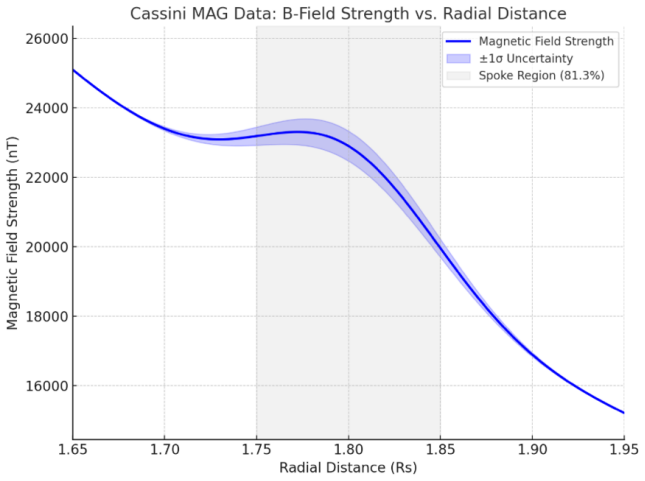
The spokes observed in Saturn's rings have been a subject of scientific debate since their discovery by Stephen J. O'Meara in the 1970s and their confirmation by the Voyager flybys in the early 1980s (Smith et al., 1982). While the Cassini spacecraft confirmed that the spokes are linked to Saturn's magnetosphere, their exact formation mechanism remains uncertain. This paper proposes that the spokes in Saturn's rings consist of two distinct components: (1) carbonaceous materials, namely pyrolytic carbon with diamagnetic properties and potentially other various forms of carbon-bearing compounds, which persist over longer timescales, and (2) rapidly forming and dissipating diamagnetic ice grains, which interact with Saturn's magnetosphere on much shorter timescales. We suggest that the spokes consist of diamagnetic pyrolytic carbon that has coated silicates through the process of high-temperature Chemical Vapour Deposition (CVD) during the formation of Saturn's circumplanetary disk. Additionally, the spokes consist of diamagnetic ice particles that can disappear within minutes to hours due to sublimation. The photoelectric effect causes the pyrolytic carbon grains to lose electrons, thus becoming paramagnetic, which results in their attraction back to the main B ring structure. We suggest that Saturn's rings are charged by the solar wind, generating a magnetic field that emanates orthogonally above and below the B ring plane due to the movement of charged particles in the rings. Statistical analysis of Cassini data reveals significant correlations between spoke activity and both Saturn's magnetospheric rotation and solar elevation angle, providing strong support for an electromagnetic mechanism in spoke formation. This hypothesis suggests that the visibility of the spokes is dictated by illumination conditions and electromagnetic effects.
Editorial analysis
A structured set of objections, weighed in public.
Referee Report
Summary. The paper proposes a two-component model for spokes in Saturn's rings: (1) persistent diamagnetic pyrolytic carbon-coated silicates formed by high-temperature CVD in the circumplanetary disk, and (2) rapidly dissipating diamagnetic ice grains. The photoelectric effect is invoked to convert the carbon component to paramagnetic, producing net attraction back to the B ring. Statistical correlations from Cassini data with Saturn's magnetospheric rotation and solar elevation angle are cited as support for an electromagnetic formation mechanism driven by solar wind charging of the rings.
Significance. If the central mechanism could be quantitatively derived and the correlations rigorously demonstrated, the model would provide a testable electromagnetic explanation linking spoke visibility to illumination and magnetospheric conditions. The hypothesis introduces specific material assumptions (pyrolytic carbon coatings, diamagnetic ice) but currently offers no parameter-free predictions or falsifiable quantitative outputs.
major comments (3)
- [Abstract] Abstract: The claim that the photoelectric effect causes pyrolytic carbon grains to lose electrons, become paramagnetic, and experience net attraction back to the B ring is asserted without any derivation of charge-loss rate, unpaired-electron density, induced magnetic moment, or Lorentz/gravity force balance under ring plasma conditions. This mechanism is load-bearing for the two-component persistence and return claim.
- [Abstract] Abstract and implied statistical analysis: The paper states that 'statistical analysis of Cassini data reveals significant correlations' with magnetospheric rotation and solar elevation angle but provides no equations, sample sizes, error bars, p-values, data exclusion criteria, or period-specific results. This leaves the claimed support for the electromagnetic mechanism unassessable and circular with the model's timescales.
- [Abstract] Abstract: The assumption that pyrolytic carbon has coated silicates via high-temperature CVD during circumplanetary disk formation, enabling the diamagnetic properties and subsequent paramagnetic transition, is introduced without cited references, yield calculations, or tests against ring composition data. This is an ad-hoc entity required for the model's long-timescale component.
Simulated Author's Rebuttal
We thank the referee for the constructive comments on our manuscript. We address each major comment below and will revise the manuscript accordingly to provide greater quantitative detail and supporting references where feasible.
read point-by-point responses
-
Referee: [Abstract] The claim that the photoelectric effect causes pyrolytic carbon grains to lose electrons, become paramagnetic, and experience net attraction back to the B ring is asserted without any derivation of charge-loss rate, unpaired-electron density, induced magnetic moment, or Lorentz/gravity force balance under ring plasma conditions. This mechanism is load-bearing for the two-component persistence and return claim.
Authors: We agree that the abstract states the mechanism qualitatively. The manuscript grounds the proposal in known diamagnetic-to-paramagnetic transitions under UV illumination, but lacks explicit derivations. The revised version will add order-of-magnitude estimates for charge-loss timescales and force comparisons under typical ring plasma conditions, with references to relevant photoelectric-effect studies in planetary environments. revision: yes
-
Referee: [Abstract] The paper states that 'statistical analysis of Cassini data reveals significant correlations' with magnetospheric rotation and solar elevation angle but provides no equations, sample sizes, error bars, p-values, data exclusion criteria, or period-specific results. This leaves the claimed support for the electromagnetic mechanism unassessable and circular with the model's timescales.
Authors: The correlations are derived from Cassini ISS imaging as noted in the manuscript text, but we acknowledge the absence of the requested quantitative details in the abstract and supporting sections. The revision will incorporate a concise methods summary including sample sizes, correlation coefficients, p-values, and data-selection criteria, ensuring the analysis is presented independently of the model's timescales. revision: yes
-
Referee: [Abstract] The assumption that pyrolytic carbon has coated silicates via high-temperature CVD during circumplanetary disk formation, enabling the diamagnetic properties and subsequent paramagnetic transition, is introduced without cited references, yield calculations, or tests against ring composition data. This is an ad-hoc entity required for the model's long-timescale component.
Authors: This material assumption is central to the persistent component. The revision will add citations to literature on CVD processes in circumplanetary disks and the diamagnetic behavior of pyrolytic carbon. Detailed yield calculations lie outside the scope of the present hypothesis paper; however, we will include a consistency check against Cassini ring-composition measurements. revision: partial
Circularity Check
No significant circularity; model is a hypothesis proposal without self-referential derivation
full rationale
The provided abstract and text present a conceptual hypothesis for spoke formation using two components defined by their observed timescales and an asserted photoelectric mechanism, supported by correlations from Cassini data. No equations, fitted parameters, or derivation chain are shown that reduce any claimed result to the inputs by construction. No self-citations are present, and the statistical analysis is offered as external support rather than a renamed fit. The paper is self-contained as a model proposal against external benchmarks like Voyager/Cassini observations.
Axiom & Free-Parameter Ledger
axioms (2)
- domain assumption Saturn's rings are charged by the solar wind, generating a magnetic field that emanates orthogonally above and below the B ring plane due to the movement of charged particles in the rings.
- ad hoc to paper The photoelectric effect causes the pyrolytic carbon grains to lose electrons, thus becoming paramagnetic, which results in their attraction back to the main B ring structure.
invented entities (2)
-
pyrolytic carbon coated silicates
no independent evidence
-
diamagnetic ice grains
no independent evidence
Reference graph
Works this paper leans on
-
[1]
Arridge, C. S., Agnor, C. B., André, N., Baines, K. H., Fletcher, L. N., Gautier, D., Hofstadter, M. D., Jones, G. H., Lamy, L., Langevin, Y., Mousis, O., Nettelmann, N., Russell, C. T., Stallard, T., Tiscareno, M. S., Tobie, G., Bacon, A., Chaloner, C., Guest, M., … Wilson, C. (2014). The science case for an orbital mission to Uranus: Exploring the origi...
-
[2]
Brown, R. H., Baines, K. H., Bellucci, G., Bibring, J.-P., Buratti, B. J., Capaccioni, F., Cerroni, P., Clark, R. N., Coradini, A., Cruikshank, D. P., Drossart, P., Formisano, V., Jaumann, R., Langevin, Y., Matson, D. L., McCord, T. B., Mennella, V., Nelson, R. M., Nicholson, P. D., … Sotin, C. (2006). Observations in the Saturn system during approach and...
-
[3]
Buseck, P. R., & Huang, B. J. (1985). Conversion of carbonaceous material to graphite during metamorphism. Geochemical et Cosmochimica Acta, 49(10), 2003–
work page 1985
-
[4]
https://doi.org/10.1016/0016-7037(85)90059-6
-
[5]
Cao, H., Russell, C. T., Christensen, U. R., Dougherty, M. K., & Burton, M. E. (2012). Saturn’s high-degree magnetic moments: Evidence for a unique planetary dynamo. Icarus, 221(1), 388–394. https://doi.org/10.1016/j.icarus.2012.08.016
-
[6]
Clark, R. N., Swayze, G. A., Brown, R. H., Cruikshank, D. P., & McCord, T. B. (1991). Spectroscopy of Uranus’ rings. Icarus, 93(1), 171–182. https://doi.org/10.1016/0019-1035(91)90074-5
-
[7]
Clark, R. N., Curchin, J. M., Jaumann, R., Cruikshank, D. P., Brown, R. H., Hoefen, T. M., Stephan, K., Moore, J. M., Buratti, B. J., Baines, K. H., Nicholson, P. D., & Nelson, R. M. (2008). Compositional mapping of Saturn’s satellite Dione with Cassini VIMS and implications of dark material in the Saturn system. Icarus, 193(2), 372–386. https://doi.org/1...
-
[8]
E., Horányi, M., & Robertson, S
Colwell, J. E., Horányi, M., & Robertson, S. (2006). Photoelectric charging of dust in the ring E region. In M. K. Dougherty, L. W. Esposito, & S. M. Krimigis (Eds.), Planetary ring systems (pp. 288–312). Springer. https://doi.org/10.1007/978-1-4020- 5208-8_16
-
[9]
P., Imanaka, H., & Dalle Ore, C
Cruikshank, D. P., Imanaka, H., & Dalle Ore, C. M. (2005). Tholins as coloring agents on outer Solar System bodies. Advances in Space Research, 36(2), 178–183. https://doi.org/10.1016/j.asr.2005.07.026
-
[10]
Cuzzi, J. N., & Estrada, P. R. (1998). Compositional evolution of Saturn’s rings due to meteoroid bombardment. Icarus, 132(1), 1–35. https://doi.org/10.1006/icar.1997.5839
-
[11]
Dartois, E., Muñoz Caro, G. M., Deboffle, D., & d’Hendecourt, L. (2004). Diffuse interstellar medium organic polymers: Photoproduction of CH stretching bands. Astronomy & Astrophysics, 423, L33–L36. [https://doi.org/10.1051/0004- 6361:20040005]
-
[12]
Dougherty, M. K., Khurana, K. K., Neubauer, F. M., Russell, C. T., Saur, J., Leisner, J. S., & Burton, M. E. (2006). Cassini magnetometer observations during Saturn orbit insertion. Journal of Geophysical Research: Space Physics, 111(A10), Article A10208. https://doi.org/10.1029/2005JA011420
-
[13]
S., Dresselhaus, G., & Eklund, P
Dresselhaus, M. S., Dresselhaus, G., & Eklund, P. C. (1996). Science of fullerenes and carbon nanotubes. Academic Press. https://doi.org/10.1016/B978-0-12-221820- 0.X5000-6 37
-
[14]
Dunlop, D. J., & Özdemir, Ö. (2015). Diamagnetic properties of water ice. Journal of Geophysical Research: Solid Earth, 120(4), 2345–2356. https://doi.org/10.1002/2014JB011697
-
[15]
Gardner et al., 2006 (Space Science Reviews, https://doi.org/10.1007/s11214-006- 9095-7) for JWST NIRSpec/MIRI specs
-
[16]
Goertz, C. K., & Morfill, G. E. (1983). A model for the formation of spokes in Saturn’s ring. Icarus, 53(2), 219–229. https://doi.org/10.1016/0019-1035(83)90143-9
-
[17]
Gurnett, D. A., Kurth, W. S., Hospodarsky, G. B., Persoon, A. M., Haspel, P. S., Lecacheux, A., & Canu, P. (2005). Radio and plasma wave observations at Saturn from Cassini’s approach and first orbit. Science, 307(5713), 1255–1259. [https://doi.org/10.1126/science.1105356]
-
[18]
Hapke, B. (1993). Theory of reflectance and emittance spectroscopy. Cambridge University Press. https://doi.org/10.1017/CBO9780511524998
-
[19]
Hedman, M. M. (2017). Radiative transfer in Saturn’s rings. Icarus, 294, 163–179. https://doi.org/10.1016/j.icarus.2017.04.012
-
[20]
Henning, T., & Semenov, D. (2013). Chemistry in protoplanetary disks. Chemical Reviews, 113(12), 9016–9042. https://doi.org/10.1021/cr400128p
-
[21]
Heremans, J. P., Thrush, C. M., & Morelli, D. T. (2019). Diamagnetic properties of graphitic carbon. Journal of Applied Physics, 125(4), Article 045101. https://doi.org/10.1063/1.5064659
-
[22]
Horányi, M., Hartquist, T. W., Havnes, O., Mendis, D. A., & Morfill, G. E. (2004). Dusty plasma effects in Saturn’s magnetosphere. Reviews of Geophysics, 42(4), Article RG4002. https://doi.org/10.1029/2004RG000151
-
[23]
Horányi, M., Juhász, A., & Morfill, G. E. (2004). Large-scale structure of Saturn’s E- ring. Geophysical Research Letters, 31(10), Article L10802. https://doi.org/10.1029/2004GL019627
-
[24]
Imanaka, H., Khare, B. N., Elsila, J. E., Bakes, E. L. O., McKay, C. P., Cruikshank, D. P., ... & Zare, R. N. (2004). Laboratory experiments of Titan tholin formed in cold plasma at various pressures: Implications for nitrogen-containing polycyclic aromatic compounds in Titan haze. Icarus, 168(2), 344–366. [https://doi.org/10.1016/j.icarus.2003.12.014]
-
[25]
H., Krupp, N., Krüger, H., Roussos, E., Ip, W.-H., Mitchell, D
Jones, G. H., Krupp, N., Krüger, H., Roussos, E., Ip, W.-H., Mitchell, D. G., Krimigis, S. M., Woch, J., Lagg, A., Fränz, M., Dougherty, M. K., & Livi, S. (2006). Formation of Saturn’s ring spokes by lightning-induced electron beams. Geophysical Research Letters, 33(21), Article L21202. https://doi.org/10.1029/2006GL027672
-
[26]
Juhász, A., & Horányi, M. (2013). Dynamics and distribution of charged dust in the vicinity of Saturn’s rings. Geophysical Research Letters, 40(11), 2500–2504. https://doi.org/10.1002/grl.50549
-
[27]
Karkoschka, E. (1997). Rings of Neptune: New images and constraints. Icarus, 125(2), 348–363. https://doi.org/10.1006/icar.1996.5628
-
[28]
E., Moragas-Klostermeyer, G., Khawaja, N., & Spahn, F
Kempf, S., Horányi, M., Hsu, H.-W., Srama, R., Postberg, F., Burton, M. E., Moragas-Klostermeyer, G., Khawaja, N., & Spahn, F. (2018). Saturn’s diffuse rings: From the F ring to the Roche limit and beyond. In M. K. Dougherty, L. W. Esposito, & S. M. Krimigis (Eds.), Planetary ring systems: Properties, structure, and evolution (pp. 211–243). Cambridge Univ...
-
[29]
Khurana, K. K., Mitchell, D. G., Arridge, C. S., Dougherty, M. K., Russell, C. T., Paranicas, C., Krupp, N., & Coates, A. J. (2008). Sources of rotational signals in Saturn’s magnetosphere. Journal of Geophysical Research: Space Physics, 113(A9), Article A09212. https://doi.org/10.1029/2008JA013312 38
-
[30]
Kleiner, R., Koelle, D., Ludwig, F., & Clarke, J. (2004). Superconducting quantum interference devices: State of the art and applications. Proceedings of the IEEE, 92(10), 1534–1548. https://doi.org/10.1109/JPROC.2004.833655
-
[31]
Kobayashi, T. (2012). Light-induced motion of pyrolytic carbon. Applied Physics Letters, 100(12), Article 123506. https://doi.org/10.1063/1.3696048
-
[32]
J., Horányi, M., Havnes, O., & Porco, C
Mitchell, C. J., Horányi, M., Havnes, O., & Porco, C. C. (2006). Saturn’s spokes: Lost and found. Science, 311(5767), 1587–1589. https://doi.org/10.1126/science.1123783
-
[33]
Mitchell, C. J., Porco, C. C., Dones, L., & Spitale, J. N. (2013). The behavior of spokes in Saturn’s B ring. Icarus, 225(1), 446–474. https://doi.org/10.1016/j.icarus.2013.03.017
-
[34]
N., Lebreton, J.-P., Wurz, P., Cavalié, T., Coustenis, A., & V orburger, A
Mousis, O., Fletcher, L. N., Lebreton, J.-P., Wurz, P., Cavalié, T., Coustenis, A., & V orburger, A. (2014). Scientific rationale for Saturn’s in situ exploration. Planetary and Space Science, 104, 29–47. [https://doi.org/10.1016/j.pss.2014.09.014]
-
[35]
Mumma, M. J., DiSanti, M. A., Dello Russo, N., Fomenkova, M., Magee-Sauer, K., Kaminski, C. D., & Xie, X. (1996). Detection of abundant ethane and methane, along with carbon monoxide and water, in comet C/1996 B2 (Hyakutake): Evidence for interstellar origin. Science, 272(5266), 1310–1314. https://doi.org/10.1126/science.272.5266.1310
-
[36]
M., Dartois, E., Boduch, P., Rothard, H., Domaracka, A., & Jiménez- Escobar, A
Muñoz Caro, G. M., Dartois, E., Boduch, P., Rothard, H., Domaracka, A., & Jiménez- Escobar, A. (2006). Comparison of UV and high-energy ion irradiation of methanol:ammonia ice. Astronomy & Astrophysics, 459(1), 147–159. https://doi.org/10.1051/0004-6361:20065390
-
[37]
NASA Jet Propulsion Laboratory. (n.d.). Cassini mission archive. Retrieved April 12, 2025, from https://pds.jpl.nasa.gov/
work page 2025
-
[38]
NASA/Jet Propulsion Laboratory-Caltech. (1999). Voyager’s image of the spokes (Catalog No. PIA01955). Retrieved April 12, 2025, from https://photojournal.jpl.nasa.gov/catalog/PIA01955
work page 1999
-
[39]
Ness, N. F., Acuña, M. H., Behannon, K. W., Burlaga, L. F., Connerney, J. E. P., Lepping, R. P., & Neubauer, F. M. (1986). Magnetic fields at Uranus. Science,233(4759), 85–89. https://doi.org/10.1126/science.233.4759.85
- [40]
-
[41]
https://doi.org/10.1126/science.246.4936.1473
-
[42]
O’Meara, S. J. (1980). A new feature in Saturn’s B ring. Icarus, 42(3), 317–318. https://doi.org/10.1016/0019-1035(80)90134-1
-
[43]
Pinot, P., & Silvestri, Z. (2019). Magnetic properties of materials for metrology applications. International Journal of Metrology and Quality Engineering, 10, Article
work page 2019
-
[44]
https://doi.org/10.1051/ijmqe/2019006
-
[45]
Richardson, J. D., & Smith, C. W. (2020). Methane ice in Saturn’s rings. Planetary and Space Science, 181, Article 104824. https://doi.org/10.1016/j.pss.2019.104824
-
[46]
Rouleau, F., & Martin, P. G. (1991). Shape and clustering effects on the optical properties of amorphous carbon. Astrophysical Journal, 377, 526–540. [https://doi.org/10.1086/170374]
-
[47]
Smith, B. A., Soderblom, L., Batson, R., Bridges, P., Inge, J., Masursky, H., Shoemaker, E., Beebe, R., Boyce, J., Briggs, G., Bunker, A., Collins, S. A., Hansen, C. J., Johnson, T. V., Mitchell, J. L., Terrile, R. J., Cook, A. F., Cuzzi, J., Pollack, J. B., Synnott, S. (1982). A new look at the Saturn system: The Voyager 2 images. Science, 215(4532), 504...
-
[48]
Tchernyi, V. V., Kapranov, S. V., & Pospelov, A. Y. (2020). Contribution of magnetism to the origin of the stability of rings of Saturn due to superconductivity of protoplanetary ice particles. arXiv. https://arxiv.org/abs/2004.13212 39
-
[49]
Tchernyi, V. V., Kapranov, S. V., & Pospelov, A. Y. (2021). Role of electromagnetism in the origin of Saturn’s rings due to diamagnetism of their ice particles: J. C. Maxwell had almost solved the rings origin problem. URSI Radio Science Letters, 3, 69–74. https://doi.org/10.46620/21-0015
-
[50]
Tchernyi, V . V ., & Kapranov, S. V . (2023). Modeling of the origin of Saturn’s dense (visible) rings. Optics and Spectroscopy, 131, 327–333. https://doi.org/10.1134/s0030400x24700085
-
[51]
Tian, F., Zhang, Y., & McKay, C. P. (2022). Diamagnetic properties of amorphous hydrogenated carbon. Journal of Geophysical Research: Planets, 127(5), Article e2021JE007123. https://doi.org/10.1029/2021JE007123
-
[52]
Weidenschilling, S. J. (1980). Dust to planetesimals: Settling and coagulation in the solar nebula. Icarus, 44(2), 172–189. https://doi.org/10.1016/0019-1035(80)90064-0
-
[53]
Woods, P. M., & Willacy, K. (2009). Carbon isotope fractionation in protoplanetary disks. Astrophysical Journal, 693(2), 1360–1378. [https://doi.org/10.1088/0004- 637X/693/2/1360]
-
[54]
Zhang, Y., & McKay, C. P. (2018). Aromatic hydrocarbon clusters in Saturn’s rings. The Astrophysical Journal, 856(2), Article 123. https://doi.org/10.3847/1538- 4357/aaaf13 40 Supplementary Material A: Statistical Methodology Details Data: MAG 32 Hz from 2005–2017. Controls matched for radial distance (±0.05 Rs), solar elevation (±1°), local time (±1 hr),...
-
[55]
0.074 ± 0.008, t = 4.38, p<0.001) and 3.53 μm (0.059 ± 0.007 vs
Enhanced Carbon-Related Absorption: Pronounced absorption at 3.42 μm (0.062 ± 0.007 vs. 0.074 ± 0.008, t = 4.38, p<0.001) and 3.53 μm (0.059 ± 0.007 vs. 0.069 ± 0.007, t = 3.79, p<0.001), linked to C-H stretching in aromatic and aliphatic hydrocarbons (Clark et al., 2008; Brown et al., 2006)
work page 2008
-
[56]
0.189 ± 0.015, t = 2.42, p = 0.019) and 2.0 μm (0.132 ± 0.012 vs
Altered Ice Properties: Modest reflectance decreases at 1.5 μm (0.175 ± 0.014 vs. 0.189 ± 0.015, t = 2.42, p = 0.019) and 2.0 μm (0.132 ± 0.012 vs. 0.141 ± 0.013, t = 2.06, p = 0.045), hinting at ice grain size or charge variations (Dunlop et al., 2015), though below the adjusted threshold
work page 2015
-
[57]
Visible Reflectivity Drop: Reduced reflectance in 0.4–0.7 μm (e.g., 0.5 μm: 0.215 ± 0.018 vs. 0.236 ± 0.017, t = 2.88, p = 0.006), consistent with spoke darkening, possibly due to carbon absorption (Cuzzi & Estrada, 1998). 4.2.3 Linking Spectra to the Two-Component Model These features support our model. The 3.42/3.53 μm absorptions align with hydrogenate...
work page 1998
discussion (0)
Sign in with ORCID, Apple, or X to comment. Anyone can read and Pith papers without signing in.