Rhombohedral graphite junctions as a platform for continuous tuning between topologically trivial and non-trivial electronic phases
Pith reviewed 2026-05-22 20:58 UTC · model grok-4.3
The pith
Junctions between rhombohedral graphite crystals enable continuous tuning between topologically trivial and non-trivial electronic phases via crystal sliding.
A machine-rendered reading of the paper's core claim, the machinery that carries it, and where it could break.
Core claim
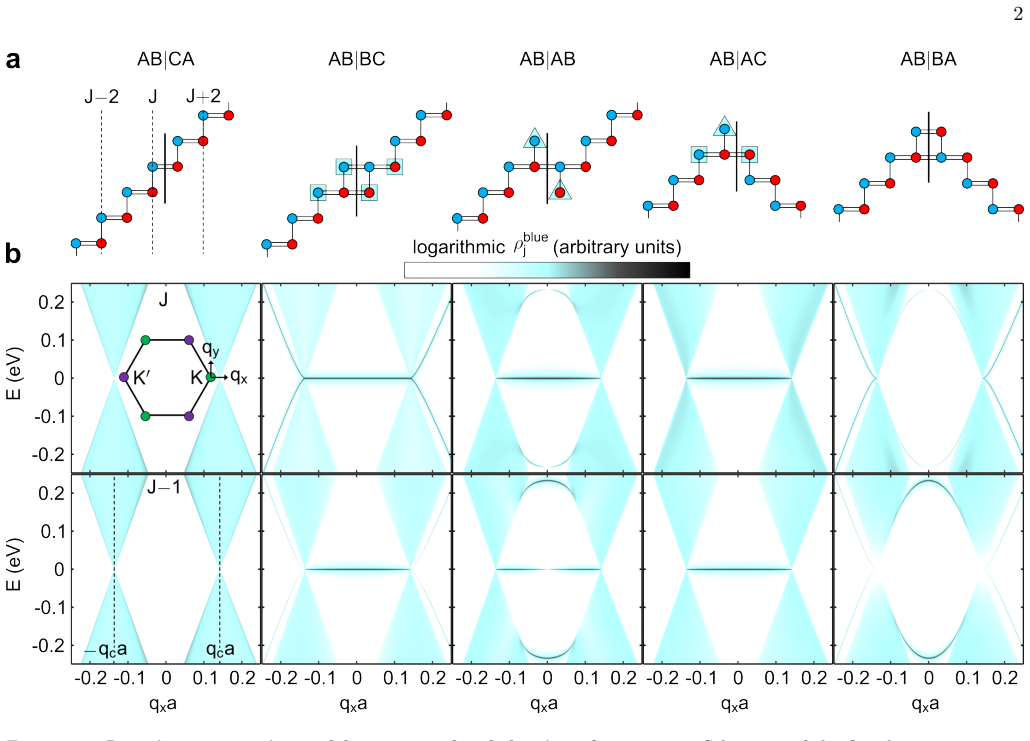
Junctions between rhombohedral graphite crystals enable a smooth transition between topologically trivial and non-trivial regimes, distinguished by the absence or presence of topological junction states. By analogy with the Su-Schrieffer-Heeger model, the appearance of these topological states is related to the symmetry of the atomic stacking at the interface. Sliding the crystals with respect to each other provides the means to explore both the topological and non-topological phases.
What carries the argument
The symmetry of atomic stacking at the rhombohedral graphite interface, mapped through a Su-Schrieffer-Heeger model analogy to determine the presence of topological junction states.
If this is right
- Topological junction states can appear or disappear depending on interface stacking symmetry.
- Both trivial and non-trivial phases become accessible by relative sliding of the crystals.
- Topology can be tuned continuously without changing material composition.
- Protected states in the non-trivial phase offer potential robustness against disorder.
Where Pith is reading between the lines
- This mechanical tuning via sliding could enable switchable topological devices in van der Waals structures.
- Similar stacking-based control might apply to other layered materials with tunable interfaces.
- Real-time observation of the transition could reveal dynamics of topological phase changes.
Load-bearing premise
The Su-Schrieffer-Heeger model analogy correctly maps the symmetry of atomic stacking at the interface onto the presence or absence of topological junction states without confounding effects from other interactions.
What would settle it
Spectroscopic or transport measurements showing the absence of expected topological junction states for a given stacking symmetry, or their presence when symmetry predicts none.
Figures


read the original abstract
Manipulating the topological properties of quantum states can provide a way to protect them against disorder. However, typically, changing the topology of electronic states in a crystalline material is challenging because their nature is underpinned by chemical composition and lattice symmetry that are difficult to modify. We propose junctions between rhombohedral graphite crystals as a platform that enables smooth transition between topologically trivial and non-trivial regimes distinguished by the absence or presence of topological junction states. By invoking an analogy with the Su-Schrieffer-Heeger model, the appearance of topological states is related to the symmetry of the atomic stacking at the interface between the crystals. The possibility to explore both the topological and non-topological phases is provided by sliding the crystals with respect to each other.
Editorial analysis
A structured set of objections, weighed in public.
Referee Report
Summary. The manuscript proposes junctions between rhombohedral graphite crystals, formed by relative sliding, as a platform for continuous tuning between topologically trivial and non-trivial electronic phases. The distinction is tied to the presence or absence of topological junction states, which the authors relate to the symmetry of atomic stacking at the interface via an analogy with the Su-Schrieffer-Heeger (SSH) model.
Significance. If the proposed mapping holds and protected junction states survive integration over the 2D Brillouin zone, the platform would allow mechanical control of topology in a single material without altering composition or lattice symmetry. The work highlights a potential route to tunable topological states in van der Waals systems, but currently offers only a conceptual framework.
major comments (2)
- Abstract and introduction: the central claim that interface stacking symmetry alone toggles the presence of protected topological junction states rests entirely on an SSH-model analogy; no explicit low-energy Hamiltonian, tight-binding calculations, or band-structure results are presented to demonstrate that the junction-localized modes remain gapless once 3D momentum dispersion, valley mixing, and layer polarization are included.
- The SSH analogy section: the 1D chain mapping does not automatically guarantee topological protection in the actual 2D system of coupled Dirac cones in rhombohedral graphite; a concrete check (e.g., parity of the number of interface states or a winding-number calculation across the interface) is required to establish that the transition survives the full Brillouin-zone integration.
Simulated Author's Rebuttal
We thank the referee for their thoughtful review and valuable comments on our manuscript. We address each major comment below and outline the revisions we plan to make.
read point-by-point responses
-
Referee: Abstract and introduction: the central claim that interface stacking symmetry alone toggles the presence of protected topological junction states rests entirely on an SSH-model analogy; no explicit low-energy Hamiltonian, tight-binding calculations, or band-structure results are presented to demonstrate that the junction-localized modes remain gapless once 3D momentum dispersion, valley mixing, and layer polarization are included.
Authors: The current manuscript presents a conceptual proposal based on the SSH analogy to illustrate the potential for tuning topological phases via sliding in rhombohedral graphite junctions. We agree that demonstrating the robustness of the junction states against 3D effects, valley mixing, and layer polarization would strengthen the work. In the revised manuscript, we will include an explicit low-energy Hamiltonian and discuss how the topological protection is expected to persist in the full system. revision: yes
-
Referee: The SSH analogy section: the 1D chain mapping does not automatically guarantee topological protection in the actual 2D system of coupled Dirac cones in rhombohedral graphite; a concrete check (e.g., parity of the number of interface states or a winding-number calculation across the interface) is required to establish that the transition survives the full Brillouin-zone integration.
Authors: We acknowledge that the 1D analogy needs to be validated in the 2D context. To address this point, the revised manuscript will include a concrete topological invariant calculation, such as a winding number analysis integrated over the Brillouin zone, to confirm that the distinction between trivial and non-trivial phases holds. revision: yes
Circularity Check
No significant circularity in derivation chain
full rationale
The paper's central claim maps interface stacking symmetry to topological junction states via an explicit analogy to the external Su-Schrieffer-Heeger model, without defining the topological distinction in terms of the result itself, fitting parameters to data and renaming them as predictions, or relying on self-citation chains for load-bearing uniqueness theorems. The derivation remains self-contained against the cited external SSH benchmark and does not reduce any equation or prediction to its own inputs by construction.
Axiom & Free-Parameter Ledger
axioms (1)
- domain assumption The Su-Schrieffer-Heeger model analogy applies directly to the electronic states at the rhombohedral graphite junction interface.
Lean theorems connected to this paper
-
IndisputableMonolith/Foundation/AlexanderDuality.leanalexander_duality_circle_linking (D=3 forcing) unclear?
unclearRelation between the paper passage and the cited Recognition theorem.
By invoking an analogy with the Su-Schrieffer-Heeger model, the appearance of topological states is related to the symmetry of the atomic stacking at the interface... effective one-dimensional description... belongs to this class [BDI/CI/AI].
-
IndisputableMonolith/Cost/FunctionalEquation.leanwashburn_uniqueness_aczel (J-cost uniqueness) unclear?
unclearRelation between the paper passage and the cited Recognition theorem.
The alternating nature of the intra- and inter-layer electronic hopping allows mapping... onto the SSH model in the limit where only these two couplings are considered.
What do these tags mean?
- matches
- The paper's claim is directly supported by a theorem in the formal canon.
- supports
- The theorem supports part of the paper's argument, but the paper may add assumptions or extra steps.
- extends
- The paper goes beyond the formal theorem; the theorem is a base layer rather than the whole result.
- uses
- The paper appears to rely on the theorem as machinery.
- contradicts
- The paper's claim conflicts with a theorem or certificate in the canon.
- unclear
- Pith found a possible connection, but the passage is too broad, indirect, or ambiguous to say the theorem truly supports the claim.
discussion (0)
Sign in with ORCID, Apple, or X to comment. Anyone can read and Pith papers without signing in.