REVIEW 5 major objections 6 minor 51 references
FaceCraft4D: Animated 3D Facial Avatar Generation from a Single Image
T0 review · 5 major / 6 minor · reviewed 2026-08-16 · deepseek-v4-flash
Pith's one-line read FaceCraft4D claims that a single portrait image is enough to build a full-360-degree, FLAME-animatable 3D head avatar with consistent viewpoints and expressions, using shape, image, and video priors plus a consistent-inconsistent training…
desk verdict A well-engineered one-shot 4D avatar pipeline with a genuinely useful COIN training idea, but the 360-degree and animation claims outrun the evidence: back-of-head geometry is hallucinated and the evaluation cannot see where it fails. read the letter →
The pith
A machine-rendered reading of the paper's core claim, the machinery that carries it, and where it could break.
The reading
What carries the argument
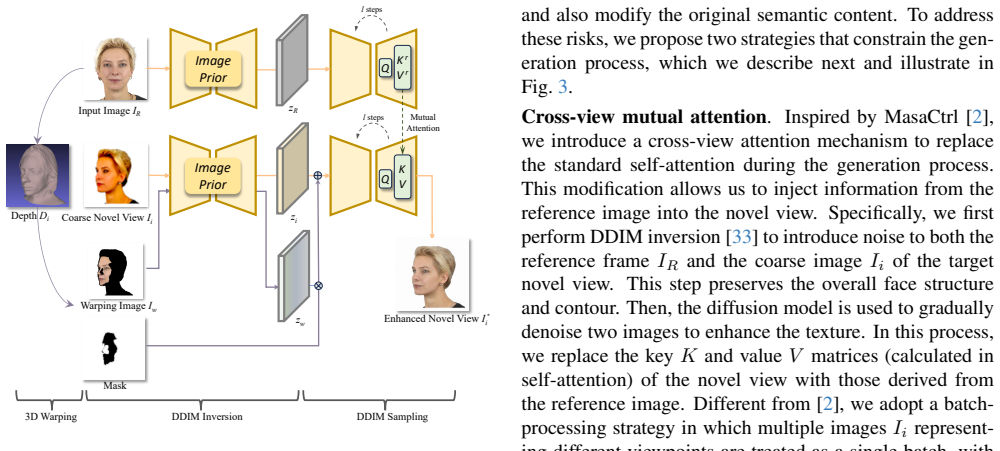
The load-bearing object is the COIN (Consistent-Inconsistent) training scheme combined with a FLAME-rigged 3D Gaussian backbone. A base 3D Gaussian model holds the view-consistent structure and is supervised with a perceptual LPIPS loss, while a two-layer MLP, conditioned on a learnable view embedding and a per-Gaussian position embedding, predicts a color offset for each Gaussian; the combined render is supervised with L1 and SSIM, and the offsets are regularized toward zero. This separation lets the optimizer localize view-dependent inconsistencies in the offset MLP instead of smearing them into the base model, preserving sharp details such as teeth and hair. The other load-bearing piece is the warping-based control generation, which uses depth-based projection and masks to blend reference textures into novel views so the diffusion model stays consistent with the input identity.
What would settle it
Run FaceCraft4D on a subject with a known 360-degree capture, then compare the rendered back-of-head and the rendered unseen expressions against the ground truth using per-region PSNR/SSIM and face-recognition identity scores; if back-of-head geometry or identity on unseen expressions diverges sharply from ground truth, the central claim fails.
Extended reading notes
Core claim
The central claim is that a single image suffices for a photorealistic, full-view, animatable head avatar if the missing information is supplied by three priors in sequence: a shape prior (3D-GAN inversion) that provides full-head geometry and a coarse texture, an image prior (a diffusion model with cross-view mutual attention and depth-guided warping) that produces identity-consistent high-quality novel views, and a video prior (re-enactment) that generates synchronized expression sequences across views. The final 4D model is a FLAME-rigged 3D Gaussian representation. Because the synthesized training views are imperfectly aligned, the paper introduces COIN training: a consistent base model plus a view-specific MLP that absorbs color inconsistencies, so the base model stays sharp and the inconsistencies do not blur the render. At inference the view embedding from the reference image is used for all views, and expressions or poses are controlled through FLAME parameters.
Load-bearing premise
The whole pipeline assumes that the multiview images and videos synthesized by the three priors are reliable enough to serve as ground truth; if the coarse 3D-GAN shape is wrong at the back of the head or the video prior shifts identity or expression, those errors are baked into the final avatar and the main evaluation would not detect them.
Editorial extensions
If this is right
- A single portrait can yield a full 360-degree head model, including the back of the head, rather than only frontal or near-frontal views.
- The resulting avatar can be posed and re-expressed through FLAME parameters, so the same model supports novel viewpoints and expressions from one input image.
- Rendering is real-time (about 156 FPS at 512x512), making interactive avatars feasible for games and virtual meetings.
- COIN training lets the 3D model absorb imperfect, inconsistently aligned synthetic training views without blur, so the pipeline can use generated data as pseudo ground truth.
- On the paper's reported metrics (CLIP-I, ID score, FID), FaceCraft4D beats prior single-image avatar methods for both static heads and animation.
Reading between the lines
- If the back-of-head geometry is inherited from the 3D-GAN prior, avatars for people with atypical skull or hair shapes may collapse toward the prior's average; this is testable by comparing against real 360-degree scans.
- The quantitative evaluation uses FID, CLIP-I, and ID scores without ground truth and with generated pseudo-ground-truth, so the reported margins may partly reward methods that share the same priors; a user study or ground-truth multiview evaluation would clarify the real gain.
- The COIN scheme's choice of a single fixed reference view embedding at inference means one high-frequency detail set is carried across all views; if the reference has unusual lighting or expression, novel expressions might look less sharp, which could be tested with held-out expressions.
- The same 'synthesize multiview training data, then robustify' recipe could transfer to other single-image-to-3D tasks such as full-body avatars or generic objects, wherever a shape prior and a video prior exist.
Signed reviews
Editorial analysis
A structured set of objections, weighed in public.
Referee Report
Summary. The paper presents FaceCraft4D, a pipeline for generating a full-360-degree, FLAME-animatable 3D head avatar from a single input image. The method combines a shape prior (PanoHead 3D-GAN inversion), an image prior (diffusion-based multiview texture enhancement with cross-view mutual attention and depth-guided warping), and a video prior (LivePortrait reenactment) to synthesize personalized multiview training data, which is then used to optimize a FLAME-rigged 3D Gaussian representation. A proposed Consistent-Inconsistent (COIN) training scheme separates view-consistent structure from view-specific details. Experiments compare against prior methods on FFHQ and MEAD using CLIP-I, ID, FID, PSNR, SSIM, and LPIPS, and report real-time rendering at 156 FPS. The central claims are that the method achieves superior quality, cross-view and cross-expression consistency, and true 360-degree coverage with pure 3D representation.
Significance. If the claims are substantiated, the system would be practically valuable for applications needing animatable avatars from a single portrait, and the COIN training idea is a sensible response to noisy pseudo-ground-truth multiview data. The paper ships a complete, reproducible-looking pipeline and includes ablations and a real-time rendering measurement. However, the evaluation as presented does not validate the two headline capabilities (360-degree correctness and animation consistency) because the only ground-truth experiment is underdescribed and the main FFHQ results use non-reference metrics computed against the same reference image that drives the entire pipeline. The work is therefore more a plausible engineering contribution than a demonstrated scientific advance in its current form.
major comments (5)
- [Sec. 4.1-4.2, Tabs. 2-3] The quantitative superiority claims rest on CLIP-I, ID, and FID computed on 100 FFHQ images with no error bars, confidence intervals, or significance tests. ID and CLIP-I compare rendered novel views to the reference image that anchors the whole generation process, and FID compares generated images to the FFHQ distribution; none of these metrics can detect systematic errors in the unseen back-of-head region that is central to the '360-degree' claim. Please report per-view metrics with a back-view breakout, and include statistical significance testing.
- [Sec. 7.2, Tab. 7] The MEAD experiment, which is the only ground-truth validation in the paper, is underdescribed: the text does not state how many subjects or sequences are used, how the input frame is selected, which camera viewpoints are rendered, whether back-of-head views are included, or whether animation is evaluated at all. The aggregate PSNR/SSIM/LPIPS/ID numbers cannot isolate performance on the regions and capabilities that constitute the paper's novelty, so this experiment does not currently support the 360-degree or animation-consistency claims.
- [Secs. 3.1-3.3] The entire training-data generation relies on synthesized multiview videos from PanoHead inversion, diffusion-based enhancement, and LivePortrait reenactment. The back-of-head shape and texture are never observed in the input image, yet their correctness is assumed for the final avatar. The paper provides no evidence—such as geometric comparison against multiview ground truth, failure-case analysis, or a user study—that the hallucinated posterior geometry is faithful for real identities. This assumption is load-bearing for the 360-degree and animation claims and must be addressed.
- [Sec. 3.4, Eq. (1)] At inference, a fixed view embedding (the reference view's embedding) is used for all rendered views. This means the view-dependent color offset is constant across viewpoints, so identity metrics computed on novel views may partly measure the reference image's embedding rather than true multiview identity consistency. Please justify this design choice or ablate it, and clarify what 'pure 3D consistency' means when a view-dependent component is frozen to a single view.
- [Page 1 footnote] The footnote states 'No biometric data was used to train, validate, or evaluate the model described in this work.' This assertion is contradicted by the paper's own evaluation on FFHQ (Sec. 4) and MEAD (Sec. 7.2), both of which are datasets of facial images. The statement must be corrected or qualified, as written it is misleading.
minor comments (6)
- [Title] The title contains a typographical error: 'A vatar' should be 'Avatar'.
- [Tab. 1] The symbols used in Tab. 1 (e.g., '!' and '-') are not explained anywhere in the text or caption; please add a legend defining what each symbol means.
- [Sec. 3.4] The phrase 'In specific' should be 'Specifically'.
- [Sec. 3.4, Eq. (1)] The dimension, initialization, and update rule for the per-view embedding e_view are not specified; please provide these details in the implementation section.
- [Sec. 4.1] The evaluation section says 24 views are rendered for static reconstruction, but the quantitative protocol in Sec. 4.1 uses only five viewpoints; please clarify how the five viewpoints are selected and whether the other 24 views are used elsewhere.
- [Sec. 4.2] The sentence 'We test our data on unseen views' is ambiguous; it should say 'We test our method on unseen views'.
Circularity Check
No circularity: FaceCraft4D is an empirical synthesis-and-fit pipeline whose claimed results are not equivalent to its inputs by construction, and the self-referential FFHQ protocol is a validation limitation rather than a circular derivation.
full rationale
FaceCraft4D's derivation chain is a pipeline of external priors: PanoHead inversion gives a coarse 360-degree shape, Cosmicman with cross-view attention and depth warping enhances multiview textures, LivePortrait produces synchronized expression videos, and a FLAME-rigged GaussianAvatar plus a view-offset MLP is optimized against those frames (Eqs. 1-4). No predicted quantity is defined in terms of the quantity it is supposed to explain, and no fitted parameter is renamed as a prediction. The COIN MLP is a trained residual with an offset-regularization term, not a constant fitted to a subset of data and then reported as a held-out result. The FFHQ evaluation does anchor identity metrics to the same reference image that drives generation, which can reward copying, and the back-of-head geometry is hallucinated by the shape/image priors; but the paper explicitly notes the absence of ground truth ('In the absence of ground truth data, we use commonly adopted non-reference metrics', Sec. 4) and provides an independent MEAD evaluation (Tab. 7) with external ground-truth views, albeit with an underdescribed protocol. The statement that a pure 3D representation is multiview-consistent by design is a definitional property of a single 3D model, not a circular derivation of the empirical animation-consistency claims. Self-citations (SV3D as a baseline, SPI/StyleHeat in related work) are not load-bearing. No equation-level reduction of a central claim to its own inputs was found, so the circularity score is 0.
Assumptions & free parameters
free parameters (5)
- Loss weights lambda1=0.8, lambdaSSIM=0.2, lambdaLPIPS=0.05, lambdaoffset=1 =
0.8, 0.2, 0.05, 1
- DDIM inversion steps and image strength =
T=25, strength=0.4 (timestep 10)
- Training data and iteration counts =
24 views, 11 frontal sources, 8 video clips, 30K static + 90K COIN iterations
- Warping mask boundary value =
0.1
- Added FLAME teeth triangles =
168 triangles
assumptions (5)
- domain assumption PanoHead inversion yields a coarse 3D shape accurate enough for depth-guided warping.
- domain assumption The image diffusion prior preserves identity when constrained by cross-view attention and warping.
- domain assumption LivePortrait transfers expressions across views without identity drift.
- domain assumption Synthesized multiview videos are a valid proxy for real multiview capture.
- domain assumption FLAME with added teeth triangles can represent the full 360-degree head.
invented entities (1)
-
Per-view embedding eview in Eq. (1)
Cite this review
Pith. "Pith review of FaceCraft4D: Animated 3D Facial Avatar Generation from a Single Image." pith.science (2026). https://pith.science/paper/TVOX577E
@misc{pith2026250415179,
  author       = {Pith},
  title        = {Pith review of: FaceCraft4D: Animated 3D Facial Avatar Generation from a Single Image},
  year         = {2026},
  howpublished = {\url{https://pith.science/paper/TVOX577E}},
  note         = {Machine review of arXiv:2504.15179}
}
read the original abstract
We present a novel framework for generating high-quality, animatable 4D avatar from a single image. While recent advances have shown promising results in 4D avatar creation, existing methods either require extensive multiview data or struggle with shape accuracy and identity consistency. To address these limitations, we propose a comprehensive system that leverages shape, image, and video priors to create full-view, animatable avatars. Our approach first obtains initial coarse shape through 3D-GAN inversion. Then, it enhances multiview textures using depth-guided warping signals for cross-view consistency with the help of the image diffusion model. To handle expression animation, we incorporate a video prior with synchronized driving signals across viewpoints. We further introduce a Consistent-Inconsistent training to effectively handle data inconsistencies during 4D reconstruction. Experimental results demonstrate that our method achieves superior quality compared to the prior art, while maintaining consistency across different viewpoints and expressions.
Figures


Figures from the paper (9 more)


Reference graph
Works this paper leans on
-
[1]
Panohead: Geometry-aware 3d full- head synthesis in 360deg
Sizhe An, Hongyi Xu, Yichun Shi, Guoxian Song, Umit Y Ogras, and Linjie Luo. Panohead: Geometry-aware 3d full- head synthesis in 360deg. In Proceedings of the IEEE/CVF conference on computer vision and pattern recognition , pages 20950–20959, 2023. 1, 2, 3, 4, 6, 7
work page 2023
-
[2]
Masactrl: Tuning-free mu- tual self-attention control for consistent image synthesis and editing
Mingdeng Cao, Xintao Wang, Zhongang Qi, Ying Shan, Xi- aohu Qie, and Yinqiang Zheng. Masactrl: Tuning-free mu- tual self-attention control for consistent image synthesis and editing. In Proceedings of the IEEE/CVF International Con- ference on Computer Vision, pages 22560–22570, 2023. 4
2023
-
[3]
Efficient geometry-aware 3d generative adversarial networks
Eric R Chan, Connor Z Lin, Matthew A Chan, Koki Nagano, Boxiao Pan, Shalini De Mello, Orazio Gallo, Leonidas J Guibas, Jonathan Tremblay, Sameh Khamis, et al. Efficient geometry-aware 3d generative adversarial networks. In Pro- ceedings of the IEEE/CVF conference on computer vision and pattern recognition, pages 16123–16133, 2022. 2
2022
-
[4]
Generalizable and animatable gaussian head avatar
Xuangeng Chu and Tatsuya Harada. Generalizable and animatable gaussian head avatar. arXiv preprint arXiv:2410.07971, 2024. 3
arXiv 2024
-
[5]
Gpavatar: Generaliz- able and precise head avatar from image (s)
Xuangeng Chu, Yu Li, Ailing Zeng, Tianyu Yang, Lijian Lin, Yunfei Liu, and Tatsuya Harada. Gpavatar: Generaliz- able and precise head avatar from image (s). arXiv preprint arXiv:2401.10215, 2024. 3
arXiv 2024
-
[6]
Arcface: Additive angular margin loss for deep face recognition
Jiankang Deng, Jia Guo, Niannan Xue, and Stefanos Zafeiriou. Arcface: Additive angular margin loss for deep face recognition. In Proceedings of the IEEE/CVF con- ference on computer vision and pattern recognition , pages 4690–4699, 2019. 7
work page 2019
-
[7]
Portrait4d: Learning one-shot 4d head avatar synthesis using synthetic data
Yu Deng, Duomin Wang, Xiaohang Ren, Xingyu Chen, and Baoyuan Wang. Portrait4d: Learning one-shot 4d head avatar synthesis using synthetic data. In IEEE/CVF Confer- ence on Computer Vision and Pattern Recognition, 2024. 1, 2, 7
work page 2024
-
[8]
Megaportraits: One-shot megapixel neural head avatars
Nikita Drobyshev, Jenya Chelishev, Taras Khakhulin, Alek- sei Ivakhnenko, Victor Lempitsky, and Egor Zakharov. Megaportraits: One-shot megapixel neural head avatars. In Proceedings of the 30th ACM International Conference on Multimedia, pages 2663–2671, 2022. 3
2022
Show all 51 references
-
[9]
Neural head avatars from monocular rgb videos
Philip-William Grassal, Malte Prinzler, Titus Leistner, Carsten Rother, Matthias Nießner, and Justus Thies. Neural head avatars from monocular rgb videos. In Proceedings of the IEEE/CVF Conference on Computer Vision and Pattern Recognition, pages 18653–18664, 2022. 2
2022
-
[10]
Livepor- trait: Efficient portrait animation with stitching and retarget- ing control
Jianzhu Guo, Dingyun Zhang, Xiaoqiang Liu, Zhizhou Zhong, Yuan Zhang, Pengfei Wan, and Di Zhang. Livepor- trait: Efficient portrait animation with stitching and retarget- ing control. arXiv preprint arXiv:2407.03168 , 2024. 2, 5, 6
2024 arXiv
-
[11]
Headsculpt: Crafting 3d head avatars with text
Xiao Han, Yukang Cao, Kai Han, Xiatian Zhu, Jiankang Deng, Yi-Zhe Song, Tao Xiang, and Kwan-Yee K Wong. Headsculpt: Crafting 3d head avatars with text. Advances in Neural Information Processing Systems, 36, 2024. 2
2024
-
[12]
Gans trained by a two time-scale update rule converge to a local nash equilib- rium
Martin Heusel, Hubert Ramsauer, Thomas Unterthiner, Bernhard Nessler, and Sepp Hochreiter. Gans trained by a two time-scale update rule converge to a local nash equilib- rium. Advances in neural information processing systems , 30, 2017. 6
2017
-
[13]
Depth-aware generative adversarial network for talking head video generation
Fa-Ting Hong, Longhao Zhang, Li Shen, and Dan Xu. Depth-aware generative adversarial network for talking head video generation. In Proceedings of the IEEE/CVF con- ference on computer vision and pattern recognition , pages 3397–3406, 2022. 3
2022
-
[14]
Headnerf: A real-time nerf-based parametric head model
Yang Hong, Bo Peng, Haiyao Xiao, Ligang Liu, and Juy- ong Zhang. Headnerf: A real-time nerf-based parametric head model. In Proceedings of the IEEE/CVF Conference on Computer Vision and Pattern Recognition, pages 20374– 20384, 2022. 3
2022
-
[15]
A style-based generator architecture for generative adversarial networks
Tero Karras, Samuli Laine, and Timo Aila. A style-based generator architecture for generative adversarial networks. In Proceedings of the IEEE/CVF conference on computer vi- sion and pattern recognition, pages 4401–4410, 2019. 3, 7
2019
-
[16]
3d gaussian splatting for real-time radiance field rendering
Bernhard Kerbl, Georgios Kopanas, Thomas Leimk ¨uhler, and George Drettakis. 3d gaussian splatting for real-time radiance field rendering. ACM Trans. Graph., 42(4):139–1,
-
[17]
Realistic one-shot mesh-based head avatars
Taras Khakhulin, Vanessa Sklyarova, Victor Lempitsky, and Egor Zakharov. Realistic one-shot mesh-based head avatars. In European Conference on Computer Vision , pages 345–
-
[18]
Davis E. King. Dlib-ml: A machine learning toolkit. Journal of Machine Learning Research, 10:1755–1758, 2009. 1
2009
-
[19]
Nersemble: Multi-view radi- ance field reconstruction of human heads.ACM Transactions on Graphics (TOG), 42(4):1–14, 2023
Tobias Kirschstein, Shenhan Qian, Simon Giebenhain, Tim Walter, and Matthias Nießner. Nersemble: Multi-view radi- ance field reconstruction of human heads.ACM Transactions on Graphics (TOG), 42(4):1–14, 2023. 1, 6
2023
-
[20]
Cosmicman: A text-to-image foun- dation model for humans
Shikai Li, Jianglin Fu, Kaiyuan Liu, Wentao Wang, Kwan- Yee Lin, and Wayne Wu. Cosmicman: A text-to-image foun- dation model for humans. In Computer Vision and Pattern Recognition (CVPR), 2024. 6
2024
-
[21]
Tianye Li, Timo Bolkart, Michael. J. Black, Hao Li, and Javier Romero. Learning a model of facial shape and ex- pression from 4D scans. ACM Transactions on Graphics, (Proc. SIGGRAPH Asia), 36(6), 2017. 2, 5, 1
2017
-
[22]
One-shot high-fidelity talking- head synthesis with deformable neural radiance field
Weichuang Li, Longhao Zhang, Dong Wang, Bin Zhao, Zhi- gang Wang, Mulin Chen, Bang Zhang, Zhongjian Wang, Liefeng Bo, and Xuelong Li. One-shot high-fidelity talking- head synthesis with deformable neural radiance field. InPro- ceedings of the IEEE/CVF Conference on Computer Vi...
2023
-
[23]
3d gaussian blendshapes for head avatar animation
Shengjie Ma, Yanlin Weng, Tianjia Shao, and Kun Zhou. 3d gaussian blendshapes for head avatar animation. In ACM SIGGRAPH 2024 Conference Papers, pages 1–10, 2024. 1
2024
-
[24]
Sdedit: Guided image synthesis and editing with stochastic differential equa- tions
Chenlin Meng, Yutong He, Yang Song, Jiaming Song, Jia- jun Wu, Jun-Yan Zhu, and Stefano Ermon. Sdedit: Guided image synthesis and editing with stochastic differential equa- tions. arXiv preprint arXiv:2108.01073, 2021. 4
2021 arXiv
-
[25]
Nerf: Representing scenes as neural radiance fields for view syn- thesis
Ben Mildenhall, Pratul P Srinivasan, Matthew Tancik, Jonathan T Barron, Ravi Ramamoorthi, and Ren Ng. Nerf: Representing scenes as neural radiance fields for view syn- thesis. Communications of the ACM , 65(1):99–106, 2021. 3
2021
-
[26]
Dreamfusion: Text-to-3d using 2d diffusion
Ben Poole, Ajay Jain, Jonathan T Barron, and Ben Milden- hall. Dreamfusion: Text-to-3d using 2d diffusion. arXiv preprint arXiv:2209.14988, 2022. 2, 7
2022 arXiv
-
[27]
Gaus- sianavatars: Photorealistic head avatars with rigged 3d gaus- sians
Shenhan Qian, Tobias Kirschstein, Liam Schoneveld, Davide Davoli, Simon Giebenhain, and Matthias Nießner. Gaus- sianavatars: Photorealistic head avatars with rigged 3d gaus- sians. In Proceedings of the IEEE/CVF Conference on Com- puter Vision and Pattern Recognition , pages 2...
-
[28]
Learning transferable visual models from natural language supervi- sion
Alec Radford, Jong Wook Kim, Chris Hallacy, Aditya Ramesh, Gabriel Goh, Sandhini Agarwal, Girish Sastry, Amanda Askell, Pamela Mishkin, Jack Clark, et al. Learning transferable visual models from natural language supervi- sion. In International conference on machine learning, ...
2021
-
[29]
Dream- booth3d: Subject-driven text-to-3d generation
Amit Raj, Srinivas Kaza, Ben Poole, Michael Niemeyer, Nataniel Ruiz, Ben Mildenhall, Shiran Zada, Kfir Aber- man, Michael Rubinstein, Jonathan Barron, et al. Dream- booth3d: Subject-driven text-to-3d generation. In Proceed- ings of the IEEE/CVF international conference on comp...
2023
-
[30]
Pirenderer: Controllable portrait image generation via semantic neural rendering
Yurui Ren, Ge Li, Yuanqi Chen, Thomas H Li, and Shan Liu. Pirenderer: Controllable portrait image generation via semantic neural rendering. In Proceedings of the IEEE/CVF international conference on computer vision , pages 13759– 13768, 2021. 3
2021
-
[31]
Pivotal tuning for latent-based editing of real im- ages
Daniel Roich, Ron Mokady, Amit H Bermano, and Daniel Cohen-Or. Pivotal tuning for latent-based editing of real im- ages. ACM Transactions on graphics (TOG) , 42(1):1–13,
-
[32]
High-resolution image synthesis with latent diffusion models
Robin Rombach, Andreas Blattmann, Dominik Lorenz, Patrick Esser, and Bj ¨orn Ommer. High-resolution image synthesis with latent diffusion models. In Proceedings of the IEEE/CVF conference on computer vision and pattern recognition, pages 10684–10695, 2022. 2, 4
2022
-
[33]
Denoising diffusion implicit models
Jiaming Song, Chenlin Meng, and Stefano Ermon. Denoising diffusion implicit models. arXiv preprint arXiv:2010.02502, 2020. 4
2010 arXiv
-
[34]
Next3d: Genera- tive neural texture rasterization for 3d-aware head avatars
Jingxiang Sun, Xuan Wang, Lizhen Wang, Xiaoyu Li, Yong Zhang, Hongwen Zhang, and Yebin Liu. Next3d: Genera- tive neural texture rasterization for 3d-aware head avatars. In CVPR, 2023. 2, 1
2023
-
[35]
3dfaceshop: Explicitly controllable 3d-aware portrait generation
Junshu Tang, Bo Zhang, Binxin Yang, Ting Zhang, Dong Chen, Lizhuang Ma, and Fang Wen. 3dfaceshop: Explicitly controllable 3d-aware portrait generation. IEEE transactions on visualization and computer graphics , 30(9):6020–6037,
-
[36]
Cap4d: Creating animatable 4d portrait avatars with morphable multi-view diffusion models
Felix Taubner, Ruihang Zhang, Mathieu Tuli, and David B Lindell. Cap4d: Creating animatable 4d portrait avatars with morphable multi-view diffusion models. arXiv preprint arXiv:2412.12093, 2024. 1, 2
2024 arXiv
-
[37]
Hq3davatar: High-quality implicit 3d head avatar
Kartik Teotia, Mallikarjun B R, Xingang Pan, Hyeong- woo Kim, Pablo Garrido, Mohamed Elgharib, and Christian Theobalt. Hq3davatar: High-quality implicit 3d head avatar. ACM Transactions on Graphics, 43(3):1–24, 2024. 1, 2
2024
-
[38]
Sv3d: Novel multi-view syn- thesis and 3d generation from a single image using latent video diffusion
Vikram V oleti, Chun-Han Yao, Mark Boss, Adam Letts, David Pankratz, Dmitry Tochilkin, Christian Laforte, Robin Rombach, and Varun Jampani. Sv3d: Novel multi-view syn- thesis and 3d generation from a single image using latent video diffusion. arXiv preprint arXiv:2403.12008, 2...
2024 arXiv
-
[39]
Mead: A large-scale audio-visual dataset for emotional talking-face generation
Kaisiyuan Wang, Qianyi Wu, Linsen Song, Zhuoqian Yang, Wayne Wu, Chen Qian, Ran He, Yu Qiao, and Chen Change Loy. Mead: A large-scale audio-visual dataset for emotional talking-face generation. In European Conference on Com- puter Vision, pages 700–717. Springer, 2020. 1
2020
-
[40]
Aniportrait: Audio-driven synthesis of photorealistic portrait animation
Huawei Wei, Zejun Yang, and Zhisheng Wang. Aniportrait: Audio-driven synthesis of photorealistic portrait animation. arXiv preprint arXiv:2403.17694, 2024. 1, 2, 7
2024 arXiv
-
[41]
Portrait3d: Text- guided high-quality 3d portrait generation using pyramid representation and gans prior
Yiqian Wu, Hao Xu, Xiangjun Tang, Xien Chen, Siyu Tang, Zhebin Zhang, Chen Li, and Xiaogang Jin. Portrait3d: Text- guided high-quality 3d portrait generation using pyramid representation and gans prior. ACM Transactions on Graph- ics (TOG), 43(4):1–12, 2024. 1, 2, 3, 7
2024
-
[42]
Deep 3d portrait from a single image
Sicheng Xu, Jiaolong Yang, Dong Chen, Fang Wen, Yu Deng, Yunde Jia, and Xin Tong. Deep 3d portrait from a single image. In Proceedings of the IEEE/CVF Conference on Computer Vision and Pattern Recognition , pages 7710– 7720, 2020. 3
2020
-
[43]
Real3d-portrait: One-shot realistic 3d talking portrait synthesis
Zhenhui Ye, Tianyun Zhong, Yi Ren, Jiaqi Yang, Weichuang Li, Jiawei Huang, Ziyue Jiang, Jinzheng He, Rongjie Huang, Jinglin Liu, et al. Real3d-portrait: One-shot realistic 3d talking portrait synthesis. arXiv preprint arXiv:2401.08503,
-
[44]
Styleheat: One-shot high-resolution ed- itable talking face generation via pre-trained stylegan
Fei Yin, Yong Zhang, Xiaodong Cun, Mingdeng Cao, Yanbo Fan, Xuan Wang, Qingyan Bai, Baoyuan Wu, Jue Wang, and Yujiu Yang. Styleheat: One-shot high-resolution ed- itable talking face generation via pre-trained stylegan. In European conference on computer vision , pages 85–101. ...
2022
-
[45]
3d gan inversion with facial symmetry prior
Fei Yin, Yong Zhang, Xuan Wang, Tengfei Wang, Xiaoyu Li, Yuan Gong, Yanbo Fan, Xiaodong Cun, Ying Shan, Cengiz Oztireli, et al. 3d gan inversion with facial symmetry prior. In Proceedings of the IEEE/CVF Conference on Computer Vision and Pattern Recognition, pages 342–351, 2023. 2
2023
-
[46]
Nofa: Nerf-based one-shot facial avatar recon- struction
Wangbo Yu, Yanbo Fan, Yong Zhang, Xuan Wang, Fei Yin, Yunpeng Bai, Yan-Pei Cao, Ying Shan, Yang Wu, Zhongqian Sun, et al. Nofa: Nerf-based one-shot facial avatar recon- struction. In ACM SIGGRAPH 2023 Conference Proceed- ings, pages 1–12, 2023. 3
2023
-
[47]
Gaussiancube: Structuring gaussian splatting using opti- mal transport for 3d generative modeling
Bowen Zhang, Yiji Cheng, Jiaolong Yang, Chunyu Wang, Feng Zhao, Yansong Tang, Dong Chen, and Baining Guo. Gaussiancube: Structuring gaussian splatting using opti- mal transport for 3d generative modeling. arXiv preprint arXiv:2403.19655, 2024. 7
2024 arXiv
-
[48]
The unreasonable effectiveness of deep features as a perceptual metric
Richard Zhang, Phillip Isola, Alexei A Efros, Eli Shechtman, and Oliver Wang. The unreasonable effectiveness of deep features as a perceptual metric. In CVPR, 2018. 3
2018
-
[49]
Pointavatar: Deformable point-based head avatars from videos
Yufeng Zheng, Wang Yifan, Gordon Wetzstein, Michael J Black, and Otmar Hilliges. Pointavatar: Deformable point-based head avatars from videos. In Proceedings of the IEEE/CVF conference on computer vision and pattern recognition, pages 21057–21067, 2023. 2 FaceCraft4D: Animated...
2023
-
[50]
Data Pre-processing Following [1], we crop head regions for GAN inversion
Implementation Details 6.1. Data Pre-processing Following [1], we crop head regions for GAN inversion. Specifically, we use dlib [18] to detect 68 facial keypoints. The keypoints are then aligned to ensure the face is cen- tered in the image. To isolate the face, we apply matt...
-
[51]
Comparison with Controllable 3D GANs We compare our method with controllable 3D GANs: 3DFaceShop [35] and Next3D [34]
Additional Experiments 7.1. Comparison with Controllable 3D GANs We compare our method with controllable 3D GANs: 3DFaceShop [35] and Next3D [34]. For a fair compari- son, since controllable 3D GANs do not develop proper GAN inversion methods, we randomly sampled images from 3...
Reviewed August 16, 2026 · model on record in the stance chip above.
Discussion (0). Continue with ORCID to comment.