REVIEW 1 major objections 4 minor 1 cited by
Surface-code Superconducting Quantum Processors: From Calibration To Logical Performance
T0 review · 1 major / 4 minor · reviewed 2026-08-16 · deepseek-v4-flash
Pith's one-line read Run under repeated error detection, a seven-transmon distance-2 surface code can initialize, measure, and gate a logical qubit through a universal single-qubit set, with fault-tolerant variants outperforming non-fault-tolerant ones.
desk verdict Solid thesis compilation with two strong published experiments and useful engineering content, but the supplementary claim that all logical error rates beat the best physical error rates is contradicted by the paper's own numbers. read the letter →
The pith
A machine-rendered reading of the paper's core claim, the machinery that carries it, and where it could break.
The reading
What carries the argument
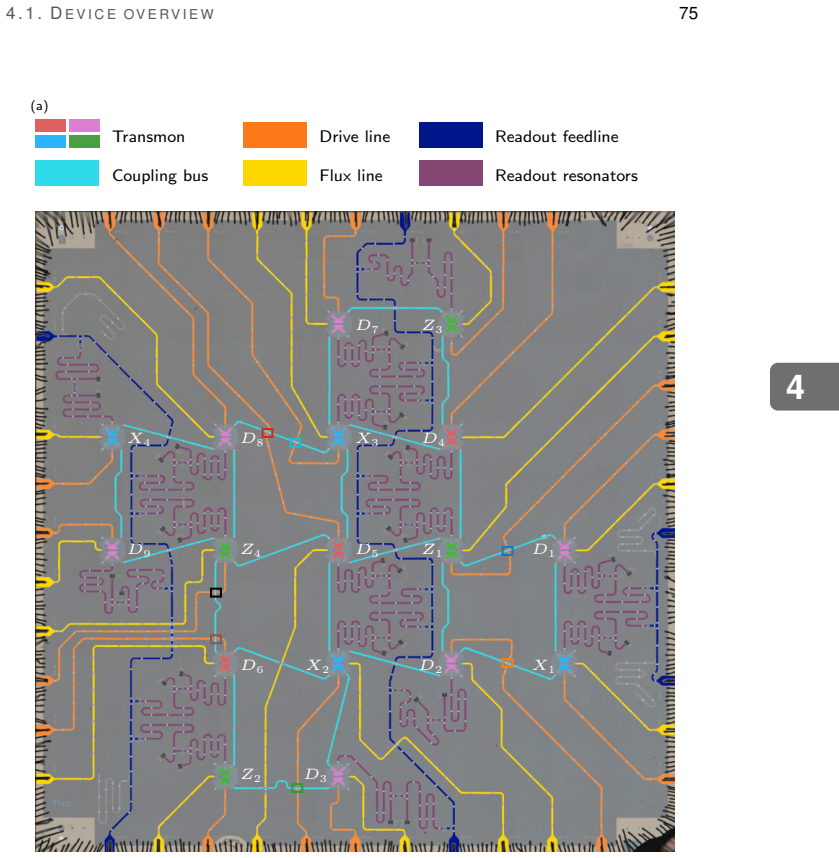
The load-bearing object is the distance-2 surface-code logical qubit: seven flux-tunable transmons, four data and three ancilla, arranged so that the codespace is the even-parity subspace of the stabilizer set $S = \{Z_{D1}Z_{D3},\; X_{D1}X_{D2}X_{D3}X_{D4},\; Z_{D2}Z_{D4}\}$. The stabilizer measurements project the data into the codespace and flag errors by returning $-1$; because this code cannot uniquely identify every error, the protocol post-selects runs with no detected error. Fault tolerance is achieved by designing each logical operation so that any single fault either yields a non-trivial syndrome or leaves the desired logical state with a detectable error; the order of CZ gates in the weight-4 stabilizer circuit is what prevents ancilla faults from becoming logical errors. The second carrying mechanism is the logical Pauli transfer matrix, a $4\times 4$ real matrix mapping input logical Pauli expectation values to outputs, which lets logical gates be benchmarked with a single average fidelity. The third is the sudden net-zero (SNZ) controlled-Z pulse, whose two square half-pulses realize an exact Mach-Zehnder interferometer for the $|11\rangle$-$|02\rangle$ transition, giving 99.93% gate fidelity and a regular leakage landscape that makes tuneup simple.
What would settle it
Run the logical $X_L$ measurement with a deliberately inserted single-qubit pre-rotation error (for example, a 1% under-rotation on one data qubit) while keeping data-qubit readout unchanged, and extract $F_R^L$ with the paper's assignment-probability-matrix method; if the extracted value moves materially away from 98.7%, the negligible-single-qubit-error premise is false and the quoted logical readout fidelities need recalibration.
Extended reading notes
Core claim
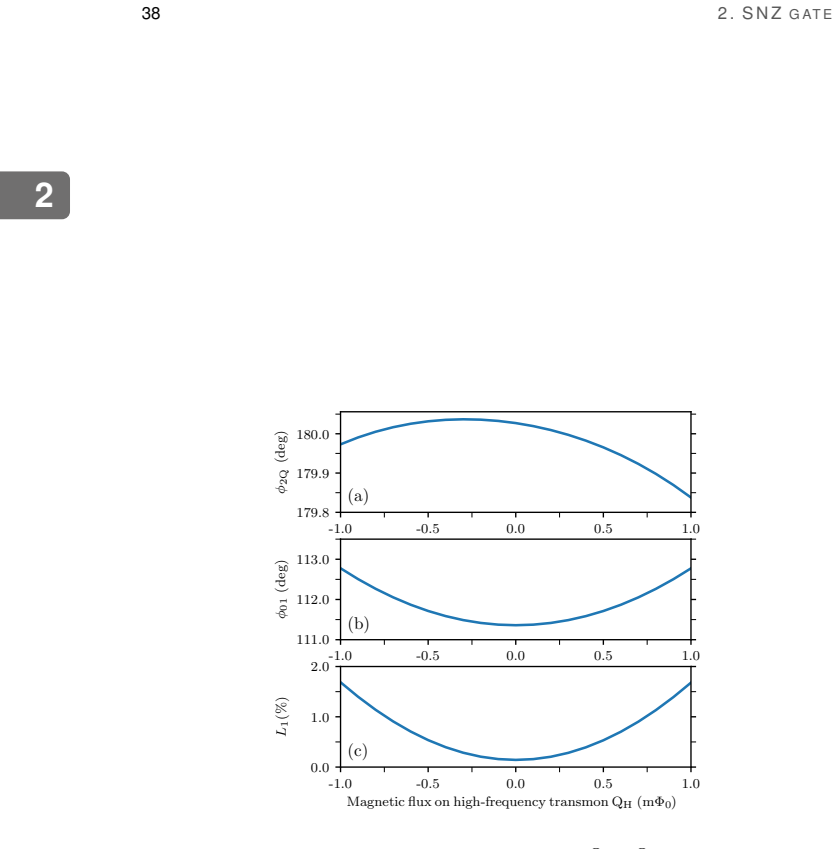
The core discovery is that a distance-2 surface code (Surface-7), four data transmons and three ancillas, can be operated as a logical qubit under repeated error detection, not just as a stabilized quantum memory. The work demonstrates initialization of arbitrary logical states, fault-tolerant logical measurement in the $Z_L$ and $X_L$ bases, a non-fault-tolerant $Y_L$ measurement, and a universal single-qubit logical gate set that includes transversal $R_X^{\pi}$ and $R_Z^{\pi}$ gates and gate-by-measurement $R_X^{\pi/2}$ and $T_L$ gates. It characterizes the gates with a logical Pauli transfer matrix, reporting average logical gate fidelities of 97.9%, 98.1%, 95.6%, and 97.3% for those four gates. For each operation type the fault-tolerant variant beats the non-fault-tolerant variant, and logical error rates per round (0.15% to 0.67%) lie below the best physical-qubit $T_1$ and $T_2$ error rates. The work further compares two scalable stabilizer-measurement schemes, pipelined and parallel, finding the pipelined scheme slightly better, and identifies leakage to higher transmon states during CZ gates as the dominant error source not captured by standard decoherence and readout models.
Load-bearing premise
The quoted logical readout fidelities rest on the assumption that single-qubit gate errors during the measurement pre-rotations are negligible compared with data-qubit readout errors; if that premise fails, the fault-tolerant versus non-fault-tolerant readout comparison shifts.
Editorial extensions
If this is right
- A complete logical operation set, including a non-Clifford $T_L$ gate, can be executed on a distance-2 code with repeated error detection, providing a template for the logical-level primitives needed in higher-distance surface codes.
- Fault-tolerant circuit design pays off even at the smallest code distance: every operation type shows a measurable improvement of the fault-tolerant variant over the non-fault-tolerant variant.
- Logical error rates per round below the best physical qubit error rates imply that error detection already confers a logical benefit, and that the path to fault tolerance is through code distance rather than through better physical qubits alone.
- A scalable stabilizer-measurement scheme with distance-independent cycle time, such as the pipelined scheme, can be used without sacrificing logical performance; its per-cycle error rate is about 3% lower than the parallel scheme.
- Leakage out of the computational subspace, chiefly from CZ gates, must be actively managed in repeated stabilizer experiments; post-selection and leakage-reduction units are the near-term tools, and the thesis shows both working.
Reading between the lines
- If the negligible-single-qubit-error premise in the logical-readout analysis is relaxed, the exact quoted $F_R^L$ values (99.8/98.7/91.4%) would need recomputation; the fault-tolerant ordering might survive, but the margins could narrow.
- The same assignment-probability-matrix method used to extract logical readout fidelity without initialization corruption could be applied directly to the distance-3 code, giving a readout benchmark that is independent of state-preparation errors.
- A natural next experiment is to run the Chapter 3 protocol on a distance-3 device with the automated calibration, leakage reduction, and soft-information decoding of Chapters 4, 5, and 7; if the per-round logical error rate drops when distance increases, the exponential-suppression claim would be tested directly.
Signed reviews
Editorial analysis
A structured set of objections, weighed in public.
Referee Report
Summary. This PhD thesis compiles experimental work on flux-tunable transmon surface-code processors. Chapter 2 presents the SNZ controlled-Z gate, reporting up to 99.93% gate fidelity and 0.10% leakage. Chapter 3 demonstrates a distance-2 Surface-7 logical qubit stabilized by repeated error detection, including logical initialization to arbitrary states, logical measurement in the ZL/XL/YL bases, and a universal single-qubit logical gate set; a central claim is that fault-tolerant variants outperform non-fault-tolerant variants. Chapter 4 describes automatic calibration and benchmarking of a 17-transmon Surface-17 device, including techniques for coping with two-level-system defects and frequency-targeting errors. Chapters 5-7 cover leakage reduction units, calibration of QEC cycles, and soft-information decoding for a bit-flip code. The central narrative is that small-scale surface-code error detection can realize a complete logical-qubit operation set and that the building blocks can be calibrated and optimized for larger codes.
Significance. If the results hold, the thesis provides valuable experimental milestones for surface-code quantum error correction with superconducting qubits: a complete logical-operation suite on a distance-2 surface code, a high-fidelity and easily tuned two-qubit gate, automatic calibration at the 17-qubit scale, and a demonstrated benefit of soft-information decoding. Strengths include the availability of processed data for Chapters 2 and 3, the use of standard randomized benchmarking and tomography with quoted error bars, the detailed comparison of pipelined versus parallel stabilizer readout, and the transparent treatment of leakage as a free parameter in simulations. The SNZ gate argument is concise and analytical in its ideal limit. However, one supporting comparison in the Chapter 3 supplementary material is internally inconsistent and needs correction before the manuscript can be accepted as a coherent record of logical performance.
major comments (1)
- [Supplement 3.6.5, Eq. (3.23), Fig. 3.9] The statement that "the logical error rates for all states ... are lower than the corresponding best physical error rates" is not supported by the paper's own numbers. For the |+_L> state, the fitted per-cycle logical error rate is 0.49%, while Eq. (3.23) with the best measured echo T2 = 117 us (D4, Table 3.2) and the 840 ns pipelined cycle gives a physical dephasing error of 1 - exp(-840 ns / (2 x 117 us)) ~ 0.36%; the logical rate is therefore about 36% larger, contradicting the "all states" claim. In addition, the comparison for |0_L> uses the T1 error of the physical |1> state (Eq. 3.22), which is not the corresponding error for a physical qubit prepared in |0>; a state-matched comparison would make the |0_L> rate of 0.43% per cycle look worse, not better. Please correct or remove this comparison, or present a state-matched and cycle-matched physical baseline.
minor comments (4)
- [Section 3.6.11 and Section 3.2.1] The cross-reference to "Table 5.1" in these sections should point to Table 3.2, the device-characteristics table in Chapter 3; the current numbering is confusing because Chapter 5 has its own tables.
- [Section 3.4] The text contains an unresolved citation "[77, 128?]" with a literal question mark; this reference should be completed or removed.
- [Eq. (3.23)] The notation 1 - e^{-t/T2/2} is ambiguous; please write the intended expression explicitly, e.g., 1 - exp(-t/(2T2)) or 1 - exp(-2t/T2), and ensure it matches the physical dephasing model used in the comparison.
- [Chapter 4, title and figure captions] There are several typographical errors, including "benchmakring" in the Chapter 4 title and headings, "envolved" in Section 3.4, and "uncertasinties" in the Fig. 4.3 caption; these should be corrected in a final proofreading pass.
Circularity Check
No significant circularity: central claims are grounded in external benchmarks and measured data, not self-referential reductions.
full rationale
The central derivations are self-contained against external benchmarks. Chapter 3's logical fidelities are obtained from tomographic reconstruction using ideal Pauli operators and maximum-likelihood estimation, with readout errors corrected via an experimentally measured 16x16 assignment matrix; the resulting logical readout fidelities are corrected estimates, not fitted predictions. The error-detection rates are extracted by exponential fits to post-selected fractions, and the logical error rates by fits to measured expectation-value decay; these are standard parameter extractions, not circular predictions. The simulation in Supplement 3.6.14 treats the leakage per CZ gate L1 as an explicit free parameter to match simulation to experiment, explicitly disclaiming accuracy; this is honest model fitting, not a fitted input renamed as a prediction. Self-citations to Refs. [69], [74], and [98] supply hardware-architecture and gate-implementation context; none is used as a uniqueness theorem or as a substitute for the measured data supporting the thesis claims. The Supplement 3.6.5 comparison of logical to physical error rates is an empirical comparison; the skeptic's arithmetic inconsistency (j+_L at 0.49% versus a T2-derived physical bound near 0.36%) would be a correctness concern if verified, but it does not constitute a circular reduction. Overall, no load-bearing step reduces by construction to its own inputs.
Assumptions & free parameters
free parameters (1)
- L1 (leakage per CZ gate) =
~5% (fitted)
assumptions (4)
- domain assumption A single fault in a logical operation either produces a non-trivial syndrome or a detectable outgoing error (fault-tolerance definition).
- domain assumption Stabilizer measurements are projective and quantum non-demolition enough that post-selection removes errors without changing the logical state.
- ad hoc to paper Errors are dominated by local, Markovian decoherence plus a single fitted CZ leakage rate L1; correlated errors from residual ZZ and measurement are included only partially.
- domain assumption Single-qubit gate errors are negligible compared with data-qubit readout errors when extracting logical assignment fidelity.
Cite this review
Pith. "Pith review of Surface-code Superconducting Quantum Processors: From Calibration To Logical Performance." pith.science (2026). https://pith.science/paper/LMIYBDIQ
@misc{pith2026250417082,
  author       = {Pith},
  title        = {Pith review of: Surface-code Superconducting Quantum Processors: From Calibration To Logical Performance},
  year         = {2026},
  howpublished = {\url{https://pith.science/paper/LMIYBDIQ}},
  note         = {Machine review of arXiv:2504.17082}
}
read the original abstract
Current quantum processors are fragile, noisy and fairly limited in both quantity and quality with tens of qubits and physical error rates of around 10^-3. To realize practical quantum applications, however, error rates need to be below 10^-15 across millions of qubits. To bridge this gap and fully harness the potential of quantum computers, quantum error correction (QEC) is essential. QEC codes are designed to protect quantum information by redundantly encoding it onto multiple physical qubits. This encoding allows for the detection and correction of local errors affecting individual qubits, e.g., through stabilizer measurements. Importantly, if the physical error rates are below a specific threshold, QEC codes can exponentially suppress logical error rates by increasing the number of physical qubits involved. This is essential for achieving fault-tolerant computations, which are key to unlocking the full potential of quantum computers. The work presented in this thesis focuses on the implementation and optimization of small-scale QEC experiments using the surface code and flux-tunable superconducting qubits (Transmons). It addresses several key challenges: enhancing two-qubit gate fidelity in Surface-4 (Chapter 2), implementing an error-detection code with Surface-7 (Chapter 3), automating the calibration and benchmarking of the building blocks in Surface-17 (Chapter 4), reducing leakage into higher excited states with leakage reduction units (Chapter 5), assessing and enhancing the performance of logical qubits (Chapters 7 and 8).
Figures


Figures from the paper (95 more)






Forward citations
Cited by 1 Pith paper
-
Analytic gradients for low-rank quantum optimal control
A new gradient-based quantum control algorithm propagates only a low-rank factorization of the density matrix, giving analytic gradients and quadratic speedups over full master-equation simulations for high-purity protocols.
Reference graph
Works this paper leans on
-
[1]
H. Ali, J. F . Marques, O. Crawford, and J. Majaniemi,Reducing the error rate of a superconducting logical qubit using analog readout information , Physical Review Applied, Vol. 22, No. 4, Article 044031 (2024)
2024
-
[2]
J. F . Marques , H. Ali , B. M. Varbanov, M. Finkel, H. M. Veen, S. L. M. van der Meer, S. Valles- Sanclemente, N. Muthusubramanian, M. Beekman, N. Haider, B. M. Terhal, and L. DiCarlo, All- Microwave Leakage Reduction Units for Quantum Error Correction with Superconducting Transmon Qubits, Physical Review Letters, Vol. 130, No. 25, Article 250602 (2023)
2023
-
[3]
Vallés-Sanclemente, S
S. Vallés-Sanclemente, S. L. M. van der Meer, M. Finkel, N. Muthusubramanian, M. Beekman, H. Ali, J. F . Marques, C. Zachariadis, H. M. Veen, T. Stavenga, N. Haider, and L. DiCarlo, Post- fabrication frequency trimming of coplanar-waveguide resonators in circuit QED quantum proces- sors, Applied Physics Letters, Vol. 123, No. 3, Article 034004 (2023)
2023
-
[4]
M. S. Moreira, G. G. Guerreschi, W. Vlothuizen, J. F . Marques, J. van Straten, S. P . Premaratne, X. Zou, H. Ali, N. Muthusubramanian, C. Zachariadis, J. van Someren, M. Beekman, N. Haider, A. Bruno, C. G. Almudever, A. Y . Matsuura, and L. DiCarlo, Realization of a quantum neural network using repeat-until-success circuits in a superconducting quantum p...
2023
-
[5]
J. F . Marques, B. M. Varbanov, M. S. Moreira, H. Ali, N. Muthusubramanian, C. Zachariadis, F . Battistel, M. Beekman, N. Haider, W. Vlothuizen, A. Bruno, B. M. Terhal, and L. DiCarlo, Logical- qubit operations in an error-detecting surface code , Nature Physics, Vol. 18, No. 1, pp. 80-86 (2022)
2022
-
[6]
Negîrneac , H
V. Negîrneac , H. Ali , N. Muthusubramanian, F . Battistel, R. Sagastizabal, M. S. Moreira, J. F . Marques, W. J. Vlothuizen, M. Beekman, C. Zachariadis, N. Haider, A. Bruno, and L. DiCarlo,High- Fidelity Controlled-Z Gate with Maximal Intermediate Leakage Operating at the Speed Limit in a Superconducting Quantum Processor, Physical Review Letters, Vol. 1...
2021
-
[7]
Janneck, T
R. Janneck, T. S. Nowack, F . De Roose,H. Ali, W. Dehaene, P . Heremans, J. Genoe, and C. Rolin, Integration of highly crystalline C8-BTBT thin-films into simple logic gates and circuits , Organic Electronics, Vol. 67, pp. 64-71 (2019)
2019
-
[8]
H. Ali, M. Pirro, P . Poulichet, W. Cesar, F . Marty, I. Azzouz, M. Gnambodoe-Capochichi, E. Nefzaoui, T. Bourouina, Thermal aspects of a micro thermal conductivity detector for micro gas chromatogra- phy,s 2019 Symposium on Design, Test, Integration and Packaging of MEMS and MOEMS (DTIP), pp. 1-6, IEEE, (2019)
2019
Show all 272 references
-
[9]
Shaun, S
F . Shaun, S. Sarkar,H. Ali, P . Poulichet, F . Peressutti, F . Marty, T. Bourouina, E. Nefzaoui, J. P . Oliveira, Energy efficient micro-machined thermal flow-rate sensor based on transient operation mode, 2018 Symposium on Design, Test, Integration and Packaging of MEMS and MO...
2018
-
[10]
Rolin, R
C. Rolin, R. Janneck, K. Muhieddine, T. Nowack,H. Ali, J. Genoe, P . Heremans,Contact resistance characterization in organic thin film transistors (Conference Presentation) , Organic Field-Effect Transistors XVII, Vol. 10739, International Society for Optics and Photonics (2018)
2018
-
[11]
O. A. M. Abdelraouf, H. A. Ali, N. K. Allam, Optimizing absorption and scattering cross section of metal nanostructures for enhancing light coupling inside perovskite solar cells, 2017 Conference on Lasers and Electro-Optics Europe and European Quantum Electronics Conference (...
2017
-
[12]
M . A . N I E L S E Nand I . L . C H U A N G. Quantum computation and quantum information. Cambridge University Press, Cambridge, 2000. (see page: 1)
2000
-
[13]
D E U T S C Hand R
D. D E U T S C Hand R . J O Z S A. Rapid solution of problems by quantum computation. Proc. R. Soc. Lond. A, 439, 553–558, 1992. (see page: 1)
1992
-
[14]
P. W. S H O R. Algorithms for quantum computation: discrete logarithms and factoring. Proceedings 35th Annual Symposium on Foundations of Computer Science, pages 124–134, 1994. (see page: 1)
1994
-
[15]
P. W. S H O R. Polynomial-time algorithms for prime factorization and discrete logarithms on a quantum computer. SIAM Journal on Computing, 26, 1484, 1997. (see pages: 2, 3, and 130)
1997
-
[16]
R . L . R I V E S T, A . S H A M I R, and L . A D L E M A N. A method for obtaining digital signatures and public-key cryptosystems. Commun. ACM, 21 (2), 120–126, 1978. (see page: 2)
1978
-
[17]
R . P. F E Y N M A N. Simulating physics with computers. International Journal of Theoretical Physics, 21 (6-7), 467–488, 1982. (see page: 2)
1982
-
[18]
L . K . G R O V E R. Quantum mechanics helps in searching for a needle in a haystack. Phys. Rev. Lett., 79, 325,
-
[19]
M O N TA N A R O
A . M O N TA N A R O. Quantum algorithms: an overview. npj Quantum Information, 2 (1), 15 023, 2016. (see page: 2)
2016
-
[20]
Quantum algorithm zoo
S. Jordan. "Quantum algorithm zoo" can be found at http://math.nist.gov/quantum/zoo/ 2019
2019
-
[21]
B A U E R, S
B. B A U E R, S. B R AV Y I, M . M O T TA, and G . K . - L . CH A N. Quantum algorithms for quantum chemistry and quantum materials science. Chem. Rev., 120 (22), 12 685–12 717, 2020. (see page: 2)
2020
-
[22]
A . G . F O W L E R, A . C. W H I T E S I D E, and L . C. L . H O L L E N B E R G. Towards practical classical processing for the surface code. Phys. Rev. Lett., 108, 180 501, 2012. (see pages: 3, 130, and 131)
2012
-
[23]
P R E S K I L L
J. P R E S K I L L. Quantum Computing in the NISQ era and beyond . Quantum, 2, 79, 2018. (see pages: 3, 21, and 41)
2018
-
[24]
A R U T E, K
F. A R U T E, K . A R YA, R . B A B B U S H, D. B A C O N, J. B A R D I N, R . B A R E N D S, et al. Quantum supremacy using a programmable superconducting processor. Nature, 574 (7779), 505–510, 2019. (see pages: 3, 20, 77, 88, and 199)
2019
-
[25]
B H A R T I, A
K . B H A R T I, A . C E R V E R A- LI E R TA, T. H . K YA W, T. H A U G, S. A L P E R I N- LE A, A . A N A N D, M . D E G- R O O T E, H . H E I M O N E N, J. S. K O T T M A N N, T. M E N K E, W. - K . M O K, S. S I M, L . - C. K W E K, et al. Noisy intermediate-scale quantum ...
2022
-
[26]
D. P. D I V I N C E N Z O. The physical implementation of quantum computation. Fortschritte der Physik, 48 (9–11), 771–783, 2000. (see page: 3)
2000
-
[27]
M . D. R E E D, B. R . J O H N S O N, A . A . H O U C K, L . D I C A R L O, J. M . C H O W, D. I . S C H U S T E R, L . F R U N- Z I O, and R . J. S C H O E L K O P F. Fast reset and suppressing spontaneous emission of a superconducting qubit. App. Phys. Lett., 96 (20), 203 11...
2010
-
[28]
G E E R L I N G S, Z
K . G E E R L I N G S, Z . L E G H TA S, I . M . P O P, S. S H A N K A R, L . F R U N Z I O, R . J. S C H O E L K O P F, M . M I R- R A H I M I, and M . H . D E V O R E T. Demonstrating a driven reset protocol for a superconducting qubit. Phys. Rev. Lett., 110, 120 501, 2013
2013
-
[29]
C. C. B U LT I N K, M . A . R O L, T. E . O ’ BR I E N, X . F U, B. C. S. D I K K E N, C. D I C K E L, R . F. L . V E R- M E U L E N, J. C. D E S T E R K E, A . B R U N O, R . N . S C H O U T E N, and L . D I C A R L O. Active resonator reset in the nonlinear dispersive regime...
2016
-
[30]
M A G N A R D, P
P. M A G N A R D, P. K U R P I E R S, B. R OY E R, T. W A LT E R, J. - C. B E S S E, S. G A S PA R I N E T T I, M . P E C H A L, J. H E I N S O O, S. S T O R Z, A . B L A I S, and A . W A L L R A F F. Fast and unconditional all-microwave reset of a superconducting qubit. Phys....
2018
-
[31]
M C E W E N, D
M . M C E W E N, D. K A F R I, Z . C H E N, J. A TA L AYA, K . J. S AT Z I N G E R, C. Q U I N TA N A, P. V. K L I M O V, D. S A N K, C. G I D N E Y, A . G . F O W L E R, F. A R U T E, K . A R YA, B. B U C K L E Y, et al. Removing leakage- induced correlated errors in supercon...
-
[32]
A B O B E I H, Y
M . A B O B E I H, Y. W A N G, J. R A N D A L L, S. L O E N E N, C. B R A D L E Y, M . M A R K H A M, D. T W I T C H E N, B. T E R H A L, and T. T A M I N I A U. Fault-tolerant operation of a logical qubit in a diamond quantum processor. Nature, 606 (7916), 884–889, 2022. (see...
2022
-
[33]
P. W. S H O R. Scheme for reducing decoherence in quantum computer memory. Phys. Rev. A, 52, R2493, 1995. (see page: 3)
1995
-
[34]
A . Y. K I TA E V. Fault-tolerant quantum computation by anyons. Annals of Physics, 303 (1), 2–30, 2003. (see pages: 3, 130)
2003
-
[35]
S. J. D E V I T T, W. J. M U N R O, and K . N E M O T O. Quantum error correction for beginners. Rep. Prog. Phys., 76 (7), 076 001, 2013
2013
-
[36]
B. M . T E R H A L. Quantum error correction for quantum memories. Rev. Mod. Phys., 87, 307–346, 2015. (see pages: 3, 41, 130, and 131)
2015
-
[37]
C H E N, K
Z . C H E N, K . J. S AT Z I N G E R, J. A TA L AYA, A . N . K O R O T K O V, A . D U N S W O R T H, D. S A N K, C. Q U I N- TA N A, M . M C E W E N, R . B A R E N D S, P. V. K L I M O V, S. H O N G, C. J O N E S, A . P E T U K H O V, et al. Expo- nential suppression of bit or...
2021
-
[38]
A C H A R YA, I
R . A C H A R YA, I . A L E I N E R, R . A L L E N, T. I . A N D E R S E N, M . A N S M A N N, F. A R U T E, K . A R YA, A . A S - F A W, J. A TA L AYA, R . B A B B U S H, D. B A C O N, J. C. B A R D I N, J. B A S S O, et al. Suppressing quantum errors by scaling a surface cod...
2023
-
[39]
A C H A R YA, D
R . A C H A R YA, D. A . A B A N I N, L . A G H A B A B A I E- BE N I, I . A L E I N E R, T. I . A N D E R S E N, M . A N S M A N N, F. A R U T E, K . A R YA, A . A S F A W, N . A S T R A K H A N T S E V, J. A TA L AYA, R . B A B B U S H, D. B A C O N, et al. Quantum error cor...
2024
-
[40]
D. P. D I V I N C E N Z O. Two-bit gates are universal for quantum computation. Phys. Rev. A, 51, 1015–1022, 1995. (see page: 4)
1995
-
[41]
L . M . K . V A N D E R S Y P E N, M . S T E F F E N, G . B R E Y TA, C. S. Y A N N O N I, M . H . S H E R W O O R D, and I . L . C H U A N G. Experimental realization of Shor’s quantum factoring algorithm. Nature, 414, 883–887, 2001. (see page: 4)
2001
-
[42]
B L U V S T E I N, S
D. B L U V S T E I N, S. J. E V E R E D, A . A . G E I M, S. H . L I, H . Z H O U, T. M A N O V I T Z, S. E B A D I, M . C A I N, M . K A L I N O W S K I, D. H A N G L E I T E R, J. P. B. A TA I D E S, N . M A S K A R A, I . C O N G, et al. Logical quantum processor based on r...
2023
-
[43]
E G A N, D
L . E G A N, D. M . D E B R OY, C. N O E L, A . R I S I N G E R, D. Z H U, D. B I S W A S, M . N E W M A N, M . L I, K . R . B R O W N, M . C E T I N A, et al. Fault-tolerant operation of a quantum error-correction code. arXiv preprint arXiv:2009.11482, 2020. (see pages: 4, 41...
2009 arXiv
-
[44]
D. C. Z A N U Z, Q . F I C H E U X, L . M I C H A U D, A . O R E K H O V, K . H A N K E, A . F L A S B Y, M . B. P A N A H, G . J. N O R R I S, M . K E R S C H B A U M, A . R E M M, F. S W I A D E K, C. H E L L I N G S, S. L A Z ˘A R, et al. Mitigating losses of superconductin...
2024 arXiv
-
[45]
M A D S E N, F
L . M A D S E N, F. L A U D E N B A C H, M . A S K A R A N I, F. R O R TA I S, T. V I N C E N T, J. B U L M E R, et al. Quantum computational advantage with a programmable photonic processor. Nature, 606 (7912), 75–81, 2022. (see page: 4)
2022
-
[46]
X U E, B
X . X U E, B. D ’ AN J O U, T. F. W AT S O N, D. R . W A R D, D. E . S AVA G E, M . G . L A G A L LY, M . F R I E S E N, S. N . C O P P E R S M I T H, M . A . E R I K S S O N, W. A . C O I S H, and L . M . V A N D E R S Y P E N. Repetitive quantum nondemolition measurement and...
2020
-
[47]
N A K A M U R A, Y
Y. N A K A M U R A, Y. P A S H K I N, and J. T S A I. Coherent control of macroscopic quantum states in a single- Cooper-pair box. Nature, 398, 786, 1999. (see page: 4)
1999
-
[48]
K O C H, T
J. K O C H, T. M . Y U, J. G A M B E T TA, A . A . H O U C K, D. I . S C H U S T E R, et al. Charge-insensitive qubit design derived from the Cooper-pair box. Phys. Rev. A, 76, 042 319, 2007. (see pages: 4, 78, and 190)
2007
-
[49]
J. E . M O O I J, T. P. O R L A N D O, L . L E V I T O V, L . T I A N, C. H . VA N D E R WA L, and S. L L OY D. Josephson persistent-current qubit. Science, 285 (5430), 1036–1039, 1999. http://www.sciencemag.org/content/285/ 5430/1036.full.pdf
1999
-
[50]
V. E . M A N U C H A R YA N, J. K O C H, L . I . G L A Z M A N, and M . H . D E V O R E T. Fluxonium: Single cooper-pair circuit free of charge offsets. Science, 326 (5949), 113–116, 2009. (see page: 4)
2009
-
[51]
B L A I S, A
A . B L A I S, A . L . G R I M S M O, S. G I R V I N, and A . W A L L R A F F. Circuit quantum electrodynamics. Reviews of Modern Physics, 93 (2), 2021. (see pages: 4, 9, and 11)
2021
-
[52]
G . J. N . A L B E R T S, M . A . R O L, T. L A S T, B. W. B R O E R, C. C. B U LT I N K, M . S. C. R I J L A A R S D A M, and A . E . V A N H A U W E R M E I R E N. Accelerating quantum computer developments. EPJ Quantum Technology, 8 (1), 18, 2021. (see page: 5)
2021
-
[53]
(see page: 5)
The QuantWare website can be found at https://www.quantware.com/. (see page: 5)
-
[54]
K . N . S M I T H, G . S. R AV I, J. M . B A K E R, and F. T. C H O N G. Scaling superconducting quantum computers with chiplet architectures, 2022. 2210.10921. (see page: 7)
2022 arXiv
-
[55]
M Ü L L E R, J
C. M Ü L L E R, J. H . C O L E, and J. L I S E N F E L D. Towards understanding two-level-systems in amorphous solids: insights from quantum circuits. Reports on Progress in Physics, 82 (12), 124 501, 2019. (see pages: 7, 158, and 192)
2019
-
[56]
(see page: 9)
OpenSuperQPlus website can be found at https://opensuperqplus.eu/. (see page: 9)
-
[57]
M C E W E N, L
M . M C E W E N, L . F A O R O, K . A R YA, A . D U N S W O R T H, T. H U A N G, S. K I M, B. B U R K E T T, A . F O W L E R, F. A R U T E, J. C. B A R D I N, A . B E N G T S S O N, A . B I L M E S, B. B. B U C K L E Y, et al. Resolving catastrophic error bursts from cosmic ra...
2022
-
[58]
M C E W E N, K
M . M C E W E N, K . C. M I A O, J. A TA L AYA, A . B I L M E S, A . C R O O K, J. B O VA I R D, J. M . K R E I K E B A U M, N . Z O B R I S T, E . J E F F R E Y, B. Y I N G, A . B E N G T S S O N, H . - S. C H A N G, A . D U N S W O R T H, et al. Resisting high-energy impact ...
2024
-
[59]
S I D D I Q I
I . S I D D I Q I. Engineering high-coherence superconducting qubits. Nature Reviews Materials, 6 (10), 875–891,
-
[60]
B R AV Y I, O
S. B R AV Y I, O. D I A L, J. M . G A M B E T TA, D. G I L, and Z . N A Z A R I O. The future of quantum computing with superconducting qubits. Journal of Applied Physics, 132 (16), 2022. (see page: 193) 212 R E F E R E N C E S
2022
-
[61]
M O H S E N I, A
M . M O H S E N I, A . S C H E R E R, K . G . J O H N S O N, O. W E R T H E I M, M . O T T E N, N . A . A A D I T, K . M . B R E S- N I K E R, K . Y. C A M S A R I, B. C H A P M A N, S. C H AT T E R J E E, G . A . D A G N E W, A . E S P O S I T O, F. F A H I M, et al. How to b...
2024 arXiv
-
[62]
(see page: 7)
Delft Circuits website can be found at https://delft-circuits.com/. (see page: 7)
-
[63]
V. Y. M O N A R K H A, S. S I M B I E R O W I C Z, M . B O R R E L L I, R . VA N G U L I K, N . D R O B O T U N, D. K U I T E N- B R O U W E R, D. B O U M A N, D. D AT TA, P. E S K E L I N E N, E . M A N N I L A, J. K A I K K O N E N, V. V E S T E R I N E N, J. G O V E N I U S...
2024 arXiv
-
[64]
K R I N N E R, S
S. K R I N N E R, S. S T O R Z, P. K U R P I E R S, P. M A G N A R D, J. H E I N S O O, R . K E L L E R, J. L Ü T O L F, C. E I C H- L E R, and A . W A L L R A F F. Engineering cryogenic setups for 100-qubit scale superconducting circuit systems . EPJ Quantum Technology,6 (1),...
2019
-
[65]
D. M . P O Z A R. Microwave engineering. John Wiley & Sons, Hoboken, 3 edition, 2005. (see page: 8)
2005
-
[66]
(see page: 8)
Qblox_website can be found at https://www.qblox.com/. (see page: 8)
-
[67]
V A L L É S- SA N C L E M E N T E, S
S. V A L L É S- SA N C L E M E N T E, S. L . M . VA N D E R M E E R, M . F I N K E L, N . M U T H U S U B R A M A N I A N, M . B E E K M A N, H . A L I, J. F. M A R Q U E S, C. Z A C H A R I A D I S, H . M . V E E N, T. S TAV E N G A, N . H A I D E R, and L . D I C A R L O. Po...
2023 doi
-
[68]
B A R E N D S, C
R . B A R E N D S, C. M . Q U I N TA N A, A . G . P E T U K H O V, Y. C H E N, D. K A F R I, K . K E C H E D Z H I, R . C O L L I N S, O. N A A M A N, S. B O I X O, F. A R U T E, K . A R YA, D. B U E L L, B. B U R K E T T, et al. Diabatic gates for frequency-tunable supercondu...
2019
-
[69]
B L A I S, J
A . B L A I S, J. G A M B E T TA, A . W A L L R A F F, D. I . S C H U S T E R, S. M . G I R V I N, M . H . D E V O R E T, and R . J. S C H O E L K O P F. Quantum-information processing with circuit quantum electrodynamics. Phys. Rev. A, 75, 032 329, 2007. (see page: 9)
2007
-
[70]
K R A N T Z, M
P. K R A N T Z, M . K J A E R G A A R D, F. Y A N, T. P. O R L A N D O, S. G U S TAV S S O N, and W. D. O L I V E R. A quantum engineer’s guide to superconducting qubits. App. Phys. Rev., 6 (2), 021 318, 2019. (see pages: 10, 11, 12, 13, 14, 33, 54, 121, and 215)
2019
-
[71]
B. D. J O S E P H S O N. Possible new effects in superconductive tunnelling. Phys. Lett., 1 (7), 251–253, 1962. (see page: 11)
1962
-
[72]
R . H . K O C H, D. P. D I V I N C E N Z O, and J. C L A R K E. Model for 1=f flux noise in squids and qubits. Phys. Rev. Lett., 98, 267 003, 2007. (see pages: 11, 112)
2007
-
[73]
K H E Z R I, A
M . K H E Z R I, A . O P R E M C A K, Z . C H E N, A . B E N G T S S O N, T. W H I T E, O. N A A M A N, R . A C H A R YA, K . A N D E R S O N, M . A N S M A N N, F. A R U T E, K . A R YA, A . A S F A W, J. C. B A R D I N, et al. Measurement- induced state transitions in a supe...
2022 arXiv
-
[74]
M . F. D U M A S, B. G R O L E A U- PA R É, A . M C D O N A L D, M . H . M U Ñ O Z- AR I A S, C. L L E D Ó, B. D ’ AN J O U, and A . B L A I S. Measurement-induced transmon ionization. Physical Review X, 14 (4), 2024. (see page: 11)
2024
-
[75]
B L A I S, R
A . B L A I S, R . - S. H U A N G, A . W A L L R A F F, S. M . G I R V I N, and R . J. S C H O E L K O P F. Cavity quantum electrodynamics for superconducting electrical circuits: An architecture for quantum computation. Phys. Rev. A, 69, 062 320, 2004. (see pages: 12, 41)
2004
-
[76]
M O T Z O I, J
F. M O T Z O I, J. M . G A M B E T TA, P. R E B E N T R O S T, and F. K . W I L H E L M. Simple pulses for elimination of leakage in weakly nonlinear qubits . Phys. Rev. Lett., 103, 110 501, 2009. (see pages: 13, 32, 86, 112, 168, and 215)
2009
-
[77]
J. M . C H O W, L . D I C A R L O, J. M . G A M B E T TA, F. M O T Z O I, L . F R U N Z I O, S. M . G I R V I N, and R . J. S C H O E L K O P F. Optimized driving of superconducting artificial atoms for improved single-qubit gates. Phys. Rev. A, 82, 040 305, 2010. (see pages: 1...
2010
-
[78]
F. W. S T R A U C H, P. R . J O H N S O N, A . J. D R A G T, C. J. L O B B, J. R . A N D E R S O N, and F. C. W E L L- S T O O D. Quantum logic gates for coupled superconducting phase qubits . Phys. Rev. Lett., 91, 167 005, 2003. (see pages: 14, 20, and 88)
2003
-
[79]
D I C A R L O, J
L . D I C A R L O, J. M . C H O W, J. M . G A M B E T TA, L . S. B I S H O P, B. R . J O H N S O N, D. I . S C H U S T E R, J. M A J E R, A . B L A I S, L . F R U N Z I O, S. M . G I R V I N, and R . J. S C H O E L K O P F. Demonstration of two-qubit algorithms with a supercon...
2009
-
[80]
A . G . F O W L E R. Coping with qubit leakage in topological codes . Phys. Rev. A, 88, 042 308, 2013. (see page: 112) 214 R E F E R E N C E S
2013
-
[81]
N E G Î R N E A C, H
V. N E G Î R N E A C, H . A L I, N . M U T H U S U B R A M A N I A N, F. B AT T I S T E L, R . S A G A S T I Z A B A L, M . S. M O R- E I R A, J. F. M A R Q U E S, W. J. V L O T H U I Z E N, M . B E E K M A N, C. Z A C H A R I A D I S, N . H A I D E R, A . B R U N O, and L . D...
2021
-
[82]
K J A E R G A A R D, M
M . K J A E R G A A R D, M . S C H W A R T Z, J. B R A U M Ü L L E R, P. K R A N T Z, J. W A N G, S. G U S TAV S S O N, and W. O L I V E R. Superconducting qubits: Current state of play. Annu. Rev. Condens. Matter Phys.,11 (1), 369–395,
-
[83]
A . G . F O W L E R, M . M A R I A N T O N I, J. M . M A R T I N I S, and A . N . C L E L A N D. Surface codes: Towards practical large-scale quantum computation. Phys. Rev. A, 86, 032 324, 2012. (see pages: 20, 41, and 112)
2012
-
[84]
C. C. B U LT I N K, T. E . O ’ BR I E N, R . V O L L M E R, N . M U T H U S U B R A M A N I A N, M . W. B E E K M A N, M . A . R O L, X . F U, B. T A R A S I N S K I, V. O S T R O U K H, B. V A R B A N O V, A . B R U N O, and L . D I C A R L O. Protecting quantum entanglement ...
2020
-
[85]
C. K . A N D E R S E N, A . R E M M, S. L A Z A R, S. K R I N N E R, J. H E I N S O O, J. - C. B E S S E, M . G A B U R E A C, A . W A L L R A F F, and C. E I C H L E R. Entanglement stabilization using ancilla-based parity detection and real-time feedback in superconducting c...
2019
-
[86]
C. K . A N D E R S E N, A . R E M M, S. L A Z A R, S. K R I N N E R, N . L A C R O I X, G . J. N O R R I S, M . G A B U R E A C, C. E I C H L E R, and A . W A L L R A F F. Repeated quantum error detection in a surface code . Nat. Phys., 16 (8), 875–880, 2020. (see pages: 20, 2...
2020
-
[87]
S H E L D O N, E
S. S H E L D O N, E . M A G E S A N, J. M . C H O W, and J. M . G A M B E T TA. Procedure for systematically tuning up cross-talk in the cross-resonance gate. Phys. Rev. A, 93, 060302(R), 2016. (see page: 20)
2016
-
[88]
S. S. H O N G, A . T. P A PA G E O R G E, P. S I VA R A J A H, G . C R O S S M A N, N . D I D I E R, A . M . P O L L O R E N O, E . A . S E T E, S. W. T U R K O W S K I, M . P. D A S I LVA , and B. R . J O H N S O N. Demonstration of a parametrically activated entangling gate ...
2020
-
[89]
B. M . V A R B A N O V, F. B AT T I S T E L, B. M . T A R A S I N S K I, V. P. O S T R O U K H, T. E . O ’ B R I E N, L . D I - C A R L O, and B. M . T E R H A L. Leakage detection for a transmon-based surface code. npj Quantum Information, 6 (1), 102, 2020. (see pages: 20, 53...
2020
-
[90]
A L I F E R I Sand B
P. A L I F E R I Sand B. M . T E R H A L. Fault-tolerant quantum computation for local leakage faults. Quantum Info. Comput., 7 (1), 139–156, 2007. (see pages: 20, 112)
2007
-
[91]
G H O S H, A
J. G H O S H, A . G . F O W L E R, J. M . M A R T I N I S, and M . R . G E L L E R. Understanding the effects of leakage in superconducting quantum-error-detection circuits. Phys. Rev. A, 88, 062 329, 2013
2013
-
[92]
Y. X U, J. C H U, J. Y U A N, J. Q I U, Y. Z H O U, L . Z H A N G, X . T A N, Y. Y U, S. L I U, J. L I, F. Y A N, and D. Y U. High-fidelity, high-scalability two-qubit gate scheme for superconducting qubits. Phys. Rev. Lett., 125, 240 503, 2020. (see pages: 20, 199)
2020
-
[93]
S U C H A R A, A
M . S U C H A R A, A . W. C R O S S, and J. M . G A M B E T TA. Leakage suppression in the toric code. Quantum Info. Comput., 15 (11-12), 997–1016, 2015. (see pages: 112, 166)
2015
-
[94]
G H O S H and A
J. G H O S H and A . G . F O W L E R. Leakage-resilient approach to fault-tolerant quantum computing with super- conducting elements. Phys. Rev. A, 91, 020 302(R), 2015. (see pages: 20, 112)
2015
-
[95]
D I C A R L O, M
L . D I C A R L O, M . D. R E E D, L . S U N, B. R . J O H N S O N, J. M . C H O W, J. M . G A M B E T TA, L . F R U N Z I O, S. M . G I R V I N, M . H . D E V O R E T, and R . J. S C H O E L K O P F. Preparation and measurement of three-qubit entanglement in a superconducting...
2010
-
[96]
B A R E N D S, J
R . B A R E N D S, J. K E L LY, A . M E G R A N T, A . V E I T I A, D. S A N K, E . J E F F R E Y, T. C. W H I T E, J. M U T U S, A . G . F O W L E R, B. C A M P B E L L, Y. C H E N, Z . C H E N, B. C H I A R O, et al. Superconducting quantum circuits at the surface code thres...
2014
-
[97]
K E L LY, R
J. K E L LY, R . B A R E N D S, A . G . F O W L E R, A . M E G R A N T, E . J E F F R E Y, T. W H I T E, D. S A N K, J. M U T U S, B. C A M P B E L L, Y. C H E N, B. C H I A R O, A . D U N S W O R T H, I . - C. H O I, et al. State preservation by repetitive error detection in ...
2015
-
[98]
J. M . M A R T I N I Sand M . R . G E L L E R. Fast adiabatic qubit gates using only z control. Phys. Rev. A, 90, 022 307, 2014. (see pages: 20, 29, 99, 190, and 215)
2014
-
[99]
K R I N N E R, S
S. K R I N N E R, S. L A Z A R, A . R E M M, C. K . A N D E R S E N, N . L A C R O I X, G . J. N O R R I S, et al. Benchmarking coherent errors in controlled-phase gates due to spectator qubits . Phys. Rev. Appl., 14, 024 042, 2020. (see pages: 20, 79, 94, 96, and 147)
2020
-
[100]
C H E N, A
Z . C H E N, A . M E G R A N T, J. K E L LY, R . B A R E N D S, J. B O C H M A N N, Y. C H E N, B. C H I A R O, A . D U N S W O R T H, E . J E F F R E Y, J. M U T U S, P. O ’ MA L L E Y, C. N E I L L, P. R O U S H A N, et al. Fabrica- tion and characterization of aluminum airb...
2014
-
[101]
Y A N, P
F. Y A N, P. K R A N T Z, Y. S U N G, M . K J A E R G A A R D, D. L . C A M P B E L L, T. P. O R L A N D O, S. G U S TAV S- S O N, and W. D. O L I V E R. Tunable coupling scheme for implementing high-fidelity two-qubit gates. Phys. Rev. App., 10 (5), 054 062, 2018. (see page: 199)
2018
-
[102]
M U N D A D A, G
P. M U N D A D A, G . Z H A N G, T. H A Z A R D, and A . H O U C K. Suppression of qubit crosstalk in a tunable coupling superconducting circuit. Phys. Rev. Appl., 12 (5), 054 023, 2019. (see page: 199)
2019
-
[103]
M . C. C O L L O D O, J. H E R R M A N N, N . L A C R O I X, C. K . A N D E R S E N, A . R E M M, S. L A Z A R, J. - C. B E S S E, T. W A LT E R, A . W A L L R A F F, and C. E I C H L E R. Implementation of conditional phase gates based on tunable zz interactions. Phys. Rev. L...
2020
-
[104]
N I J H O LT, J
B. N I J H O LT, J. W E S T O N, J. H O O F W I J K, and A . A K H M E R O V. Adaptive: parallel active learning of mathe- matical functions, 2019. (see pages: 24, 34, and 215)
2019
-
[105]
J. A . S C H R E I E R, A . A . H O U C K, J. K O C H, D. I . S C H U S T E R, B. R . J O H N S O N, J. M . C H O W, J. M . G A M B E T TA, J. M A J E R, L . F R U N Z I O, M . H . D E V O R E T, S. M . G I R V I N, and R . J. S C H O E L K O P F. Suppressing charge noise deco...
2008
-
[106]
M . A . R O L, F. B AT T I S T E L, F. K . M A L I N O W S K I, C. C. B U LT I N K, B. M . T A R A S I N S K I, R . V O L L M E R, N . H A I D E R, N . M U T H U S U B R A M A N I A N, A . B R U N O, B. M . T E R H A L, and L . D I C A R L O. Fast, high-fidelity conditional-pha...
2019
-
[107]
K J A E R G A A R D, M
M . K J A E R G A A R D, M . E . S C H W A R T Z, A . G R E E N E, G . O. S A M A C H, M . O. A . B E N G T S S O N, C. M . M C N A L LY, J. B R A U M Ü L L E R, D. K . K I M, P. K R A N T Z, M . M A R V I A N, A . M E LV I L L E, B. M . N I E D Z I E L- S K I, Y. S U N G, et ...
2001 arXiv
-
[108]
M A G E S A N, J
E . M A G E S A N, J. M . G A M B E T TA, and J. E M E R S O N. Characterizing quantum gates via randomized bench- marking. Phys. Rev. A, 85, 042 311, 2012. (see pages: 21, 86, 95, and 121)
2012
-
[109]
C. J. W O O D and J. M . G A M B E T TA. Quantification and characterization of leakage errors. Phys. Rev. A, 97, 032 306, 2018. (see pages: 21, 26, 65, 95, 121, 167, and 168)
2018
-
[110]
V E R S L U I S, S
R . V E R S L U I S, S. P O L E T T O, N . K H A M M A S S I, B. T A R A S I N S K I, N . H A I D E R, D. J. M I C H A L A K, A . B R U N O, K . B E R T E L S, and L . D I C A R L O. Scalable quantum circuit and control for a superconducting surface code. Phys. Rev. Applied, 8...
2017
-
[111]
L A C R O I X, C
N . L A C R O I X, C. H E L L I N G S, C. K . A N D E R S E N, A . D I PA O L O, A . R E M M, S. L A Z A R, S. K R I N N E R, G . J. N O R R I S, M . G A B U R E A C, J. H E I N S O O, A . B L A I S, C. E I C H L E R, and A . W A L L R A F F. Improving the performance of deep ...
-
[112]
B A R E N D S, L
R . B A R E N D S, L . L A M ATA, J. K E L LY, L . G A R C Í A- ÁLVA R E Z, A . F O W L E R, A . M E G R A N T, E . J E F F R E Y, T. W H I T E, D. S A N K, J. M U T U S, B. C A M P B E L L, Y. C H E N, Z . C H E N, et al. Digital quantum simulation of fermionic models with a ...
2015
-
[113]
[58, 64, 65, 72, 86, 94, 102, 104, 106]
See Supplemental Material at [URL] for additional information supporting statements and claims made in the main text, which includes Refs. [58, 64, 65, 72, 86, 94, 102, 104, 106]. (see pages: 23, 26, and 27)
-
[114]
H E I N S O O, C
J. H E I N S O O, C. K . A N D E R S E N, A . R E M M, S. K R I N N E R, T. W A LT E R, Y. S A L AT H É, S. G A S- PA R I N E T T I, J. - C. B E S S E, A . P O T OˇC N I K, A . W A L L R A F F, and C. E I C H L E R. Rapid high-fidelity mul- tiplexed readout of superconducting q...
2018
-
[115]
M . A . R O L, L . C I O R C I A R O, F. K . M A L I N O W S K I, B. M . T A R A S I N S K I, R . E . S A G A S T I Z A B A L, C. C. B U LT I N K, Y. S A L AT H E, N . H A A N D B A E K, J. S E D I V Y, and L . D I C A R L O. Time-domain characterization and correction of on-c...
-
[116]
N E G N E V I T S K Y, M
V. N E G N E V I T S K Y, M . M A R I N E L L I, K . K . M E H TA, H . - Y. L O, C. F L Ü H M A N N, and J. P. H O M E. Re- peated multi-qubit readout and feedback with a mixed-species trapped-ion register. Nature, 563 (7732), 527–531,
-
[117]
O F E K, A
N . O F E K, A . P E T R E N K O, R . H E E R E S, P. R E I N H O L D, Z . L E G H TA S, B. V L A S TA K I S, Y. L I U, L . F R U N- Z I O, S. M . G I R V I N, L . J I A N G, M . M I R R A H I M I, M . H . D E V O R E T, and R . J. S C H O E L K O P F. Extending the lifetime o...
2016
-
[118]
https://www.quantum-inspire.com/
QuTech Quantum Inspire. https://www.quantum-inspire.com/. (see page: 28)
-
[119]
C. C. B U LT I N K, B. T A R A S I N S K I, N . H A A N D B A E K, S. P O L E T T O, N . H A I D E R, D. J. M I C H A L A K, A . B R U N O, and L . D I C A R L O. General method for extracting the quantum efficiency of dispersive qubit readout in circuit qed. App. Phys. Lett., ...
2018
-
[120]
J. F. M A R Q U E S, B. M . V A R B A N O V, M . S. M O R E I R A, H . A L I, N . M U T H U S U B R A M A N I A N, C. Z A C H A R I A D I S, F. B AT T I S T E L, M . B E E K M A N, N . H A I D E R, W. V L O T H U I Z E N, A . B R U N O, B. M . T E R H A L, and L . D I C A R L ...
2022
-
[121]
J. M . M A R T I N I S. Qubit metrology for building a fault-tolerant quantum computer. npj Quantum Inf., 1, 15 005,
-
[122]
(see page: 44)
Qiskit: An open-source framework for quantum computing, 2019. (see page: 44)
2019
-
[123]
L E S C A N N E, M
R . L E S C A N N E, M . V I L L I E R S, T. P E R O N N I N, A . S A R L E T T E, M . D E L B E C Q, B. H U A R D, T. K O N T O S, M . M I R R A H I M I, and Z . L E G H TA S. Exponential suppression of bit-flips in a qubit encoded in an oscillator . Nature Physics, 16 (5), 50...
2020
-
[124]
G R I M M, N
A . G R I M M, N . E . F R AT T I N I, S. P U R I, S. O. M U N D H A D A, S. T O U Z A R D, M . M I R R A H I M I, S. M . G I R V I N, S. S H A N K A R, and M . H . D E V O R E T. Stabilization and operation of a kerr-cat qubit . Nature, 584 (7820), 205–209, 2020. (see page: 41)
2020
-
[125]
R I S T È, S
D. R I S T È, S. P O L E T T O, M . Z . H U A N G, A . B R U N O, V. V E S T E R I N E N, O. P. S A I R A, and L . D I C A R L O. Detecting bit-flip errors in a logical qubit using stabilizer measurements . Nat. Commun., 6, 6983, 2015. (see pages: 41, 112) 216 R E F E R E N C E S
2015
-
[126]
C R A M E R, N
J. C R A M E R, N . K A L B, M . A . R O L, B. H E N S E N, M . M A R K H A M, D. J. T W I T C H E N, R . H A N S O N, and T. H . T A M I N I A U. Repeated quantum error correction on a continuously encoded qubit by real-time feedback. Nat. Commun., 5, 11 526, 2016
2016
-
[127]
R I S T È, L
D. R I S T È, L . C. G . G O V I A, B. D O N O VA N, S. D. F A L L E K, W. D. K A L F U S, M . B R I N K, N . T. B R O N N, and T. A . O H K I. Real-time processing of stabilizer measurements in a bit-flip code. npj Quantum Information, 6 (1), 71, 2020. (see page: 41)
2020
-
[128]
N I G G, M
D. N I G G, M . M Ü L L E R, E . A . M A R T I N E Z, P. S C H I N D L E R, M . H E N N R I C H, T. M O N Z, M . A . M A R T I N- D E L G A D O, and R . B L AT T. Quantum computations on a topologically encoded qubit. Science, 345 (6194), 302–305, 2014. (see page: 41)
2014
-
[129]
E R H A R D, H
A . E R H A R D, H . P. N A U T R U P, M . M E T H, L . P O S T L E R, R . S T R I C K E R, M . S TA D L E R, V. N E G N E V I T- S K Y, M . R I N G B A U E R, P. S C H I N D L E R, H . J. B R I E G E L, et al. Entangling logical qubits with lattice surgery. Nature, 589 (7841)...
2021
-
[130]
R I S T È, J
D. R I S T È, J. G . VA N L E E U W E N, H . - S. K U, K . W. L E H N E R T, and L . D I C A R L O. Initialization by measurement of a superconducting quantum bit circuit. Phys. Rev. Lett., 109, 050 507, 2012. (see pages: 54, 68, and 112)
2012
-
[131]
W A LT E R, P
T. W A LT E R, P. K U R P I E R S, S. G A S PA R I N E T T I, P. M A G N A R D, A . P O T OˇC N I K, Y. S A L AT H É, M . P E C H A L, M . M O N D A L, M . O P P L I G E R, C. E I C H L E R, and A . W A L L R A F F. Rapid High-Fidelity Single- Shot Dispersive Readout of Superc...
2017
-
[132]
L . H U, Y. M A, W. C A I, X . M U, Y. X U, W. W A N G, Y. W U, H . W A N G, Y. P. S O N G, C. - L . Z O U, S. M . G I R V I N, L . - M . DU A N, and L . S U N. Quantum error correction and universal gate set operation on a binomial bosonic logical qubit. Nat. Phys., 2019. (se...
2019
-
[133]
C A M PA G N E- IB A R C Q, A
P. C A M PA G N E- IB A R C Q, A . E I C K B U S C H, S. T O U Z A R D, E . Z A LY S- GE L L E R, N . E . F R AT T I N I, V. V. S I VA K, P. R E I N H O L D, S. P U R I, S. S H A N K A R, R . J. S C H O E L K O P F, L . F R U N Z I O, M . M I R R A H I M I, and M . H . D E V O...
2020
-
[134]
J. M . C H O W, J. M . G A M B E T TA, A . D. C Ó R C O L E S, S. T. M E R K E L, J. A . S M O L I N, C. R I G E T T I, S. P O L E T T O, G . A . K E E F E, M . B. R O T H W E L L, J. R . R O Z E N, M . B. K E T C H E N, and M . S T E F F E N. Universal quantum gate set approa...
2012
-
[135]
T O M I TA and K
Y. T O M I TA and K . M . S V O R E. Low-distance surface codes under realistic quantum noise. Phys. Rev. A, 90, 062 320, 2014. (see pages: 42, 51, 59, and 131)
2014
-
[136]
O. F. M . F. C. Z . M . M . W. V. M . B. N . H . A . B. L . D. H A N Y A L I, J O R G E M A R Q U E S. Quantum error correction experiments on a 17-qubit superconducting processor. Part I: Optimized calibration strategies. 2022, Q35.010, 2022. (see pages: 73, 168)
2022
-
[137]
D E J O N G
J. D E J O N G. Implementation of a fault-tolerant swap operation on the ibm 5-qubit device . Master’s thesis, Technical University of Delft, 2019. (see page: 45)
2019
-
[138]
O. - P. S A I R A, J. P. G R O E N, J. C R A M E R, M . M E R E T S K A, G . D E L A N G E, and L . D I C A R L O. Entangle- ment genesis by ancilla-based parity measurement in 2D circuit QED. Phys. Rev. Lett., 112, 070 502, 2014. (see page: 45)
2014
-
[139]
T A K I TA, A
M . T A K I TA, A . D. C Ó R C O L E S, E . M A G E S A N, B. A B D O, M . B R I N K, A . C R O S S, et al. Demonstration of weight-four parity measurements in the surface code architecture. Phys. Rev. Lett., 117, 210 505, 2016. (see page: 45)
2016
-
[140]
A L I F E R I S, D
P. A L I F E R I S, D. G O T T E S M A N, and J. P R E S K I L L. Quantum accuracy threshold for concatenated distance-3 codes. Quantum Inf. Comput., 6 (quant-ph/0504218), 97–165, 2005. (see page: 49)
2005 arXiv
-
[141]
P A E T Z N I C Kand K
A . P A E T Z N I C Kand K . M . S V O R E. Repeat-until-success: non-deterministic decomposition of single-qubit unitaries. Quantum Information & Computation, 14, 1277–1301, 2014. (see page: 49) R E F E R E N C E S 217
2014
-
[142]
B AT T I S T E L, B
F. B AT T I S T E L, B. V A R B A N O V, and B. T E R H A L. Hardware-Efficient Leakage-Reduction Scheme for Quantum Error Correction with Superconducting Transmon Qubits. PRX Quantum, 2 (3), 030 314, 2021. (see pages: 53, 67, 112, 113, 116, 119, and 196)
2021
-
[143]
K . J. S AT Z I N G E R, Y. - J. L I U, A . S M I T H, C. K N A P P, M . N E W M A N, C. J O N E S, Z . C H E N, C. Q U I N- TA N A, X . M I, A . D U N S W O R T H, C. G I D N E Y, I . A L E I N E R, F. A R U T E, et al. Realizing topologically ordered states on a quantum proc...
2021
-
[144]
N E R S I S YA N, S
A . N E R S I S YA N, S. P O L E T T O, N . A L I D O U S T, R . M A N E N T I, R . R E N Z A S, C. V. B U I, et al. Manufacturing low dissipation superconducting quantum processors. In Int. Electron Devices Meet. (IEDM), pages 31–1. IEEE,
-
[145]
A . P. P L A C E, L . V. R O D G E R S, P. M U N D A D A, B. M . S M I T H A M, M . F I T Z PAT R I C K, Z . L E N G, A . P R E M K U M A R, J. B R YO N, S. S U S S M A N, G . C H E N G, et al. New material platform for superconducting transmon qubits with coherence times exce...
2003 arXiv
-
[146]
S A G A S T I Z A B A L, S
R . S A G A S T I Z A B A L, S. P. P R E M A R AT N E, B. A . K L AV E R, M . A . R O L, V. N E G Î R N E A C, M . S. M O R- E I R A, X . Z O U, S. J O H R I, N . M U T H U S U B R A M A N I A N, M . B E E K M A N, C. Z A C H A R I A D I S, V. P. O S - T R O U K H, N . H A I D...
2021
-
[147]
A S A A D, C
S. A S A A D, C. D I C K E L, S. P O L E T T O, A . B R U N O, N . K . L A N G F O R D, M . A . R O L, D. D E U R L O O, and L . D I C A R L O. Independent, extensible control of same-frequency superconducting qubits by selective broadcasting. npj Quantum Inf., 2, 16 029, 2016...
2016
-
[148]
T. E . O ’ BR I E N, B. M . T A R A S I N S K I, and L . D I C A R L O. Density-matrix simulation of small surface codes under current and projected experimental noise . npj Quantum Information, 3 (39), 2017. (see pages: 65, 130, 159, 163, 189, and 194)
2017
-
[149]
S A N K, Z
D. S A N K, Z . C H E N, M . K H E Z R I, J. K E L LY, R . B A R E N D S, B. C A M P B E L L, Y. C H E N, B. C H I A R O, A . D U N S W O R T H, A . F O W L E R, E . J E F F R E Y, E . L U C E R O, A . M E G R A N T, et al. Measurement-induced state transitions in a supercondu...
2016
-
[150]
M . R O L. Control for programmable superconducting quantum systems. PhD Dissertation, Delft University of Technology, 2020. (see pages: 81, 85)
2020
-
[151]
B. V. M . F. C. Z . W. V. M . B. N . H . B. T. L . D. H A N Y A L I, J O R G E M A R Q U E S. Repeated stabilizer measurements in a superconducting distance-3 surface code. 66, V30–002, 2021. (see pages: 73, 129)
2021
-
[152]
M A J E R, J
J. M A J E R, J. M . C H O W, J. M . G A M B E T TA, B. R . J O H N S O N, J. A . S C H R E I E R, L . F R U N Z I O, D. I . S C H U S T E R, A . A . H O U C K, A . W A L L R A F F, A . B L A I S, M . H . D E V O R E T, S. M . G I R V I N, and R . J. S C H O E L K O P F. Coupl...
2007
-
[153]
B R U N O, G
A . B R U N O, G . D E L A N G E, S. A S A A D, K . L . VA N D E R E N D E N, N . K . L A N G F O R D, and L . D I C A R L O. Reducing intrinsic loss in superconducting resonators by surface treatment and deep etching of silicon substrates. App. Phys. Lett., 106, 182 601, 2015...
2015
-
[154]
J O H N S O N
B. J O H N S O N. Entanglement and quantum error correction with superconducting qubits. PhD Dissertation, Y ale University, 2013. (see pages: 74, 81, and 86)
2013
-
[155]
K R I N N E R, N
S. K R I N N E R, N . L A C R O I X, A . R E M M, A . D I PA O L O, E . G E N O I S, C. L E R O U X, et al. Realizing repeated quantum error correction in a distance-three surface code. Nature, 605 (7911), 669–674, 2022. (see pages: 77, 79, 84, 88, 102, 112, 119, 131, 149, 150...
2022
-
[156]
H . V E E N. pyclq: Image analysis suite for fabrication and metrology of superconducting quantum processors. Bachelors thesis, The Hague University of Applied Sciences, 2021. (see page: 77) 218 R E F E R E N C E S
2021
-
[157]
G A O, M
J. G A O, M . D A A L, A . V AYO N A K I S, S. K U M A R, J. Z M U I D Z I N A S, B. S A D O U L E T, B. A . M A Z I N, P. K . D AY , and H . G . L E D U C. Experimental evidence for a surface distribution of two-level systems in superconduct- ing lithographed microwave resona...
2008
-
[158]
M . A . R O L, L . C I O R C I A R O, and P. E E N D E B A K. AutoDepGraph, 2017. (see pages: 85, 168) R E F E R E N C E S 219
2017
-
[159]
B R A N D W I J K
A . B R A N D W I J K. Graph-based tuneup of transmon qubits. BEC report, Delft University of Technology, 2019. (see page: 85)
2019
-
[160]
D. I . S C H U S T E R, A . A . H O U C K, J. A . S C H R E I E R, A . W A L L R A F F, J. M . G A M B E T TA, A . B L A I S, L . F R U N Z I O, J. M A J E R, M . H . D E V O R E T, S. M . G I V I N, and R . J. S C H O E L K O P F. Resolving photon number states in a supercond...
2007
-
[161]
K . C. M I A O, M . M C E W E N, J. A TA L AYA, D. K A F R I, L . P. P R YA D K O, A . B E N G T S S O N, A . O P R E M C A K, K . J. S AT Z I N G E R, Z . C H E N, P. V. K L I M O V, C. Q U I N TA N A, R . A C H A R YA, K . A N D E R S O N, et al. Overcoming leakage in scalab...
2022 arXiv
-
[162]
D. I . S C H U S T E R, A . W A L L R A F F, A . B L A I S, L . F R U N Z I O, R . - S. H U A N G, J. M A J E R, S. M . G I R V I N, and R . J. S C H O E L K O P F. ac Stark shift and dephasing of a superconducting qubit strongly coupled to a cavity field. Phys. Rev. Lett., 94,...
2005
-
[163]
O S M A N, J
A . O S M A N, J. S I M O N, A . B E N G T S S O N, S. K O S E N, P. K R A N T Z, D. P. L O Z A N O, et al. Simplified Josephson-junction fabrication process for reproducibly high-performance superconducting qubits. Appl. Phys. Lett., 118 (6), 064 002, 2021. (see page: 81)
2021
-
[164]
M U T H U S U B R A M A N I A N, P
N . M U T H U S U B R A M A N I A N, P. D U I V E S T E I N, C. Z A C H A R I A D I S, A . B R U N O, M . F I N K E L, S. VA N D E R M E E R, H . V E E N, M . B E E K M A N, T. S TAV E N G A, and L . D I C A R L O. Comparing uniformity and yield of dolan-bridge versus bridgele...
-
[165]
P. V. K L I M O V, J. K E L LY, Z . C H E N, M . N E E L E Y, A . M E G R A N T, B. B U R K E T T, R . B A R E N D S, K . A R YA, B. C H I A R O, Y. C H E N, A . D U N S W O R T H, A . F O W L E R, B. F OX E N, et al. Fluctuations of energy-relaxation times in superconducting ...
2018
-
[166]
M U T H U S U B R A M A N I A N, A
N . M U T H U S U B R A M A N I A N, A . B R U N O, B. M . T A R A S I N S K I, A . F O G N I N I, R . H A G E N, and L . D I C A R L O. Local trimming of transmon qubit frequency by laser annealing of Josephson junctions. In Bull. Am. Phys. Soc., pages B29–015. 2019. (see pag...
2019
-
[167]
VA N D E R M E E R
S. VA N D E R M E E R. Improving frequency targeting of transmon qubits through automated laser annealing. Masters thesis, Delft University of Technology, 2021. (see page:81)
2021
-
[168]
B R AV Y I, M
S. B R AV Y I, M . E N G L B R E C H T, R . K Ö N I G, and N . P E A R D. Correcting coherent errors with surface codes. npj Quantum Information, 4 (1), 55, 2018. (see pages: 84, 197)
2018
-
[169]
W A N G, P
R . W A N G, P. Z H A O, Y. J I N, and H . Y U. Control and mitigation of microwave crosstalk effect with su- perconducting qubits. Applied Physics Letters, 121 (15), 152 602, 2022. https://pubs.aip.org/aip/apl/ article-pdf/doi/10.1063/5.0115393/16450454/152602_1_online.pdf. (...
2022 doi
-
[170]
K E L LY, R
J. K E L LY, R . B A R E N D S, A . G . F O W L E R, A . M E G R A N T, E . J E F F R E Y, T. C. W H I T E, D. S A N K, J. Y. M U T U S, B. C A M P B E L L, Y. C H E N, Z . C H E N, B. C H I A R O, A . D U N S W O R T H, et al. Scalable in situ qubit calibration during repetit...
2016
-
[171]
K E L LY, P
J. K E L LY, P. O ’ MA L L E Y, M . N E E L E Y, H . N E V E N, and J. M . M A R T I N I S. Physical qubit calibration on a directed acyclic graph. ArXiv:1803.03226, 2018. (see pages: 85, 168)
2018 arXiv
-
[172]
T. R . VA N A B S W O U D E. Graph-based automation of transmon characterization. BEC report, Delft University of Technology, 2019. (see page: 85)
2019
-
[173]
G A M B E T TA, A
J. G A M B E T TA, A . B L A I S, D. I . S C H U S T E R, A . W A L L R A F F, L . F R U N Z I O, J. M A J E R, M . H . D E V O R E T, S. M . G I R V I N, and R . J. S C H O E L K O P F. Qubit-photon interactions in a cavity: Measurement-induced dephasing and number splitting....
2006
-
[174]
G A M B E T TA, A
J. G A M B E T TA, A . B L A I S, M . B O I S S O N N E A U LT, A . A . H O U C K, D. I . S C H U S T E R, and S. M . G I R V I N. Quantum trajectory approach to circuit QED: Quantum jumps and the Zeno effect. Phys. Rev. A, 77 (1), 012 112,
-
[175]
J. F. M A R Q U E S, H . A L I, B. M . V A R B A N O V, M . F I N K E L, H . M . V E E N, S. L . M . VA N D E R M E E R, S. V A L L E S- SA N C L E M E N T E, N . M U T H U S U B R A M A N I A N, M . B E E K M A N, N . H A I D E R, B. M . T E R H A L, and L . D I C A R L O. Al...
2023
-
[176]
E M E R S O N, R
J. E M E R S O N, R . A L I C K I, and K . ˙Z Y C Z K O W S K I. Scalable noise estimation with random unitary operators. Journal of Optics B: Quantum and Semiclassical Optics, 7 (10), S347, 2005. (see page: 86)
2005
-
[177]
K N I L L, D
E . K N I L L, D. L E I B F R I E D, R . R E I C H L E, J. B R I T T O N, R . B. B L A K E S TA D, J. D. J O S T, C. L A N G E R, R . O Z E R I, S. S E I D E L I N, and D. J. W I N E L A N D. Randomized benchmarking of quantum gates. Phys. Rev. A, 77, 012 307, 2008
2008
-
[178]
M A G E S A N, J
E . M A G E S A N, J. M . G A M B E T TA, and J. E M E R S O N. Scalable and robust randomized benchmarking of quantum processes. Phys. Rev. Lett., 106, 180 504, 2011. (see pages: 86, 168)
2011
-
[179]
J. M . G A M B E T TA, A . D. C Ó R C O L E S, S. T. M E R K E L, B. R . J O H N S O N, J. A . S M O L I N, J. M . C H O W, C. A . R YA N, C. R I G E T T I, S. P O L E T T O, T. A . O H K I, M . B. K E T C H E N, and M . S T E F F E N. Characteri- zation of addressability by s...
2012
-
[180]
R YA N- AN D E R S O N, J
C. R YA N- AN D E R S O N, J. B O H N E T, K . L E E, D. G R E S H, A . H A N K I N, J. G A E B L E R, D. F R A N C O I S, A . C H E R N O G U Z O V, D. L U C C H E T T I, N . B R O W N, T. G AT T E R M A N, S. H A L I T, K . G I L M O R E, et al. Realization of Real-Time Faul...
2021
-
[181]
H . Y. J A D O E N AT H M I S S I E R. Graph based tuneup of simultaneous single-qubit gates in surface 17 supercon- ducting transmon qubits. MEP report, Delft University of Technology, 2021. (see page: 87)
2021
-
[182]
P. V. K L I M O V, A . B E N G T S S O N, C. Q U I N TA N A, A . B O U R A S S A, S. H O N G, A . D U N S W O R T H, K . J. S AT Z I N G E R, W. P. L I V I N G S T O N, V. S I VA K, M . Y. N I U, T. I . A N D E R S E N, Y. Z H A N G, D. C H I K, et al. Optimizing quantum gates...
2023 arXiv
-
[183]
E . H . C H E N, T. J. Y O D E R, Y. K I M, N . S U N D A R E S A N, S. S R I N I VA S A N, M . L I, et al. Calibrated decoders for experimental quantum error correction. Phys. Rev. Lett., 128 (11), 110 504, 2022. (see pages: 88, 104, 130, 148, 162, and 168)
2022
-
[184]
F E R R E I R AM A R Q U E S
J. F E R R E I R AM A R Q U E S. Quantum error correction with superconducting qubits. Dissertation (tu delft), Delft University of Technology, 2024. (see page: 92)
2024
-
[185]
F OX E N, J
B. F OX E N, J. M U T U S, E . L U C E R O, E . J E F F R E Y, D. S A N K, R . B A R E N D S, K . A R YA, B. B U R K E T T, Y. C H E N, Z . C H E N, B. C H I A R O, A . D U N S W O R T H, A . F O W L E R, et al. High speed flux sampling for tunable superconducting qubits with a...
2018 arXiv
-
[186]
S A G A S T I Z A B A L, X
R . S A G A S T I Z A B A L, X . B O N E T- MO N R O I G, M . S I N G H, M . A . R O L, C. C. B U LT I N K, X . F U, C. H . P R I C E, V. P. O S T R O U K H, N . M U T H U S U B R A M A N I A N, A . B R U N O, M . B E E K M A N, N . H A I D E R, T. E . O ’ BR I E N, et al. Err...
2019
-
[187]
M . R E E D. Controllingphotonsinsuperconductingelectricalcircuits,. PhD Dissertation, Y ale University, 2011. (see page: 100)
2011
-
[188]
G R A S S L, T
M . G R A S S L, T. B E T H, and T. P E L L I Z Z A R I. Codes for the quantum erasure channel . Phys. Rev. A, 56, 33–38, 1997. (see page: 112)
1997
-
[189]
C. H . B E N N E T T, D. P. D I V I N C E N Z O, and J. A . S M O L I N. Capacities of quantum erasure channels. Phys. Rev. Lett., 78, 3217–3220, 1997. (see page: 112)
1997
-
[190]
T. M . S TA C E, S. D. B A R R E T T, and A . C. D O H E R T Y. Thresholds for topological codes in the presence of loss. Phys. Rev. Lett., 102, 200 501, 2009. (see page: 112)
2009
-
[191]
S. D. B A R R E T Tand T. M . S TA C E. Fault tolerant quantum computation with very high threshold for loss errors. Phys. Rev. Lett.,105, 200 502, 2010. R E F E R E N C E S 221
2010
-
[192]
T H O R B E C K, Z
T. T H O R B E C K, Z . X I A O, A . K A M A L, and L . C. G . G O V I A. Readout-induced suppression and enhancement of superconducting qubit lifetimes, 2023. 2305.10508. (see page: 105)
2023 arXiv
-
[193]
B E N G T S S O N, A
A . B E N G T S S O N, A . O P R E M C A K, M . K H E Z R I, D. S A N K, A . B O U R A S S A, K . J. S AT Z I N G E R, S. H O N G, C. E R I C K S O N, B. J. L E S T E R, K . C. M I A O, A . N . K O R O T K O V, J. K E L LY, Z . C H E N, et al. Model-based optimization of super...
2023 arXiv
-
[194]
E Z Z E L L, B
N . E Z Z E L L, B. P O K H A R E L, L . T E W A L A, G . Q U I R O Z, and D. A . L I D A R. Dynamical decoupling for superconducting qubits: a performance survey. 2023. 2207.03670. (see page: 108)
2023 arXiv
-
[195]
T A K I TA, A
M . T A K I TA, A . W. C R O S S, A . D. C Ó R C O L E S, J. M . C H O W, and J. M . G A M B E T TA. Experimental demonstration of fault-tolerant state preparation with superconducting qubits . Phys. Rev. Lett., 119, 180 501,
-
[196]
O ’ BR I E N, B
T. O ’ BR I E N, B. M . TA R A S I N S K I, C. C. B U LT I N K, M . A . RO L, R . VE R S L U I S, S. P O L E T T O, and L . D I - C A R L O. IARPA LogiQ M6 report, QuSurf logical qubit and its simulated performance with current physical-qubit parameters, not publicly available...
2016
-
[197]
Z H A O, Y
Y. Z H A O, Y. Y E, H . - L . H U A N G, Y. Z H A N G, D. W U, H . G U A N, Q . Z H U, Z . W E I, T. H E, S. C A O, F. C H E N, T. - H . CH U N G, H . D E N G, et al. Realization of an error-correcting surface code with superconducting qubits. Phys. Rev. Lett., 129, 030 501, 2...
2022
-
[198]
S U N D A R E S A N, T
N . S U N D A R E S A N, T. J. Y O D E R, Y. K I M, M . L I, E . H . C H E N, G . H A R P E R, T. T H O R B E C K, A . W. C R O S S, A . D. C Ó R C O L E S, and M . T A K I TA. Demonstrating multi-round subsystem quantum error correction using matching and maximum likelihood d...
2023
-
[199]
P O S T L E R, S
L . P O S T L E R, S. H E U E N, I . P O G O R E L O V, M . R I S P L E R, T. F E L D K E R, M . M E T H, C. D. M A R C I N I A K, R . S T R I C K E R, M . R I N G B A U E R, R . B L AT T, P. S C H I N D L E R, M . M Ü L L E R, and T. M O N Z. Demonstration of fault-tolerant u...
2022
-
[200]
M C E W E N, D
M . M C E W E N, D. B A C O N, and C. G I D N E Y. Relaxing hardware requirements for surface code circuits using time-dynamics. 2023. 2302.02192. (see page: 112)
2023 arXiv
-
[201]
N . C. B R O W N, M . N E W M A N, and K . R . B R O W N. Handling leakage with subsystem codes. New Journal of Physics, 21 (7), 073 055, 2019. (see page: 112)
2019
-
[202]
N . C. B R O W N, A . W. C R O S S, and K . R . B R O W N. Critical faults of leakage errors on the surface code
-
[203]
H AY E S, D
D. H AY E S, D. S TA C K, B. B J O R K, A . C. P O T T E R, C. H . B A L D W I N, and R . P. S T U T Z. Eliminating leakage errors in hyperfine qubits. Phys. Rev. Lett., 124, 170 501, 2020. (see page: 112)
2020
-
[204]
D E N N I S, A
E . D E N N I S, A . K I TA E V, A . L A N D A H L, and J. P R E S K I L L. Topological quantum memory . Journal of Mathematical Physics, 43 (4452), 2002. (see pages: 159, 161, and 175)
2002
-
[205]
H I G G O T Tand C
O. H I G G O T Tand C. G I D N E Y. Sparse blossom: correcting a million errors per core second with minimum- weight matching. arXiv preprint arXiv:2303.15933, 2023. (see pages: 159, 161)
2023 arXiv
-
[206]
G A M B E T TA, W
J. G A M B E T TA, W. A . B R A F F, A . W A L L R A F F, S. M . G I R V I N, and R . J. S C H O E L K O P F. Protocols for optimal readout of qubits using a continuous quantum nondemolition measurement. Phys. Rev. A, 76, 012 325,
-
[207]
C. A . R YA N, B. R . J O H N S O N, J. M . G A M B E T TA, J. M . C H O W, M . P. D A S I LVA , O. E . D I A L, and T. A . O H K I. Tomography via correlation of noisy measurement records. Phys. Rev. A, 91, 022 118, 2015. 222 R E F E R E N C E S
2015
-
[208]
K U B I C A, A
A . K U B I C A, A . H A I M, Y. V A K N I N, F. B R A N D Ã O, and A . R E T Z K E R. Erasure qubits: Overcoming the t1 limit in superconducting circuits. 2022. 2208.05461
2022 arXiv
-
[209]
Y. W U, S. K O L K O W I T Z, S. P U R I, and J. D. T H O M P S O N. Erasure conversion for fault-tolerant quantum computing in alkaline earth rydberg atom arrays. Nature Communications, 13 (1), 4657, 2022. (see page: 112)
2022
-
[210]
M A G E S A N, J
E . M A G E S A N, J. M . G A M B E T TA, B. R . J O H N S O N, C. A . R YA N, J. M . C H O W, S. T. M E R K E L, M . P. D A S I LVA , G . A . K E E F E, M . B. R O T H W E L L, T. A . O H K I, M . B. K E T C H E N, and M . S T E F F E N. Efficient measurement of quantum gate e...
-
[211]
D E L F O S S Eand N
N . D E L F O S S Eand N . H . N I C K E R S O N. Almost-linear time decoding algorithm for topological codes. Quantum, 5, 595, 2021. (see page: 161)
2021
-
[212]
M O T Z O I and F
F. M O T Z O I and F. K . W I L H E L M. Improving frequency selection of driven pulses using derivative-based transition suppression. arXiv e-prints, 2013. 1310.8363. (see page: 120)
2013 arXiv
-
[213]
S P I T Z, B
S. S P I T Z, B. M . T A R A S I N S K I, C. B E E N A K K E R, and T. O ’ BR I E N. Adaptive weight estimator for quantum error correction in a time-dependent environment. Advanced Quantum Technologies, 1 (1), 1800 012, 2017. (see page: 162)
2017
-
[214]
P E D R E G O S A, G
F. P E D R E G O S A, G . V A R O Q U A U X, A . G R A M F O R T, V. M I C H E L, B. T H I R I O N, O. G R I S E L, M . B L O N- D E L, P. P R E T T E N H O F E R, R . W E I S S, V. D U B O U R G, J. V A N D E R P L A S, A . P A S S O S, D. C O U R N A P E A U, et al. Scikit-l...
2011
-
[215]
B. M . V A R B A N O V, M . S E R R A- PE R A LTA, D. B Y F I E L D, and B. M . T E R H A L. Neural network decoder for near-term surface-code experiments, 2023. 2307.03280. (see pages: 153, 158, 159, 162, 163, 165, 170, 171, and 173)
2023 arXiv
-
[216]
B. M . V A R B A N O V. Optimizing quantum error correction for superconducting-qubit processors. PhD Dissertation, Delft University of Technology, 2024. (see pages: 156, 162)
2024
-
[217]
A L I, J
H . A L I, J. F. M A R Q U E S, M . C R A W F O R D, O. S E R R A- PE R A LTA, D. B Y F I E L D, B. M . V A R B A N O V, M . F I N K E L, M . B E E K M A N, B. M . T E R H A L, E . C A M P B E L L, and L . D I C A R L O. Improving logical qubit fidelity by using iq readout info...
2024
-
[218]
R . S. G U P TA, N . S U N D A R E S A N, T. A L E X A N D E R, C. J. W O O D, S. T. M E R K E L, M . B. H E A LY, M . H I L- L E N B R A N D, T. J O C H Y M- O ’ CO N N O R, J. R . W O O T T O N, T. J. Y O D E R, A . W. C R O S S, M . T A K I TA, and B. J. B R O W N. Encoding...
2024
-
[219]
C. A . P AT T I S O N, M . E . B E V E R L A N D, M . P. D A S I LVA , and N . D E L F O S S E. Improved quantum error correction using soft information. arXiv preprint arXiv:2107.13589, 2021. (see pages: 158, 160, 162, 166, 177, 178, and 183)
2021 arXiv
-
[220]
B A U S C H, A
J. B A U S C H, A . W. S E N I O R, F. J. H . H E R A S, T. E D L I C H, A . D AV I E S, M . N E W M A N, C. J O N E S, K . S AT Z I N G E R, M . Y. N I U, S. B L A C K W E L L, G . H O L L A N D, D. K A F R I, J. A TA L AYA, et al. Learning to decode the surface code with a r...
2023
-
[221]
P. K . S A R V E PA L L I, A . K L A P P E N E C K E R, and M . R Ö T T E L E R. Asymmetric quantum codes: constructions, bounds and performance. Proceedings of the Royal Society A: Mathematical, Physical and Engineering Sciences, 465 (2105), 1645–1672, 2009. (see page: 177)
2009
-
[222]
L I S E N F E L D, A
J. L I S E N F E L D, A . B I L M E S, A . M E G R A N T, R . B A R E N D S, J. K E L LY, P. K L I M O V, G . W E I S S, J. M . M A R T I N I S, and A . V. U S T I N O V. Electric field spectroscopy of material defects in transmon qubits . npj Quantum Information, 5 (1), 2019. ...
2019
-
[223]
A . P. V E P S Ä L Ä I N E N, A . H . K A R A M L O U, J. L . O R R E L L, A . S. D O G R A, B. L O E R, F. V A S C O N C E L O S, D. K . K I M, A . J. M E LV I L L E, B. M . N I E D Z I E L S K I, J. L . Y O D E R, S. G U S TAV S S O N, J. A . F O R M A G G I O, B. A . V A ND...
2020
-
[224]
C. D. W I L E N, S. A B D U L L A H, N . A . K U R I N S K Y, C. S TA N F O R D, L . C A R D A N I, G . D ’ I M P E R I O, C. T O M E I, L . F A O R O, L . B. I O F F E, C. H . L I U, A . O P R E M C A K, B. G . C H R I S T E N S E N, J. L . D U B O I S, et al. Correlated char...
2021
-
[225]
M A G E S A N, J
E . M A G E S A N, J. M . G A M B E T TA, A . D. C Ó R C O L E S, and J. M . C H O W. Machine learning for discriminating quantum measurement trajectories and improving readout. Phys. Rev. Lett., 114, 200 501, 2015. (see page: 160)
2015
-
[226]
A . G . F O W L E R. Minimum weight perfect matching of fault-tolerant topological quantum error correction in average o(1) parallel time, 2014. 1307.1740. (see pages: 161, 175)
2014 arXiv
-
[227]
H I G G O T T
O. H I G G O T T. Pymatching: A Python package for decoding quantum codes with minimum-weight perfect matching, 2021. 2105.13082. (see pages: 161, 175)
2021 arXiv
-
[228]
PAT R I C K
A . PAT R I C K. Extending coherence in superconducting qubits: from microseconds to milliseconds. PhD Disser- tation, Y ale University, 2013. (see page:190)
2013
-
[229]
G I D N E Y
C. G I D N E Y. Stim: a fast stabilizer circuit simulator. Quantum, 5, 497, 2021. (see pages: 162, 177)
2021
-
[230]
P R E M K U M A R, C
A . P R E M K U M A R, C. W E I L A N D, S. H W A N G, B. J A E C K, A . P. M . P L A C E, I . W A L U YO, A . H U N T, V. B I S O G N I, J. P E L L I C I A R I, A . B A R B O U R, M . S. M I L L E R, P. R U S S O, F. C A M I N O, et al. Microscopic relaxation channels in mate...
2020 arXiv
-
[231]
U E N O, M
Y. U E N O, M . K O N D O, M . T A N A K A, Y. S U Z U K I, and Y. T A B U C H I. NEO-QEC: Neural Network Enhanced Online Superconducting Decoder for Surface Codes, 2022. 2208.05758. (see page: 162)
2022 arXiv
-
[232]
B A I R E U T H E R, M
P. B A I R E U T H E R, M . D. C A I O, B. C R I G E R, C. W. B E E N A K K E R, and T. E . O ’ BR I E N. Neural network decoder for topological color codes with circuit level noise. New Journal of Physics, 21 (1), 013 003, 2019. (see page: 162)
2019
-
[233]
N A F TA LY, N
U. N A F TA LY, N . I N T R AT O R, and D. H O R N. Optimal ensemble averaging of neural networks. Network: Computation in Neural Systems, 8 (3), 283, 1997. (see pages: 163, 172)
1997
-
[234]
B. M . V A R B A N O Vand M . S E R R A- PE R A LTA. Github Repository Quantum REcurrent Neural Network De- coder (QRENND), 2023. (see page: 166)
2023
-
[235]
S E R R A- PE R A LTA
M . S E R R A- PE R A LTA. Github Repository Surface-13 NN decoder, 2024. (see page: 166)
2024
-
[236]
B A I R E U T H E R, T
P. B A I R E U T H E R, T. E . O ’ BR I E N, B. T A R A S I N S K I, and C. W. B E E N A K K E R. Machine-learning-assisted correction of correlated qubit errors in a topological code. Quantum, 2, 48, 2018. (see page: 171)
2018
-
[237]
D ’ AN J O U
B. D ’ AN J O U. Generalized figure of merit for qubit readout. Physical Review A, 103 (4), 042 404, 2021. (see page: 172)
2021
-
[238]
B I L M E S, S
A . B I L M E S, S. V O L O S H E N I U K, A . V. U S T I N O V, and J. L I S E N F E L D. Probing defect densities at the edges and inside josephson junctions of superconducting qubits. npj Quantum Information, 8 (1), 2022. (see page: 192)
2022
-
[239]
H E R T Z B E R G, E
J. H E R T Z B E R G, E . Z H A N G, S. R O S E N B L AT T, E . M A G E S A N, J. S M O L I N, J. Y A U, V. A D I G A, M . S A N D B E R G, B. M ., J. M . C H O W, and J. S. O R C U T T. Laser-annealing josephson junctions for yielding scaled-up superconducting quantum process...
2021
-
[240]
E . J. Z H A N G, S. S R I N I VA S A N, N . S U N D A R E S A N, D. F. B O G O R I N, Y. M A R T I N, J. B. H E R T Z B E R G, J. T I M M E R W I L K E, E . J. P R I T C H E T T, J. - B. Y A U, C. W A N G, W. L A N D E R S, E . P. L E W A N D O W S K I, A . N A R A S G O N D,...
2022 doi
-
[241]
K I M, C
H . K I M, C. J Ü N G E R, A . M O R VA N, E . S. B A R N A R D, W. P. L I V I N G S T O N, M . V. P. A LT O É, Y. K I M, C. S O N G, L . C H E N, J. M . K R E I K E B A U M, D. F. O G L E T R E E, D. I . S A N T I A G O, and I . S I D D I Q I. Effects of laser-annealing on fix...
2022
-
[242]
T H O R B E C K, A
T. T H O R B E C K, A . E D D I N S, I . L A U E R, D. T. M C C L U R E, and M . C A R R O L L. c, 2022. 2210.04780. (see pages: 190, 192) R E F E R E N C E S 223
2022 arXiv
-
[243]
B A R E N D S, J
R . B A R E N D S, J. K E L LY, A . M E G R A N T, D. S A N K, E . J E F F R E Y, Y. C H E N, Y. Y I N, B. C H I A R O, J. M U - T U S, C. N E I L L, P. O ’ MA L L E Y, P. R O U S H A N, J. W E N N E R, et al. Coherent Josephson qubit suitable for scalable quantum integrated c...
2013
-
[244]
L E N A N D E R, H
M . L E N A N D E R, H . W A N G, R . C. B I A L C Z A K, E . L U C E R O, M . M A R I A N T O N I, M . N E E L E Y, A . D. O ’ CO N N E L L, D. S A N K, M . W E I D E S, J. W E N N E R, T. Y A M A M O T O, Y. Y I N, J. Z H A O, et al. Measurement of energy decay in supercondu...
2011
-
[245]
G O L D, J
A . G O L D, J. P. P A Q U E T T E, A . S T O C K K L A U S E R, M . J. R E A G O R, M . S. A L A M, A . B E S T W I C K, N . D I D I E R, A . N E R S I S YA N, F. O R U C, A . R A Z AV I, B. S C H A R M A N N, E . A . S E T E, B. S U R, et al. Entanglement across separate sil...
2021
-
[246]
V E R J A U W, A
J. V E R J A U W, A . P O T OˇC N I K, M . M O N G I L L O, R . A C H A R YA, F. M O H I YA D D I N, G . S I M I O N, A . P A C C O, T. I VA N O V, D. W A N, A . V A N L E E N H O V E, L . S O U R I A U, J. J U S S O T, A . T H I A M, et al. Investigation of microwave loss ind...
2021
-
[247]
B. M . T A R A S I N S K I, T. E . O ’ BR I E N, and L . D I C A R L O. The QuSurf logical qubit and its simulated perfor- mance with current physical-qubit parameters. Y ear-2 Update of LogiQ Feasibility Study, not publicly available. (see page: 194)
-
[248]
S. V. Surface treatments for increased coherence of superconducting quantum processors. Masters thesis, Delft University of Technology, 2021. (see page: 190)
2021
-
[249]
J. C. L O V E, L . A . E S T R O F F, J. K . K R I E B E L, R . G . N U Z Z O, and G . M . W H I T E S I D E S. Self-assembled monolayers of thiolates on metals as a form of nanotechnology. Chemical Reviews, 105 (4), 1103–1170, 2005. PMID: 15826011, https://doi.org/10.1021/cr0...
2005 doi
-
[250]
J. M . M A R T I N I S, K . B. C O O P E R, R . M C D E R M O T T, M . S T E F F E N, M . A N S M A N N, K . D. O S B O R N, K . C I C A K, S. O H, D. P. P A P PA S, R . W. S I M M O N D S, and C. C. Y U. Decoherence in josephson qubits from dielectric loss. Phys. Rev. Lett., ...
2005
-
[251]
B I L M E S, A
A . B I L M E S, A . M E G R A N T, P. K L I M O V, G . W E I S S, J. M . M A R T I N I S, A . V. U S T I N O V, and J. L I S E N- F E L D. Resolving the positions of defects in superconducting quantum bits . ArXiv:1911.08246, 2019. (see page: 192)
1911 arXiv
-
[252]
R . W. S I M M O N D S, K . M . L A N G, D. A . H I T E, S. N A M, D. P. P A P PA S, and J. M . M A R T I N I S. Decoher- ence in josephson phase qubits from junction resonators. Phys. Rev. Lett., 93, 077 003, 2004. (see page: 192)
2004
-
[253]
K R I S T E N, J
M . K R I S T E N, J. N . V O S S, M . W I L D E R M U T H, A . B I L M E S, J. L I S E N F E L D, H . R O T Z I N G E R, and A . V. U S T I N O V. Observation of giant two-level systems in a granular superconductor, 2023. 2307.09078. (see page: 192)
2023 arXiv
-
[254]
L I S E N F E L D, A
J. L I S E N F E L D, A . B I L M E S, and A . V. U S T I N O V. Enhancing the coherence of superconducting quantum bits with electric fields. npj Quantum Information, 9 (1), 2023. (see pages: 192, 193)
2023
-
[259]
R O S E N B E R G, D
D. R O S E N B E R G, D. K I M, R . D A S, D. Y O S T, S. G U S TAV S S O N, D. H O V E R, et al. 3D integrated super- conducting qubits. npj Quantum Inf., 3 (1), 1–4, 2017. (see page: 193)
2017
-
[260]
M A L L E K, D
J. M A L L E K, D. Y O S T, D. R O S E N B E R G, J. Y O D E R, G . C A L U S I N E, M . C O O K, et al. Fabrication of superconducting through-silicon vias. arXiv:2103.08536, 2021. (see page: 193)
2021 arXiv
-
[261]
G . J. N O R R I S, L . M I C H A U D, D. P A H L, M . K E R S C H B A U M, C. E I C H L E R, J. - C. B E S S E, and A . W A L L- R A F F. Improved parameter targeting in 3d-integrated superconducting circuits through a polymer spacer process,
-
[264]
Z O E P F L, P
D. Z O E P F L, P. R . M U P PA L L A, C. M . F. S C H N E I D E R, S. K A S E M A N N, S. P A R T E L, and G . K I R C H M A I R. Characterization of low loss microstrip resonators as a building block for circuit QED in a 3D waveguide . AIP Advances, 7 (8), 085 118, 2017. htt...
2017 doi
-
[266]
K R I N N E R, N
S. K R I N N E R, N . L A C R O I X, A . R E M M, A . D. P A O L O, E . G E N O I S, C. L E R O U X, C. H E L L I N G S, S. L A Z A R, F. S W I A D E K, J. H E R R M A N N, G . J. N O R R I S, C. K . A N D E R S E N, M . M Ü L L E R, et al. Realizing repeated quantum error cor...
2021
-
[267]
Z H A O, P
P. Z H A O, P. X U, D. L A N, J. C H U, X . T A N, H . Y U, and Y. Y U. High-contrast zz interaction using super- conducting qubits with opposite-sign anharmonicity. Phys. Rev. Lett., 125, 200 503, 2020. (see page: 199)
2020
-
[268]
J. K U, X . X U, M . B R I N K, D. C. M C K AY , J. B. H E R T Z B E R G, M . H . A N S A R I, and B. L . T. P L O U R D E. Suppression of unwanted zz interactions in a hybrid two-qubit system. Phys. Rev. Lett., 125, 200 504, 2020. (see page: 199)
2020
-
[269]
K A N D A L A, K
A . K A N D A L A, K . X . W E I, S. S R I N I VA S A N, E . M A G E S A N, S. C A R N E VA L E, G . A . K E E F E, D. K L A U S, O. D I A L, and D. C. M C K AY . Demonstration of a high-fidelity cnot gate for fixed-frequency transmons with engineered zz suppression. Phys. Rev. ...
2021
-
[270]
C H E N, C
Y. C H E N, C. N E I L L, P. R O U S H A N, N . L E U N G, M . F A N G, R . B A R E N D S, J. K E L LY, et al. Qubit architec- ture with high coherence and fast tunable coupling. Phys. Rev. Lett., 113, 220 502, 2014. (see page: 199)
2014
-
[271]
S T E H L I K, D
J. S T E H L I K, D. M . Z A J A C, D. L . U N D E R W O O D, T. P H U N G, J. B L A I R, S. C A R N E VA L E, D. K L A U S, G . A . K E E F E, A . C A R N I O L, M . K U M P H, M . S T E F F E N, and O. E . D I A L. Tunable coupling architecture for fixed-frequency transmon su...
2021
-
[272]
K . X . W E I, E . M A G E S A N, I . L A U E R, S. S R I N I VA S A N, D. F. B O G O R I N, S. C A R N E VA L E, G . A . K E E F E, Y. K I M, D. K L A U S, W. L A N D E R S, N . S U N D A R E S A N, C. W A N G, E . J. Z H A N G, et al. Hamiltonian engineering with multicolor ...
2022
-
[2008]
(see page: 105) 220 R E F E R E N C E S
-
[2012]
(see pages: 121, 167, and 168)
-
[2015]
(see pages: 41, 130, 148, and 159)
-
[2019]
(see pages: 190, 191)
-
[2020]
(see pages: 23, 89, 99, 100, 101, 134, and 194)
-
[2021]
(see pages: 3, 112, 117, and 119)
- [2023]
Reviewed August 16, 2026 · model on record in the stance chip above.
Discussion (0). Continue with ORCID to comment.