REVIEW 4 major objections 6 minor 1 cited by
Investigating Co-Constructive Behavior of Large Language Models in Explanation Dialogues
T0 review · 4 major / 6 minor · reviewed 2026-08-16 · deepseek-v4-flash
Pith's one-line read Prompting an LLM to explain co-constructively produces more interactive, engaging dialogues but leaves its monitoring and scaffolding too inconsistent to raise average objective understanding.
desk verdict A solid, transparent user study showing prompt-level co-constructive instructions shift LLM explainer behavior but do not reliably improve objective understanding; the behavioral result is credible, but the abstract's causal 'can improve' claim over-reaches the design. read the letter →
The pith
A machine-rendered reading of the paper's core claim, the machinery that carries it, and where it could break.
The reading
What carries the argument
The central objects are the two processes that define co-constructive explanation: monitoring, the explainer's ongoing use of diagnostic and verification questions to identify the explainee's knowledge gap, and scaffolding, adjusting the explanation's content and complexity to that gap. The argument is carried by comparing two system prompts, a minimal base prompt and an enhanced prompt that defines these processes, and by measuring behavior in three ways: automatic annotation of dialogue acts and explanation moves, readability metrics (Gunning Fog Index, type-token ratio, Shannon entropy) as a proxy for scaffolding before and after the explainee signals non-understanding, and pre/post questionnaires that separate subjective understanding, objective comprehension, enabledness, and perceived co-constructiveness.
What would settle it
Hand-annotate a random sample of the 277 dialogues and compare the rates of check questions and prior-knowledge tests between settings; if human annotation finds no significant increase, the monitoring result collapses. A cheaper calculation: re-run the quantitative comparison of Section 6.2 with a classifier whose agreement with human labels is above 0.7 and check whether the significant differences survive.
Extended reading notes
Core claim
The paper's central claim is that LLMs are capable of partial, surface-level co-construction in explanation dialogues: explicit prompting produces measurable co-constructive behavior, mainly in the form of monitoring questions, and this behavior can engage explainees and improve understanding in selected cases, but it is applied inconsistently and does not translate into better average understanding. The study's numbers show the split clearly: participants in the enhanced setting interacted longer, sent more queries, and rated the LLM more co-constructive (4.1 vs. 3.7), and objective-comprehension scores spread into wider tails with more participants doing better or worse. But overall objective comprehension (74.6% vs. 75.1%) and enabledness (69.5% vs. 67.0%) are statistically similar between settings, and after an explainee signals non-understanding the enhanced model lowers explanation complexity for Sleep and Black holes but sharply increases it for Quarto. The authors interpret the missing average gain not as evidence against co-constructive explanations, but as evidence that the LLM's monitoring and scaffolding capabilities are the bottleneck.
Load-bearing premise
The claim that the enhanced LLM really monitors more rests on an automatic labeler that agrees with human annotations only 37 to 48 percent of the time, and the study treats those labels as reliable evidence for Llama 3.1 explanation dialogues.
Editorial extensions
If this is right
- Explicit prompting alone can shift an LLM explainer from monologue toward dialogue: shorter turns, more verification questions, and more frequent tests of prior knowledge, with no fine-tuning.
- Because average understanding does not improve, users should not yet expect prompt-instructed LLMs to reliably personalize explanations to their level.
- Objective comprehension in the enhanced setting splits into wider tails, so co-constructive prompting helps some explainees while leaving others worse off; mean-based evaluation hides this.
- Participants who were led to provide explanations themselves achieved higher objective comprehension, pointing to self-explanation as a concrete mechanism worth eliciting deliberately.
- Scaffolding success varies by topic, so conclusions about an LLM's adaptivity drawn from a single topic may mislead.
Reading between the lines
- An untested extension would keep the enhanced prompt but add an explicit rule that the explainer must elicit a brief self-explanation after each chunk; the paper's own correlation suggests this should raise objective comprehension, but the paper does not test it.
- The low agreement of the automatic dialogue-act labeler suggests the monitoring differences in Section 6.2 may be partly an artifact; a hand-annotated replication is the natural next check.
- Since the enhanced prompt produced wider outcome tails, stratifying participants by prior motivation and topic interest would likely show that co-constructive prompting amplifies motivation rather than compensating for it; the paper reports a motivation correlation but does not pursue this causal reading.
- A multimodal version of the same study, with voice, face, or backchannel signals, could find stronger monitoring because the explainer would receive implicit cues that text-only chat withholds; the paper notes the unimodal limitation but does not quantify how much it costs.
Signed reviews
Editorial analysis
A structured set of objections, weighed in public.
Referee Report
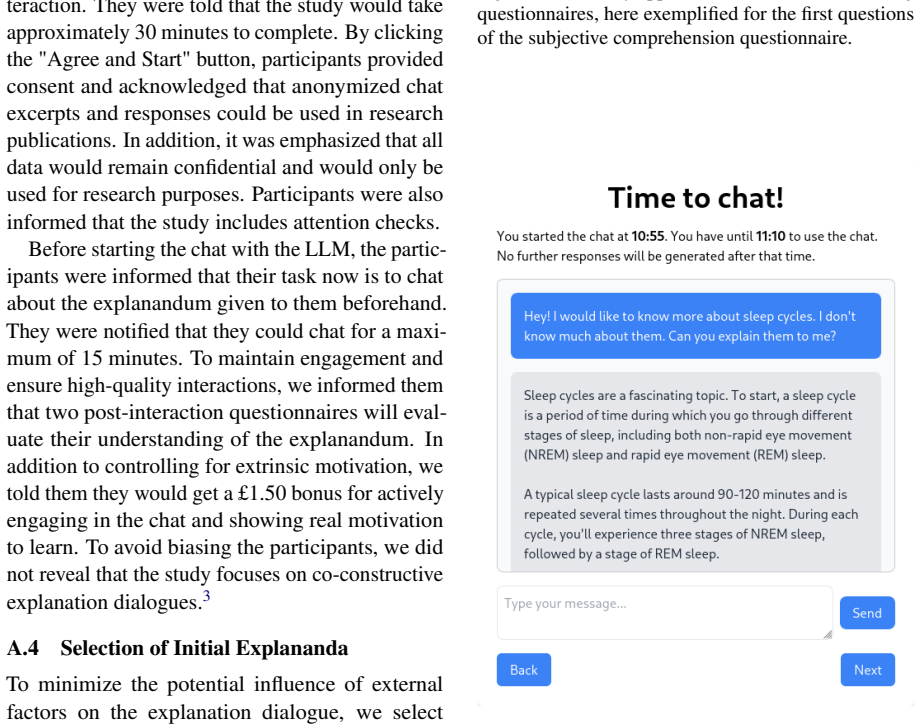
Summary. The paper studies whether an instruction-tuned LLM (Llama 3.1 70B) can act as a co-constructive explainer in explanation dialogues. In a user study with 277 participants after filtering, each participant chatted with the LLM under one of two system prompts: a minimal 'base' explainer prompt and an 'enhanced' prompt instructing the LLM to apply monitoring and scaffolding. The authors measure subjective and objective comprehension, enabledness, motivation, and perceived co-constructiveness, and they automatically annotate dialogue acts and explanation moves, compute readability metrics, and analyze nine dialogues qualitatively. They report that the enhanced prompt leads the LLM to ask more verification questions and to test prior knowledge more often, and that participants in the enhanced setting interact longer and produce more diverse dialogue acts. Subjective comprehension and motivation increase in both settings, objective comprehension is similar on average, but the distribution of objective scores has heavier tails in the enhanced setting, and scaffolding, measured via readability adjustment after signals of non-understanding, is inconsistent. The paper's central claim is that LLMs exhibit some co-constructive behaviors that foster engagement and can improve understanding, while their monitoring and scaffolding abilities remain limited.
Significance. If the central claim were fully supported, the paper would make a useful contribution to XAI and human-LLM interaction by showing that prompt-level instructions can shift an LLM's explanation behavior toward more interactive, verification-oriented dialogue, and by documenting the limits of that shift. The study is transparent: the code and data are released, the setup uses a fixed seed, the questionnaires were validated by domain experts, and the paper carefully discusses limitations. The behavioral findings about increased interaction, more check questions, and higher perceived co-constructiveness are plausible and interesting. However, the causal claim that co-constructive behavior 'can improve understanding' is not supported by the study design, as the authors themselves concede in Appendix A.5. The quantitative monitoring and scaffolding evidence also relies on an auto-annotator with low macro F1 and on a very small scaffolding sample. The paper is therefore best viewed as an exploratory evaluation of prompt-induced co-constructive surface behavior, with the understanding-improvement claim needing either a different experimental design or a substantial softening.
major comments (4)
- [Abstract and §5.3/Appendix A.5] The abstract's claim that co-constructive behaviors 'can improve understanding of a topic' is not testable from the reported design. Objective comprehension and enabledness are measured only after the interaction, and there is no non-interaction control condition. The authors state in Appendix A.5 that 'to draw conclusions about the understanding gained during the interaction, two different questionnaires of equal complexity would be required' and that this is 'out of scope for our study.' Consequently, the improvement component of the central claim is unsupported, and the subjective comprehension gains reported in Table 3 are self-reported and increase in both settings. Please either add a no-interaction control or a pre-test with matched forms, or revise the abstract and conclusion to say that co-constructive prompting is associated with particular interaction behaviors and may support understanding in selected cases rather than that it improves understanding.
- [§6.2 and Appendix B.4] The quantitative evidence that the enhanced setting produces more co-constructive behavior rests on an automatically annotated dialogue-act and explanation-move classifier with macro F1 scores between 0.37 and 0.48 on its training corpora (Table 6). No validation on Llama 3.1 explanation dialogues is reported, and the domain shift from ELI-5 and Wired 5-Levels to this study's conversations could be substantial. The differences highlighted in Section 6.2 (e.g., Ask a check question 28.4 vs. 38.4, Test prior knowledge 15.8 vs. 19.3) may therefore be artifacts of annotation error rather than true behavioral differences. This is load-bearing for the monitoring claim. Please report human agreement on a sample of the study's dialogues or explicitly treat the automatic annotation results as exploratory, and adjust the strength of the wording accordingly.
- [§6.3 and Table 2] The scaffolding analysis is based on only 14 interactions (Quarto: 2, Sleep: 4, Black holes: 8), with extremely high variance, such as the Quarto readability increase of +109.4% ± 100.9. The statement that the enhanced LLM 'successfully reduces its explanation complexity for two topics' is not supported robustly by these data, and no significance test is reported. The authors do note the small sample, but the quantitative scaffolding claim still overstates the evidence. Please report per-dialogue values, provide nonparametric tests or confidence intervals, or recast this section as a qualitative observation about variability rather than a quantitative finding.
- [§6.5 and Figure 4] The correlations used to suggest a link between co-constructive behavior and objective understanding (Kendall's τ = 0.15 to 0.17 for informing statements, provide explanation, and participant self-explanations) are observational and cannot establish causal direction. The 'heavier tails' interpretation of Figure 4 is also purely descriptive, with no statistical test for differences in distribution shape. Because these correlational results are used to support the claim that co-constructive behavior can improve understanding, the causal language should be removed or supplemented with a proper causal or longitudinal design. In addition, the labels feeding these correlations come from the low-F1 classifier discussed above, which further weakens the inference.
minor comments (6)
- [Table 1] The column header 'Sent's' appears to be a typo for 'Sentences'; please correct it.
- [Figure 3 and Appendix B.4] The definition of the 'Rest' category is inconsistent: Figure 3 says labels with proportion smaller than 5% are grouped into Rest, while Appendix B.4 says the threshold is 2%. Please unify the definitions across the main text and appendix.
- [Table 3 and Figure 11] The composite scores for motivation, subjective comprehension, and co-constructiveness are averaged over Likert items, but no reliability statistics (e.g., Cronbach's alpha) are reported. Given that one co-constructiveness item was excluded after the fact, reporting scale reliability would strengthen the interpretation.
- [§6.1] The 'processing time' metric is described as the time to respond to the LLM's answer, which conflates reading time, thinking time, and typing time. Please clarify this in the text so readers do not interpret it as pure reading time.
- [Appendix B.5] The qualitative selection procedure says the authors 'filter the 25% best and worst participants' but does not specify how the composite criterion of subjective gain, objective comprehension, and co-constructiveness score was combined. Please describe the selection rule precisely.
- [Appendix A.2] The hyperparameters include temperature 1.0 and top-p 1.0, which makes exact reproduction unlikely despite the fixed seed. Please either state that the seed was verified to yield identical outputs or note that nondeterminism remains.
Circularity Check
No significant circularity: the study is an empirical prompt comparison whose self-referential measurement instruments are tools, not fitted predictions, and the acknowledged baseline gap is an evidentiary limitation rather than a circular reduction.
full rationale
The paper contains no derivation chain in which an output is equivalent to an input by construction. The central comparison is empirical: two system prompts (base vs. enhanced) are administered to Llama 3.1, and the resulting dialogue behavior and questionnaire outcomes are measured. The enhanced prompt explicitly instructs monitoring and scaffolding, but whether the model follows that instruction is an empirical question, and the paper's finding is that it does so partially and inconsistently; the behavior is therefore not defined into existence. The dialogue-act and explanation-move classifier (Alshomary et al., 2024, with one overlapping author) and the questionnaires (Buhl et al., 2025; Terfloth and Schaffer, 2025, also with an overlapping author) are measurement instruments, not fitted parameters or renamed predictions; their low macro-F1 (0.37-0.48) is a measurement-validity concern, not circularity. The abstract's clause that co-constructive behaviors 'can improve understanding' is not supported by the design, because objective understanding is measured only post-interaction and the paper itself states in Appendix A.5 that 'two different questionnaires of equal complexity would be required' to draw conclusions about understanding gained during the interaction, but this is an acknowledged evidentiary gap and overclaim rather than a reduction of the claim to its inputs. Accordingly, no circular step is identified.
Assumptions & free parameters
assumptions (5)
- domain assumption The co-constructive explanation framework of Rohlfing et al. (2021) and Wachsmuth and Alshomary (2022), including the categories monitoring, scaffolding, and explanation moves, is a valid operationalization for evaluating explanation quality.
- domain assumption The re-trained dialogue-act and explanation-move classifier by Alshomary et al. (2024) transfers to Llama 3.1 explanation dialogues with acceptable accuracy.
- domain assumption The questionnaire items from Buhl et al. (2025) and Terfloth and Schaffer (2025) validly measure subjective comprehension, objective comprehension, enabledness, and co-constructive behavior.
- domain assumption Readability indices (Gunning Fog, Type-Token Ratio, Shannon Entropy) are valid proxies for scaffolding and adaptation of explanation complexity.
- standard math Statistical tests assume independent observations across participants and no unmodeled confounds from topic assignment.
Cite this review
Pith. "Pith review of Investigating Co-Constructive Behavior of Large Language Models in Explanation Dialogues." pith.science (2026). https://pith.science/paper/Y2JM2ZO4
@misc{pith2026250418483,
  author       = {Pith},
  title        = {Pith review of: Investigating Co-Constructive Behavior of Large Language Models in Explanation Dialogues},
  year         = {2026},
  howpublished = {\url{https://pith.science/paper/Y2JM2ZO4}},
  note         = {Machine review of arXiv:2504.18483}
}
read the original abstract
The ability to generate explanations that are understood by explainees is the quintessence of explainable artificial intelligence. Since understanding depends on the explainee's background and needs, recent research focused on co-constructive explanation dialogues, where an explainer continuously monitors the explainee's understanding and adapts their explanations dynamically. We investigate the ability of large language models (LLMs) to engage as explainers in co-constructive explanation dialogues. In particular, we present a user study in which explainees interact with an LLM in two settings, one of which involves the LLM being instructed to explain a topic co-constructively. We evaluate the explainees' understanding before and after the dialogue, as well as their perception of the LLMs' co-constructive behavior. Our results suggest that LLMs show some co-constructive behaviors, such as asking verification questions, that foster the explainees' engagement and can improve understanding of a topic. However, their ability to effectively monitor the current understanding and scaffold the explanations accordingly remains limited.
Figures


Figures from the paper (9 more)




Forward citations
Cited by 1 Pith paper
-
Vibe Coding vs. Agentic Coding: Fundamentals and Practical Implications of Agentic AI
A qualitative taxonomy positions vibe coding and agentic coding as complementary paradigms rather than rivals in AI-assisted software development.
Reference graph
Works this paper leans on
-
[1]
I have prior knowledge of sleep cycles
-
[3]
At some point in the past, I did study sleep cycles
-
[9]
I want to be acknowledged by others through my knowledge about sleep cycles. Figure 7: The questionnaire to assess the participants’ prior subjective comprehension of sleep cylces and the motivation to learn about it before interacting with the LLM. The statements are based on Buhl and Herrmann (2025) and are rated on a five-point Likert scale. Figure 10 ...
work page 2025
-
[10]
I want to deepen my understanding of sleep cycles to be the best in the field
-
[11]
I want to be acknowledged by others through my knowledge about sleep cycles. Figure 8: The questionnaire to assess the participants’ post subjective comprehension of the explanandum re- lated to sleep and the motivation to learn about it after interacting with the LLM. The statements are based on Buhl and Herrmann (2025). The participants rate the stateme...
work page 2025
-
[12]
I’m motivated to learn something new about sleep cycles
-
[21]
I’m a real expert on the topic of sleep cycles
-
[22]
I know a lot about sleep cycles
Show all 65 references
-
[23]
I understand what the sleep stages of a sleep cycle are
-
[24]
I can explain the sleep stages of a sleep cycle
-
[25]
Motivation
I know the sleep stages of a sleep cycle. Motivation
-
[26]
I was motivated by the explanation to discover new connections between the concepts related to sleep cycles and its stages
-
[27]
I found the explanation to be very interesting
-
[28]
I had fun understanding the explanations
-
[29]
I find the topic of sleep cycles very exciting
-
[30]
I would also engage in the topic of sleep cycles in my free time
-
[31]
In general, I find the topic of sleep cycles boring
-
[32]
I have fun engaging in the topic of sleep cycles
-
[33]
I want to deepen my understanding of sleep cycles to know more about it
-
[34]
I want to deepen my understanding of sleep cycles to know more about it than others
-
[37]
The sleep cycle always runs in fixed phases
-
[38]
Sleep cycles can be altered by external influences such as light and temperature
-
[39]
Slow-wave sleep is crucial for physical recovery
-
[40]
Everyone needs the same amount of sleep
-
[41]
A complete sleep cycle lasts about 60 minutes
-
[42]
There are five sleep stages
-
[43]
Melatonin production is highest during REM sleep
-
[44]
We only dream during REM sleep
-
[45]
Our body temperature and heart rate drop during deep sleep
-
[46]
It’s harmful to wake up during REM sleep
-
[47]
Slow-wave sleep is dominated by delta waves with frequencies below 4 Hz
-
[48]
Melatonin and Cortisol are primarily involved in regulating the sleep-wake cycle
-
[49]
Serotonin is the primary neurotransmitter responsible for REM sleep
-
[50]
Figure 9: The questionnaire to assess the participants’ objective comprehension of the explanandum related to sleep after interacting with the LLM
Alpha waves play a role in the initial sleep onset. Figure 9: The questionnaire to assess the participants’ objective comprehension of the explanandum related to sleep after interacting with the LLM. The statements are based on Terfloth and Schaffer (2025). The participants va...
2025
-
[51]
They are likely experiencing restorative processes
-
[52]
They may be in a state of wakefulness or light sleep
-
[53]
A person's sleep was monitored
They are in a slow-wave sleep with minimal brain activity. A person's sleep was monitored. The result is plotted in the sleep graph seen below. What sleep stage does the yellow segment (marked with an arrow) represent?
-
[54]
What does this pattern most likely indicate about their sleep architecture?
Slow-wave sleep A person exhibits prolonged periods of slow-wave sleep during the first half of the night, with a gradual increase in REM duration towards the morning. What does this pattern most likely indicate about their sleep architecture?
-
[55]
A typical and healthy sleep cycle
-
[56]
Unusually low amount of slow-wave sleep
-
[57]
A lack of REM rebound If someone only gets about 5 hours of sleep per night, which sleep stages are most likely to be impacted?
-
[58]
REM sleep and slow-wave sleep
-
[59]
Light and moderate sleep
-
[60]
Only slow-wave sleep
-
[61]
All sleep stages equally Which of the following is a correct sequence of sleep stages in one complete sleep cycle?
-
[62]
Light sleep → Moderate sleep → REM → Slow-wave sleep
-
[63]
REM → Light sleep → Moderate sleep → Slow-wave sleep
-
[64]
Light sleep → Moderate sleep → Slow-wave sleep → REM
-
[65]
The questions are based on Terfloth and Schaffer (2025)
Slow-wave sleep → Moderate sleep → Light sleep → REM Figure 10: The questionnaire to assess the participants’ enabledness of the explanandum related to sleep after interacting with the LLM. The questions are based on Terfloth and Schaffer (2025). For every question, the partic...
2025
-
[66]
My dialogue partner carefully adapted their utterances to my utterances
-
[67]
My dialogue partner considered my understanding
-
[68]
While explaining, my dialogue partner met me halfway
-
[69]
My dialogue partner took my statements into account
-
[70]
The explanation was meant to encourage me to question my understanding
-
[71]
My dialogue partner intended to provide me with the opportunity to build an understanding of the topic by asking questions
-
[72]
My dialogue partner encouraged me to continuously think about further details of the topic
-
[73]
When learning about a new topic, it’s better to think about details yourself, rather than having everything fully explained
-
[74]
My dialogue partner encouraged me to visualize the different processes of the topic
-
[75]
While explaining, it was important to my dialogue partner to continuously consider if I understood the explanation
-
[76]
While explaining, it was important to my dialogue partner to monitor whether I understood everything
-
[77]
Figure 11: The questionnaire to assess the co- constructive behavior of the LLM
My dialogue partner responded, when I signaled non- understanding. Figure 11: The questionnaire to assess the co- constructive behavior of the LLM. The items are adopted from Buhl et al. (2025). The participants rate the statements on a five-point Likert scale. unchangeable, r...
2025
-
[2001]
Mama always had a way of explaining things so I could understand
Fam: Ein fragebogen zur erfassung aktuller motivation in lern- und leistungssituationen. Diag- nostica, 47:57–66. Amelie S. Robrecht, Christoph R. Kowalski, and Stefan Kopp. 2025. SNAPE-PM: Building and Utilizing Dynamic Partner Models for Adaptive Explanation Generation. arXi...
2025 arXiv
-
[2010]
In Proceedings of the Seventh International Conference on Language Resources and Evaluation (LREC’10), Valletta, Malta
Towards an ISO standard for dialogue act an- notation. In Proceedings of the Seventh International Conference on Language Resources and Evaluation (LREC’10), Valletta, Malta. European Language Re- sources Association (ELRA). Hendrik Buschmeier, Heike M. Buhl, Friederike Kern, ...
2023
-
[2011]
In Towards Ubiqui- tous Learning, pages 461–466, Berlin, Heidelberg
The effect of dynamic computerized scaffold- ing on collaborative discourse. In Towards Ubiqui- tous Learning, pages 461–466, Berlin, Heidelberg. Springer Berlin Heidelberg. Robert Nimmo, Marios Constantinides, Ke Zhou, Daniele Quercia, and Simone Stumpf. 2024. User Characteri...
2024
-
[2020]
arXiv preprint
Longformer: The Long-Document Trans- former. arXiv preprint. Meisam Booshehri, Hendrik Buschmeier, Philipp Cimi- ano, Stefan Kopp, Jaroslaw Kornowicz, Olesja Lam- mert, Marco Matarese, Dimitry Mindlin, Amelie So- phie Robrecht, Anna-Lisa V ollmer, Petra Wagner, and Britta Wred...
2024
Reviewed August 16, 2026 · model on record in the stance chip above.
Discussion (0). Continue with ORCID to comment.