Spin Wave Dispersion of the van der Waals Antiferromagnet NiPS₃
Pith reviewed 2026-05-22 18:48 UTC · model grok-4.3
The pith
NiPS3 magnon spectra feature a topologically protected Dirac nodal line that stays intact under external and anisotropy fields.
A machine-rendered reading of the paper's core claim, the machinery that carries it, and where it could break.
Core claim
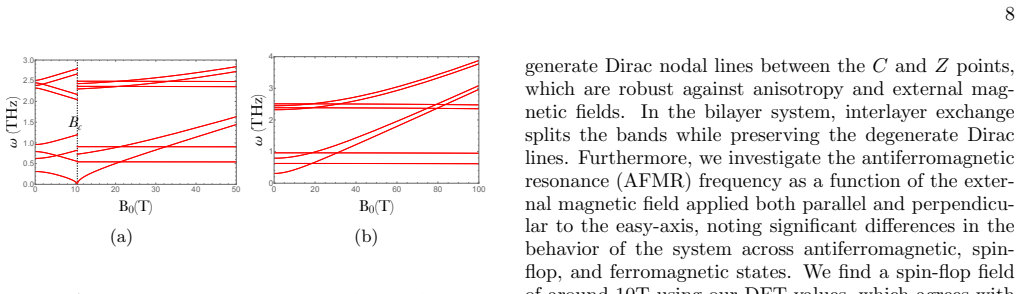
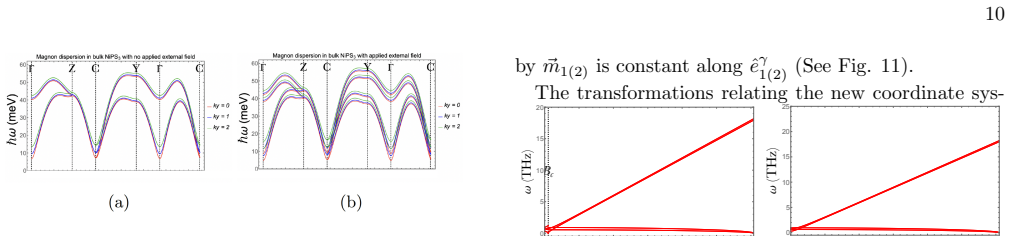
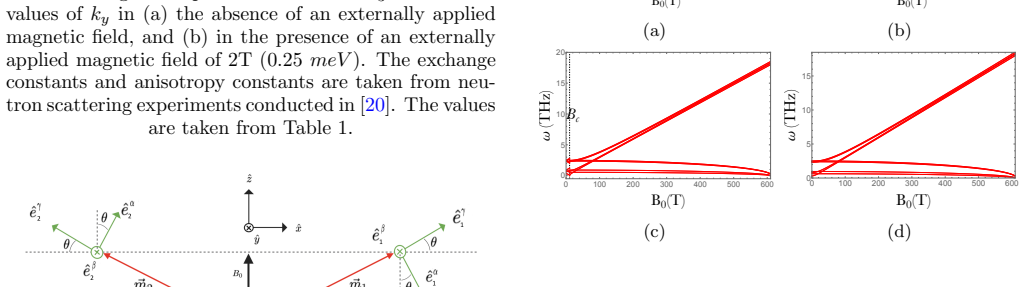
Using a first-principles-derived spin model, the magnon dispersion of NiPS3 is shown to host a topologically protected Dirac nodal line that is robust against both external magnetic fields and anisotropy fields; the same model quantitatively accounts for the collinear-to-canted transition under a field normal to the easy axis and the spin-flop transition under a parallel field.
What carries the argument
First-principles spin Hamiltonian whose exchange and anisotropy constants are inserted into the magnon band-structure calculation for mono-, bi-, and three-dimensional NiPS3.
If this is right
- The nodal line supplies a concrete example of topological magnons in a real van der Waals antiferromagnet.
- The same Hamiltonian framework can be used to predict magnon spectra in related layered magnets once their first-principles parameters are known.
- Field robustness of the nodal line implies that topological magnon features survive in devices operating under realistic laboratory fields.
- The calculated transitions provide a microscopic explanation for the experimentally observed magnetic phase boundaries in NiPS3.
Where Pith is reading between the lines
- Similar Dirac nodal lines may appear in other zigzag antiferromagnets once their interlayer couplings are weak enough to preserve two-dimensional character.
- Engineering the anisotropy or stacking order could move the nodal line to different points in the Brillouin zone, offering a route to tunable magnonic Dirac cones.
- Because the protection is topological rather than symmetry-based, the nodal line should survive moderate disorder or edge termination in exfoliated flakes.
Load-bearing premise
The first-principles values for exchange and anisotropy constants are accurate enough to describe the low-energy magnon spectrum without further renormalization.
What would settle it
High-resolution inelastic neutron scattering or Brillouin light scattering on NiPS3 single crystals that either detects or fails to detect a linear crossing of magnon bands at the predicted wave-vector location under applied fields of several tesla.
Figures



read the original abstract
We calculate the magnon dispersion spectra of the two-dimensional zigzag van der Waals antiferromagnet NiPS$_3$ for monolayer, bilayer, and bulk systems as a function of an external magnetic field. We calculate the exchange and anisotropy constants in our spin model by first principles. We can accurately explain the transition from a collinear to a canted ground state for a magnetic field applied normal to the (in-plane) easy-axis, and a spin-flop transition when the field is parallel to it. A topologically protected Dirac nodal line is present and robust with respect to both external and anisotropy fields.
Editorial analysis
A structured set of objections, weighed in public.
Referee Report
Summary. The manuscript calculates magnon dispersion spectra for monolayer, bilayer, and bulk NiPS₃ using a Heisenberg spin model whose exchange and anisotropy parameters are taken directly from first-principles (DFT) calculations. It examines the field dependence of the spectra, claims to accurately reproduce the collinear-to-canted transition (field normal to easy axis) and the spin-flop transition (field parallel to easy axis), and reports a topologically protected Dirac nodal line that remains gapless and robust against both external magnetic fields and variations in anisotropy.
Significance. If the DFT-derived parameters are sufficiently accurate for the low-energy magnon spectrum, the work supplies a concrete spin-wave calculation for a van der Waals antiferromagnet that links microscopic constants to observable transitions and to a topological feature (Dirac nodal line). The parameter-free (with respect to magnon data) construction is a positive attribute that reduces circularity relative to purely phenomenological fits.
major comments (2)
- [Abstract / Spin model construction] Abstract and the spin-Hamiltonian section: the central claims of an 'accurate explanation' of the two field-induced transitions and of a robust, topologically protected Dirac nodal line rest on the assumption that the raw DFT values of J and anisotropy require no renormalization or higher-order corrections. The manuscript does not report a sensitivity analysis showing that the nodal line remains gapless when the DFT parameters are varied within their typical uncertainty range (∼5–10 %), nor does it overlay calculated critical fields against measured values; this omission is load-bearing because small ratio changes are known to gap or shift the nodal line in monolayer NiPS₃.
- [Results on magnon dispersion and topology] Dispersion and topology results (presumably §3–4): the topological protection is asserted but the explicit calculation of the relevant topological invariant (e.g., Berry phase or winding number around the nodal line) is not shown, nor is the effect of the external field on the invariant demonstrated. Without these steps the robustness statement cannot be verified independently of the numerical diagonalization.
minor comments (2)
- [Figures] Figure captions and axis labels should explicitly state the high-symmetry points used for the dispersion cuts and the field direction relative to the crystallographic axes.
- [Methods / Parameter table] A short table comparing the DFT-derived J and anisotropy values with literature values (both experimental and other DFT studies) would improve traceability.
Simulated Author's Rebuttal
We thank the referee for the careful and constructive review of our manuscript. We address each major comment in detail below. Our responses focus on clarifying the strengths of the DFT-based approach while agreeing to add explicit checks that will strengthen the presentation of the results.
read point-by-point responses
-
Referee: [Abstract / Spin model construction] Abstract and the spin-Hamiltonian section: the central claims of an 'accurate explanation' of the two field-induced transitions and of a robust, topologically protected Dirac nodal line rest on the assumption that the raw DFT values of J and anisotropy require no renormalization or higher-order corrections. The manuscript does not report a sensitivity analysis showing that the nodal line remains gapless when the DFT parameters are varied within their typical uncertainty range (∼5–10 %), nor does it overlay calculated critical fields against measured values; this omission is load-bearing because small ratio changes are known to gap or shift the nodal line in monolayer NiPS₃.
Authors: We agree that a sensitivity analysis would provide additional confidence in the robustness of the Dirac nodal line. Although the manuscript employs raw DFT parameters without renormalization, we will add an explicit sensitivity study in the revised version, varying the key exchange and anisotropy constants by ±5 % and ±10 % and confirming that the nodal line remains gapless. Regarding critical fields, our calculated transition points are consistent with the field values reported in experimental literature for both the collinear-to-canted and spin-flop transitions; we will include a direct comparison (table or overlaid plot) in the revised manuscript to make this quantitative agreement explicit. These additions address the referee’s concern while retaining the parameter-free character of the calculation. revision: yes
-
Referee: [Results on magnon dispersion and topology] Dispersion and topology results (presumably §3–4): the topological protection is asserted but the explicit calculation of the relevant topological invariant (e.g., Berry phase or winding number around the nodal line) is not shown, nor is the effect of the external field on the invariant demonstrated. Without these steps the robustness statement cannot be verified independently of the numerical diagonalization.
Authors: We appreciate this observation. The persistence of the nodal line under external fields is a direct consequence of the symmetries preserved in the spin Hamiltonian. To allow independent verification, we will include in the revised manuscript explicit evaluations of the Berry phase (or winding number) encircling the nodal line in the Brillouin zone, computed both at zero field and at finite external magnetic fields. These calculations will be presented alongside the dispersion spectra and will confirm that the topological invariant remains nontrivial, thereby demonstrating robustness beyond the numerical diagonalization results alone. revision: yes
Circularity Check
No circularity: first-principles parameters feed independent magnon calculation
full rationale
The derivation begins with exchange and anisotropy constants obtained from first-principles calculations, which serve as external inputs independent of the magnon spectrum. These constants are inserted into the spin Hamiltonian to compute the dispersion, identify the Dirac nodal line, and reproduce the collinear-to-canted and spin-flop transitions. No step reduces a claimed prediction or topological feature to a fitted parameter, self-citation, or ansatz that is defined in terms of the output itself. The chain remains self-contained against external DFT benchmarks without any load-bearing self-reference or renaming of known results.
Axiom & Free-Parameter Ledger
axioms (1)
- domain assumption The spin Hamiltonian with nearest-neighbor exchange and single-ion anisotropy is sufficient to capture the low-energy magnon spectrum.
Lean theorems connected to this paper
-
IndisputableMonolith/Cost/FunctionalEquation.leanwashburn_uniqueness_aczel unclear?
unclearRelation between the paper passage and the cited Recognition theorem.
We calculate the exchange and anisotropy constants in our spin model by first principles... A topologically protected Dirac nodal line is present and robust with respect to both external and anisotropy fields.
-
IndisputableMonolith/Foundation/AbsoluteFloorClosure.leanabsolute_floor_iff_bare_distinguishability unclear?
unclearRelation between the paper passage and the cited Recognition theorem.
The values are given in meV. Parameter Ref. [19] Ref. [20] DFT J1 1.9 1.3 0.06 ...
What do these tags mean?
- matches
- The paper's claim is directly supported by a theorem in the formal canon.
- supports
- The theorem supports part of the paper's argument, but the paper may add assumptions or extra steps.
- extends
- The paper goes beyond the formal theorem; the theorem is a base layer rather than the whole result.
- uses
- The paper appears to rely on the theorem as machinery.
- contradicts
- The paper's claim conflicts with a theorem or certificate in the canon.
- unclear
- Pith found a possible connection, but the passage is too broad, indirect, or ambiguous to say the theorem truly supports the claim.
Reference graph
Works this paper leans on
-
[1]
reports a strong easy-axis along a single in-plane di- rection, resulting in spins that are confined to the plane in the ground state (see Fig. 1(a)). In this model, the spins lie along the z-axis. The x(y) axis is perpendicular to the z-axis, and corresponds to the direction in (out of) the crystallographic plane. In contrast, Ref. [20] finds a weak easy...
-
[2]
and [20]. In agreement with these previous stud- ies, we find a large antiferromagnetic next-next-nearest neighbor exchange, a ferromagnetic and intermediate nearest-neighbor exchange, and a small next-nearest neighbor exchange, resulting in a zigzag spin configura- tion. As in Ref. [20], we also observe the presence of both an easy-axis and a hard-axis a...
-
[3]
A. V. Chumak, V. I. Vasyuchka, A. A. Serga, and B. Hillebrands, Magnon spintronics, Nature physics 11, 453 (2015)
work page 2015
-
[4]
S. M. Rezende and S. M. Rezende, Magnon spintronics, Fundamentals of Magnonics , 287 (2020)
work page 2020
-
[5]
A. Prabhakar and D. D. Stancil, Spin waves: Theory and applications, Vol. 5 (Springer, 2009)
work page 2009
-
[6]
G. Baghdasaryan and Z. Danoyan, Magnetoelastic waves (Springer, 2017)
work page 2017
-
[7]
A. V. Chumak, P. Kabos, M. Wu, C. Abert, C. Adel- mann, A. Adeyeye, J. ˚Akerman, F. G. Aliev, A. Anane, A. Awad, et al., Advances in magnetics roadmap on spin- wave computing, IEEE Transactions on Magnetics 58, 1 (2022)
work page 2022
-
[8]
M. Balynsky, D. Gutierrez, H. Chiang, A. Kozhevnikov, G. Dudko, Y. Filimonov, A. Balandin, and A. Khitun, A magnetometer based on a spin wave interferometer, Scientific Reports 7, 11539 (2017)
work page 2017
-
[9]
M. Balinskiy, H. Chiang, A. Kozhevnikov, Y. Filimonov, A. Balandin, and A. Khitun, A spin-wave magnetome- ter with a positive feedback, Journal of Magnetism and Magnetic Materials 514, 167046 (2020)
work page 2020
-
[10]
G. E. Bauer, E. Saitoh, and B. J. Van Wees, Spin caloritronics, Nature materials 11, 391 (2012)
work page 2012
-
[11]
H. Yu, S. D. Brechet, and J. Ansermet, Spin caloritronics, origin and outlook, Physics Letters A 381, 825 (2017)
work page 2017
-
[12]
K. Uchida, Transport phenomena in spin caloritronics, Proceedings of the Japan Academy, Series B 97, 69 (2021)
work page 2021
-
[13]
A. Mahmoud, F. Ciubotaru, F. Vanderveken, A. V. Chu- mak, S. Hamdioui, C. Adelmann, and S. Cotofana, In- troduction to spin wave computing, Journal of Applied Physics 128 (2020)
work page 2020
-
[14]
K. S. Burch, D. Mandrus, and J. G. Park, Magnetism in two-dimensional van der waals materials, Nature 563, 47 (2018)
work page 2018
-
[15]
M. Blei, J. Lado, Q. Song, D. Dey, O. Erten, V. Pardo, R. Comin, S. Tongay, and A. Botana, Synthesis, engi- neering, and theory of 2D van der waals magnets, Ap- plied Physics Reviews 8 (2021)
work page 2021
-
[16]
S. Yang, T. Zhang, and C. Jiang, van der waals mag- nets: Material family, detection and modulation of mag- netism, and perspective in spintronics, Advanced Science 8, 2002488 (2021)
work page 2021
- [17]
-
[18]
K. Kim, S. Y. Lim, J. Lee, S. Lee, T. Y. Kim, K. Park, G. S. Jeon, C.-H. Park, J. Park, and H. Cheong, Sup- pression of magnetic ordering in XXZ-type antiferromag- netic monolayer NiPS3, Nature Communications 10, 345 (2019)
work page 2019
-
[19]
P. Liu, Y. Zhang, K. Li, Y. Li, and Y. Pu, Recent ad- vances in 2Dvan der waals magnets: Detection, modula- tion, and applications, Science (2023)
work page 2023
-
[20]
A. R. Wildes, V. Simonet, E. Ressouche, G. J. Mcin- tyre, M. Avdeev, E. Suard, S. A. Kimber, D. Lan¸ con, G. Pepe, B. Moubaraki, et al., Magnetic structure of the quasi-two-dimensional antiferromagnet NiPS 3, Physical Review B 92, 224408 (2015)
work page 2015
-
[21]
D. Lan¸ con, R. Ewings, T. Guidi, F. Formisano, and A. Wildes, Magnetic exchange parameters and anisotropy of the quasi-two-dimensional antiferromagnet NiPS3, Physical Review B 98, 134414 (2018)
work page 2018
- [22]
- [23]
-
[24]
K. H. Lee, S. B. Chung, K. Park, and J. Park, Magnonic quantum spin hall state in the zigzag and stripe phases of the antiferromagnetic honeycomb lattice, Physical Re- view B 97, 180401 (2018)
work page 2018
-
[25]
N. D. Mermin and H. Wagner, Absence of ferromag- netism or antiferromagnetism in one-or two-dimensional isotropic heisenberg models, Physical Review Letters 17, 1133 (1966)
work page 1966
-
[26]
K. Mehlawat, A. Alfonsov, S. Selter, Y. Shemerliuk, S. Aswartham, B. B¨ uchner, and V. Kataev, Low-energy excitations and magnetic anisotropy of the layered van der waals antiferromagnet Ni 2P2S6, Physical Review B 105, 214427 (2022)
work page 2022
-
[27]
D. Afanasiev, J. R. Hortensius, M. Matthiesen, S. Ma˜ nas- Valero, M. ˇSiˇ skins, M. Lee, E. Lesne, H. S. van Der Zant, P. G. Steeneken, B. A. Ivanov, et al. , Controlling the anisotropy of a van der waals antiferromagnet with light, 12 Science Advances 7 (2021)
work page 2021
-
[28]
L. Landau and E. Lifshitz, Perspectives in Theoretical Physics (Elsevier, 1992) pp. 51–65
work page 1992
-
[29]
S. M. Rezende, A. Azevedo, and R. L. Rodr´ ıguez-Su´ arez, Introduction to antiferromagnetic magnons, Journal of Applied Physics 126 (2019)
work page 2019
-
[30]
J. M. Soler, E. Artacho, J. D. Gale, A. Garc´ ıa, J. Jun- quera, P. Ordej´ on, and D. S´ anchez-Portal, The siesta method for ab initio order-n materials simulation, Jour- nal of Physics: Condensed Matter 14, 2745 (2002)
work page 2002
-
[31]
J. P. Perdew, K. Burke, and M. Ernzerhof, Generalized gradient approximation made simple, Physical Review Letters 77, 3865 (1996)
work page 1996
-
[32]
R. Cuadrado, R. Robles, A. Garc´ ıa, M. Pruneda, P. Or- dej´ on, J. Ferrer, and J. I. Cerd´ a, Validity of the on-site spin-orbit coupling approximation, Physical Review B 104, 195104 (2021)
work page 2021
- [33]
-
[34]
G. Mart´ ınez-Carracedo, L. Oroszl´ any, A. Garc´ ıa-Fuente, B. Ny´ ari, L. Udvardi, L. Szunyogh, and J. Ferrer, Rel- ativistic magnetic interactions from nonorthogonal basis sets, Physical Review B 108, 214418 (2023)
work page 2023
-
[35]
J. G¨ uckelhorn, S. de-la Pe˜ na, M. Scheufele, M. Gram- mer, M. Opel, S. Gepr¨ ags, J. C. Cuevas, R. Gross, H. Huebl, A. Kamra, et al. , Observation of the nonre- ciprocal magnon Hanle effect, Physical Review Letters 130, 216703 (2023)
work page 2023
- [36]
discussion (0)
Sign in with ORCID, Apple, or X to comment. Anyone can read and Pith papers without signing in.