Tracking the Evolution of Near-Field Photonic Qubits into High-Dimensional Qudits via State Tomography
Pith reviewed 2026-05-22 19:02 UTC · model grok-4.3
The pith
A near-field total angular momentum qubit evolves into a free-space qudit entangled in spin and orbital angular momentum.
A machine-rendered reading of the paper's core claim, the machinery that carries it, and where it could break.
Core claim
Through quantum state tomography performed on heralded single photons, the total angular momentum qubit in the near-field becomes a free-space qudit entangled in the photonic spin angular momentum and orbital angular momentum. The reconstructed density matrix and Wigner function indicate a state preparation fidelity above 97 percent, showing that the information transfer between free-space and nanophotonic degrees of freedom preserves the quantum state with high accuracy.
What carries the argument
Quantum state tomography applied to heralded single photons before and after nanophotonic coupling, which reveals the conversion of a total angular momentum qubit into a spin-orbital angular momentum entangled qudit.
If this is right
- Quantum information can be transferred between free-space degrees of freedom and nanophotonic degrees of freedom with high fidelity.
- High-dimensional quantum circuitry on a chip becomes feasible using these near-field conversion processes.
- Nanophotonic platforms enable new methodologies for scalable quantum information processing in miniature form factors.
- Initial qubits can be converted into entangled qudits via coupling into and out of the near-field.
Where Pith is reading between the lines
- This evolution could be tested in other nanophotonic geometries to generate alternative high-dimensional entangled states.
- Hybrid free-space and on-chip networks might use the conversion for reliable state preparation in quantum communication.
- The high fidelity suggests potential integration with error mitigation in photonic qudit-based systems.
Load-bearing premise
The heralding and coupling processes preserve the quantum state sufficiently for tomography to accurately reconstruct the evolution without unaccounted losses or decoherence.
What would settle it
A reconstructed density matrix with fidelity well below 97 percent or a Wigner function that deviates from the expected entangled qudit structure in free space would show the claimed evolution does not occur.
Figures


read the original abstract
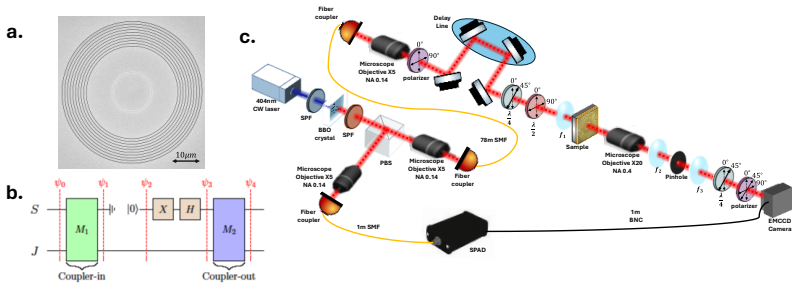
Quantum nanophotonics offers essential tools and technologies for controlling quantum states, while maintaining a miniature form factor and high scalability. For example, nanophotonic platforms can transfer information from the traditional degrees of freedom (DoFs), such as spin angular momentum (SAM) and orbital angular momentum (OAM), to the DoFs of the nanophotonic platform - and back, opening new directions for quantum information processing. Recent experiments have utilized the total angular momentum (TAM) of a photon as a unique means to produce entangled qubits in nanophotonic platforms. Yet, the process of transferring the information between the free-space DoFs and the TAM was never investigated, and its implications are still unknown. Here, we reveal the evolution of quantum information in heralded single photons as they couple into and out of the near-field of a nanophotonic system. Through quantum state tomography, we discover that the TAM qubit in the near-field becomes a free-space qudit entangled in the photonic SAM and OAM. The extracted density matrix and Wigner function in free-space indicate state preparation fidelity above 97%. The concepts described here bring new concepts and methodologies in developing high-dimensional quantum circuitry on a chip.
Editorial analysis
A structured set of objections, weighed in public.
Referee Report
Summary. The manuscript reports an experimental study tracking the evolution of a total angular momentum (TAM) qubit in the near-field of a nanophotonic structure into a free-space high-dimensional qudit entangled in spin angular momentum (SAM) and orbital angular momentum (OAM). Using quantum state tomography on heralded single photons, the authors reconstruct the density matrix and Wigner function, claiming a state preparation fidelity above 97%.
Significance. If the tomography results and fidelity are robustly supported by detailed measurements and error analysis, the work would contribute meaningfully to quantum nanophotonics by demonstrating the transfer of quantum information between nanophotonic TAM degrees of freedom and free-space SAM-OAM qudits. This could inform the design of scalable high-dimensional quantum circuits on chip. The experimental use of tomography and Wigner function reconstruction provides direct visualization of the state evolution, which is a positive aspect of the approach.
major comments (2)
- Abstract: The central claim of state preparation fidelity above 97% from the extracted density matrix and Wigner function is presented without any description of the tomography protocol, including the specific measurement bases chosen for SAM and OAM, the number of measurements performed, coincidence count statistics, or how losses and efficiencies in the heralding and near-field coupling were calibrated or corrected. This information is load-bearing for assessing whether the reported fidelity accurately reflects the quantum state or is affected by uncharacterized mode-dependent losses.
- Results/Methods (tomography and fidelity extraction): No loss-budget analysis, independent calibration of coupling efficiencies, or propagation of uncertainties (e.g., via Monte-Carlo simulation) into the fidelity estimator is reported. Without this, potential systematic biases from heralding detector inefficiencies or near-field coupling losses cannot be ruled out as contributors to the high fidelity value.
minor comments (1)
- The abstract and introduction could more clearly distinguish the near-field TAM qubit state from the free-space qudit state to improve readability for readers unfamiliar with the platform.
Simulated Author's Rebuttal
We thank the referee for their careful reading of the manuscript and for highlighting the need for additional methodological details. We address each major comment below and will incorporate the requested information into the revised manuscript.
read point-by-point responses
-
Referee: Abstract: The central claim of state preparation fidelity above 97% from the extracted density matrix and Wigner function is presented without any description of the tomography protocol, including the specific measurement bases chosen for SAM and OAM, the number of measurements performed, coincidence count statistics, or how losses and efficiencies in the heralding and near-field coupling were calibrated or corrected. This information is load-bearing for assessing whether the reported fidelity accurately reflects the quantum state or is affected by uncharacterized mode-dependent losses.
Authors: We agree that the abstract does not contain sufficient detail on the tomography protocol. In the revised manuscript we will expand the abstract and add a dedicated paragraph in the Methods section describing the chosen SAM and OAM measurement bases, the total number of measurements performed, the recorded coincidence count statistics, and the calibration procedures used to account for losses and efficiencies in the heralding arm and near-field coupling. These additions will allow readers to evaluate the fidelity claim more rigorously. revision: yes
-
Referee: Results/Methods (tomography and fidelity extraction): No loss-budget analysis, independent calibration of coupling efficiencies, or propagation of uncertainties (e.g., via Monte-Carlo simulation) into the fidelity estimator is reported. Without this, potential systematic biases from heralding detector inefficiencies or near-field coupling losses cannot be ruled out as contributors to the high fidelity value.
Authors: We acknowledge that a comprehensive loss-budget analysis, independent calibration of coupling efficiencies, and uncertainty propagation were omitted from the original submission. In the revision we will include a loss-budget table, describe the independent calibration measurements performed for the near-field coupling and heralding efficiencies, and report the results of a Monte-Carlo simulation that propagates statistical and systematic uncertainties into the fidelity estimator. This will directly address the possibility of mode-dependent losses biasing the reported fidelity. revision: yes
Circularity Check
Experimental tomography study with no circular derivation chain
full rationale
This is an experimental paper reporting quantum state tomography measurements on heralded single photons to track the evolution of a near-field TAM qubit into a free-space SAM-OAM entangled qudit. The central result (density matrix, Wigner function, and >97% fidelity) is obtained directly from coincidence measurements and reconstruction, not from any mathematical derivation or equation set that reduces to its own inputs by construction. No self-definitional steps, fitted parameters renamed as predictions, or load-bearing self-citations appear in the provided abstract or methodology description. The work is self-contained against external benchmarks via direct measurement, yielding a normal non-finding for circularity.
Axiom & Free-Parameter Ledger
axioms (1)
- standard math Quantum state tomography can fully reconstruct the density matrix of heralded single-photon states from measurements in appropriate bases.
Lean theorems connected to this paper
-
IndisputableMonolith/Foundation/RealityFromDistinction.leanreality_from_one_distinction unclear?
unclearRelation between the paper passage and the cited Recognition theorem.
Through quantum state tomography, we discover that the TAM qubit in the near-field becomes a free-space qudit entangled in the photonic SAM and OAM. The extracted density matrix and Wigner function in free-space indicate state preparation fidelity above 97%.
-
IndisputableMonolith/Foundation/AlexanderDuality.leanalexander_duality_circle_linking unclear?
unclearRelation between the paper passage and the cited Recognition theorem.
the TAM of the photon eigenvalues j = nℏ cannot be simply separated into independent measurable components of proper SAM and OAM
What do these tags mean?
- matches
- The paper's claim is directly supported by a theorem in the formal canon.
- supports
- The theorem supports part of the paper's argument, but the paper may add assumptions or extra steps.
- extends
- The paper goes beyond the formal theorem; the theorem is a base layer rather than the whole result.
- uses
- The paper appears to rely on the theorem as machinery.
- contradicts
- The paper's claim conflicts with a theorem or certificate in the canon.
- unclear
- Pith found a possible connection, but the passage is too broad, indirect, or ambiguous to say the theorem truly supports the claim.
Reference graph
Works this paper leans on
-
[1]
Tame, M. S. et al. Quantum plasmonics. Nat Phys 9, 329–340 (2013)
work page 2013
-
[2]
Wang, J., Sciarrino, F ., Laing, A. & Thompson, M. G. Integrated photonic quantum technologies. Nat Photonics , 273–284 (2020)
work page 2020
-
[3]
Faraon, A. et al. Coherent generation of non-classical light on a chip via photon- induced tunnelling and blockade. Nat Phys , 859–863 (2008)
work page 2008
-
[4]
Loredo, J. C. et al. Generation of non-classical light in a photon-number superposition. Nat Photonics 3 , 803–808 (2019)
work page 2019
-
[5]
Djordjevic, I. B. Multidimensional QKD Based on Combined Orbital and Spin Angular Momenta of Photon. IEEE Photonics J , 7600112–7600112 (2013)
work page 2013
-
[6]
Bennett, C. H. & Brassard, G. Quantum cryptography: Public key distribution and coin tossing. Theor Comput Sci 6 , 7–11 (2014)
work page 2014
-
[7]
Renner, R., Gisin, N. & Kraus, B. Information-theoretic security proof for quantum-key-distribution protocols. Phys Rev A (Coll Park) , 012332 (2005)
work page 2005
-
[8]
Marsili, F . et al. Detecting single infrared photons with 93% system efficiency. Nat Photonics , 210–214 (2013)
work page 2013
-
[9]
Reddy, D. V ., Nerem, R. R., Nam, S. W., Mirin, R. P . & Verma, V . B. Superconducting nanowire single-photon detectors with 98% system detection efficiency at 1550 nm. Optica , 1649 (2020)
work page 2020
-
[10]
O’Brien, J. L., Furusawa, A. & Vučković, J. Photonic quantum technologies. Nat Photonics 3, 687–695 (2009)
work page 2009
-
[11]
Alexander, K. et al. A manufacturable platform for photonic quantum computing. Nature (2025)
work page 2025
-
[12]
Crespi, A. et al. Integrated photonic quantum gates for polarization qubits. Nat Commun , 566 (2011)
work page 2011
-
[13]
Madsen, L. S. et al. Quantum computational advantage with a programmable photonic processor. Nature 6 6 , 75–81 (2022)
work page 2022
-
[14]
Pelucchi, E. et al. The potential and global outlook of integrated photonics for quantum technologies. Nature Reviews Physics , 194–208 (2021)
work page 2021
-
[15]
Krenn, M., Hochrainer, A., Lahiri, M. & Zeilinger, A. Entanglement by Path Identity. Phys Rev Lett , 080401 (2017)
work page 2017
-
[16]
Halder, M. et al. Entangling independent photons by time measurement. Nat Phys 3, 692–695 (2007)
work page 2007
-
[17]
Reimer, C. et al. Generation of multiphoton entangled quantum states by means of integrated frequency combs. Science 3 , 1176–1180 (2016)
work page 2016
-
[18]
Stav, T. et al. Quantum entanglement of the spin and orbital angular momentum of photons using metamaterials. Science 36 , 1101–1104 (2018). 13
work page 2018
-
[19]
Mair, A., Vaziri, A., Weihs, G. & Zeilinger, A. Entanglement of the orbital angular momentum states of photons. Nature , 313–316 (2001)
work page 2001
-
[20]
Nagali, E. et al. Quantum Information Transfer from Spin to Orbital Angular Momentum of Photons. Phys Rev Lett 3 , 013601 (2009)
work page 2009
-
[21]
Wu, C. et al. Room-temperature on-chip orbital angular momentum single- photon sources. Sci Adv , (2022)
work page 2022
-
[22]
Müller, M., Bounouar, S., Jöns, K. D., Glässl, M. & Michler, P . On-demand generation of indistinguishable polarization-entangled photon pairs. Nat Photonics , 224–228 (2014)
work page 2014
-
[23]
Simon, C. & Pan, J.-W. Polarization Entanglement Purification using Spatial Entanglement. Phys Rev Lett 9 , 257901 (2002)
work page 2002
-
[24]
Kwiat, P . G. et al. New High-Intensity Source of Polarization-Entangled Photon Pairs. Phys Rev Lett , 4337–4341 (1995)
work page 1995
-
[25]
Allen, L., Beijersbergen, M. W., Spreeuw, R. J. C. & Woerdman, J. P . Orbital angular momentum of light and the transformation of Laguerre-Gaussian laser modes. Phys Rev A (Coll Park) , 8185–8189 (1992)
work page 1992
-
[26]
Beth, R. A. Mechanical Detection and Measurement of the Angular Momentum of Light. Physical Review , 115–125 (1936)
work page 1936
-
[27]
Fickler, R. et al. Quantum Entanglement of High Angular Momenta. Science 33 , 640–643 (2012)
work page 2012
-
[28]
Fickler, R. et al. Interface between path and orbital angular momentum entanglement for high-dimensional photonic quantum information. Nat Commun , 4502 (2014)
work page 2014
-
[29]
Wang, J. et al. Terabit free-space data transmission employing orbital angular momentum multiplexing. Nat Photonics 6, 488–496 (2012)
work page 2012
-
[30]
Gorodetski, Y ., Niv, A., Kleiner, V . & Hasman, E. Observation of the Spin-Based Plasmonic Effect in Nanoscale Structures. Phys Rev Lett , 043903 (2008)
work page 2008
-
[31]
Bliokh, K. Y ., Rodríguez-Fortuño, F . J., Nori, F . & Zayats, A. V . Spin–orbit interactions of light. Nat Photonics 9, 796–808 (2015)
work page 2015
-
[32]
Li, C.-F . Spin and orbital angular momentum of a class of nonparaxial light beams having a globally defined polarization. Phys Rev A (Coll Park) , 063814 (2009)
work page 2009
-
[33]
Zhao, Y ., Edgar, J. S., Jeffries, G. D. M., McGloin, D. & Chiu, D. T. Spin-to-Orbital Angular Momentum Conversion in a Strongly Focused Optical Beam. Phys Rev Lett 99, 073901 (2007)
work page 2007
-
[34]
Das, P ., Yang, L.-P . & Jacob, Z. What are the quantum commutation relations for the total angular momentum of light? tutorial. Journal of the Optical Society of America B , 1764 (2024)
work page 2024
-
[35]
Krenn, M., Tischler, N. & Zeilinger, A. On small beams with large topological charge. New J Phys , 033012 (2016). 14
work page 2016
-
[36]
Kam, A. et al. Near-field photon entanglement in total angular momentum. Nature 6 , 634–640 (2025)
work page 2025
-
[37]
Spektor, G., David, A., Gjonaj, B., Bartal, G. & Orenstein, M. Metafocusing by a Metaspiral Plasmonic Lens. Nano Lett , 5739–5743 (2015)
work page 2015
-
[38]
David, A., Gjonaj, B., Blau, Y ., Dolev, S. & Bartal, G. Nanoscale shaping and focusing of visible light in planar metal–oxide–silicon waveguides. Optica , 1045 (2015)
work page 2015
-
[39]
Kim, H. et al. Synthesis and Dynamic Switching of Surface Plasmon Vortices with Plasmonic Vortex Lens. Nano Lett , 529–536 (2010)
work page 2010
-
[40]
Kher-Aldeen, J. et al. Dynamic control and manipulation of near-fields using direct feedback. Light Sci Appl 3 , 298 (2024)
work page 2024
-
[41]
Picardi, M. F ., Bliokh, K. Y ., Rodríguez-Fortuño, F . J., Alpeggiani, F . & Nori, F . Angular momenta, helicity, and other properties of dielectric-fiber and metallic- wire modes. Optica , 1016 (2018)
work page 2018
-
[42]
Machado, F ., Rivera, N., Buljan, H., Soljačić, M. & Kaminer, I. Shaping Polaritons to Reshape Selection Rules. ACS Photonics , 3064–3072 (2018)
work page 2018
-
[43]
Lopez-Mago, D. & Gutiérrez-Vega, J. C. Shaping Bessel beams with a generalized differential operator approach. Journal of Optics , 095603 (2016)
work page 2016
-
[44]
Soares, W. C., Caetano, D. P . & Hickmann, J. M. Hermite-Bessel beams and the geometrical representation of nondiffracting beams with orbital angular momentum. Opt Express , 4577 (2006)
work page 2006
-
[45]
Milione, G., Sztul, H. I., Nolan, D. A. & Alfano, R. R. Higher-Order Poincaré Sphere, Stokes Parameters, and the Angular Momentum of Light. Phys Rev Lett , 053601 (2011)
work page 2011
- [46]
- [47]
-
[48]
Pesah, A. et al. Absence of Barren Plateaus in Quantum Convolutional Neural Networks. Phys Rev X , 041011 (2021)
work page 2021
-
[49]
Cramer, M. et al. Efficient quantum state tomography. Nat Commun , 149 (2010)
work page 2010
-
[50]
Christandl, M. & Renner, R. Reliable Quantum State Tomography. Phys Rev Lett 9 , 120403 (2012)
work page 2012
-
[51]
Torlai, G. et al. Neural-network quantum state tomography. Nat Phys , 447–450 (2018)
work page 2018
-
[52]
Rippe, L., Julsgaard, B., Walther, A., Ying, Y . & Kröll, S. Experimental quantum- state tomography of a solid-state qubit. Phys Rev A (Coll Park) , 022307 (2008). 15
work page 2008
-
[53]
Altepeter, J. B., Jeffrey, E. R. & Kwiat, P . G. Photonic State Tomography. in 105–159 (2005)
work page 2005
-
[54]
Lvovsky, A. I. & Raymer, M. G. Continuous-variable optical quantum-state tomography. Rev Mod Phys , 299–332 (2009)
work page 2009
-
[55]
da Silva, B. P ., Tasca, D. S., Galvão, E. F . & Khoury, A. Z. Astigmatic tomography of orbital-angular-momentum superpositions. Phys Rev A (Coll Park) 99, 043820 (2019)
work page 2019
-
[56]
Bauer, T. et al. Ultrafast Time Dynamics of Plasmonic Fractional Orbital Angular Momentum. ACS Photonics , 4252–4258 (2023)
work page 2023
-
[57]
Tsesses, S. et al. Optical skyrmion lattice in evanescent electromagnetic fields. Science 36 , 993–996 (2018)
work page 2018
-
[58]
Kauranen, M. & Zayats, A. V . Nonlinear plasmonics. Nat Photonics 6, 737–748 (2012)
work page 2012
-
[59]
Frischwasser, K. et al. Real-time sub-wavelength imaging of surface waves with nonlinear near-field optical microscopy. Nat Photonics , 442–448 (2021). 16 Acknowledgements This research was supported by the Israeli innovation authority trough the MAGNET program, Grant number 73756, and was supported by the Israel Science Foundation (ISF), Grant number 362...
work page 2021
discussion (0)
Sign in with ORCID, Apple, or X to comment. Anyone can read and Pith papers without signing in.