Global Activity Scores
Pith reviewed 2026-05-22 21:48 UTC · model grok-4.3
The pith
Global activity scores based on finite differences identify influential variables more stably than derivative-based measures when additive noise is present.
A machine-rendered reading of the paper's core claim, the machinery that carries it, and where it could break.
Core claim
Global activity scores provide a finite-difference based alternative to derivative-based sensitivity measures, with a theoretical link to Sobol' indices, and demonstrate greater stability in noisy conditions for ranking variable importance.
What carries the argument
Global activity scores, computed by aggregating finite differences of the function to quantify each input's overall influence.
If this is right
- Global activity scores can serve as a direct substitute for derivative-based methods when model outputs contain additive noise.
- In the absence of noise the three compared approaches produce similar variable rankings.
- The finite-difference construction avoids the noise amplification that affects derivative estimates.
- The established connection to Sobol' indices allows global activity scores to inherit some of their interpretability properties.
Where Pith is reading between the lines
- The finite-difference foundation may allow direct use of the scores on black-box simulators where analytic derivatives are unavailable.
- Hybrid procedures that combine global activity scores with partial Sobol' computations could reduce overall cost while preserving robustness.
- Extension to time-dependent or stochastic models would test whether the stability advantage persists beyond static functions.
Load-bearing premise
The numerical examples used to demonstrate superiority are representative of real-world functions with additive noise.
What would settle it
Run global activity scores alongside derivative-based measures on a standard test function with known influential variables, add independent Gaussian noise at several signal-to-noise ratios, and check whether the variable ranking produced by global activity scores stays consistent across repeated noise realizations while the derivative-based ranking changes.
Figures



read the original abstract
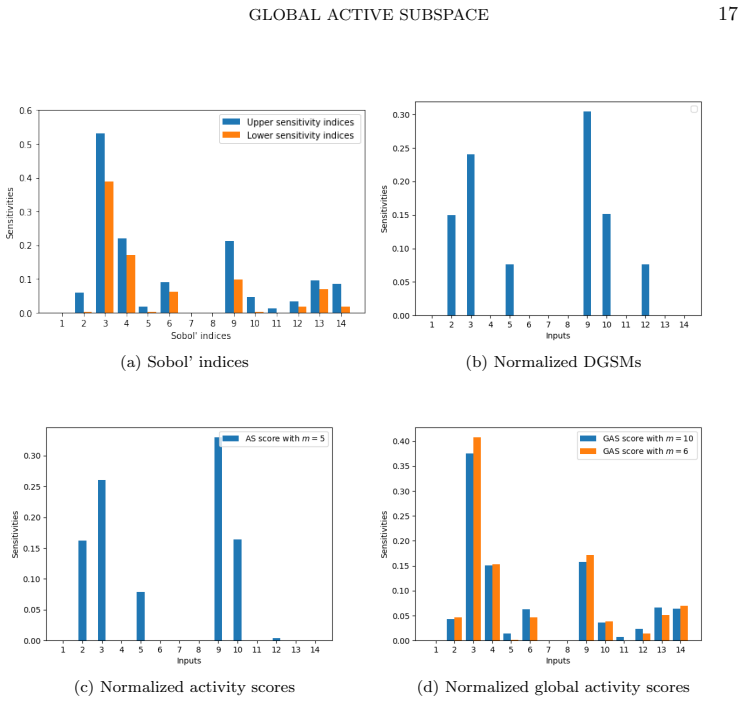
We introduce a new global sensitivity measure, the global activity scores. The measure is based on finite differences of the underlying function, in contrast to several sensitivity measures in the literature that are based on derivatives of the function. We establish its theoretical connection with Sobol' sensitivity indices and demonstrate its performance through numerical examples. In these examples, we compare global activity scores with Sobol' sensitivity indices, derivative-based sensitivity measures, and activity scores. The results show that in the presence of additive noise or high variability, global activity scores provide more stable and reliable identification of influential variables than derivative-based measures and activity scores, which are more sensitive to noise. In noiseless settings, however, all three approaches yield comparable results.
Editorial analysis
A structured set of objections, weighed in public.
Referee Report
Summary. The paper introduces global activity scores, a sensitivity measure based on finite differences of the model function. It claims a theoretical connection to Sobol' indices (in the noiseless case) and, via numerical examples, asserts that these scores yield more stable identification of influential inputs than derivative-based measures or activity scores when additive noise or high variability is present, while all methods perform comparably without noise.
Significance. If the claimed noise robustness generalizes beyond the specific examples, the measure could provide a practical finite-difference alternative for global sensitivity analysis in noisy settings, complementing variance-based indices.
major comments (2)
- [Numerical examples] Numerical examples (section containing the comparisons): the superiority claim under additive noise rests entirely on unspecified test functions, noise amplitudes, finite-difference step-size choices, and absence of error bars or statistical tests. Without these details it is impossible to judge whether the observed stability is general or an artifact of the chosen setups.
- [Theoretical connection] Theoretical connection (section establishing link to Sobol' indices): the connection is stated to hold only in the noiseless case, yet the central practical claim concerns noisy regimes where no supporting analysis (e.g., bias-variance trade-off for finite differences) is provided.
minor comments (1)
- [Abstract] The abstract should explicitly note that the noise-robustness result is empirical and limited to the presented examples.
Simulated Author's Rebuttal
We thank the referee for the constructive comments. We address each major point below.
read point-by-point responses
-
Referee: [Numerical examples] Numerical examples (section containing the comparisons): the superiority claim under additive noise rests entirely on unspecified test functions, noise amplitudes, finite-difference step-size choices, and absence of error bars or statistical tests. Without these details it is impossible to judge whether the observed stability is general or an artifact of the chosen setups.
Authors: We agree that the numerical examples require more explicit detail for reproducibility and assessment. In the revised manuscript we will specify the test functions, noise amplitudes, finite-difference step sizes, and include error bars from repeated runs together with statistical tests. revision: yes
-
Referee: [Theoretical connection] Theoretical connection (section establishing link to Sobol' indices): the connection is stated to hold only in the noiseless case, yet the central practical claim concerns noisy regimes where no supporting analysis (e.g., bias-variance trade-off for finite differences) is provided.
Authors: The manuscript states that the theoretical connection holds only in the noiseless case. Claims of improved stability under noise are supported exclusively by the numerical examples. A bias-variance analysis for finite differences in noisy settings is a natural extension but is outside the scope of the present work, which focuses on introducing the measure and its empirical behavior. revision: no
Circularity Check
No circularity: new finite-difference measure defined independently with external theoretical link to Sobol' indices
full rationale
The paper defines global activity scores directly from finite differences of the function. It states a theoretical connection to Sobol' indices is established (abstract), which is presented as a derived property rather than an input. Performance comparisons under noise are shown via numerical examples, not by renaming fitted quantities or self-referential definitions. No self-citations, ansatzes smuggled via prior work, or uniqueness theorems from the same authors are invoked as load-bearing steps. The derivation chain remains self-contained against external benchmarks.
Axiom & Free-Parameter Ledger
Reference graph
Works this paper leans on
-
[1]
report, Illinois Center for a Smarter Electric Grid, https://icseg
IEEE 14-Bus System , tech. report, Illinois Center for a Smarter Electric Grid, https://icseg. iti.illinois.edu/ieee-14-bus-system/. 1In examples 1 and 3, numerical simulations and sensitivity analysis experiments were conducted on a 2022 MacBook Pro workstation. The system is equipped with an Apple M2 System on a Chip (SoC) featuring an 8-core CPU based ...
work page 2022
-
[2]
F. Campolongo, J. Cariboni, and A. Saltelli , An effective screening design for sensitivity analysis of large models , Environmental Modelling & Software, 22 (2007), pp. 1509–1518
work page 2007
-
[3]
P. G. Constantine, Active subspaces: Emerging ideas for dimension reduction in parameter studies, SIAM, 2015
work page 2015
-
[4]
P. G. Constantine and P. Diaz , Global sensitivity metrics from active subspaces , Reliability Engineering & System Safety, 162 (2017), pp. 1–13
work page 2017
-
[5]
P. G. Constantine, E. Dow, and Q. Wang , Active subspace methods in theory and prac- tice: applications to kriging surfaces , SIAM Journal on Scientific Computing, 36 (2014), pp. A1500–A1524
work page 2014
-
[6]
H. Duan and G. ¨Okten, Derivative-based Shapley value for global sensitivity analysis and machine learning explainability , International Journal for Uncertainty Quantification, 15 (2025), pp. 1–16
work page 2025
-
[7]
J.-C. Fort, T. Klein, and A. Lagnoux , Global sensitivity analysis and Wasserstein spaces , SIAM/ASA Journal on Uncertainty Quantification, 9 (2021), pp. 880–921
work page 2021
-
[8]
J. L. Hart, A. Alexanderian, and P. A. Gremaud , Efficient computation of Sobol’ indices for stochastic models, SIAM Journal on Scientific Computing, 39 (2017), pp. A1514–A1530
work page 2017
-
[9]
B. Iooss and P. Lemaˆıtre, A review on global sensitivity analysis methods , Uncertainty Man- agement in Simulation-Optimization of Complex Systems: Algorithms and Applications, (2015), pp. 101–122
work page 2015
-
[10]
J. F. C. Kingman and S. J. Taylor , Introduction to Measure and Probability , Cambridge University Press, 1966
work page 1966
-
[11]
S. Kucherenko et al. , A new derivative based importance criterion for groups of variables and its link with the global sensitivity indices , Computer Physics Communications, 181 (2010), pp. 1212–1217
work page 2010
-
[12]
S. Kucherenko and B. Iooss , Derivative based global sensitivity measures , arXiv preprint arXiv:1412.2619, (2014)
-
[13]
S. Kucherenko and B. Iooss , Derivative-based global sensitivity measures , in Handbook of Uncertainty Quantification, 2017, pp. 1241–1263
work page 2017
-
[14]
S. Kucherenko, S. Tarantola, and P. Annoni , Estimation of global sensitivity indices for models with dependent variables, Computer Physics Communications, 183 (2012), pp. 937– 946
work page 2012
-
[15]
M. Lamboni, B. Iooss, A.-L. Popelin, and F. Gamboa , Derivative-based global sensitivity measures: General links with Sobol’ indices and numerical tests , Mathematics and Com- puters in Simulation, 87 (2013), pp. 45–54
work page 2013
-
[16]
M. Lamboni and S. Kucherenko, Multivariate sensitivity analysis and derivative-based global sensitivity measures with dependent variables, Reliability Engineering & System Safety, 212 (2021), p. 107519. This manuscript is for review purposes only. 22 RUILONG YUE, GIRAY ¨OKTEN
work page 2021
- [17]
- [18]
-
[19]
F. Ni, M. Nijhuis, P. H. Nguyen, and J. F. Cobben, Variance-based global sensitivity analysis for power systems , IEEE Transactions on Power Systems, 33 (2017), pp. 1670–1682
work page 2017
-
[20]
A. B. Owen, Better estimation of small Sobol’ sensitivity indices , ACM Transactions on Mod- eling and Computer Simulation (TOMACS), 23 (2013), pp. 1–17
work page 2013
-
[21]
O. Roustant, F. Barthe, and B. Iooss , Poincar´ e inequalities on intervals–application to sensitivity analysis, Electronic Journal of Statistics, 11 (2017), pp. 3081–3119
work page 2017
-
[22]
A. Saltelli, P. Annoni, I. Azzini, F. Campolongo, M. Ratto, and S. Tarantola, Variance based sensitivity analysis of model output. Design and estimator for the total sensitivity index, Computer Physics Communications, 181 (2010), pp. 259–270
work page 2010
-
[23]
A. Saltelli, M. Ratto, T. Andres, F. Campolongo, J. Cariboni, D. Gatelli, M. Saisana, and S. Tarantola, Global sensitivity analysis: the primer , John Wiley & Sons, 2008
work page 2008
-
[24]
I. Sobol’, On derivative-based global sensitivity criteria , Mathematical Models and Computer Simulations, 3 (2011), pp. 419–423
work page 2011
-
[25]
I. Sobol’ and S. Kucherenko, Derivative based global sensitivity measures and their link with global sensitivity indices, Mathematics and Computers in Simulation, 79 (2009), pp. 3009– 3017
work page 2009
-
[26]
I. Sobol’ and S. Kucherenko , Derivative based global sensitivity measures , Procedia Social and Behavioral Sciences, 2 (2010), pp. 7745–7746
work page 2010
-
[27]
I. M. Sobol’, Sensitivity analysis for non-linear mathematical models, Mathematical Modelling and Computational Experiment, 1 (1993), pp. 407–414
work page 1993
-
[28]
I. M. Sobol’ , Global sensitivity indices for nonlinear mathematical models and their Monte Carlo estimates, Mathematics and Computers in Simulation, 55 (2001), pp. 271–280
work page 2001
-
[29]
W. F. Tinney and C. E. Hart , Power flow solution by Newton’s method , IEEE Transactions on Power Apparatus and Systems, PAS-86 (1967), pp. 1449–1460
work page 1967
-
[30]
R. Yue, H. Duan, G. ¨Okten, and B. Uzuno ˘glu, A comparison of global sensitivity methods for power systems , in 2022 6th International Conference on System Reliability and Safety (ICSRS), IEEE, 2022, pp. 130–137. This manuscript is for review purposes only
work page 2022
discussion (0)
Sign in with ORCID, Apple, or X to comment. Anyone can read and Pith papers without signing in.