REVIEW 3 major objections 5 minor 39 references
Observation of Full Hierarchy of Temporal Quantum Correlations with a Superconducting Qubit
T0 review · 3 major / 5 minor · reviewed 2026-08-16 · deepseek-v4-flash
Pith's one-line read A superconducting qubit in a depolarizing channel displays the full logical hierarchy of temporal quantum correlations, with nonmacrorealism vanishing before temporal steering, which vanishes before temporal inseparability.
desk verdict First experiment to see the full temporal-correlation hierarchy on a superconducting qubit; the physics is credible, but missing error bars and an unverified no-signaling-in-time assumption need fixing before I'd lean on it. read the letter →
The pith
A machine-rendered reading of the paper's core claim, the machinery that carries it, and where it could break.
The reading
What carries the argument
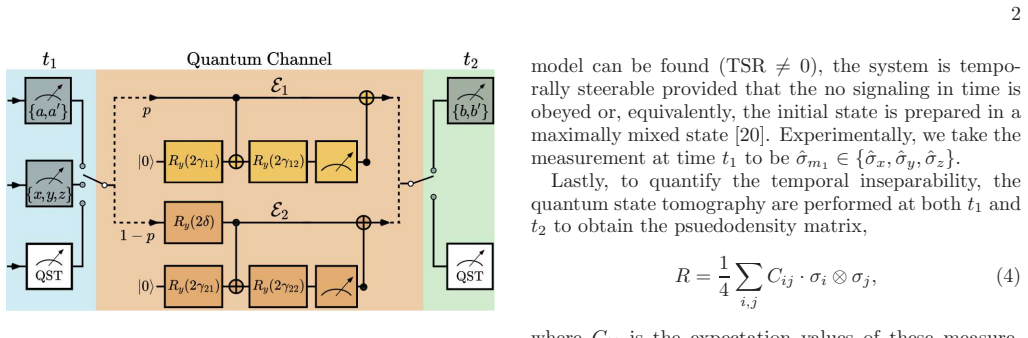
The argument rests on three witness quantities evaluated at two times on the same qubit: $B_{\max}$, the normalized violation of the temporal CHSH inequality, which detects nonmacrorealism; $\mathrm{TSR}$, the minimal noise needed to fit the post-measurement states to a hidden-state model, which detects temporal steering; and $f = \lVert \mathcal{R} \rVert_{\mathrm{tr}} - 1$, where $\mathcal{R} = \frac{1}{4}\sum_{i,j} C_{ij}\,\sigma_i\otimes\sigma_j$ is the pseudodensity matrix built from two-time correlation expectations, which detects temporal inseparability. The device that makes the comparison clean is the maximally mixed initial state: with $\rho_0 = I/2$ the first measurement cannot change the second-time statistics, so the three witnesses measure temporal correlation rather than measurement disturbance. A second enabling element is the decomposition of the desired quantum channel into a probabilistic mixture of two extreme channels, implemented with CNOT gates and rotations, which lets the authors realize amplitude-damping, dephasing, and depolarizing dynamics and then read off the hierarchy from the distinct sudden-death times of the three witnesses.
What would settle it
Perform quantum state tomography of the initial state and an explicit no-signaling-in-time test, comparing the $t_2$ statistics conditioned on the $t_1$ outcome with the unconditional $t_2$ statistics. A state fidelity noticeably below $I/2$, or a nonzero difference between the conditioned and unconditional $t_2$ distributions, would show that the sudden-death ordering observed in the depolarizing channel could be an artifact of invasive measurement.
Extended reading notes
Core claim
The paper claims that the three temporal quantum correlations---nonmacrorealism, temporal steering, and temporal inseparability---form a strict logical hierarchy, and that this hierarchy is directly visible in the decay dynamics of a single qubit. Concretely, for a qubit initialized in the maximally mixed state $\rho_0 = I/2$ and evolved through a depolarizing channel, the temporal CHSH violation $B_{\max}$ (nonmacrorealism) drops to zero first, the temporal steering robustness $\mathrm{TSR}$ vanishes second, and the $f$-function of the pseudodensity matrix (temporal inseparability) vanishes last. The same experiment also finds that freely evolving qubits can show a revival of temporal steering, which the authors attribute to non-Markovian crosstalk with neighboring qubits, and they use the decay and revival patterns to benchmark individual qubits on the processor.
Load-bearing premise
The result depends on the prepared initial state being exactly the maximally mixed state $I/2$: if it is not, the measurement at $t_1$ can alter the statistics at $t_2$, and the reported witnesses could be inflated by measurement disturbance rather than by genuine temporal quantum correlation; the paper does not report a tomographic check of this preparation.
Editorial extensions
If this is right
- In the depolarizing channel, the three witnesses vanish abruptly and in a fixed temporal order, making that channel a one-setting testbed for the full hierarchy.
- Because sudden-death times of temporal steering differ between qubits and can be followed by revivals, TSR provides a qubit benchmark that captures non-Markovian noise beyond standard $T_1$ and $T_2$ figures.
- Revival of temporal steering is presented as a signature of environment memory, supporting the use of temporal steering as a non-Markovianity witness in open quantum systems.
- The hierarchy, once established, can be applied to identifying causal structure in quantum networks and to bounding the security of quantum key distribution with trusted or untrusted devices.
Reading between the lines
- If the ordering is a universal feature of single-qubit depolarizing dynamics, it doubles as an experimental sanity check: a reversed death order would flag preparation or measurement disturbance rather than a new physical effect.
- The revival of temporal steering under non-Markovian crosstalk raises the possibility of engineering environment memory to prolong temporal quantum correlations for tasks such as quantum key distribution, a use the paper mentions but does not demonstrate.
- A natural extension is to run the same three witnesses on two entangled qubits to see whether the temporal hierarchy and the spatial sudden death of entanglement share the same time ordering.
Signed reviews
Editorial analysis
A structured set of objections, weighed in public.
Referee Report
Summary. The manuscript reports an experimental study of temporal quantum correlations in a single superconducting qubit implemented on IBM quantum hardware. The authors prepare the qubit in a maximally mixed state, implement amplitude-damping, dephasing, and depolarizing channels with controlled circuit parameters, and measure three temporal correlation quantifiers: Bmax (nonmacrorealism), temporal steering robustness TSR (temporal steering), and the f-function (temporal inseparability). They observe sudden death of these correlations at distinct times in the depolarizing channel, which they interpret as the full logical hierarchy of temporal quantum correlations. They also observe revival of temporal steering in a freely evolving qubit and attribute it to non-Markovian crosstalk with an environment qubit, supported by a simplified two-qubit model. The central claim is that the hierarchy is experimentally demonstrated by the distinct sudden-death time scales.
Significance. If the central claim is correct, this is a valuable experimental milestone: the first observation of the full hierarchy of nonmacrorealism, temporal steering, and temporal inseparability in a single physical system, with potential applications in quantum benchmarking and non-Markovianity detection. The experimental implementation of the engineered channels and the use of a superconducting circuit are appropriate for the claim. However, the result is only as strong as its experimental controls. Two issues are load-bearing: (i) the operational interpretation of the measured correlations relies on the no-signaling-in-time (NSIT) condition, which is asserted rather than verified; and (ii) no statistical uncertainties are reported, so the 'unambiguous ranking' of sudden-death times is not quantitatively supported. The non-Markovian revival model also uses fitted parameters and is presented as confirmatory rather than as a falsifiable prediction. These issues are addressable in revision, so the work merits further consideration.
major comments (3)
- [Sec. II and Fig. 4] The NSIT condition is the operational backbone of all three measures, but the paper never verifies that the prepared initial state is sufficiently close to I/2. The text in Sec. II states that a maximally mixed state ensures the no-signaling-in-time condition; this is exact only for ρ0 = I/2. Any preparation error makes the t1 measurement invasive, and the post-measurement states at t2 will depend on the measurement basis, potentially inflating Bmax, TSR, and f by different amounts. Because the central claim is the ordering of the sudden-death times, the manuscript should report a tomographic characterization of the prepared state (e.g., fidelity to I/2) and an explicit NSIT test conducted at the same time scales, or at least a worst-case analysis showing that the observed ordering is robust against the measured preparation error. Without such a test, the hierarchy claim is not compelled by the data.
- [Figs. 2 and 4] No error bars or uncertainty estimates appear on any experimental data point in Figs. 2 and 4. The manuscript's central statement that the sudden deaths of nonmacrorealism, temporal steering, and temporal inseparability occur 'on distinct time scales' and are 'unambiguously ranked' requires statistical support. The curves from the Lindblad master equation are useful comparisons, but the data points show visible scatter, and without propagated shot noise or gate-calibration uncertainties it is impossible to know whether the sudden-death times are actually separated. The authors should provide error bars (at least from projective-measurement shot noise) and, ideally, confidence intervals for the sudden-death locations, particularly in the depolarizing channel shown in Fig. 4(c).
- [Sec. II, Fig. 2(a) inset] The non-Markovian revival claim is supported by a simplified two-qubit model with four free parameters: γA/ℏJ and γP/ℏJ for the system qubit and for the environment qubit. The text says the 'simplified model reproduces the revival and oscillation,' but these parameters are not independently determined; they are fitted to the observed revival. This is not a falsifiable prediction, and alternative non-Markovian noise mechanisms are not excluded. The paper should explicitly state that these are fitted parameters, and should ideally validate the crosstalk mechanism by an independent measurement (e.g., varying the environment qubit's frequency or measuring its final state). As written, the non-Markovianity demonstration is suggestive but not quantitatively rigorous.
minor comments (5)
- [Sec. IV, second paragraph] The sentence 'the nonmacrorealism (Bmax>0), temporal inseparability (TSR≠0), and temporal steerability (f≠0)' swaps the definitions of TSR and f. TSR is the temporal steering robustness (temporal steering), and f is the temporal inseparability measure. This should be corrected to avoid confusion.
- [Sec. IV, third paragraph] The text refers to 'Fig. 4(a) and 4(a), respectively' when discussing the amplitude-damping and dephasing channels; the second reference should be Fig. 4(b).
- [Abstract and Introduction] The word 'casual' is used where 'causal' is intended ('identifying the casual structure', 'explore the casual structures'). Please correct these typos.
- [Appendix A] The typo 'psuedodensity' should be 'pseudodensity' throughout the appendix.
- [Fig. 3] The inset showing the geometric interpretation of the quantum channels on the Bloch sphere is described in the text but appears difficult to read at the current size; consider enlarging the inset or providing a separate figure.
Circularity Check
No significant circularity: the experimental ordering is independent measured data, and the self-cited hierarchy theory is parameter-free prior work.
full rationale
The paper's central claim is the experimental observation of the hierarchy of temporal quantum correlations. The measures Bmax, TSR, and f are defined explicitly in Eqs. (1)-(5) from two-time statistics and quantum-state tomography; none of these definitions encodes the sudden-death ordering or the final hierarchy. The logical hierarchy itself is cited from prior work (Refs. [17-20], especially [20] by some of the present authors), but it is a parameter-free theoretical result whose stated assumptions do not include this experiment's data, so invoking it is legitimate independent support rather than circularity. The measured dots in Fig. 4 are raw data; the calculated curves are obtained from Lindblad master equations with the known T1 and T2 times, not from parameters fitted to the target sudden-death ordering. The crosstalk model in Fig. 2(a) does use parameters (gamma_A/hbar J, gamma_P/hbar J) chosen to reproduce the revival, but those curves are presented as an explanatory model, not as a prediction of the central hierarchy, and the hierarchy claim rests on the measured dots. The reliance on maximally mixed preparation to guarantee no-signaling-in-time is an experimental validity assumption; even if imperfect, this is a robustness concern rather than a circular reduction of the derivation to its inputs. No fitted parameter is renamed as a prediction, and no result is equivalent to its definition by construction.
Assumptions & free parameters
free parameters (4)
- gamma_A_s/(hbar J), system qubit amplitude-damping ratio =
0.224
- gamma_P_s/(hbar J), system qubit dephasing ratio =
0.038
- gamma_A_e/(hbar J), environment qubit amplitude-damping ratio =
0.359
- gamma_P_e/(hbar J), environment qubit dephasing ratio =
0.083
assumptions (3)
- domain assumption The initial qubit state is exactly maximally mixed, so no-signaling in time holds.
- ad hoc to paper The simplified crosstalk model, Hint = hbar J (sigma+_1 sigma-_2 + sigma-_1 sigma+_2), with amplitude-damping and dephasing rates, captures the observed non-Markovian revival.
- domain assumption Lindblad master equations with known T1 and T2 describe the qubit evolution in the engineered channels.
Cite this review
Pith. "Pith review of Observation of Full Hierarchy of Temporal Quantum Correlations with a Superconducting Qubit." pith.science (2026). https://pith.science/paper/JTYZS5TM
@misc{pith2026250501379,
  author       = {Pith},
  title        = {Pith review of: Observation of Full Hierarchy of Temporal Quantum Correlations with a Superconducting Qubit},
  year         = {2026},
  howpublished = {\url{https://pith.science/paper/JTYZS5TM}},
  note         = {Machine review of arXiv:2505.01379}
}
read the original abstract
Temporal quantum correlations provide an intriguing way of testing quantumness at the macroscopic level, with a logical hierarchy present among the quantum correlations associated with nonmacrorealism, temporal steering, and temporal inseparability. By manipulating the dynamics of a superconducting qubit, we observe the full hierarchy of temporal quantum correlations. Moreover, we show that the rich dynamics of the temporal quantum correlations, such as sudden death or revival of temporal steering, provides a useful and unique measure for benchmarking qubits on a realistic circuit. Our work finds applications in identifying the casual structure in a quantum network, the non-Markovianity of open quantum systems, and the security bounds of quantum key distribution. As an example, we demonstrate the non-Markovianity of a single superconducting qubit on the quantum circuit.
Figures


Figures from the paper (1 more)

Reference graph
Works this paper leans on
-
[1]
A. J. Leggett and Anupam Garg. Quantum mechanics versus macroscopic realism: Is the flux there when no- body looks? Phys. Rev. Lett. , 54:857–860, Mar 1985
work page 1985
-
[2]
Clive Emary, Neill Lambert, and Franco Nori. Leggett–garg inequalities. Reports on Progress in Physics, 77(1):016001, Dec 2013
work page 2013
-
[3]
Leggett- garg macrorealism and temporal correlations
Giuseppe Vitagliano and Costantino Budroni. Leggett- garg macrorealism and temporal correlations. Phys. Rev. A, 107:040101, Apr 2023
work page 2023
-
[4]
J. S. Bell. On the einstein podolsky rosen paradox. 1:195 – 290, 1964
work page 1964
- [5]
-
[6]
A. Palacios-Laloy, F. Mallet, F. Nguyen, P. Bertet, D. Vion, D. Esteve, and A. N. Korotkov. Experimental violation of a bell’s inequality in time with weak mea- surement. Nat. Phys. , 6:442–447, June 2010
work page 2010
-
[7]
G. Waldherr, P. Neumann, S. F. Huelga, F. Jelezko, and J. Wrachtrup. Violation of a temporal bell inequality for single spins in a diamond defect center. Phys. Rev. Lett. , 107:090401, 2011
work page 2011
-
[8]
M. E. Goggin, M. P. Almeida, M. Barbieri, B. P. Lanyon, J. L. O’Brien, A. G. White, and G. J. Pryde. Violation of the leggett–garg inequality with weak measurements of photons. Proc. Natl. Acad. Sci. USA , 108:1256–1261, 2011
work page 2011
Show all 39 references
-
[9]
Dressel, C
J. Dressel, C. J. Broadbent, J. C. Howell, and A. N. Jordan. Experimental violation of two-party leggett-garg inequalities with semiweak measurements. Phys. Rev. Lett., 106:040402, 2011
2011
-
[10]
G. C. Knee, S. Simmons, E. M. Gauger, J. J.L. Morton, H. Riemann, N. V. Abrosimov, P. Becker, H.-J. Pohl, K. M. Itoh, M. L.W. Thewalt, G. A. D. Briggs, and S. C. Benjamin. Violation of a leggett–garg inequality with ideal non-invasive measurements. Nat. Commun. , 3:606, 2012
2012
-
[11]
Ideal negative measure- ments in quantum walks disprove theories based on clas- sical trajectories
Carsten Robens, Wolfgang Alt, Dieter Meschede, Clive Emary, and Andrea Alberti. Ideal negative measure- ments in quantum walks disprove theories based on clas- sical trajectories. Phys. Rev. X , 5:011003, 2015
2015
-
[12]
Experimen- tal test of non-macrorealistic cat states in the cloud
Huan-Yu Ku, Neill Lambert, Feng-Jui Chan, Clive Emary, Yueh-Nan Chen, and Franco Nori. Experimen- tal test of non-macrorealistic cat states in the cloud. npj Quantum Inf , 6:98, 2020
2020
-
[13]
Vieira, Huan-Yu Ku, and Costantino Budroni
Lucas B. Vieira, Huan-Yu Ku, and Costantino Budroni. Entanglement-breaking channels are a quantum memory resource. arXiv e-prints , page arXiv:2402.16789, Febru- ary 2024
2024
-
[14]
Dynamical landauer principle: Quan- tifying information transmission by thermodynamics
Chung-Yun Hsieh. Dynamical landauer principle: Quan- tifying information transmission by thermodynamics. Phys. Rev. Lett. , 134:050404, Feb 2025
2025
-
[15]
Dynamical resource theory of incom- patibility preservability
Chung-Yun Hsieh, Benjamin Stratton, Chao-Hsien Wu, and Huan-Yu Ku. Dynamical resource theory of incom- patibility preservability. Phys. Rev. A , 111:022422, Feb 2025
2025
-
[16]
R. F. Werner. Quantum states with einstein-podolsky- rosen correlations admitting a hidden-variable model. Phys. Rev. A , 40:4277–4281, 1989
1989
-
[17]
Quantum correlations in the tempo- ral clauser–horne–shimony–holt (CHSH) scenario
Tobias Fritz. Quantum correlations in the tempo- ral clauser–horne–shimony–holt (CHSH) scenario. New Journal of Physics , 12(8):083055, aug 2010
2010
-
[18]
Temporal steering inequality
Yueh-Nan Chen, Che-Ming Li, Neill Lambert, Shin-Liang Chen, Yukihiro Ota, Guang-Yin Chen, and Franco Nori. Temporal steering inequality. Phys. Rev. A , 89:032112, Mar 2014
2014
-
[19]
Fitzsimons, Jonathan A
Joseph F. Fitzsimons, Jonathan A. Jones, and Vlatko Vedral. Quantum correlations which imply causation. Scientific Reports , 5(1):18281, 2015
2015
-
[20]
Hierarchy in temporal quan- tum correlations
Huan-Yu Ku, Shin-Liang Chen, Neill Lambert, Yueh- Nan Chen, and Franco Nori. Hierarchy in temporal quan- tum correlations. Phys. Rev. A , 98:022104, Aug 2018
2018
-
[21]
K. Ried, M. Agnew, L. Vermeyden, D. Janzing, R. W. Spekkens, and K. J. Resch. A quantum advantage for inferring causal structure. Nat. Phys. , 11:414, 2015
2015
-
[22]
Quan- tifying non-markovianity with temporal steering
Shin-Liang Chen, Neill Lambert, Che-Ming Li, Adam Miranowicz, Yueh-Nan Chen, and Franco Nori. Quan- tifying non-markovianity with temporal steering. Phys. Rev. Lett., 116:020503, Jan 2016
2016
-
[23]
Steering- enhanced quantum metrology using superpositions of noisy phase shifts
Kuan-Yi Lee, Jhen-Dong Lin, Adam Miranowicz, Franco Nori, Huan-Yu Ku, and Yueh-Nan Chen. Steering- enhanced quantum metrology using superpositions of noisy phase shifts. Phys. Rev. Res. , 5:013103, Feb 2023
2023
-
[24]
Temporal steering and security of quantum key distribution with mutually un- biased bases against individual attacks
Karol Bartkiewicz, Anton ´ ınˇCernoch, Karel Lemr, Adam Miranowicz, and Franco Nori. Temporal steering and security of quantum key distribution with mutually un- biased bases against individual attacks. Phys. Rev. A , 93:062345, Jun 2016
2016
-
[25]
Hidden nonmacrorealism: Reviving the leggett-garg inequality with stochastic operations
Huan-Yu Ku, Hao-Cheng Weng, Yen-An Shih, Po-Chen Kuo, Neill Lambert, Franco Nori, Chih-Sung Chuu, and Yueh-Nan Chen. Hidden nonmacrorealism: Reviving the leggett-garg inequality with stochastic operations. Phys- ical Review Research, 3(4):043083, 2021
2021
-
[26]
Leggett-garg inequalities and no-signa ling in time: A quasiprobability approach
JJ Halliwell. Leggett-garg inequalities and no-signa ling in time: A quasiprobability approach. Physical Review A, 93(2):022123, 2016
2016
-
[27]
Temporal steering in four dimensions with applications to coupled qubits and magnetoreception
Huan-Yu Ku, Shin-Liang Chen, Hong-Bin Chen, Neill Lambert, Yueh-Nan Chen, and Franco Nori. Temporal steering in four dimensions with applications to coupled qubits and magnetoreception. Phys. Rev. A , 94:062126, Dec 2016
2016
-
[28]
Spatio-temporal steering for testing non- classical correlations in quantum networks
Shin-Liang Chen, Neill Lambert, Che-Ming Li, Guang- Yin Chen, Yueh-Nan Chen, Adam Miranowicz, and Franco Nori. Spatio-temporal steering for testing non- classical correlations in quantum networks. Scientific Re- ports, 7(1):3728, 2017
2017
-
[29]
A. J. Leggett. Macroscopic quantum systems and the quantum theory of measurement. Progress of Theoretical Physics Supplement , 69:80–100, Mar 1980. 7
1980
-
[30]
M. P. Almeida, F. de Melo, M. Hor-Meyll, A. Salles, S. P. Walborn, P. H. Souto Ribeiro, and L. Davi- dovich. Environment-induced sudden death of entangle- ment. Science, 316(5824):579, Apr 2007
2007
-
[31]
Ting Yu and J. H. Eberly. Sudden death of entanglement. Science, 323(5914):598, Jan 2009
2009
-
[32]
Sanders, Yu-Ao Chen, and Jian-Wei Pan
He Lu, Chang Liu, Dong-Sheng Wang, Luo-Kan Chen, Zheng-Da Li, Xing-Can Yao, Li Li, Nai-Le Liu, Cheng- Zhi Peng, Barry C. Sanders, Yu-Ao Chen, and Jian-Wei Pan. Experimental quantum channel simulation. Phys. Rev. A , 95:042310, Apr 2017
2017
-
[33]
Nielsen and Isaac L
Michael A. Nielsen and Isaac L. Chuang. Quantum Com- putation and Quantum Information: 10th Anniversary Edition. Cambridge University Press, New York, NY, USA, 10th edition, 2011
2011
-
[34]
Quantifying quan- tumness of channels without entanglement
Huan-Yu Ku, Josef Kadlec, Anton ´ ın ˇCernoch, Marco T´ ulio Quintino, Wenbin Zhou, Karel Lemr, Neill Lambert, Adam Miranowicz, Shin-Liang Chen, Franco Nori, and Yueh-Nan Chen. Quantifying quan- tumness of channels without entanglement. PRX Quantum, 3:020338, May 2022
2022
-
[35]
Visually quantifying single- qubit quantum memory
Wan-Guan Chang, Chia-Yi Ju, Guang-Yin Chen, Yueh- Nan Chen, and Huan-Yu Ku. Visually quantifying single- qubit quantum memory. Phys. Rev. Res. , 6:023035, Apr 2024
2024
-
[36]
Shounak Datta, Shiladitya Mal, and A. S. Majumdar. Protecting temporal correlations of two-qubit states us- ing quantum channels with memory, 2018
2018
-
[37]
Huelga, ´Angel Rivas, and Martin B
Susana F. Huelga, ´Angel Rivas, and Martin B. Ple- nio. Non-markovianity-assisted steady state entangle- ment. Phys. Rev. Lett. , 108:160402, Apr 2012
2012
-
[38]
Nonlocal memory effects allow perfect teleportation with mixed states
Elsi-Mari Laine, Heinz-Peter Breuer, and Jyrki Piilo. Nonlocal memory effects allow perfect teleportation with mixed states. Scientific Reports , 4(1):4620, 2014
2014
-
[39]
Linearly positive histories: probabilities for a robust family of sequences of quantum events
Sheldon Goldstein and Don N Page. Linearly positive histories: probabilities for a robust family of sequences of quantum events. Physical review letters , 74(19):3715, 1995
1995
Reviewed August 16, 2026 · model on record in the stance chip above.
Discussion (0). Continue with ORCID to comment.