REVIEW 4 major objections 5 minor 30 references
Feature Staleness Aware Incremental Learning for CTR Prediction
T0 review · 4 major / 5 minor · reviewed 2026-08-16 · deepseek-v4-flash
Pith's one-line read A fixed-size reservoir of historical samples selected to cover recently stale features, plus a staleness-scaled regularizer, recovers most of the AUC lost when CTR models are incrementally retrained.
desk verdict FeSAIL is a solid, well-evaluated incremental CTR method with one unvalidated assumption about staleness and reappearance; worth refereeing and likely revisable. read the letter →
The pith
A machine-rendered reading of the paper's core claim, the machinery that carries it, and where it could break.
The reading
What carries the argument
Two coupled mechanisms carry the argument. SAS maintains a staleness counter $s_i^t$ per feature, incremented when the feature is absent from the current incremental dataset and reset to 0 when it appears, and scores candidate replay samples by the total weight of stale features they cover, where weight decreases with staleness. The resulting selection is a greedy approximation to the maximum coverage problem, with neighbour-based updates reducing the per-step cost to $\mathcal{O}(|\mathcal{R}_t| m + \bar{N} L m)$, where $\bar{N}$ is the mean number of neighbours sharing a stale feature with the current pick. SAR adds the staleness-scaled guard term to the cross-entropy loss so the embedding update of a feature is damped in proportion to its staleness. Together they turn the reservoir into a fixed-size, staleness-targeted replay buffer and the training loss into a staleness-aware regularized objective.
What would settle it
On the three public datasets, measure the conditional probability that a feature appears in the next incremental dataset given it has been absent for $s$ consecutive periods. If that probability is flat or increasing in $s$, the inverse-staleness weights in Eq. (2) prioritize the wrong samples, and the reported AUC gains should be re-tested against a reservoir chosen uniformly or by reappearance probability.
Extended reading notes
Core claim
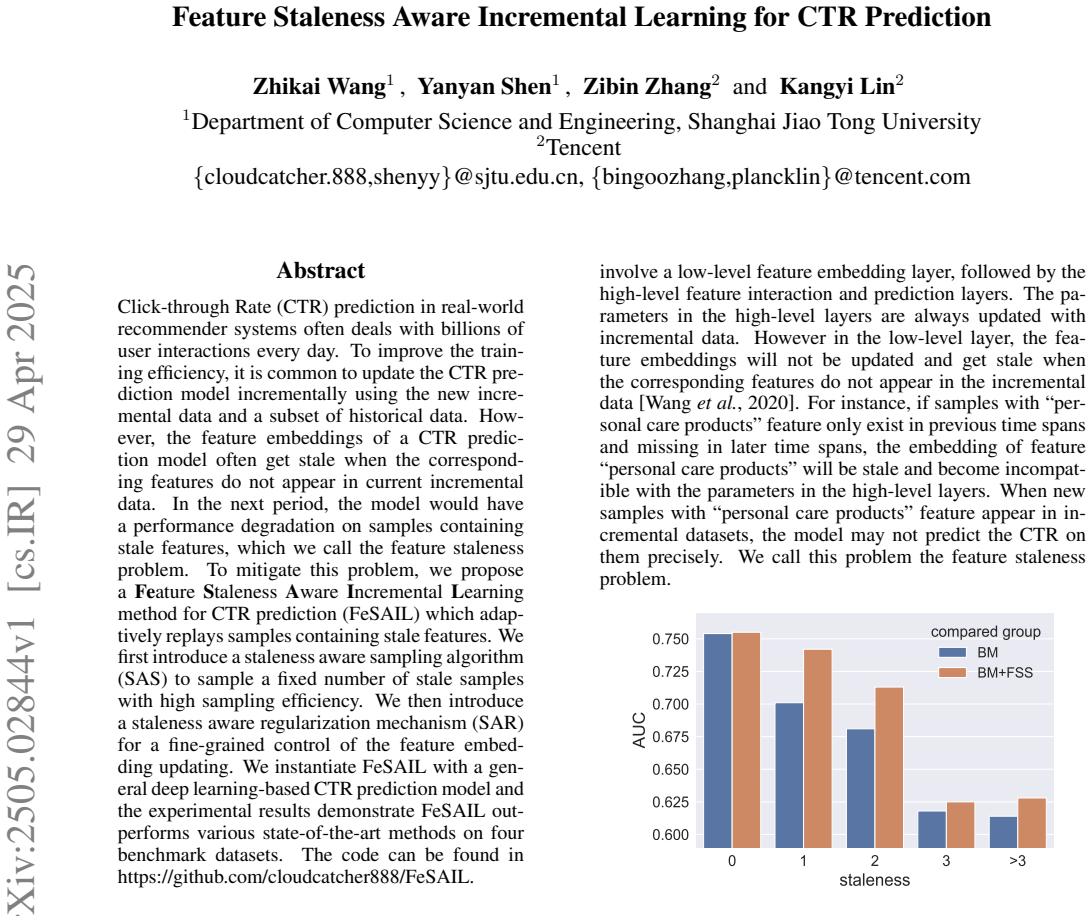
The central discovery is that feature staleness, measured as the number of consecutive time spans a feature is absent from the incremental data, can be handled at the replay-sampling and regularization levels without changing the CTR model architecture. FeSAIL first applies SAS, which treats filling the fixed reservoir as a maximum weighted coverage problem where each stale feature carries weight $w_i = \mathrm{func}(s_i^t) + b$ decreasing in staleness, and solves it greedily with approximation ratio $1 - 1/e$. It then applies SAR, adding a guard term $g_i = \frac{\min(s_i, \eta)}{\min(s_{\max}, \eta)} \|\Delta e_i\|^2$ to the loss so that embeddings of long-stale, low-frequency features can only change by small amounts. The paper reports that this combination outperforms incremental update, random sampling, RMFX, GAG, EWC, and ASMG on Criteo, iPinYou, Avazu, and a private Media dataset, with an average relative AUC improvement of 1.21% over the compared state-of-the-art methods.
Load-bearing premise
The load-bearing premise is that a feature absent for fewer time spans is more likely to reappear soon, so the reservoir should prioritize small-staleness features; the paper does not empirically measure reappearance probability as a function of staleness.
Editorial extensions
If this is right
- FeSAIL is model-agnostic: it modifies only the sampling stage and the loss, so an Embedding&MLP-style CTR model can adopt it without architectural changes.
- The fixed reservoir size keeps retraining cost predictable; the ablation on Avazu shows FeSAIL's sample count stays stable while full stale sampling grows with history.
- The per-time-span results show FeSAIL maintaining its AUC advantage over the best baselines across most of the ten incremental periods, not just on average.
- The two components are independently reusable: adding SAR to RMFX and GAG improves them, and adding SAS to EWC and ASMG improves them, which the paper presents as evidence that staleness awareness is compatible with other replay and regularization strategies.
Reading between the lines
- A natural extension the paper does not pursue is to fit the weight function $w_i$ to empirically measured reappearance probabilities; if the true curve is steeper or flatter than inverse-proportional, the same budget $L$ could cover more of the features that actually return.
- The SAS coverage objective counts features, not interaction recency, so it may under-weight a long-stale user-interest feature that is about to resurface; a recency-weighted variant is a plausible modification in settings with strong short-term drift.
- The reported comparisons do not include a staleness-stratified random sampler of equal reservoir size, so the exact contribution of the greedy coverage step versus the fixed cap is not isolated; testing against that baseline would separate the two.
- Because both components are model-agnostic and the guard term is non-parametric, FeSAIL transfers readily to other embedding-based continual learning problems, such as session-based recommendation, where the same absent-feature staleness appears.
Signed reviews
Editorial analysis
A structured set of objections, weighed in public.
Referee Report
Summary. The paper identifies a 'feature staleness problem' in incrementally trained CTR prediction models: when a feature disappears from recent incremental data, its embedding is not updated and becomes incompatible with the higher layers, degrading AUC when the feature reappears. The authors propose FeSAIL, which combines a staleness-aware sampling algorithm (SAS) that selects a fixed-size reservoir of historical samples by solving a maximum weighted coverage problem with a greedy (1-1/e) approximation guarantee, and a staleness-aware regularization mechanism (SAR) that penalizes embedding updates according to feature staleness. FeSAIL is instantiated on an Embedding&MLP model and evaluated on Criteo, iPinYou, Avazu, and a private Media dataset against six baselines, with ablations, parameter sensitivity, a case study, and runtime measurements. The paper claims an average 1.21% AUC improvement over state-of-the-art baselines.
Significance. The problem addressed is real and practically relevant for production recommender systems that retrain incrementally. The formulation of stale-sample replay as a maximum weighted coverage problem with a standard approximation guarantee is clean, and the proposal of a model-agnostic plug-in is attractive. The paper ships code, covers four datasets including a private industrial one, and includes ablations and sensitivity analyses. If the performance claims were solidly supported, FeSAIL would be a useful contribution to the incremental CTR training literature. The main reservations are an internal inconsistency in the reported improvement numbers, an underspecified SAR mechanism with a missing key hyperparameter, an unvalidated load-bearing assumption about inverse-staleness weighting, and insufficient statistical reporting for the small observed gains.
major comments (4)
- [Section 4.2, Table 2; Abstract and Conclusion] The RI values in Table 2 are internally inconsistent with the reported AUC values. For example, on Criteo, FeSAIL AUC 0.7553 versus ASMG 0.7502 gives a relative improvement of (0.7553-0.7502)/0.7502 ≈ 0.68%, not the listed 0.95%; on iPinYou the calculation gives ≈1.24% versus the listed 1.38%; on Avazu it gives ≈0.35% versus 0.78%; and on Media it gives ≈1.10% versus 1.72%. Since the headline '1.21% average AUC improvement' is simply the mean of the four listed ASMG RI values (0.95, 1.38, 0.78, 1.72), the central empirical claim is not currently supported by the table. The authors should recompute the RI values, or report per-time-span improvements with the underlying data, and revise the abstract and conclusion accordingly.
- [Section 3.3, Eqs. (3)-(4); Section 3.4] The SAR mechanism is not fully specified. In Eq. (3), the guard term g_i is defined using Δe_i, described as 'the embedding change for feature f_i between two consecutive mini-batches.' A loss term must be a differentiable function of the current parameters, but the embedding change that will result from the current gradient update is not available before that update is computed. It is therefore unclear whether SAR is a penalty on a reference embedding, a post-hoc update scaling, or something else, and the text does not explain how Eq. (4) is implemented. Moreover, λ in Eq. (4) is never given a value or a search range in Section 3.4 or Section 4.1, even though it controls the strength of the regularization. Without a precise algorithmic description and the λ value, the ablation RSS+SAR versus RSS cannot be interpreted and the method is not reproducible.
- [Section 3.2, Eq. (2); Section 4.5] The inverse-staleness weighting in Eq. (2) is load-bearing but unvalidated. The paper asserts that 'features with smaller staleness will be covered with higher priorities because they might have higher possibilities of reappearing again in future datasets,' but no measurement of reappearance probability as a function of staleness is provided. Figure 6 shows only that SAS drops high-staleness features more, which verifies the algorithm implements the rule, not that the rule is correct. If reappearance probability is not monotonically decreasing in staleness, the reservoir may preserve the wrong samples. The authors should either measure P(reappear | staleness) on the datasets or compare SAS against an unweighted coverage baseline and a reversed-weight baseline to demonstrate that the monotone inverse weighting, rather than the coverage objective alone, drives the reported gains.
- [Section 4.1-4.2, Table 2] The statistical reporting is insufficient for the size of the claimed effects. Table 2 reports p-values from a two-tailed pairwise t-test, but no standard deviations or confidence intervals are given. The text alternately says results are 'averaged over ten runs' and 'average scores over all the incremental datasets,' leaving it unclear whether the ten observations are time spans (which are sequential and not independent replicates) or random restarts. The absolute AUC differences are very small (for example, 0.0018 on Criteo against ASMG+SAS), so without variance information the reader cannot judge whether the rankings are stable. Please report standard deviations or confidence intervals, clarify the replication structure, and describe how the datasets are temporally split into D0 through D10.
minor comments (5)
- [Section 3.2, after Theorem 1] The sentence 'SAS will drop about 30% more stale features than the optimal solution. However, the SAS chooses the features with small staleness in prior and the actual drop ratio of stale features will be about 10%' is confusing; the relationship between the (1-1/e) approximation guarantee and the empirical 10% drop ratio should be explained more carefully.
- [Algorithm 1 and Section 3.2] Algorithm 1 does not describe the neighbor-based optimization that the complexity analysis in Section 3.2 and Section 3.5 relies on; please include the neighbor update procedure or a pseudocode version of the optimized algorithm.
- [Section 4.1] The temporal splitting of the datasets into D0 through D10 is not described; please specify how the 24 days of Criteo, the iPinYou logs, the Avazu data, and the 48 hours of Media are partitioned into pretraining and ten incremental periods.
- [Section 3.3, Eq. (3)] The notation for staleness uses s_i^t in Eq. (1) but plain s_i in Eq. (3); please align the notation to avoid ambiguity about the time index.
- [Figure 5] Figure 5 plots Jaccard similarity and AUC with different scales; please clarify which y-axis corresponds to which quantity in the caption or legend.
Circularity Check
No circularity found: FeSAIL's claimed gains are empirical results against external baselines, and its self-citations are background only.
full rationale
The paper's central claim is an empirical one: FeSAIL outperforms state-of-the-art incremental CTR methods by 1.21% average AUC on four datasets. This claim is supported by experiments against external baselines (IU, RS, RMFX, GAG, EWC, ASMG), not by a derivation from its own assumptions. The SAS sampling objective (Eq. (2), Definition 1) weights stale features by inverse staleness, and the SAR regularizer (Eq. (3)) restricts embedding updates; both are design choices whose usefulness is tested via ablations and comparisons. The greedy maximum-coverage argument is a standard approximation result proved in the paper and does not presuppose the outcome. The self-citations to the authors' prior work ([Zhikai and Yanyan, 2022] and [Zhikai and Yanyan, 2023]) appear only in background lists of incremental-learning and CTR methods; they are not load-bearing for defining SAS, SAR, or the evaluation protocol. The paper does not fit a parameter to the target metric and then rename the fit as a prediction; hyperparameters are tuned and reported, and the model is evaluated on held-out incremental periods. The inverse-staleness priority is an empirical assumption that is not directly validated, but this is a correctness or generalizability concern, not circularity: the method's equations do not define the reported AUC improvements in terms of the weights. Accordingly, no circular step is present, and the appropriate score is 0.
Assumptions & free parameters
free parameters (4)
- L (reservoir size) =
equal to size of current incremental dataset D_t
- func and b in Eq. (2) =
default func = inverse proportional, b = 1
- eta in Eq. (3) =
grid-searched from 5 to 10, final value not reported
- lambda in Eq. (4)
assumptions (5)
- standard math Greedy selection for maximum coverage achieves a (1 - 1/e) approximation ratio.
- domain assumption Features with smaller staleness are more likely to reappear in future datasets.
- domain assumption Long-stale features are low-frequency, and updating them frequently risks overfitting.
- domain assumption The embedding change between two consecutive mini-batches is a suitable quantity to regularize.
- domain assumption The reservoir-based incremental setting of Mi et al., 2020 applies.
Cite this review
Pith. "Pith review of Feature Staleness Aware Incremental Learning for CTR Prediction." pith.science (2026). https://pith.science/paper/VL2QNC4P
@misc{pith2026250502844,
  author       = {Pith},
  title        = {Pith review of: Feature Staleness Aware Incremental Learning for CTR Prediction},
  year         = {2026},
  howpublished = {\url{https://pith.science/paper/VL2QNC4P}},
  note         = {Machine review of arXiv:2505.02844}
}
read the original abstract
Click-through Rate (CTR) prediction in real-world recommender systems often deals with billions of user interactions every day. To improve the training efficiency, it is common to update the CTR prediction model incrementally using the new incremental data and a subset of historical data. However, the feature embeddings of a CTR prediction model often get stale when the corresponding features do not appear in current incremental data. In the next period, the model would have a performance degradation on samples containing stale features, which we call the feature staleness problem. To mitigate this problem, we propose a Feature Staleness Aware Incremental Learning method for CTR prediction (FeSAIL) which adaptively replays samples containing stale features. We first introduce a staleness aware sampling algorithm (SAS) to sample a fixed number of stale samples with high sampling efficiency. We then introduce a staleness aware regularization mechanism (SAR) for a fine-grained control of the feature embedding updating. We instantiate FeSAIL with a general deep learning-based CTR prediction model and the experimental results demonstrate FeSAIL outperforms various state-of-the-art methods on four benchmark datasets.
Figures


Figures from the paper (2 more)


Reference graph
Works this paper leans on
-
[1]
[Barrett et al., 2017] Rick Barrett, Rick Cummings, and Eu- gene Agichtein. Streaming Recommender Systems. In IJCAI, pages 381–389,
work page 2017
-
[6]
Deep Time-Aware Item Evolution Net- work for Click-Through Rate Prediction
[d’Aquin et al., 2020] Mathieu d’Aquin, Stefan Dietze, Claudia Hauff, Edward Curry, Philippe Cudre Mauroux, Xiang Li, Chao Wang, Bin Tong, Jiwei Tan, Xiaoyi Zeng, and Tao Zhuang. Deep Time-Aware Item Evolution Net- work for Click-Through Rate Prediction. In Proceedings of the 29th ACM International Conference on Information & Knowledge Management, pages 785–794,
work page 2020
-
[7]
Real- time top-n recommendation in social streams
[Diaz-Aviles et al., 2012] Ernesto Diaz-Aviles, Lucas Dru- mond, Lars Schmidt-Thieme, and Wolfgang Nejdl. Real- time top-n recommendation in social streams. In WWW, pages 59–66
work page 2012
-
[10]
Deep Interest Network for Click-Through Rate Prediction
[Guo et al., 2018] Yike Guo, Faisal Farooq, Guorui Zhou, Xiaoqiang Zhu, Chenru Song, Ying Fan, Han Zhu, Xiao Ma, Yanghui Yan, Junqi Jin, Han Li, and Kun Gai. Deep Interest Network for Click-Through Rate Prediction. In AAAI, pages 1059–1068,
work page 2018
-
[12]
Self-Attentive Sequential Recommendation
[Kang and McAuley, 2018] Wang-Cheng Kang and Julian McAuley. Self-Attentive Sequential Recommendation. ICDM, pages 197–206,
work page 2018
-
[13]
Overcoming catastrophic forgetting in neural net- works
[Kirkpatrick et al., 2016] James Kirkpatrick, Razvan Pas- canu, Neil Rabinowitz, Joel Veness, Guillaume Des- jardins, Andrei A Rusu, Kieran Milan, John Quan, Tiago Ramalho, Agnieszka Grabska-Barwinska, Demis Hass- abis, Claudia Clopath, Dharshan Kumaran, and Raia Had- sell. Overcoming catastrophic forgetting in neural net- works. arXiv,
work page 2016
-
[15]
Neural Attentive Session-based Recommendation
[Lim et al., 2017] Ee-Peng Lim, Marianne Winslett, Mark Sanderson, Ada Fu, Jimeng Sun, and Shane Culpepper. Neural Attentive Session-based Recommendation. CIKM, pages 1419–1428,
work page 2017
-
[16]
Memory Augmented Neural Model for Incremental Session-based Recommendation
[Mi and Faltings, 2020] Fei Mi and Boi Faltings. Memory Augmented Neural Model for Incremental Session-based Recommendation. In Proceedings of the Twenty-Ninth International Joint Conference on Artificial Intelligence , pages 2169–2176,
work page 2020
Show all 30 references
-
[17]
ADER: Adaptively Distilled Exemplar Replay Towards Continual Learning for Session-based Recommendation
[Mi et al., 2020] Fei Mi, Xiaoyu Lin, and Boi Faltings. ADER: Adaptively Distilled Exemplar Replay Towards Continual Learning for Session-based Recommendation. arXiv,
2020
-
[18]
Learning an Adaptive Meta Model- Generator for Incrementally Updating Recommender Sys- tems
[Peng et al., 2021] Danni Peng, Sinno Jialin Pan, Jie Zhang, and Anxiang Zeng. Learning an Adaptive Meta Model- Generator for Incrementally Updating Recommender Sys- tems. In SIGIR, pages 411–421,
2021
-
[20]
Factorizing person- alized Markov chains for next-basket recommendation
[Rendle et al., 2010] Steffen Rendle, Christoph Freuden- thaler, and Lars Schmidt-Thieme. Factorizing person- alized Markov chains for next-basket recommendation. WWW, pages 811–820,
2010
-
[24]
Deep & Cross Network for Ad Click Predic- tions
[Wang et al., 2017] Ruoxi Wang, Bin Fu, Gang Fu, and Min- gliang Wang. Deep & Cross Network for Ad Click Predic- tions. In ADKDD, pages 1–7,
2017
-
[25]
A Practical Incre- mental Method to Train Deep CTR Models
[Wang et al., 2020] Yichao Wang, Huifeng Guo, Ruiming Tang, Zhirong Liu, and Xiuqiang He. A Practical Incre- mental Method to Train Deep CTR Models. arXiv,
2020
-
[26]
Real-Time Bidding Benchmarking with iPinYou Dataset
[Zhang et al., 2014] Weinan Zhang, Shuai Yuan, Jun Wang, and Xuehua Shen. Real-Time Bidding Benchmarking with iPinYou Dataset. arXiv, 7
2014
-
[28]
Incremental learning for multi-interest sequential recom- mendation
[Zhikai and Yanyan, 2023] Wang Zhikai and Shen Yanyan. Incremental learning for multi-interest sequential recom- mendation. In ICDE,
2023
-
[30]
Fi-GNN: Modeling Feature Interactions via Graph Neural Networks for CTR Prediction
[Zhu et al., 2019] Wenwu Zhu, Dacheng Tao, Xueqi Cheng, Peng Cui, Elke Rundensteiner, David Carmel, Qi He, Jef- frey Xu Yu, Zekun Li, Zeyu Cui, Shu Wu, Xiaoyu Zhang, and Liang Wang. Fi-GNN: Modeling Feature Interactions via Graph Neural Networks for CTR Prediction. Proceed- in...
2019
-
[2004]
TeRec: a temporal recommender system over tweet stream
[Chen et al., 2013] Chen Chen, Hongzhi Yin, Junjie Yao, and Bin Cui. TeRec: a temporal recommender system over tweet stream. InRecSys, volume 6, pages 1254–1257,
2013
-
[2010]
BERT4Rec: Sequential Recommendation with Bidirectional Encoder Representations from Transformer
[Sun et al., 2019] Fei Sun, Jun Liu, Jian Wu, Changhua Pei, Xiao Lin, Wenwu Ou, and Peng Jiang. BERT4Rec: Sequential Recommendation with Bidirectional Encoder Representations from Transformer. In Proceedings of the 28th ACM International Conference on Information & Knowledge M...
2019
-
[2012]
Kingma, 2015] Jimmy Lei Ba Diederik P
[Diederik P. Kingma, 2015] Jimmy Lei Ba Diederik P. Kingma. Adam: A Method for Stochastic Optimization. In ICLR, pages 785–794,
2015
-
[2013]
Adaptive factorization network: Learning adaptive-order feature interactions
[Cheng et al., 2020] Weiyu Cheng, Yanyan Shen, and Lin- peng Huang. Adaptive factorization network: Learning adaptive-order feature interactions. In AAAI, volume 34, pages 3609–3616,
2020
-
[2014]
Time-aware multi-interest capsule network for sequential recommendation
[Zhikai and Yanyan, 2022] Wang Zhikai and Shen Yanyan. Time-aware multi-interest capsule network for sequential recommendation. In SDM, pages 558–566,
2022
-
[2015]
DeepFM: A Factorization-Machine based Neural Network for CTR Prediction
[Guo et al., 2017] Huifeng Guo, Ruiming Tang, Yunming Ye, Zhenguo Li, and Xiuqiang He. DeepFM: A Factorization-Machine based Neural Network for CTR Prediction. arXiv, abs/1703.04247,
2017 arXiv
-
[2016]
Deep Crossing: Web-Scale Model- ing without Manually Crafted Combinatorial Features
[Krishnapuram et al., 2016] Balaji Krishnapuram, Mohak Shah, and JC Mao. Deep Crossing: Web-Scale Model- ing without Manually Crafted Combinatorial Features. In KDD, pages 255–262,
2016
-
[2017]
Time Interval Aware Self-Attention for Se- quential Recommendation
[Caverlee et al., 2020] James Caverlee, Xia ”Ben” Hu, Mou- nia Lalmas, Wei Wang, Jiacheng Li, Yujie Wang, and Ju- lian McAuley. Time Interval Aware Self-Attention for Se- quential Recommendation. WSDM, pages 322–330,
2020
-
[2018]
Fusing Similarity Models with Markov Chains for Sparse Sequential Recommendation
[He and McAuley, 2016] Ruining He and Julian McAuley. Fusing Similarity Models with Markov Chains for Sparse Sequential Recommendation. arXiv,
2016
-
[2019]
Self-supervised continual graph learning in adaptive riemannian spaces
[Sun et al., 2022] Li Sun, Junda Ye, Hao Peng, Feiyang Wang, and Philip S Yu. Self-supervised continual graph learning in adaptive riemannian spaces. In IJCAI,
2022
-
[2020]
Maximum coverage problem with group budget con- straints and applications
[Chekuri and Kumar, 2004] Chandra Chekuri and Amit Ku- mar. Maximum coverage problem with group budget con- straints and applications. In Approximation, Random- ization, and Combinatorial Optimization. Algorithms and Techniques, pages 72–83. Springer,
2004
-
[2021]
Product- based neural networks for user response prediction
[Qu et al., 2016] Yanru Qu, Han Cai, Kan Ren, Weinan Zhang, Yong Yu, Ying Wen, and Jun Wang. Product- based neural networks for user response prediction. In 2016 IEEE 16th International Conference on Data Min- ing (ICDM), pages 1149–1154. IEEE,
2016
-
[2022]
Streaming Session-based Recommendation
[Teredesai et al., 2019] Ankur Teredesai, Vipin Kumar, and Ying Li. Streaming Session-based Recommendation. In IJCAI, pages 1569–1577,
2019
-
[2023]
Deep Interest Evolution Network for Click-Through Rate Prediction
[Zhou et al., 2018] Guorui Zhou, Na Mou, Ying Fan, Qi Pi, Weijie Bian, Chang Zhou, Xiaoqiang Zhu, and Kun Gai. Deep Interest Evolution Network for Click-Through Rate Prediction. In AAAI, pages 5941–5948,
2018
Reviewed August 16, 2026 · model on record in the stance chip above.
Discussion (0). Continue with ORCID to comment.