Ballistic-to-diffusive transition in engineered counter-propagating quantum Hall channels
Pith reviewed 2026-05-22 15:51 UTC · model grok-4.3
The pith
In quantum Hall systems engineered with tunable counter-propagating channels, transport is ballistic for unequal channel numbers but becomes critically diffusive when the numbers are equal, with a diverging equilibration length.
A machine-rendered reading of the paper's core claim, the machinery that carries it, and where it could break.
Core claim
Charge transport is determined by the balance of up- and downstream channels, with a ballistic regime emerging for unequal numbers of channels. For equal numbers, we observe a transition to a critical diffusive regime, characterized by a diverging equilibration length. Our approach allows simulating the equilibration of hole-conjugate states and other exotic quantum Hall effects with fully controlled parameters using well-understood quantum Hall states.
What carries the argument
Tunable counter-propagating edge states coupled by Landauer reservoirs that force charge equilibration over an adjustable effective length.
If this is right
- Transport stays ballistic across the sample length whenever upstream and downstream channel counts are unequal.
- Equal channel counts produce a diffusive regime whose equilibration length diverges.
- The same device architecture reproduces equilibration physics of hole-conjugate states using only standard integer quantum Hall channels.
- All key parameters remain experimentally adjustable without requiring new material systems.
Where Pith is reading between the lines
- The observed divergence may indicate a broader critical point shared with other one-dimensional transport systems at the ballistic-diffusive boundary.
- The engineering method offers a template for isolating equilibration effects in fractional quantum Hall states that are otherwise difficult to tune.
- Longer device geometries could map how the equilibration length grows as channel counts approach equality.
Load-bearing premise
The fabricated sample successfully hosts a tunable number of counter-propagating edge states that are coupled by Landauer reservoirs forcing charge equilibration over a tunable effective length.
What would settle it
If the measured equilibration length remains finite instead of diverging when the numbers of upstream and downstream channels are set equal, the claimed critical diffusive regime does not hold.
Figures


read the original abstract
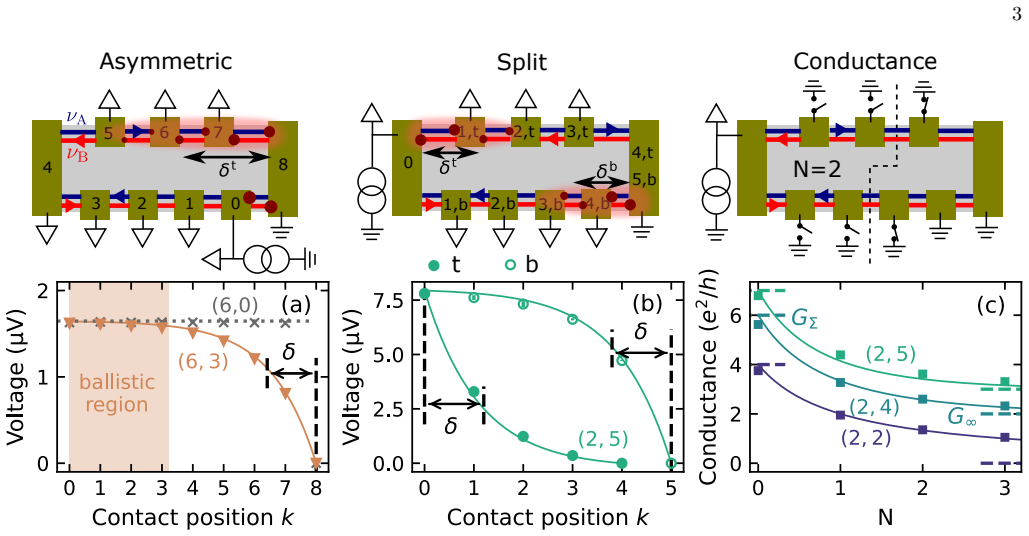
Exotic quantum Hall systems hosting counter-propagating edge states can show seemingly non-universal transport regimes, usually depending on the size of the sample. We experimentally probe transport in a quantum Hall sample engineered to host a tunable number of counter-propagating edge states. The latter are coupled by Landauer reservoirs, which force charge equilibration over a tunable effective length. We show that charge transport is determined by the balance of up- and downstream channels, with a ballistic regime emerging for unequal numbers of channels. For equal numbers, we observe a transition to a critical diffusive regime, characterized by a diverging equilibration length. Our approach allows simulating the equilibration of hole-conjugate states and other exotic quantum Hall effects with fully controlled parameters using well-understood quantum Hall states.
Editorial analysis
A structured set of objections, weighed in public.
Referee Report
Summary. The manuscript experimentally investigates charge transport in a quantum Hall sample engineered with a tunable number of counter-propagating edge states that are coupled by Landauer reservoirs over a controllable effective length. The central claim is that transport is governed by the balance between upstream and downstream channels: ballistic behavior emerges for unequal channel counts, while equal counts produce a transition to a critical diffusive regime marked by a diverging equilibration length. The approach is positioned as a controlled simulator for equilibration physics in exotic states such as hole-conjugate quantum Hall fluids using standard integer quantum Hall channels.
Significance. If the reported length-dependent resistance scaling and regime identification hold, the work supplies a clean, parameter-tunable platform for studying non-universal transport in counter-propagating edge systems. This could clarify the origin of apparently sample-size-dependent regimes in more complex quantum Hall states without requiring direct fabrication of those states, and the explicit comparison to the non-interacting Landauer-Büttiker model provides a useful benchmark.
major comments (1)
- §4.3 and Fig. 4: The identification of the critical diffusive regime for equal channel numbers rests on the observed divergence of the equilibration length with sample length. However, the manuscript does not quantify how residual inter-channel scattering or gate-induced potential fluctuations are excluded as alternative explanations for the apparent divergence; a direct comparison of the extracted length scale against independent estimates of disorder strength would strengthen the claim that the transition is purely due to channel-number balance.
minor comments (3)
- The abstract and introduction would benefit from a brief statement of the measured resistance values and their uncertainties rather than qualitative descriptions alone.
- Notation for upstream/downstream channel counts (N_up, N_down) is introduced in §2 but used inconsistently in the figure captions; a single consistent symbol set would improve readability.
- Reference to prior work on hole-conjugate states (e.g., the specific papers cited in §1) should include a short sentence clarifying which aspects of those experiments are being simulated here.
Simulated Author's Rebuttal
We thank the referee for the positive assessment of our work and the recommendation for minor revision. The single major comment raises a valid point about strengthening the evidence that the observed divergence arises specifically from channel-number balance rather than residual disorder. We address this below and will revise the manuscript accordingly.
read point-by-point responses
-
Referee: §4.3 and Fig. 4: The identification of the critical diffusive regime for equal channel numbers rests on the observed divergence of the equilibration length with sample length. However, the manuscript does not quantify how residual inter-channel scattering or gate-induced potential fluctuations are excluded as alternative explanations for the apparent divergence; a direct comparison of the extracted length scale against independent estimates of disorder strength would strengthen the claim that the transition is purely due to channel-number balance.
Authors: We agree that a quantitative comparison would strengthen the claim. The primary evidence remains the sharp contrast between ballistic transport (for unequal channel numbers) and the length-dependent resistance (for equal numbers) over identical device lengths and gate conditions, which is difficult to reconcile with uniform residual scattering. Nevertheless, in the revised manuscript we will expand §4.3 to include an estimate of disorder strength derived from the measured mobility and gate-voltage stability of the 2DEG. We will compare this length scale directly to the extracted equilibration lengths, showing that the divergence in the balanced case substantially exceeds the scale set by disorder. This addition will make explicit that the transition is governed by channel-number balance within the Landauer-Büttiker framework. revision: yes
Circularity Check
No significant circularity in experimental claims
full rationale
This is an experimental paper reporting transport measurements in gate-defined quantum Hall devices with tunable counter-propagating edge states coupled via Landauer reservoirs. The central observations—ballistic transport for unequal channel numbers and a critical diffusive regime with diverging equilibration length for equal numbers—are extracted directly from length-dependent resistance data and compared to the non-interacting Landauer-Büttiker model. No derivations, first-principles calculations, or parameter fits are presented that reduce by construction to the measured inputs or to self-citations; the results follow from device fabrication and raw transport data without self-referential definitions or load-bearing self-citation chains.
Axiom & Free-Parameter Ledger
axioms (1)
- standard math Quantum Hall edge states propagate chirally and obey Landauer-Büttiker transport formalism.
Reference graph
Works this paper leans on
- [1]
-
[2]
H. le Sueur, C. Altimiras, U. Gennser, A. Cavanna, D. Mailly, and F. Pierre, Energy relaxation in the in- teger quantum hall regime, Phys. Rev. Lett. 105, 056803 (2010)
work page 2010
-
[3]
M. K¨ onig, S. Wiedmann, C. Br¨ une, A. Roth, H. Buh- mann, L. W. Molenkamp, X.-L. Qi, and S.-C. Zhang, Quantum spin hall insulator state in hgte quantum wells, Science 318, 766 (2007)
work page 2007
-
[4]
A. H. MacDonald, Edge states in the fractional-quantum- hall-effect regime, Phys. Rev. Lett. 64, 220 (1990)
work page 1990
-
[5]
C. L. Kane, M. P. A. Fisher, and J. Polchinski, Random- ness at the edge: Theory of quantum hall transport at filling ν=2/3, Phys. Rev. Lett. 72, 4129 (1994)
work page 1994
-
[6]
I. Protopopov, Y. Gefen, and A. Mirlin, Transport in a disordered ν=2/3 fractional quantum hall junction, An- nals of Physics 385, 287 (2017)
work page 2017
-
[7]
C. Nosiglia, J. Park, B. Rosenow, and Y. Gefen, Incoher- ent transport on the ν = 2/3 quantum hall edge, Phys. Rev. B 98, 115408 (2018)
work page 2018
-
[8]
J. Park, A. D. Mirlin, B. Rosenow, and Y. Gefen, Noise on complex quantum hall edges: Chiral anomaly and heat diffusion, Phys. Rev. B 99, 161302 (2019)
work page 2019
-
[9]
C. Sp˚ ansl¨ att, J. Park, Y. Gefen, and A. D. Mirlin, Topo- logical classification of shot noise on fractional quantum hall edges, Phys. Rev. Lett. 123, 137701 (2019)
work page 2019
-
[10]
C. Sp˚ ansl¨ att, J. Park, Y. Gefen, and A. D. Mirlin, Con- ductance plateaus and shot noise in fractional quantum hall point contacts, Phys. Rev. B 101, 075308 (2020)
work page 2020
-
[11]
T. Fujisawa and C. Lin, Plasmon modes of coupled quantum hall edge channels in the presence of disorder- induced tunneling, Phys. Rev. B 103, 165302 (2021). 6
work page 2021
- [12]
-
[13]
A. Bid, N. Ofek, H. Inoue, M. Heiblum, C. L. Kane, V. Umansky, and D. Mahalu, Observation of neutral modes in the fractional quantum hall regime, Nature466, 585 (2010)
work page 2010
-
[14]
C. Lin, R. Eguchi, M. Hashisaka, T. Akiho, K. Muraki, and T. Fujisawa, Charge equilibration in integer and frac- tional quantum hall edge channels in a generalized hall- bar device, Phys. Rev. B 99, 195304 (2019)
work page 2019
- [15]
- [16]
-
[17]
S. K. Srivastav, R. Kumar, C. Sp˚ ansl¨ att, K. Watanabe, T. Taniguchi, A. D. Mirlin, Y. Gefen, and A. Das, Van- ishing thermal equilibration for hole-conjugate fractional quantum hall states in graphene, Phys. Rev. Lett. 126, 216803 (2021)
work page 2021
-
[18]
R. A. Melcer, B. Dutta, C. Sp˚ ansl¨ att, J. Park, A. D. Mirlin, and V. Umansky, Absent thermal equilibration on fractional quantum hall edges over macroscopic scale, Nature Communications 13, 376 (2022)
work page 2022
-
[19]
A. Roth, C. Br¨ une, H. Buhmann, L. W. Molenkamp, J. Maciejko, X.-L. Qi, and S.-C. Zhang, Nonlocal trans- port in the quantum spin hall state, Science 325, 294 (2009)
work page 2009
-
[20]
I. Knez, R.-R. Du, and G. Sullivan, Evidence for Heli- cal Edge Modes in Inverted InAs /GaSb Quantum Wells, Phys. Rev. Lett. 107, 136603 (2011)
work page 2011
-
[21]
S. Wu, V. Fatemi, Q. D. Gibson, K. Watanabe, T. Taniguchi, R. J. Cava, and P. Jarillo-Herrero, Ob- servation of the quantum spin hall effect up to 100 kelvin in a monolayer crystal, Science 359, 76 (2018)
work page 2018
- [22]
-
[23]
K. Kang, B. Shen, Y. Qiu, Y. Zeng, Z. Xia, K. Watan- abe, T. Taniguchi, J. Shan, and K. F. Mak, Evidence of the fractional quantum spin Hall effect in moir´ e MoTe2, Nature 628, 522 (2024)
work page 2024
-
[24]
B. Yang, B. Bhujel, D. G. Chica, E. J. Telford, X. Roy, F. Ibrahim, M. Chshiev, M. Cosset-Ch´ eneau, and B. J. v. Wees, Electrostatically controlled spin polarization in graphene-crsbr magnetic proximity heterostructures, Na- ture Communications 15, 4459 (2024)
work page 2024
-
[25]
M. Banerjee, M. Heiblum, A. Rosenblatt, Y. Oreg, D. E. Feldman, A. Stern, and V. Umansky, Observed quanti- zation of anyonic heat flow, Nature 545, 75 (2017)
work page 2017
-
[26]
C. R. Dean, A. F. Young, I. Meric, C. Lee, L. Wang, S. Sorgenfrei, K. Watanabe, T. Taniguchi, P. Kim, K. L. Shepard, and J. Hone, Boron nitride substrates for high- quality graphene electronics, Nature Nanotechnology 5, 722 (2010)
work page 2010
-
[27]
See supplemental materials
-
[28]
C. L. Kane and M. P. A. Fisher, Quantized thermal trans- port in the fractional quantum hall effect, Phys. Rev. B 55, 15832 (1997)
work page 1997
-
[29]
M. Hashisaka, T. Ito, T. Akiho, S. Sasaki, N. Ku- mada, N. Shibata, and K. Muraki, Coherent-incoherent crossover of charge and neutral mode transport as evi- dence for the disorder-dominated fractional edge phase, Phys. Rev. X 13, 031024 (2023)
work page 2023
- [30]
-
[31]
F. St¨ abler and E. Sukhorukov, Mesoscopic heat multiplier and fractionalizer, Phys. Rev. B 108, 235405 (2023)
work page 2023
-
[32]
F. St¨ abler, A. Gadiaga, and E. V. Sukhorukov, Giant heat flux effect in non-chiral transmission lines (2024), arXiv:2411.11495 [cond-mat.mes-hall]
-
[33]
top” edge and 4 in the “bottom
M. Hashisaka, T. Jonckheere, T. Akiho, S. Sasaki, J. Rech, T. Martin, and K. Muraki, Andreev reflection of fractional quantum hall quasiparticles, Nature Commu- nications 12, 2794 (2021). S7 SAMPLE DESCRIPTION Our sample (see Fig. S1) consists of two individually graphite-gated Hall bars (A and B) made of hexagonal Boron Nitride (hBN) encapsulated monolay...
work page 2021
discussion (0)
Sign in with ORCID, Apple, or X to comment. Anyone can read and Pith papers without signing in.