REVIEW 3 major objections 5 minor 29 references
Explainable Reinforcement Learning Agents Using World Models
T0 review · 3 major / 5 minor · reviewed 2026-08-15 · deepseek-v4-flash
Pith's one-line read Showing users what the world should have been like for an agent to take a preferred action significantly improves their ability to identify why the agent failed.
desk verdict Novel Reverse World Model idea with a promising human study, but unfaithful counterfactuals and a missing active-control arm leave the main attribution unsupported. read the letter →
The pith
A machine-rendered reading of the paper's core claim, the machinery that carries it, and where it could break.
The reading
What carries the argument
The load-bearing object is the Reverse World Model (RWM), a second transition model trained alongside the forward DreamerV3 world model on the agent's replay buffer with the order of each sampled transition chunk reversed and actions shifted so that the model predicts the prior embedded state from the later observation and the action taken. The forward world model gives counterfactual futures, but the RWM gives the counterfactual past: the state in which the policy would have preferred the user's action over the action actually taken. Decoding the RWM's latent predictions into images produces the 'what the world should have been like' snapshots shown to users. The design deliberately reuses the agent's own training data—no second training phase, no environment access—so the explanation is internal to the agent's model of the world.
What would settle it
Run the four coffee-task scenarios with a third condition that shows users random or deliberately distorted extra images alongside the real snapshots; if that condition performs as well as the RWM condition, the benefit is not specific to the counterfactual content. Alternatively, compare each RWM-generated image to the ground-truth state after the corresponding environmental change and check whether the changed object (moved, obstructed, or removed) is actually visible in the predicted image.
Extended reading notes
Core claim
On the paper's own terms, the central discovery is that explaining a sequential decision by inverting it—showing the state that would have made the agent take the user's desired action—significantly improves how well non-experts understand an RL agent's policy. The claim is supported by four hypotheses about accuracy, satisfaction, trust, and cognitive load, and the experiments find support for all four, with the accuracy improvement being the headline result: 64.86% correct cause identification in the treatment group versus 26.52% in the control, a difference the paper reports as significant at p < 0.00001 cumulatively. The mechanism is a Reverse World Model trained on the same DreamerV3 replay data with the temporal order of transitions reversed, which predicts the latent encoding of the prior state given a future state and an action; decoded images of those predicted prior states are what participants see. The paper frames this as an actionable explanation for non-AI experts, because it reveals the environmental feature the agent was responding to, which is something a user could in principle alter.
Load-bearing premise
The load-bearing premise is that the Reverse World Model's images accurately and intelligibly depict states in which the agent's policy would have chosen the user's desired action—the paper never directly evaluates the faithfulness of those images, so if they are noisy or misleading, the observed user-study gains might come from the extra visual material rather than from the counterfactual content.
Editorial extensions
If this is right
- Users of an RL system could diagnose why an agent deviates from their expectations by looking at a difference image: the real state versus the state the agent's reverse model says it needed.
- Because the explanation names the environmental feature driving the policy, it suggests a concrete intervention—move the object, remove the obstruction—that a non-expert can perform without touching the policy.
- The same RWM approach could be applied to any model-based RL agent whose world model is trained on collected transitions, not just DreamerV3, as long as the transition data are available in a replay buffer.
- Explanation quality becomes tied to world-model quality: the better the agent's learned dynamics, the more faithful the counterfactual states it can show a user.
Reading between the lines
- A direct test of the RWM's fidelity—comparing its predicted prior states against ground-truth altered states, or measuring pixel-level reconstruction error—would separate the claim that the content of the counterfactual images is what helps users from the alternative that any extra images would help.
- The human result probably depends on the counterfactual being visually legible in a grid environment with discrete objects; the method's benefit in continuous, photorealistic environments remains an open question.
- One could imagine a closed loop: if the RWM exposes the feature the agent expects, the same model could rank candidate world alterations by how much they shift the policy's preferred action, turning explanation into a control interface.
Signed reviews
Editorial analysis
A structured set of objections, weighed in public.
Referee Report
Summary. The paper proposes an Explainable RL method based on a Reverse World Model (RWM) trained by reversing the temporal order of DreamerV3's replay-buffer transitions. The RWM is intended to generate counterfactual images showing what the environment should have looked like for the agent's policy to prefer a user-supplied desired action. The authors evaluate this method with a Prolific-hosted human study (N=70) in a modified Crafter environment with four failure scenarios. The treatment arm receives the execution video, four true snapshots, and four RWM-generated 'expected' images; the control arm receives only the video and the four true snapshots. The paper reports significantly higher cause-identification accuracy (64.86% vs. 26.52%, Fisher's exact p<0.00001), higher satisfaction, higher trust, and lower cognitive load in the treatment arm, and concludes that showing users what the world should have been like significantly improves their understanding of the agent's policy.
Significance. If the central attribution holds, the paper makes a useful contribution to explainable reinforcement learning for non-expert users: it offers a lightweight way to generate counterfactual explanations from the agent's own world model without a separate post-hoc training phase, and it provides evidence that such explanations can improve users' causal diagnosis of agent failures. The randomized between-subjects design, the use of a fictional domain to control for commonsense assumptions, and the inclusion of a free-response text box are strengths. However, the current evidence does not yet establish the mechanistic claim. The treatment arm differs from control not only in the semantic content of the explanations but also in the sheer number of images shown, and the RWM's outputs are never directly validated for fidelity or policy-alignment. These gaps are load-bearing for the paper's central conclusion.
major comments (3)
- [§5, §6.1, §8] The central premise—that an RWM-generated image depicts a state in which the agent's policy would choose the desired action—is never directly tested. Section 5 reports only that the RWM is trained with reconstruction error on time-reversed replay data, but the paper gives no reconstruction numbers, no example generated images, no human ratings of image content, and no comparison with ground-truth altered states. Section 8 concedes that RWM outputs are tied to states the agent visited during training, while all four test scenarios involve objects removed, moved, or obstructed—states the agent never experienced. Without direct evidence that the generated images are faithful counterfactuals (rather than blurry or arbitrary reconstructions), the observed treatment-arm improvements could be caused by any extra visual information. Please report reconstruction error, show qualitative examples, and verify behaviorally that the policy, when rolled out in the generated state, selects the desired action with high probability.
- [§6.1, Table 1, Figure 5] The study confounds explanation content with information quantity. Treatment participants receive video plus eight images (four true snapshots and four RWM images), while control participants receive video plus four images. Consequently, the significant differences in cause identification (Table 1) and in satisfaction, trust, and cognitive load (Figure 5) could be driven by having more visual evidence rather than by the semantic content of the RWM counterfactuals. An active control arm—for example, showing four extra images that are not semantically related to the scenario, or RWM images from a different scenario, or randomly selected snapshots—is necessary to isolate the causal role of the explanation. Without such a baseline, hypotheses H1–H4 are not attributable to the proposed explanation mechanism.
- [§3, §5] The conceptual link from time-reversed replay data to policy-preferred counterfactual states is assumed rather than derived. Training a world model on reversed transitions approximates inverse dynamics p(z_{t-1}|z_t, a_{t-1}), but the explanation requires a state s^d_t such that π(s^d_t)=a^d_t. These are different objects: a state that is a plausible predecessor under the learned dynamics need not be one in which the policy prefers the counterfactual action. The authors should either provide a formal argument for when the RWM objective implies the required policy precondition, or empirically verify the property by evaluating the policy on generated states for each scenario. This verification is essential for the method to be usable in practice.
minor comments (5)
- [§7.2, §7.3] Section 7.2 and Section 7.3 both state 'The satisfaction survey results are shown in Figure 5b.' The satisfaction subsection should reference Figure 5a, and the trust subsection should reference Figure 5b.
- [Abstract, §9] The abstract and conclusions state as a hypothesis that explanations can help users control the agent through environment manipulation, but no experiment tests this. Please label this explicitly as untested future work rather than implying it is supported by the reported study.
- [§5] The sentence defining the RWM output, 'predicts the embedded state pφ(ẑ_{t-1}|h_{t-1}), where h_{t-1} is a function of h_t, z_t and a_{t-1}', is unclear and appears to contain a typo. Please state precisely the conditioning variables used at training and at inference, and define h_{t-1} in the same notation as Equation (1).
- [§6.1] The statement that there is a 1:16 chance of randomly selecting the correct combination assumes independent uniform selection from four objects and four verb phrases. Please clarify whether all 16 combinations were actually plausible and whether any combination could be ruled out by the snapshots alone.
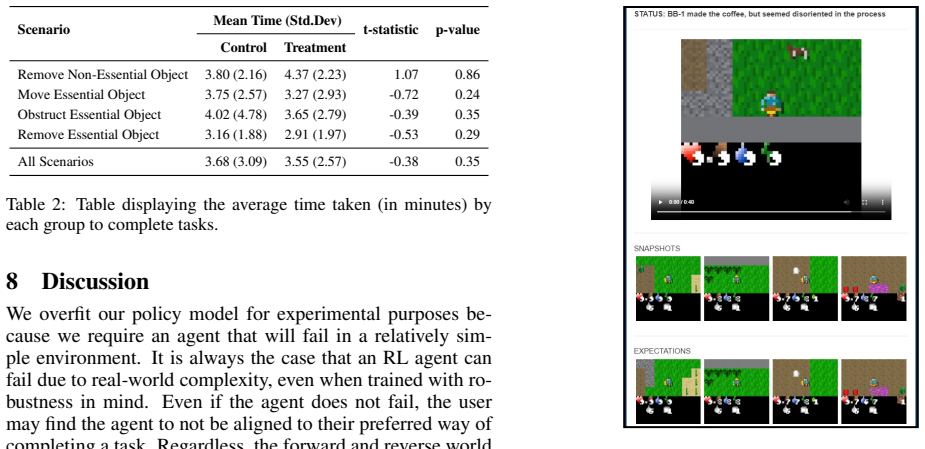
- [Table 2] The per-scenario t-tests appear to use one-sided p-values; please specify the test direction and, if multiple comparisons were made, report whether any correction was applied.
Circularity Check
No significant circularity: the human-study claim is empirical and independent of any fitted parameter, though the paper over-labels RWM reconstructions as counterfactuals without direct validation.
full rationale
The paper's central claim is an empirical human-subject result: treatment-group participants identified the cause of agent failure significantly more often than control participants (64.86% vs. 26.52%, Fisher's exact p<0.00001). This outcome is measured independently and does not feed back into the Reverse World Model, the forward world model, or the policy, so no fitted parameter is being renamed as a prediction. The RWM is described in Section 5 as trained by time-reversing replay-buffer transitions and optimizing reconstruction error between the observed prior state and the decoded image; the phrase 'state that the agent should have been at time t for its policy to pick the desired action' (Figure 2) is an interpretive label applied to the reconstruction, not a property enforced by the training loss or verified by the study. That is a validity concern about whether the generated images are true counterfactuals, not a circular derivation. The paper's self-citations (Alabdulkarim et al. 2025, Mansi and Riedl 2023, Peng et al. 2022) appear in related-work and motivation contexts and are not load-bearing for the empirical result; no uniqueness theorem or unsupported self-citation chain is invoked. Section 8 honestly concedes that RWM outputs are tied to the training distribution, which further indicates the authors are not presenting the RWM as an externally validated counterfactual oracle. The lack of an active-control arm in the user study is a methodological limitation, but it does not make the derivation circular. Overall, the paper is an empirical study with a self-contained statistical claim and no reduction of the central result to its inputs by construction.
Assumptions & free parameters
assumptions (4)
- domain assumption DreamerV3's world model (sequence model, encoder, dynamics predictor, decoder, reward predictor, continue predictor) accurately represents environment dynamics for the task at hand.
- ad hoc to paper Reversing the temporal order of the replay data and training a copy of the world model on that reversed data yields a valid approximation of the inverse transition distribution p(z_{t-1}|h_{t-1}).
- domain assumption The counterfactual state s_t (diamond) generated by the RWM, together with the desired action a_t (diamond), would lead the agent's policy to prefer a_t (diamond) over the actual action.
- domain assumption The generated counterfactual images contain interpretable, causal visual differences (e.g., missing or moved objects) that non-expert users can recognize.
invented entities (1)
-
Reverse World Model (RWM)
Cite this review
Pith. "Pith review of Explainable Reinforcement Learning Agents Using World Models." pith.science (2026). https://pith.science/paper/DHDUMQRH
@misc{pith2026250508073,
  author       = {Pith},
  title        = {Pith review of: Explainable Reinforcement Learning Agents Using World Models},
  year         = {2026},
  howpublished = {\url{https://pith.science/paper/DHDUMQRH}},
  note         = {Machine review of arXiv:2505.08073}
}
read the original abstract
Explainable AI (XAI) systems have been proposed to help people understand how AI systems produce outputs and behaviors. Explainable Reinforcement Learning (XRL) has an added complexity due to the temporal nature of sequential decision-making. Further, non-AI experts do not necessarily have the ability to alter an agent or its policy. We introduce a technique for using World Models to generate explanations for Model-Based Deep RL agents. World Models predict how the world will change when actions are performed, allowing for the generation of counterfactual trajectories. However, identifying what a user wanted the agent to do is not enough to understand why the agent did something else. We augment Model-Based RL agents with a Reverse World Model, which predicts what the state of the world should have been for the agent to prefer a given counterfactual action. We show that explanations that show users what the world should have been like significantly increase their understanding of the agent policy. We hypothesize that our explanations can help users learn how to control the agents execution through by manipulating the environment.
Figures


Figures from the paper (4 more)



Reference graph
Works this paper leans on
-
[1]
Experiential explanations for reinforce- ment learning
[Alabdulkarim et al., 2025] Amal Alabdulkarim, Madhuri Singh, Gennie Mansi, Kaely Hall, Upol Ehsan, and Mark O Riedl. Experiential explanations for reinforce- ment learning. Neural Computing and Applications, pages 1–31,
work page 2025
-
[5]
Traditional and raw task load index (tlx) correlations: Are paired comparisons necessary
[Byers et al., 1989] James C Byers, AC Bittner, and Susan G Hill. Traditional and raw task load index (tlx) correlations: Are paired comparisons necessary. Advances in industrial ergonomics and safety, 1:481–485,
work page 1989
-
[11]
[Ha and Schmidhuber, 2018] David Ha and J ¨urgen Schmid- huber. World models
work page 2018
-
[12]
Learning latent dynamics for planning from pixels,
[Hafner et al., 2019] Danijar Hafner, Timothy Lillicrap, Ian Fischer, Ruben Villegas, David Ha, Honglak Lee, and James Davidson. Learning latent dynamics for planning from pixels,
work page 2019
-
[13]
Mastering diverse control tasks through world models
[Hafner et al., 2025] Danijar Hafner, Jurgis Pasukonis, Jimmy Ba, and Timothy Lillicrap. Mastering diverse control tasks through world models. Nature, pages 1–7,
work page 2025
-
[14]
Benchmarking the spectrum of agent capabilities,
[Hafner, 2022] Danijar Hafner. Benchmarking the spectrum of agent capabilities,
work page 2022
-
[17]
[Huber et al., 2023] Tobias Huber, Maximilian Demmler, Silvan Mertes, Matthew L. Olson, and Elisabeth Andr ´e. Ganterfactual-rl: Understanding reinforcement learning agents’ strategies through visual counterfactual explana- tions. In Proceedings of the 2023 International Conference on Autonomous Agents and Multiagent Systems, AAMAS ’23, page 1097–1106, Ri...
work page 2023
-
[18]
[Kaelbling et al., 1996] Leslie Pack Kaelbling, Michael L Littman, and Andrew W Moore
International Foundation for Autonomous Agents and Multiagent Sys- tems. [Kaelbling et al., 1996] Leslie Pack Kaelbling, Michael L Littman, and Andrew W Moore. Reinforcement learn- ing: A survey. Journal of artificial intelligence research, 4:237–285,
work page 1996
Show all 29 references
-
[20]
Why don’t you do something about it? outlining connec- tions between ai explanations and user actions,
[Mansi and Riedl, 2023] Gennie Mansi and Mark Riedl. Why don’t you do something about it? outlining connec- tions between ai explanations and user actions,
2023
-
[21]
Explainable reinforcement learning: A survey and comparative review
[Milani et al., 2024] Stephanie Milani, Nicholay Topin, Manuela Veloso, and Fei Fang. Explainable reinforcement learning: A survey and comparative review. ACM Com- puting Surveys, 56(7):1–36, April
2024
-
[22]
Explanation in artificial intelli- gence: Insights from the social sciences
[Miller, 2019] Tim Miller. Explanation in artificial intelli- gence: Insights from the social sciences. Artificial intelli- gence, 267:1–38,
2019
-
[23]
Olson, Roli Khanna, Lawrence Neal, Fuxin Li, and Weng-Keen Wong
[Olson et al., 2021] Matthew L. Olson, Roli Khanna, Lawrence Neal, Fuxin Li, and Weng-Keen Wong. Coun- terfactual state explanations for reinforcement learning agents via generative deep learning. Artificial Intelligence, 295:103455,
2021
-
[24]
Inherently explainable reinforcement learning in natural language
[Peng et al., 2022] Xiangyu Peng, Mark Riedl, and Prithvi- raj Ammanabrolu. Inherently explainable reinforcement learning in natural language. Advances in Neural Infor- mation Processing Systems, 35:16178–16190,
2022
-
[25]
Counterfactual ex- plainer for deep reinforcement learning models using pol- icy distillation
[Samadi et al., 2025] Amir Samadi, Konstantinos Koufos, Kurt Debattista, and Mehrdad Dianati. Counterfactual ex- plainer for deep reinforcement learning models using pol- icy distillation. ACM Trans. Intell. Syst. Technol., 16(2), February
2025
-
[26]
Integrating policy summaries with reward decomposition for explaining reinforcement learn- ing agents
[Septon et al., 2023] Yael Septon, Tobias Huber, Elisabeth Andr´e, and Ofra Amir. Integrating policy summaries with reward decomposition for explaining reinforcement learn- ing agents. In International Conference on Practical Ap- plications of Agents and Multi-Agent Systems, p...
2023
-
[27]
Bridging the gap: Providing post-hoc sym- bolic explanations for sequential decision-making prob- lems with inscrutable representations
[Sreedharan et al., 2022] Sarath Sreedharan, Utkarsh Soni, Mudit Verma, Siddharth Srivastava, and Subbarao Kamb- hampati. Bridging the gap: Providing post-hoc sym- bolic explanations for sequential decision-making prob- lems with inscrutable representations. In International C...
2022
-
[28]
Contrastive explana- tions for reinforcement learning in terms of expected con- sequences
[van der Waa et al., 2018] J van der Waa, J van Diggelen, K van den Bosch, and M Neerincx. Contrastive explana- tions for reinforcement learning in terms of expected con- sequences. XAI 2018, page 165,
2018
-
[29]
Assessing explainability in reinforcement learning
[Zelvelder et al., 2021] Amber E Zelvelder, Marcus West- berg, and Kary Fr ¨amling. Assessing explainability in reinforcement learning. In International Workshop on Explainable, Transparent Autonomous Agents and Multi- Agent Systems, pages 223–240. Springer, 2021
2021
-
[1988]
Hoffman, Shane T
[Hoffman et al., 2023] Robert R. Hoffman, Shane T. Mueller, Gary Klein, and Jordan Litman. Measures for explainable ai: Explanation goodness, user satisfaction, mental models, curiosity, trust, and human-ai perfor- mance. Frontiers in Computer Science, V olume 5 - 2023,
2023
-
[1989]
The emerging landscape of explainable automated planning & decision making
[Chakraborti et al., 2021] Tathagata Chakraborti, Sarath Sreedharan, and Subbarao Kambhampati. The emerging landscape of explainable automated planning & decision making. In Proceedings of the Twenty-Ninth Interna- tional Conference on International Joint Conferences on Artifi...
2021
-
[1996]
Explainable reinforcement learning through a causal lens
[Madumal et al., 2020] Prashan Madumal, Tim Miller, Liz Sonenberg, and Frank Vetere. Explainable reinforcement learning through a causal lens. In Proceedings of the AAAI conference on artificial intelligence , volume 34, pages 2493–2500,
2020
-
[2018]
Explaining reinforcement learning agents through counterfactual action outcomes
[Amitai et al., 2024] Yotam Amitai, Yael Septon, and Ofra Amir. Explaining reinforcement learning agents through counterfactual action outcomes. In Proceedings of the Thirty-Eighth AAAI Conference on Artificial Intelli- gence and Thirty-Sixth Conference on Innovative Appli- ca...
2024
-
[2019]
Diversity is all you need: Learning skills without a reward function,
[Eysenbach et al., 2018] Benjamin Eysenbach, Abhishek Gupta, Julian Ibarz, and Sergey Levine. Diversity is all you need: Learning skills without a reward function,
2018
-
[2020]
State2explanation: Concept-based explanations to benefit agent learning and user understanding.Advances in Neural Information Processing Systems, 36:67156–67182,
[Das et al., 2023] Devleena Das, Sonia Chernova, and Been Kim. State2explanation: Concept-based explanations to benefit agent learning and user understanding.Advances in Neural Information Processing Systems, 36:67156–67182,
2023
-
[2021]
Leveraging rationales to improve human task per- formance
[Das and Chernova, 2020] Devleena Das and Sonia Cher- nova. Leveraging rationales to improve human task per- formance. In Proceedings of the 25th international confer- ence on intelligent user interfaces, pages 510–518,
2020
-
[2022]
Development of nasa-tlx (task load index): Re- sults of empirical and theoretical research
[Hart and Staveland, 1988] Sandra G Hart and Lowell E Staveland. Development of nasa-tlx (task load index): Re- sults of empirical and theoretical research. In Advances in psychology, volume 52, pages 139–183. Elsevier,
1988
-
[2023]
Auto- mated rationale generation: a technique for explainable ai and its effects on human perceptions
[Ehsan et al., 2019] Upol Ehsan, Pradyumna Tambwekar, Larry Chan, Brent Harrison, and Mark O Riedl. Auto- mated rationale generation: a technique for explainable ai and its effects on human perceptions. In Proceedings of the 24th international conference on intelligent user in...
2019
-
[2024]
Efficient Adaptation of Reinforcement Learning Agents to Suddent Environmental Change
[Balloch, 2024] Jonathan Balloch. Efficient Adaptation of Reinforcement Learning Agents to Suddent Environmental Change. Doctoral dissertation, Georgia Institute of Tech- nology,
2024
-
[2025]
Agent strategy summarization
[Amir et al., 2018] Ofra Amir, Finale Doshi-Velez, and David Sarne. Agent strategy summarization. In Proceed- ings of the 17th International Conference on Autonomous Agents and MultiAgent Systems, pages 1203–1207,
2018
Reviewed August 15, 2026 · model on record in the stance chip above.
Discussion (0). Continue with ORCID to comment.