A Unified Framework for the Non-Hermitian Localization: Boundary-Insensitive Modes and Electric-Magnetic Analogy
Pith reviewed 2026-05-22 15:12 UTC · model grok-4.3
The pith
A spatially inhomogeneous imaginary scalar potential induces a boundary-insensitive skin effect in non-Hermitian systems.
A machine-rendered reading of the paper's core claim, the machinery that carries it, and where it could break.
Core claim
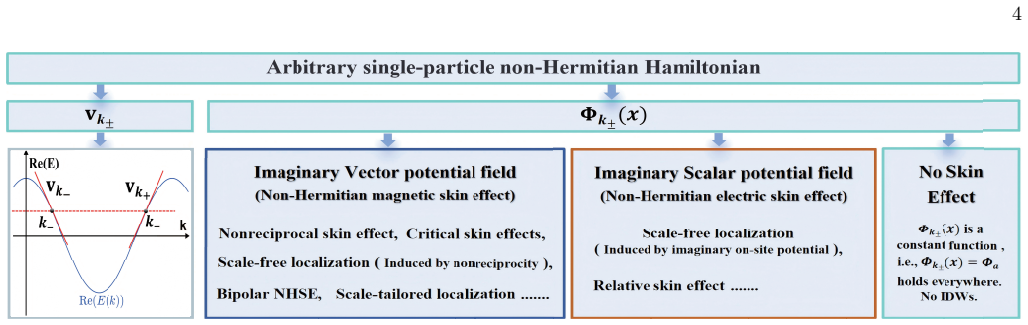
We demonstrate that a spatially inhomogeneous imaginary scalar potential field induces a skin effect that is insensitive to boundary conditions, with both the spectrum and eigenstate distribution remaining invariant. This behavior, not captured by existing theories, is attributed to translational symmetry breaking induced by spatially varying imaginary potentials in finite systems. We formulate a universal theory for localization in single-particle non-Hermitian systems that classifies skin effects into electric type driven by imaginary scalar potentials and magnetic type driven by imaginary vector potentials, revealing a phase transition to fully delocalized eigenstates.
What carries the argument
The electric-magnetic analogy classifying skin effects driven by imaginary scalar potentials versus imaginary vector potentials.
Load-bearing premise
Spatially varying imaginary potentials break translational symmetry in finite systems and thereby render the skin effect insensitive to boundary conditions.
What would settle it
Observe whether the energy spectrum and spatial distribution of eigenstates remain unchanged when switching from periodic to open boundary conditions in a finite non-Hermitian lattice with a fixed inhomogeneous imaginary scalar potential.
Figures




read the original abstract
The non-Hermitian skin effect is fundamentally characterized by its sensitivity to boundary conditions, reflected in changes to the energy spectrum and boundary-localized eigenstates. Here, we demonstrate that a spatially inhomogeneous imaginary scalar potential field induces a skin effect that is insensitive to boundary conditions. Both the spectrum and eigenstate distribution remain invariant, a behavior not captured by existing theories. We attribute this anomaly to translational symmetry breaking induced by spatially varying imaginary potentials in finite systems. We further formulate a theory that universally predicts localization in single-particle non-Hermitian systems. This framework classifies skin effects into two fundamental types: electric, driven by imaginary scalar potentials, and magnetic, driven by imaginary vector potentials, and reveals a phase transition between them, where eigenstates become fully delocalized. Our work provides a unified theory for non-Hermitian localization, allowing full control over skin modes via potential engineering in various platforms like photonic crystals and cold-atom systems.
Editorial analysis
A structured set of objections, weighed in public.
Referee Report
Summary. The paper claims that a spatially inhomogeneous imaginary scalar potential induces a non-Hermitian skin effect insensitive to boundary conditions, with both the complex spectrum and eigenstate spatial distribution remaining invariant when switching between open and periodic boundaries. This anomaly is attributed to translational symmetry breaking by the inhomogeneity in finite systems. The authors formulate a unified theory classifying non-Hermitian skin effects into 'electric' (driven by imaginary scalar potentials) and 'magnetic' (driven by imaginary vector potentials) types, identify a phase transition to fully delocalized states between them, and assert that existing non-Bloch or generalized Brillouin zone frameworks do not capture this behavior.
Significance. If the boundary-insensitivity and the electric-magnetic classification hold with explicit mappings or effective models independent of specific V(x) profiles and system sizes, the work would offer a new universality class for controlling localization in non-Hermitian systems, with potential applications in photonic crystals and cold atoms. The manuscript does not yet provide machine-checked proofs, reproducible code, or falsifiable predictions that would strengthen this assessment.
major comments (2)
- [Abstract and main theory section] The central claim that both spectrum and eigenstate distribution remain invariant under change of boundary conditions (open vs. periodic) for arbitrary spatially varying imaginary scalar potential V(x) is load-bearing but not demonstrated beyond specific finite-size examples. The translational symmetry breaking argument does not explain why standard non-Hermitian skin effect remains BC-sensitive under other inhomogeneous potentials; an explicit effective model or mapping showing invariance independent of the functional form of V(x) is required.
- [Theory formulation] The distinction from existing non-Bloch and generalized Brillouin zone frameworks is asserted but not shown to be incompatible. No concrete test or counter-example is provided demonstrating that the proposed electric-magnetic classification yields predictions outside the scope of generalized Brillouin zone methods for the same inhomogeneous potentials.
minor comments (2)
- [Classification section] Notation for the electric and magnetic skin-effect types should be defined with explicit equations rather than introduced only descriptively.
- [Numerical results] Figure captions for eigenstate distributions should explicitly state the boundary conditions used and the system size to allow direct comparison of invariance.
Simulated Author's Rebuttal
We thank the referee for the careful reading and constructive feedback on our manuscript. The comments highlight important points regarding the generality of our claims and the need for explicit demonstrations. We address each major comment below and have revised the manuscript accordingly to incorporate additional analytical mappings, numerical examples, and counter-examples.
read point-by-point responses
-
Referee: [Abstract and main theory section] The central claim that both spectrum and eigenstate distribution remain invariant under change of boundary conditions (open vs. periodic) for arbitrary spatially varying imaginary scalar potential V(x) is load-bearing but not demonstrated beyond specific finite-size examples. The translational symmetry breaking argument does not explain why standard non-Hermitian skin effect remains BC-sensitive under other inhomogeneous potentials; an explicit effective model or mapping showing invariance independent of the functional form of V(x) is required.
Authors: We thank the referee for this observation. The invariance arises because any spatially inhomogeneous imaginary scalar potential breaks translational symmetry in finite systems, eliminating the periodic phase accumulation that underlies boundary sensitivity in conventional non-Hermitian skin effects. Standard skin effects remain boundary-sensitive under other inhomogeneous potentials (e.g., real-valued or uniform imaginary ones) because those preserve an effective translational invariance or do not induce the same local complex-energy shifts. To make the argument independent of specific V(x), we have added an effective model in the revised manuscript: the inhomogeneous imaginary scalar potential is mapped to a position-dependent complex on-site shift that localizes eigenstates via gradient-driven accumulation, without requiring global periodicity or boundary reflections. This mapping holds for arbitrary functional forms. We also include additional numerical demonstrations for linear, quadratic, and random V(x) profiles across multiple system sizes to confirm the invariance. revision: yes
-
Referee: [Theory formulation] The distinction from existing non-Bloch and generalized Brillouin zone frameworks is asserted but not shown to be incompatible. No concrete test or counter-example is provided demonstrating that the proposed electric-magnetic classification yields predictions outside the scope of generalized Brillouin zone methods for the same inhomogeneous potentials.
Authors: We agree that an explicit incompatibility test strengthens the presentation. The generalized Brillouin zone (GBZ) relies on the existence of a well-defined complex momentum in systems with underlying periodicity or homogeneity, which breaks down for strongly position-dependent potentials without lattice periodicity. Our electric-magnetic classification, based on the potential type (scalar vs. vector), predicts a delocalization transition and boundary insensitivity that GBZ cannot capture for electric-type driving. In the revision, we add a concrete counter-example: for a specific linearly varying imaginary scalar potential, GBZ incorrectly anticipates boundary-localized modes with a deformed contour, whereas our framework correctly identifies full boundary invariance and the electric-to-magnetic phase transition to delocalized states. This example is supported by direct diagonalization and effective potential analysis. revision: yes
Circularity Check
No significant circularity in derivation chain
full rationale
The paper introduces a classification of non-Hermitian skin effects into electric (imaginary scalar potential) and magnetic (imaginary vector potential) types, with a claimed phase transition to delocalized states, and attributes boundary-insensitive localization to translational symmetry breaking by inhomogeneous potentials. No load-bearing step reduces by construction to a fitted parameter renamed as prediction, a self-citation chain, or an ansatz smuggled from prior work by the same authors. The framework is presented as a new organizing principle with explicit distinctions from existing non-Bloch and generalized Brillouin zone approaches, and the central invariance claim is tied to concrete finite-system examples rather than tautological redefinitions. The derivation chain therefore remains self-contained against external benchmarks.
Axiom & Free-Parameter Ledger
invented entities (1)
-
Electric and magnetic skin-effect types
no independent evidence
Lean theorems connected to this paper
-
IndisputableMonolith/Cost/FunctionalEquation.leanwashburn_uniqueness_aczel unclear?
unclearRelation between the paper passage and the cited Recognition theorem.
We classify skin effects into two fundamental types: electric, driven by imaginary scalar potentials, and magnetic, driven by imaginary vector potentials, and reveal a phase transition between them, where eigenstates become fully delocalized.
-
IndisputableMonolith/Foundation/RealityFromDistinction.leanreality_from_one_distinction unclear?
unclearRelation between the paper passage and the cited Recognition theorem.
effective model ... vk±k̂ + iΦ(x) ... |ψk±(x)|² = 1/N exp(2/vk± ∫[Φ(x′)−Φa]dx′)
What do these tags mean?
- matches
- The paper's claim is directly supported by a theorem in the formal canon.
- supports
- The theorem supports part of the paper's argument, but the paper may add assumptions or extra steps.
- extends
- The paper goes beyond the formal theorem; the theorem is a base layer rather than the whole result.
- uses
- The paper appears to rely on the theorem as machinery.
- contradicts
- The paper's claim conflicts with a theorem or certificate in the canon.
- unclear
- Pith found a possible connection, but the passage is too broad, indirect, or ambiguous to say the theorem truly supports the claim.
Forward citations
Cited by 1 Pith paper
-
Decoherence Resilience of the Non-Hermitian Skin Effect
Photonic quantum walk experiments show the non-Hermitian skin effect persists and is enhanced by dephasing decoherence but exhibits order-dependent suppression under amplitude damping.
Reference graph
Works this paper leans on
-
[1]
R. El-Ganainy, K. G. Makris, M. Khajavikhan, Z. H. Musslimani, S. Rotter, and D. N. Christodoulides, Non- hermitian physics and pt symmetry, Nat. Phys. 14, 11 (2018)
work page 2018
-
[2]
Z. Gong, Y. Ashida, K. Kawabata, K. Takasan, S. Hi- gashikawa, and M. Ueda, Topological phases of non- hermitian systems, Phys. Rev. X 8, 031079 (2018)
work page 2018
-
[3]
F. K. Kunst, E. Edvardsson, J. C. Budich, and E. J. Bergholtz, Biorthogonal bulk-boundary correspondence in non-hermitian systems, Phys. Rev. Lett. 121, 026808 (2018)
work page 2018
-
[4]
K. Kawabata, K. Shiozaki, M. Ueda, and M. Sato, Sym- metry and topology in non-hermitian physics, Phys. Rev. X 9, 041015 (2019)
work page 2019
- [5]
- [6]
-
[7]
F. Song, S. Yao, and Z. Wang, Non-hermitian skin effect and chiral damping in open quantum systems, Phys. Rev. Lett. 123, 170401 (2019)
work page 2019
-
[8]
L. Li, C. H. Lee, S. Mu, and J. Gong, Critical non- hermitian skin effect, Nat. Commun. 11, 5491 (2020)
work page 2020
- [9]
-
[10]
Z. Yang, K. Zhang, C. Fang, and J. Hu, Non-hermitian bulk-boundary correspondence and auxiliary generalized brillouin zone theory, Phys. Rev. Lett. 125, 226402 (2020)
work page 2020
- [11]
-
[12]
D. S. Borgnia, A. J. Kruchkov, and R.-J. Slager, Non- hermitian boundary modes and topology, Phys. Rev. Lett. 124, 056802 (2020)
work page 2020
- [13]
-
[14]
Y. Peng, J. Jie, D. Yu, and Y. Wang, Manipulating the non-hermitian skin effect via electric fields, Phys. Rev. B 106, L161402 (2022)
work page 2022
- [15]
-
[16]
C.-X. Guo, L. Su, Y. Wang, L. Li, J. Wang, X. Ruan, Y. Du, D. Zheng, S. Chen, and H. Hu, Scale-tailored lo- calization and its observation in non-hermitian electrical circuits, Nat. Commun. 15, 9120 (2024)
work page 2024
-
[17]
H.-Y. Wang, F. Song, and Z. Wang, Amoeba formulation of non-bloch band theory in arbitrary dimensions, Phys. Rev. X 14, 021011 (2024)
work page 2024
-
[18]
T. E. Lee, Anomalous edge state in a non-hermitian lat- tice, Phys. Rev. Lett. 116, 133903 (2016)
work page 2016
- [19]
-
[20]
Y. Li, C. Liang, C. Wang, C. Lu, and Y.-C. Liu, Gain- loss-induced hybrid skin-topological effect, Phys. Rev. Lett. 128, 223903 (2022)
work page 2022
-
[21]
B. A. Bhargava, I. C. Fulga, J. van den Brink, and A. G. 10 Moghaddam, Non-hermitian skin effect of dislocations and its topological origin, Phys. Rev. B 104, L241402 (2021)
work page 2021
-
[22]
Z. Lin, L. Ding, S. Ke, and X. Li, Steering non-hermitian skin modes by synthetic gauge fields in optical ring res- onators, Opt. Lett. 46, 3512 (2021)
work page 2021
- [23]
-
[24]
S. Manna and B. Roy, Inner skin effects on non-hermitian topological fractals, Commun. Phys. 6, 10 (2023)
work page 2023
- [25]
-
[26]
K. Wang, A. Dutt, K. Y. Yang, C. C. Wojcik, J. Vuˇ ckovi´ c, and S. Fan, Generating arbitrary topologi- cal windings of a non-hermitian band, Science 371, 1240 (2021)
work page 2021
-
[27]
C.-H. Liu, K. Zhang, Z. Yang, and S. Chen, Helical damp- ing and dynamical critical skin effect in open quantum systems, Phys. Rev. Res. 2, 043167 (2020)
work page 2020
-
[28]
K. Yokomizo and S. Murakami, Scaling rule for the crit- ical non-hermitian skin effect, Phys. Rev. B 104, 165117 (2021)
work page 2021
-
[29]
L. Li, C. H. Lee, and J. Gong, Impurity induced scale-free localization, Commun. Phys. 4, 42 (2021)
work page 2021
-
[30]
C.-X. Guo, X. Wang, H. Hu, and S. Chen, Accumula- tion of scale-free localized states induced by local non- hermiticity, Phys. Rev. B 107, 134121 (2023)
work page 2023
-
[31]
X. Xie, G. Liang, F. Ma, Y. Du, Y. Peng, E. Li, H. Chen, L. Li, F. Gao, and H. Xue, Observation of scale-free local- ized states induced by non-hermitian defects, Phys. Rev. B 109, L140102 (2024)
work page 2024
- [32]
-
[33]
X. Zhao and H. Hu, Tentaclelike spectra and bound states in the hatano-nelson chain with long-range impurity cou- pling, Phys. Rev. B 111, 054204 (2025)
work page 2025
-
[34]
F. Song, S. Yao, and Z. Wang, Non-hermitian topological invariants in real space, Phys. Rev. Lett. 123, 246801 (2019)
work page 2019
-
[35]
F. Schindler and A. Prem, Dislocation non-hermitian skin effect, Phys. Rev. B 104, L161106 (2021)
work page 2021
-
[36]
Longhi, Stochastic non-hermitian skin effect, Opt
S. Longhi, Stochastic non-hermitian skin effect, Opt. Lett. 45, 5250 (2020)
work page 2020
-
[37]
Yuce, Nonlinear non-hermitian skin effect, Phys
C. Yuce, Nonlinear non-hermitian skin effect, Phys. Lett. A 408, 127484 (2021)
work page 2021
-
[38]
X. Xu, H. Xu, S. Mandal, R. Banerjee, S. Ghosh, and T. C. H. Liew, Interaction-induced double-sided skin ef- fect in an exciton-polariton system, Phys. Rev. B 103, 235306 (2021)
work page 2021
-
[39]
Longhi, Erratic non-hermitian skin localization, Phys
S. Longhi, Erratic non-hermitian skin localization, Phys. Rev. Lett. 134, 196302 (2025)
work page 2025
- [40]
- [41]
-
[42]
S. Weidemann, M. Kremer, T. Helbig, T. Hofmann, A. Stegmaier, M. Greiter, R. Thomale, and A. Szameit, Topological funneling of light, Science 368, 311 (2020)
work page 2020
-
[43]
L. Xiao, T. Deng, K. Wang, G. Zhu, Z. Wang, W. Yi, and P. Xue, Non-hermitian bulk–boundary correspondence in quantum dynamics, Nat. Phys. 16, 761 (2020)
work page 2020
-
[44]
D. Zou, T. Chen, W. He, J. Bao, C. H. Lee, H. Sun, and X. Zhang, Observation of hybrid higher-order skin- topological effect in non-hermitian topolectrical circuits, Nat. Commun. 12, 7201 (2021)
work page 2021
- [45]
- [46]
-
[47]
Q. Lin, T. Li, L. Xiao, K. Wang, W. Yi, and P. Xue, Topological phase transitions and mobility edges in non- hermitian quasicrystals, Phys. Rev. Lett. 129, 113601 (2022)
work page 2022
-
[48]
K. Yokomizo, Non-Bloch Band Theory of Non-Hermitian Systems, Springer Theses (Springer Nature Singapore, Singapore, 2022)
work page 2022
- [49]
-
[50]
Y. Jiang, M.-L. Cai, Y.-K. Wu, Q.-X. Mei, W.-D. Zhao, X.-Y. Chang, L. Yao, L. He, Z.-C. Zhou, and L.-M. Duan, Quantum simulation of the two-dimensional weyl equa- tion in a magnetic field, Phys. Rev. Lett. 128, 200502 (2022)
work page 2022
- [51]
-
[52]
S. M. Rafi-Ul-Islam, Z. B. Siu, M. S. H. Razo, and M. B. A. Jalil, Critical non-hermitian skin effect in a cross-coupled hermitian chain, Phys. Rev. B 111, 115415 (2025)
work page 2025
-
[53]
J. Zhang, E.-Z. Li, Y.-J. Wang, B. Liu, L.-H. Zhang, Z.- Y. Zhang, S.-Y. Shao, Q. Li, H.-C. Chen, Y. Ma, T.-Y. Han, Q.-F. Wang, J.-D. Nan, Y.-M. Yin, D.-Y. Zhu, G.- C. Guo, D.-S. Ding, and B.-S. Shi, Exceptional point and hysteresis trajectories in cold rydberg atomic gases, Nat. Commun. 16, 3511 (2025)
work page 2025
-
[54]
F. Qin, R. Shen, L. Li, and C. H. Lee, Kinked linear response from non-hermitian cold-atom pumping, Phys. Rev. A 109, 053311 (2024)
work page 2024
-
[55]
L. Li, C. H. Lee, and J. Gong, Topological switch for non-hermitian skin effect in cold-atom systems with loss, Phys. Rev. Lett. 124, 250402 (2020)
work page 2020
-
[56]
Longhi, Incoherent non-hermitian skin effect in pho- tonic quantum walks, Light Sci
S. Longhi, Incoherent non-hermitian skin effect in pho- tonic quantum walks, Light Sci. Appl. 13, 95 (2024)
work page 2024
- [57]
-
[58]
M. Gao, C. Sheng, Y. Zhao, R. He, L. Lu, W. Chen, K. Ding, S. Zhu, and H. Liu, Quantum walks of correlated photons in non-hermitian photonic lattices, Phys. Rev. B 110, 094308 (2024)
work page 2024
-
[59]
A. Wang, Z. Meng, and C. Q. Chen, Non-hermitian topology in static mechanical metamaterials, Sci. Adv. 11 9, eadf7299 (2023)
work page 2023
-
[60]
J. Lu, W. Deng, X. Huang, M. Ke, and Z. Liu, Non-hermitian topological phononic metamaterials, Adv. Mater. , 2307998 (2023)
work page 2023
-
[61]
See supplementary material at [url will be inserted by publisher] for (i) special solutions to eq. (2) under open boundary conditions (ii) universality of generalized non- hermitian skin effect; (iii) matlab code for figures. ACKNOWLEDGMENTS Acknowledgments This work was supported by the National Key R&D Program of China (Grant No. 2023YF A1406704) and Natu...
-
[62]
SFL from non-Hermitian electric skin effect 6
-
[63]
Critical non-Hermitian skin effect 11 D
SFL from non-Hermitian magnetic skin effect 9 C. Critical non-Hermitian skin effect 11 D. Bipolar Non-Hermitian Skin Effect 13 E. Summary 15 III. MATLAB Code for Figures 15 A. Figs. 1 16
- [64]
-
[65]
Fig. 5(b)-(d) 24 E. Fig. 6 26 References 27 I. SPECIAL SOLUTIONS TO EQ. (2) UNDER OPEN BOUNDAR Y CONDITIONS In addition to the derivation presented in the main text, there are t wo special cases that require separate treatment: (1) scale-free localization in the non-Hermitian electric skin effec t, and (2) scalar potentials of the form Φ( x) = λ sgn ( (x −...
-
[66]
F orvk > 0: λ + − Ei < 0 and λ − − Ei > 0 = ⇒ λ + <E i <λ − , which requires λ + <λ −
-
[67]
F orvk < 0: λ + − Ei > 0 and λ − − Ei < 0 = ⇒ λ − <E i <λ + , which requires λ − <λ +. Thus, when Φ( x) approaches distinct constants at infinity, solutions satisfying ful l Dirichlet boundary conditions exist. Since λ + < λ− and λ − < λ+ cannot hold simultaneously, only one of the two modes corresponding to vk± survives. Consequently, the degeneracy in Eq...
-
[68]
fall into two distinct classes: The first class comprises P -fold degenerate solutions, representing a P th-order exceptional point. Their eigenstates localize strictly at the first site, interpreted as remnants of the N th-order exceptional point under open boundaries, unaffected by the long-range coupling. The second class consists of l non-degenerate solu...
-
[69]
SFL from non-Hermitian electric skin effect Following Ref. [ 2], SFL manifests in two distinct scenarios: one with a localized non -Hermitian perturbation (e.g., gain/loss) applied at the boundary, and another with a non-Hermitian impuri ty located at a finite distance from the boundary. We first consider the simplest boundary case: HSFL, edge = L− 1∑ j=1 t ...
-
[70]
SFL from non-Hermitian magnetic skin effect An imaginary vector potential can also induce scale-free localization (SF L). We begin with the model proposed in Ref. [ 3], illustrated in Fig. 3(a): H = L− 1∑ j=0 [eα ˆc† j ˆcj+1 +e− α ˆc† j ˆcj− 1] +µ +ˆc† Lˆc0 +µ − ˆc† 0ˆcL, (17) where µ ± = µe ± α , µ controls the local impurity strength, and the nonreciproc...
-
[71]
(22) We denote such operators as H0 ∈ Af, with Af ⊂ A
∄ {H1, H2} ⊂ A \ { 0} such that H0 = C (H1, H2) (irreducibility) . (22) We denote such operators as H0 ∈ Af, with Af ⊂ A. Note: C : An → A is a composition operator mapping H1, H2,... to a new operator Hj, where {H1, H2, Hj} ⊂ A. For any Hsym ∈ A satisfying PSE (Hsym) = 1, Hsym can always be decomposed as Hsym = C (H1, H2... ). We further define a translat...
-
[72]
Figs. 1(a)-(b) clear clc mp.Digits(64) %high-precision computation plugin: https://www.advanpix.com N=200; r3=0.1; %nonreciprocal hopping amplitude t1=1; [Hs,Hop]=Hsum(N,t1,r3); [VR,VE]=eig(mp(Hs));% me=diag(VE); [~,ind]=sort(real(me),’descend’); % me=me(ind); VR=VR(:,ind); [VRo,VEo]=eig(mp(Hop));% meo=diag(VEo); [~,ind]=sort(real(meo),’descend’); % meo=m...
-
[73]
Figs. 1(c)-(d) clear clc mp.Digits(34) %high-precision computation plugin: https://www.advanpix.com N=200; r3=0.02; %imaginary scalar potential field strength t1=1; phia=0; % spatial average of the potential \Phi_a [Hs,Hop]=Hsum(N,t1,r3); [VR,VE]=eig(mp(Hs));% me=diag(VE); [~,ind]=sort(real(me),’descend’); % me=me(ind); VR=VR(:,ind); ind_logic = abs(imag(...
-
[74]
The first approach involves gradually increasing the strength of nonrec iprocal skin effect (NSE) on the basis of relative skin effect (RSE) and observing their competition through c hanges in the inverse decay length, as shown in (a), the numerical phase diagram
-
[75]
The second approach involves gradually increasing the strength of RSE on the basis of NSE and observing their competition through changes in the GBZ, as shown in (b)-(d)
- [76]
-
[77]
This result serves as the baseline, denoted as ”xiR”
First, set γ = 0 and vary λ, then fit the eigenstate distribution to obtain the change in the inve rse decay length of the eigenstates under pure RSE conditions. This result serves as the baseline, denoted as ”xiR”. clear clc mp.Digits(34) %High-precision computation library provided by https://www.advanpix.com/ %% Parameter settings %r_1 and r_2 represent...
-
[78]
Next, starting from this baseline (”xiR”), gradually increase γ, and fit the eigenstate distribution again to obtain the change in the inverse decay length of the eigenstates after intro ducing NSE. This data is recorded as ”xiG”. clear load("basic.mat") b=xiR; mp.Digits(34) %High-precision computation library provided by https://www.advanpix.com/ %% Param...
-
[79]
Finally, subtract the two results (”xiR - xiG”) to compute the orde r parameter η introduced in the main text. By identifying the zero points of η, the numerical phase boundary can be determined. clear load("basic.mat") n=size(xiR,1); xiRb = repmat(xiR,1,n); load("cal.mat") [X, Y] = meshgrid(r1,r3); % 1:n,1:n pic=xiRb-xiG; %Inverse decay length during the...
-
[80]
Fig. 5(b)-(d) GBZ Calculation Code: clear syms y t=1;gmma=0.1; tL1=t+gmma;tL2=t-gmma; tR1=tL2; tR2=tL1; s=0.; %\lambda %Number of discrete points numerically computed to form the GBZ A =[linspace(-2.5,2*pi+2.5,300),-0.05:0.013:2*pi+0.05]; beta11=zeros(size(A,2),2);beta21=beta11;EE=beta11; beta2_21=beta11;beta2_22=beta11;beta2_12=beta11;beta2_11=beta11; fo...
discussion (0)
Sign in with ORCID, Apple, or X to comment. Anyone can read and Pith papers without signing in.