REVIEW 3 major objections 5 minor 1 cited by
A Skull-Adaptive Framework for AI-Based 3D Transcranial Focused Ultrasound Simulation
T0 review · 3 major / 5 minor · reviewed 2026-08-15 · deepseek-v4-flash
Pith's one-line read The paper introduces a public dataset of 2,500 full-wave transcranial ultrasound simulations and a neural model that predicts the 3D pressure field from skull anatomy and transducer geometry, localizing the focal spot within a median of…
desk verdict TFUScapes fills a genuine gap with an open 3D tFUS simulation dataset, but the attenuation mapping has an ambiguity that must be resolved before the ground truth is trustworthy. read the letter →
The pith
A machine-rendered reading of the paper's core claim, the machinery that carries it, and where it could break.
The reading
What carries the argument
The load-bearing mechanism is transducer-aware conditioning of a 3D U-Net (an encoder–decoder convolutional network with skip connections). The transducer's active surface is represented as a set of 3D points, each encoded by a Fourier positional embedding and processed by MLP layers; an attention-weighted sum pools the points into a single permutation-invariant embedding. That embedding is injected into the U-Net three ways: dynamic convolutions in the encoder, feature-wise linear modulation (FiLM, a learned per-channel scale-and-shift) in the decoder, and bi-directional cross-attention between the embedding and CT features at each resolution. A weighted mean-squared-error loss, with voxel weights exponential in pressure, plus a gradient-consistency loss, focuses training on the focal region and preserves spatial structure.
What would settle it
Generate a test set where ground truth comes from real CT-derived acoustic parameters (or from hydrophone measurements through an ex vivo human skull) and run DeepTFUS with the same 55–75 mm bowl transducer at 500 kHz; the claim would be falsified if median focal position error rises above roughly one wavelength (3 mm) or median peak-pressure error exceeds about 25% on that real-bone benchmark.
Extended reading notes
Core claim
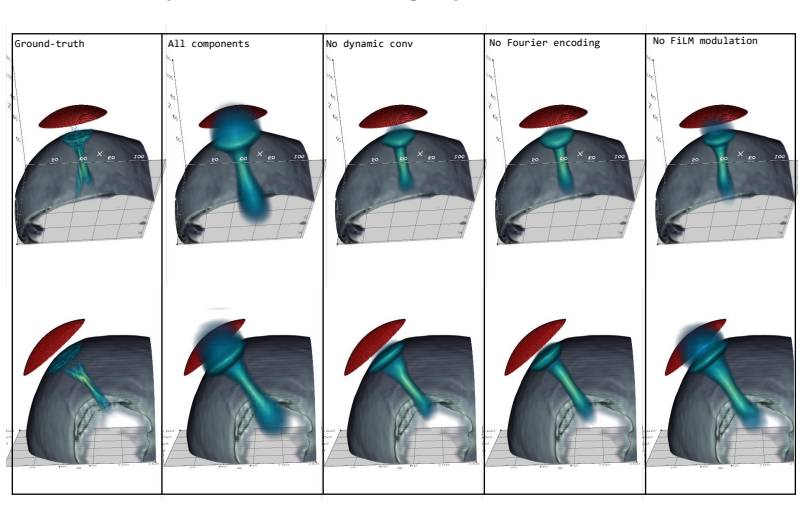
The central discovery is that a conditional deep network can approximate the full-wave pressure field of a transcranial focused ultrasound transducer well enough to locate the focus and estimate its amplitude, given only a pseudo-CT skull volume and the transducer's 3D coordinates. The paper builds the largest openly released dataset of its kind—2,500 full-wave simulations at 500 kHz through 125 anatomically realistic skull models, each with 20 transducer placements—and shows that the proposed model, DeepTFUS, achieves a median focal position error of 2.45 mm and a median maximum-pressure error of 16.6% on 30 unseen subjects. The ablation study establishes that the spatially weighted loss, not the architectural embellishments, is the main driver of localization accuracy: moving from plain L2 to the weighted loss reduces median focal error from 4.64 mm to 2.55 mm, while removing FiLM actually improves peak-pressure error. The paper therefore argues that simulation-grade accuracy is achievable at inference speed, with the residual error being acceptable for planning.
Load-bearing premise
The central assumption is that pseudo-CT volumes made from T1 MRI, combined with the simplified Hounsfield-unit-to-acoustic-property formulas, faithfully capture how real skull bone bends and absorbs ultrasound; if the synthetic skull properties are systematically wrong, the simulated training data and everything learned from it will not reflect true patient acoustics.
Editorial extensions
If this is right
- Patient-specific tFUS planning could shrink from hours of numerical simulation to seconds of network inference, enabling real-time re-planning during a procedure.
- The public TFUScapes dataset gives the community a common benchmark to compare future data-driven tFUS solvers, which did not previously exist at this scale.
- The loss-function result indicates that any competitive model should weight high-pressure voxels heavily, not just minimize global L2 error.
- The transducer-conditioning design is general: the same embedding machinery could accept different aperture sizes and curvatures within the trained range, and extensions could cover other source geometries.
- The reported median localization error of 2.45 mm is below one wavelength at 500 kHz (3 mm in water), suggesting the predicted field is usable for focus targeting.
Reading between the lines
- A decisive validation the paper does not perform is testing on real CT-derived acoustic models; if pseudo-CT systematically underestimates bone density, the 2.45 mm error may not survive the transfer to actual patient bone.
- The network outputs a normalized field, so converting predictions into absolute acoustic intensities or thermal dose requires a separate calibration step against the solver's source amplitude.
- Because the conditioning mechanism is decoupled from the U-Net backbone, the same architecture could be retrained for transcranial imaging or phase-aberration correction, where the input–output pair has the same geometry.
- The ablation suggests the model is over-parameterized: removing FiLM improved peak-pressure error, so a leaner architecture might match or beat the full model at lower inference cost.
Signed reviews
Editorial analysis
A structured set of objections, weighed in public.
Referee Report
Summary. The paper introduces TFUScapes, a public dataset of 2,500 full-wave 3D transcranial focused ultrasound (tFUS) simulations generated with the k-Wave solver from pseudo-CT volumes derived from T1-weighted MRI scans of 125 subjects. Each subject is paired with 20 bowl-transducer configurations at 500 kHz with random focal lengths and apertures in the 55–75 mm range. The paper also presents DeepTFUS, a transducer-conditioned 3D U-Net that predicts normalized pressure fields from a cropped pseudo-CT volume and transducer surface coordinates, using Fourier positional encoding, attention pooling, dynamic convolutions, FiLM, and cross-attention. Training uses a weighted MSE loss plus a gradient consistency loss. On a held-out test set of 30 subjects, the full model achieves relative_l2 of about 41%, a median focal position error of 2.45 mm, and a median maximum-pressure error of 16.63%. The dataset and configuration files are publicly released.
Significance. If the simulations are physically sound, TFUScapes would be a valuable public resource for data-driven tFUS planning, and DeepTFUS demonstrates a plausible path toward near-instant pressure-field estimation. The paper's strengths include the use of a standard solver (k-Wave), release of the dataset and code, detailed configuration-file pipeline, and explicit discussion of limitations. The main significance is therefore contingent on the correctness of the acoustic medium construction; the reported predictive accuracy is meaningful only if the underlying simulations are trustworthy, which the manuscript does not yet establish.
major comments (3)
- [Section 3.1, Eq. (1c)] Equation (1c) is undefined for Hounsfield units below HUmin=300 because the square root of (HU−HUmin)/(HUmax−HUmin) becomes negative when HU<300. The text in Section 4.1 states that soft tissue and brain matter (HU≈0) are modeled approximately as water. If values below HUmin are clipped to HUmin, then every soft-tissue and brain voxel receives α=αmax=8.7 dB/(MHz cm), which is not water-like and would strongly alter focal amplitudes and phase. If a different clipping or water assignment is used, it is not specified. Since this mapping defines the acoustic medium for every k-Wave simulation in the dataset, this is not a cosmetic issue: it propagates into all ground-truth fields, the trained model, and all reported metrics. The authors must correct the formula, specify the exact handling of HU<300, and confirm that the released configuration files are consistent with the stated water-like brain model.
- [Section 5 and Section 4.1] The dataset is not validated against real CT-based simulations or experimental measurements. The paper's central claim is that TFUScapes contains 'anatomically realistic' full-wave simulations, but the acoustic medium is derived entirely from pseudo-CT (an MR-to-pCT model) with a simplified HU-to-property mapping and a water-like brain model. The Limitations section acknowledges uncertainty, but the manuscript provides no quantitative comparison—e.g., a subset of cases re-simulated with real CT, or comparison with the Aubry et al. benchmark cases (Ref. [2])—to support the fidelity of the generated ground truth. Without such validation, the dataset's value as a benchmark for physics-based tFUS planning is unclear. Please add at least one comparison experiment or state explicitly and more prominently that the dataset is not validated for physical accuracy.
- [Table 1] The ablation results do not consistently support the full architectural design. Removing FiLM yields the lowest max_pressure_error (14.65±12.59), removing dynamic convolutions gives nearly identical focal_position_error to the full model (2.98±2.03 vs. 2.89±2.14), and DeepTFUStiny is competitive across all metrics. No statistical tests, confidence intervals, or repeated runs are reported. The text's claim that DeepTFUS achieves 'the best focal position accuracy' is therefore not substantiated. Please report variance across seeds or statistical significance, and temper the architectural conclusions accordingly.
minor comments (5)
- [Throughout] There are several typos: 'Y AML' in Section 1, 'vmodels' in Section 2.2, and 'Fourier postional encoding' in Section 4.2.
- [Section 3.2, Eq. (3)] The Fourier encoding formula is ambiguous as typeset: 'sin(20πti), cos(20πti),..., sin(2n−1πti)' likely means sin(2^{k}πt_i) for k=0,...,n−1; please use explicit superscript notation.
- [Section 4.1] The variable 'ppp' (points-per-period) is used but not defined in terms of ppw and the CFL number; please provide the exact relation used to compute Δt.
- [Section 3.2] The description of dynamic convolutions is underspecified: it is not clear how many dynamic kernels are generated, what their spatial size is, or how they are applied to the U-Net feature maps at each resolution.
- [Section 4.1] The dataset release would benefit from explicit specification of the file format (beyond '.npz'), the exact contents of the metadata (e.g., transducer geometry, HU-to-property parameters per simulation), and the software license terms.
Circularity Check
No significant circularity: the paper presents a supervised surrogate benchmark whose predictions are evaluated against independently generated k-Wave simulations.
full rationale
The derivation chain is not circular. TFUScapes is generated by running an external numerical solver (k-Wave's kspaceFirstOrder3D) on anatomically derived pseudo-CT volumes and transducer configurations, with tissue parameters assigned through the stated empirical mappings in Eq. (1). DeepTFUS is trained on these simulations and evaluated on held-out subjects from the same generation pipeline, which is a standard generalization test for a learned surrogate rather than a re-derivation of the physics. The model's outputs are genuine empirical predictions, and the metrics (relative L2, focal position error, max pressure error) compare those outputs to the precomputed simulation fields. No fitted parameter is renamed as a prediction, and no equation is defined in terms of the quantity it is claimed to predict. The external dependencies cited, such as k-Wave and the MR-to-pCT tool, are toolchain components with transparent assumptions, not self-citations carrying the paper's central claim; no load-bearing result is justified solely by the authors' prior work. The concern raised about Eq. (1c) being undefined or inconsistently clipped for soft-tissue HU values is a correctness and reproducibility issue in the simulation grounding, not a circularity in the reasoning chain. The paper also explicitly disclaims clinical validity and identifies pseudo-CT fidelity as a limitation, further supporting the view that it is a self-contained simulation benchmark study rather than a circular derivation.
Assumptions & free parameters
free parameters (2)
- alpha (loss weighting) =
5.0
- lambda (gradient loss weight) =
0.1
assumptions (5)
- domain assumption HU-to-acoustic-property mappings (Eq. 1) with constants rho_min=1000, rho_max=1900, c_min=1500, c_max=3100, alpha_min=4, alpha_max=8.7, HU_min=300, HU_max=2000 are valid for skull tissue acoustics.
- domain assumption Soft tissue and brain (HU approximately 0) can be modeled as water-like medium with c=1500 m/s and alpha=4 dB/(MHz cm).
- domain assumption The k-Wave pseudo-spectral solver with ppw=6 and CFL=0.3 produces accurate steady-state pressure fields.
- domain assumption The MR-to-pCT model (ref [32]) produces pseudo-CT volumes accurate enough for acoustic simulation.
- domain assumption NFBS skulls are representative of human skull morphology across populations.
Cite this review
Pith. "Pith review of A Skull-Adaptive Framework for AI-Based 3D Transcranial Focused Ultrasound Simulation." pith.science (2026). https://pith.science/paper/FKM4PGN7
@misc{pith2026250512998,
  author       = {Pith},
  title        = {Pith review of: A Skull-Adaptive Framework for AI-Based 3D Transcranial Focused Ultrasound Simulation},
  year         = {2026},
  howpublished = {\url{https://pith.science/paper/FKM4PGN7}},
  note         = {Machine review of arXiv:2505.12998}
}
read the original abstract
Transcranial focused ultrasound (tFUS) is an emerging modality for non-invasive brain stimulation and therapeutic intervention, offering millimeter-scale spatial precision and the ability to target deep brain structures. However, the heterogeneous and anisotropic nature of the human skull introduces significant distortions to the propagating ultrasound wavefront, which require time-consuming patient-specific planning and corrections using numerical solvers for accurate targeting. To enable data-driven approaches in this domain, we introduce TFUScapes, the first large-scale, high-resolution dataset of tFUS simulations through anatomically realistic human skulls derived from T1-weighted MRI images. We have developed a scalable simulation engine pipeline using the k-Wave pseudo-spectral solver, where each simulation returns a steady-state pressure field generated by a focused ultrasound transducer placed at realistic scalp locations. In addition to the dataset, we present DeepTFUS, a deep learning model that estimates normalized pressure fields directly from input 3D CT volumes and transducer position. The model extends a U-Net backbone with transducer-aware conditioning, incorporating Fourier-encoded position embeddings and MLP layers to create global transducer embeddings. These embeddings are fused with U-Net encoder features via feature-wise modulation, dynamic convolutions, and cross-attention mechanisms. The model is trained using a combination of spatially weighted and gradient-sensitive loss functions, enabling it to approximate high-fidelity wavefields. The TFUScapes dataset is publicly released to accelerate research at the intersection of computational acoustics, neurotechnology, and deep learning. The project page is available at https://github.com/CAMMA-public/TFUScapes.
Figures


Figures from the paper (1 more)
Forward citations
Cited by 1 Pith paper
-
tFUSOperator: Operator Learning for Transcranial Focused Ultrasound Digital Twins
tFUSOperator predicts focused ultrasound pressure fields on seen and unseen skulls from CT or MR input in about 2 ms, matching the k-Wave focus location within about 3 mm.
Reference graph
Works this paper leans on
-
[2]
Jean-Francois Aubry, Oscar Bates, Christian Boehm, Kim Butts Pauly, Douglas Christensen, Carlos Cueto, Pierre Gélat, Lluis Guasch, Jiri Jaros, Yun Jing, et al. Benchmark problems for transcranial ultrasound simulation: Intercomparison of compressional wave models. The Journal of the Acoustical Society of America, 152(2):1003–1019, 2022
work page 2022
-
[1]
J-F Aubry, Mickael Tanter, Mathieu Pernot, J-L Thomas, and Mathias Fink. Experimental demonstration of noninvasive transskull adaptive focusing based on prior computed tomography scans. The Journal of the Acoustical Society of America, 113(1):84–93, 2003
work page 2003
-
[3]
Thomas Bancel, Alexandre Houdouin, Philippe Annic, Itay Rachmilevitch, Yeruham Shapira, Mickael Tanter, and Jean-Francois Aubry. Comparison Between Ray-Tracing and Full-Wave Simulation for Transcranial Ultrasound Focusing on a Clinical System Using the Transfer Matrix Formalism. IEEE Transactions on Ultrasonics, Ferroelectrics, and Frequency Control, 68(7...
work page 2021
-
[4]
Yaml ain’t markup language (yaml ™) version 1.1
Oren Ben-Kiki, Clark Evans, and Brian Ingerson. Yaml ain’t markup language (yaml ™) version 1.1. Working Draft 2008, 5(11), 2009
work page 2008
-
[5]
Paolo Cabras, Pierre Auloge, Fabrice Bing, Pramod Prabhakar Rao, Stéphanie Hoarau, Erik Dumont, Alexandre Durand, Benjamin Maurin, Benoit Wach, Loïc Cuvillon, et al. A new versatile mr-guided high-intensity focused ultrasound (hifu) device for the treatment of musculoskeletal tumors. Scientific Reports, 12(1):9095, 2022
work page 2022
-
[6]
Dynamic convolution: Attention over convolution kernels
Yinpeng Chen, Xiyang Dai, Mengchen Liu, Dongdong Chen, Lu Yuan, and Zicheng Liu. Dynamic convolution: Attention over convolution kernels. In Proceedings of the IEEE/CVF conference on computer vision and pattern recognition, pages 11030–11039, 2020
work page 2020
-
[7]
Stride: A flexible software platform for high-performance ultrasound computed tomography
Carlos Cueto, Oscar Bates, George Strong, Javier Cudeiro, Fabio Luporini, Òscar Calderón Agudo, Gerard Gorman, Lluis Guasch, and Meng-Xing Tang. Stride: A flexible software platform for high-performance ultrasound computed tomography. Computer methods and programs in biomedicine, 221:106855, 2022
work page 2022
-
[8]
The courant–friedrichs–lewy (cfl) condition
Carlos A De Moura and Carlos S Kubrusly. The courant–friedrichs–lewy (cfl) condition. AMC, 10(12):45– 90, 2013
work page 2013
Show all 34 references
-
[9]
Noninvasive mr imaging–guided focal opening of the blood-brain barrier in rabbits
Kullervo Hynynen, Nathan McDannold, Natalia Vykhodtseva, and Ferenc A Jolesz. Noninvasive mr imaging–guided focal opening of the blood-brain barrier in rabbits. Radiology, 220(3):640–646, 2001
2001
-
[10]
A review of the current therapies, challenges, and future directions of transcranial focused ultrasound technology: advances in diagnosis and treatment
Vibhor Krishna, Francesco Sammartino, and Ali Rezai. A review of the current therapies, challenges, and future directions of transcranial focused ultrasound technology: advances in diagnosis and treatment. JAMA neurology, 75(2):246–254, 2018
2018
-
[11]
Neuromodulation with transcranial focused ultrasound
Jan Kubanek. Neuromodulation with transcranial focused ultrasound. Neurosurgical focus, 44(2):E14, 2018
2018
-
[12]
Decoupled weight decay regularization
Ilya Loshchilov and Frank Hutter. Decoupled weight decay regularization. arXiv preprint arXiv:1711.05101, 2017
2017 arXiv
-
[13]
Low-intensity focused ultrasound targeting the nucleus accumbens as a potential treatment for substance use disorder: safety and feasibility clinical trial
James J Mahoney, Marc W Haut, Jeffrey Carpenter, Manish Ranjan, Daisy GY Thompson-Lake, Jennifer L Marton, Wanhong Zheng, James H Berry, Padma Tirumalai, Ashley Mears, et al. Low-intensity focused ultrasound targeting the nucleus accumbens as a potential treatment for substanc...
2023
-
[14]
Emerging hifu applications in cancer therapy
Ezekiel Maloney and Joo Ha Hwang. Emerging hifu applications in cancer therapy. International Journal of Hyperthermia, 31(3):302–309, 2015
2015
-
[15]
A deep-learning model for one-shot transcranial ultrasound simulation and phase aberration correction
Kasra Naftchi-Ardebili, Karanpartap Singh, Gerald R Popelka, and Kim Butts Pauly. A deep-learning model for one-shot transcranial ultrasound simulation and phase aberration correction. arXiv preprint arXiv:2410.19995, 2024
2024 arXiv
-
[16]
Real-time acoustic simulation framework for tfus: a feasibility study using navigation system
Tae Young Park, Heekyung Koh, Wonhye Lee, So Hee Park, Won Seok Chang, and Hyungmin Kim. Real-time acoustic simulation framework for tfus: a feasibility study using navigation system. NeuroImage, 282:120411, 2023
2023
-
[17]
Transducer modeling for accurate acoustic simulations of transcranial focused ultrasound stimulation
Cristina Pasquinelli, Hazael Montanaro, Hyunjoo J Lee, Lars G Hanson, Hyungkook Kim, Niels Kuster, Hartwig R Siebner, Esra Neufeld, and Axel Thielscher. Transducer modeling for accurate acoustic simulations of transcranial focused ultrasound stimulation. Journal of neural engi...
2020
-
[18]
Film: Visual reasoning with a general conditioning layer
Ethan Perez, Florian Strub, Harm De Vries, Vincent Dumoulin, and Aaron Courville. Film: Visual reasoning with a general conditioning layer. InProceedings of the AAAI conference on artificial intelligence, volume 32, 2018
2018
-
[19]
The preprocessed connectomes project repository of manually corrected skull-stripped t1-weighted anatomical mri data
Benjamin Puccio, James P Pooley, John S Pellman, Elise C Taverna, and R Cameron Craddock. The preprocessed connectomes project repository of manually corrected skull-stripped t1-weighted anatomical mri data. Gigascience, 5(1):s13742–016, 2016
2016
-
[20]
Ultrasound stimulation of piezo- electric nanocomposite hydrogels boosts chondrogenic differentiation in vitro, in both a normal and inflammatory milieu
Leonardo Ricotti, Andrea Cafarelli, Cristina Manferdini, Diego Trucco, Lorenzo Vannozzi, Elena Gabusi, Francesco Fontana, Paolo Dolzani, Yasmin Saleh, Enrico Lenzi, et al. Ultrasound stimulation of piezo- electric nanocomposite hydrogels boosts chondrogenic differentiation in ...
2024
-
[21]
U-net: Convolutional networks for biomedical image segmentation
Olaf Ronneberger, Philipp Fischer, and Thomas Brox. U-net: Convolutional networks for biomedical image segmentation. In Medical image computing and computer-assisted intervention–MICCAI 2015: 18th international conference, Munich, Germany, October 5-9, 2015, proceedings, part ...
2015
-
[22]
Rosnitskiy, Petr V
Pavel B. Rosnitskiy, Petr V . Yuldashev, Oleg A. Sapozhnikov, Leonid R. Gavrilov, and Vera A. Khokhlova. Simulation of nonlinear trans-skull focusing and formation of shocks in brain using a fully populated ultrasound array with aberration correction. The Journal of the Acoust...
2019
-
[23]
Computational modeling of a single-element transcranial focused ultrasound transducer for subthalamic nucleus stimulation
Mohammed A Samoudi, Timothy Van Renterghem, and Dick Botteldooren. Computational modeling of a single-element transcranial focused ultrasound transducer for subthalamic nucleus stimulation. Journal of neural engineering, 16(2):026015, 2019
2019
-
[24]
Advances in transcranial focused ultrasound neuromodulation for mental disorders
Yu Shi and Wen Wu. Advances in transcranial focused ultrasound neuromodulation for mental disorders. Progress in Neuro-Psychopharmacology and Biological Psychiatry, page 111244, 2025
2025
-
[25]
Ultrasound neuromodulation: planning and validating treatments
Michelle K Sigona and Charles F Caskey. Ultrasound neuromodulation: planning and validating treatments. Current Opinion in Behavioral Sciences, 59:101430, 2024
2024
-
[26]
Arridge, Ben T
Antonio Stanziola, Simon R. Arridge, Ben T. Cox, and Bradley E. Treeby. A Helmholtz equation solver using unsupervised learning: Application to transcranial ultrasound. Journal of Computational Physics, 441:110430, September 2021. arXiv: 2010.15761
2021 arXiv
-
[27]
Fourier features let networks learn high frequency functions in low dimensional domains
Matthew Tancik, Pratul Srinivasan, Ben Mildenhall, Sara Fridovich-Keil, Nithin Raghavan, Utkarsh Singhal, Ravi Ramamoorthi, Jonathan Barron, and Ren Ng. Fourier features let networks learn high frequency functions in low dimensional domains. Advances in neural information proc...
2020
-
[28]
k-wave: Matlab toolbox for the simulation and reconstruction of photoacoustic wave fields
Bradley E Treeby and Benjamin T Cox. k-wave: Matlab toolbox for the simulation and reconstruction of photoacoustic wave fields. Journal of biomedical optics, 15(2):021314–021314, 2010
2010
-
[29]
Modeling nonlinear ultrasound propagation in heterogeneous media with power law absorption using a k-space pseudospectral method
Bradley E Treeby, Jiri Jaros, Alistair P Rendell, and Benjamin T Cox. Modeling nonlinear ultrasound propagation in heterogeneous media with power law absorption using a k-space pseudospectral method. The Journal of the Acoustical Society of America, 131(6):4324–4336, 2012
2012
-
[30]
Attention is all you need
Ashish Vaswani, Noam Shazeer, Niki Parmar, Jakob Uszkoreit, Llion Jones, Aidan N Gomez, Łukasz Kaiser, and Illia Polosukhin. Attention is all you need. Advances in neural information processing systems, 30, 2017. 11
2017
-
[31]
Urvi Vyas and Douglas Christensen. Ultrasound beam simulations in inhomogeneous tissue geometries using the hybrid angular spectrum method.IEEE Transactions on Ultrasonics, Ferroelectrics and Frequency Control, 59(6):1093–1100, June 2012
2012
-
[32]
Pseudo-cts from t1-weighted mri for planning of low-intensity transcranial focused ultrasound neuromodulation: An open-source tool
Siti N Yaakub, Tristan A White, Eric Kerfoot, Lennart Verhagen, Alexander Hammers, and Elsa F Fouragnan. Pseudo-cts from t1-weighted mri for planning of low-intensity transcranial focused ultrasound neuromodulation: An open-source tool. Brain Stimulation: Basic, Translational,...
2023
-
[33]
Bric tus simulation tools
Siti Nurbaya Yaakub. Bric tus simulation tools. https://github.com/sitiny/BRIC_TUS_ Simulation_Tools
-
[34]
k-Wave-Python
Farid Yagubbbayli, David Sinden, and Walter Simson. k-Wave-Python. https://github.com/ waltsims/k-wave-python . 12
Reviewed August 15, 2026 · model on record in the stance chip above.
Discussion (0). Continue with ORCID to comment.