Unconventional Hexacopters via Evolution and Learning: Performance Gains and New Insights
Pith reviewed 2026-05-22 14:57 UTC · model grok-4.3
The pith
Evolving hexacopter morphologies while learning controllers yields unconventional drones that outperform traditional designs on complex tasks.
A machine-rendered reading of the paper's core claim, the machinery that carries it, and where it could break.
Core claim
The combination of evolution and learning can deliver non-conventional drones that significantly outperform the traditional hexacopter on several tasks that are more complex than previously considered in the literature, while novel metrics and analyses uncover hitherto unidentified effects in the interaction of morphological evolution and learning.
What carries the argument
Evolvable morphologies paired with learnable controllers in hexacopter-type drones, which jointly search over body configurations and control policies to locate high-performing combinations.
If this is right
- Non-conventional drone morphologies can achieve significant performance gains over the traditional hexacopter on complex aerial tasks.
- Novel metrics reveal previously unidentified effects in how morphological evolution and learning interact.
- Domain-agnostic analysis tools can support foundations for embodied AI systems that integrate evolution and learning.
- The approach extends to tasks more complex than those addressed in prior drone evolution studies.
Where Pith is reading between the lines
- If the simulated gains hold in hardware, unconventional drone shapes could improve efficiency in applications such as inspection or payload transport.
- The interaction metrics developed here may transfer to studying co-adaptation in other robot bodies such as quadrupeds or manipulators.
- Hybrid workflows that mix evolutionary search with selective human design choices could emerge as a practical extension.
Load-bearing premise
Performance advantages measured in simulation for the evolved morphologies and learned controllers will transfer to real-world flight without major degradation from unmodeled dynamics or hardware constraints.
What would settle it
Constructing and flying a physical prototype of one of the evolved unconventional hexacopters and finding that it fails to outperform a standard hexacopter on the same tasks under comparable conditions.
Figures



read the original abstract
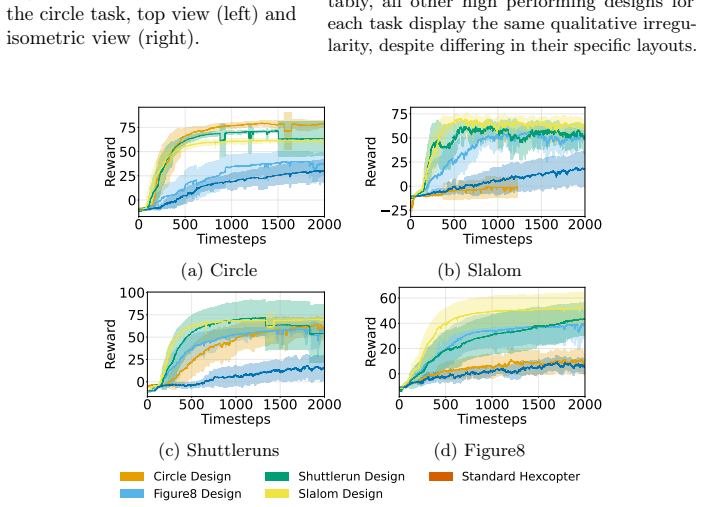
Evolution and learning have historically been interrelated topics, and their interplay is attracting increased interest lately. The emerging new factor in this trend is morphological evolution, the evolution of physical forms within embodied AI systems such as robots. In this study, we investigate a system of hexacopter-type drones with evolvable morphologies and learnable controllers and make contributions to two fields. For aerial robotics, we demonstrate that the combination of evolution and learning can deliver non-conventional drones that significantly outperform the traditional hexacopter on several tasks that are more complex than previously considered in the literature. For the field of Evolutionary Computing, we introduce novel metrics and perform new analyses into the interaction of morphological evolution and learning, uncovering hitherto unidentified effects. Our analysis tools are domain-agnostic, making a methodological contribution towards building solid foundations for embodied AI systems that integrate evolution and learning.
Editorial analysis
A structured set of objections, weighed in public.
Referee Report
Summary. The paper investigates hexacopter drones with evolvable morphologies paired with learnable controllers. It claims that this combination yields non-conventional designs that significantly outperform the standard hexacopter on several complex tasks, while also introducing novel metrics and analyses that reveal new interactions between morphological evolution and learning, with domain-agnostic tools offered as a methodological contribution to embodied AI.
Significance. If the simulation results hold under scrutiny, the work could meaningfully advance aerial robotics by demonstrating concrete performance benefits from morphological evolution on tasks more complex than prior literature, and it supplies reusable analysis tools for studying evolution-learning interplay. The experimental grounding in simulation is a clear strength when setups are reproducible.
major comments (2)
- [§4.2] §4.2 (Performance Comparison): the central claim of significant outperformance on complex tasks is supported only by simulation results using a rigid-body model with simplified aerodynamics; no sensitivity analysis to unmodeled effects (blade flapping, motor delays, or structural flexibility) is provided for the asymmetric or non-planar evolved morphologies, which directly bears on whether the reported gains are robust.
- [§5.1] §5.1 (New Metrics): the introduced metrics for evolution-learning interaction are presented as uncovering 'hitherto unidentified effects,' yet no ablation or statistical comparison against standard evolutionary metrics (e.g., fitness landscape measures or phenotypic diversity indices) is given, weakening the methodological contribution claim.
minor comments (3)
- [Abstract] Abstract: explicitly state that all quantitative results are obtained in simulation to prevent readers from assuming direct real-world applicability.
- [Figure 2] Figure 2 and Table 1: axis labels and morphology parameter definitions are inconsistent between the figure caption and the text; add a clear legend for arm angles and lengths.
- [§3.3] §3.3 (Controller Learning): the learning algorithm hyperparameters are listed but lack justification or sensitivity results; a brief ablation would improve clarity without altering the main claims.
Simulated Author's Rebuttal
We thank the referee for the constructive and detailed comments. We have addressed each major point below and revised the manuscript where the concerns identify clear gaps in the presented evidence or analyses.
read point-by-point responses
-
Referee: [§4.2] §4.2 (Performance Comparison): the central claim of significant outperformance on complex tasks is supported only by simulation results using a rigid-body model with simplified aerodynamics; no sensitivity analysis to unmodeled effects (blade flapping, motor delays, or structural flexibility) is provided for the asymmetric or non-planar evolved morphologies, which directly bears on whether the reported gains are robust.
Authors: We agree that the performance claims rest on a rigid-body model with simplified aerodynamics and that no explicit sensitivity analysis to blade flapping, motor delays, or structural flexibility was included for the evolved asymmetric and non-planar morphologies. This is a substantive limitation for assessing real-world robustness. In the revised manuscript we have added a new subsection in §4.2 that discusses the expected influence of these unmodeled effects on the reported gains, together with a qualitative argument that the largest performance differences arise from geometric properties (e.g., thrust vectoring) that remain advantageous even under moderate perturbations. We have also tempered the strength of the central claim to reflect the simulation-only grounding. revision: yes
-
Referee: [§5.1] §5.1 (New Metrics): the introduced metrics for evolution-learning interaction are presented as uncovering 'hitherto unidentified effects,' yet no ablation or statistical comparison against standard evolutionary metrics (e.g., fitness landscape measures or phenotypic diversity indices) is given, weakening the methodological contribution claim.
Authors: The metrics were developed specifically to quantify joint morphological-controller adaptation trajectories that are not directly measured by conventional fitness-landscape or phenotypic-diversity statistics. The original analyses already illustrate effects (e.g., morphology-dependent learning speed plateaus) that appear only under simultaneous evolution and learning. Nevertheless, the referee’s request for explicit comparison is fair. We have therefore inserted an additional ablation subsection in §5.1 that contrasts our metrics against standard phenotypic diversity and fitness-landscape ruggedness measures, including statistical tests showing that the new metrics capture variance unexplained by the baselines. This strengthens the claim of novel insight while preserving the domain-agnostic framing. revision: yes
Circularity Check
No circularity; claims rest on empirical simulation outcomes
full rationale
The paper reports performance gains from evolving hexacopter morphologies and learning controllers, with novel metrics introduced for analyzing their interaction. These are presented as experimental results and post-hoc analyses rather than any derivation that reduces by construction to fitted parameters, self-definitions, or self-citation chains. No equations, uniqueness theorems, or ansatzes are shown that presuppose the target outcomes. This aligns with the reader's assessment that metrics and insights do not reduce to self-referential quantities.
Axiom & Free-Parameter Ledger
Reference graph
Works this paper leans on
- [1]
-
[2]
Adaptive Behaviour4, 29–50 (1996)
Cecconi, F., F., M., Belew, R.: Maturation and the evolution of imitative learning in artificial organisms. Adaptive Behaviour4, 29–50 (1996)
work page 1996
-
[3]
Cheney, N., Bongard, J., SunSpiral, V., Lipson, H.: Scalable co-optimization of morphology and control in embodied machines. Journal of The Royal Society Interface15(143), 20170937 (2018).https://doi.org/10.1098/rsif.2017.0937
-
[4]
(eds.): Evolution and Learning: The Baldwin Effect Reconsidered
Depew, D.J., Weber, B.H. (eds.): Evolution and Learning: The Baldwin Effect Reconsidered. MIT Press (2003)
work page 2003
-
[5]
In: Proceedings of the 2020 Genetic and Evolutionary Computation Conference Companion
Eiben, A.E., Hart, E.: If it evolves it needs to learn. In: Proceedings of the 2020 Genetic and Evolutionary Computation Conference Companion. p. 1383–1384. GECCO ’20, Association for Computing Machinery, New York, NY, USA (2020). https://doi.org/10.1145/3377929.3398151, https://doi.org/10.1145/ 3377929.3398151
-
[6]
In: P., L., O, M., G, N., S, N., M., P
Eiben, A., Bredeche, N., Hoogendoorn, M., Stradner, J., Timmis, J., Tyrrell, A., Winfield, A.: The triangle of life: Evolving robots in real-time and real-space. In: P., L., O, M., G, N., S, N., M., P. (eds.) Proc. 12th European Conference on the Synthesis and Simulation of Living Systems. pp. 1056–1063. MIT Press (2013), triangle-2013
work page 2013
- [7]
-
[8]
In: Proceedings of the Fourth International Conference on Simulation of Adaptive Behavior (SAB ’96)
Floreano, D., Mondada, F.: Evolution of plastic neurocontrollers for situated agents. In: Proceedings of the Fourth International Conference on Simulation of Adaptive Behavior (SAB ’96). pp. 402–410. MIT Press, Cambridge, MA (1996).https: //doi.org/10.3929/ethz-a-010111547
-
[9]
Nature Communications12(1) (2021).https://doi.org/10.1038/ s41467-021-25874-z
Gupta, A., Savarese, S., Ganguli, S., Fei-Fei, L.: Embodied intelligence via learning and evolution. Nature Communications12(1) (2021).https://doi.org/10.1038/ s41467-021-25874-z
work page 2021
-
[10]
Complex Syst.1(3) (1987),http://www.complex-systems.com/abstracts/v01_i03_a06.html
Hinton, G.E., Nowlan, S.J.: How learning can guide evolution. Complex Syst.1(3) (1987),http://www.complex-systems.com/abstracts/v01_i03_a06.html
work page 1987
-
[11]
Naval Re- search Logistics Quarterly2(1-2), 83–97 (1955).https://doi.org/https://doi
Kuhn, H.W.: The Hungarian method for the assignment problem. Naval Re- search Logistics Quarterly2(1-2), 83–97 (1955).https://doi.org/https://doi. org/10.1002/nav.3800020109, https://onlinelibrary.wiley.com/doi/abs/10. 1002/nav.3800020109
-
[13]
IEEE Transactions on Cognitive and Developmental Systems15(2), 507–517 (2023)
Le Goff, L.K., Buchanan, E., Hart, E., Eiben, A.E., Li, W., De Carlo, M., Winfield, A.F., Hale, M.F., Woolley, R., Angus, M., Timmis, J., Tyrrell, A.M.: Morpho evolution with learning using a controller archive as an inheritance mechanism. IEEE Transactions on Cognitive and Developmental Systems15(2), 507–517 (2023). https://doi.org/10.1109/TCDS.2022.3148543
-
[14]
Li, W., Buchanan, E., Le Goff, L., Hart, E., Hale, M., Wei, B., Carlo, M., Angus, M., Woolley, R., Gan, Z., Winfield, A., Timmis, J., Eiben, A., Tyrrell, A.: Evaluation of frameworks that combine evolution and learning to design robots in complex Unconventional Hexacopters via Evolution and Learning 17 morphological spaces. IEEE Transactions on Evolutiona...
-
[15]
Frontiers in Robotics and AI8(2022)
Luo, J., Stuurman, A., Tomczak, J., Ellers, J., Eiben, A.: The effects of learning in morphologically evolving robot systems. Frontiers in Robotics and AI8(2022). https://doi.org/10.3389/frobt.2022.797393
-
[16]
Evolutionary Computation4(3), 213–234 (1997)
Mayley, G.: Landscapes, learning costs, and genetic assimilation. Evolutionary Computation4(3), 213–234 (1997)
work page 1997
-
[17]
In: Castillo, P.A., Laredo, J.L.J., de Vega, F.F
Miras, K., Carlo, M.D., Akhatou, S., Eiben, A.E.: Evolving-controllers versus learning-controllers for morphologically evolvable robots. In: Castillo, P.A., Laredo, J.L.J., de Vega, F.F. (eds.) Applications of Evolutionary Computation - 23rd European Conference, EvoApplications 2020, Held as Part of EvoStar 2020, Seville, Spain, April 15-17, 2020, Proceed...
work page 2020
-
[18]
Autonomous Robots7, 89–113 (1999)
Nolfi, S., Floriano, D.: Learning and evolution. Autonomous Robots7, 89–113 (1999)
work page 1999
-
[19]
Pfeifer, R., Bongard, J.: How the body shapes the way we think: a new view of intelligence. MIT press (2006)
work page 2006
-
[20]
In: International Congress Series
Pfeifer, R., Iida, F., Gómez, G.: Morphological computation for adaptive behavior and cognition. In: International Congress Series. vol. 1291, pp. 22–29. Elsevier (2006)
work page 2006
-
[21]
Radhakrishna Prabhu, S.G., Seals, R.C., Kyberd, P.J., Wetherall, J.C.: A survey on evolutionary-aided design in robotics. Robotica p. 1–18 (2018)
work page 2018
-
[22]
Journal of Machine Learning Research22(268), 1–8 (2021),http://jmlr.org/papers/v22/20-1364
Raffin, A., Hill, A., Gleave, A., Kanervisto, A., Ernestus, M., Dormann, N.: Stable- baselines3: Reliable reinforcement learning implementations. Journal of Machine Learning Research22(268), 1–8 (2021),http://jmlr.org/papers/v22/20-1364. html
work page 2021
-
[23]
Proximal Policy Optimization Algorithms
Schulman, J., Wolski, F., Dhariwal, P., Radford, A., Klimov, O.: Proximal policy optimization algorithms. ArXivabs/1707.06347(2017), https://api. semanticscholar.org/CorpusID:28695052
work page internal anchor Pith review Pith/arXiv arXiv 2017
-
[24]
Smith, J.: When learning guides evolution. Nature329, 761–762 (1987)
work page 1987
-
[25]
Evolutionary Biology39(3), 301–310 (Dec 2011).https://doi.org/10.1007/s11692-011-9155-2
Sznajder, B., Sabelis, M.W., Egas, M.: How adaptive learning affects evolution: Reviewing theory on the baldwin effect. Evolutionary Biology39(3), 301–310 (Dec 2011).https://doi.org/10.1007/s11692-011-9155-2
-
[26]
Whiten, A., van Schaik, C.P.: The evolution of animal ‘cultures’ and social in- telligence. Philosophical Transactions of the Royal Society B: Biological Sciences 362(1480), 603–620 (2007).https://doi.org/10.1098/rstb.2006.1998
discussion (0)
Sign in with ORCID, Apple, or X to comment. Anyone can read and Pith papers without signing in.