REVIEW 2 major objections 4 minor 64 references
Magnetic vortex writing and local reversal seeding in artificial spin-vortex ice via all-optical and surface-probe control
T0 review · 2 major / 4 minor · reviewed 2026-08-07 · deepseek-v4-flash
Pith's one-line read Focused laser light and a magnetic tip can locally write double-vortex and single-vortex textures in artificial spin-vortex ice, and the written vortices seed programmable avalanche-like reversal chains.
desk verdict Solid local-write techniques for vortex states in ASVI, but the avalanche-like reversal claim is stronger than the static MFM evidence supports. read the letter →
The pith
A machine-rendered reading of the paper's core claim, the machinery that carries it, and where it could break.
The reading
What carries the argument
The paper's central object is the width-modified artificial spin-vortex ice (ASVI): alternating rows of wide and narrow stadia-shaped magnetic nanoislands, with the wide islands dimensioned so that macrospin, single-vortex, and double-vortex textures are all metastable. The argument runs through the local stray-field landscape, encoded in the effective switching field $\mu_0H_{c\text{-eff}} = \mu_0H_{c\text{-int}} + \mu_0H_{dip}$: because a vortex closes its flux internally, it emits less stray field than a macrospin and lowers the switching threshold of neighbouring islands by about 1.6 mT, while a double-vortex additionally has a lower intrinsic coercivity than a macrospin. The two writing tools are local perturbations to this landscape: a magnetic tip injects a vortex core directly beneath it, and a focused laser writes double-vortices with polarisation-dependent absorption selecting which island orientation responds. Written double-vortices thereby act as sacrificial templates that locally re-route reversal pathways under a global field.
What would settle it
Apply the same driving field in small increments, for example stepping from 0 to 18.2 mT in sub-mT steps, and image with magnetic force microscopy after each step. If unwritten islands reverse one by one in spatial order away from the double-vortex seeds, the avalanche interpretation is supported; if the whole cluster changes in a single step, or reversals appear in no order relative to the seed positions, then the propagating-avalanche claim is falsified.
Extended reading notes
Core claim
The central claim is that ASVI nanoislands can be engineered so that macrospin, single-vortex, and double-vortex textures are all metastable, and that each can be locally written in a controlled way. Laser illumination preferentially creates double-vortices when the linear polarisation lies along the island's short axis, and the written vortex configuration is set by the array's prior saturation direction; scanning a high-moment magnetic tip writes single-vortices, with the crossing point on the island influencing chirality and whether a macrospin reversal occurs. Written double-vortices, which have lower coercivity than macrospins, then act as local seeds: at 91% of the macrospin start-switching field they themselves switch to macrospins and, according to the authors, trigger a one-dimensional avalanche-like reversal chain through adjacent unwritten islands, producing a row of type-1 ground-state vertices. Simulation supports the mechanism by showing that a vortex reduces the effective switching field of a nearest-neighbour island by about 1.6 mT through the local demagnetising field, and together these results expand the accessible microstate space to six states per nanoisland.
Load-bearing premise
The avalanche claim rests on the assumption that adjacent unwritten islands reverse in a domino-like sequence starting from the written double-vortices, rather than reversing independently because the static magnetic landscape and fabrication defects have already lowered their switching thresholds; the paper images only before and after the field step, not the order of events.
Editorial extensions
If this is right
- Pairing a global field below the macrospin switching threshold with locally written double-vortices prepares one-dimensional chains of type-1 ground-state vertices at chosen positions in the array.
- Avalanche studies become repeatable and location-controlled: the writing step fixes where a reversal chain starts, instead of relying on stochastic nucleation and many repeated imaging runs.
- The laser's polarisation acts as a spatial mask, writing double-vortices preferentially into islands whose short axis is aligned with the polarisation, so either the +45° or −45° island subset can be targeted.
- Because double-vortices switch below the macrospin field and end as macrospins, they act as sacrificial templates that can be repeatedly rewritten, while single-vortices, with higher switching fields than macrospins, act as persistent templates for steering later reversals.
- The enlarged six-state-per-island microstate space and local writing give a route to direct physical implementation of nanomagnetic weights and memory states in neuromorphic devices.
Reading between the lines
- We infer that the avalanche interpretation could be tested directly by applying the driving field in small increments and imaging between steps; a spatial ordering of reversals propagating outward from the seeded double-vortices would confirm the domino picture, whereas a near-simultaneous cluster would point to static threshold lowering.
- We infer that the unresolved 0° versus 90° polarisation asymmetry, which cannot be explained by linear absorption alone, points to a magneto-optical or magnetic-state-dependent mechanism; a clean test would be laser-writing well-separated islands with controlled initial magnetic states so that stray fields from neighbours cannot mask the effect.
- We infer that the dependence of written double-vortex configuration on the array's initial saturation direction could be exploited as an additional writing degree of freedom, since the written vortex polarity would then encode the prior global-field history.
- We infer that the technique could serve as a fabrication-free probe of quenched disorder: repeated local writes across many arrays would map the distribution of switching fields island by island, separating intrinsic disorder from seeded effects.
Signed reviews
Editorial analysis
A structured set of objections, weighed in public.
Referee Report
Summary. The paper reports two local, field-free methods for writing vortex textures in artificial spin-vortex ice (ASVI): scanning an MFM tip writes single-vortex states, and scanning a focused linearly polarized CW laser writes double-vortex states with a polarization-dependent selectivity for ±45°-oriented nanoislands. The authors characterize writing fidelity with per-row statistics, support the texture assignments with MuMax3 micromagnetic simulations and simulated MFM images, and show that laser-written double-vortices have reduced switching fields compared with macrospins. In a field-application experiment, laser-written double-vortices and several neighboring unwritten macrospins reverse at a field below the macrospin switching threshold; the authors interpret this as locally seeded, avalanche-like propagation of reversal. The paper claims an expanded six-state microstate space per nanoisland and proposes applications in avalanche physics, memory, and neuromorphic computing.
Significance. If the writing demonstrations hold, the paper provides useful experimental tools for local, reconfigurable control of vortex textures in strongly interacting nanomagnet arrays, extending prior single-vortex work to double-vortex writing and expanding the ASVI platform. Strengths include the use of standard micromagnetic parameters (Msat, Aex) rather than parameters fitted to the target outcomes, the provision of raw per-row switching statistics in the Supporting Information, and falsifiable quantitative predictions such as the lower switching field of the parallel double-vortex configuration and the spatially extended stray-field reduction around vortex textures. The main caveat is that the headline 'avalanche-like seeding' claim rests on static before/after imaging rather than on time-resolved or field-step-resolved observations, and the reported laser-writing 'fidelity' is a conditional rate whose denominator excludes several outcome categories.
major comments (2)
- [Section 'Local seeding of avalanche-like reversal via double-vortex writing' (Fig. 4b; Supporting Figs. S14–S17)] The claim that the optically written double-vortices seed a propagating, avalanche-like reversal chain is not established by the presented data. The evidence is a comparison of MFM images before and after a single global field application at 91% of Hc-start, with no time-resolved or field-step-resolved observation of the reversal order. The alternative interpretation, that the same stray-field modification that lowers the switching field of a double-vortex island also lowers the thresholds of several neighboring macrospins simultaneously so that those islands reverse independently at the applied field, is fully consistent with the static before/after images and is in fact supported by the authors' own micromagnetic field-landscape plots in Fig. 5h–i, which show a spatially extended demagnetizing-field reduction covering several islands. Because the abstract and conclusions present 'programmable local seeding of avalanche-like reversal events' as a central result, this distinction is load-bearing. I recommend either softening the language to describe spatially correlated, locally seeded reversals without claiming sequential propagation, or adding an incremental-field experiment (e.g., applying the global field in small steps with MFM imaging between steps) to demonstrate the propagation order.
- [Section 'All-optical control of vortex textures' and Methods (Laser-writing; SI Tables S1–S2)] The reported double-vortex writing 'fidelity' is a conditional success rate: the denominator excludes islands that were damaged, islands written into single-vortex states, and islands with unidentifiable textures. Since single-vortex writing is a possible outcome of the same illumination rather than a damage event, this exclusion inflates the reported success rate relative to the probability that an illuminated island becomes a double-vortex. The raw per-row counts in Supporting Tables S1 and S2 allow unconditional rates to be recovered, so this is not a fatal flaw, but the main-text definition of fidelity should be stated explicitly, and the unconditional rates should be reported or plotted alongside the conditional rates so that readers can judge the actual writing selectivity.
minor comments (4)
- [Section 'All-optical control of vortex textures'] The text states 'Figures 2 a) and b) show the fidelities of double-vortex writing', but the relevant panels are in Figure 3; this cross-reference should be corrected.
- [Supporting Information figure numbering] The main text references Supporting Figures S1–S4 for array dimensions and S10–S12 for repeated avalanche-like seeding tests, but the supplied Supporting Information uses S6–S9 for the dimension histograms and S14–S17 for the repeated seeding experiments; the numbering should be harmonized.
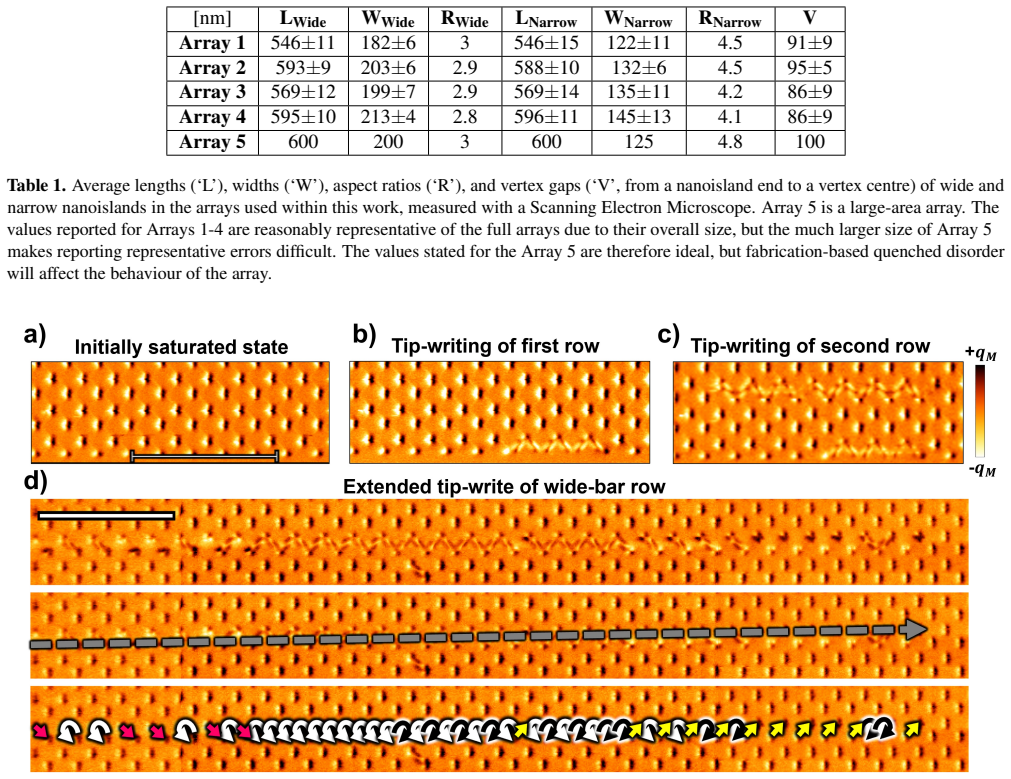
- [Section 'Surface-probe control of vortex textures'] The tip-writing results are presented through selected examples without quantitative success or chirality-selectivity statistics; a compact table of attempted writes, successes, and outcome types would strengthen the comparison with the laser-writing characterization.
- [Section 'Multi-level switching fields of macrospin, single-vortex and double-vortex states'] The P/AP double-vortex labels are defined relative to an applied field at +46° in Fig. 5a, while the simulations are described as averaging fields at ±45°; the relation between the schematic angle and the averaged simulation geometry should be clarified in the caption or text.
Circularity Check
No significant circularity: the writing demonstrations and simulated switching-field hierarchy are experimentally and computationally self-contained.
full rationale
The paper's central claims are experimental demonstrations (laser-writing of double vortices, MFM-tip writing of single vortices, and local modification of switching behavior) supported by direct MFM imaging before and after writing and global-field application. No central 'prediction' is derived from a fitted parameter. The micromagnetic simulations use standard literature material parameters (Msat = 750 x 10^3 A/m, Aex = 13 x 10^-12) and geometry measured by SEM, and they are used to rationalize, not to generate, the observed switching-field hierarchy. Citations to prior work by the same group (refs 30, 47) supply context and the tip-injection mechanism, but the article independently computes switching fields with MuMax3 and images the written states, so no load-bearing claim reduces to a self-citation. The only scientifically weak point is the interpretation of the Figure 4b state change as a 'propagating' avalanche-like reversal based on initial and final MFM images without time- or field-step-resolved reversal order; a parallel threshold-lowering nucleation scenario is equally consistent with the static data. That underdetermination is a correctness or interpretation concern, not circularity: the claim is not equivalent to its inputs by construction, no fitted parameter is relabeled as a prediction, and no uniqueness theorem or ansatz is imported from the authors' prior work. Accordingly no circular steps are identified.
Assumptions & free parameters
free parameters (1)
- Applied field fraction for seeding test =
18.2 mT (91% of measured Hc-start = 20 mT)
assumptions (5)
- domain assumption MuMax3 micromagnetic solver reliably models energy-minimized states of Permalloy nanoislands at these dimensions
- domain assumption MFM images correctly distinguish macrospin, single-vortex, and double-vortex textures
- domain assumption Effective switching field of a nanoisland equals intrinsic switching field plus local dipolar stray field from neighbors (Hc_eff = Hc_int + Hdip)
- domain assumption The high-moment MFM tip injects vortices via a divergent monopole-like field, as established in prior work (refs 47, 49, 50)
- ad hoc to paper Each reversal event in the chain propagated sequentially from the written double-vortices outward
Cite this review
Pith. "Pith review of Magnetic vortex writing and local reversal seeding in artificial spin-vortex ice via all-optical and surface-probe control." pith.science (2026). https://pith.science/paper/L5GCEUDW
@misc{pith2026250516874,
  author       = {Pith},
  title        = {Pith review of: Magnetic vortex writing and local reversal seeding in artificial spin-vortex ice via all-optical and surface-probe control},
  year         = {2026},
  howpublished = {\url{https://pith.science/paper/L5GCEUDW}},
  note         = {Machine review of arXiv:2505.16874}
}
read the original abstract
Artificial spin-vortex ice ('ASVI') is a reconfigurable nanomagnetic metamaterial consisting of magnetic nanoislands tailored to support both Ising macrospin and vortex textures. ASVI has recently shown functional applications including reconfigurable magnonics and neuromorphic computing, where the introduction of vortex textures broadens functionality beyond conventional artificial spin ice which generally supports macrospin states. However, local control of writing vortex states in ASVI remains an open challenge. Here we demonstrate techniques for field-free magnetic vortex writing in ASVI. We expand ASVI to support metastable macrospin, single-vortex and double-vortex states. All-optical writing via focused laser illumination can locally write double-vortex textures, and surface-probe writing using an MFM tip can locally write single vortex states. We leverage this writing to tailor and explore the reconfigurable energy landscape of ASVI, demonstrating programmable local seeding of avalanche-like reversal events. The global field-free texture selective writing techniques reported here expand the suite of nanomagnetic control techniques, with a host of future applications including fundamental studies of avalanche dynamics, physical memory, and direct writing of nanomagnetic 'weights' in physical neuromorphic neural networks.
Figures


Figures from the paper (2 more)


Reference graph
Works this paper leans on
-
[1]
Harris, M. J., Bramwell, S. T., McMorrow, D. F., Zeiske, T. & Godfrey, K. W. Geometrical frustration in the ferromagnetic pyrochlore ho2ti2O7.Phys. Rev. Lett.79, 2554–2557, DOI: 10.1103/PhysRevLett.79.2554 (1997)
-
[2]
Wang, R. F.et al.Artificial ‘spin ice’ in a geometrically frustrated lattice of nanoscale ferromagnetic islands.Nature439, DOI: 10.1038/nature04447 (2006)
-
[3]
Skjærvø, S. H., Marrows, C. H., Stamps, R. L. & Heyderman, L. J. Advances in artificial spin ice.Nat. Rev. Phys.2, DOI: 10.1038/s42254-019-0118-3 (2020)
-
[4]
Schiffer, P. & Nisoli, C. Artificial spin ice: Paths forward.Appl. Phys. Lett.118, 110501, DOI: 10.1063/5.0044790 (2021). https://pubs.aip.org/aip/apl/article-pdf/doi/10.1063/5.0044790/13040158/110501_1_online.pdf
-
[5]
Commun.15, 4077, DOI: 10.1038/s41467-024-48080-z (2024)
Dion, T.et al.Ultrastrong magnon-magnon coupling and chiral spin-texture control in a dipolar 3d multilayered artificial spin-vortex ice.Nat. Commun.15, 4077, DOI: 10.1038/s41467-024-48080-z (2024)
-
[6]
Berchialla, L., Macauley, G. M. & Heyderman, L. J. Focus on three-dimensional artificial spin ice.Appl. Phys. Lett.125 (2024)
work page 2024
-
[7]
Ladak, S., Read, D. E., Perkins, G. K., Cohen, L. F. & Branford, W. R. Direct observation of magnetic monopole defects in an artificial spin-ice system.Nat. Phys.6, 359–363, DOI: 10.1038/nphys1628 (2010)
-
[8]
Morgan, J. P., Stein, A., Langridge, S. & Marrows, C. H. Thermal ground-state ordering and elementary excitations in artificial magnetic square ice.Nat. Phys.7, 75–79, DOI: 10.1038/nphys1853 (2011)
Show all 64 references
-
[9]
S.et al.Experimental realization of the 1d random field ising model.Phys
Bingham, N. S.et al.Experimental realization of the 1d random field ising model.Phys. Rev. Lett.127, 207203, DOI: 10.1103/PhysRevLett.127.207203 (2021)
2021 doi
-
[10]
& Reichhardt, C
Chern, G.-W., Reichhardt, C. & Reichhardt, C. J. O. Avalanches and disorder-induced criticality in artificial spin ices.New J. Phys.16, 063051, DOI: 10.1088/1367-2630/16/6/063051 (2014)
2014 doi
-
[11]
R., Ladak, S., Read, D
Branford, W. R., Ladak, S., Read, D. E., Zeissler, K. & Cohen, L. F. Emerging chirality in artificial spin ice.Science335, 1597–1600, DOI: 10.1126/science.1211379 (2012). https://www.science.org/doi/pdf/10.1126/science.1211379
2012 doi
-
[12]
D., Grassi, M
Slöetjes, S. D., Grassi, M. P. & Kapaklis, V . Modelling nanomagnet vertex dynamics through coulomb charges.J. Physics: Condens. Matter36, 405804, DOI: 10.1088/1361-648X/ad5acc (2024)
2024 doi
-
[13]
https://www.science.org/doi/pdf/10.1126/science.add6575
Zhang, X.et al.Topological kinetic crossover in a nanomagnet array.Science380, 526–531, DOI: 10.1126/science.add6575 (2023). https://www.science.org/doi/pdf/10.1126/science.add6575
2023 doi
-
[14]
Zhang, S.et al.Crystallites of magnetic charges in artificial spin ice.Nature500, 553–557, DOI: 10.1038/nature12399 (2013)
2013 doi
-
[15]
H.et al.Clocked dynamics in artificial spin ice.Nat
Jensen, J. H.et al.Clocked dynamics in artificial spin ice.Nat. Commun.15, 964, DOI: 10.1038/s41467-024-45319-7 (2011)
2011 doi
-
[16]
C.et al.Realization of ground state in artificial kagome spin ice via topological defect-driven magnetic writing
Gartside, J. C.et al.Realization of ground state in artificial kagome spin ice via topological defect-driven magnetic writing. Nat. Nanotechnol.13, 53–58, DOI: 10.1038/s41565-017-0002-1 (2018)
2018 doi
-
[17]
Commun.14, 5674, DOI: 10.1038/s41467-023-41235-4 (2023)
Saccone, M.et al.Real-space observation of ergodicity transitions in artificial spin ice.Nat. Commun.14, 5674, DOI: 10.1038/s41467-023-41235-4 (2023)
2023 doi
-
[18]
T., Lendinez, S
Kaffash, M. T., Lendinez, S. & Jungfleisch, M. B. Nanomagnonics with artificial spin ice.Phys. Lett. A402, 127364, DOI: https://doi.org/10.1016/j.physleta.2021.127364 (2021)
2021
-
[19]
& Heinonen, O
Gliga, S., Iacocca, E. & Heinonen, O. G. Dynamics of reconfigurable artificial spin ice: Toward magnonic functional materials.APL Mater.8(2020)
2020
-
[20]
& Heinonen, O
Iacocca, E., Gliga, S. & Heinonen, O. G. Tailoring spin-wave channels in a reconfigurable artificial spin ice.Phys. Rev. Appl.13, 044047 (2020)
2020
-
[21]
review letters125, 117208 (2020)
Bhat, V .et al.Magnon modes of microstates and microwave-induced avalanche in kagome artificial spin ice with topological defects.Phys. review letters125, 117208 (2020). 26/29
2020
-
[22]
Dion, T.et al.Tunable magnetization dynamics in artificial spin ice via shape anisotropy modification.Phys. Rev. B100, 054433 (2019)
2019
-
[23]
C.et al.Reconfigurable magnonic mode-hybridisation and spectral control in a bicomponent artificial spin ice
Gartside, J. C.et al.Reconfigurable magnonic mode-hybridisation and spectral control in a bicomponent artificial spin ice. Nat. Commun.12, 2488 (2021). 10.1038/s41467-021-22723-x
2021 doi
-
[24]
Dion, T.et al.Observation and control of collective spin-wave mode hybridization in chevron arrays and in square, staircase, and brickwork artificial spin ices.Phys. Rev. Res.4, 013107 (2022)
2022
-
[25]
& Adeyeye, A
de Rojas, J., Atkinson, D. & Adeyeye, A. O. Tuning magnon spectra via interlayer coupling in pseudo-3d nanostructured artificial spin ice arrays.Appl. Phys. Lett.123(2023)
2023
-
[26]
Bhat, V . S. & Jungfleisch, M. B. Magnon signatures of multidimensional reconfigurations in multilayer square artificial spin ices.Appl. Phys. Lett.126(2025)
2025
-
[27]
Arava, H.et al.Engineering relaxation pathways in building blocks of artificial spin ice for computation.Phys. Rev. Appl. 11, 054086, DOI: 10.1103/PhysRevApplied.11.054086 (2019)
2019 doi
-
[28]
ALIFE 2018: The 2018 Conference on Artificial Life ofArtificial Life Conference Proceedings
International Society for Artificial Life.Computation in artificial spin ice, vol. ALIFE 2018: The 2018 Conference on Artificial Life ofArtificial Life Conference Proceedings. DOI: 10.1162/isal_a_00011. https://direct.mit.edu/isal/ proceedings-pdf/alife2018/30/15/1904940/isal_...
2018 doi
-
[29]
Hon, K.et al.Numerical simulation of artificial spin ice for reservoir computing.Appl. Phys. Express14, 033001, DOI: 10.35848/1882-0786/abdcd8 (2021)
2021 doi
-
[30]
C.et al.Reconfigurable training and reservoir computing in an artificial spin-vortex ice via spin-wave fingerprinting.Nat
Gartside, J. C.et al.Reconfigurable training and reservoir computing in an artificial spin-vortex ice via spin-wave fingerprinting.Nat. Nanotechnol.17, DOI: https://doi.org/10.1038/s41565-022-01091-7 (2022)
2022 doi
-
[31]
D.et al.Neuromorphic overparameterisation and few-shot learning in multilayer physical neural networks
Stenning, K. D.et al.Neuromorphic overparameterisation and few-shot learning in multilayer physical neural networks. Nat. Commun.15, 7377 (2024)
2024
-
[32]
Commun.14, 2562, DOI: 10.1038/s41467-023-38286-y (2023)
Hu, W.et al.Distinguishing artificial spin ice states using magnetoresistance effect for neuromorphic computing.Nat. Commun.14, 2562, DOI: 10.1038/s41467-023-38286-y (2023)
2023 doi
-
[33]
Liang, Z.et al.Ultrafast probabilistic neuron in an artificial spin ice for robust deep neural networks.Adv. Funct. Mater. 2417334 (2024)
2024
-
[34]
Seynaeve, E.et al.Transition from a single-domain to a multidomain state in mesoscopic ferromagnetic co structures.J. Appl. Phys.89, 531–534, DOI: 10.1063/1.1324687 (2001). https://pubs.aip.org/aip/jap/article-pdf/89/1/531/19276251/ 531_1_online.pdf
2001 doi
-
[35]
& Ono, T
Shinjo, T., Okuno, T., Hassdorf, R., Shigeto, K. & Ono, T. Magnetic vortex core observation in circular dots of permalloy. Science289, 930–932, DOI: 10.1126/science.289.5481.930 (2000). https://www.science.org/doi/pdf/10.1126/science.289. 5481.930
2000 doi
-
[36]
Metlov, K. L. & Guslienko, K. Y . Stability of magnetic vortex in soft magnetic nano-sized circular cylinder.J. Magn. Magn. Mater.242-245, 1015–1017, DOI: https://doi.org/10.1016/S0304-8853(01)01360-9 (2002). Proceedings of the Joint European Magnetic Symposia (JEMS’01)
2002 doi
-
[37]
Guslienko, K. Y . Magnetic vortex state stability, reversal and dynamics in restricted geometries.J. Nanosci. Nanotechnol. 8, 2745–2760, DOI: doi:10.1166/jnn.2008.18305 (2008)
2008
-
[38]
S.et al.Soliton-pair dynamics in patterned ferromagnetic ellipses.Nat
Buchanan, K. S.et al.Soliton-pair dynamics in patterned ferromagnetic ellipses.Nat. Phys.1, 172–176, DOI: 10.1038/ nphys173 (2005)
2005
-
[39]
& Hertel, R
Zhang, H., Liu, Y ., Yan, M. & Hertel, R. Azimuthal spin wave modes excited in an elliptical nanomagnet with vortex pair states.IEEE Transactions on Magn.46, 1675–1678, DOI: 10.1109/TMAG.2010.2043714 (2010)
2010
-
[40]
C., Stenning, K
Saccone, M., Gartside, J. C., Stenning, K. D., Branford, W. R. & Caravelli, F. From vertices to vortices in magnetic nanoislands.Phys. Fluids35, 017101, DOI: 10.1063/5.0131158 (2023). https://pubs.aip.org/aip/pof/article-pdf/doi/10. 1063/5.0131158/16675567/017101_1_online.pdf
2023 doi
-
[41]
& Chern, G.-W
Tchernyshyov, O. & Chern, G.-W. Fractional vortices and composite domain walls in flat nanomagnets.Phys. Rev. Lett. 95, 197204, DOI: 10.1103/PhysRevLett.95.197204 (2005)
2005 doi
-
[42]
Vavassori, P.et al.Magnetization reversal via single and double vortex states in submicron permalloy ellipses.Phys. Rev. B69, 214404, DOI: 10.1103/PhysRevB.69.214404 (2004)
2004 doi
-
[43]
Jain, S., Adeyeye, A. O. & Singh, N. Spin re-orientation in magnetostatically coupled ni80fe20 ellipsoidal nanomagnets. Nanotechnology21, 285702, DOI: 10.1088/0957-4484/21/28/285702 (2010). 27/29
2010 doi
-
[44]
Y .et al.Formation of complex spin textures in thermally demagnetized la0.7sr0.3mno3 artificial-spin-ice structures.Phys
Sasaki, D. Y .et al.Formation of complex spin textures in thermally demagnetized la0.7sr0.3mno3 artificial-spin-ice structures.Phys. Rev. Appl.17, 064057, DOI: 10.1103/PhysRevApplied.17.064057 (2022)
2022 doi
-
[45]
D.et al.Magnonic bending, phase shifting and interferometry in a 2d reconfigurable nanodisk crystal.ACS Nano15, 674–685, DOI: 10.1021/acsnano.0c06894 (2021)
Stenning, K. D.et al.Magnonic bending, phase shifting and interferometry in a 2d reconfigurable nanodisk crystal.ACS Nano15, 674–685, DOI: 10.1021/acsnano.0c06894 (2021). PMID: 33320533, https://doi.org/10.1021/acsnano.0c06894
2021 doi
-
[46]
& Adeyeye, A
Talapatra, A., Singh, N. & Adeyeye, A. O. Magnetic tunability of permalloy artificial spin ice structures.Phys. Rev. Appl. 13, 014034, DOI: 10.1103/PhysRevApplied.13.014034 (2020)
2020 doi
-
[47]
C., Burn, D
Gartside, J. C., Burn, D. M., Cohen, L. F. & Branford, W. R. A novel method for the injection and manipulation of magnetic charge states in nanostructures.Sci. Reports6, 32864, DOI: 10.1038/srep32864 (2016). 48.Romming, N.et al.Writing and deleting single magnetic skyrmions.Sc...
2016 doi
-
[49]
P., Hucht, A., Hinrichsen, H., Dahmen, S
Magiera, M. P., Hucht, A., Hinrichsen, H., Dahmen, S. R. & Wolf, D. E. Magnetic vortices induced by a moving tip. Europhys. Lett.100, 27004 (2012). 50.Magiera, M. P. & Schulz, S. Magnetic vortices induced by a monopole tip.IEEE Transactions on Magn.50, 1–4 (2014)
2012
-
[51]
Finazzi, M.et al.Laser-induced magnetic nanostructures with tunable topological properties.Phys. Rev. Lett.110, 177205, DOI: 10.1103/PhysRevLett.110.177205 (2013)
2013 doi
-
[52]
Eggebrecht, T.et al.Light-induced metastable magnetic texture uncovered by in situ lorentz microscopy.Phys. Rev. Lett. 118, 097203, DOI: 10.1103/PhysRevLett.118.097203 (2017)
2017 doi
-
[53]
& Tatara, G
Taguchi, K., Ohe, J.-i. & Tatara, G. Ultrafast magnetic vortex core switching driven by the topological inverse faraday effect.Phys. Rev. Lett.109, 127204, DOI: 10.1103/PhysRevLett.109.127204 (2012)
2012 doi
-
[54]
Adv.4, eaat3077, DOI: 10.1126/sciadv.aat3077 (2018)
Fu, X.et al.Optical manipulation of magnetic vortices visualized in situ by lorentz electron microscopy.Sci. Adv.4, eaat3077, DOI: 10.1126/sciadv.aat3077 (2018). https://www.science.org/doi/pdf/10.1126/sciadv.aat3077
2018 doi
-
[55]
Mater.17, 1076–1080, DOI: 10.1038/s41563-018-0199-x (2018)
Louis, D.et al.A tunable magnetic metamaterial based on the dipolar four-state potts model.Nat. Mater.17, 1076–1080, DOI: 10.1038/s41563-018-0199-x (2018)
2018 doi
-
[56]
Phys.15, 191–195, DOI: 10.1038/ s41567-018-0348-9 (2019)
Sklenar, J.et al.Field-induced phase coexistence in an artificial spin ice.Nat. Phys.15, 191–195, DOI: 10.1038/ s41567-018-0348-9 (2019). 57.Wang, Y .-L.et al.Rewritable artificial magnetic charge ice.Science352, 962–966 (2016)
2019
-
[58]
& Lehmann, J
Lehmann, J. & Lehmann, J. Poling of artificial magneto-toroidal crystals.Toroidal Order Magn. Metamaterials113–131 (2022)
2022
-
[59]
D.et al.Low-power continuous-wave all-optical magnetic switching in ferromagnetic nanoarrays.Cell Reports Phys
Stenning, K. D.et al.Low-power continuous-wave all-optical magnetic switching in ferromagnetic nanoarrays.Cell Reports Phys. Sci.4, 101291, DOI: https://doi.org/10.1016/j.xcrp.2023.101291 (2023)
2023
-
[60]
& Grundler, D
Baumgaertl, K. & Grundler, D. Reversal of nanomagnets by propagating magnons in ferrimagnetic yttrium iron garnet enabling nonvolatile magnon memory.Nat. Commun.14, 1490 (2023). 61.Vansteenkiste, A.et al.The design and verification of Mumax3.AIP Adv.4, 107133, DOI: 10.1063/1.4...
2023 doi
-
[63]
Phys.23, 033024, DOI: 10.1088/1367-2630/abe3ad (2021)
Leo, N.et al.Chiral switching and dynamic barrier reductions in artificial square ice.New J. Phys.23, 033024, DOI: 10.1088/1367-2630/abe3ad (2021)
2021 doi
-
[64]
& Cumings, J
Drisko, J., Marsh, T. & Cumings, J. Topological frustration of artificial spin ice.Nat. Commun.8, 14009, DOI: 10.1038/ncomms14009 (2017)
2017 doi
-
[65]
Phys.7, 68–74, DOI: 10.1038/nphys1794 (2011)
Mengotti, E.et al.Real-space observation of emergent magnetic monopoles and associated dirac strings in artificial kagome spin ice.Nat. Phys.7, 68–74, DOI: 10.1038/nphys1794 (2011)
2011 doi
-
[66]
& Klapetek, P
Neˇcas, D. & Klapetek, P. Gwyddion: an open-source software for SPM data analysis.Cent. Eur. J. Phys.10, 181–188, DOI: 10.2478/s11534-011-0096-2 (2012)
2012 doi
-
[67]
Exl, L.et al.LaBonte’s method revisited: An effective steepest descent method for micromagnetic energy minimization.J. Appl. Phys.115, 17D118, DOI: 10.1063/1.4862839 (2014). 68.Inc., T. M. Matlab version: R2023b (2023)
2014 doi
-
[69]
& de Boer, J
van Rossum, G. & de Boer, J. Interactively testing remote servers using the python programming language.CWI Q.4, 283–304 (1991). 70.Harris, C. R.et al.Array programming with NumPy.Nature585, 357–362, DOI: 10.1038/s41586-020-2649-2 (2020). 28/29
1991 doi
-
[71]
Hunter, J. D. Matplotlib: A 2d graphics environment.Comput. Sci. & Eng.9, 90–95, DOI: 10.1109/MCSE.2007.55 (2007). 72.Imperial college research computing service. DOI: 10.14469/hpc/2232. 29/29
2007 doi
Reviewed August 7, 2026 · model on record in the stance chip above.
Discussion (0). Continue with ORCID to comment.