REVIEW 3 major objections 5 minor 115 references
Orbital Decay of the Ultra-Hot Jupiter TOI-2109b: Tidal Constraints and Transit-Timing Analysis
T0 review · 3 major / 5 minor · reviewed 2026-08-07 · deepseek-v4-flash
Pith's one-line read TOI-2109b, the shortest-period ultra-hot Jupiter known, shows transit-timing variations consistent with a constant orbital period rather than rapid tidal decay.
desk verdict New TESS timing data give a solid upper limit on TOI-2109b's orbital decay, but the paper's young-versus-old star conclusion leans on an unquantified wave-breaking threshold. read the letter →
The pith
A machine-rendered reading of the paper's core claim, the machinery that carries it, and where it could break.
The reading
What carries the argument
The engine of the argument is the coupled set of tidal evolution equations (constant time-lag model) with frequency-averaged tidal quality factors computed from two-layer interior models: inertial waves (IWs) in the convective envelope, internal gravity waves (IGWs) in radiative regions, and a viscoelastic solid core for the planet. The decisive element is the stellar-age dependence: internal gravity waves are efficiently damped only if the planet exceeds a critical mass $M_\mathrm{crit}$ that decreases with stellar age, so the same $\sim5\,M_\mathrm{J}$ planet produces either slow decay (young star, $Q'_{\star,\mathrm{IGW}} \approx 10^{8.5}$) or fast decay (old star, $Q'_{\star,\mathrm{IGW}} \propto (P_\mathrm{tide}/0.5\,\mathrm{d})^{8/3}$). The transit-timing measurements themselves are carried by a quadratic-ephemeris fit to 102 mid-transit times from TESS, CHEOPS, and ground-based follow-up, using a dedicated period-derivative fitting procedure.
What would settle it
Continue high-cadence transit timing of TOI-2109b for several more years. If the true decay were in the 10–740 ms/yr range, the cumulative mid-transit-time shift over the 2020–2028 baseline would reach tens of minutes to hours, vastly exceeding current uncertainties of roughly two minutes, so an absence of such drift would confirm the constant-period conclusion. Independently, a direct stellar age measurement (for example by asteroseismology or gyrochronology) would settle whether the star is young enough for the slow-decay branch to apply.
Extended reading notes
Core claim
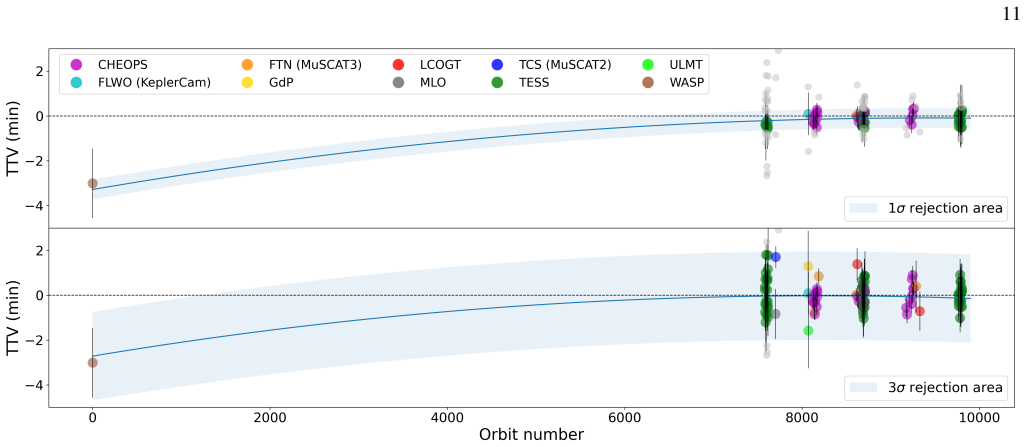
The central claim is that transit-timing variations of TOI-2109b across four years of data favor a rather constant-period orbit, with a best-fit $\dot{P} = (-2.616 \pm 1.285)$ ms/yr at $3\sigma$, which excludes the fast-decay range of 10–740 ms/yr proposed in the discovery paper and supports a young host star with $Q'_\star > 3.7\times10^7$. In the authors' tidal evolution model, a young star dissipates tides mainly through inertial waves in the convective envelope, giving $\dot{P} \approx -4.2$ ms/yr, whereas an old star whose internal gravity waves reach the wave-breaking regime would decay at about $-1107$ ms/yr—a rate that would have produced easily visible shifts in the 2022 and 2024 TESS transits and is rejected by the data. The paper also shows that gravitational perturbations from a possible outer companion, stellar and planetary oblateness, and general-relativistic precession can each generate TTV signals that mimic or mask orbital decay, so those must be subtracted before attributing any trend to tides.
Load-bearing premise
The argument that the data single out a young host star rests on the wave-breaking threshold: the authors assume a 5-Jupiter-mass planet fully damps internal gravity waves only when the star is near its 2.65 Gyr upper age limit, because the critical mass for wave breaking from the adopted tidal model falls between 1 and 10 Jupiter masses at that age; if that threshold were different for a 1.45-solar-mass F star, the old-star scenario would not necessarily decay at the fast rate, and the timing data would no longer favor a young host.
Editorial extensions
If this is right
- If the period is truly nearly constant, TOI-2109b is not on the verge of tidal disruption, and its 16-hour orbit can be used to probe stellar tidal quality factors near $Q'_\star \sim 10^7$ rather than a fast-decay endpoint.
- The young-star scenario implies $Q'_\star > 2.3\times10^7$ from tidal modeling and $>3.7\times10^7$ from timing, values at the high end for F stars, which constrains how efficiently inertial waves dissipate in rapidly rotating convective envelopes.
- Under the accepted decay rate, mid-transit times advance by less than about 10 seconds over three years, a signal detectable with high-cadence space photometry and a concrete target for future campaigns.
- The demonstration that a possible outer companion, oblateness, and relativistic precession can produce TTV signals resembling decay means future analyses of ultra-short-period planets must model those effects before claiming orbital decay.
Reading between the lines
- The paper leaves stellar age as the dominant unknown; a precise age determination would break the young/old degeneracy and either confirm the slow decay or reopen the fast-decay scenario.
- The assumption of a solid planetary core with rigidity derived from Jupiter-Io tidal interaction influences the planetary dissipation term; updated Jupiter interior models with a diluted core could shift the modeled $Q'_p$ and slightly alter the predicted $\dot{P}$.
- If the suggested $\sim 0.2\,M_\mathrm{J}$ outer companion exists, its ~1–2 minute periodic TTV signal should be detectable in a few more CHEOPS or TESS sectors, offering a direct test independent of the decay question.
Signed reviews
Editorial analysis
A structured set of objections, weighed in public.
Referee Report
Summary. The paper studies the orbital evolution of the ultra-hot Jupiter TOI-2109b using a two-layer tidal model that includes inertial waves in the convective envelope and internal gravity waves in the radiative region, with stellar age as the key parameter. For a 'young' host star the model predicts a slow period decay of approximately -4 ms/yr, while for an 'old' host star (t_age = 2.65 Gyr) it predicts a much faster decay of about -1100 ms/yr. The authors combine TESS data from three sectors (including new 20-s cadence data from Sector 79), CHEOPS transit times from the literature, and ground-based light curves to perform a TTV analysis with the PdotQuest code. They find a best-fit period decay of Pdot_OBSV = (-2.616 ± 1.285) ms/yr under a 3-sigma rejection scheme, which rules out the high end of the 10-740 ms/yr range suggested by Wong et al. (2021) and yields a 95% lower limit of Q'_* > 3.7 × 10^7. The authors interpret this as support for a young host star and a constant-period orbit, and they also simulate TTV contributions from an outer companion, stellar/planetary oblateness, and general relativity to aid interpretation.
Significance. The observational TTV result is a solid contribution: it incorporates new TESS 20-s cadence data, re-reduces earlier TESS and ground-based transits, and reports a consistent small period decay under two sigma-clipping schemes. This is a genuine, model-independent timing constraint that tightens the lower limit on Q'_* and rules out the fast-decay end of previous predictions. The paper also makes its timing data and reduction code publicly available, which supports reproducibility. If the young-star interpretation holds, the result implies that TOI-2109b is not currently spiraling into its host star at an observable rate and that stellar age is a controlling factor in tidal dissipation efficiency. The theoretical tidal modeling, however, rests on two under-specified inputs—the Barker (2020) critical-mass threshold and the scaling of the two-layer inertial-wave model—so the central age interpretation is less secure than the timing measurement itself.
major comments (3)
- [§4.2 and Table 1] The division into 'young' and 'old' host-star scenarios relies on an unquantified critical-mass threshold from Barker (2020). The authors state that at t_age = 2.65 Gyr (the 1-sigma upper age limit in Table 1) M_crit lies between 1 and 10 M_J, so a ~5 M_J planet fully damps IGWs; they do not quote M_crit itself nor its dependence on stellar mass and age. If M_crit exceeds 5 M_J at this age, or if the true age is below 2.65 Gyr, the 'old' star reverts to Q'_IGW ≈ 10^8.5 and Pdot_TIDE ≈ 4 ms/yr, making it observationally indistinguishable from the 'young' case. Since the abstract's claim that TTVs 'support a young host star' depends entirely on this binary threshold, the authors should compute or quote M_crit from Barker (2020) and show how it varies across the allowed age range, and present the old-star prediction as a conditional scenario rather than a fixed alternative.
- [§3.1 and §4.1] The two-layer inertial-wave model is said to underpredict dissipation in F-type stars by 1-2 orders of magnitude, and the authors account for the difference by using Barker (2020) to scale Q'_*, but no numerical scale factor, equation, or methodology is provided. As a result, the quoted Pdot_TIDE = (-4.186 ± 0.797) ms/yr for the young-star scenario is not reproducible, and its uncertainty almost certainly understates the model error from the unspecified scaling. This matters because the central comparison in Section 5.3 between Pdot_TIDE and Pdot_OBSV = (-2.616 ± 1.285) ms/yr is used to support the young-star interpretation; a factor of a few in the scaling would change the theoretical prediction by an order of magnitude and could spoil the agreement.
- [§5.3] The conversion from the fitted Pdot_OBSV to the headline lower limit Q'_*,OBSV > 3.7 × 10^7 is not shown. Unlike Section 4.1, where the Goldreich & Soter relation and adopted stellar/planetary parameters are described, Section 5.3 simply states the result. The authors should present the formula used to convert a measured period derivative into Q'_* and list the assumed values of M_p, R_*, a, and the stellar moment of inertia, so that the reader can verify the one-sided 95% lower limit. This is a central quantitative claim of the paper.
minor comments (5)
- [§5.3 and §6] There are a few typographical errors: 'With a a cadence' in Section 5.3 and 'evolutionaryS timescales' in Section 6.
- [§5.3] The statement that the result 'rules out any Pdot > 10 ms/yr' is imprecise. The 3-sigma interval on Pdot is approximately [-6.5, 1.3] ms/yr, so a decay rate of 10 ms/yr is excluded at about 5.7 sigma; the formal significance should be stated instead.
- [§5.1 and §5.2] When combining TESS, CHEOPS, and heterogeneous ground-based data, the analysis does not quantify correlated red noise or possible systematic offsets between instruments. The reported uncertainties on Pdot would be more robust if a jitter term or per-instrument offset were included; at least a brief discussion of this limitation should be added.
- [Figure 9] The two sigma-rejection fits use different samples (53 vs 102 transits); it would aid interpretation to plot both data sets and the best quadratic curves with residuals in a single panel, in addition to the TTV plots shown.
- [§5.4] The simulated TTV amplitudes from the companion, oblateness, and general relativity are presented without a quantitative comparison to the observed TTV residuals. Even a simple chi-square or amplitude comparison would clarify whether these effects are consistent with the data or are merely illustrative.
Circularity Check
No significant circularity: the observed period decay is measured independently of the tidal model, and the theoretical decay rates are forward-model outputs compared with, not fitted to, the TTV data.
full rationale
The paper's central test is a genuine model-vs-data comparison. The observed decay rate, Pdot_OBSV = (-2.616 ± 1.285) ms/yr, is obtained by fitting a quadratic ephemeris to 102 transit times from TESS, CHEOPS, and ground-based observations (Section 5.3, Table 4). This fit involves no tidal parameters. The theoretical decay rates for the young and old stellar scenarios are obtained by integrating the tidal evolution equations with quality factors computed from structural inputs and external tidal-dissipation prescriptions (Sections 3 and 4). The young-star value Pdot_TIDE = (-4.186 ± 0.797) ms/yr and the old-star value Pdot_TIDE = (-1107 ± 648) ms/yr follow from those forward simulations and are not constructed from the measured TTVs. The age discrimination does depend on the binary M_crit threshold from Barker (2020), but that is an external published calculation, not a self-citation, and the paper itself flags the old-star scenario as uncertain ('should be taken with a grain of salt', Section 6). The self-citations in the paper (Alvarado-Montes 2022; Alvarado-Montes et al. 2021) concern the choice of tidal evolution code and a comparison of stellar spin-up; they are not used to define the measured quantity or to forbid alternative interpretations. The TTV analysis also explicitly considers non-tidal sources of transit-timing variation in Section 5.4. Therefore, no claimed prediction reduces by construction to its inputs, and no load-bearing argument reduces to a self-citation. Scientific concerns about the M_crit threshold or the constant-Q' assumption are modeling uncertainties, not circularity.
Assumptions & free parameters
free parameters (4)
- Stellar interior aspect ratios alpha_* and beta_* =
Not explicitly quoted in text; adopted from Gallet et al. (2017) for M* ~ 1.45 M_sun (Figure 3 shows the allowed range)
- Barker (2020) scaling factor for Q'_*,IW =
Not stated
- Normalization C in Q'_*,IGW = C (P_tide/0.5 d)^(8/3) =
3
- Planet core rigidity R =
4.46e10 Pa
assumptions (5)
- domain assumption Constant tidal lag-time model (Hut 1981) with Q' = 1/(2 n_p tau) and dominant tidal frequency omega ~ 2 n_p
- domain assumption Frequency-averaged inertial-wave dissipation formalism (Ogilvie 2013) is representative of the true IW dissipation in TOI-2109
- domain assumption Internal gravity wave dissipation follows Barker (2020): Q'_*,IGW ~ 10^8.5 and Q'_*,IGW ∝ (P_tide/0.5 d)^(8/3) when the planet mass exceeds M_crit
- domain assumption Spin-orbit alignment and negligible obliquity
- domain assumption Stellar rotation period P_rot = 1.05 d (from v sin i and assumed inclination) and no core-envelope decoupling
invented entities (1)
-
Hypothetical outer companion TOI-2109c (0.2 M_J, P ~ 1.125 d, e = 0.05)
Cite this review
Pith. "Pith review of Orbital Decay of the Ultra-Hot Jupiter TOI-2109b: Tidal Constraints and Transit-Timing Analysis." pith.science (2026). https://pith.science/paper/RKB2BHQX
@misc{pith2026250518941,
  author       = {Pith},
  title        = {Pith review of: Orbital Decay of the Ultra-Hot Jupiter TOI-2109b: Tidal Constraints and Transit-Timing Analysis},
  year         = {2026},
  howpublished = {\url{https://pith.science/paper/RKB2BHQX}},
  note         = {Machine review of arXiv:2505.18941}
}
abstract
TOI-2109b is the ultra-hot Jupiter with the shortest orbital period ($\sim16\,$hr) yet discovered. At this close distance, strong tidal interactions can produce a significant exchange of angular momentum with the star. Since the orbital period of this planet is shorter than the stellar rotation period, TOI-2109b may be an optimal candidate for studying orbital decay. This process depends on how efficiently the star and the planet dissipate energy, due mainly to interior mechanisms that are poorly constrained in exoplanet systems. In this work, we study for the first time the tidal evolution of TOI-2109b under a formalism of inertial waves (IWs) in convective envelopes and internal gravity waves (IGWs) in stellar radiative regions. We find that uncertainties in the age of TOI-2109 ($t_\mathrm{\star, age}$) significantly affect the rate of orbital evolution, as IWs and IGWs interact differently depending on $t_\mathrm{\star, age}$. For an 'old' host star, we find that TOI-2109b would undergo fast orbital decay. Conversely, if TOI-2109b orbits a 'young' host star, a rather slow decay rate for $Q_\star'>2.3\times10^7$ would suggest a constant-period orbit. Our calculated mid-transit times and transit-timing variations (TTVs) support a 'young' host star with $Q_\star'>3.7\times10^7$, suggesting a decay rate $\dot{P}\sim4\,$ms yr$^{-1}$ that could lead to mid-transit-time shifts $\lesssim10\,$s over three years. Orbital decay and other TTV-inducing effects will be confirmed or ruled out with future higher-quality timing data. The results presented here aim at constraining the current modeling of tides and TTVs for TOI-2109b, helping us further understand light-curve changes associated to the long-term evolution of ultra-short-period planets.
Figures


Figures from the paper (8 more)




Reference graph
Works this paper leans on
-
[1]
R., Jackson, B., Sickafoose, A
Adams, E. R., Jackson, B., Sickafoose, A. A., et al. 2024, PSJ, 5, 163, doi: 10.3847/PSJ/ad3e80
-
[2]
Akinsanmi, B., Barros, S. C. C., Santos, N. C., et al. 2019, A&A, 621, A117, doi: 10.1051/0004-6361/201834215
-
[3]
Akinsanmi, B., Barros, S. C. C., Lendl, M., et al. 2024, A&A, 685, A63, doi: 10.1051/0004-6361/202348502
-
[4]
Alexander, M. E. 1973, Ap&SS, 23, 459, doi: 10.1007/BF00645172
-
[5]
Alvarado, E., Bostow, K. B., Patra, K. C., et al. 2024, MNRAS, 534, 800, doi: 10.1093/mnras/stae2062
-
[6]
Alvarado-Montes, J. A. 2022, MNRAS, 517, 2831, doi: 10.1093/mnras/stac2741
-
[7]
Alvarado-Montes, J. A., & García-Carmona, C. 2019, MNRAS, 486, 3963, doi: 10.1093/mnras/stz1081
-
[8]
A., Sucerquia, M., García-Carmona, C., et al
Alvarado-Montes, J. A., Sucerquia, M., García-Carmona, C., et al. 2021, MNRAS, 506, 2247, doi: 10.1093/mnras/stab1081
Show all 115 references
-
[9]
2019, MNRAS, 482, 1872, doi: 10.1093/mnras/sty2805
Bailey, A., & Goodman, J. 2019, MNRAS, 482, 1872, doi: 10.1093/mnras/sty2805
2019 doi
-
[11]
Barker, A. J. 2016, MNRAS, 459, 939, doi: 10.1093/mnras/stw702
2016 doi
-
[12]
Barker, A. J. 2020, MNRAS, 498, 2270, doi: 10.1093/mnras/staa2405
2020 doi
-
[13]
J., Efroimsky, M., Makarov, V
Barker, A. J., Efroimsky, M., Makarov, V. V., & Veras, D. 2024, MNRAS, 527, 5131, doi: 10.1093/mnras/stad3530
2024 doi
-
[14]
J., & Ogilvie, G
Barker, A. J., & Ogilvie, G. I. 2009, MNRAS, 395, 2268, doi: 10.1111/j.1365-2966.2009.14694.x
2009
-
[15]
J., & Ogilvie, G
Barker, A. J., & Ogilvie, G. I. 2010, MNRAS, 404, 1849, doi: 10.1111/j.1365-2966.2010.16400.x
2010
-
[16]
Barros, S. C. C., Akinsanmi, B., Boué, G., et al. 2022, A&A, 657, A52, doi: 10.1051/0004-6361/202142196
2022 doi
-
[17]
2019, A&A, 621, A124, doi: 10.1051/0004-6361/201833314
Mathis, S. 2019, A&A, 621, A124, doi: 10.1051/0004-6361/201833314
2019 doi
-
[18]
P., & Parthasarathy, K
Biswas, S., Bisht, D., Jiang, I.-G., Sariya, D. P., & Parthasarathy, K. 2024, AJ, 168, 176, doi: 10.3847/1538-3881/ad6d66
2024 doi
-
[19]
2016, Celestial Mechanics and Dynamical Astronomy, 126, 275, doi: 10.1007/s10569-016-9690-3
Bolmont, E., & Mathis, S. 2016, Celestial Mechanics and Dynamical Astronomy, 126, 275, doi: 10.1007/s10569-016-9690-3
2016 doi
-
[20]
G., Winn, J
Bouma, L. G., Winn, J. N., Baxter, C., et al. 2019, AJ, 157, 217, doi: 10.3847/1538-3881/ab189f
2019 doi
-
[21]
2022, A&A, 659, L4, doi: 10.1051/0004-6361/202243082
Brandeker, A., Heng, K., Lendl, M., et al. 2022, A&A, 659, L4, doi: 10.1051/0004-6361/202243082
2022 doi
-
[22]
2011, MNRAS, 415, 605, doi: 10.1111/j.1365-2966.2011.18729.x
Smalley, B. 2011, MNRAS, 415, 605, doi: 10.1111/j.1365-2966.2011.18729.x
2011
-
[23]
M., Baliber, N., Bianco, F
Brown, T. M., Baliber, N., Bianco, F. B., et al. 2013, PASP, 125, 1031, doi: 10.1086/673168
2013 doi
-
[24]
A., Tenenbaum, P., Twicken, J
Caldwell, D. A., Tenenbaum, P., Twicken, J. D., et al. 2020, Research Notes of the American Astronomical Society, 4, 201, doi: 10.3847/2515-5172/abc9b3
2020 doi
-
[25]
J., Kashyap, V
Cohen, O., Drake, J. J., Kashyap, V. L., Sokolov, I. V., & Gombosi, T. I. 2010, ApJL, 723, L64, doi: 10.1088/2041-8205/723/1/L64 Collier Cameron, A., & Jardine, M. 2018, MNRAS, 476, 2542, doi: 10.1093/mnras/sty292 Collier Cameron, A., & Li, J. 1994, MNRAS, 269, 1099, doi: 10.1...
2010 doi
-
[26]
2025, arXiv e-prints, arXiv:2504.15757
Cont, D., Nortmann, L., Lesjak, F., et al. 2025, arXiv e-prints, arXiv:2504.15757. https://arxiv.org/abs/2504.15757
2025 arXiv
-
[27]
I., & Johnson, J
Dawson, R. I., & Johnson, J. A. 2018, ARA&A, 56, 175, doi: 10.1146/annurev-astro-081817-051853 17
2018 doi
-
[28]
2023, Nature, 617, 55, doi: 10.1038/s41586-023-05842-x
De, K., MacLeod, M., Karambelkar, V., et al. 2023, Nature, 617, 55, doi: 10.1038/s41586-023-05842-x
2023 doi
-
[29]
M., et al
Delrez, L., Santerne, A., Almenara, J. M., et al. 2016, MNRAS, 458, 4025, doi: 10.1093/mnras/stw522
2016 doi
-
[30]
D., de Vries, N
Duguid, C. D., de Vries, N. B., Lecoanet, D., & Barker, A. J. 2024, ApJL, 966, L14, doi: 10.3847/2041-8213/ad3c40
2024 doi
-
[31]
2012, ApJ, 746, 150, doi: 10.1088/0004-637X/746/2/150
Efroimsky, M. 2012, ApJ, 746, 150, doi: 10.1088/0004-637X/746/2/150
2012 doi
-
[32]
Essick, R., & Weinberg, N. N. 2016, ApJ, 816, 18, doi: 10.3847/0004-637X/816/1/18
2016 doi
-
[33]
2023, A&A, 669, A2, doi: 10.1051/0004-6361/202243621
Fellay, L., Pezzotti, C., Buldgen, G., Eggenberger, P., & Bolmont, E. 2023, A&A, 669, A2, doi: 10.1051/0004-6361/202243621
2023 doi
-
[34]
J., & Matt, S
Finley, A. J., & Matt, S. P. 2017, ApJ, 845, 46, doi: 10.3847/1538-4357/aa7fb9
2017 doi
-
[35]
2017, A&A, 604, A112, doi: 10.1051/0004-6361/201730661
Gallet, F., Bolmont, E., Mathis, S., Charbonnel, C., & Amard, L. 2017, A&A, 604, A112, doi: 10.1051/0004-6361/201730661
2017 doi
-
[36]
S., Stassun, K
Gaudi, B. S., Stassun, K. G., Collins, K. A., et al. 2017, Nature, 546, 514, doi: 10.1038/nature22392
2017 doi
-
[37]
1966, icarus, 5, 375, doi: 10.1016/0019-1035(66)90051-0
Goldreich, P., & Soter, S. 1966, icarus, 5, 375, doi: 10.1016/0019-1035(66)90051-0
1966 doi
- [38]
-
[39]
Gu, P.-G., Lin, D. N. C., & Bodenheimer, P. H. 2003, ApJ, 588, 509, doi: 10.1086/373920
2003 doi
-
[40]
2014, A&A, 566, L9, doi: 10.1051/0004-6361/201424010
Guenel, M., Mathis, S., & Remus, F. 2014, A&A, 566, L9, doi: 10.1051/0004-6361/201424010
2014 doi
-
[41]
R., Edwards, B., & Boley, A
Hagey, S. R., Edwards, B., & Boley, A. C. 2022, AJ, 164, 220, doi: 10.3847/1538-3881/ac959a
2022 doi
-
[42]
H., & Schlaufman, K
Hamer, J. H., & Schlaufman, K. C. 2020, AJ, 160, 138, doi: 10.3847/1538-3881/aba74f
2020 doi
-
[43]
Harre, J.-V., & Smith, A. M. S. 2023, Universe, 9, 506, doi: 10.3390/universe9120506
2023 doi
-
[44]
V., Smith, A
Harre, J. V., Smith, A. M. S., Barros, S. C. C., et al. 2024, A&A, 692, A254, doi: 10.1051/0004-6361/202451068
2024 doi
-
[45]
2022, MNRAS, 511, 3133, doi: 10.1093/mnras/stac169
Hou, Q., & Wei, X. 2022, MNRAS, 511, 3133, doi: 10.1093/mnras/stac169
2022 doi
-
[46]
W., Marcy, G
Howard, A. W., Marcy, G. W., Bryson, S. T., et al. 2012, ApJS, 201, 15, doi: 10.1088/0067-0049/201/2/15
2012 doi
-
[47]
2020, A&A, 635, A24, doi: 10.1051/0004-6361/201936325
Hoyer, S., Guterman, P., Demangeon, O., et al. 2020, A&A, 635, A24, doi: 10.1051/0004-6361/201936325
2020 doi
-
[48]
B., Papaloizou, J
Ivanov, P. B., Papaloizou, J. C. B., & Chernov, S. V. 2013, MNRAS, 432, 2339, doi: 10.1093/mnras/stt595
2013 doi
-
[49]
S., & Winn, J
Ivshina, E. S., & Winn, J. N. 2022, ApJS, 259, 62, doi: 10.3847/1538-4365/ac545b
2022 doi
-
[50]
2016, Celestial Mechanics and Dynamical Astronomy, 126, 227, doi: 10.1007/s10569-016-9704-1
Jackson, B., Jensen, E., Peacock, S., Arras, P., & Penev, K. 2016, Celestial Mechanics and Dynamical Astronomy, 126, 227, doi: 10.1007/s10569-016-9704-1
2016 doi
-
[51]
P., Güdel, M., Lüftinger, T., Toth, G., & Brott, I
Johnstone, C. P., Güdel, M., Lüftinger, T., Toth, G., & Brott, I. 2015, A&A, 577, A27, doi: 10.1051/0004-6361/201425300
2015 doi
-
[52]
M., Demory, B
Jones, K., Morris, B. M., Demory, B. O., et al. 2022, A&A, 666, A118, doi: 10.1051/0004-6361/202243823
2022 doi
-
[53]
1960, Figures of Equilibrium of Celestial Bodies: With Emphasis on Problems of Motion of Artificial Satellites (Madison, WI: University of Wisconsin Press), 135
Kopal, Z. 1960, Figures of Equilibrium of Celestial Bodies: With Emphasis on Problems of Motion of Artificial Satellites (Madison, WI: University of Wisconsin Press), 135
1960
-
[54]
Kotorashvili, K., & Blackman, E. G. 2024, arXiv e-prints, arXiv:2411.17916. https://arxiv.org/abs/2411.17916
2024
-
[55]
2012, ApJ, 752, 14, doi: 10.1088/0004-637X/752/1/14
Lainey, V., Karatekin, Ö., Desmars, J., et al. 2012, ApJ, 752, 14, doi: 10.1088/0004-637X/752/1/14
2012 doi
-
[56]
Lanza, A. F. 2010, A&A, 512, A77, doi: 10.1051/0004-6361/200912789
2010 doi
-
[57]
F., Damiani, C., & Gandolfi, D
Lanza, A. F., Damiani, C., & Gandolfi, D. 2011, A&A, 529, A50, doi: 10.1051/0004-6361/201016144
2011 doi
-
[58]
Lazovik, Y. A. 2021, MNRAS, 508, 3408, doi: 10.1093/mnras/stab2768
2021 doi
-
[59]
2010, A&A, 516, A64, doi: 10.1051/0004-6361/201014337
Leconte, J., Chabrier, G., Baraffe, I., & Levrard, B. 2010, A&A, 516, A64, doi: 10.1051/0004-6361/201014337
2010 doi
-
[60]
2024, A&A, 686, A84, doi: 10.1051/0004-6361/202348363
Leonardi, P., Nascimbeni, V., Granata, V., et al. 2024, A&A, 686, A84, doi: 10.1051/0004-6361/202348363
2024 doi
-
[61]
2009, ApJL, 692, L9, doi: 10.1088/0004-637X/692/1/L9 Lightkurve Collaboration, Cardoso, J
Levrard, B., Winisdoerffer, C., & Chabrier, G. 2009, ApJL, 692, L9, doi: 10.1088/0004-637X/692/1/L9 Lightkurve Collaboration, Cardoso, J. V. d. M., Hedges, C., et al. 2018,, Astrophysics Source Code Library http://ascl.net/1812.013
2009 doi
-
[62]
Lin, Y., & Ogilvie, G. I. 2018, MNRAS, 474, 1644, doi: 10.1093/mnras/stx2764
2018 doi
-
[63]
Love, A. E. H. 1927, A Treatise on the Mathematical Theory of
1927
-
[64]
2021, ApJ, 918, 16, doi: 10.3847/1538-4357/ac088e
Ma, L., & Fuller, J. 2021, ApJ, 918, 16, doi: 10.3847/1538-4357/ac088e
2021 doi
-
[65]
2021, A&A, 656, A88, doi: 10.1051/0004-6361/202142424
Maciejewski, G., Fernández, M., Aceituno, F., et al. 2021, A&A, 656, A88, doi: 10.1051/0004-6361/202142424
2021 doi
-
[66]
2016, A&A, 588, L6, doi: 10.1051/0004-6361/201628312
Maciejewski, G., Dimitrov, D., Fernández, M., et al. 2016, A&A, 588, L6, doi: 10.1051/0004-6361/201628312
2016 doi
-
[67]
2002, ApJL, 580, L171, doi: 10.1086/345520
Mandel, K., & Agol, E. 2002, ApJL, 580, L171, doi: 10.1086/345520
2002 doi
-
[68]
2015, A&A, 580, L3, doi: 10.1051/0004-6361/201526472
Mathis, S. 2015, A&A, 580, L3, doi: 10.1051/0004-6361/201526472
2015 doi
-
[69]
1995, Nature, 378, 355, doi: 10.1038/378355a0
Mayor, M., & Queloz, D. 1995, Nature, 378, 355, doi: 10.1038/378355a0
1995 doi
-
[70]
2019, ApJ, 886, 72, doi: 10.3847/1538-4357/ab4c3f Mol Lous, M., & Miguel, Y
Millholland, S. 2019, ApJ, 886, 72, doi: 10.3847/1538-4357/ab4c3f Mol Lous, M., & Miguel, Y. 2020, MNRAS, 495, 2994, doi: 10.1093/mnras/staa1405 Müller, S., Helled, R., & Cumming, A. 2020, A&A, 638, A121, doi: 10.1051/0004-6361/201937376
2019 doi
-
[71]
D., & Dermott, S
Murray, C. D., & Dermott, S. F. 2000, Solar System Dynamics (New York: Cambridge Univ. Press) NASA Exoplanet Archive. 2025,, Version: 2025-04-27 21:00 NExScI-Caltech/IPAC, doi: 10.26133/NEA12 18Jaime A. Alvarado-Montes et al
2000 doi
-
[72]
E., Rodriguez, J
Oberst, T. E., Rodriguez, J. E., Colón, K. D., et al. 2017, AJ, 153, 97, doi: 10.3847/1538-3881/153/3/97
2017 doi
-
[73]
Ogilvie, G. I. 2013, MNRAS, 429, 613, doi: 10.1093/mnras/sts362
2013 doi
- [74]
-
[75]
M., Brewer, J
Oh, S., Price-Whelan, A. M., Brewer, J. M., et al. 2018, ApJ, 854, 138, doi: 10.3847/1538-4357/aaab4d
2018 doi
-
[76]
R., Bean, J
Parmentier, V., Line, M. R., Bean, J. L., et al. 2018, A&A, 617, A110, doi: 10.1051/0004-6361/201833059
2018 doi
-
[77]
2015, MNRAS, 450, 3233, doi: 10.1093/mnras/stv894
Parviainen, H. 2015, MNRAS, 450, 3233, doi: 10.1093/mnras/stv894
2015 doi
-
[78]
C., Winn, J
Patra, K. C., Winn, J. N., Holman, M. J., et al. 2017, AJ, 154, 4, doi: 10.3847/1538-3881/aa6d75
2017 doi
-
[79]
C., Winn, J
Patra, K. C., Winn, J. N., Holman, M. J., et al. 2020, AJ, 159, 150, doi: 10.3847/1538-3881/ab7374
2020 doi
-
[80]
G., Winn, J
Penev, K., Bouma, L. G., Winn, J. N., & Hartman, J. D. 2018, AJ, 155, 165, doi: 10.3847/1538-3881/aaaf71
2018 doi
-
[81]
D., Bakos, G
Penev, K., Hartman, J. D., Bakos, G. Á., et al. 2016, AJ, 152, 127, doi: 10.3847/0004-6256/152/5/127
2016 doi
-
[82]
2020, MNRAS, 491, 1243, doi: 10.1093/mnras/stz3034
Petrucci, R., Jofré, E., Gómez Maqueo Chew, Y., et al. 2020, MNRAS, 491, 1243, doi: 10.1093/mnras/stz3034
2020 doi
-
[83]
L., Skillen, I., Collier Cameron, A., et al
Pollacco, D. L., Skillen, I., Collier Cameron, A., et al. 2006, PASP, 118, 1407, doi: 10.1086/508556
2006 doi
-
[84]
Rein, H., & Liu, S. F. 2012, A&A, 537, A128, doi: 10.1051/0004-6361/201118085
2012 doi
-
[85]
2015, MNRAS, 452, 376, doi: 10.1093/mnras/stv1257
Rein, H., & Tamayo, D. 2015, MNRAS, 452, 376, doi: 10.1093/mnras/stv1257
2015 doi
-
[86]
R., Winn, J
Ricker, G. R., Winn, J. N., Vanderspek, R., et al. 2015, JATIS, 1, 014003, doi: 10.1117/1.JATIS.1.1.014003
2015 doi
-
[87]
2010, Journal of Fluid Mechanics, 643, 363, doi: 10.1017/S002211200999214X
Rieutord, M., & Valdettaro, L. 2010, Journal of Fluid Mechanics, 643, 363, doi: 10.1017/S002211200999214X
2010 doi
-
[88]
1849, Acad
Roche, E. 1849, Acad. Montpellier, 1, 243 Rosário, N. M., Barros, S. C. C., Demangeon, O. D. S., & Santos, N. C. 2022, A&A, 668, A114, doi: 10.1051/0004-6361/202244513
2022 doi
-
[89]
B., & Grishin, E
Rozner, M., Glanz, H., Perets, H. B., & Grishin, E. 2022, ApJ, 931, 10, doi: 10.3847/1538-4357/ac6808
2022 doi
-
[90]
2011, A&A, 532, A6, doi: 10.1051/0004-6361/201116594
Sanz-Forcada, J., Micela, G., Ribas, I., et al. 2011, A&A, 532, A6, doi: 10.1051/0004-6361/201116594
2011 doi
-
[91]
G., Oelkers, R
Stassun, K. G., Oelkers, R. J., Pepper, J., et al. 2018, AJ, 156, 102, doi: 10.3847/1538-3881/aad050
2018 doi
-
[92]
P., Naoz, S., & Gaudi, B
Stephan, A. P., Naoz, S., & Gaudi, B. S. 2018, AJ, 156, 128, doi: 10.3847/1538-3881/aad6e5
2018 doi
-
[93]
2025, A&A, 694, L8, doi: 10.1051/0004-6361/202452968
Sucerquia, M., & Cuello, N. 2025, A&A, 694, L8, doi: 10.1051/0004-6361/202452968
2025 doi
-
[94]
Tamayo, D., Rein, H., Shi, P., & Hernandez, D. M. 2020, MNRAS, 491, 2885, doi: 10.1093/mnras/stz2870
2020 doi
-
[95]
Tokuno, T., Fukui, A., & Suzuki, T. K. 2024, ApJ, 973, 128, doi: 10.3847/1538-4357/ad67c9
2024 doi
-
[96]
A., Marchant, P., & Rogers, L
Valsecchi, F., Rappaport, S., Rasio, F. A., Marchant, P., & Rogers, L. A. 2015, ApJ, 813, 101, doi: 10.1088/0004-637X/813/2/101
2015 doi
-
[97]
2018, MNRAS, 475, 4579, doi: 10.1093/mnras/sty080
Vidal, J., Cébron, D., Schaeffer, N., & Hollerbach, R. 2018, MNRAS, 475, 4579, doi: 10.1093/mnras/sty080
2018 doi
-
[98]
2022, ApJL, 941, L31, doi: 10.3847/2041-8213/aca47e
Vissapragada, S., Chontos, A., Greklek-McKeon, M., et al. 2022, ApJL, 941, L31, doi: 10.3847/2041-8213/aca47e
2022 doi
-
[99]
M., Thorngren, D., Lu, T., & Militzer, B
Wahl, S. M., Thorngren, D., Lu, T., & Militzer, B. 2021, ApJ, 921, 105, doi: 10.3847/1538-4357/ac1a72
2021 doi
-
[100]
2024, ApJS, 270, 14, doi: 10.3847/1538-4365/ad0847
Wang, W., Zhang, Z., Chen, Z., et al. 2024, ApJS, 270, 14, doi: 10.3847/1538-4365/ad0847
2024 doi
-
[101]
J., & Davis, Leverett, J
Weber, E. J., & Davis, Leverett, J. 1967, ApJ, 148, 217, doi: 10.1086/149138
1967 doi
-
[102]
N., Arras, P., Quataert, E., & Burkart, J
Weinberg, N. N., Arras, P., Quataert, E., & Burkart, J. 2012, ApJ, 751, 136, doi: 10.1088/0004-637X/751/2/136
2012 doi
-
[103]
N., Davachi, N., Essick, R., et al
Weinberg, N. N., Davachi, N., Essick, R., et al. 2024, ApJ, 960, 50, doi: 10.3847/1538-4357/ad05c9
2024 doi
-
[104]
N., Fabrycky, D., Albrecht, S., & Johnson, J
Winn, J. N., Fabrycky, D., Albrecht, S., & Johnson, J. A. 2010, ApJL, 718, L145, doi: 10.1088/2041-8205/718/2/L145
2010 doi
-
[105]
N., Sanchis-Ojeda, R., & Rappaport, S
Winn, J. N., Sanchis-Ojeda, R., & Rappaport, S. 2018, NewAR, 83, 37, doi: 10.1016/j.newar.2019.03.006
2018 doi
-
[106]
1991, AJ, 102, 1528, doi: 10.1086/115978
Wisdom, J., & Holman, M. 1991, AJ, 102, 1528, doi: 10.1086/115978
1991 doi
-
[107]
S., & Ragozzine, D
Wolf, A. S., & Ragozzine, D. 2009, in IAU Symposium, Vol. 253, Transiting Planets, ed. F. Pont, D. Sasselov, & M. J. Holman, 163–169, doi: 10.1017/S1743921308026367
2009 doi
-
[108]
2022, AJ, 163, 175, doi: 10.3847/1538-3881/ac5680
Wong, I., Shporer, A., Vissapragada, S., et al. 2022, AJ, 163, 175, doi: 10.3847/1538-3881/ac5680
2022 doi
-
[109]
2021, AJ, 162, 256, doi: 10.3847/1538-3881/ac26bd
Wong, I., Shporer, A., Zhou, G., et al. 2021, AJ, 162, 256, doi: 10.3847/1538-3881/ac26bd
2021 doi
-
[110]
T., Marcy, G
Wright, J. T., Marcy, G. W., Howard, A. W., et al. 2012, ApJ, 753, 160, doi: 10.1088/0004-637X/753/2/160
2012 doi
-
[111]
W., Winn, J
Yee, S. W., Winn, J. N., Knutson, H. A., et al. 2020, ApJL, 888, L5, doi: 10.3847/2041-8213/ab5c16
2020 doi
-
[112]
2024, NewA, 106, 102130, doi: 10.1016/j.newast.2023.102130
Yeh, L.-C., Jiang, I.-G., & A-thano, N. 2024, NewA, 106, 102130, doi: 10.1016/j.newast.2023.102130
2024
-
[113]
Zahn, J. P. 1989, A&A, 220, 112
1989
-
[114]
Zahn, J. P. 2008, in EAS Publications Series, ed. M. J. Goupil & J. P. Zahn, Vol. 29, 67–90, doi: 10.1051/eas:0829002
2008 doi
-
[115]
Zendejas, J., Segura, A., & Raga, A. C. 2010, Icarus, 210, 539, doi: 10.1016/j.icarus.2010.07.013
2010 doi
-
[116]
N., & Trubitsyn, V
Zharkov, V. N., & Trubitsyn, V. P. 1978, Physics of planetary interiors
1978
Reviewed August 7, 2026 · model on record in the stance chip above.
Discussion (0). Continue with ORCID to comment.