REVIEW 3 major objections 3 minor 2 cited by
Zero-Shot Time Series Forecasting with Covariates via In-Context Learning
T0 review · 3 major / 3 minor · reviewed 2026-08-07 · deepseek-v4-flash
Pith's one-line read COSMIC is a pretrained transformer that performs zero-shot forecasting with covariates by inferring covariate-target relationships from context, trained on synthetically augmented covariate-free data.
desk verdict COSMIC is a genuine step forward in covariate-aware zero-shot forecasting, but the SOTA-with-covariates headline overstates what the evidence, including the paper's own linear in-context baseline, supports. read the letter →
The pith
A machine-rendered reading of the paper's core claim, the machinery that carries it, and where it could break.
The reading
What carries the argument
The load-bearing object is Informative Covariate Augmentation, which manufactures training samples by sampling covariates from a corpus or a synthetic generator and adding an impact function, a sparse piecewise-linear function of recent covariate lags active on quantile-selected time steps, to an otherwise covariate-free target series. Around it, COSMIC is an encoder-decoder transformer that z-score normalizes each series, patches them with shared weights, and inserts distinct separator tokens and rotary embeddings so the attention stack can tell the target from each covariate and align them in time. The output layer emits nine quantiles per horizon step, trained by quantile loss. The augmentation is what gives the model a training signal that covariates predict the future target; without it, covariates do not reduce the loss and the model has no reason to learn the in-context behavior.
What would settle it
A controlled benchmark where the target depends on a covariate through a stable but nonlinear map, such as threshold-switching or multiplicative interaction, with ample evidence of the relationship in the context: if COSMIC's covariate-input forecasts do not beat its no-covariate forecasts, the claim that it learns covariate-target relations in context would be falsified.
Extended reading notes
Core claim
COSMIC is a pretrained encoder-decoder transformer that accepts a target series plus any number of past-only or past-and-future covariate series, normalizes each individually, patches them into tokens, and interleaves them with separator tokens so the attention stack can relate covariates to the target. At inference it reads the covariate-target relationship from the provided context and applies it to the forecast horizon, outputting nine quantiles per time step. The paper claims this yields state-of-the-art zero-shot probabilistic forecasts on covariate-included benchmarks, first place on 9 of 11 dataset groups in weighted quantile loss, and matches or exceeds prior zero-shot models on no-covariate benchmarks, while remaining competitive with task-specific models that are trained per dataset.
Load-bearing premise
The covariate-target relationship must be simple, roughly linear or piecewise-linear with small lags, and stable across the context and forecast horizon, and the synthetic covariate relationships used in pretraining must transfer to real-world covariates.
Editorial extensions
If this is right
- Pretrained forecasters can now be deployed on covariate-rich domains such as energy, retail, and healthcare without any dataset-specific training or manual feature engineering.
- Covariate-aware zero-shot models can be built from covariate-free corpora, so the scarcity of public covariate-labeled time series need not block this capability.
- Providing locally informative covariates, including past-only ones, can improve forecasts, and on datasets where covariates carry no local signal, performance stays roughly flat.
- COSMIC's probabilistic forecasts are competitive with task-specific models trained per dataset, at least on the aggregate weighted quantile loss benchmark, despite seeing none of the task data.
- The ability to consume covariates does not degrade no-covariate zero-shot performance, since the same model matches or beats prior zero-shot models on the covariate-free benchmark.
Reading between the lines
- A natural extension is to teach other auxiliary reasoning tasks, such as known interventions, calendar effects, or target-target correlations, by synthesizing them into the training corpus in the same way, without needing labeled examples.
- Because the paper's analysis shows COSMIC uses covariates more strongly when more evidence of the relationship appears in context, larger models and longer contexts may close more of the remaining gap to task-specific covariate models.
- The exclusion of static covariates suggests a hybrid design: a task-specific global encoder for static features combined with COSMIC's in-context machinery could handle datasets where the covariate signal lives outside the horizon.
Signed reviews
Editorial analysis
A structured set of objections, weighed in public.
Referee Report
Summary. The paper introduces COSMIC, an encoder-decoder transformer for zero-shot time series forecasting that accepts covariates through in-context learning. To avoid relying on scarce real-world covariate datasets, the authors propose Informative Covariate Augmentation, which generates synthetic covariates and adds piecewise-linear, quantile-threshold impact functions to standard no-covariate pretraining series. COSMIC is evaluated on 11 covariate-included dataset groups (split into Benchmark I and Benchmark II) and on the Chronos no-covariate benchmark. The paper reports first-place rankings on 9 of 11 WQL and 7 of 11 MASE dataset groups among pretrained zero-shot models, and competitive performance relative to task-specific models. The central claims are that COSMIC achieves state-of-the-art zero-shot forecasting both with and without covariates, and that the augmentation enables effective covariate usage.
Significance. If confirmed, COSMIC would be a useful contribution because it provides a way to train covariate-aware zero-shot forecasters without any covariate-included pretraining data, and its evaluation design is broad: multiple model sizes, both covariate and no-covariate benchmarks, an augmentation ablation (Table 1), analysis of Moirai's training overlap, past-only covariate experiments, inference-time measurements, and a comparison against an external linear in-context model (Appendix D.5). The synthetic-only pretraining recipe is appealing for practical deployment. The main weakness is that the headline state-of-the-art claim is not supported against the paper's own simple linear baseline on Benchmark I, and the question of how far the learned covariate mechanism generalizes beyond the synthetic impact-function family is left unmeasured.
major comments (3)
- [Appendix D.5, Figure 21] The paper's own comparison against a ridge-regression in-context covariate model combined with a no-covariate pretrained forecaster shows that this simple baseline outperforms COSMIC on Benchmark I for both MASE and WQL, while COSMIC wins only on Benchmark II (which excludes datasets where other targets are used as covariates). This directly qualifies the abstract's and Section 5.1's claim that COSMIC achieves state-of-the-art zero-shot forecasting with covariates. Because Benchmark I is the headline covariate-included evaluation, the authors should either include this baseline in the main results and revise the contribution claim, or justify carefully why Benchmark II is the appropriate basis for the claim and make that framing explicit throughout the paper.
- [Section 4, Impact Function] The impact function family F is restricted to piecewise-linear, threshold-triggered functions with coefficients that are constant over the whole series, and Section 4 explicitly assumes the covariate-target relationship is stable throughout the context and forecast horizon. Section 6 concedes that highly complex relationships cannot be captured. However, the paper does not provide a stress test or an analysis of where COSMIC's covariate mechanism breaks down as the relationship moves outside F, such as nonlinear, lag-varying, regime-dependent, or nonstationary effects. Given that the real-world datasets in Table 3 include electricity, traffic, and air-quality series where such effects are plausible, the evaluation does not establish how far the learned in-context covariate mechanism generalizes beyond the augmentation distribution. I would ask for a synthetic transfer experiment with out-of-family impact functions, or for a tempering of the generalization claims in the abstract and conclusion.
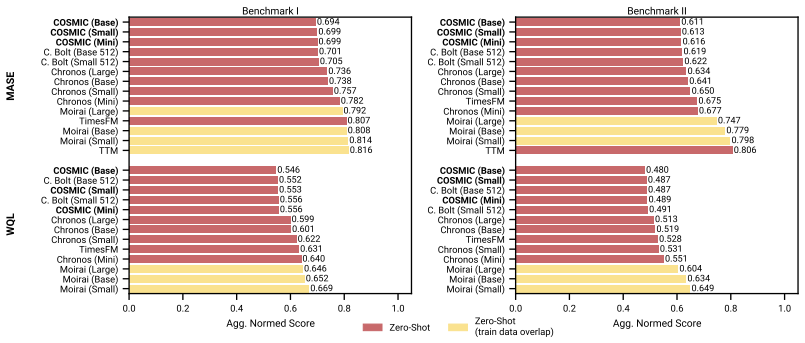
- [Section 5.1, Figures 3 and 6, Table 1] The quantitative support for the phrase 'effectively leverages covariates' is weaker than the rank-based claims suggest. Providing covariates improves aggregate MASE by only about 1% (Figure 6), and Table 1 shows that both the augmentation and the covariate-access benefit are concentrated in a few datasets, such as PEMS08 and ETTh. Moreover, no error bars or multiple seeds are reported anywhere in the experimental section, so small aggregate differences — for example COSMIC Base WQL 0.546 versus Chronos Bolt Base 0.552 in Figure 3 — cannot be separated from noise. Reporting confidence intervals, standard deviations across evaluation rolls, or repeated-seed results for the key comparisons would be necessary to support the 'state-of-the-art' wording.
minor comments (3)
- [Throughout] There are several typos, including 'Copmarision' in Section 5.1, 'zeros-hot' in Appendix C, 'pice-wise' in Appendix A, 'Aggreagted' in multiple figure captions, and 'covaraites' in Section 4; these should be corrected before publication.
- [Appendix A, Algorithm 2] Algorithm 2 returns the condition symbol inconsistently: line 12 writes '(, ⊕, z, q)' while line 13 writes '(>, y, 0)'. The notation should be harmonized, and the text around the algorithm should define what 'first order' and 'piece-wise' mean since these names appear in Table 2 but not in the main text.
- [Appendix D.5] The failure-case analysis introduces Rideshare and KDD2022 as datasets that are not part of the covariate-included benchmark in Table 3. The paper does state this, but it would help readers if Figure 21 and the surrounding text made explicit that these are auxiliary datasets chosen to probe the linear in-context model's limitations rather than part of the main evaluation.
Circularity Check
No significant circularity: the covariate claim is evaluated on external real-world benchmarks, while the synthetic augmentation is an explicitly stated training-time transfer assumption.
full rationale
COSMIC's central claim is supported by evaluations on held-out real-world covariate-included datasets (Electricity, ETTh, ETTm, ProEnfo, PEMS, ChinaAir, and others) that are not generated by Informative Covariate Augmentation. Algorithm 1 constructs training targets by adding sampled impact functions to Chronos-corpus series, but the reported WQL and MASE numbers in Figures 3-4 and Tables 6-9 are computed on real series, so the evaluation is not an alias of the training objective. The restricted linear/piecewise impact-function family is a stated inductive bias and transfer assumption, explicitly acknowledged in Section 6 as a limitation, rather than an input-output identity: the model is not defined in terms of the benchmark outcome, and no parameter is fitted to the evaluation data. Self-citations to the Chronos corpus and its benchmark protocol provide the training pool and normalization procedure, but they do not by themselves force the result, and the comparison includes external baselines (Moirai, TimesFM, TTM, task-specific and local models). No equation reduces the central prediction to its input by construction, and no load-bearing uniqueness theorem or fitted parameter is renamed as a prediction. The paper is therefore self-contained against external benchmarks, and the appropriate finding is no significant circularity.
Assumptions & free parameters
free parameters (11)
- p =
0.25
- pFO =
0.2
- pPW =
0.15
- kmax =
10
- plagcount =
0.85
- plagpos =
0.15
- l =
500
- s_eps =
0.02
- cmax_e =
20
- cmax_cp =
8
- sigma_cp =
2
assumptions (4)
- domain assumption Covariate-target relationships are stable across the context and forecast horizon within a sample.
- domain assumption Simple linear and piecewise-linear impact functions can approximate real-world covariate-target relationships well enough for zero-shot transfer.
- ad hoc to paper The synthetic augmentation distribution over covariates and impacts is similar enough to real-world covariate-included data for the learned in-context capability to transfer.
- domain assumption Transformers can learn to infer covariate-target relationships from local context after seeing synthetic examples.
Cite this review
Pith. "Pith review of Zero-Shot Time Series Forecasting with Covariates via In-Context Learning." pith.science (2026). https://pith.science/paper/EKZBWSEH
@misc{pith2026250603128,
  author       = {Pith},
  title        = {Pith review of: Zero-Shot Time Series Forecasting with Covariates via In-Context Learning},
  year         = {2026},
  howpublished = {\url{https://pith.science/paper/EKZBWSEH}},
  note         = {Machine review of arXiv:2506.03128}
}
read the original abstract
Pretrained time series models, capable of zero-shot forecasting, have demonstrated significant potential in enhancing both the performance and accessibility of time series forecasting. However, existing pretrained models either do not support covariates or fail to incorporate them effectively. We introduce COSMIC, a zero-shot forecasting model that utilizes covariates via in-context learning. To address the challenge of data scarcity, we propose Informative Covariate Augmentation, which enables the training of COSMIC without requiring any datasets that include covariates. COSMIC achieves state-of-the-art performance in zero-shot forecasting, both with and without covariates. Our quantitative and qualitative analysis demonstrates that COSMIC effectively leverages covariates in zero-shot forecasting.
Figures


Figures from the paper (20 more)






Forward citations
Cited by 2 Pith papers
-
RMISC: A Large-scale Real-world Multivariate Corpus for Time Series Foundation Models
A curated 142-billion-point real-world multivariate time series corpus improves zero-shot forecasting when combined with existing synthetic and univariate pretraining data across four foundation models.
-
CITRAS-FM: Tiny Time Series Foundation Model for Covariate-Informed Zero-Shot Forecasting
CITRAS-FM is a 7M-param decoder-only Transformer TSFM with Shifted Attention and CovSynth synthetic covariate pretraining that claims SOTA zero-shot accuracy among sub-10M models on fev-bench with sub-0.1s CPU inference.
Reference graph
Works this paper leans on
-
[1]
C., Rangapuram, S., Salinas, D., Schulz, J., Stella, L., T \"u rkmen, A
Alexandrov, A., Benidis, K., Bohlke-Schneider , M., Flunkert, V., Gasthaus, J., Januschowski, T., Maddix, D. C., Rangapuram, S., Salinas, D., Schulz, J., Stella, L., T \"u rkmen, A. C., and Wang, Y. GluonTS : Probabilistic Time Series Models in Python , June 2019
work page 2019
-
[2]
C., Rangapuram, S., Salinas, D., Schulz, J., Stella, L., T \"u rkmen, A
Alexandrov, A., Benidis, K., Bohlke-Schneider , M., Flunkert, V., Gasthaus, J., Januschowski, T., Maddix, D. C., Rangapuram, S., Salinas, D., Schulz, J., Stella, L., T \"u rkmen, A. C., and Wang, Y. GluonTS : Probabilistic and Neural Time Series Modeling in Python . Journal of Machine Learning Research, 21 0 (116): 0 1--6, 2020. ISSN 1533-7928
work page 2020
-
[3]
Ansari, A. F., Stella, L., Turkmen, A. C., Zhang, X., Mercado, P., Shen, H., Shchur, O., Rangapuram, S. S., Arango, S. P., Kapoor, S., Zschiegner, J., Maddix, D. C., Wang, H., Mahoney, M. W., Torkkola, K., Wilson, A. G., Bohlke-Schneider , M., and Wang, B. Chronos: Learning the Language of Time Series . Transactions on Machine Learning Research, May 2024 ...
work page 2024
-
[4]
F., Turkmen, C., Shchur, O., and Stella, L
Ansari, A. F., Turkmen, C., Shchur, O., and Stella, L. Fast and accurate zero-shot forecasting with Chronos-Bolt and AutoGluon , December 2024 b . URL https://aws.amazon.com/blogs/machine-learning/fast-and-accurate-zero-shot-forecasting-with-chronos-bolt-and-autogluon/
work page 2024
-
[5]
Box, G. E. P. and Jenkins, G. M. Some Recent Advances in Forecasting and Control . Journal of the Royal Statistical Society Series C, 17 0 (2): 0 91--109, 1968
work page 1968
-
[6]
Brown, T., Mann, B., Ryder, N., Subbiah, M., Kaplan, J. D., Dhariwal, P., Neelakantan, A., Shyam, P., Sastry, G., Askell, A., Agarwal, S., Herbert-Voss , A., Krueger, G., Henighan, T., Child, R., Ramesh, A., Ziegler, D., Wu, J., Winter, C., Hesse, C., Chen, M., Sigler, E., Litwin, M., Gray, S., Chess, B., Clark, J., Berner, C., McCandlish, S., Radford, A....
1901
-
[7]
Challu, C., Olivares, K. G., Oreshkin, B. N., Garza Ramirez, F., Mergenthaler Canseco, M., and Dubrawski, A. NHITS : Neural Hierarchical Interpolation for Time Series Forecasting . In Proceedings of the AAAI Conference on Artificial Intelligence , volume 37, pp.\ 6989--6997, June 2023. doi:10.1609/aaai.v37i6.25854
-
[8]
Chen, S.-A., Li, C.-L., Yoder, N., Arik, S. O., and Pfister, T. TSMixer : An All-MLP Architecture for Time Series Forecasting , September 2023
work page 2023
Show all 40 references
-
[9]
A decoder-only foundation model for time-series forecasting
Das, A., Kong, W., Sen, R., and Zhou, Y. A decoder-only foundation model for time-series forecasting. In Proceedings of the 41st International Conference on Machine Learning , pp.\ 10148--10167. PMLR, July 2024
2024
-
[10]
David, E., Bellot, J., and Corff, S. L. HERMES : Hybrid Error-corrector Model with inclusion of External Signals for nonstationary fashion time series. Transactions on Machine Learning Research, March 2023. ISSN 2835-8856
2023
-
[11]
An Image is Worth 16x16 Words : Transformers for Image Recognition at Scale
Dosovitskiy, A., Beyer, L., Kolesnikov, A., Weissenborn, D., Zhai, X., Unterthiner, T., Dehghani, M., Minderer, M., Heigold, G., Gelly, S., Uszkoreit, J., and Houlsby, N. An Image is Worth 16x16 Words : Transformers for Image Recognition at Scale . In International Conference ...
2020
-
[12]
An image is worth 16x16 words: Transformers for image recognition at scale
Dosovitskiy, A., Beyer, L., Kolesnikov, A., Weissenborn, D., Zhai, X., Unterthiner, T., Dehghani, M., Minderer, M., Heigold, G., Gelly, S., Uszkoreit, J., and Houlsby, N. An image is worth 16x16 words: Transformers for image recognition at scale. In International Conference on...
2021
-
[13]
H., Gifford, W
Ekambaram, V., Jati, A., Dayama, P., Mukherjee, S., Nguyen, N. H., Gifford, W. M., Reddy, C., and Kalagnanam, J. Tiny Time Mixers ( TTMs ): Fast Pre-trained Models for Enhanced Zero / Few-Shot Forecasting of Multivariate Time Series , November 2024
2024
-
[14]
StatsForecast : Lightning fast forecasting with statistical and econometric models
Garza, A., Mergenthaler Canseco, M., C., C., and K., O. StatsForecast : Lightning fast forecasting with statistical and econometric models. PyCon Salt Lake City, Utah, US 2022, 2022
2022
-
[15]
Rideshare dataset with missing values, July 2021
Godahewa, R., Bergmeir, C., Webb, G., Hyndman, R., and Montero-Manso , P. Rideshare dataset with missing values, July 2021
2021
-
[16]
Deep Residual Learning for Image Recognition , December 2015
He, K., Zhang, X., Ren, S., and Sun, J. Deep Residual Learning for Image Recognition , December 2015
2015
-
[17]
TabPFN : A Transformer That Solves Small Tabular Classification Problems in a Second , September 2023
Hollmann, N., M \"u ller, S., Eggensperger, K., and Hutter, F. TabPFN : A Transformer That Solves Small Tabular Classification Problems in a Second , September 2023
2023
-
[18]
Forecasting with Exponential Smoothing
Hyndman, R., Koehler, A., Ord, K., and Snyder, R. Forecasting with Exponential Smoothing . Springer Series in Statistics . Springer, Berlin, Heidelberg, 2008. ISBN 978-3-540-71916-8 978-3-540-71918-2. doi:10.1007/978-3-540-71918-2
2008 doi
-
[19]
X., and Wang, J
Jiang, J., Han, C., Jiang, W., Zhao, W. X., and Wang, J. LibCity : A Unified Library Towards Efficient and Comprehensive Urban Spatial-Temporal Prediction , March 2024
2024
-
[20]
Reversible Instance Normalization for Accurate Time-Series Forecasting against Distribution Shift
Kim, T., Kim, J., Tae, Y., Park, C., Choi, J.-H., and Choo, J. Reversible Instance Normalization for Accurate Time-Series Forecasting against Distribution Shift . In International Conference on Learning Representations , October 2021
2021
-
[21]
D., and Weron, R
Lago, J., Marcjasz, G., Schutter, B. D., and Weron, R. Forecasting day-ahead electricity prices: A review of state-of-the-art algorithms, best practices and an open-access benchmark. Applied Energy, 293: 0 116983, July 2021. ISSN 03062619. doi:10.1016/j.apenergy.2021.116983
2021
-
[22]
\"O ., Loeff, N., and Pfister, T
Lim, B., Ar k, S. \"O ., Loeff, N., and Pfister, T. Temporal Fusion Transformers for interpretable multi-horizon time series forecasting. International Journal of Forecasting, 37 0 (4): 0 1748--1764, October 2021. ISSN 0169-2070. doi:10.1016/j.ijforecast.2021.03.012
2021 doi
-
[23]
and Hutter, F
Loshchilov, I. and Hutter, F. Decoupled Weight Decay Regularization . In International Conference on Learning Representations , September 2018
2018
-
[24]
P., Grabocka, J., and Hutter, F
M \"u ller, S., Hollmann, N., Arango, S. P., Grabocka, J., and Hutter, F. Transformers Can Do Bayesian Inference . In International Conference on Learning Representations , October 2021
2021
-
[25]
H., Sinthong, P., and Kalagnanam, J
Nie, Y., Nguyen, N. H., Sinthong, P., and Kalagnanam, J. A Time Series is Worth 64 Words : Long-term Forecasting with Transformers . In The Eleventh International Conference on Learning Representations , September 2022
2022
-
[26]
G., Challu, C., Marcjasz, G., Weron, R., and Dubrawski, A
Olivares, K. G., Challu, C., Marcjasz, G., Weron, R., and Dubrawski, A. Neural basis expansion analysis with exogenous variables: Forecasting electricity prices with NBEATSx . International Journal of Forecasting, 39 0 (2): 0 884--900, April 2023. ISSN 0169-2070. doi:10.1016/j...
2023 doi
-
[27]
N., Carpov, D., Chapados, N., and Bengio, Y
Oreshkin, B. N., Carpov, D., Chapados, N., and Bengio, Y. N- BEATS : Neural basis expansion analysis for interpretable time series forecasting. In International Conference on Learning Representations , September 2019
2019
-
[28]
PPG-DaLiA
Reiss, A., Indlekofer, I., and Schmidt, P. PPG-DaLiA . UCI Machine Learning Repository, 2019. DOI : https://doi.org/10.24432/C53890
2019 doi
-
[29]
DeepAR : Probabilistic forecasting with autoregressive recurrent networks
Salinas, D., Flunkert, V., Gasthaus, J., and Januschowski, T. DeepAR : Probabilistic forecasting with autoregressive recurrent networks. International Journal of Forecasting, 36 0 (3): 0 1181--1191, July 2020. ISSN 0169-2070. doi:10.1016/j.ijforecast.2019.07.001
2020 doi
-
[30]
K., Greff, K., and Schmidhuber, J
Srivastava, R. K., Greff, K., and Schmidhuber, J. Training Very Deep Networks , November 2015
2015
-
[31]
RoFormer : Enhanced Transformer with Rotary Position Embedding , November 2023
Su, J., Lu, Y., Pan, S., Murtadha, A., Wen, B., and Liu, Y. RoFormer : Enhanced Transformer with Rotary Position Embedding , November 2023
2023
-
[32]
W., Narang, S., Yogatama, D., Vaswani, A., and Metzler, D
Tay, Y., Dehghani, M., Rao, J., Fedus, W., Abnar, S., Chung, H. W., Narang, S., Yogatama, D., Vaswani, A., and Metzler, D. Scale Efficiently : Insights from Pretraining and Finetuning Transformers . In International Conference on Learning Representations , October 2021
2021
-
[33]
Llama: Open and efficient foundation language models, 2023
Touvron, H., Lavril, T., Izacard, G., Martinet, X., Lachaux, M.-A., Lacroix, T., Rozière, B., Goyal, N., Hambro, E., Azhar, F., Rodriguez, A., Joulin, A., Grave, E., and Lample, G. Llama: Open and efficient foundation language models, 2023. URL https://arxiv.org/abs/2302.13971
2023 arXiv
-
[34]
N., Kaiser, L., and Polosukhin, I
Vaswani, A., Shazeer, N., Parmar, N., Uszkoreit, J., Jones, L., Gomez, A. N., Kaiser, L., and Polosukhin, I. Attention is All you Need . In Advances in Neural Information Processing Systems , volume 30. Curran Associates, Inc., 2017
2017
-
[35]
V., Pan, S., and Wang, Y
Wang, Z., Wen, Q., Zhang, C., Sun, L., Krannichfeldt, L. V., Pan, S., and Wang, Y. Benchmarks and Custom Package for Energy Forecasting , October 2024
2024
-
[36]
Unified Training of Universal Time Series Forecasting Transformers
Woo, G., Liu, C., Kumar, A., Xiong, C., Savarese, S., and Sahoo, D. Unified Training of Universal Time Series Forecasting Transformers . In Forty-First International Conference on Machine Learning , June 2024
2024
-
[37]
Zeng, A., Chen, M., Zhang, L., and Xu, Q. Are transformers effective for time series forecasting? In Proceedings of the Thirty-Seventh AAAI Conference on Artificial Intelligence and Thirty-Fifth Conference on Innovative Applications of Artificial Intelligence and Thirteenth Sy...
2023 doi
-
[38]
Forecasting Fine-Grained Air Quality Based on Big Data
Zheng, Y., Yi, X., Li, M., Li, R., Shan, Z., Chang, E., and Li, T. Forecasting Fine-Grained Air Quality Based on Big Data . In Proceedings of the 21th ACM SIGKDD International Conference on Knowledge Discovery and Data Mining , KDD '15, pp.\ 2267--2276, New York, NY, USA, Augu...
2015
-
[39]
Informer: Beyond Efficient Transformer for Long Sequence Time-Series Forecasting
Zhou, H., Zhang, S., Peng, J., Zhang, S., Li, J., Xiong, H., and Zhang, W. Informer: Beyond Efficient Transformer for Long Sequence Time-Series Forecasting . Proceedings of the AAAI Conference on Artificial Intelligence, 35 0 (12): 0 11106--11115, May 2021. ISSN 2374-3468, 215...
2021 doi
-
[40]
SDWPF : A Dataset for Spatial Dynamic Wind Power Forecasting Challenge at KDD Cup 2022, August 2022
Zhou, J., Lu, X., Xiao, Y., Su, J., Lyu, J., Ma, Y., and Dou, D. SDWPF : A Dataset for Spatial Dynamic Wind Power Forecasting Challenge at KDD Cup 2022, August 2022
2022
Reviewed August 7, 2026 · model on record in the stance chip above.
Discussion (0). Continue with ORCID to comment.