REVIEW 4 major objections 6 minor 11 references
Adaptive stable distribution and Hurst exponent by method of moments moving estimator for nonstationary time series
T0 review · 4 major / 6 minor · reviewed 2026-08-07 · deepseek-v4-flash
Pith's one-line read An exponentially weighted method-of-moments estimator for alpha-stable parameters is proposed to track time-varying tail heaviness and Hurst exponent in nonstationary financial time series.
desk verdict A straightforward, honest extension of the EMA moment-estimator program to alpha-stable tails; the GARCH comparison is overstated because the baseline is Gaussian GARCH, and the method admittedly loses to adaptive Student's t. read the letter →
The pith
A machine-rendered reading of the paper's core claim, the machinery that carries it, and where it could break.
The reading
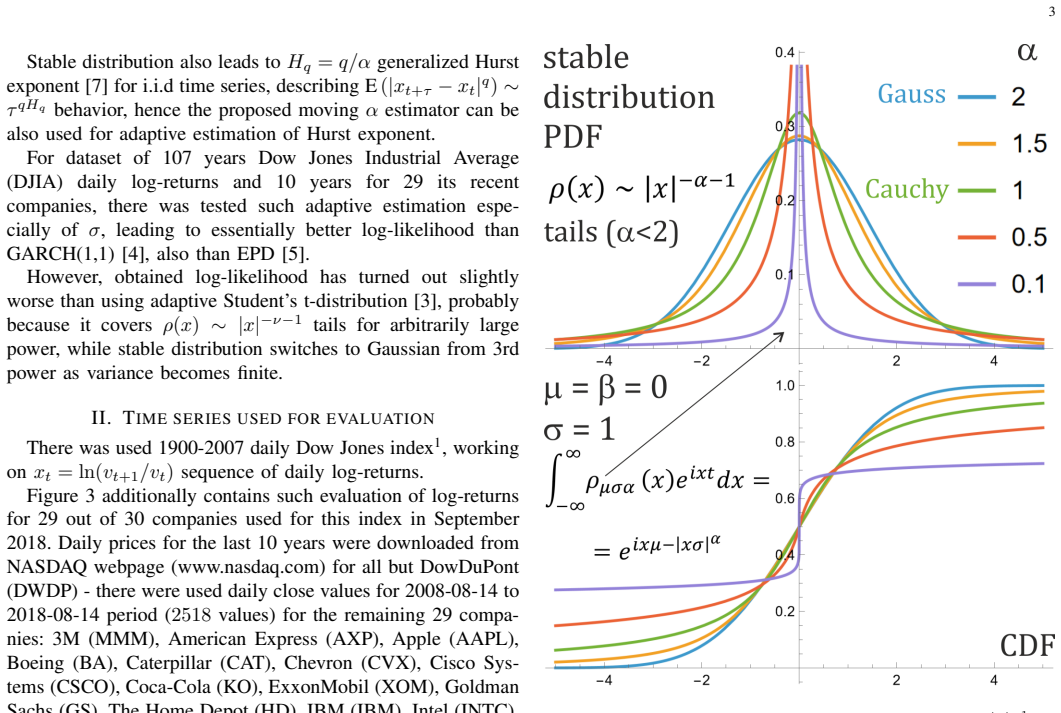
The main empirical finding is that this adaptive stable estimator achieves better sequential log-likelihood than a standard GARCH(1,1) model on the reported data, while remaining slightly worse than an earlier adaptive Student's t estimator from the same author. The estimated alpha drops around major events such as Black Monday and rises during calmer periods, so the author interprets alpha as a market-stability indicator. The paper also notes that for i.i.d. stable data the generalized Hurst exponent equals q divided by alpha, and suggests normalizing returns through the estimated cumulative distribution function before measuring long-range dependence.
The proposal is not yet a complete tool. The learning rates, moment powers, asymmetry parameter, and a scale correction factor are manually tuned on the same data used for evaluation, and no uncertainty intervals are reported. The Hurst part is only a suggestion, with no implemented estimator or experiment. The underlying formulas are standard stable-distribution identities, so the contribution is an extension of an existing moving-estimator program rather than a new theory.
Extended reading notes
Core claim
The paper's central empirical claim is: 'For dataset of 107 years Dow Jones Industrial Average daily log-returns and 10 years for 29 its recent companies, there was tested such adaptive estimation especially of sigma, leading to essentially better log-likelihood than GARCH(1,1), also than EPD. However, obtained log-likelihood has turned out slightly worse than using adaptive Student's t-distribution.' If correct, the EMA moment estimator for alpha-stable parameters is a viable online estimator that outperforms GARCH(1,1) on these series and produces an interpretable alpha_t tail-stability signal that can be converted into an adaptive Hurst estimate via H_q=q/alpha.
Load-bearing premise
The load-bearing premise is that the EMA moment updates in Eqs. (9)-(10) produce parameter estimates theta_t close to the local log-likelihood maximizer of Eq. (1) while the underlying distribution changes, so the reported log-likelihood gains reflect genuine tracking rather than artifacts of the chosen learning rates. The paper never proves this approximation, nor does it run simulations with known time-varying parameters; it only checks the final average log-likelihood after manually tuning all hyperparameters on the same data.
Signed reviews
Editorial analysis
A structured set of objections, weighed in public.
Referee Report
Summary. The paper proposes an adaptive method-of-moments moving estimator for alpha-stable distributions, replacing static averages with exponential moving averages (EMA) of absolute central moments to track time-varying parameters (µt, σt, αt). The method is applied to 107 years of DJIA daily log-returns and 10 years of 29 individual stocks, with comparisons to GARCH(1,1), EPD, and adaptive Student's t-distribution. The paper reports log-likelihood improvements over GARCH(1,1) and EPD, but slightly worse performance than adaptive Student's t, and discusses an adaptive Hurst exponent via Hq = q/α and a heavy-tail removal procedure. The central contribution is a computationally simple, online estimator for the stability parameter α, which is interpretable as a market-stability signal.
Significance. If validated, the proposed EMA moment estimator offers a lightweight and interpretable alternative to recursive filtering for time-varying tail behavior in financial time series. The explicit moment formulas in Eq. (6) and the simple updates in Eqs. (9)–(10) are appealing, and the connection between α and the generalized Hurst exponent is a useful conceptual bridge. The paper also provides reproducible-looking code in Fig. 1, which is a strength. However, the empirical claims are currently supported mainly by a small set of manually tuned evaluations without uncertainty quantification or comparison against standard heavy-tailed benchmarks, so the practical significance is not yet established.
major comments (4)
- [Fig. 3 and Section I] The headline claim of 'essentially better log-likelihood than GARCH(1,1)' is not supported because the GARCH(1,1) baseline appears to use only Gaussian innovations ('comparable with α = 2 Gaussian case'). For daily financial returns, the standard heavy-tailed benchmark GARCH(1,1) with Student-t innovations typically dominates Gaussian GARCH and would also capture volatility clustering and tail risk. Since the paper itself reports that adaptive Student's t slightly beats the proposed stable estimator, the comparison against GARCH-t is necessary before claiming an advantage over a standard GARCH model.
- [Fig. 1 and Eq. (2)] The evaluation protocol is in-sample and circular: the hyperparameters (η1, η2, η3, p, σm, β) are manually tuned to maximize the same mean log-likelihood (Eq. (2)) that is later reported as evidence of performance. For example, Fig. 1 states 'The parameters were manually tuned for this case to maximize log-likelihood', and Eq. (2) is used both for tuning and final evaluation. This does not establish out-of-sample predictive gains. A validation split or a properly specified model-selection criterion (e.g., AIC/BIC or cross-validated likelihood) is required.
- [Section III-B] The load-bearing premise that the EMA moment updates in Eqs. (9)–(10) produce parameter estimates close to the local log-likelihood maximizer of Eq. (1) is never tested. No simulation with known time-varying parameters is reported, so it is unclear whether the empirical log-likelihood improvements reflect genuine tracking of nonstationarity or artifacts of the manually chosen learning rates. A simulation study with known piecewise-constant or smoothly varying α, σ, and µ would directly validate the tracking claim and is essential for the paper's central methodological contribution.
- [Section IV] The adaptive Hurst exponent claim, Hq = q/α, is derived from i.i.d. stable behavior and then proposed for empirical time series, but no empirical evaluation of the Hurst estimates is given. The paper would benefit from at least a simple validation on simulated data with known long-range dependence, or a comparison of the resulting Hurst estimates with a standard estimator, before presenting this as a practical tool.
minor comments (6)
- [Keywords] 'methods od moments' contains a typo; it should be 'method of moments'.
- [Eq. (6)] The notation in Eq. (6) is ambiguous: the left-hand side should clearly denote the p-th root, and the displayed formula is missing parentheses around the fraction. Please rewrite the p-th root in standard notation.
- [Section III-B] The phrase 'p <mint(αt)' is garbled; it should read 'p < min_t(α_t)' or similar. This is important because the moment formula is finite only for p < α.
- [Eq. (12)] The asymmetric PDF formula is under-parenthesized and hard to parse. The normalization factor and the conditional branches should be written with explicit braces so the reader can verify that the density integrates to 1.
- [Section I] The sentence 'However, obtained log-likelihood has turned out slightly worse than using adaptive Student's t-distribution' should be rephrased for grammatical clarity, e.g., 'the obtained log-likelihood was slightly worse than that of the adaptive Student's t-distribution'.
- [References] Reference [6] is missing publication details (publisher, year). Please complete the reference.
Assumptions & free parameters
free parameters (7)
- eta1 learning rate for mu =
0.002
- eta2 learning rate for sigma =
0.03 in Fig. 1, 0.05 in Fig. 3
- eta3 learning rate for alpha =
0.006
- power p for sigma estimation =
1 in Fig. 1, 0.8 in Fig. 3
- powers p1, p2 for alpha ratio =
not fully specified
- sigma multiplier =
1.05
- beta asymmetry parameter =
-0.3
assumptions (4)
- ad hoc to paper EMA moment updates approximate the local log-likelihood maximizer of Eq. (1).
- domain assumption Daily log-returns follow a time-varying symmetric stable distribution with beta = 0 or fixed beta.
- standard math Absolute central moment formula (6) is valid for the chosen powers p < alpha.
- domain assumption H_q = q/alpha and CDF-based normalization preserve a meaningful compensated Hurst exponent.
Cite this review
Pith. "Pith review of Adaptive stable distribution and Hurst exponent by method of moments moving estimator for nonstationary time series." pith.science (2026). https://pith.science/paper/Y5X7VGGE
@misc{pith2026250605354,
  author       = {Pith},
  title        = {Pith review of: Adaptive stable distribution and Hurst exponent by method of moments moving estimator for nonstationary time series},
  year         = {2026},
  howpublished = {\url{https://pith.science/paper/Y5X7VGGE}},
  note         = {Machine review of arXiv:2506.05354}
}
abstract
Nonstationarity of real-life time series requires model adaptation. In classical approaches like ARMA-ARCH there is assumed some arbitrarily chosen dependence type. To avoid their bias, we will focus on novel more agnostic approach: moving estimator, which estimates parameters separately for every time $t$: optimizing $F_t=\sum_{\tau<t} (1-\eta)^{t-\tau} \ln(\rho_\theta (x_\tau))$ local log-likelihood with exponentially weakening weights of the old values. In practice such moving estimates can be found by EMA (exponential moving average) of some parameters, like $m_p=E[|x-\mu|^p]$ absolute central moments, updated by $m_{p,t+1} = m_{p,t} + \eta (|x_t-\mu_t|^p-m_{p,t})$. We will focus here on its applications for alpha-Stable distribution, which also influences Hurst exponent, hence can be used for its adaptive estimation. Its application will be shown on financial data as DJIA time series - beside standard estimation of evolution of center $\mu$ and scale parameter $\sigma$, there is also estimated evolution of $\alpha$ parameter allowing to continuously evaluate market stability - tails having $\rho(x) \sim 1/|x|^{\alpha+1}$ behavior, controlling probability of potentially dangerous extreme events.
Figures


Figures from the paper (4 more)


Reference graph
Works this paper leans on
-
[1]
L \'e vy, Calcul des probabilit \'e s
P. L \'e vy, Calcul des probabilit \'e s . 1em plus 0.5em minus 0.4em Gauthier-Villars, 1925
work page 1925
-
[2]
C. L. Nikias and M. Shao, Signal processing with alpha-stable distributions and applications. 1em plus 0.5em minus 0.4em Wiley-Interscience, 1995
work page 1995
-
[3]
J. Duda, ``Adaptive student's t-distribution with method of moments moving estimator for nonstationary time series,'' arXiv preprint arXiv:2304.03069, 2023
work page Pith review arXiv 2023
-
[4]
T. Bollerslev, ``Generalized autoregressive conditional heteroskedasticity,'' Journal of econometrics, vol. 31, no. 3, pp. 307--327, 1986
work page 1986
-
[5]
Adaptive exponential power distribution with moving estimator for nonstationary time series
J. Duda, ``Adaptive exponential power distribution with moving estimator for nonstationary time series,'' arXiv preprint arXiv:2003.02149, 2020
work page Pith review arXiv 2003
-
[6]
B. V. Gnedenko and A. Kolmogorov, Limit distributions for sums of independent random variables
-
[7]
J. W. Kantelhardt, S. A. Zschiegner, E. Koscielny-Bunde, S. Havlin, A. Bunde, and H. E. Stanley, ``Multifractal detrended fluctuation analysis of nonstationary time series,'' Physica A: Statistical Mechanics and its Applications, vol. 316, no. 1-4, pp. 87--114, 2002
work page 2002
-
[8]
Parametric context adaptive Laplace distribution for multimedia compression
J. Duda, ``Parametric context adaptive laplace distribution for multimedia compression,'' arXiv preprint arXiv:1906.03238, 2019
work page Pith review arXiv 1906
Show all 11 references
-
[9]
------, ``Exploiting statistical dependencies of time series with hierarchical correlation reconstruction,'' arXiv preprint arXiv:1807.04119, 2018
2018 arXiv
-
[10]
------, `` Improving SGD convergence by tracing multiple promising directions and estimating distance to minimum ,'' arXiv preprint arXiv:1901.11457, 2019
1901 arXiv
-
[11]
7 tׁ ! Oy -Aa RČ;АДl` BaH/z/_Ė! (pE @p vˁB 4x (x fDPg ʥ06 ( fk.s Nl ^ :t W T! A^AA (99 ] :Du#/_ )Մ ?A)
11em plus .33em minus .07em 4000 4000 100 4000 4000 500 `\.=1000 = #1 \@IEEEnotcompsoconly \@IEEEcompsoconly #1 * [1] 0pt [0pt][0pt] #1 * \| ** #1 \@IEEEauthorblockNstyle \@IEEEcompsocnotconfonly \@IEEEcompsocconfonly \@IEEEauthorblockAstyle \@IEEEcompsocnotconfonly \@IEEEcomp...
Reviewed August 7, 2026 · model on record in the stance chip above.
Discussion (0). Continue with ORCID to comment.