REVIEW 2 major objections 5 minor 57 references
Enhanced superconducting gap in the outer CuO$_2$ plane of the trilayer cuprate (Hg,Re)Ba$_2$Ca$_2$Cu$_3$O$_{8+\delta}$
T0 review · 2 major / 5 minor · reviewed 2026-08-07 · deepseek-v4-flash
Pith's one-line read In the trilayer cuprate (Hg,Re)1223, the outer CuO2 plane carries a much larger superconducting gap than in Bi2223, and the paper argues this outer-plane pairing is what enables the highest ambient-pressure Tc.
desk verdict First ARPES gap map of a Hg-based trilayer cuprate, but the claimed OP enhancement stands or falls on the imported near-nodal calibration, not on the IP/OP assignment. read the letter →
The pith
A machine-rendered reading of the paper's core claim, the machinery that carries it, and where it could break.
The reading
What carries the argument
The key instrument is a micro-focused angle-resolved photoemission beam (10 µm × 10 µm spot) used on cleaved (Hg,Re)1223 single crystals, which lets the authors find clean surface regions despite the lack of natural cleavage planes. The argument then rests on assigning the two observed Fermi-surface branches to the inner and outer CuO2 planes (smaller radius to IP, larger to OP, guided by NMR doping estimates) and on extracting $\Delta_0$ by linearly extrapolating the near-nodal d-wave gap to the antinode. A small Fermi-pocket picture based on the doped resonating-valence-bond spin liquid is invoked to convert measured Fermi-surface areas into hole dopings and to avoid the unphysical electron doping that a large-surface tight-binding fit would give for the inner plane.
What would settle it
A bulk-sensitive measurement of IP and OP hole concentrations on the same crystals (for example, NMR) that contradicted the assumed doping ordering, or an ARPES experiment resolving interlayer Bogoliubov hybridization to fix the branch labels, would settle whether the enhanced gap truly sits in the outer plane.
Extended reading notes
Core claim
The central discovery is a plane-resolved comparison of superconducting gap magnitudes: in (Hg,Re)1223, $\Delta_0(\mathrm{IP}) = 63 \pm 3$ meV, nearly the same as optimally doped Bi2223, but $\Delta_0(\mathrm{OP}) = 57 \pm 1$ meV, sharply larger than the ~43 meV of Bi2223's outer plane. The d-wave gap amplitude $\Delta_0$ is obtained by extrapolating the near-nodal linear part of the gap to the antinode, a procedure argued to isolate the superconducting component from the pseudogap. Because Tc rises from 110 K in Bi2223 to 130 K in (Hg,Re)1223 while the inner-plane gap barely changes, the authors attribute the Tc gain to the amplified outer-plane pairing. They also note that averaging $\Delta_0$ over the CuO2 planes restores a smooth scaling with optimal Tc across single-layer, bilayer, and trilayer cuprates.
Load-bearing premise
The result depends on the assignment of the two Fermi-surface branches to the inner and outer planes, and on the small-Fermi-pocket model used to recover reasonable hole doping for the inner plane.
Editorial extensions
If this is right
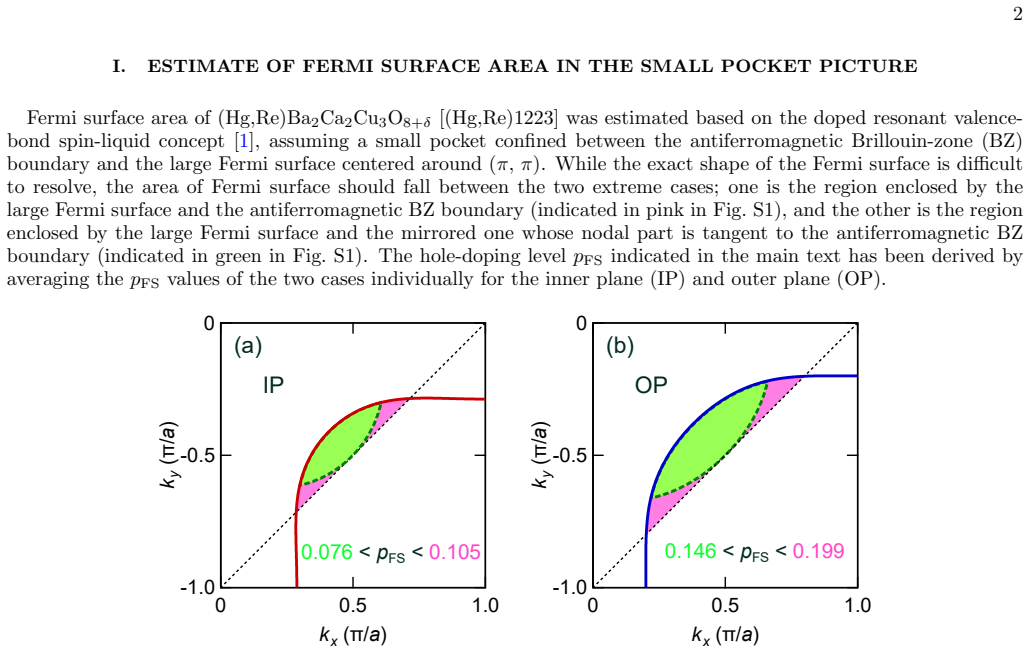
- In (Hg,Re)1223 the outer-plane hole concentration ($p_{\mathrm{FS}} = 0.12$–0.17) is lower than in optimally doped Bi2223 ($p_{\mathrm{FS}} = 0.23$), so the OP is less overdoped than previously assumed.
- The highest ambient-pressure Tc in the Hg-based trilayer is attributable to the enhanced outer-plane pairing, with the inner-plane pairing roughly unchanged from Bi2223.
- The average of IP and OP gap amplitudes scales with optimal Tc across LSCO, Bi2201, Bi2212, Bi2223, Hg1201, and (Hg,Re)1223, suggesting that the plane-averaged pairing energy governs Tc.
- The flat, clean outer plane environment in Hg1223 (small buckling, distant disorder) likely supports the enhanced OP pairing through reduced $d_{x^2-y^2}$/$d_{3z^2-r^2}$ hybridization and stronger electron-phonon coupling to buckling modes.
- The feasibility of micro-ARPES on Hg-based trilayers opens the way to resolve interlayer hybridization and other fine spectral features.
Reading between the lines
- Editorial extension: if the outer-plane pairing is the decisive ingredient, theoretical models of trilayer superconductivity should focus on the OP environment (apical oxygen distance, crystal-field splitting, out-of-plane disorder) rather than on the IP alone.
- Editorial extension: a testable prediction is that other trilayer cuprates with flattened, clean outer planes and similarly large apical-oxygen distances should also show an enhanced OP gap, while those with buckled OP should not.
- Editorial extension: the plane-averaged scaling suggests that raising Tc further may require optimizing both planes simultaneously, so that the average gap grows instead of being limited by the smaller of the two.
Editorial analysis
A structured set of objections, weighed in public.
Referee Report
Summary. The manuscript reports the first momentum-resolved ARPES study of the trilayer cuprate (Hg,Re)Ba2Ca2Cu3O8+δ, a material with Tc = 130 K that holds the ambient-pressure record. Using a 10 µm micro-focused beam, the authors separate quasiparticle dispersions from the inner and outer CuO2 planes and extract the superconducting gap along the Fermi surface. From a near-nodal d-wave extrapolation they obtain Δ0(IP) = 63 ± 3 meV and Δ0(OP) = 57 ± 1 meV, which they compare with the corresponding values in Bi2223 (about 60 and 43 meV). The central claim is that the outer-plane pairing energy is substantially enhanced relative to Bi2223, and that this enhancement, rather than the inner-plane gap, is essential for the highest Tc at ambient pressure.
Significance. If the result holds, it is a significant step: it is the first momentum-resolved superconducting gap in a Hg-based trilayer cuprate, a system long inaccessible to ARPES, and it offers a direct test of the prevailing view that the inner plane dominates pairing in trilayer cuprates. The paper also provides a useful comparison of Δ0 versus Tc across several cuprate families and proposes a plausible mechanism based on reduced Cu-3d/(apical-O) hybridization at the outer plane. The experimental methodology—micro-spot ARPES with spatial selection of clean regions, symmetrized-EDC analysis, and explicit accounting of statistical smoothing/photon-drift errors—is careful and reproducible in spirit, although no code or raw data are deposited.
major comments (2)
- [Supplemental Sec. II; main-text Fig. 3(l)] The near-nodal gap points that determine the slope of the linear d-wave extrapolation in Fig. 3(l) are obtained from leading-edge midpoints via the imported empirical relation Δ ≈ 2.2 Δ_LEM. The quoted uncertainties (Δ0(IP)=63±3 meV, Δ0(OP)=57±1 meV) propagate only the smoothing extrapolation and photon-energy drift, not the uncertainty in the 2.2 conversion factor nor the effect of the 12 meV instrumental resolution. Since the claimed OP enhancement over Bi2223 (~43 meV) is only about 14 meV, a plausible ±20% variation in the conversion factor would shift Δ0(OP) by roughly 10 meV, reducing the comparison to within systematic noise. The authors should provide a quantitative propagation of this systematic uncertainty into Δ0, or explicitly restrict the conclusion to a qualitative statement of enhanced OP pairing.
- [Fig. 2(e); main text after the tight-binding fit] The assignment of the two Fermi-surface branches to the IP and OP relies on the NMR-based doping ordering and is made before the gap analysis. The text does not discuss the robustness of the central conclusion to a swap of the branch labels. Although a swap would exchange the two measured Δ0 values (57 and 63 meV) and would not change the qualitative claim that the OP branch has a larger gap than Bi2223's OP (~43 meV), the authors should state this explicitly; as written, the reader could infer that the IP/OP identification is a necessary premise of the result. This clarification would strengthen the paper without new data.
minor comments (5)
- [Introduction] Typographical errors: 'charaterization' should be 'characterization', and 'psuedogap' should be 'pseudogap' (appears twice).
- [Last paragraph of main text] The phrase 'electron-photon coupling' should be 'electron-phonon coupling'.
- [Supplemental Sec. I] The small-pocket Fermi-surface area estimate is based on averaging two extreme cases, and the text does not propagate the resulting uncertainty in pFS into the comparison with Bi2223. A brief statement of the range (e.g., pFS(OP)=0.12–0.17) in the main-text discussion would be appropriate.
- [Fig. 4] The gray line in Fig. 4 is described as a guide to the eye; given that the scaling claim is central to the paper's interpretive framework, the authors should indicate whether a linear correlation is statistically significant and how the trilayer points (which are averages over two planes) were treated in the comparison.
- [Supplemental Sec. II] The symbol σ is used both for the total error and for the standard deviation in the formula σ = sqrt(σ_gap^2 + σ_hν^2); renaming the total error, for example to δΔ, would avoid ambiguity.
Circularity Check
No significant circularity: the superconducting-gap values are direct ARPES measurements, and the imported calibrations and self-citations are not load-bearing.
full rationale
The central quantitative claims are direct ARPES measurements of superconducting gap magnitudes obtained from symmetrized energy distribution curves, not outputs of a fit designed to realize the conclusion. The IP/OP branch assignment rests on independent prior NMR reports of relative hole concentrations (Refs. 17 and 18), not on the present authors' fitted parameters. The small-Fermi-pocket estimate of pFS in Supplemental Sec. I is used only to reinterpret doping levels; it does not enter the gap extraction, and the conclusion that the OP gap is enhanced relative to Bi2223 would not be produced by that estimate. The near-nodal calibration Delta ~ 2.2 Delta_LEM (Supplemental Sec. II) is an imported empirical relation from Yoshida et al. (2009). Although it is a legitimate source of systematic uncertainty, it is not tuned to force the OP enhancement, so it does not constitute circularity. The self-citations (Refs. 25 and 35) support peripheral statements about electron-doped pseudogap behavior and a prior application of the small-pocket-area method; those are externally falsifiable prior results and are not the load-bearing basis of the OP-gap claim. No equation in the paper defines the measured Delta_0 values in terms of the comparison target, and no fitted parameter is renamed as a prediction. The causal statement about OP pairing and Tc is an interpretation of measured comparisons, not a derivation from them. Therefore no circular step is identified.
Assumptions & free parameters
free parameters (5)
- tight-binding t'/t for IP =
-0.36
- tight-binding epsilon0/t for IP =
0.40
- tight-binding t'/t for OP =
-0.28
- tight-binding epsilon0/t for OP =
0.91
- t''/t' ratio =
-0.5
assumptions (5)
- domain assumption Empirical relation Delta = 2.2 Delta_LEM applies to near-nodal gaps smaller than the experimental resolution in (Hg,Re)1223
- domain assumption The smaller Fermi-surface branch is the inner plane and the larger branch is the outer plane
- domain assumption The doped resonating-valence-bond small-Fermi-pocket picture is the correct way to convert Fermi-surface area to hole doping for the IP (and possibly the OP)
- domain assumption The selected cleaved surface region (P4) is representative of bulk (Hg,Re)1223 and free of polar surface reconstruction
- domain assumption The empirical Delta0-versus-Tc scaling established in previous cuprate ARPES studies is a valid reference for judging which plane controls Tc
Cite this review
Pith. "Pith review of Enhanced superconducting gap in the outer CuO$_2$ plane of the trilayer cuprate (Hg,Re)Ba$_2$Ca$_2$Cu$_3$O$_{8+\delta}$." pith.science (2026). https://pith.science/paper/M3VCRL2Y
@misc{pith2026250608763,
  author       = {Pith},
  title        = {Pith review of: Enhanced superconducting gap in the outer CuO$_2$ plane of the trilayer cuprate (Hg,Re)Ba$_2$Ca$_2$Cu$_3$O$_8+\delta$},
  year         = {2026},
  howpublished = {\url{https://pith.science/paper/M3VCRL2Y}},
  note         = {Machine review of arXiv:2506.08763}
}
abstract
We report the first observation of a momentum-resolved superconducting gap in the Hg-based trilayer cuprate, which holds the highest record of superconducting transition temperature ($T_\mathrm{c}$) at ambient pressure. By angle-resolved photoemission spectroscopy utilizing a micro-focused beam, clear quasiparticle dispersions originating from the inner and outer CuO$_2$ planes (IP and OP, respectively) were separately identified. The magnitude of the superconducting gap for the IP was comparable to that of the Bi-based trilayer cuprate with a lower $T_\mathrm{c}$. In contrast, the superconducting gap for the OP was significantly larger than that of the Bi-based one. While strong pairing in the IP has been highlighted as the key element of trilayer cuprates, the present results suggest that the enhanced pairing energy in the OP is essential for the highest $T_\mathrm{c}$ at ambient pressure realized in the Hg-based trilayer cuprate.
Figures


Figures from the paper (3 more)


Reference graph
Works this paper leans on
-
[1]
S. S. P. Parkin, V. Y. Lee, A. I. Nazzal, R. Savoy, R. Bey- ers, and S. J. La Placa, Phys. Rev. Lett. 61, 750 (1988)
work page 1988
-
[2]
J. M. Tarascon, W. R. McKinnon, P. Barboux, D. M. Hwang, B. G. Bagley, L. H. Greene, G. W. Hull, Y. LeP- age, N. Stoffel, and M. Giroud, Phys. Rev. B 38, 8885 (1988)
work page 1988
-
[3]
A. Iyo, Y. Tanaka, H. Kito, Y. Kodama, P. M. Shi- rage, D. D. Shivagan, H. Matsuhata, K. Tokiwa, and T. Watanabe, J. Phys. Soc. Jpn. 76, 094711 (2007)
work page 2007
- [4]
- [5]
-
[6]
S. Kunisada, S. Adachi, S. Sakai, N. Sasaki, M. Nakayama, S. Akebi, K. Kuroda, T. Sasagawa, T. Watanabe, S. Shin, and T. Kondo, Phys. Rev. Lett. 119, 217001 (2017)
work page 2017
- [7]
-
[8]
X. Luo, H. Chen, Y. Li, Q. Gao, C. Yin, H. Yan, T. Miao, H. Luo, Y. Shu, Y. Chen, C. Lin, S. Zhang, Z. Wang, F. Zhang, F. Yang, Q. Peng, G. Liu, L. Zhao, Z. Xu, T. Xiang, and X. J. Zhou, Nat. Phys. 19, 1841 (2023)
work page 2023
Show all 57 references
-
[9]
Kivelson, Physica B: Condensed Matter 318, 61 (2002)
S. Kivelson, Physica B: Condensed Matter 318, 61 (2002)
2002
-
[10]
E. Berg, D. Orgad, and S. A. Kivelson, Phys. Rev. B 78, 094509 (2008)
2008
-
[11]
Okamoto and T
S. Okamoto and T. A. Maier, Phys. Rev. Lett. 101, 156401 (2008)
2008
-
[12]
Nishiguchi, K
K. Nishiguchi, K. Kuroki, R. Arita, T. Oka, and H. Aoki, Phys. Rev. B 88, 014509 (2013)
2013
-
[13]
Nishiguchi, S
K. Nishiguchi, S. Teranishi, K. Kusakabe, and H. Aoki, Phys. Rev. B 98, 174508 (2018)
2018
-
[14]
Schilling, M
A. Schilling, M. Cantoni, J. D. Guo, and H. R. Ott, Nature 363, 56 (1993)
1993
-
[15]
J. L. Wagner, B. A. Hunter, D. G. Hinks, and J. D. Jorgensen, Phys. Rev. B 51, 15407 (1995)
1995
-
[16]
Eisaki, N
H. Eisaki, N. Kaneko, D. L. Feng, A. Damascelli, P. K. Mang, K. M. Shen, Z.-X. Shen, and M. Greven, Phys. Rev. B 69, 064512 (2004)
2004
-
[17]
Magishi, Y
K.-i. Magishi, Y. Kitaoka, G.-q. Zheng, K. Asayama, K. Tokiwa, A. Iyo, and H. Ihara, J. Phys. Soc. Jpn. 6 64, 4561 (1995)
1995
-
[18]
S. Iwai, H. Mukuda, S. Shimizu, Y. Kitaoka, S. Ishida, A. Iyo, H. Eisaki, and S. ichi Uchida, JPS Conf. Proc. 1, 012105 (2014)
2014
-
[19]
Y. Mino, S. Ishida, J. Kato, S. Nakagawa, T. Kashiwagi, T. Nozue, N. Takeshita, K. Kihou, C.-H. Lee, T. Nishio, and H. Eisaki, J. Phys. Soc. Jpn. 93, 044707 (2024)
2024
-
[20]
Momma and F
K. Momma and F. Izumi, Journal of Applied Crystallog- raphy 44, 1272 (2011)
2011
-
[21]
C. M. Polley, M. Leandersson, J. Adell, J. Osiecki, D. Carbone, K. Ali, H. Fedderwitz, and T. Balasub- ramanian, Synchrotron Radiation News 37, 18 (2024)
2024
-
[22]
Yoshida, X
T. Yoshida, X. J. Zhou, K. Tanaka, W. L. Yang, Z. Hus- sain, Z.-X. Shen, A. Fujimori, S. Sahrakorpi, M. Lin- droos, R. S. Markiewicz, A. Bansil, S. Komiya, Y. Ando, H. Eisaki, T. Kakeshita, and S. Uchida, Phys. Rev. B 74, 224510 (2006)
2006
-
[23]
Hashimoto, T
M. Hashimoto, T. Yoshida, H. Yagi, M. Takizawa, A. Fu- jimori, M. Kubota, K. Ono, K. Tanaka, D. H. Lu, Z.-X. Shen, S. Ono, and Y. Ando, Phys. Rev. B 77, 094516 (2008)
2008
-
[24]
N. P. Armitage, P. Fournier, and R. L. Greene, Rev. Mod. Phys. 82, 2421 (2010)
2010
-
[25]
Horio, S
M. Horio, S. Sakai, H. Suzuki, Y. Nonaka, M. Hashimoto, D. Lu, Z.-X. Shen, T. Ohgi, T. Konno, T. Adachi, Y. Koike, M. Imada, and A. Fujimori, Proc. Natl. Acad. Sci. U.S.A. 122, e2406624122 (2025)
2025
-
[26]
K. M. Shen, F. Ronning, D. H. Lu, F. Baumberger, N. J. C. Ingle, W. S. Lee, W. Meevasana, Y. Kohsaka, M. Azuma, M. Takano, H. Takagi, and Z.-X. Shen, Sci- ence 307, 901 (2005)
2005
-
[27]
H.-B. Yang, J. D. Rameau, Z.-H. Pan, G. D. Gu, P. D. Johnson, H. Claus, D. G. Hinks, and T. E. Kidd, Phys. Rev. Lett. 107, 047003 (2011)
2011
-
[28]
J.-Q. Meng, M. Brunner, K.-H. Kim, H.-G. Lee, S.-I. Lee, J. S. Wen, Z. J. Xu, G. D. Gu, and G.-H. Gweon, Phys. Rev. B 84, 060513 (2011)
2011
-
[30]
Badoux, W
S. Badoux, W. Tabis, F. Lalibert´ e, G. Grissonnanche, B. Vignolle, D. Vignolles, J. B´ eard, D. A. Bonn, W. N. Hardy, R. Liang, N. Doiron-Leyraud, L. Taillefer, and C. Proust, Nature 531, 210 (2016)
2016
-
[31]
Collignon, S
C. Collignon, S. Badoux, S. A. A. Afshar, B. Michon, F. Lalibert´ e, O. Cyr-Choini` ere, J.-S. Zhou, S. Liccia- rdello, S. Wiedmann, N. Doiron-Leyraud, and L. Taille- fer, Phys. Rev. B 95, 224517 (2017)
2017
-
[32]
Putzke, S
C. Putzke, S. Benhabib, W. Tabis, J. Ayres, Z. Wang, L. Malone, S. Licciardello, J. Lu, T. Kondo, T. Takeuchi, N. E. Hussey, J. R. Cooper, and A. Carrington, Nat. Phys. 17, 826 (2021)
2021
-
[33]
See Supplemental Material [url] for details about the eval - uation of Fermi surface area and spectral gap magnitude, which includes Ref. [34]
-
[34]
Marchand and L
P. Marchand and L. Marmet, Rev. Sci. Instrum. 54, 1034 (1983)
1983
-
[35]
Horio, X
M. Horio, X. Peiao, M. Miyamoto, T. Wada, K. Isomura, J. Osiecki, B. Thiagarajan, C. M. Polley, K. Tanaka, M. Kitamura, K. Horiba, K. Ozawa, T. Taniguchi, M. Fu- jita, and I. Matsuda, Phys. Rev. B 108, 035105 (2023)
2023
-
[36]
Nakayama, T
K. Nakayama, T. Sato, K. Terashima, H. Matsui, T. Takahashi, M. Kubota, K. Ono, T. Nishizaki, Y. Taka- hashi, and N. Kobayashi, Phys. Rev. B 75, 014513 (2007)
2007
-
[37]
V. B. Zabolotnyy, S. V. Borisenko, A. A. Kordyuk, J. Geck, D. S. Inosov, A. Koitzsch, J. Fink, M. Knupfer, B. B¨ uchner, S.-L. Drechsler, H. Berger, A. Erb, M. Lam- bacher, L. Patthey, V. Hinkov, and B. Keimer, Phys. Rev. B 76, 064519 (2007)
2007
-
[38]
Iwasawa, N
H. Iwasawa, N. B. M. Schr¨ oter, T. Masui, S. Tajima, T. K. Kim, and M. Hoesch, Phys. Rev. B 98, 081112 (2018)
2018
-
[39]
I. M. Vishik, N. Bariˇ si´ c, M. K. Chan, Y. Li, D. D. Xia, G. Yu, X. Zhao, W. S. Lee, W. Meevasana, T. P. Dev- ereaux, M. Greven, and Z.-X. Shen, Phys. Rev. B 89, 195141 (2014)
2014
-
[40]
S. A. Sreedhar, A. Rossi, J. Nayak, Z. W. Anderson, Y. Tang, B. Gregory, M. Hashimoto, D.-H. Lu, E. Roten- berg, R. J. Birgeneau, M. Greven, M. Yi, and I. M. Vishik, Phys. Rev. B 102, 205109 (2020)
2020
-
[41]
Tanaka, W
K. Tanaka, W. S. Lee, D. H. Lu, A. Fujimori, T. Fu- jii, null, I. Terasaki, D. J. Scalapino, T. P. Devereaux, Z. Hussain, and Z.-X. Shen, Science 314, 1910 (2006)
2006
-
[42]
Kondo, T
T. Kondo, T. Takeuchi, A. Kaminski, S. Tsuda, and S. Shin, Phys. Rev. Lett. 98, 267004 (2007)
2007
-
[43]
Kondo, R
T. Kondo, R. Khasanov, T. Takeuchi, J. Schmalian, and A. Kaminski, Nature 457, 296 (2009)
2009
-
[44]
Yoshida, M
T. Yoshida, M. Hashimoto, S. Ideta, A. Fujimori, K. Tanaka, N. Mannella, Z. Hussain, Z.-X. Shen, M. Kub- ota, K. Ono, S. Komiya, Y. Ando, H. Eisaki, and S. Uchida, Phys. Rev. Lett. 103, 037004 (2009)
2009
-
[45]
Hashimoto, T
M. Hashimoto, T. Yoshida, A. Fujimori, D. H. Lu, Z.-X. Shen, M. Kubota, K. Ono, M. Ishikado, K. Fujita, and S. Uchida, Phys. Rev. B 79, 144517 (2009)
2009
-
[46]
I. M. Vishik, M. Hashimoto, R.-H. He, W.-S. Lee, F. Schmitt, D. Lu, R. G. Moore, C. Zhang, W. Meevasana, T. Sasagawa, S. Uchida, K. Fujita, S. Ishida, M. Ishikado, Y. Yoshida, H. Eisaki, Z. Hussain, T. P. Devereaux, and Z.-X. Shen, Proc. Natl. Acad. Sci. U.S.A. 109, 18332 (2012)
2012
-
[47]
P. Ai, Q. Gao, J. Liu, Y. Zhang, C. Li, J. Huang, C. Song, H. Yan, L. Zhao, G.-D. Liu, G.-D. Gu, F.-F. Zhang, F. Yang, Q.-J. Peng, Z.-Y. Xu, and X.-J. Zhou, Chin. Phys. Lett. 36, 067402 (2019)
2019
-
[48]
W. S. Lee, I. M. Vishik, K. Tanaka, D. H. Lu, T. Sasagawa, N. Nagaosa, T. P. Devereaux, Z. Hussain, and Z.-X. Shen, Nature 450, 81 (2007)
2007
-
[49]
Y. J. Uemura, G. M. Luke, B. J. Sternlieb, J. H. Brewer, J. F. Carolan, W. N. Hardy, R. Kadono, J. R. Kempton, R. F. Kiefl, S. R. Kreitzman, P. Mulhern, T. M. Rise- man, D. L. Williams, B. X. Yang, S. Uchida, H. Takagi, J. Gopalakrishnan, A. W. Sleight, M. A. Subramanian, C. L....
1989
-
[50]
Fujii, I
T. Fujii, I. Terasaki, T. Watanabe, and A. Matsuda, Phys. Rev. B 66, 024507 (2002)
2002
-
[51]
Johnston, F
S. Johnston, F. Vernay, B. Moritz, Z.-X. Shen, N. Na- gaosa, J. Zaanen, and T. P. Devereaux, Phys. Rev. B 82, 064513 (2010)
2010
-
[52]
Sakakibara, H
H. Sakakibara, H. Usui, K. Kuroki, R. Arita, and H. Aoki, Phys. Rev. B 85, 064501 (2012)
2012
-
[53]
Sakakibara, K
H. Sakakibara, K. Suzuki, H. Usui, S. Miyao, I. Maruyama, K. Kusakabe, R. Arita, H. Aoki, and K. Kuroki, Phys. Rev. B 89, 224505 (2014)
2014
-
[54]
Sakakibara, H
H. Sakakibara, H. Usui, K. Kuroki, R. Arita, and H. Aoki, Phys. Rev. Lett. 105, 057003 (2010)
2010
-
[55]
Ideta, T
S. Ideta, T. Yoshida, M. Hashimoto, A. Fujimori, H. An- 7 zai, A. Ino, M. Arita, H. Namatame, M. Taniguchi, K. Takashima, K. M. Kojima, and S. Uchida, Journal of Physics: Conference Series 428, 012039 (2013) . Supplemental Material: Enhanced superconducting gap in the outer Cu...
2013
-
[56]
K.-Y. Yang, T. M. Rice, and F.-C. Zhang, Phys. Rev. B 73, 174501 (2006)
2006
-
[57]
Marchand and L
P. Marchand and L. Marmet, Rev. Sci. Instrum. 54, 1034 (1983) . 3 /s32/s33/s34/s35/s33/s36/s37/s34/s38/s39/s40/s41/s42/s43/s44/s39/s45/s33/s37/s34/s36/s46 /s47/s48/s49/s47/s50/s49/s49 /s50/s49 /s32/s33/s34/s33/s32/s51/s39/s40/s52/s35/s53/s46 /s47/s48/s49/s47/s50/s49/s49 /s50/s...
1983
-
[58]
Yoshida, M
T. Yoshida, M. Hashimoto, S. Ideta, A. Fujimori, K. Tanaka, N. Mannella, Z. Hussain, Z.-X. Shen, M. Kubota, K. Ono, S. Komiya, Y. Ando, H. Eisaki, and S. Uchida, Phys. Rev. Lett. 103, 037004 (2009)
2009
Reviewed August 7, 2026 · model on record in the stance chip above.
Discussion (0). Sign in to comment.