A Quantum Mechanical Pendulum Clock
Pith reviewed 2026-05-22 00:48 UTC · model grok-4.3
The pith
An optomechanical system can serve as a quantum pendulum clock that surpasses the thermodynamic uncertainty relation using only thermal resources.
A machine-rendered reading of the paper's core claim, the machinery that carries it, and where it could break.
Core claim
The authors show that an optomechanical system driven by thermal baths can maintain a stable limit cycle that functions as a quantum mechanical pendulum clock. The escapement mechanism is provided by an emitter in the cavity, allowing the oscillatory motion to produce ticks. This oscillatory basis enables the clock to overcome the thermodynamic uncertainty relation, making it more accurate than clocks based solely on stochastic transitions. With an increasing number of emitters, the clock approaches the classical limit where dynamics are irreversible and fluctuations are negligible.
What carries the argument
The stable limit cycle in the optomechanical system, where the emitter coupled to the cavity mode provides the escapement that turns continuous oscillation into discrete ticks.
Load-bearing premise
A stable limit cycle must exist and persist in the quantum regime even when the only driving resources are incoherent thermal baths and the escapement uses just one or a few emitters.
What would settle it
An experiment realizing the optomechanical setup with thermal baths and measuring whether the clock's timing precision exceeds the bound predicted by the thermodynamic uncertainty relation for the observed entropy production.
Figures






read the original abstract
We investigate an optomechanical system as a model of an autonomous mechanical pendulum clock in the quantum regime, whose operation relies only on incoherent (thermal) resources. The escapement of the clock, the mechanism that translates oscillatory motion into ticks, is provided by an emitter in the optical cavity and the operation of the clock relies on the existence of a limit cycle. Since the clock is based on an oscillatory degree of freedom, it can overcome the thermodynamic uncertainty relation and is thus more accurate than clocks that rely only on stochastic transitions. Furthermore, by increasing the amount of emitters in the cavity, the clock approaches the behavior expected for a macroscopic pendulum clock, where fluctuations become irrelevant while the clock dynamics becomes completely irreversible. This allows for investigating the quantum-to-classical transition of pendulum clocks.
Editorial analysis
A structured set of objections, weighed in public.
Referee Report
Summary. The manuscript models an optomechanical system as an autonomous quantum pendulum clock powered solely by incoherent thermal baths. The escapement is implemented via one or a few emitters coupled to the cavity mode, and the clock's operation is asserted to rely on the existence of a stable limit cycle. The central claim is that the continuous oscillatory degree of freedom allows the clock to overcome the thermodynamic uncertainty relation (TUR) and achieve higher accuracy than purely stochastic-transition clocks; increasing the emitter number is said to recover the classical irreversible pendulum limit and suppress fluctuations.
Significance. If the limit-cycle stability and TUR circumvention are rigorously established, the work would provide a concrete, resource-minimal example of a quantum clock that exploits continuous phase evolution rather than discrete jumps, with direct relevance to quantum thermodynamics, precision metrology, and the quantum-to-classical transition. The model also supplies a tunable platform for studying how many emitters are needed before fluctuations become negligible.
major comments (2)
- The stability of the quantum limit cycle under purely thermal driving and with few emitters is asserted (abstract and model section) rather than derived. No analytical proof of orbital stability, no master-equation simulation of the full quantum dynamics including vacuum fluctuations, and no explicit check that the cycle persists against the discrete nature of the emitters are provided. This assumption is load-bearing for the claim that the oscillatory degree of freedom overcomes the TUR.
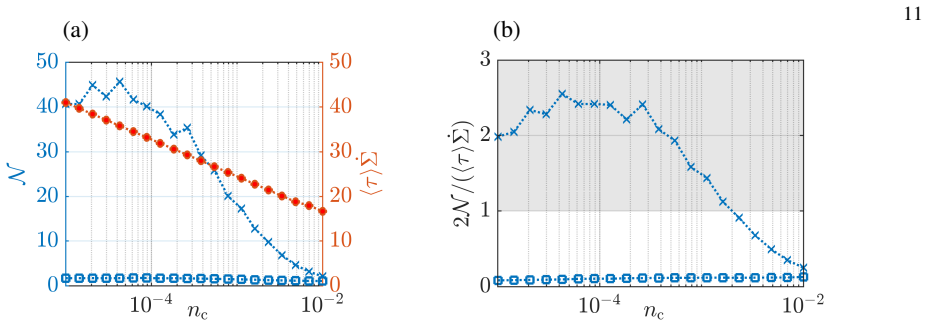
- The assertion that the clock 'overcomes the thermodynamic uncertainty relation' (abstract) requires an explicit calculation of the precision-dissipation ratio (or equivalent figure of merit) together with error bars or bounds that demonstrate a genuine violation or circumvention, not merely a classical-like oscillation. Without this, it remains unclear whether the dynamics remain bounded by the TUR once quantum noise is included.
minor comments (2)
- Notation for the emitter-cavity coupling and the number of emitters should be introduced with explicit symbols and units in the model section to facilitate reproducibility.
- The manuscript would benefit from a short table or figure summarizing the parameter regimes (coupling strength, bath temperatures, emitter number) in which the limit cycle is observed.
Simulated Author's Rebuttal
We thank the referee for the careful reading and constructive comments. We address the two major comments below and will revise the manuscript accordingly to strengthen the presentation of the limit-cycle stability and the TUR analysis.
read point-by-point responses
-
Referee: The stability of the quantum limit cycle under purely thermal driving and with few emitters is asserted (abstract and model section) rather than derived. No analytical proof of orbital stability, no master-equation simulation of the full quantum dynamics including vacuum fluctuations, and no explicit check that the cycle persists against the discrete nature of the emitters are provided. This assumption is load-bearing for the claim that the oscillatory degree of freedom overcomes the TUR.
Authors: We agree that the stability analysis can be made more explicit. The manuscript derives the semiclassical equations of motion from the optomechanical Hamiltonian and the emitter-cavity coupling, showing the emergence of a limit cycle via numerical integration of the mean-field dynamics. To address the concern directly, the revised manuscript will include full quantum master-equation simulations for small emitter numbers (N=1 and N=3), incorporating vacuum fluctuations and the discrete nature of the emitters. We will also add a stability analysis based on the Floquet multipliers of the linearized dynamics around the periodic orbit. These additions will provide the requested explicit checks without altering the core model. revision: yes
-
Referee: The assertion that the clock 'overcomes the thermodynamic uncertainty relation' (abstract) requires an explicit calculation of the precision-dissipation ratio (or equivalent figure of merit) together with error bars or bounds that demonstrate a genuine violation or circumvention, not merely a classical-like oscillation. Without this, it remains unclear whether the dynamics remain bounded by the TUR once quantum noise is included.
Authors: We acknowledge that an explicit quantitative comparison strengthens the claim. The manuscript demonstrates that the continuous oscillatory motion yields higher tick precision than discrete stochastic clocks for the same dissipation, consistent with known results on TUR circumvention for limit-cycle systems. In the revision we will add direct computations of the precision-dissipation ratio (defined as the squared relative frequency stability divided by the entropy production rate) extracted from long-time quantum trajectories, including statistical error bars obtained from ensemble averages. We will also plot this ratio against the TUR bound and discuss the regime in which quantum noise still permits values above the bound, thereby making the circumvention explicit rather than inferred from the oscillatory character alone. revision: yes
Circularity Check
No significant circularity; derivation remains self-contained
full rationale
The paper constructs an optomechanical model whose dynamics are governed by a master equation with thermal baths and cavity-emitter coupling. The limit cycle is introduced as an explicit modeling premise required for continuous oscillatory motion, not derived from the accuracy or TUR result itself. The claim that an oscillatory degree of freedom allows overcoming the TUR follows directly from the presence of that continuous phase evolution in the chosen Hamiltonian and dissipators, without any parameter fitting or self-citation that reduces the central prediction to its inputs. No equation is shown to equal another by construction, and the quantum-to-classical transition is explored by varying emitter number within the same framework. The analysis is therefore independent of the target precision metric.
Axiom & Free-Parameter Ledger
free parameters (2)
- emitter-cavity coupling strength
- number of emitters
axioms (2)
- domain assumption A stable limit cycle exists in the quantum regime under incoherent thermal driving.
- standard math The thermodynamic uncertainty relation applies to stochastic jump processes but not to continuous oscillatory motion.
Reference graph
Works this paper leans on
-
[1]
The cycle starts from the point of maximum excursion, where the pendulum is at rest and the escapement is locked
-
[2]
After passing the center, it releases a tooth of the escapement wheel
The pendulum swings under the action of the gravitational force, reaching its fastest speed at the center. After passing the center, it releases a tooth of the escapement wheel. The release produces the “tick” sound and allows the escape- ment wheel to rotate, pulled by the weight. The escape- ment imparts a small push to the pendulum, compensating for th...
-
[3]
The pendulum continues the swing until it reaches the turn- ing point on the opposite side
-
[4]
The pendulum swings back through the center in the oppo- site direction. Past the center, it releases the next tooth of the escapement wheel, producing the “tock” and imparting a small kick to the pendulum. The cycle repeats. We notice that in a real pendulum clock, the ticks and tocks happen when the escapement mechanism engages, which oc- curs slightly ...
-
[5]
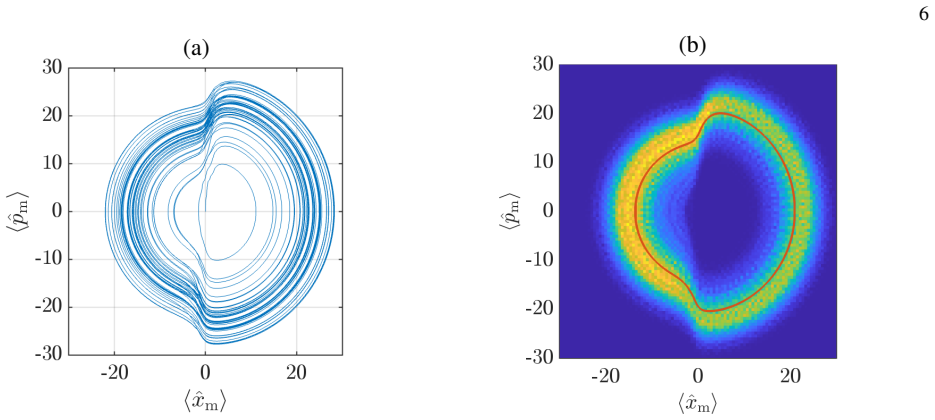
Starting from maximum negative excursion the cavity and lasing transition are far off resonant, the effective detuning being given by ∆ − √ 2g⟨ˆxm⟩, cf. Eq. (2) and left panel of Fig. 2 (a). For simplicity, we take ∆ = 0 in the following. The mechanical resonator undergoes free motion under the action of the restoring force. The corresponding state of the...
-
[6]
The mechanics sweeps through ⟨ˆxm⟩ = 0 and for a brief interval of time the lasing transition becomes resonant with the cavity frequency. The populations⟨ˆp1⟩ and ⟨ˆp2⟩ almost fully exchange, and concurrently a photon pulse is released into the cavity. This process takes place over a fraction (roughly 1/10) of a mechanical period. The photon pulse imparts...
-
[7]
Past the resonance both ⟨ˆp1⟩ and ⟨ˆa†ˆa⟩ quickly relax to zero, while the mechanical motion proceeds freely. (a) (b) (c) FIG. 3. Long time evolution of (a) the average mechanical quadra- tures, (b) the emitter populations and (c) the mean photon number. Parameters are the same as those used for Fig. 2 (b). The dashed gray lines are half a mechanical period apart
-
[8]
The resonance condition is met again and the “tock” is pro- duced. In this case the photon momentum is opposite to the mechanical momentum, slowing the resonator down, as seen by the sudden reduction in momentum once past the resonance, see Fig. 3 (a). The cycle repeats. A distinctive feature of our optomechanical clock is that it proceeds asymmetrically ...
work page 2028
-
[9]
(31) Here j labels the emitters and there is a total of M emitters in the cavity
− √ 2gˆa†ˆaˆxm, (30) with the free Hamiltonian ˆH0 = MX j=1 3X k=1 εk ˆpj k + Ωfˆa†ˆa + Ωmˆb†ˆb. (31) Here j labels the emitters and there is a total of M emitters in the cavity. The projector ˆpj k projects on the k-th energy eigenstate of the j-th emitter, and ˆσj kl denotes the transition operator for l → k of emitter j. For simplicity, we consider all...
-
[10]
III C to obtain nonlinear stochastic differential equations
(35) We may now follow the same steps as in Sec. III C to obtain nonlinear stochastic differential equations. In addition to the factorization assumptions used above, we also assume that the emitters remain uncorrelated, i.e. we factorize ⟨ˆpi l ˆpj k⟩ → ⟨ ˆpi l⟩⟨ˆpj k⟩, ⟨ˆpi lˆσj rs⟩ → ⟨ ˆpj l ⟩⟨ˆσj rs⟩, ⟨ˆσi lkˆσj rs⟩ → ⟨ ˆσi lk⟩⟨ˆσj rs⟩, (36) for i ̸= ...
-
[11]
A. C. Barato and U. Seifert, Cost and precision of brownian clocks, Phys. Rev. X 6, 041053 (2016)
work page 2016
- [12]
-
[13]
G. J. Milburn, The thermodynamics of clocks, Contemp. Phys. 61, 69 (2020)
work page 2020
-
[14]
A. N. Pearson, Y . Guryanova, P. Erker, E. A. Laird, G. A. D. Briggs, M. Huber, and N. Ares, Measuring the thermodynamic cost of timekeeping, Phys. Rev. X 11, 021029 (2021)
work page 2021
-
[15]
E. Schwarzhans, M. P. E. Lock, P. Erker, N. Friis, and M. Hu- ber, Autonomous temporal probability concentration: Clock- works and the second law of thermodynamics, Phys. Rev. X11, 011046 (2021)
work page 2021
-
[16]
Pietzonka, Classical pendulum clocks break the thermo- dynamic uncertainty relation, Phys
P. Pietzonka, Classical pendulum clocks break the thermo- dynamic uncertainty relation, Phys. Rev. Lett. 128, 130606 (2022)
work page 2022
- [17]
-
[18]
X. He, P. Pakkiam, A. A. Gangat, M. J. Kewming, G. J. Mil- burn, and A. Fedorov, Effect of measurement backaction on quantum clock precision studied with a superconducting circuit, Phys. Rev. Appl. 20, 034038 (2023)
work page 2023
- [19]
-
[20]
O. Culhane, M. J. Kewming, A. Silva, J. Goold, and M. T. Mitchison, Powering an autonomous clock with quantum elec- tromechanics, New J. Phys. 26, 023047 (2024)
work page 2024
- [21]
- [22]
-
[23]
F. Meier, Y . Minoguchi, S. Sundelin, T. J. G. Apollaro, P. Erker, S. Gasparinetti, and M. Huber, Precision is not limited by the second law of thermodynamics, Nat. Phys. 10.1038/s41567- 025-02929-2 (2025)
-
[24]
V . Wadhia, F. Meier, F. Fedele, R. Silva, N. Nurgalieva, D. L. Craig, D. Jirovec, J. Saez-Mollejo, A. Ballabio, D. Chrastina, G. Isella, M. Huber, M. T. Mitchison, P. Erker, and N. Ares, Entropic costs of the quantum-to-classical transition in a mi- croscopic clock, arXiv:2502.00096 [quant-phys]
-
[25]
A. C. Barato and U. Seifert, Thermodynamic uncertainty rela- tion for biomolecular processes, Phys. Rev. Lett. 114, 158101 (2015)
work page 2015
-
[26]
T. R. Gingrich, J. M. Horowitz, N. Perunov, and J. L. England, Dissipation bounds all steady-state current fluctuations, Phys. Rev. Lett. 116, 120601 (2016)
work page 2016
-
[27]
J. M. Horowitz and T. R. Gingrich, Thermodynamic uncertainty relations constrain non-equilibrium fluctuations, Nat. Phys. 16, 15 (2020)
work page 2020
-
[28]
[2, 7], which can be understood as the amount of ticks until the clock is off by one tick on average
We note that we use the accuracy as defined in Refs. [2, 7], which can be understood as the amount of ticks until the clock is off by one tick on average. A large accuracy is thus desired. This is to be contrasted with atomic clocks, where the accuracy is typically quantified in terms uncertainties which are desired to be small
- [29]
-
[30]
M. P. Woods, R. Silva, G. P¨utz, S. Stupar, and R. Renner, Quan- tum clocks are more accurate than classical ones, PRX Quan- tum 3, 010319 (2022)
work page 2022
-
[31]
M. P. Woods and M. Horodecki, Autonomous quantum devices: When are they realizable without additional thermodynamic costs?, Phys. Rev. X 13, 011016 (2023)
work page 2023
-
[32]
S. K. Manikandan, Autonomous quantum clocks using ather- mal resources, Phys. Rev. Res. 5, 043013 (2023)
work page 2023
- [33]
-
[34]
D. Gelbwaser-Klimovsky, R. Alicki, and G. Kurizki, Mini- mal universal quantum heat machine, Phys. Rev. E 87, 012140 (2013)
work page 2013
-
[35]
D. Venturelli, R. Fazio, and V . Giovannetti, Minimal self- contained quantum refrigeration machine based on four quan- tum dots, Phys. Rev. Lett. 110, 256801 (2013)
work page 2013
-
[36]
S. L. Macey, ed., Encyclopedia of Time (Routledge, 1994)
work page 1994
-
[37]
M. Aspelmeyer, T. J. Kippenberg, and F. Marquardt, Cavity op- tomechanics, Rev. Mod. Phys. 86, 1391 (2014)
work page 2014
-
[38]
H. E. D. Scovil and E. O. Schulz-DuBois, Three-level masers as heat engines, Phys. Rev. Lett. 2, 262 (1959)
work page 1959
-
[39]
W. Niedenzu, M. Huber, and E. Boukobza, Concepts of work in 15 autonomous quantum heat engines, Quantum 3, 195 (2019)
work page 2019
-
[40]
S.-W. Li, M. B. Kim, G. S. Agarwal, and M. O. Scully, Quan- tum statistics of a single-atom scovil–schulz-dubois heat en- gine, Phys. Rev. A 96, 063806 (2017)
work page 2017
-
[41]
Kubo, Generalized cumulant expansion method, J
R. Kubo, Generalized cumulant expansion method, J. Phys. Soc. Jpn. 17, 1100 (1962)
work page 1962
-
[42]
D. Plankensteiner, C. Hotter, and H. Ritsch, QuantumCumu- lants.jl: A Julia framework for generalized mean-field equa- tions in open quantum systems, Quantum 6, 617 (2022)
work page 2022
-
[43]
G. T. Landi, M. J. Kewming, M. T. Mitchison, and P. P. Potts, Current fluctuations in open quantum systems: Bridging the gap between quantum continuous measurements and full counting statistics, PRX Quantum 5, 020201 (2024)
work page 2024
- [44]
-
[45]
H. Yu, Y . Zhang, Q. Wu, C.-X. Shan, and K. Mølmer, Condi- tional dynamics in heterodyne detection of superradiant lasing with incoherently pumped atoms, Phys. Rev. Lett. 133, 073601 (2024)
work page 2024
-
[46]
T. Nadolny, C. Bruder, and M. Brunelli, Nonreciprocal syn- chronization of active quantum spins, Phys. Rev. X 15, 011010 (2025)
work page 2025
-
[47]
H. M. Wiseman and G. J. Milburn, Quantum Measurement and Control (Cambridge University Press, 2009)
work page 2009
-
[48]
D. W. Allan, Statistics of atomic frequency standards, Proc. IEEE 54, 221 (1966)
work page 1966
-
[49]
1139-2022 (Revision of IEEE Std
Ieee standard definitions of physical quantities for fundamental frequency and time metrology–random instabilities, IEEE Std. 1139-2022 (Revision of IEEE Std. 1139-2008) (2022)
work page 2022
-
[50]
A. Levy and R. Kosloff, The local approach to quantum trans- port may violate the second law of thermodynamics, EPL 107, 20004 (2014)
work page 2014
-
[51]
P. P. Hofer, M. Perarnau-Llobet, L. D. M. Miranda, G. Haack, R. Silva, J. B. Brask, and N. Brunner, Markovian master equa- tions for quantum thermal machines: local versus global ap- proach, New J. Phys. 19, 123037 (2017)
work page 2017
-
[52]
P. P. Potts, A. A. S. Kalaee, and A. Wacker, A thermodynami- cally consistent markovian master equation beyond the secular approximation, New J. Phys. 23, 123013 (2021)
work page 2021
-
[53]
R. H. Dicke, Coherence in spontaneous radiation processes, Phys. Rev. 93, 99 (1954)
work page 1954
- [54]
- [55]
-
[56]
Spohn, Entropy production for quantum dynamical semi- groups, J
H. Spohn, Entropy production for quantum dynamical semi- groups, J. Math. Phys. 19, 1227 (1978)
work page 1978
-
[57]
H. Spohn and J. L. Lebowitz, Irreversible thermodynamics for quantum systems weakly coupled to thermal reservoirs, in Adv. Chem. Phys. (John Wiley and Sons, Ltd, 1978) pp. 109–142. Appendix A: Analytical steady-state expression in the limit of a rigid cavity In this Appendix, we provide additional information on the steady state of the optomechanical pend...
work page 1978
discussion (0)
Sign in with ORCID, Apple, or X to comment. Anyone can read and Pith papers without signing in.