REVIEW 4 major objections 7 minor 39 references
DTHA: A Digital Twin-Assisted Handover Authentication Scheme for 5G and Beyond
T0 review · 4 major / 7 minor · reviewed 2026-08-07 · deepseek-v4-flash
Pith's one-line read A digital twin can pre-authenticate a phone with the next base station in advance.
desk verdict A novel digital-twin handover protocol with a real algebraic gap in the RoR proof; the idea deserves a revised resubmission, not acceptance as is. read the letter →
The pith
A machine-rendered reading of the paper's core claim, the machinery that carries it, and where it could break.
The reading
What carries the argument
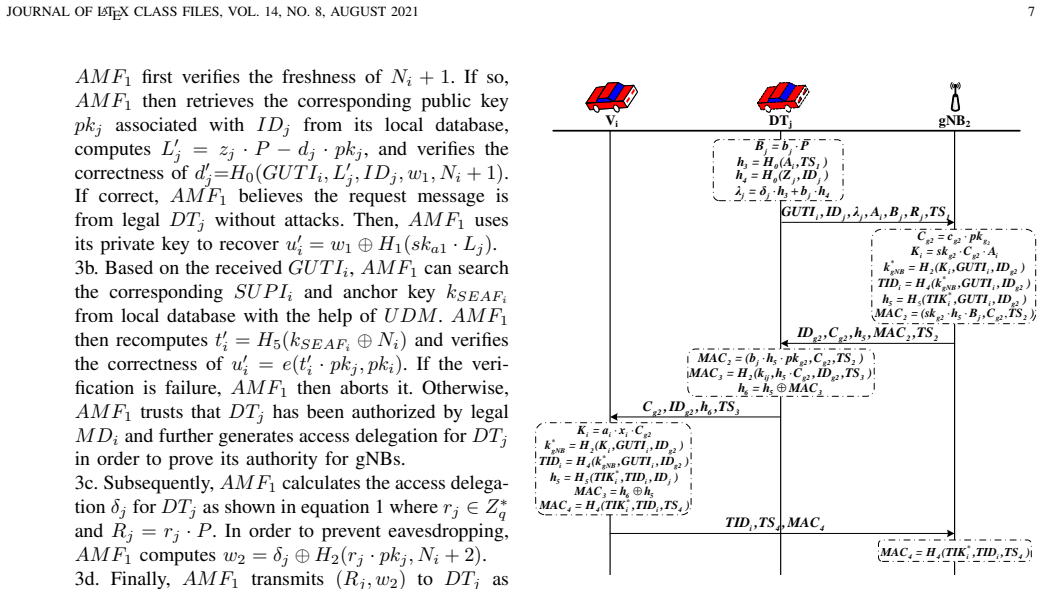
The load-bearing object is the authorized delegation token $\delta_j$: the AMF issues it to the digital twin after verifying that the twin holds a token produced by the device, and the twin later uses $\delta_j$ in the signature $\lambda_j$ that target base stations verify to confirm the twin speaks for the device. A second mechanism is the paired ECC values $A_i = a_i \cdot pk_i$ and $C_{g2} = c_{g2} \cdot pk_{g2}$, which let the device and the target base station independently arrive at the same session key while the twin only relays parameters.
What would settle it
Compromise a digital twin completely, revealing its long-term key $sk_j$, and check whether an adversary can forge the handover signature $\lambda_j$ or recover the negotiated key $k^*_{gNB}$; alternatively, run the protocol with the twin's API saturated by a denial-of-service flood and measure whether handover latency stays within the 5G requirement.
Extended reading notes
Core claim
The central claim is that a digital twin authorized by the network can legitimately stand in for a mobile device during handover, so that mutual authentication and key agreement between the device and the target base station are completed in advance over wired, dedicated interfaces. The device and the base station each compute the same session key $k^*_{gNB} = H_2(K_i, GUTI_i, ID_{g2})$ from a shared secret $K_i$ that combines the device's random $a_i$ and long-term key $sk_i$ with the base station's random $c_{g2}$ and long-term key $sk_{g2}$, so neither the digital twin nor any eavesdropper can reconstruct it. Both intra-AMF and inter-AMF handovers are covered: in the inter-domain case the source AMF forwards security context to the target AMF, which issues a fresh delegation to the twin. The paper reports that the phone's on-the-air cost after the pre-authentication is one hash operation plus one 288-bit key-confirmation message.
Load-bearing premise
The digital twin, running on operator cloud infrastructure, is trusted to represent the phone and stays reachable over secure, guaranteed-available API channels; if the twin is compromised, offline, or its channel is disrupted, the pre-authentication cannot happen and the scheme degrades to ordinary handover.
Editorial extensions
If this is right
- If the scheme works as claimed, a phone performing a predicted handover sends a single 288-bit acknowledgement to the target base station, so wireless control-plane traffic during handover drops to roughly the size of one message.
- The phone's own computation during handover falls to a single hash operation, because the twin has already performed the elliptic-curve operations and verifications on its behalf.
- Security properties the scheme claims to add over the standard 5G-AKA procedure include unlinkability of the device's temporary identities, perfect forward/backward secrecy, key-escrow freedom, and resistance to ephemeral-secret leakage.
- The inter-AMF variant re-issues a delegation for the twin across domain boundaries through N14 context transfer, extending the same pre-authentication benefit to cross-domain mobility.
Reading between the lines
- Beyond the paper: the architecture concentrates trust in the digital twin, so a fully compromised twin could likely authenticate itself to every base station it is delegated to; the real-world security margin depends on the twin's isolation.
- Beyond the paper: the efficiency gain is coupled to trajectory prediction accuracy, since each mispredicted target base station wastes a pre-authentication; in chaotic urban movement the practical gain over reactive schemes may shrink even though protocol costs drop.
- Beyond the paper: the inter-AMF design suggests an immediate extension to federated or multi-operator roaming, where the N14 context transfer step would be replaced by a cross-operator handshake, making the delegation token portable across administrative domains.
- Beyond the paper: because the device's on-air cost is a single hash and one message, the same machinery could be reused for machine-type devices or IoT sensors with tight energy budgets, where most existing handover protocols are too heavy.
Signed reviews
Editorial analysis
A structured set of objections, weighed in public.
Referee Report
Summary. The paper proposes DTHA, a digital twin-assisted handover authentication and key agreement scheme for 5G and beyond. A mobile device's digital twin, running in the operator's cloud, obtains a delegation from the AMF, proactively performs mutual authentication with predicted target gNBs, and forwards parameters so that the MD and target gNB can establish a session key before the MD attaches. The scheme covers both intra-AMF and inter-AMF handover scenarios. The authors claim security and performance advantages, supported by BAN logic, the RoR model, ProVerif, and informal analysis, together with comparisons of signaling, computation, and communication overheads against related schemes.
Significance. The DT-assisted proactive handover idea is timely for 5G/B5G mobility management, and the protocol construction appears novel relative to the cited SDN-based and blockchain-based handover schemes. The protocol equations are mostly coherent, the paper is honest about some performance trade-offs, and a public ProVerif code link is provided. However, the formal security validation—which is a central claim of the paper—has significant gaps in both the BAN logic and the RoR model. These gaps are fixable in a revision, but as written they prevent the reader from verifying the scheme's security guarantees.
major comments (4)
- [V.B, Theorem 1 and Eq. (6)] The Game 3 reduction is not established as written. The text states that after Corrupt and Reveal queries, to compute k*_gNB the adversary 'must obtain either the pair (a_i, sk_g2) or the pair (c_g2, sk_i)'. Given the public values A_i = a_i·sk_i·P and C_g2 = c_g2·sk_g2·P, the pair (a_i, sk_g2) lets one compute a_i·sk_g2·C_g2 = a_i·c_g2·sk_g2^2·P, and the pair (c_g2, sk_i) lets one compute c_g2·sk_i·A_i = a_i·c_g2·sk_i^2·P; neither expression equals K_i = a_i·sk_i·c_g2·sk_g2·P. The pairs that directly yield K_i are (a_i, sk_i) with C_g2 or (c_g2, sk_g2) with A_i. A correct reduction to ECDHP could be constructed by placing the CDH challenge on derived points (e.g., (a_i^{-1})·A_i and (sk_g2^{-1})·C_g2), but the proof does not provide such a reduction. Consequently, the claimed bound |Pr[Succ3] − Pr[Succ2]| ≤ q_h·Adv_ECDHP in Eq. (6), and hence the final bound in Eq. (2), are unsupported.
- [V.A, Assumption 3] Assumption 3 grants gNB2 jurisdiction over the entire handover request message (GUTI_i, ID_j, λ_j, A_i, B_j, R_j, T_S1), and Assumptions 4 and 5 similarly grant jurisdiction over the response parameters. The proof uses Assumption 3 with the jurisdiction rule to derive S7 (gNB2 |≡ A_i) and S8 (gNB2 |≡ GUTI_i), which are necessary for the session-key beliefs in S11–S13. This effectively assumes the authentication of the handover request and the authenticity of the MD-originated values, rather than deriving them from the protocol's verifiable steps such as the delegation check and the λ_j·P signature verification. The BAN analysis is therefore circular for the core mutual authentication goal and does not independently establish the scheme's authentication claim.
- [V.B.4, adversary model] The RoR model defines Reveal as releasing ephemeral state and Corrupt as releasing long-term keys, but it does not state any restriction on issuing both queries to the same instance. Section III.B declares that simultaneous compromise of a party's long-term and ephemeral secrets is infeasible, yet this restriction is not incorporated into the game definition or the freshness condition. The proof's Game 3 considers only cross-party Corrupt+Reveal combinations and silently omits the case where the adversary obtains both (sk_i, a_i) or both (sk_g2, c_g2), which would directly yield K_i. The model either needs to include this restriction explicitly, or the proof must handle all query patterns that the game allows.
- [V.C, ProVerif] The paper claims ProVerif-based formal verification but does not include the ProVerif model in the manuscript; it provides only a query listing, a screenshot of results, and a GitHub URL. Without the protocol model, channel definitions, and the full code, the verification claim cannot be checked or reproduced from the paper. The authors should include the ProVerif code or a sufficiently detailed model description in the supplement so that the formal verification is assessable.
minor comments (7)
- [V.B, Eq. (2) and Eq. (5)] The text says '|Hash| denotes the bit lengths of the hash function' but uses |Hash| as a denominator that should be the size of the output space (2^l), not the bit length. This should be clarified to avoid a dimensionally inconsistent bound.
- [Table II] The table header contains the typo 'Key Errow Freshness' (should be 'Key Escrow Freedom') and the acronym 'ELS' appears in the header text while the table uses 'ESL'. These should be made consistent.
- [IV.C.4, Step 4b] The session key computation is written as K_i = a_i · x_i · C_g2, but the notation table defines the MD's private key as sk_i and no x_i is introduced for the MD. This appears to be a typo for sk_i; it should be corrected to avoid ambiguity with the gNB's partial private key notation.
- [VI.E, Eq. (11)] The formula for Com_avg divides by p_succ without explanation, and the standard expected-value expression would not include this denominator. The equation should be justified or corrected.
- [Figures 2–4] The figures contain rendering artifacts and garbled fragments (e.g., 'EVO' in Figure 2, alignment issues in several places). They should be regenerated with a proper vector graphics tool.
- [Reference [37]] The ProVerif code is provided only as a GitHub link. For archival stability, the authors should consider adding a DOI or including the code as supplementary material with the submission.
- [General] There are several typos in the text, including 'Builiding' in Section I, 'leasttout' in Section II, and inconsistent use of 'Key Errow' in Table II. A thorough proofreading pass is recommended.
Circularity Check
No material circularity: the central protocol and its security bound derive from standard cryptographic assumptions and external baselines, not from self-cited inputs; the RoR proof's algebraic gap is a correctness concern, not circularity.
full rationale
Walking the derivation chain, the central claim—that DTHA's session key k*_gNB is semantically secure and compares favorably with prior handover schemes—does not reduce to its own inputs. The key K_i = a_i·sk_i·C_g2 = c_g2·sk_g2·A_i is a fresh ECDH-style construction whose security is reduced to ECDLP/ECDHP and random-oracle hashing in Theorem 1, and the performance comparisons use fixed operation timings and external baselines from [2], [7], [9], and [21]. No parameter is fitted to the data being 'predicted', and no equation defines the claimed result in terms of itself. The self-citations, e.g. [14] and [34], are used for background architecture—DT deployment and a pre-existing DT–MD secure channel—not for the session-key security result, so they are not load-bearing. The ProVerif verification is machine-checked on a protocol model, not a fitted prediction. The paper's own limitation discussion in §VI.F acknowledges DT exposure to DoS and side-channel attacks, which is an honest boundary condition rather than a recycled conclusion. One flagged issue is not circular: the Game 3 portion of the RoR proof in §V.B states that the adversary needs pairs (a_i, sk_g2) or (c_g2, sk_i), but algebraically those pairs do not produce K_i = a_i·c_g2·sk_i·sk_g2·P; the sufficient pairs are (a_i, sk_i) with C_g2 or (c_g2, sk_g2) with A_i. This is a defect in the reduction, not a reduction of the result to its own assumptions, so it raises correctness risk without making the derivation circular.
Assumptions & free parameters
assumptions (7)
- standard math Elliptic curve discrete logarithm problem (ECDLP) is hard
- standard math Elliptic curve computational Diffie-Hellman problem (ECDHP) is hard
- domain assumption Random oracle model for hash functions
- domain assumption Dolev-Yao adversary with control of the wireless channel
- domain assumption The digital twin is honest and follows the protocol
- domain assumption Dedicated APIs between the digital twin and the 5G core are secure and available
- domain assumption Trajectory prediction by the digital twin is accurate enough
Cite this review
Pith. "Pith review of DTHA: A Digital Twin-Assisted Handover Authentication Scheme for 5G and Beyond." pith.science (2026). https://pith.science/paper/ZELE3QEB
@misc{pith2026250611669,
  author       = {Pith},
  title        = {Pith review of: DTHA: A Digital Twin-Assisted Handover Authentication Scheme for 5G and Beyond},
  year         = {2026},
  howpublished = {\url{https://pith.science/paper/ZELE3QEB}},
  note         = {Machine review of arXiv:2506.11669}
}
read the original abstract
With the rapid development and extensive deployment of the fifth-generation wireless system (5G), it has achieved ubiquitous high-speed connectivity and improved overall communication performance. Additionally, as one of the promising technologies for integration beyond 5G, digital twin in cyberspace can interact with the core network, transmit essential information, and further enhance the wireless communication quality of the corresponding mobile device (MD). However, the utilization of millimeter-wave, terahertz band, and ultra-dense network technologies presents urgent challenges for MD in 5G and beyond, particularly in terms of frequent handover authentication with target base stations during faster mobility, which can cause connection interruption and incur malicious attacks. To address such challenges in 5G and beyond, in this paper, we propose a secure and efficient handover authentication scheme by utilizing digital twin. Acting as an intelligent intermediate, the authorized digital twin can handle computations and assist the corresponding MD in performing secure mutual authentication and key negotiation in advance before attaching the target base stations in both intra-domain and inter-domain scenarios. In addition, we provide the formal verification based on BAN logic, RoR model, and ProVerif, and informal analysis to demonstrate that the proposed scheme can offer diverse security functionality. Performance evaluation shows that the proposed scheme outperforms most related schemes in terms of signaling, computation, and communication overheads.
Figures


Figures from the paper (6 more)


Reference graph
Works this paper leans on
-
[1]
Role of sensing and computer vision in 6g wireless communications,
S. Kim, J. Moon, J. Kim, Y . Ahn, D. Kim, S. Kim, K. Shim, and B. Shim, “Role of sensing and computer vision in 6g wireless communications,” IEEE Wireless Communications, 2024
work page 2024
-
[2]
G. T. . V16.1.0, “Technical specification group services and system aspects; Security architecture and procedures for 5G system (Release 16)[R],” 3rd Generation Partnership Project (3GPP), Technical Specifi- cation (TS), 2019
work page 2019
-
[3]
A secure and efficient handover authentication and key management protocol for 5g networks,
J. Huang and Y . Qian, “A secure and efficient handover authentication and key management protocol for 5g networks,”Journal of Communi- cations and Information Networks, vol. 5, no. 1, pp. 40–49, 2020
work page 2020
-
[4]
Terahertz communications for massive con- nectivity and security in 6g and beyond era,
N. Yang and A. Shafie, “Terahertz communications for massive con- nectivity and security in 6g and beyond era,”IEEE Communications Magazine, 2022
work page 2022
-
[5]
On the road to 6g: Visions, requirements, key technologies, and testbeds,
C.-X. Wang, X. You, X. Gao, X. Zhu, Z. Li, C. Zhang, H. Wang, Y . Huang, Y . Chen, H. Haaset al., “On the road to 6g: Visions, requirements, key technologies, and testbeds,”IEEE Communications Surveys & Tutorials, vol. 25, no. 2, pp. 905–974, 2023
2023
-
[6]
N. Sharma and K. Kumar, “Resource allocation trends for ultra dense networks in 5g and beyond networks: A classification and comprehen- sive survey,”Physical Communication, vol. 48, p. 101415, 2021
work page 2021
-
[7]
A novel authentication scheme supporting multiple user access for 5g and beyond,
C. Lai, Y . Ma, R. Lu, Y . Zhang, and D. Zheng, “A novel authentication scheme supporting multiple user access for 5g and beyond,”IEEE Transactions on Dependable and Secure Computing, 2022
work page 2022
-
[8]
Mobility management paradigm shift: from reactive to proactive handover using ai/ml,
H.-S. Park, H. Kim, C. Lee, and H. Lee, “Mobility management paradigm shift: from reactive to proactive handover using ai/ml,”IEEE Network, 2024
work page 2024
Show all 39 references
-
[9]
Ftgpha: Fixed-trajectory group pre-handover authentication mechanism for mobile relays in 5g high-speed rail networks,
R. Ma, J. Cao, D. Feng, H. Li, and S. He, “Ftgpha: Fixed-trajectory group pre-handover authentication mechanism for mobile relays in 5g high-speed rail networks,”IEEE transactions on vehicular technology, vol. 69, no. 2, pp. 2126–2140, 2019
2019
-
[10]
Lshsc: Lightweight and secure handover scheme with conditional privacy- preserving for group-based sdvn,
X. Zhang, H. Zhong, J. Cui, I. Bolodurina, C. Gu, and D. He, “Lshsc: Lightweight and secure handover scheme with conditional privacy- preserving for group-based sdvn,”IEEE Transactions on Dependable and Secure Computing, 2025
2025
-
[11]
Blockchain-enabled authentication handover with efficient privacy pro- tection in sdn-based 5g networks,
A. Yazdinejad, R. M. Parizi, A. Dehghantanha, and K.-K. R. Choo, “Blockchain-enabled authentication handover with efficient privacy pro- tection in sdn-based 5g networks,”IEEE Transactions on Network Science and Engineering, vol. 8, no. 2, pp. 1120–1132, 2019
2019
-
[12]
Decentralized edge collab- oration for seamless handover authentication in zero-trust iov,
H. Fang, Y . Zhu, Y . Zhang, and X. Wang, “Decentralized edge collab- oration for seamless handover authentication in zero-trust iov,”IEEE Transactions on Wireless Communications, 2024
2024
-
[13]
Digital twin of wireless systems: Overview, taxonomy, challenges, and opportunities,
L. U. Khan, Z. Han, W. Saad, E. Hossain, M. Guizani, and C. S. Hong, “Digital twin of wireless systems: Overview, taxonomy, challenges, and opportunities,”IEEE Communications Surveys & Tutorials, 2022
2022
-
[14]
Breaking down data sharing barrier of smart city: A digital twin approach,
G. Li, T. H. Luan, X. Li, J. Zheng, C. Lai, Z. Su, and K. Zhang, “Breaking down data sharing barrier of smart city: A digital twin approach,”IEEE Network, 2023
2023
-
[15]
Blockchain assisted intra-twin and inter-twin authentication scheme for vehicular digital twin system,
D. Gautam, G. Thakur, P. Kumar, A. K. Das, and Y . Park, “Blockchain assisted intra-twin and inter-twin authentication scheme for vehicular digital twin system,”IEEE Transactions on Intelligent Transportation Systems, 2024
2024
-
[16]
D-tracking: digital twin enabled trajectory tracking system of autonomous vehicles,
Y . Hu, M. Wu, J. Kang, and R. Yu, “D-tracking: digital twin enabled trajectory tracking system of autonomous vehicles,”IEEE Transactions on Vehicular Technology, 2024
2024
-
[17]
3GPP TR 28.915: Study on management aspects of Network Digital Twin,
3rd Generation Partnership Project (3GPP), “3GPP TR 28.915: Study on management aspects of Network Digital Twin,” Tech. Rep., 2023. [Online]. Available: https://www.3gpp.org/DynaReport/28915.htm
2023
-
[18]
Digital twin enabled 6g radio testing: Concepts, challenges and solutions,
H. Gao, P. Ky ¨osti, X. Zhang, and W. Fan, “Digital twin enabled 6g radio testing: Concepts, challenges and solutions,”IEEE communications Magazine, vol. 61, no. 11, pp. 88–94, 2023
2023
-
[19]
Digital twin in 6g: Embracing comprehensive network intelligence,
J. Zheng, T. H. Luan, Y . Zhang, G. Li, Z. Su, and W. Wu, “Digital twin in 6g: Embracing comprehensive network intelligence,”IEEE Wireless Communications, 2024
2024
-
[20]
Authentication handover and privacy protection in 5g hetnets using software-defined networking,
X. Duan and X. Wang, “Authentication handover and privacy protection in 5g hetnets using software-defined networking,”IEEE Communica- tions Magazine, vol. 53, no. 4, pp. 28–35, 2015. JOURNAL OF LATEX CLASS FILES, VOL. 14, NO. 8, AUGUST 2021 18
2015
-
[21]
Cppha: Capability-based privacy-protection handover authentication mechanism for sdn-based 5g hetnets,
J. Cao, M. Ma, Y . Fu, H. Li, and Y . Zhang, “Cppha: Capability-based privacy-protection handover authentication mechanism for sdn-based 5g hetnets,”IEEE transactions on dependable and secure computing, vol. 18, no. 3, pp. 1182–1195, 2019
2019
-
[22]
Robust and universal seamless handover authentication in 5g hetnets,
Y . Zhang, R. H. Deng, E. Bertino, and D. Zheng, “Robust and universal seamless handover authentication in 5g hetnets,”IEEE Transactions on Dependable and Secure Computing, vol. 18, no. 2, pp. 858–874, 2019
2019
-
[23]
Pecha: Privacy-preserving and efficient cross-domain handover authentication for heterogeneous networks,
G. Liu, H. Li, N. Wang, B. Chen, J. Le, Y . Liu, and T. Xiang, “Pecha: Privacy-preserving and efficient cross-domain handover authentication for heterogeneous networks,”IEEE Transactions on Dependable and Secure Computing, 2024
2024
-
[24]
Design of blockchain- based lightweight v2i handover authentication protocol for vanet,
S. Son, J. Lee, Y . Park, Y . Park, and A. K. Das, “Design of blockchain- based lightweight v2i handover authentication protocol for vanet,”IEEE Transactions on Network Science and Engineering, vol. 9, no. 3, pp. 1346–1358, 2022
2022
-
[25]
Blockchain-based efficient access control with handover policy in iov-enabled intelligent transportation system,
S. Roy, S. Nandi, R. Maheshwari, S. Shetty, A. K. Das, and P. Lorenz, “Blockchain-based efficient access control with handover policy in iov-enabled intelligent transportation system,”IEEE Transactions on Vehicular Technology, 2023
2023
-
[26]
Dkgauth: Blockchain- assisted distributed key generation and authentication for cross-domain intelligent iot,
K. Liu, J. Guan, S. Yao, L. Wang, and H. Zhang, “Dkgauth: Blockchain- assisted distributed key generation and authentication for cross-domain intelligent iot,”IEEE Internet of Things Journal, vol. 11, no. 15, pp. 25 663–25 673, 2024
2024
-
[27]
A proxy signature based efficient and robust handover aka protocol for lte/lte-a networks,
S. Gupta, B. L. Parne, and N. S. Chaudhari, “A proxy signature based efficient and robust handover aka protocol for lte/lte-a networks,” Wireless Personal Communications, vol. 103, no. 3, pp. 2317–2352, 2018
2018
-
[28]
Towards resilience 5g-v2n: Efficient and privacy- preserving authentication protocol for multi-service access and han- dover,
Y . Bi and C. Jia, “Towards resilience 5g-v2n: Efficient and privacy- preserving authentication protocol for multi-service access and han- dover,”IEEE Transactions on Mobile Computing, 2025
2025
-
[29]
Efficient group handover authentication for secure 5g-based communications in platoons,
X. Yan, M. Ma, and R. Su, “Efficient group handover authentication for secure 5g-based communications in platoons,”IEEE Transactions on Intelligent Transportation Systems, 2022
2022
-
[30]
Lsaa: a lightweight and secure access authentication scheme for both ue and mmtc devices in 5g networks,
J. Cao, Z. Yan, R. Ma, Y . Zhang, Y . Fu, and H. Li, “Lsaa: a lightweight and secure access authentication scheme for both ue and mmtc devices in 5g networks,”IEEE Internet of Things Journal, vol. 7, no. 6, pp. 5329–5344, 2020
2020
-
[31]
Fasthand: A fast handover au- thentication protocol for densely deployed small-cell networks,
P. K. Roy, P. Sahu, and A. Bhattacharya, “Fasthand: A fast handover au- thentication protocol for densely deployed small-cell networks,”Journal of Network and Computer Applications, p. 103435, 2022
2022
-
[32]
Machine learning protocol for secure 5g handovers,
V . O. Nyangaresi, A. J. Rodrigues, and S. O. Abeka, “Machine learning protocol for secure 5g handovers,”International Journal of Wireless Information Networks, vol. 29, no. 1, pp. 14–35, 2022
2022
-
[33]
Handover strategy based on side information in air-ground integrated vehicular networks,
Y . Zhou, J. Sun, J. Yang, G. Gui, H. Gacanin, and F. Adachi, “Handover strategy based on side information in air-ground integrated vehicular networks,”IEEE Transactions on Vehicular Technology, vol. 71, no. 10, pp. 10 823–10 831, 2022
2022
-
[34]
Seccdv: A security reference archi- tecture for cybertwin-driven 6g v2x,
G. Li, C. Lai, R. Lu, and D. Zheng, “Seccdv: A security reference archi- tecture for cybertwin-driven 6g v2x,”IEEE Transactions on Vehicular Technology, vol. 71, no. 5, pp. 4535–4550, 2021
2021
-
[35]
Password-based au- thenticated key exchange in the three-party setting,
M. Abdalla, P.-A. Fouque, and D. Pointcheval, “Password-based au- thenticated key exchange in the three-party setting,” inInternational workshop on public key cryptography. Springer, 2005, pp. 65–84
2005
-
[36]
2.04: Automatic cryptographic protocol verifier,
B. Blanchet, B. Smyth, V . Cheval, and M. P. Sylvestre, “2.04: Automatic cryptographic protocol verifier,”User Manual and Tutorial, INRIA Paris- Rocquencourt, 2021
2021
-
[37]
Dtha proverif simulation code,
“Dtha proverif simulation code,” 2025, accessed: 2025-02-22. [Online]. Available: https://github.com/GuanjieLi/DTHA/blob/main/DTHA.pv
2025
-
[38]
Anonymous handover authentication protocol for mobile wireless networks with conditional privacy preservation,
D. He, D. Wang, Q. Xie, K. Chenet al., “Anonymous handover authentication protocol for mobile wireless networks with conditional privacy preservation,”Science China Information Sciences, vol. 60, no. 5, pp. 1–17, 2017
2017
-
[39]
Blockchain-assisted handover authentication for intelligent telehealth in multi-server edge computing environment,
W. Wang, H. Huang, L. Xue, Q. Li, R. Malekian, and Y . Zhang, “Blockchain-assisted handover authentication for intelligent telehealth in multi-server edge computing environment,”Journal of Systems Ar- chitecture, vol. 115, p. 102024, 2021. Guanjie Lireceived B.S. degree in com...
2021
Reviewed August 7, 2026 · model on record in the stance chip above.
Discussion (0). Continue with ORCID to comment.