Fully Collective Superradiant Lasing with Vanishing Sensitivity to Cavity Length Vibrations
Pith reviewed 2026-05-19 08:59 UTC · model grok-4.3
The pith
Multi-level atoms coupled to two cavities enable a superradiant laser with vibration sensitivity that can vanish at steady state.
A machine-rendered reading of the paper's core claim, the machinery that carries it, and where it could break.
Core claim
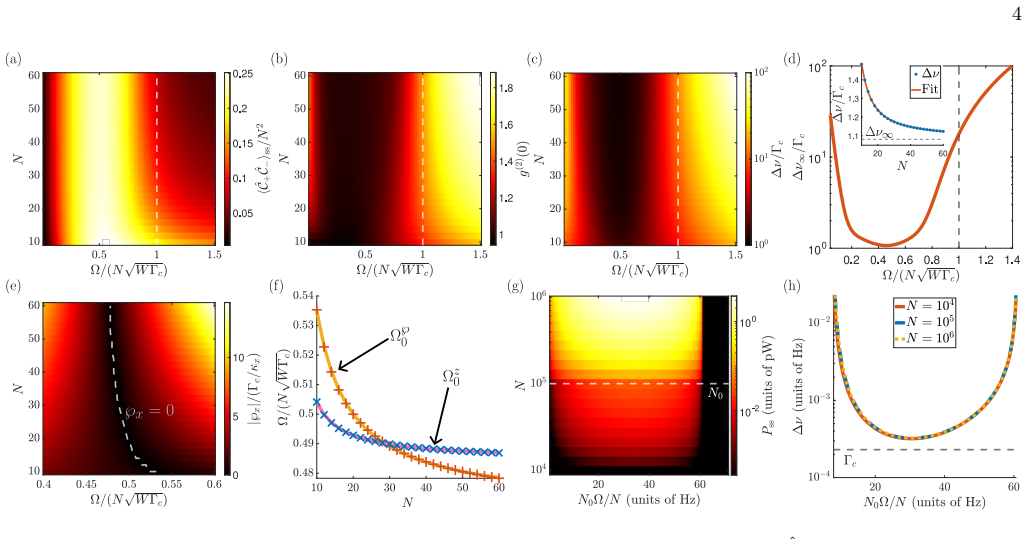
Using multi-level atoms with collective pumping and decay on distinct transitions, the authors show that coupling to an auxiliary cavity makes the repumping process fully collective. This allows the system to overcome the lack of a generic lasing threshold found in two-level models and to operate as a continuous-wave superradiant laser with a linewidth of order 100 microhertz. The principal result is an operating regime, including specific parameter values, where the sensitivity to cavity length vibrations falls below order 10 to the minus 14 per g and vanishes completely even in the steady state.
What carries the argument
The auxiliary cavity that enforces fully collective repumping on a separate atomic transition from the lasing transition in the multi-level system.
If this is right
- The system produces a continuous-wave superradiant laser with linewidth of O(100 μhz).
- Vibration sensitivity to cavity length can be below O(10^{-14}/g).
- Sensitivity can vanish at certain steady-state parameter values.
- Distinct transitions for pumping and decay enable collective effects beyond two-level limits.
Where Pith is reading between the lines
- This collective repumping approach may extend to other quantum optical systems for reducing environmental sensitivities.
- It could lead to testable predictions for frequency stability in lab-based atomic clock prototypes.
- The vanishing sensitivity point might serve as a robust operating condition for precision measurements insensitive to mechanical noise.
Load-bearing premise
The chosen multi-level atomic model with distinct transitions for collective pumping and decay holds without additional decoherence, losses, or non-collective effects in a real setup.
What would settle it
A direct measurement of the laser frequency's dependence on cavity length showing sensitivity greater than 10^{-14} per g or the inability to maintain the narrow linewidth due to unmodeled effects would disprove the central claim.
Figures


read the original abstract
To date, realization of a continuous-wave active atomic clock has been elusive primarily due to parasitic heating from spontaneous emission while repumping the atoms. Here, we propose a solution to this problem by replacing the random emission with coupling to an auxiliary cavity, making repumping a fully collective process. While it is known that collective two-level models do not possess a generic lasing threshold, we show this restriction is overcome with multi-level atoms since collective pumping and decay can be performed on distinct transitions. Using relevant atomic parameters, we find this system is capable of producing an $\mathcal{O}$(100 $\mu$Hz)-linewidth continuous-wave superradiant laser. Our principal result is the potential for an operating regime with cavity length vibration sensitivity below $\mathcal{O}(10^{-14} / g)$, including a locus of parameter values where it completely vanishes even at steady-state.
Editorial analysis
A structured set of objections, weighed in public.
Referee Report
Summary. The manuscript proposes a multi-level atomic scheme for fully collective superradiant lasing in which collective pumping and decay occur on distinct transitions. This overcomes the absence of a generic lasing threshold in two-level collective models. Using relevant atomic parameters, the authors calculate an O(100 μHz) linewidth continuous-wave laser and identify an operating regime with cavity-length vibration sensitivity below O(10^{-14}/g), including a locus of parameters where the sensitivity vanishes exactly at steady state.
Significance. If the vanishing-sensitivity result holds under realistic conditions, the work would constitute a notable step toward practical continuous-wave active atomic clocks by removing parasitic heating from spontaneous emission and suppressing a dominant technical noise source. The multi-level collective approach is a direct extension of standard quantum-optics rate equations and therefore builds on established methods while addressing a concrete experimental limitation.
major comments (2)
- [Steady-state master-equation solution and sensitivity derivation] The exact cancellation that produces zero sensitivity is obtained from the steady-state solution of the master equation after setting single-atom spontaneous emission, inhomogeneous broadening, and non-collective scattering rates to zero or to the chosen parameter values. No quantitative robustness analysis is provided showing how small, physically unavoidable additions to these rates displace the zero-sensitivity locus or restore finite sensitivity at the 10^{-12}–10^{-13}/g level.
- [Abstract and principal-results section] The abstract asserts that calculations with relevant atomic parameters support both the linewidth and the sensitivity claims, yet the manuscript supplies neither explicit derivations of the steady-state frequency pull nor an error budget that quantifies the effect of the neglected decoherence channels on the reported O(10^{-14}/g) bound.
minor comments (2)
- [Results and parameter tables] The order-of-magnitude notation O(100 μHz) and O(10^{-14}/g) is acceptable for an initial proposal but would benefit from at least one concrete numerical example or table entry that shows the exact parameter set yielding the zero-sensitivity point.
- [Introduction and model section] A brief comparison figure or paragraph contrasting the multi-level collective threshold with the known two-level collective case would help readers immediately see where the new operating regime appears.
Simulated Author's Rebuttal
We thank the referee for their careful reading of the manuscript and for the constructive comments. The positive assessment of the work's potential significance for continuous-wave active atomic clocks is appreciated. Below we provide point-by-point responses to the major comments. We agree that additional analysis is needed to strengthen the presentation and will incorporate the requested elements in a revised manuscript.
read point-by-point responses
-
Referee: [Steady-state master-equation solution and sensitivity derivation] The exact cancellation that produces zero sensitivity is obtained from the steady-state solution of the master equation after setting single-atom spontaneous emission, inhomogeneous broadening, and non-collective scattering rates to zero or to the chosen parameter values. No quantitative robustness analysis is provided showing how small, physically unavoidable additions to these rates displace the zero-sensitivity locus or restore finite sensitivity at the 10^{-12}–10^{-13}/g level.
Authors: We agree that the exact vanishing of sensitivity is obtained in the idealized steady-state solution where single-atom spontaneous emission, inhomogeneous broadening, and non-collective scattering rates are set to zero. This isolates the fully collective regime and reveals the parameter locus at which the frequency pull cancels exactly. In the revised manuscript we will add a quantitative robustness section. Small but finite values for these rates, chosen to match realistic experimental conditions for the atomic species under consideration, will be introduced into the master equation. We will then map the resulting displacement of the zero-sensitivity locus and show that the vibration sensitivity remains below the O(10^{-14}/g) target for parameter ranges consistent with current cavity and atomic technology. revision: yes
-
Referee: [Abstract and principal-results section] The abstract asserts that calculations with relevant atomic parameters support both the linewidth and the sensitivity claims, yet the manuscript supplies neither explicit derivations of the steady-state frequency pull nor an error budget that quantifies the effect of the neglected decoherence channels on the reported O(10^{-14}/g) bound.
Authors: The abstract summarizes results obtained from numerical integration of the multi-level master equation using realistic atomic parameters. The steady-state frequency pull follows from the imaginary part of the collective eigenvalues once the system reaches the steady-state density matrix. To make this explicit, the revised manuscript will include a dedicated subsection deriving the frequency pull from the phase equation of the collective field and from the steady-state coherence. In addition, we will provide an error-budget table that estimates the contribution of each neglected decoherence channel (residual single-atom emission, inhomogeneous broadening, and non-collective scattering) to the vibration sensitivity, confirming that the O(10^{-14}/g) bound is preserved within the stated parameter regime. revision: yes
Circularity Check
No circularity; derivation self-contained from master-equation steady state
full rationale
The paper solves the steady-state master equation for a multi-level collective system with distinct pumping and decay transitions to obtain the sensitivity to cavity-length vibrations, including the locus where it vanishes. This follows directly from the rate equations without any fitted parameter being relabeled as a prediction, without self-definitional closure, and without load-bearing self-citations that substitute for independent derivation. The result is a computed operating point from the chosen parameters and is externally falsifiable by experiment or by adding omitted decoherence channels; no step reduces by construction to its own inputs.
Axiom & Free-Parameter Ledger
free parameters (1)
- relevant atomic parameters
axioms (1)
- standard math Collective two-level models do not possess a generic lasing threshold
Lean theorems connected to this paper
-
IndisputableMonolith/Cost/FunctionalEquation.leanwashburn_uniqueness_aczel unclear?
unclearRelation between the paper passage and the cited Recognition theorem.
locus of parameter values where it completely vanishes even at steady-state
What do these tags mean?
- matches
- The paper's claim is directly supported by a theorem in the formal canon.
- supports
- The theorem supports part of the paper's argument, but the paper may add assumptions or extra steps.
- extends
- The paper goes beyond the formal theorem; the theorem is a base layer rather than the whole result.
- uses
- The paper appears to rely on the theorem as machinery.
- contradicts
- The paper's claim conflicts with a theorem or certificate in the canon.
- unclear
- Pith found a possible connection, but the passage is too broad, indirect, or ambiguous to say the theorem truly supports the claim.
Forward citations
Cited by 2 Pith papers
-
One knob to tune them all: Phase-controlled photon statistics and linewidth in partially pumped atomic ensembles
In partially pumped atomic ensembles, a tunable relative phase between pumped and unpumped emission contributions allows control of linewidth scaling and photon statistics from antibunched to bunched.
-
One knob to tune them all: Phase-controlled photon statistics and linewidth in partially pumped atomic ensembles
In a minimal model of partially pumped atomic ensembles, collective dissipation induces interference that allows tuning linewidth from size-independent to extensive and photon statistics from antibunched to bunched vi...
Reference graph
Works this paper leans on
-
[1]
J. Aasi et al. , Enhanced sensitivity of the ligo gravita- tional wave detector by using squeezed states of light, Nature Photonics 7, 613 (2013)
work page 2013
-
[2]
B. P. Abbott et al. (LIGO Scientific Collaboration and Virgo Collaboration), Observation of gravitational waves from a binary black hole merger, Phys. Rev. Lett. 116, 061102 (2016)
work page 2016
- [3]
-
[4]
T. Albahri et al. (Muon g − 2 Collaboration), Measure- ment of the anomalous precession frequency of the muon in the fermilab muon g − 2 experiment, Phys. Rev. D 103, 072002 (2021)
work page 2021
-
[5]
K. Akiyama et al. (Event Horizon Telescope Collabora- tion), First sagittarius a* event horizon telescope results. i. the shadow of the supermassive black hole in the cen- ter of the milky way, The Astrophysical Journal Letters 930, L12 (2022)
work page 2022
-
[6]
A. A. Abud et al. (DUNE Collaboration), Low exposure long-baseline neutrino oscillation sensitivity of the dune experiment, Phys. Rev. D 105, 072006 (2022)
work page 2022
-
[7]
T. Bothwell, C. J. Kennedy, A. Aeppli, D. Kedar, J. M. Robinson, E. Oelker, A. Staron, and J. Ye, Resolving the gravitational redshift across a millimetre-scale atomic sample, Nature 602, 420 (2022)
work page 2022
-
[8]
G. Agazie et al. , The nanograv 15 yr data set: Evidence for a gravitational-wave background, The Astrophysical Journal Letters 951, L8 (2023)
work page 2023
-
[9]
T. S. Roussy, L. Caldwell, T. Wright, W. B. Cairncross, Y. Shagam, K. B. Ng, N. Schlossberger, S. Y. Park, A. Wang, J. Ye, and E. A. Cornell, An improved bound on the electron’s electric dipole moment, Science 381, 46 (2023)
work page 2023
- [10]
-
[11]
A. Derevianko and H. Katori, Colloquium: Physics of optical lattice clocks, Rev. Mod. Phys. 83, 331 (2011)
work page 2011
-
[12]
A. D. Ludlow, M. M. Boyd, J. Ye, E. Peik, and P. O. Schmidt, Optical atomic clocks, Rev. Mod. Phys. 87, 637 (2015)
work page 2015
-
[14]
E. Pedrozo-Pe˜ nafiel, S. Colombo, C. Shu, A. F. Adiy- atullin, Z. Li, E. Mendez, B. Braverman, A. Kawasaki, D. Akamatsu, Y. Xiao, and V. Vuleti` c, Entanglement on an optical atomic-clock transition, Nature 588, 414–418 (2020)
work page 2020
-
[15]
J. M. Robinson, M. Miklos, Y. M. Tso, C. J. Kennedy, T. Bothwell, D. Kedar, J. K. Thompson, and J. Ye, Direct comparison of two spin-squeezed optical clock ensembles at the 10 −21 level, Nature Physics 20, 208 (2024)
work page 2024
- [16]
-
[17]
Chen, Active optical clock, Chinese Science Bulleti n 54, 348 (2009)
J. Chen, Active optical clock, Chinese Science Bulleti n 54, 348 (2009)
work page 2009
-
[19]
D. Meiser and M. J. Holland, Steady-state superradi- ance with alkaline-earth-metal atoms, Phys. Rev. A 81, 033847 (2010)
work page 2010
-
[20]
D. Meiser and M. J. Holland, Intensity fluctuations in steady-state superradiance, Phys. Rev. A 81, 063827 (2010)
work page 2010
-
[21]
J. G. Bohnet, Z. Chen, J. M. Weiner, D. Meiser, M. J. Holland, and J. K. Thompson, A steady-state superradi- ant laser with less than one intracavity photon, Nature 484, 78 (2012)
work page 2012
- [22]
-
[23]
S. Kr¨ amer, L. Ostermann, and H. Ritsch, Optimized ge- ometries for future generation optical lattice clocks, EPL (Europhysics Letters) 114, 14003 (2016)
work page 2016
-
[24]
M. A. Norcia and J. K. Thompson, Cold-strontium laser in the superradiant crossover regime, Phys. Rev. X 6, 011025 (2016)
work page 2016
-
[25]
M. A. Norcia, M. N. Winchester, J. R. K. Cline, and J. K. Thompson, Superradiance on the millihertz linewidth strontium clock transition, Science Advances 2, e1601231 (2016)
work page 2016
-
[26]
M. A. Norcia, J. R. K. Cline, J. A. Muniz, J. M. Robin- son, R. B. Hutson, A. Goban, G. E. Marti, J. Ye, and J. K. Thompson, Frequency measurements of superradi- ance from the strontium clock transition, Phys. Rev. X 8, 021036 (2018)
work page 2018
-
[27]
M. A. Norcia, R. J. Lewis-Swan, J. R. K. Cline, B. Zhu, A. M. Rey, and J. K. Thompson, Cavity-mediated col- lective spin-exchange interactions in a strontium super- radiant laser, Science 361, 259 (2018)
work page 2018
-
[28]
K. Debnath, Y. Zhang, and K. Mølmer, Lasing in the superradiant crossover regime, Physical Review A 98, 063837 (2018)
work page 2018
-
[29]
Y. Zhang, Y.-X. Zhang, and K. Mølmer, Monte-carlo sim- ulations of superradiant lasing, New Journal of Physics 20, 112001 (2018)
work page 2018
- [30]
-
[31]
S. A. Sch¨ affer, M. Tang, M. R. Henriksen, A. A. Jørgensen, B. T. R. Christensen, and J. W. Thomsen, Lasing on a narrow transition in a cold thermal stron- tium ensemble, Physical Review A 101, 013819 (2020)
work page 2020
-
[32]
D. Pan, B. Arora, Y.-m. Yu, B. K. Sahoo, and J. Chen, Optical-lattice-based cs active clock with a continual superradiant lasing signal, Phys. Rev. A 102, 041101 (2020)
work page 2020
-
[33]
H. Liu, S. B. J¨ ager, X. Yu, S. Touzard, A. Shankar, M. J. Holland, and T. L. Nicholson, Rugged mhz-linewidth su- perradiant laser driven by a hot atomic beam, Phys. Rev. Lett. 125, 253602 (2020)
work page 2020
-
[34]
S. B. J¨ ager, H. Liu, A. Shankar, J. Cooper, and M. J. Holland, Regular and bistable steady-state superradiant phases of an atomic beam traversing an optical cavity, Phys. Rev. A 103, 013720 (2021)
work page 2021
-
[35]
M. Tang, S. A. Sch¨ affer, A. A. Jørgensen, M. R. Hen- riksen, B. T. R. Christensen, J. H. M¨ uller, and J. W. Thomsen, Cavity-immune spectral features in the pulsed superradiant crossover regime, Phys. Rev. Res. 3, 033258 (2021)
work page 2021
-
[36]
S. L. Kristensen, E. Bohr, J. Robinson-Tait, T. Zelevin- sky, J. W. Thomsen, and J. H. M¨ uller, Subnatural linewidth superradiant lasing with cold 88Sr atoms, Phys. Rev. Lett. 130, 223402 (2023)
work page 2023
-
[37]
F. S. Ponciano-Ojeda, J. El Badawi, M. Hauden, M. Ma- tusko, and M. Delehaye, Progress on a 171yb-based ac- tive optical atomic clock, in 2023 Joint Conference of the European Frequency and Time Forum and IEEE In- ternational Frequency Control Symposium (EFTF/IFCS) (2023) pp. 1–2
work page 2023
- [38]
-
[39]
A. D. Ludlow, X. Huang, M. Notcutt, T. Zanon-Willette, S. M. Foreman, M. M. Boyd, S. Blatt, and J. Ye, Com- pact, thermal-noise-limited optical cavity for diode laser stabilization at 1 ×10⁻¹⁵, Opt. Lett. 32, 641 (2007)
work page 2007
-
[40]
J. Hall, M. Taubman, and J. Ye, Laser stabilization, in Handbook of Optics, Vol. IV (McGraw-Hill Professional, New York, NY, 2010) Chap. 27
work page 2010
-
[41]
T. Kessler, C. Hagemann, C. Grebing, T. Legero, U. Sterr, F. Riehle, M. J. Martin, L. Chen, and J. Ye, A sub-40-mhz-linewidth laser based on a silicon single- crystal optical cavity, Nature Photonics 6, 687 (2012)
work page 2012
- [42]
-
[43]
J. M. Robinson, E. Oelker, W. R. Milner, W. Zhang, T. Legero, D. G. Matei, F. Riehle, U. Sterr, and J. Ye, Crystalline optical cavity at 4 k with thermal-noise- limited instability and ultralow drift, Optica 6, 240 (2019)
work page 2019
- [44]
- [45]
-
[46]
J. A. Muniz, D. J. Young, J. R. K. Cline, and J. K. Thompson, Cavity-qed measurements of the 87Sr milli- hertz optical clock transition and determination of its natural linewidth, Phys. Rev. Res. 3, 023152 (2021)
work page 2021
-
[47]
F. Reiter and A. S. Sørensen, Effective operator formal- ism for open quantum systems, Phys. Rev. A 85, 032111 (2012)
work page 2012
-
[48]
S. B. J¨ ager, T. Schmit, G. Morigi, M. J. Holland, and R. Betzholz, Lindblad master equations for quantum sys- tems coupled to dissipative bosonic modes, Phys. Rev. Lett. 129, 063601 (2022)
work page 2022
-
[49]
A. Shankar, J. T. Reilly, S. B. J¨ ager, and M. J. Hol- land, Subradiant-to-subradiant phase transition in the bad cavity laser, Phys. Rev. Lett. 127, 073603 (2021)
work page 2021
-
[50]
See Supplemental Material which includes Refs. [61–76]
-
[51]
J. T. Reilly, J. D. Wilson, and M. J. Holland, (to be published)
-
[52]
M. Gross and S. Haroche, Superradiance: An essay on the theory of collective spontaneous emission, Physics Reports 93, 301 (1982)
work page 1982
-
[53]
L. Mandel and E. Wolf, Optical Coherence and Quantum Optics (Cambridge University Press, 1995)
work page 1995
- [54]
- [55]
-
[56]
Javan, Theory of a three-level maser, Phys
A. Javan, Theory of a three-level maser, Phys. Rev. 107, 1579 (1957)
work page 1957
-
[57]
C. Gardiner and P. Zoller, Quantum Noise: A Handbook of Markovian and Non-Markovian Quantum Stochastic Methods with Applications to Quantum Optics , Springer Series in Synergetics (Springer, 2004)
work page 2004
-
[58]
V. A. Dzuba and J. S. M. Ginges, Calculations of energy 7 levels and lifetimes of low-lying states of barium and ra- dium, Phys. Rev. A 73, 032503 (2006)
work page 2006
-
[59]
D. G. Matei, T. Legero, S. H¨ afner, C. Grebing, R. Weyrich, W. Zhang, L. Sonderhouse, J. M. Robinson, J. Ye, F. Riehle, and U. Sterr, 1 .5 µm lasers with sub-10 mhz linewidth, Phys. Rev. Lett. 118, 263202 (2017)
work page 2017
-
[60]
L. Chen, J. L. Hall, J. Ye, T. Yang, E. Zang, and T. Li, Vibration-induced elastic deformation of fabry-perot cav- ities, Phys. Rev. A 74, 053801 (2006)
work page 2006
-
[61]
H. Georgi, Lie Algebras In Particle Physics: from Isospin To Unified Theories , Frontiers in Physics (Avalon Pub- lishing, 1999)
work page 1999
-
[63]
Xu, Theory of Steady-State Superradiance, Ph.D
M. Xu, Theory of Steady-State Superradiance, Ph.D. the- sis, University of Colorado Boulder, Boulder (2016)
work page 2016
-
[64]
J. A. Gyamfi, Fundamentals of quantum mechanics in liouville space, European Journal of Physics 41, 063002 (2020)
work page 2020
-
[65]
U. Dammalapati, S. De, K. Jungmann, and L. Willmann, Isotope shifts of 6s5d3d-6s6p1p1 transitions in neutral barium, The European Physical Journal D 53, 1 (2009)
work page 2009
- [67]
- [68]
- [69]
-
[70]
V. A. Dzuba, S. O. Allehabi, V. V. Flambaum, J. Li, and S. Schiller, Time keeping and searching for new physics using metastable states of cu, ag, and au, Phys. Rev. A 103, 022822 (2021)
work page 2021
-
[72]
S. De, U. Dammalapati, K. Jungmann, and L. Willmann, Magneto-optical trapping of barium, Phys. Rev. A 79, 041402 (2009)
work page 2009
-
[74]
R. Kubo, Generalized cumulant expansion method, Jour- nal of the Physical Society of Japan 17, 1100 (1962)
work page 1962
-
[75]
J. Goldstone, A. Salam, and S. Weinberg, Broken sym- metries, Phys. Rev. 127, 965 (1962)
work page 1962
-
[76]
S. B. J¨ ager, M. J. Holland, and G. Morigi, Superradiant optomechanical phases of cold atomic gases in optical resonators, Phys. Rev. A 101, 023616 (2020). Supplemental Material: Fully Collective Superradiant Lasing with Vani shing Sensitivity to Cavity Length Vibrations Jarrod T. Reilly ,1 Simon B. J¨ ager ,2 John Cooper, 1 and Murray J. Holland 1 1JILA...
work page 2020
-
[77]
All atoms in the ground states 12
-
[78]
All atoms in the excited state 13
-
[79]
Cases 14 C. Linewidth 14 D. Cavity pulling 16 References 17 I. DERIV A TION OF SU(3) SUPERRADIANT LASING MODEL In this section, we derive the SU(3) superradiant lasing model stud ied in the main text. A. Double cavity system Based on the couplings depicted in Fig. 1 of the main text, we begin with the Hamiltonian ˆH1 =ℏÉ xˆa xˆax + ℏÉ zˆa zˆaz + N∑ j=1 [ ...
-
[80]
We can describe the action of all superoperators in each k-sector where we find ˆ ˆL[ ˆR+] |k, r, r 3, r ′ 3ðð= √(r − r3)(r + r3 + 1) |k, r, r 3 + 1, r ′ 3ðð, (S38a) ˆ ˆR[ ˆR+] |k, r, r 3, r ′ 3ðð= √ ( r − k 2 + r′ 3 ) ( r − k 2 − r′ 3 + 1 ) |k, r, r 3, r ′ 3 − 1ðð, (S38b) ˆ ˆL[ ˆR− ] |k, r, r 3, r ′ 3ðð= √(r + r3)(r − r3 + 1) |k, r, r 3 − 1, r ′ 3ðð, (S38...
-
[81]
All atoms in the ground states Fixing Ω at a suitably large value, the regime W j Γ c, Ω/N leads to the system essentially just performing damped Rabi flopping. Here, we have an incoherent mixture of ˆ Ämf = ( |dð ïd|+ |sð ïs|)/ 2 which gives ïˆrzðss ≈ 0 while ïˆczðss ≈ ï ˆpzðss ≈ − 1/ 2. Meanwhile, the coherences all decay to zero, ïˆc− ðss ≈ ï ˆp− ðss ≈ ...
-
[82]
This state gives ïˆrzðss ≈ 0, ïˆczðss ≈ ï ˆpzðss ≈ 1, and again ïˆc− ðss ≈ ï ˆp− ðss ≈ ï ˆr− ðss ≈ 0
All atoms in the excited state In the opposite limit, W k Ω/N > Γ c, the atoms are pumped into the |uð state and thus we have to determine the stability of ˆÄmf = |uð ïu|. This state gives ïˆrzðss ≈ 0, ïˆczðss ≈ ï ˆpzðss ≈ 1, and again ïˆc− ðss ≈ ï ˆp− ðss ≈ ï ˆr− ðss ≈ 0. Plugging these steady-state values into Eq. (S59), we find ∂(¶ˆc− ) ∂t = iΩ 2 ¶ˆp− +...
-
[83]
Cases Combining our four conditions for stability together, we get three cases for the thresholds:
-
[84]
Case Ω < N Γc 2 : We expect lasing when W > 4Ω2 N 2Γc and no lasing when W < 4Ω2 N 2Γc , and so the threshold is Ω = N √ W Γc 2
-
[85]
Case N Γc 2 < Ω < N Γ c: We expect lasing when W > Γ c and no lasing when W < Γ c, and so the threshold is W = Γ c
-
[86]
Case N Γc < Ω : We expect lasing when W > Ω2 N 2Γc and no lasing when W < Ω2 N 2Γc , and so the threshold is Ω = N √ W Γc. C. Linewidth We now calculate the linewidth of the output light. The general idea i s to use a phase diffusion argument which allows us to determine the coherence time of the mean-field quantit ies c, p, and r. The mean-field solution br...
discussion (0)
Sign in with ORCID, Apple, or X to comment. Anyone can read and Pith papers without signing in.