REVIEW 4 major objections 5 minor 31 references
DiFuse-Net: RGB and Dual-Pixel Depth Estimation using Window Bi-directional Parallax Attention and Cross-modal Transfer Learning
T0 review · 4 major / 5 minor · reviewed 2026-08-15 · deepseek-v4-flash
Pith's one-line read Separate RGB and dual-pixel encoders with windowed bi-directional parallax attention cut ordinal depth error to 0.0799 on the public test set and add a dense dataset.
desk verdict A solid architecture-and-dataset paper whose Google DP results are plausible but whose DCDP benchmark rests on an undisclosed AI-stereo ground truth; the DCDP numbers need a disclosed and validated GT pipeline before they are meaningful. read the letter →
The pith
A machine-rendered reading of the paper's core claim, the machinery that carries it, and where it could break.
The reading
What carries the argument
The central object is the Window Bi-directional Parallax Attention Module (WBiPAM), an adaptation of stereo parallax attention for dual-pixel defocus disparity. It partitions the left and right DP feature maps into non-overlapping k-by-1 windows along the epipolar direction, computes cross-attention scores from left-to-right as softmax(QK^T) and obtains the right-to-left scores as the transpose, then merges the windows back to the original spatial layout. Because the DP disparity range in smartphone images is small and localized, the windowed attention keeps the matching local and preserves cues that would be lost under global attention or heavy downsampling; the paper limits the DP encoder to two blocks for the same reason. The fusion module then estimates a feature-wise score per source (left DP, right DP, RGB) and recalibrates the concatenated features before convolution.
What would settle it
Measure a sample of DCDP scenes with a high-precision depth sensor (e.g., time-of-flight or structured light) and compare those depths against the AI-estimated ground truth, especially at distances where the 2.5 cm stereo baseline produces sub-pixel disparities; if large systematic deviations appear, the dataset's claimed ground-truth quality and the DCDP benchmark numbers would be undermined.
Extended reading notes
Core claim
DiFuse-Net's central claim is that disentangling the two modalities is the key to good smartphone dual-pixel depth: an RGB encoder supplies global scene context while a shallow siamese DP encoder, equipped with WBiPAM, extracts local defocus disparity cues, and a dynamic fusion module weights the three feature streams feature-wise. The paper reports an ordinal-error metric, 1 minus the Spearman rank correlation coefficient (1-SRCC, lower is better), of 0.0799 on the public dual-pixel test set, versus 0.1520 for DPNet, 0.0927 for a parameter-matched baseline, and 0.0911 for a stereo baseline; on the new DCDP dataset the same ordering holds (0.0878 versus 0.1522 for DPNet). It further claims that the two-layer DP encoder is optimal because deeper downsampling destroys the subtle disparity cues, and that CmTL adds a measurable gain over training from scratch.
Load-bearing premise
The DCDP dataset's ground-truth depth is not measured by a range sensor but produced by an AI stereo disparity estimator trained on synthetic data, with only manual masking of visibly wrong regions, and the authors assume that estimator is accurate enough to train and evaluate depth models without a disclosed validation of its errors.
Editorial extensions
If this is right
- DiFuse-Net's decoupled design can be adopted in phone and drone depth pipelines without additional sensors or calibration.
- CmTL shows that large RGB-D datasets can substitute for scarce RGB-DP-D data, lowering the data-collection barrier for dual-pixel depth.
- The DCDP dataset and its capture protocol provide a dense, manually cleaned training resource plus a benchmark for future RGB-DP methods.
- The two-layer DP encoder finding implies that preserving low-level disparity detail matters more than very deep feature extraction for DP cues.
Reading between the lines
- If DCDP's AI stereo ground truth is systematically biased in textureless or far regions, then DiFuse-Net's margin over baselines on DCDP could partly reflect agreement with that estimator rather than true geometric accuracy; this is my inference, not the paper's claim.
- The WBiPAM window size k is a de facto maximum-disparity prior; adapting k (or the number of windows) during inference is a testable extension for cameras with different apertures or for foveated processing.
- Because the paper notes that many smartphone DP sensors have vertical rather than horizontal disparity, an orientation-aware or rotation-invariant WBiPAM variant is a natural next experiment that could generalize the method across sensor configurations.
- The staged CmTL procedure could be applied to other sensor-pair tasks with scarce co-registered data, such as event-camera depth or RGB plus thermal, by pretraining each modality branch on large single-modality corpora.
Signed reviews
Editorial analysis
A structured set of objections, weighed in public.
Referee Report
Summary. The paper proposes DiFuse-Net, a two-branch encoder-decoder for depth estimation from RGB and dual-pixel (DP) images, with a windowed bi-directional parallax attention module (WBiPAM), a dynamic fusion module, and a three-stage cross-modal transfer learning (CmTL) strategy. The authors also introduce a new real-world RGB-DP-D dataset called DCDP, created with two Galaxy S23 Ultra phones in a symmetric stereo setup, where ground-truth depth is obtained from an AI stereo disparity estimator trained on synthetic data. The method is evaluated on the Google DP dataset and on the DCDP dataset, reporting improved metrics over DPNet, a parameter-matched baseline, a RAFT-stereo-based baseline, and the monocular models MiDaS and ZoeDepth. Ablations analyze the contributions of WBiPAM, fusion granularity, DP encoder depth, and CmTL.
Significance. If the claims are validated, the paper makes a useful contribution: it addresses the scarcity of dense RGB-DP-D training data, proposes a dedicated attention module for the small disparities characteristic of smartphone DP sensors, and demonstrates that a decoupled RGB/DP design can outperform concatenation-based architectures. The comparative ablations and the effort to create a new dataset with a careful capture and rectification protocol are strengths. However, the DCDP ground-truth generation and the benchmarking on it are the central load-bearing pieces, and they currently rely on an undisclosed learned stereo model with only qualitative masking; until that pseudo-ground truth is independently validated and fully disclosed, the dataset contribution and the DCDP results cannot be taken as established.
major comments (4)
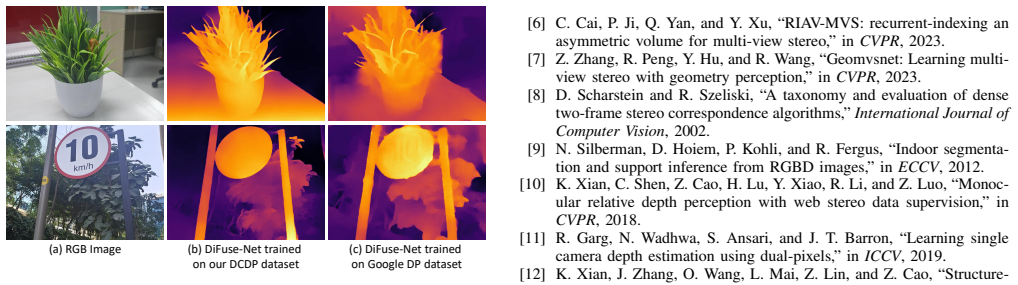
- [Section IV-C and Table IV] The DCDP ground-truth depth is generated by an undisclosed "AI stereo disparity estimation" model trained on a synthetic dataset [27], with manual masks used to exclude visually incorrect regions from the training loss. The paper does not name the model, specify its training details, quantify its accuracy on real 2.5 cm-baseline stereo images, or state whether the same masks are applied to the DCDP test set used in Table IV. Because a 2.5 cm baseline yields very small disparity magnitudes, a synthetic-trained stereo model can carry a systematic bias that dominates the relative inverse-depth error, so the DCDP metrics in Table IV and the boundary-quality claims in Fig. 12 are not currently interpretable. The authors should disclose the estimator, validate it against an independent depth source (e.g., structure-from-motion or an active sensor), and clarify the exact masking protocol for test labels.
- [Section VI-A and Table I] The DPNet baseline numbers are taken "from their official GitHub page" after the authors' "release of modified train and test datasets," but the modification is never described, and no version or date is cited. In addition, all quantitative results in Tables I, II, and IV appear to be single-run numbers with no error bars, multiple seeds, or statistical significance testing; the gap between DiFuse-Net (0.0799) and the Stereo Baseline (0.0911) on the Google DP dataset is small in absolute terms. The authors should specify the exact DPNet variant and dataset split, and they should report variance across at least three training runs or otherwise demonstrate that the reported ranking is robust.
- [Section III-F] The CmTL description is internally inconsistent: Stage 1 and Stage 2 train the decoder together with the DP and RGB encoders respectively, but Stage 3 states that "The Fusion module and the Decoder weights are initialized randomly." This discards the decoder knowledge learned in Stages 1 and 2, making the purpose of the decoder pretraining unclear and weakening the claimed transfer mechanism. The authors should either reinitialize only the fusion module, justify why the decoder pretraining is unnecessary, or redesign the stage description to match the actual implementation.
- [Section VI-A, Table I (Stereo Baseline)] The "Stereo Baseline" is introduced as replacing WBiPAM with a traditional stereo matching cost-volume approach using RAFT-Stereo [30], but the paper does not describe how this baseline is adapted to dual-pixel inputs. It is unspecified whether the DP left/right images are fed as a stereo pair, how the network is trained on the Google DP and DCDP data, whether the baseline sees the same training labels, and how the disparity range and vertical/horizontal orientation are handled. Without this information, the comparison against the Stereo Baseline in Tables I and IV cannot be reproduced or properly interpreted.
minor comments (5)
- [Section III-C] The window size k used in WBiPAM is never given a numerical value, nor is there an ablation over k; since k defines the parallax search range and the attention window, the authors should report the chosen value and its sensitivity.
- [Fig. 12 caption] The caption reads "DPNet trained (second)" while subfigures (b) and (c) are described as "DiFuse-Net trained on our DCDP dataset" and "DiFuse-Net trained on Google DP dataset"; the caption text appears to be a typo.
- [Fig. 6 caption] There is a typo: "captured in the begging of a capture session" should be "beginning."
- [Section III-F] The method name is "Cross-modal Transfer Learning" (CmTL), but Section III-F introduces it as "cross-model transfer learning"; the terminology should be made consistent.
- [Section V-C] The metrics AIWE 1 and AIWE 2 are used without being defined in the text; the authors should state the formulas or explicitly cite the definitions from [11].
Circularity Check
No significant circularity: DiFuse-Net is a supervised architecture validated on external ground truth; DCDP pseudo-ground-truth is a data-quality caveat, not a circular derivation.
full rationale
We walked the derivation chain and found no step where a prediction reduces by construction to a fitted input or a self-citation. The architecture (WBiPAM, fusion, CmTL) is defined from input features and losses that are independent of the evaluation metrics; ablations are compared on the external Google DP dataset (Tables I and II), so component contributions are empirically grounded rather than derived from the target quantity. CmTL uses external RGB-D datasets for initialization, not the test set. The DCDP ground-truth is generated by an AI stereo estimator trained on synthetic data (Section IV-C), which is a legitimate external-supervision source albeit one that makes DCDP-based claims dependent on pseudo-GT quality; this is a data-quality concern, not circularity, because the model's predictions are not defined in terms of those labels and no parameter fit is renamed as a prediction. The paper contains no load-bearing self-citations by the present authors. Accordingly, the central claims do not reduce to their inputs by definition or by construction, and the appropriate circularity score is 0.
Assumptions & free parameters
free parameters (4)
- lambda (loss weight) =
30
- initial learning rate =
1e-4
- window size k in WBiPAM
- DP encoder depth =
2 blocks
assumptions (4)
- domain assumption Smartphone DP disparity is limited to about -8 to +8 pixels along one epipolar axis and can be captured with a k x 1 window attention.
- domain assumption The AI stereo disparity model trained on synthetic data (Section IV-C) produces dense, accurate ground truth for real smartphone stereo pairs.
- domain assumption The scale-invariant MAE plus gradient loss (Eq. 3) is an appropriate surrogate for relative depth quality.
- domain assumption Stereo calibration and rectification errors are small enough that a 40-pixel border crop and sign-inverted distortion coefficients sufficiently align disparity maps with DP images.
Cite this review
Pith. "Pith review of DiFuse-Net: RGB and Dual-Pixel Depth Estimation using Window Bi-directional Parallax Attention and Cross-modal Transfer Learning." pith.science (2026). https://pith.science/paper/ZIU7TFPZ
@misc{pith2026250614709,
  author       = {Pith},
  title        = {Pith review of: DiFuse-Net: RGB and Dual-Pixel Depth Estimation using Window Bi-directional Parallax Attention and Cross-modal Transfer Learning},
  year         = {2026},
  howpublished = {\url{https://pith.science/paper/ZIU7TFPZ}},
  note         = {Machine review of arXiv:2506.14709}
}
read the original abstract
Depth estimation is crucial for intelligent systems, enabling applications from autonomous navigation to augmented reality. While traditional stereo and active depth sensors have limitations in cost, power, and robustness, dual-pixel (DP) technology, ubiquitous in modern cameras, offers a compelling alternative. This paper introduces DiFuse-Net, a novel modality decoupled network design for disentangled RGB and DP based depth estimation. DiFuse-Net features a window bi-directional parallax attention mechanism (WBiPAM) specifically designed to capture the subtle DP disparity cues unique to smartphone cameras with small aperture. A separate encoder extracts contextual information from the RGB image, and these features are fused to enhance depth prediction. We also propose a Cross-modal Transfer Learning (CmTL) mechanism to utilize large-scale RGB-D datasets in the literature to cope with the limitations of obtaining large-scale RGB-DP-D dataset. Our evaluation and comparison of the proposed method demonstrates its superiority over the DP and stereo-based baseline methods. Additionally, we contribute a new, high-quality, real-world RGB-DP-D training dataset, named Dual-Camera Dual-Pixel (DCDP) dataset, created using our novel symmetric stereo camera hardware setup, stereo calibration and rectification protocol, and AI stereo disparity estimation method.
Figures


Figures from the paper (6 more)


Reference graph
Works this paper leans on
-
[27]
N. Mayer, E. Ilg, P. H ¨ausser, P. Fischer, D. Cremers, A. Dosovitskiy, and T. Brox, “A large dataset to train convolutional networks for disparity, optical flow, and scene flow estimation,” in CVPR, 2016, pp. 4040–4048
work page 2016
-
[30]
Raft-stereo: Multilevel recurrent field transforms for stereo matching,
L. Lipson, Z. Teed, and J. Deng, “Raft-stereo: Multilevel recurrent field transforms for stereo matching,” in International Conference on 3D Vision 3DV, 2021, pp. 218–227
work page 2021
-
[1]
Vision meets robotics: The KITTI dataset,
A. Geiger, P. Lenz, C. Stiller, and R. Urtasun, “Vision meets robotics: The KITTI dataset,” Int. J. Robotics Res. , 2013
work page 2013
-
[2]
Virtual kitti 2,
Y . Cabon, N. Murray, and M. Humenberger, “Virtual kitti 2,” 2020
2020
-
[3]
Synthetic depth-of-field with a single-camera mobile phone,
N. Wadhwa, R. Garg, D. E. Jacobs, B. E. Feldman, N. Kanazawa, R. Carroll, Y . Movshovitz-Attias, J. T. Barron, Y . Pritch, and M. Levoy, “Synthetic depth-of-field with a single-camera mobile phone,” ACM Trans. Graph., 2018
work page 2018
-
[4]
Practical stereo matching via cascaded recurrent network with adaptive correlation,
J. Li, P. Wang, P. Xiong, T. Cai, Z. Yan, L. Yang, J. Liu, H. Fan, and S. Liu, “Practical stereo matching via cascaded recurrent network with adaptive correlation,” in CVPR, 2022
work page 2022
-
[5]
C. Luo, Y . Li, K. Lin, G. Chen, S. Lee, J. Choi, Y . F. Yoo, and M. O. Polley, “Wavelet synthesis net for disparity estimation to synthesize DSLR calibre bokeh effect on smartphones,” in CVPR, 2020
work page 2020
-
[6]
RIA V-MVS: recurrent-indexing an asymmetric volume for multi-view stereo,
C. Cai, P. Ji, Q. Yan, and Y . Xu, “RIA V-MVS: recurrent-indexing an asymmetric volume for multi-view stereo,” in CVPR, 2023
work page 2023
Show all 31 references
-
[7]
Geomvsnet: Learning multi- view stereo with geometry perception,
Z. Zhang, R. Peng, Y . Hu, and R. Wang, “Geomvsnet: Learning multi- view stereo with geometry perception,” in CVPR, 2023
2023
-
[8]
A taxonomy and evaluation of dense two-frame stereo correspondence algorithms,
D. Scharstein and R. Szeliski, “A taxonomy and evaluation of dense two-frame stereo correspondence algorithms,” International Journal of Computer Vision, 2002
2002
-
[9]
Indoor segmenta- tion and support inference from RGBD images,
N. Silberman, D. Hoiem, P. Kohli, and R. Fergus, “Indoor segmenta- tion and support inference from RGBD images,” in ECCV, 2012
2012
-
[10]
Monoc- ular relative depth perception with web stereo data supervision,
K. Xian, C. Shen, Z. Cao, H. Lu, Y . Xiao, R. Li, and Z. Luo, “Monoc- ular relative depth perception with web stereo data supervision,” in CVPR, 2018
2018
-
[11]
Learning single camera depth estimation using dual-pixels,
R. Garg, N. Wadhwa, S. Ansari, and J. T. Barron, “Learning single camera depth estimation using dual-pixels,” in ICCV, 2019
2019
-
[12]
Structure- guided ranking loss for single image depth prediction,
K. Xian, J. Zhang, O. Wang, L. Mai, Z. Lin, and Z. Cao, “Structure- guided ranking loss for single image depth prediction,” inCVPR, 2020
2020
-
[13]
Towards robust monocular depth estimation: Mixing datasets for zero-shot cross- dataset transfer,
K. Lasinger, R. Ranftl, K. Schindler, and V . Koltun, “Towards robust monocular depth estimation: Mixing datasets for zero-shot cross- dataset transfer,” IEEE Trans. Pattern Anal. Mach. Intell. , 2021
2021
-
[14]
Defocus deblurring using dual-pixel data,
A. Abuolaim and M. S. Brown, “Defocus deblurring using dual-pixel data,” in ECCV, 2020
2020
-
[15]
Hess, Blender Foundations: The Essential Guide to Learning Blender 2.6
R. Hess, Blender Foundations: The Essential Guide to Learning Blender 2.6. Focal Press, 2010
2010
-
[16]
Hypersim: A photorealistic synthetic dataset for holistic indoor scene understanding,
M. Roberts, J. Ramapuram, A. Ranjan, A. Kumar, M. ´A. Bautista, N. Paczan, R. Webb, and J. M. Susskind, “Hypersim: A photorealistic synthetic dataset for holistic indoor scene understanding,” in ICCV, 2021
2021
-
[17]
Du 2net: Learning depth estimation from dual-cameras and dual-pixels,
Y . Zhang, N. Wadhwa, S. Orts-Escolano, C. H ¨ane, S. R. Fanello, and R. Garg, “Du 2net: Learning depth estimation from dual-cameras and dual-pixels,” in ECCV, 2020
2020
-
[18]
Dual pixel exploration: Simultaneous depth estimation and image restoration,
L. Pan, S. Chowdhury, R. Hartley, M. Liu, H. Zhang, and H. Li, “Dual pixel exploration: Simultaneous depth estimation and image restoration,” in CVPR, 2021
2021
-
[19]
Modeling defocus-disparity in dual-pixel sensors,
A. Punnappurath, A. Abuolaim, M. Afifi, and M. S. Brown, “Modeling defocus-disparity in dual-pixel sensors,” in ICCP, 2020
2020
-
[20]
U-net: Convolutional networks for biomedical image segmentation,
O. Ronneberger, P. Fischer, and T. Brox, “U-net: Convolutional networks for biomedical image segmentation,” in MICCAI, 2015, pp. 234–241
2015
-
[21]
Efficientnet: Rethinking model scaling for convolutional neural networks,
M. Tan and Q. V . Le, “Efficientnet: Rethinking model scaling for convolutional neural networks,” in ICML. PMLR, 2019, pp. 6105– 6114
2019
-
[22]
Imagenet: A large-scale hierarchical image database,
J. Deng, W. Dong, R. Socher, L. Li, K. Li, and L. Fei-Fei, “Imagenet: A large-scale hierarchical image database,” in CVPR, 2009, pp. 248– 255
2009
-
[23]
Mobilenetv2: Inverted residuals and linear bottlenecks,
M. Sandler, A. G. Howard, M. Zhu, A. Zhmoginov, and L. Chen, “Mobilenetv2: Inverted residuals and linear bottlenecks,” in CVPR, 2018, pp. 4510–4520
2018
-
[24]
Parallax attention for unsupervised stereo correspondence learning,
L. Wang, Y . Guo, Y . Wang, Z. Liang, Z. Lin, J. Yang, and W. An, “Parallax attention for unsupervised stereo correspondence learning,” IEEE Trans. Pattern Anal. Mach. Intell., vol. 44, no. 4, pp. 2108–2125, 2022
2022
-
[25]
Megadepth: Learning single-view depth pre- diction from internet photos,
Z. Li and N. Snavely, “Megadepth: Learning single-view depth pre- diction from internet photos,” in CVPR, 2018
2018
-
[26]
Delving deep into rectifiers: Surpassing human-level performance on imagenet classification,
K. He, X. Zhang, S. Ren, and J. Sun, “Delving deep into rectifiers: Surpassing human-level performance on imagenet classification,” in ICCV, 2015, pp. 1026–1034
2015
-
[28]
Pytorch: An imperative style, high- performance deep learning library,
A. Paszke, S. Gross, F. Massa, A. Lerer, J. Bradbury, G. Chanan, T. Killeen, Z. Lin, N. Gimelshein, L. Antiga, A. Desmaison, A. Kopf, E. Yang, Z. DeVito, M. Raison, A. Tejani, S. Chilamkurthy, B. Steiner, L. Fang, J. Bai, and S. Chintala, “Pytorch: An imperative style, high- p...
2019
-
[29]
Adam: A method for stochastic optimiza- tion,
D. P. Kingma and J. Ba, “Adam: A method for stochastic optimiza- tion,” in ICLR, 2015
2015
-
[31]
Zoedepth: Zero-shot transfer by combining relative and metric depth,
S. F. Bhat, R. Birkl, D. Wofk, P. Wonka, and M. M ¨uller, “Zoedepth: Zero-shot transfer by combining relative and metric depth,” CoRR, vol. abs/2302.12288, 2023
2023 arXiv
Reviewed August 15, 2026 · model on record in the stance chip above.
Discussion (0). Continue with ORCID to comment.