REVIEW 3 major objections 5 minor 56 references
OLALa: Online Learned Adaptive Lattice Codes for Heterogeneous Federated Learning
T0 review · 3 major / 5 minor · reviewed 2026-08-06 · deepseek-v4-flash
Pith's one-line read OLALa shows per-client time-varying lattice quantizers preserve FedAvg's O(1/T) convergence and beat fixed quantizers in FL experiments.
desk verdict OLALa is a sensible adaptive-lattice FL scheme with solid-looking experiments, but its convergence theorem does not cover the implemented algorithm—there is a scaling mismatch in the proof and a deliberate violation of the no-overload assumption. read the letter →
The pith
A machine-rendered reading of the paper's core claim, the machinery that carries it, and where it could break.
The reading
What carries the argument
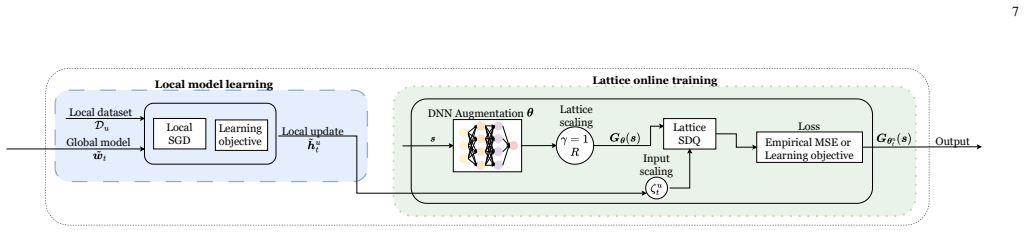
The load-bearing object is the dithered lattice quantizer Q_SDQ with generator matrix G_t^u and support radius gamma; under the no-overload assumption, its distortion is white noise uniformly distributed over the basic lattice cell with variance $sigma^{2}$_SDQ(L_gamma(G)). The enabler for online learning is the exact reformulation Q_L(G)(x) = G * argmin_{l in I_L(G)} ||x - G l||, whose linear dependence on G gives an approximate gradient for training the generator, combined with a DNN augmentation (fixed input, output reshaped to G) that stabilizes learning and keeps the communicated metadata compact. The scale factor zeta controls the trade-off between avoiding overloading and reducing distortion, and the two candidate losses (empirical MSE and task-based learning objective) drive the adaptation.
What would settle it
Run OLALa on MNIST-CNN with overloading thresholds of 1%, 5%, and 10% and record E[F(w_T)] - F(w*) against T; if the empirical convergence rate visibly slows below O(1/T) or the quantization error becomes input-dependent once overloading exceeds a small fraction, the assumption behind Theorem III.2 fails.
Extended reading notes
Core claim
The central claim is that adaptive, client-specific lattice quantizers are not only feasible in federated learning but beneficial: the convergence rate of FedAvg is preserved at O(1/T) even when every user changes its lattice every round, and the non-asymptotic convergence bound is minimized by letting lattices vary per user and per round (Theorem III.3). This generalizes the fixed-lattice FL convergence result [19] to time-varying, user-dependent generator matrices by bounding the aggregated quantization noise with the average SDQ distortion (Theorem III.1). The method then realizes this adaptivity by learning the generator matrix through a small DNN with a fixed input, using an exact reformulation of lattice quantization that supports gradient-based online training, and by scaling updates with a factor zeta to keep overloading small. Empirically, OLALa consistently outperforms fixed and statically learned lattice quantizers in both final accuracy and convergence speed.
Load-bearing premise
The analysis assumes every client's lattice is never overloaded in any round (AS3), yet OLALa deliberately permits small overloading by scaling updates; if overloading becomes non-negligible, the white-noise distortion model and the O(1/T) convergence guarantee are no longer proven.
Editorial extensions
If this is right
- Federated training keeps its O(1/T) convergence rate even when every user switches its lattice every round, so personalizing compression does not cost asymptotic performance.
- The non-asymptotic convergence bound contains the average SDQ distortion, so any scheme that lowers per-user lattice distortion tightens the finite-time guarantee.
- Because the generator matrix is rate-independent and small (L by L), communicating per-round quantizer metadata is negligible relative to the model updates themselves.
- Permitting small, controlled overloading (around 0.5% to 1%) gives better accuracy than strictly avoiding it, which is why OLALa scales updates by zeta rather than forcing no overload.
Reading between the lines
- Editorial inference: the same differentiable-lattice recipe could be dropped into other distributed optimization loops, such as sparsified or periodic-averaging FL, as long as the shared dither and approximate no-overload regime are maintained.
- Editorial inference: because the theory only requires the distortion terms B_t to be bounded, one could try to learn lattices by directly minimizing the convergence bound rather than local MSE; the paper's task-based loss already moves in that direction.
- Editorial inference: a testable extension is to let the dither distribution itself adapt along with the lattice; the authors list it as future work, and the white-noise property would then need to be re-derived.
Editorial analysis
A structured set of objections, weighed in public.
Referee Report
Summary. The paper proposes OLALa, a federated learning compression scheme in which each client learns a lattice generator matrix online and transmits quantized model updates together with compact lattice metadata. The authors state convergence guarantees for FL with time-varying, client-specific lattice quantizers (Theorems III.1-III.3), argue that per-client adaptation can tighten the convergence bound, and support the method with experiments on MNIST and CIFAR-10 against fixed and statically learned lattice baselines. The central theoretical claim is that OLALa preserves the O(1/T) convergence rate of FedAvg.
Significance. The idea of replacing a single fixed lattice with online-learned, per-client lattices is natural, and the experimental comparison is useful: the code is provided, the baselines are external, and OLALa consistently improves accuracy over fixed alternatives, e.g., 93.00% versus 90.36% for Fixed-Hexagon at R=3 on MNIST-CNN (Table III). However, the theoretical analysis is not currently connected to the algorithm actually evaluated. The proof quantizes gradients, while the algorithm quantizes step-size-scaled updates, and the algorithm deliberately permits overloading while Assumption AS3 forbids it. These are load-bearing gaps, so the paper's central theoretical claim requires substantial revision before the guarantees can be accepted.
major comments (3)
- [Section III-B and Appendix C (Eq. (A.3), Lemma C.1)] The proof does not match Algorithm 1. Algorithm 1 and Section III-B take the local update as \tilde h_t^u = -\eta_t \nabla F_u(\tilde w_t, i_t^u) and the server aggregates Q^{SDQ}_{L}(\tilde h_t^u) in Eq. (11). However, \widehat{g}^{SDQ}_t in Eq. (A.3) is defined as (1/U) \sum_u Q^{SDQ}_{L}(\nabla F_u(\tilde w_t, i_t^u)), and Lemma C.1 uses \tilde w_{t+1} = \tilde w_t - \eta_t \widehat{g}^{SDQ}_t. This equality requires Q^{SDQ}_{L}(\eta_t v) = \eta_t Q^{SDQ}_{L}(v), which is false for a fixed dithered lattice quantizer because the nearest-neighbor mapping is not homogeneous under scaling of the input unless the lattice and dither are correspondingly rescaled. Until \eta_t is absorbed into the lattice and dither scaling (or the theorem is restated for the actually quantized, step-size-scaled update), Theorem III.2 does not establish convergence of Algorithm 1 as written.
- [Section III-C and Table II] The convergence analysis relies on AS3, which requires that the quantizer is never overloaded for every user and round. OLALa deliberately violates AS3: the text in Section III-C states that the design allows some level of overloading, Algorithm 2 uses the scaling parameter \zeta_t^u to keep overloading below 1%, and Table II evaluates overloading thresholds of 0%, 0.5%, 1%, 10%, and 50%, with 0% overloading reported as harmful. When overloading occurs, Theorem II.3's white-noise distortion model and the unbiasedness identity (A.5) fail, so the distortion bound (12) and the O(1/T) bound (14) do not apply to the scheme evaluated in Section IV. The manuscript itself notes in Section III-C that the overloaded regime has no tractable characterization, which confirms that the current proof cannot cover the implemented algorithm.
- [Theorem III.3 and Appendix D (Eq. (16), Eq. (D.5))] The displayed equality in Theorem III.3 is not a valid mathematical statement: an argmin over generator matrices cannot equal a scalar multiple of an argmin over unit-volume shape matrices. The proof instead yields min_G \sigma^2_{SDQ}(L_\gamma(G)) = \gamma^2 \min_A G(A)/(r_A(R))^2, with the minimizing generator given by (\gamma / r_{A_\star}(R)) A_\star when A_\star minimizes G(A)/(r_A(R))^2. As written, Eq. (16) conflates the minimum value with the minimizing matrix and should be corrected, with the dependence of r_A on A made explicit.
minor comments (5)
- [Section IV-B, Table II] The table caption says the '-1' heuristic allows at most 0.05% overloading, while the text states 0.3%; these numbers should be reconciled.
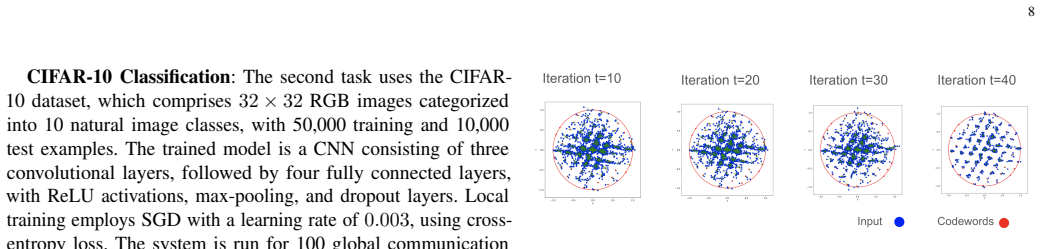
- [Section IV-C, Figs. 7-8] The captions of Figs. 7 and 8 state R=3, but the text says CIFAR-10 was evaluated at R=5 bits per weight; the captions and text should be harmonized.
- [Theorem III.2 and Appendix C] The parameter \nu is defined as \max\{8\kappa, 1\} in the theorem statement, while the proof chooses \nu+1 = \max\{8L/\mu, 1\}; Eq. (14) uses \nu+T-1 while the proof derives a denominator \nu+t. These definitions should be made consistent.
- [Appendix introduction] There is a typo, 'the low of total expectation', which should read 'the law of total expectation'.
- [Section III-B, final paragraph] 'systemically showcased' should be 'systematically showcased'.
Circularity Check
No material circularity: the empirical contribution is benchmarked against external fixed-lattice baselines, and the convergence proof is an independent adaptation of [43]; the main weaknesses (eta-scaling commutation and AS3 overloading) are proof/correctness gaps, not input-output circularity.
full rationale
The central empirical claim that OLALa outperforms fixed and statically learned lattice quantizers is tested against external baselines (hexagonal, A2, D2 lattices and non-compressed FL), so no fitted parameter is renamed as a prediction. The convergence analysis is self-contained in that Theorem III.2 is proved by the induction of [43, Thm. 1]; [19] is cited only as the fixed-lattice result being generalized and is not load-bearing. Self-citations [1], [32], [34] are background for the lattice-learning machinery and privacy/compression variants, not for the central derivation. The statement that adaptive lattices can tighten the convergence bound (Theorem III.3) is tautological: B_t in (15) contains sigma^2_SDQ of the chosen lattices, so choosing smaller distortion lowers the bound by construction. However, this is a conditional statement about the bound, not a prediction about test accuracy, and the experiments establish the latter independently. Two proof gaps are flagged but are not circularity: (i) Section III-B sets the update as -eta_t times the gradient, while Appendix A.3 defines bgSDQ_t using QSDQ of the un-scaled gradient, and Lemma C.1 writes the one-step recursion as if QSDQ(eta*grad) = eta*QSDQ(grad), which is false for a fixed dithered lattice; (ii) AS3 requires zero overloading, whereas OLALa deliberately permits about 0.5% overloading via the zeta scaling in Section III-C and Table II. These gaps undermine the theorem's applicability to Algorithm 1 as written, but they do not make the derivation equivalent to its own inputs.
Assumptions & free parameters
free parameters (3)
- Overloading threshold =
0.5% default; heuristic -1 uses 0.3% and 3x standard deviation
- Scaling parameter zeta_t^u =
Not fixed; set per user per round to achieve target overloading within radius gamma=1
- DNN fixed input s =
Arbitrary vector
assumptions (5)
- domain assumption AS1: local datasets are i.i.d. within each user but heterogeneous across users
- domain assumption AS2: stochastic gradient variance is bounded by sigma_u^2 per user
- ad hoc to paper AS3: each lattice quantizer is never overloaded for every user and round
- domain assumption AS4: local objectives are L-smooth and mu-strongly convex
- ad hoc to paper Metadata (generator matrix and scaling) is transmitted at negligible cost
Cite this review
Pith. "Pith review of OLALa: Online Learned Adaptive Lattice Codes for Heterogeneous Federated Learning." pith.science (2026). https://pith.science/paper/PIMARESG
@misc{pith2026250620297,
  author       = {Pith},
  title        = {Pith review of: OLALa: Online Learned Adaptive Lattice Codes for Heterogeneous Federated Learning},
  year         = {2026},
  howpublished = {\url{https://pith.science/paper/PIMARESG}},
  note         = {Machine review of arXiv:2506.20297}
}
read the original abstract
Federated learning (FL) enables collaborative training across distributed clients without sharing raw data, often at the cost of substantial communication overhead induced by transmitting high-dimensional model updates. This overhead can be alleviated by having the clients quantize their model updates, with dithered lattice quantizers identified as an attractive scheme due to its structural simplicity and convergence-preserving properties. However, existing lattice-based FL schemes typically rely on a fixed quantization rule, which is suboptimal in heterogeneous and dynamic environments where the model updates distribution varies across users and training rounds. In this work, we propose Online Learned Adaptive Lattices (OLALa), a heterogeneous FL framework where each client can adjust its quantizer online using lightweight local computations. We first derive convergence guarantees for FL with non-fixed lattice quantizers and show that proper lattice adaptation can tighten the convergence bound. Then, we design an online learning algorithm that enables clients to tune their quantizers throughout the FL process while exchanging only a compact set of quantization parameters. Numerical experiments demonstrate that OLALa consistently improves learning performance under various quantization rates, outperforming conventional fixed-codebook and non-adaptive schemes.
Figures

Figures from the paper (3 more)


Reference graph
Works this paper leans on
-
[1]
Data-driven lattices for vector quantization,
N. Lang, I. Assaf, O. Bokobza, and N. Shlezinger, “Data-driven lattices for vector quantization,” in IEEE International Conference on Acoustics, Speech and Signal Processing (ICASSP) , 2024, pp. 8080–8084
work page 2024
-
[2]
Communication-efficient learning of deep networks from decentralized data,
B. McMahan, E. Moore, D. Ramage, S. Hampson, and B. A. y Arcas, “Communication-efficient learning of deep networks from decentralized data,” in Artificial Intelligence and Statistics. PMLR, 2017, pp. 1273–1282
work page 2017
-
[3]
S. AbdulRahman et al. , “A survey on federated learning: The journey from centralized to distributed on-site learning and beyond,” IEEE Internet Things J., vol. 8, no. 7, pp. 5476–5497, 2020
work page 2020
-
[4]
A survey on federated learning: challenges and applications,
J. Wen et al., “A survey on federated learning: challenges and applications,” International Journal of Machine Learning and Cybernetics , vol. 14, no. 2, pp. 513–535, 2023
work page 2023
-
[5]
Advances and open problems in federated learning,
P. Kairouz et al., “Advances and open problems in federated learning,” Foun- dations and trends® in machine learning, vol. 14, no. 1–2, pp. 1–210, 2021. 13
work page 2021
-
[6]
Federated learning: A signal processing perspective,
T. Gafni, N. Shlezinger, K. Cohen, Y . C. Eldar, and H. V . Poor, “Federated learning: A signal processing perspective,” IEEE Signal Process. Mag. , vol. 39, no. 3, pp. 14–41, 2022
work page 2022
-
[7]
Communication-efficient federated learning,
M. Chen, N. Shlezinger, H. V . Poor, Y . C. Eldar, and S. Cui, “Communication-efficient federated learning,” Proceedings of the National Academy of Sciences , vol. 118, no. 17, p. e2024789118, 2021
work page 2021
-
[8]
PAUSE: Privacy- aware active user selection for federated learning,
O. Peleg, N. Lang, S. Rini, N. Shlezinger, and K. Cohen, “PAUSE: Privacy- aware active user selection for federated learning,” in IEEE International Conference on Acoustics, Speech and Signal Processing (ICASSP) , 2025
work page 2025
Show all 56 references
-
[9]
Adaptive gradient sparsification for efficient federated learning: An online learning approach,
P. Han, S. Wang, and K. K. Leung, “Adaptive gradient sparsification for efficient federated learning: An online learning approach,” in IEEE Interna- tional Conference on Distributed Computing Systems , 2020, pp. 300–310
2020
-
[10]
Sparse communication for distributed gradient descent,
A. Aji and K. Heafield, “Sparse communication for distributed gradient descent,” in Conference on Empirical Methods in Natural Language Process- ing. Association for Computational Linguistics (ACL), 2017, pp. 440–445
2017
-
[11]
The convergence of sparsified gradient methods,
D. Alistarh et al. , “The convergence of sparsified gradient methods,” Advances in Neural Information Processing Systems , vol. 31, 2018
2018
-
[12]
Machine learning at the wireless edge: Distributed stochastic gradient descent over-the-air,
M. M. Amiri and D. G ¨und¨uz, “Machine learning at the wireless edge: Distributed stochastic gradient descent over-the-air,” IEEE Trans. Signal Process., vol. 68, pp. 2155–2169, 2020
2020
-
[13]
Over-the-air federated learning from heterogeneous data,
T. Sery, N. Shlezinger, K. Cohen, and Y . C. Eldar, “Over-the-air federated learning from heterogeneous data,” IEEE Trans. Signal Process. , vol. 69, pp. 3796–3811, 2021
2021
-
[14]
Federated learning via over-the-air computation,
K. Yang, T. Jiang, Y . Shi, and Z. Ding, “Federated learning via over-the-air computation,” IEEE Trans. Wireless Commun. , vol. 19, no. 3, pp. 2022–2035, 2020
2022
-
[15]
Learned parameter compression for efficient and privacy-preserving federated learning,
Y . Chen, L. Abrahamyan, H. Sahli, and N. Deligiannis, “Learned parameter compression for efficient and privacy-preserving federated learning,” IEEE Open Journal of the Communications Society , vol. 5, pp. 3506–3516, 2024
2024
-
[16]
QSGD: Communication-efficient SGD via gradient quantization and encoding,
D. Alistarh, D. Grubic, J. Li, R. Tomioka, and M. V ojnovic, “QSGD: Communication-efficient SGD via gradient quantization and encoding,” Advances in Neural Information Processing Systems , vol. 30, pp. 1709–1720, 2017
2017
-
[17]
Fedpaq: A communication-efficient federated learning method with periodic averaging and quantization,
A. Reisizadeh, A. Mokhtari, H. Hassani, A. Jadbabaie, and R. Pedarsani, “Fedpaq: A communication-efficient federated learning method with periodic averaging and quantization,” in International Conference on Artificial Intelligence and Statistics . PMLR, 2020, pp. 2021–2031
2020
-
[18]
signSGD: Compressed optimisation for non-convex problems,
J. Bernstein, Y .-X. Wang, K. Azizzadenesheli, and A. Anandkumar, “signSGD: Compressed optimisation for non-convex problems,” in Inter- national Conference on Machine Learning . PMLR, 2018, pp. 560–569
2018
-
[19]
UVeQFed: Universal vector quantization for federated learning,
N. Shlezinger, M. Chen, Y . C. Eldar, H. V . Poor, and S. Cui, “UVeQFed: Universal vector quantization for federated learning,” IEEE Trans. Signal Process., vol. 69, pp. 500–514, 2020
2020
-
[20]
Natural compression for distributed deep learning,
S. Horv ´oth et al., “Natural compression for distributed deep learning,” in Mathematical and Scientific Machine Learning. PMLR, 2022, pp. 129–141
2022
-
[21]
Quantized federated learning under transmission delay and outage constraints,
Y . Wang, Y . Xu, Q. Shi, and T.-H. Chang, “Quantized federated learning under transmission delay and outage constraints,” IEEE J. Sel. Areas Commun., vol. 40, no. 1, pp. 323–341, 2021
2021
-
[22]
Quantization,
R. M. Gray and D. L. Neuhoff, “Quantization,” IEEE Trans. Inf. Theory , vol. 44, no. 6, pp. 2325–2383, 1998
1998
-
[23]
An algorithm for vector quantizer design,
Y . Linde, A. Buzo, and R. Gray, “An algorithm for vector quantizer design,” IEEE Trans. Commun. , vol. 28, no. 1, pp. 84–95, 1980
1980
-
[24]
Learning vector quantization,
T. Kohonen, “Learning vector quantization,” Self-organizing maps, pp. 245–261, 2001
2001
-
[25]
Neural discrete representation learning,
A. Van Den Oord and O. Vinyals, “Neural discrete representation learning,” Advances in Neural Information Processing Systems , vol. 30, 2017
2017
-
[26]
Remote inference over dynamic links via adaptive rate deep task-oriented vector quantization,
E. Fishel, M. Malka, S. Ginzach, and N. Shlezinger, “Remote inference over dynamic links via adaptive rate deep task-oriented vector quantization,” arXiv preprint arXiv:2501.02521 , 2025
2025 arXiv
-
[27]
Hardware-limited task-based quantization,
N. Shlezinger, Y . C. Eldar, and M. R. Rodrigues, “Hardware-limited task-based quantization,” IEEE Trans. Signal Process. , vol. 67, no. 20, pp. 5223–5238, 2019
2019
-
[28]
Lecture notes on information theory,
Y . Polyanskiy and Y . Wu, “Lecture notes on information theory,” Lecture Notes for 6.441 (MIT), ECE563 (University of Illinois Urbana-Champaign), and STAT 664 (Yale), 2012-2017
2012
-
[29]
Dithered quantizers,
R. M. Gray and T. G. Stockham, “Dithered quantizers,” IEEE Trans. Inf. Theory, vol. 39, no. 3, pp. 805–812, 1993
1993
-
[30]
Quantization and dither: A theoretical survey,
S. P. Lipshitz, R. A. Wannamaker, and J. Vanderkooy, “Quantization and dither: A theoretical survey,” Journal of the audio engineering society , vol. 40, no. 5, pp. 355–375, 1992
1992
-
[31]
On universal quantization by randomized uniform/lattice quantizers,
R. Zamir and M. Feder, “On universal quantization by randomized uniform/lattice quantizers,” IEEE Trans. Inf. Theory , vol. 38, no. 2, pp. 428–436, 1992
1992
-
[32]
Joint privacy enhancement and quantization in federated learning,
N. Lang, E. Sofer, T. Shaked, and N. Shlezinger, “Joint privacy enhancement and quantization in federated learning,” IEEE Trans. Signal Process., vol. 71, pp. 295–310, 2023
2023
-
[33]
Communication-efficient Laplace mechanism for differential privacy via random quantization,
A. M. Shahmiri, C. W. Ling, and C. T. Li, “Communication-efficient Laplace mechanism for differential privacy via random quantization,” in IEEE International Conference on Acoustics, Speech and Signal Processing (ICASSP), 2024, pp. 4550–4554
2024
-
[34]
Compressed private aggregation for scalable and robust federated learning over massive networks,
N. Lang, N. Shlezinger, R. G. D’Oliveira, and S. E. Rouayheb, “Compressed private aggregation for scalable and robust federated learning over massive networks,” IEEE Trans. Mobile Comput. , 2025, early access
2025
-
[35]
On lattice quantization noise,
R. Zamir and M. Feder, “On lattice quantization noise,” IEEE Trans. Inf. Theory, vol. 42, no. 4, pp. 1152–1159, 1996
1996
-
[36]
Asymptotically optimal block quantization,
A. Gersho, “Asymptotically optimal block quantization,” IEEE Trans. Inf. Theory, vol. 25, no. 4, pp. 373–380, 1979
1979
-
[37]
Better lattice quantizers constructed from complex integers,
S. Lyu, Z. Wang, C. Ling, and H. Chen, “Better lattice quantizers constructed from complex integers,” IEEE Trans. Commun. , vol. 70, no. 12, pp. 7932–7940, 2022
2022
-
[38]
On the best lattice quantizers,
E. Agrell and B. Allen, “On the best lattice quantizers,” IEEE Trans. Inf. Theory, vol. 69, no. 12, pp. 7650–7658, 2023
2023
-
[39]
Optimization of lattices for quantization,
E. Agrell and T. Eriksson, “Optimization of lattices for quantization,” IEEE Trans. Inf. Theory , vol. 44, no. 5, pp. 1814–1828, 1998
1998
-
[40]
Optimization and identification of lattice quantizers,
E. Agrell, D. Pook-Kolb, and B. Allen, “Optimization and identification of lattice quantizers,” IEEE Trans. Inf. Theory , 2025, early access
2025
-
[41]
Discriminative and generative learning for linear estimation of random signals [lecture notes],
N. Shlezinger and T. Routtenberg, “Discriminative and generative learning for linear estimation of random signals [lecture notes],” IEEE Signal Process. Mag., vol. 40, no. 6, pp. 75–82, 2023
2023
-
[42]
Heterogeneous federated learning: State-of-the-art and research challenges,
M. Ye, X. Fang, B. Du, P. C. Yuen, and D. Tao, “Heterogeneous federated learning: State-of-the-art and research challenges,” ACM Computing Surveys, vol. 56, no. 3, pp. 1–44, 2023
2023
-
[43]
On the convergence of fedavg on non-iid data,
X. Li, K. Huang, W. Yang, S. Wang, and Z. Zhang, “On the convergence of fedavg on non-iid data,” in International conference on learning representations (ICLR), 2020
2020
-
[44]
Model-based deep learning: On the intersection of deep learning and optimization,
N. Shlezinger, Y . C. Eldar, and S. P. Boyd, “Model-based deep learning: On the intersection of deep learning and optimization,” IEEE Access , vol. 10, pp. 115 384–115 398, 2022
2022
-
[45]
Deep image prior,
D. Ulyanov, A. Vedaldi, and V . Lempitsky, “Deep image prior,” in IEEE Conference on Computer Vision and Pattern Recognition , 2018, pp. 9446–9454
2018
-
[46]
Local SGD converges fast and communicates little,
S. U. Stich, “Local SGD converges fast and communicates little,” in International Conference on Learning Representations , 2019
2019
-
[47]
Vector quantization,
R. Gray, “Vector quantization,” IEEE ASSP Mag. , vol. 1, no. 2, pp. 4–29, 1984
1984
-
[48]
Closest point search in lattices,
E. Agrell, T. Eriksson, A. Vardy, and K. Zeger, “Closest point search in lattices,” IEEE Trans. Inf. Theory , vol. 48, no. 8, pp. 2201–2214, 2002
2002
-
[49]
The communication-aware clustered federated learning problem,
N. Shlezinger, S. Rini, and Y . C. Eldar, “The communication-aware clustered federated learning problem,” in IEEE International Symposium on Information Theory (ISIT) , 2020, pp. 2610–2615
2020
-
[50]
Communication-efficient algorithms for statistical optimization,
Y . Zhang, M. J. Wainwright, and J. C. Duchi, “Communication-efficient algorithms for statistical optimization,” Advances in Neural Information Processing Systems, vol. 25, 2012
2012
-
[51]
Stragglers-aware low-latency synchronous federated learning via layer-wise model updates,
N. Lang, A. Cohen, and N. Shlezinger, “Stragglers-aware low-latency synchronous federated learning via layer-wise model updates,” IEEE Trans. Commun., vol. 73, no. 5, pp. 3333–3346, 2025
2025
-
[52]
Straightening out the straight-through estimator: Overcoming optimization challenges in vector quantized networks,
M. Huh, B. Cheung, P. Agrawal, and P. Isola, “Straightening out the straight-through estimator: Overcoming optimization challenges in vector quantized networks,” in International Conference on Machine Learning . PMLR, 2023, pp. 14 096–14 113
2023
-
[53]
Deep task-based analog-to-digital conversion,
N. Shlezinger, A. Amar, B. Luijten, R. J. Van Sloun, and Y . C. Eldar, “Deep task-based analog-to-digital conversion,” IEEE Trans. Signal Process., vol. 70, pp. 6021–6034, 2022
2022
-
[54]
Learning task-based trainable neuromorphic ADCs via power-aware distillation,
T. V ol, L. Danial, and N. Shlezinger, “Learning task-based trainable neuromorphic ADCs via power-aware distillation,” IEEE Trans. Signal Process., vol. 73, pp. 1246–1261, 2025
2025
-
[55]
Entropy-constrained vector quantization,
P. A. Chou, T. Lookabaugh, and R. M. Gray, “Entropy-constrained vector quantization,” IEEE Trans. Acoust., Speech, Signal Process. , vol. 37, no. 1, pp. 31–42, 1989
1989
-
[56]
A catalogue of lattices
G. Nebe and N. Sloane, “A catalogue of lattices.” [Online]. Available: https://www.math.rwth-aachen.de/homes/Gabriele.Nebe/LATTICES/
Reviewed August 6, 2026 · model on record in the stance chip above.
Discussion (0). Sign in to comment.