Investigating New Physics through the Observables of Semileptonic B_(s)to K^(ast)(to K π)μ⁺μ⁻ Decay
Pith reviewed 2026-05-19 08:02 UTC · model grok-4.3
The pith
Modifications to Wilson coefficients for the b to d mu mu transition produce deviations from Standard Model predictions in multiple observables of the Bs to K* mu+ mu- decay.
A machine-rendered reading of the paper's core claim, the machinery that carries it, and where it could break.
Core claim
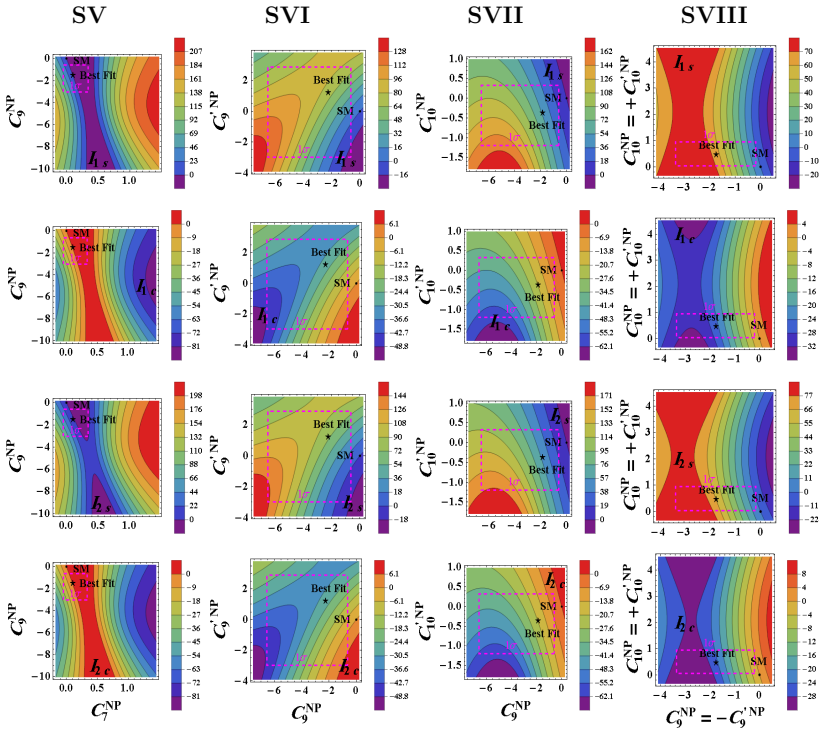
In the one-dimensional and two-dimensional scenarios where new physics modifies the Wilson coefficients C7^NP, C9^(prime)NP, and C10^(prime)NP, the full set of observables including branching ratio, forward-backward asymmetry, polarization fractions, and angular coefficients I_i exhibit clear deviations from their Standard Model values over the accessible q^2 range.
What carries the argument
Weak effective field theory description of the b to d mu+ mu- transition, with new physics introduced exclusively through selected Wilson coefficients.
If this is right
- Two-dimensional contour plots of pairs of observables can further restrict the allowed ranges for new-physics Wilson coefficients.
- The decay provides a complementary channel to other b to s and b to d processes for testing the Standard Model.
- Correlations among angular coefficients offer additional handles for distinguishing among possible new-physics scenarios.
- Updated experimental data on these quantities can tighten bounds on the size of the new-physics contributions.
Where Pith is reading between the lines
- The same framework could be applied to related decays such as Bd to K* mu+ mu- to test whether the same coefficient shifts appear consistently.
- The observed deviations could be confronted with explicit ultraviolet models that generate the required operator modifications.
- Precision measurements at upcoming runs of LHCb or Belle II could confirm or exclude the specific 1D and 2D scenarios examined.
Load-bearing premise
New physics affects the decay only by changing the values of C7^NP, C9 prime NP, and C10 prime NP while all Standard Model inputs and hadronic form factors remain exactly as predicted.
What would settle it
Future high-precision measurements that agree with Standard Model predictions for every listed observable across the full q^2 interval, within experimental errors, would rule out the new-physics contributions considered here.
Figures



read the original abstract
The rare four-fold decay $B_s \to K^*(\to K\pi)\mu^+\mu^- $, governed by the flavor-changing neutral current transition $b \to d\mu^+\mu^-$, provides a sensitive probe for testing the Standard Model (SM) and investigating signatures of new physics (NP). This work presents a comprehensive model-independent analysis of the decay using the framework of the weak effective field theory. We compute a set of key physical observables, including the differential branching ratio, forward-backward asymmetry, longitudinal polarization fraction, and several normalized angular coefficients $\langle I_i\rangle$, as a function of the dilepton invariant mass squared $q^2$. The impact of NP is explored via both one-dimensional (1D) and two-dimensional (2D) scenarios involving NP Wilson coefficients $C_7^{\text{NP}}$, $C_9^{(\prime)\text{NP}}$, and $C_{10}^{(\prime)\text{NP}}$. Our findings reveal notable deviations from the SM predictions across multiple observables. Furthermore, we analyze the correlations between different observables and their 2D contour plots which would be useful to further constrain the parametric space of possible NP contributions. This study reinforces the potential of $B_s \to K^* \mu^+ \mu^-$ decay as a complementary channel in the search for physics beyond the SM.
Editorial analysis
A structured set of objections, weighed in public.
Referee Report
Summary. The manuscript performs a model-independent analysis of the rare decay Bs → K*(→Kπ)μ+μ− in the weak effective field theory framework. It computes observables including the differential branching ratio, forward-backward asymmetry, longitudinal polarization fraction, and normalized angular coefficients ⟨Ii⟩ as functions of q². New physics is explored by varying the Wilson coefficients C7^NP, C9^(′)NP, and C10^(′)NP in one- and two-dimensional scenarios, with reported notable deviations from SM predictions and analysis of correlations via 2D contour plots.
Significance. If the deviations remain after proper treatment of hadronic uncertainties, the work would provide useful complementary constraints on new physics in the less-explored b→dμ+μ− transition. The explicit computation of multiple angular observables and their correlations, including 2D contours, is a constructive element that can inform future experimental analyses.
major comments (2)
- [Abstract] Abstract: the central claim that 'our findings reveal notable deviations from the SM predictions across multiple observables' provides no quantitative information on the size of the deviations, their statistical significance, error bars, or the precise SM baseline and experimental inputs used for comparison. This omission is load-bearing for evaluating the result.
- [Methodology and results sections] Methodology and results sections: the analysis fixes hadronic form factors to SM values with no uncertainty propagation shown (standard 10–20% errors are typical). Because the separation between NP-modified observables and SM predictions relies on this assumption, the lack of variation or propagation undermines the robustness of the reported deviations.
minor comments (2)
- [Notation] Notation for the primed Wilson coefficients (C9^(′)NP etc.) should be defined once and used consistently in all 1D/2D scenario descriptions.
- [Figures] The 2D contour plots would benefit from explicit marking of the SM point (C_i^NP=0) and indication of the confidence level contours.
Simulated Author's Rebuttal
We thank the referee for the careful reading and constructive comments on our manuscript. We address the major comments point by point below, indicating where revisions will be incorporated.
read point-by-point responses
-
Referee: [Abstract] Abstract: the central claim that 'our findings reveal notable deviations from the SM predictions across multiple observables' provides no quantitative information on the size of the deviations, their statistical significance, error bars, or the precise SM baseline and experimental inputs used for comparison. This omission is load-bearing for evaluating the result.
Authors: We agree that the abstract would benefit from additional quantitative context. In the revised manuscript we will update the abstract to include specific information on the magnitude of deviations (e.g., relative differences from SM predictions for the differential branching ratio and selected angular coefficients) together with a brief reference to the SM baseline and form-factor inputs employed. This change will be made while preserving the original scope and conclusions of the work. revision: yes
-
Referee: [Methodology and results sections] Methodology and results sections: the analysis fixes hadronic form factors to SM values with no uncertainty propagation shown (standard 10–20% errors are typical). Because the separation between NP-modified observables and SM predictions relies on this assumption, the lack of variation or propagation undermines the robustness of the reported deviations.
Authors: The referee correctly identifies that the present analysis employs central values of the hadronic form factors. This choice was made to isolate the effects of the NP Wilson coefficients in a transparent, model-independent manner. To strengthen the presentation we will add a dedicated paragraph in the methodology section discussing the typical size of hadronic uncertainties and their potential impact on the size of the reported deviations. Where computationally feasible we will also overlay representative uncertainty bands on the main figures. A complete statistical propagation across all 1D and 2D scenarios is not included in the current version but will be noted as a direction for future refinement. revision: partial
Circularity Check
No significant circularity; standard NP scenario exploration with fixed inputs
full rationale
The paper conducts a model-independent effective-theory calculation of decay observables by explicitly varying NP Wilson coefficients in chosen 1D/2D scenarios while holding form factors and SM inputs fixed. The resulting deviations from SM are the direct numerical output of those chosen non-zero NP values and are presented as such for constraining purposes; this does not constitute a self-definitional loop, a fitted parameter renamed as prediction, or any load-bearing self-citation. The derivation chain relies on standard weak EFT machinery and externally cited hadronic inputs, remaining self-contained without reduction to its own assumptions by construction.
Axiom & Free-Parameter Ledger
free parameters (3)
- C7^NP
- C9^NP
- C10^NP
axioms (2)
- domain assumption Weak effective field theory provides a valid description of the b to d mu mu transition at low energies.
- domain assumption Hadronic form factors and other non-perturbative inputs are taken from prior literature without re-derivation.
Lean theorems connected to this paper
-
IndisputableMonolith/Cost/FunctionalEquation.leanwashburn_uniqueness_aczel unclear?
unclearRelation between the paper passage and the cited Recognition theorem.
The impact of NP is explored via both one-dimensional (1D) and two-dimensional (2D) scenarios involving NP Wilson coefficients C7^NP, C9^(′)NP, and C10^(′)NP. Our findings reveal notable deviations from the SM predictions across multiple observables.
-
IndisputableMonolith/Foundation/AlphaCoordinateFixation.leanalpha_pin_under_high_calibration unclear?
unclearRelation between the paper passage and the cited Recognition theorem.
We use the fit results from simplified series expansion (SSE) coefficients in the fit to light cone sum rules (LCSR) and lattice form factors
What do these tags mean?
- matches
- The paper's claim is directly supported by a theorem in the formal canon.
- supports
- The theorem supports part of the paper's argument, but the paper may add assumptions or extra steps.
- extends
- The paper goes beyond the formal theorem; the theorem is a base layer rather than the whole result.
- uses
- The paper appears to rely on the theorem as machinery.
- contradicts
- The paper's claim conflicts with a theorem or certificate in the canon.
- unclear
- Pith found a possible connection, but the passage is too broad, indirect, or ambiguous to say the theorem truly supports the claim.
Forward citations
Cited by 2 Pith papers
-
Real and Complex Singlet-Scalar Benchmarks with a Vector-Like Down Quark for $B\to X_s\gamma$ and $B_s-\bar B_s$ Mixing
In minimal benchmarks with a vector-like down quark D and singlet scalar, the new-physics contribution to B to X_s gamma is only 0.4 percent of the Standard Model value at TeV scales, while B_s mixing imposes stronger...
-
Weak Annihilation Contribution to Angular Observables in $B_{c}^+\to D^{\ast+}\ell^{+}\ell^{-}$ Decays
Weak annihilation contributions are sizable in B_c^+ to D^{*+} lepton pair decays and must be included to obtain reliable Standard Model predictions for angular observables.
Reference graph
Works this paper leans on
-
[1]
S. L. Glashow, J. Iliopoulos, and L. Maiani, Phys. Rev. D, 2, 1285–1292 (1970)
work page 1970
-
[2]
S. Descotes-Genon, T. Hurth, J. Matias, and J. Virto, JHEP, 05, 137 (2013)
work page 2013
-
[3]
S. Descotes-Genon, L. Hofer, J. Matias, and J. Virto, JHEP, 06, 092 (2016)
work page 2016
-
[4]
A. K. Alok, A. Datta, A. Dighe, M. Duraisamy, D. Ghosh, and D. London, JHEP, 11, 121 (2011)
work page 2011
- [5]
-
[6]
A. J. Buras, M. V. Carlucci, S. Gori, and G. Isidori, JHEP, 10, 009 (2010)
work page 2010
-
[7]
R. Fleischer, R. Jaarsma, and G. Tetlalmatzi-Xolocotzi, JHEP, 05, 156 (2017)
work page 2017
-
[8]
C. O. Dib, J. C. Helo, V. E. Lyubovitskij, I. Schmidt, and N. Sinha, JHEP, 02, 224 (2023)
work page 2023
-
[9]
Rare $B$ Decays as Tests of the Standard Model
Thomas Blake, Gaia Lanfranchi, and David M. Straub, Prog. Part. Nucl. Phys., 92, 50–91 (2017), arXiv:1606.00916
work page internal anchor Pith review Pith/arXiv arXiv 2017
-
[10]
Gudrun Hiller and Frank Kruger, Phys. Rev. D, 69, 074020 (2004), hep-ph/0310219
work page internal anchor Pith review Pith/arXiv arXiv 2004
-
[11]
Christoph Bobeth, PoS, EPS-HEP2011, 169 (2011), arXiv:1111.3478
work page internal anchor Pith review Pith/arXiv arXiv 2011
-
[12]
R. Aaij et al., Phys. Rev. Lett., 131(5), 051803 (2023), arXiv:2212.09152
-
[13]
Roel Aaij et al., Int. J. Mod. Phys. A, 30(07), 1530022 (2015), arXiv:1412.6352
work page internal anchor Pith review Pith/arXiv arXiv 2015
- [14]
-
[15]
J. P. Lees et al., Phys. Rev. D, 86, 032012 (2012), arXiv:1204.3933
work page internal anchor Pith review Pith/arXiv arXiv 2012
-
[16]
S. Choudhury et al., JHEP, 03, 105 (2021), arXiv:1908.01848
-
[17]
Bernat Capdevila, Ursula Laa, and German Valencia, Eur. Phys. J. C, 79(6), 462 (2019), arXiv:1811.10793
work page internal anchor Pith review Pith/arXiv arXiv 2019
-
[18]
Rajeev (2 2025), arXiv:2502.20145
Md Isha Ali, Utpal Chattopadhyay, Dilip Kumar Ghosh, and N. Rajeev (2 2025), arXiv:2502.20145
-
[19]
I. Adachi et al., Phys. Rev. Lett., 133(10), 101804 (2024), arXiv:2404.08133
-
[20]
Nicola Cabibbo, Phys. Rev. Lett., 10, 531–533 (1963)
work page 1963
-
[21]
Makoto Kobayashi and Toshihide Maskawa, Prog. Theor. Phys., 49, 652–657 (1973)
work page 1973
-
[22]
Sebastien Descotes-Genon, Joaquim Matias, Marc Ramon, and Javier Virto, JHEP, 01, 048 (2013), arXiv:1207.2753
work page internal anchor Pith review Pith/arXiv arXiv 2013
-
[23]
Sebastien Descotes-Genon, Tobias Hurth, Joaquim Matias, and Javier Virto, JHEP, 05, 137 (2013), arXiv:1303.5794
work page internal anchor Pith review Pith/arXiv arXiv 2013
-
[24]
Saadi Ishaq, Faisal Munir, and Ishtiaq Ahmed, JHEP, 07, 006 (2013)
work page 2013
- [25]
-
[26]
Faisal Munir, Saadi Ishaq, and Ishtiaq Ahmed, PTEP, 2016(1), 013B02 (2016), arXiv:1511.07075
work page internal anchor Pith review Pith/arXiv arXiv 2016
-
[27]
Ali Paracha, and Wenyu Wang, Nucl
Faisal Munir Bhutta, Zhuo-Ran Huang, Cai-Dian L¨ u, M. Ali Paracha, and Wenyu Wang, Nucl. Phys. B, 979, 115763 (2022), arXiv:2009.03588
-
[28]
Jamil Aslam, Ishtiaq Ahmed, and Saadi Ishaq (10 2024), arXiv:2410.20633
Faisal Munir Bhutta, Abdur Rehman, M. Jamil Aslam, Ishtiaq Ahmed, and Saadi Ishaq (10 2024), arXiv:2410.20633
-
[29]
Diganta Das, Bharti Kindra, Girish Kumar, and Namit Mahajan, Phys. Rev. D, 99(9), 093012 (2019), arXiv:1812.11803
work page internal anchor Pith review Pith/arXiv arXiv 2019
-
[30]
Mohapatra and Anjan Giri, Phys
Manas K. Mohapatra and Anjan Giri, Phys. Rev. D, 104(9), 095012 (2021), arXiv:2109.12382
- [31]
- [32]
-
[33]
Manas K. Mohapatra, N. Rajeev, and Rupak Dutta, Phys. Rev. D, 105(11), 115022 (2022), arXiv:2108.10106
-
[34]
Ali Paracha, and Faisal Munir Bhutta, Nucl
Marwah Zaki, M. Ali Paracha, and Faisal Munir Bhutta, Nucl. Phys. B, 992, 116236 (2023), arXiv:2303.01145
- [35]
- [36]
- [37]
-
[38]
Jian-Jun Wang, Ru-Min Wang, Yuan-Guo Xu, and Ya-Dong Yang, Phys. Rev. D, 77, 014017 (2008), arXiv:0711.0321
work page internal anchor Pith review Pith/arXiv arXiv 2008
-
[39]
Hai-Zhen Song, Lin-Xia Lu, and Gong-Ru Lu, Commun. Theor. Phys., 50, 696–702 (2008)
work page 2008
-
[40]
Wen-Fei Wang and Zhen-Jun Xiao, Phys. Rev. D, 86, 114025 (2012), arXiv:1207.0265
work page internal anchor Pith review Pith/arXiv arXiv 2012
-
[41]
Ali Paracha, and Faisal Munir Bhutta, Chin
Nimra Farooq, Marwah Zaki, M. Ali Paracha, and Faisal Munir Bhutta, Chin. Phys. C, 48(10), 103107 (2024), arXiv:2407.00520
- [42]
-
[43]
Roel Aaij et al., JHEP, 07, 020 (2018), arXiv:1804.07167
work page internal anchor Pith review Pith/arXiv arXiv 2018
- [44]
- [45]
-
[46]
Damir Becirevic, Nejc Kosnik, Federico Mescia, and Elia Schneider, Phys. Rev. D, 86, 034034 (2012), arXiv:1205.5811
work page internal anchor Pith review Pith/arXiv arXiv 2012
-
[47]
On the anomalies in the latest LHCb data
T. Hurth, F. Mahmoudi, and S. Neshatpour, Nucl. Phys. B, 909, 737–777 (2016), arXiv:1603.00865
work page internal anchor Pith review Pith/arXiv arXiv 2016
-
[48]
J. P. Lees et al., Phys. Rev. D, 88(3), 032012 (2013), arXiv:1303.6010
work page internal anchor Pith review Pith/arXiv arXiv 2013
-
[49]
J. T. Wei et al., Phys. Rev. D, 78, 011101 (2008), arXiv:0804.3656
work page internal anchor Pith review Pith/arXiv arXiv 2008
-
[50]
Roel Aaij et al., JHEP, 10, 034 (2015), arXiv:1509.00414
work page internal anchor Pith review Pith/arXiv arXiv 2015
-
[51]
$B\to V\ell^+\ell^-$ in the Standard Model from Light-Cone Sum Rules
Aoife Bharucha, David M. Straub, and Roman Zwicky, JHEP, 08, 098 (2016), arXiv:1503.05534
work page internal anchor Pith review Pith/arXiv arXiv 2016
-
[52]
Roel Aaij et al., JHEP, 02, 104 (2016), arXiv:1512.04442
work page internal anchor Pith review Pith/arXiv arXiv 2016
-
[53]
M. Huschle et al., Phys. Rev. D, 92, 072014 (2015), 1507.03233
work page internal anchor Pith review Pith/arXiv arXiv 2015
-
[54]
R. L. Workman et al., PTEP, 2022, 083C01 (2022)
work page 2022
- [55]
- [56]
-
[57]
Charm-loop effect in $B \to K^{(*)} \ell^{+} \ell^{-}$ and $B\to K^*\gamma$
A. Khodjamirian, T. Mannel, and Y. M. Wang, JHEP, 09, 089 (2010), 1006.4945
work page internal anchor Pith review Pith/arXiv arXiv 2010
-
[58]
Rare decay B -> K ll form factors from lattice QCD
Chris Bouchard, G. Peter Lepage, Christopher Monahan, Heechang Na, and Junko Shigemitsu, Phys. Rev. D, 88(5), 054509, [Erratum: Phys.Rev.D 88, 079901 (2013)] (2013), arXiv:1306.2384
work page internal anchor Pith review Pith/arXiv arXiv 2013
-
[59]
Christoph Bobeth, Mikolaj Misiak, and Jorg Urban, Nucl. Phys. B, 574, 291–330 (2000), hep-ph/9910220
work page internal anchor Pith review Pith/arXiv arXiv 2000
-
[60]
Systematic approach to exclusive B ->V l^+l^-, V gamma decays
M. Beneke, T. Feldmann, and D. Seidel, Nucl. Phys., B612, 25–58 (2001), arXiv:hep-ph/0106067
work page internal anchor Pith review Pith/arXiv arXiv 2001
-
[61]
H. H. Asatrian, H. M. Asatrian, C. Greub, and M. Walker, Phys. Lett. B, 507, 162–172 (2001), hep-ph/0103087
work page internal anchor Pith review Pith/arXiv arXiv 2001
- [62]
-
[63]
Christoph Greub, Volker Pilipp, and Christof Schupbach, JHEP, 12, 040 (2008), arXiv:0810.4077
work page internal anchor Pith review Pith/arXiv arXiv 2008
-
[64]
Daping Du, A. X. El-Khadra, Steven Gottlieb, A. S. Kronfeld, J. Laiho, E. Lunghi, R. S. Van de Water, and Ran Zhou, Phys. Rev. D, 93(3), 034005 (2016), arXiv:1510.02349. 31
work page internal anchor Pith review Pith/arXiv arXiv 2016
discussion (0)
Sign in with ORCID, Apple, or X to comment. Anyone can read and Pith papers without signing in.