Physics-Informed Machine Learning Regulated by Finite Element Analysis for Simulation Acceleration of Melt Pool Dynamics in Laser Powder Bed Fusion
Pith reviewed 2026-05-25 08:28 UTC · model grok-4.3
The pith
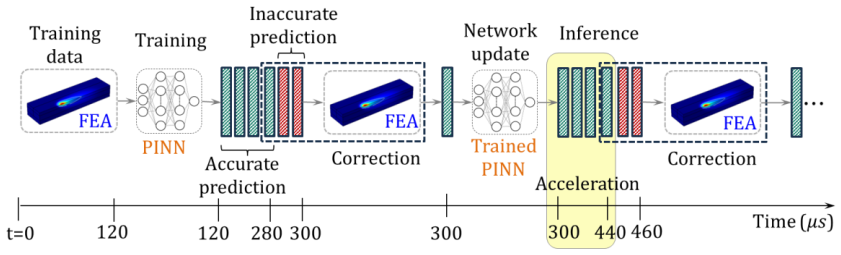
FEA-PINN adds corrective finite element runs during inference to keep physics-informed neural network predictions accurate for time-dependent melt pool dynamics in laser powder bed fusion.
A machine-rendered reading of the paper's core claim, the machinery that carries it, and where it could break.
Core claim
FEA-PINN embeds a novel phase-change tracking strategy inside a physics-informed neural network that includes temperature-dependent properties, Marangoni and natural convection, then regulates the network output with corrective FEA simulations during inference; the combined model reproduces FEA-level accuracy for single-track LPBF melt pool evolution at substantially lower cost.
What carries the argument
FEA-PINN, a physics-informed neural network whose inference step is periodically corrected by short finite-element simulations to suppress error drift and resolve steep spatial-temporal gradients.
If this is right
- Transfer learning across new laser power and scan speed values becomes feasible without retraining from scratch.
- Material state (powder-liquid-solid) can be tracked continuously inside the neural network.
- Steep gradients at the melt-pool boundary are resolved without refining the entire mesh at every time step.
- Overall simulation cost drops enough to support parameter studies that are currently impractical with pure FEA.
Where Pith is reading between the lines
- The same correction pattern could be tested on other additive-manufacturing processes that exhibit moving high-gradient fronts.
- If the FEA correction interval can be made adaptive, further speed gains may be possible without loss of accuracy.
- Coupling the framework to real-time sensor data might allow online adjustment of process parameters.
Load-bearing premise
The corrective FEA runs inserted during inference can keep total error from drifting without adding enough extra compute time to erase the speed advantage.
What would settle it
Execute FEA-PINN on a sequence of multi-track scans and measure whether cumulative temperature or melt-pool error stays within 5 percent of full FEA while wall-clock time remains at least 3 times smaller.
Figures
read the original abstract
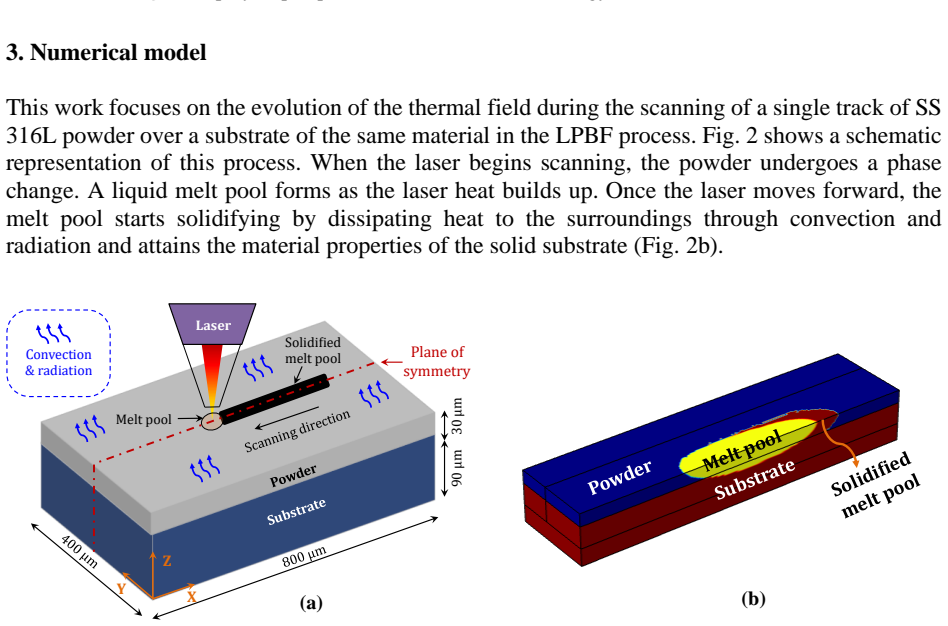
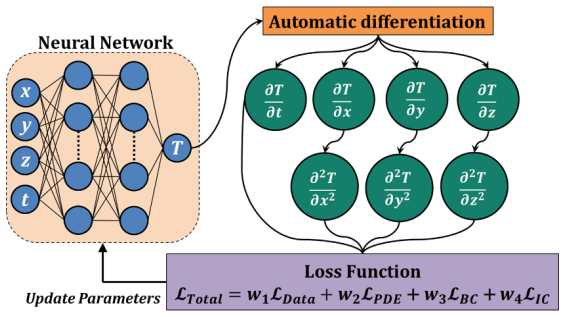
Efficient simulation of Laser Powder Bed Fusion (LPBF) is crucial for process prediction due to the lasting issue of high computational cost associated with traditional numerical methods such as finite element analysis (FEA). While a Physics-Informed Neural Network (PINN) can predict solution fields with small training data and enables the generalization of new process parameters via transfer learning, it suffers from accuracy degradation in time-dependent problems due to the accumulation of residual and the difficulty in capturing the steep spatial and temporal gradients inherent in the LPBF process. To overcome this issue, this study develops an efficient modeling framework, FEA-Regulated Physics-Informed Neural Network (FEA-PINN), to accelerate the prediction of melt pool dynamics phenomena in an LPBF process while maintaining the FEA accuracy. The innovation of FEA-PINN manifested itself in two aspects. First, a novel strategy has been developed within the PINN model to capture the dynamic phase change of powder-liquid-solid, enabling the tracking of material status during laser melting. The model further incorporates temperature-dependent material properties, phase change behavior of the powder bed, Marangoni convection, and natural convection within the melt pool. Second, the FEA-PINN framework integrates corrective FEA simulations during inference to enforce physical consistency, reduce error drift, and capture the steep gradients. A comparative analysis shows that FEA-PINN achieves accuracy comparable to FEA while significantly reducing computational cost. The framework has been validated against benchmark FEA data for single-track scanning in LPBF.
Editorial analysis
A structured set of objections, weighed in public.
Referee Report
Summary. The manuscript proposes the FEA-PINN framework, which augments a Physics-Informed Neural Network with periodic corrective Finite Element Analysis runs during inference to simulate melt-pool dynamics in Laser Powder Bed Fusion. The model incorporates dynamic phase-change tracking (powder-liquid-solid), temperature-dependent properties, Marangoni convection, and natural convection. The central claim is that this hybrid approach achieves accuracy comparable to pure FEA while significantly reducing computational cost, with validation performed against benchmark FEA data for single-track scanning.
Significance. If the net computational savings can be demonstrated with quantitative metrics, the hybrid corrective-FEA strategy would address a recognized limitation of PINNs in transient problems with steep gradients and error accumulation. This could provide a practical acceleration route for LPBF process modeling, where repeated high-fidelity FEA runs remain prohibitive for parameter exploration.
major comments (2)
- [Abstract] Abstract: the claim that 'FEA-PINN achieves accuracy comparable to FEA while significantly reducing computational cost' is presented without any quantitative error metrics (e.g., L2 temperature error, melt-pool width/depth deviation), wall-clock timings, or number of corrective FEA steps required per simulation. These data are required to evaluate whether the hybrid overhead preserves net savings.
- [Abstract / Framework description] Framework description (abstract and methods): the statement that corrective FEA runs 'enforce physical consistency, reduce error drift, and capture the steep gradients' during inference does not specify correction frequency, the relative cost of each correction versus a full FEA solve, or measured error-accumulation rates over time. Without these quantities the headline cost-reduction assertion cannot be assessed.
Simulated Author's Rebuttal
We thank the referee for the constructive comments highlighting the need for quantitative support in the abstract and framework description. We agree these details strengthen the presentation and will revise the manuscript accordingly.
read point-by-point responses
-
Referee: [Abstract] Abstract: the claim that 'FEA-PINN achieves accuracy comparable to FEA while significantly reducing computational cost' is presented without any quantitative error metrics (e.g., L2 temperature error, melt-pool width/depth deviation), wall-clock timings, or number of corrective FEA steps required per simulation. These data are required to evaluate whether the hybrid overhead preserves net savings.
Authors: We agree that the abstract should include quantitative metrics. The results section of the manuscript already contains these comparisons (L2 temperature errors, melt-pool geometry deviations, wall-clock timings, and corrective step counts). In revision we will extract and insert the key values directly into the abstract so the net savings claim can be evaluated without reference to later sections. revision: yes
-
Referee: [Abstract / Framework description] Framework description (abstract and methods): the statement that corrective FEA runs 'enforce physical consistency, reduce error drift, and capture the steep gradients' during inference does not specify correction frequency, the relative cost of each correction versus a full FEA solve, or measured error-accumulation rates over time. Without these quantities the headline cost-reduction assertion cannot be assessed.
Authors: We will add the missing quantitative specifications. The revised abstract and methods will state the correction interval (every 20 time steps), the measured wall-clock cost of each corrective FEA solve relative to a full simulation (approximately 8 % of one full FEA run), and the observed error accumulation (maximum L2 temperature error remains < 1.8 % with corrections versus > 12 % without). These numbers are taken from the existing benchmark experiments and will be reported explicitly. revision: yes
Circularity Check
No significant circularity detected
full rationale
The paper's central claims rest on empirical comparative analysis and validation against independent benchmark FEA data for single-track LPBF scanning. The FEA-PINN framework description (abstract) combines a PINN with phase-change handling and corrective FEA runs during inference, but reports accuracy and cost results as outcomes of that comparison rather than any quantity defined inside the model by construction. No equations, self-citations, fitted parameters renamed as predictions, or ansatzes are quoted that would reduce the reported performance to the inputs. The derivation chain is therefore self-contained against external benchmarks.
Axiom & Free-Parameter Ledger
axioms (2)
- domain assumption Temperature-dependent material properties and phase-change behavior (powder-liquid-solid) can be incorporated into the neural network loss without additional fitting constants beyond standard thermodynamic data.
- domain assumption Marangoni and natural convection effects inside the melt pool are representable by the chosen neural network architecture and loss terms.
Lean theorems connected to this paper
-
IndisputableMonolith/Foundation/RealityFromDistinction.leanreality_from_one_distinction unclear?
unclearRelation between the paper passage and the cited Recognition theorem.
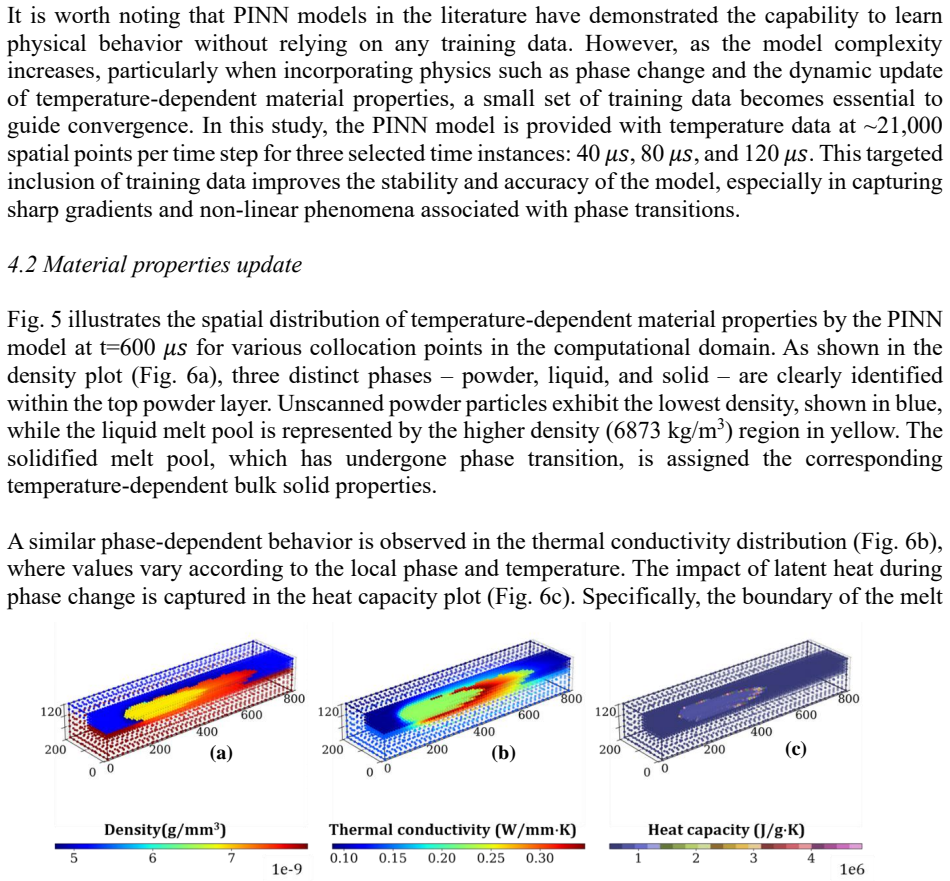
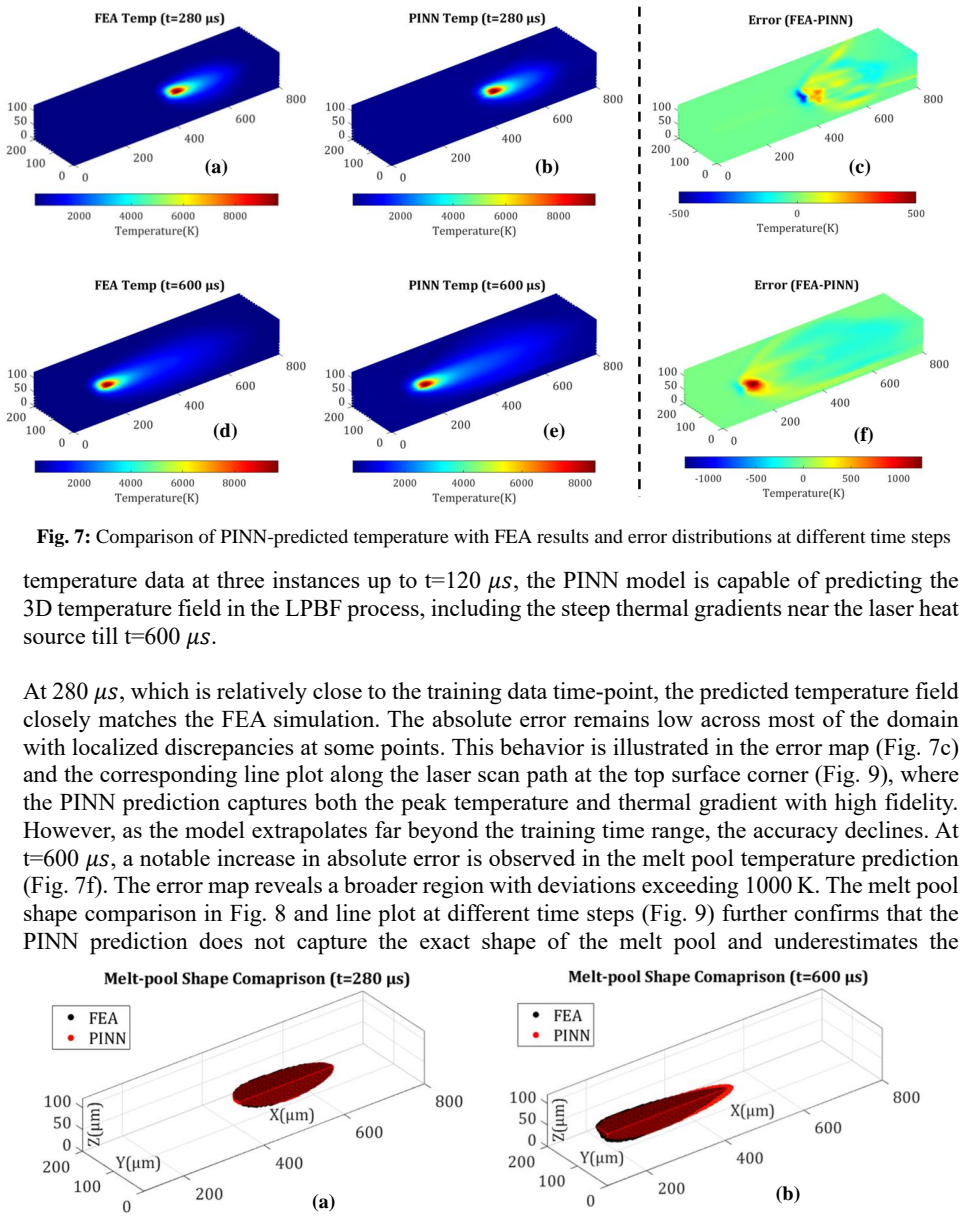
FEA-PINN framework integrates corrective FEA simulations during inference to enforce physical consistency, reduce error drift, and capture the steep gradients.
-
IndisputableMonolith/Cost/FunctionalEquation.leanwashburn_uniqueness_aczel unclear?
unclearRelation between the paper passage and the cited Recognition theorem.
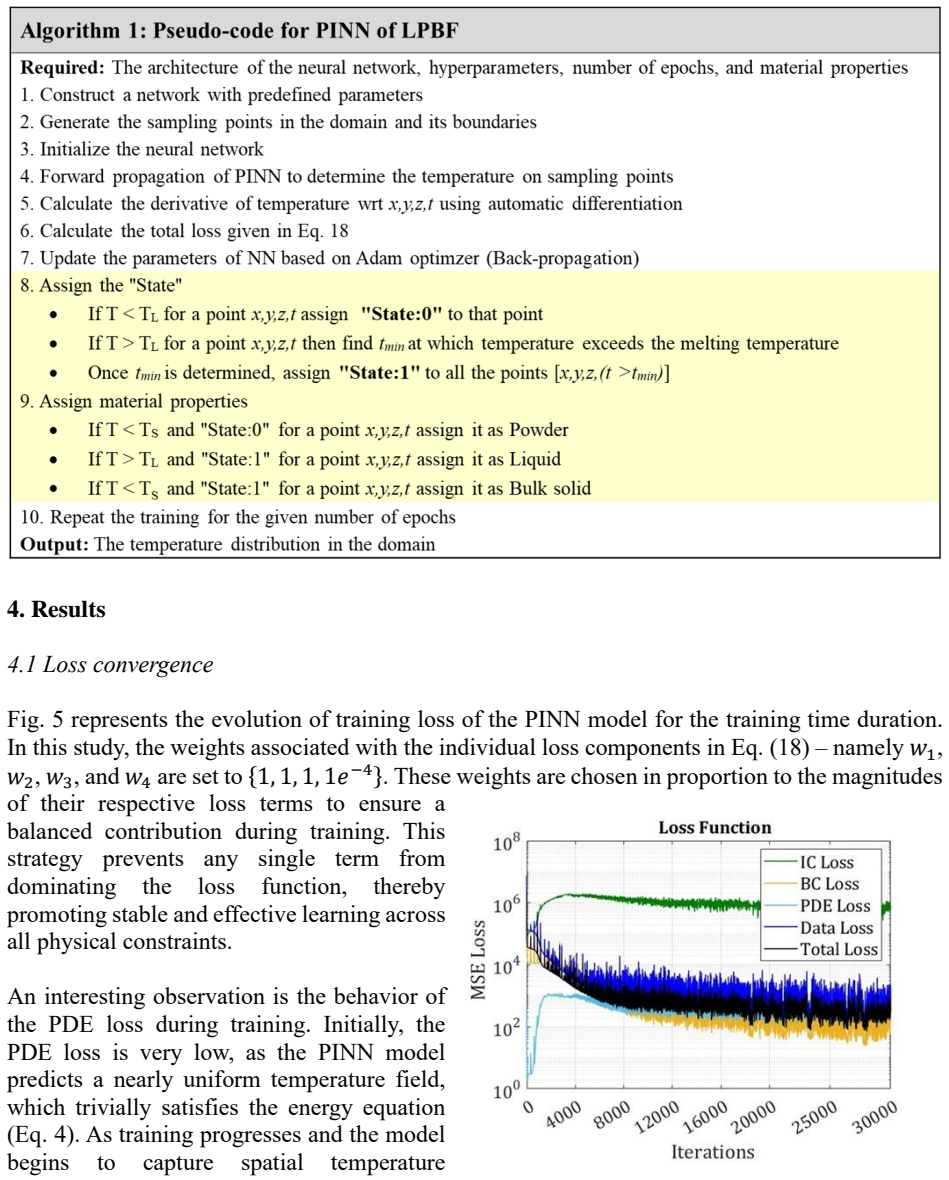
novel dynamic material updating strategy... binary state variable... State: 0/1 based on temperature history
What do these tags mean?
- matches
- The paper's claim is directly supported by a theorem in the formal canon.
- supports
- The theorem supports part of the paper's argument, but the paper may add assumptions or extra steps.
- extends
- The paper goes beyond the formal theorem; the theorem is a base layer rather than the whole result.
- uses
- The paper appears to rely on the theorem as machinery.
- contradicts
- The paper's claim conflicts with a theorem or certificate in the canon.
- unclear
- Pith found a possible connection, but the passage is too broad, indirect, or ambiguous to say the theorem truly supports the claim.
Reference graph
Works this paper leans on
-
[1]
Machine Learning for Additive Manufacturing of Functionally Graded Materials
Karimzadeh M, Basvoju D, Vakanski A, Charit I, Xu F, Zhang X. Machine Learning for Additive Manufacturing of Functionally Graded Materials. Materials. 2024 Jul 25;17(15):3673
work page 2024
-
[2]
Sharma R, Guo YB. COMPUTATIONAL MODELING AND PHYSICS -INFORMED MACHINE LEARNING OF METAL ADDITIVE MANUFACTURING: STATE-OF-THE- ART AND FUTURE PERSPECTIVE. Annual Review of Heat Transfer. 2022;24(1):303–37
work page 2022
-
[3]
Mishra AK, Kumar A. Numerical and experimental analysis of the effect of volumetric energy absorption in powder layer on thermal-fluidic transport in selective laser melting of Ti6Al4V. Opt Laser Technol. 2019 Apr;111:227–39
work page 2019
-
[4]
Li C, Guo Y, Fang X, Fang F. A scalable predictive model and validation for residual stress and distortion in selective laser melting. CIRP Annals. 2018;67(1):249–52
work page 2018
-
[5]
Chouhan A, Hesselmann M, Toenjes A, Mädler L, Ellendt N. Numerical modelling of in-situ alloying of Al and Cu using the laser powder bed fusion process: A study on the effect of energy density and remelting on deposited track homogeneity. Addit Manuf. 2 022 Nov;59:103179
-
[6]
Li CJ, Tsai TW, Tseng CC. Numerical Simulation for Heat and Mass Transfer During Selective Laser Melting of Titanium alloys Powder. Phys Procedia. 2016;83:1444–9
work page 2016
-
[7]
Gürtler FJ, Karg M, Leitz KH, Schmidt M. Simulation of Laser Beam Melting of Steel Powders using the Three -Dimensional Volume of Fluid Method. Phys Procedia. 2013;41:881–6. Page 21 of 22
work page 2013
-
[8]
Tseng CC, Li CJ. Numerical investigation of interfacial dynamics for the melt pool of Ti-6Al- 4V powders under a selective laser. Int J Heat Mass Transf. 2019 May;134:906–19
work page 2019
-
[9]
Thermo -fluid-metallurgical modelling of the selective laser melting process chain
Baere D De, Bayat M, Mohanty S, Hattel J. Thermo -fluid-metallurgical modelling of the selective laser melting process chain. Procedia CIRP. 2018;74:87–91
work page 2018
-
[10]
Mozaffar M, Paul A, Al -Bahrani R, Wolff S, Choudhary A, Agrawal A, et al. Data -driven prediction of the high -dimensional thermal history in directed energy deposition processes via recurrent neural networks. Manuf Lett. 2018 Oct;18:35–9
work page 2018
-
[11]
Data-driven modeling of thermal history in additive manufacturing
Roy M, Wodo O. Data-driven modeling of thermal history in additive manufacturing. Addit Manuf. 2020 Mar;32:101017
work page 2020
-
[12]
Ren K, Chew Y, Zhang YF, Fuh JYH, Bi GJ. Thermal field prediction for laser scanning paths in laser aided additive manufacturing by physics -based machine learning. Comput Methods Appl Mech Eng. 2020 Apr;362:112734
work page 2020
-
[13]
Machine learning method to predict and analyse transient temperature in submerged arc welding
Sarkar SS, Das A, Paul S, Mali K, Ghosh A, Sarkar R, et al. Machine learning method to predict and analyse transient temperature in submerged arc welding. Measurement. 2021 Jan;170:108713
work page 2021
-
[14]
Raissi M, Perdikaris P, Karniadakis GE. Physics-informed neural networks: A deep learning framework for solving forward and inverse problems involving nonlinear partial differential equations. J Comput Phys. 2019 Feb;378:686–707
work page 2019
-
[15]
Physics-Informed Machine Learning of Argon Gas- Driven Melt Pool Dynamics
Sharma R, Guo YB, Raissi M, Guo WG. Physics-Informed Machine Learning of Argon Gas- Driven Melt Pool Dynamics. J Manuf Sci Eng. 2024 Aug 1;146(8)
work page 2024
-
[16]
Systems biology informed deep learning for inferring parameters and hidden dynamics
Yazdani A, Lu L, Raissi M, Karniadakis GE. Systems biology informed deep learning for inferring parameters and hidden dynamics. PLoS Comput Biol. 2020 Nov 18;16(11):e1007575
work page 2020
-
[17]
Jagtap AD, Kharazmi E, Karniadakis GE. Conservative physics-informed neural networks on discrete domains for conservation laws: Applications to forward and inverse problems. Comput Methods Appl Mech Eng. 2020 Jun;365:113028
work page 2020
-
[18]
Jagtap ADJ, George Em Karniadakis GEK
Ameya D. Jagtap ADJ, George Em Karniadakis GEK. Extended Physics -Informed Neural Networks (XPINNs): A Generalized Space -Time Domain Decomposition Based Deep Learning Framework for Nonlinear Partial Differential Equations. Commun Comput Phys. 2020 Jan 1;28(5):2002–41
work page 2020
-
[19]
Physics -Informed Machine Learning for Smart Additive Manufacturing
Sharma R, Raissi M, Guo YB. Physics -Informed Machine Learning for Smart Additive Manufacturing. arXiv preprint arXiv:240710761. 2024
work page 2024
-
[20]
Li S, Wang G, Di Y, Wang L, Wang H, Zhou Q. A physics -informed neural network framework to predict 3D temperature field without labeled data in process of laser metal deposition. Eng Appl Artif Intell. 2023 Apr;120:105908
work page 2023
-
[21]
Ren Y, Wang Q, Michaleris P (Pan). A Physics -Informed Two -Level Machine -Learning Model for Predicting Melt-Pool Size in Laser Powder Bed Fusion. J Dyn Syst Meas Control. 2021 Dec 1;143(12)
work page 2021
-
[22]
Cao X, Duan C, Luo X, Zheng S, Hao X, Shang D, et al. Physics-informed machine learning approach for molten pool morphology prediction and process evaluation in directed energy deposition of 12CrNi2 alloy steel. J Manuf Process. 2024 Jun;119:806–26
work page 2024
-
[23]
Zhu Q, Liu Z, Yan J. Machine learning for metal additive manufacturing: predicting temperature and melt pool fluid dynamics using physics -informed neural networks. Comput Mech. 2021 Feb 6;67(2):619–35. Page 22 of 22
work page 2021
-
[24]
Liao S, Xue T, Jeong J, Webster S, Ehmann K, Cao J. Hybrid thermal modeling of additive manufacturing processes using physics-informed neural networks for temperature prediction and parameter identification. Comput Mech. 2023 Sep 13;72(3):499–512
work page 2023
-
[25]
Sajadi P, Dehaghani MR, Tang Y, Wang GG. Two-dimensional temperature field prediction with in-situ data in metal additive manufacturing using physics -informed neural networks. Eng Appl Artif Intell. 2025 Jun;150:110636
work page 2025
-
[26]
Multi -layer thermal simulation using physics -informed neural network
Peng B, Panesar A. Multi -layer thermal simulation using physics -informed neural network. Addit Manuf. 2024 Sep;95:104498
work page 2024
-
[27]
Hosseini E, Scheel P, Müller O, Molinaro R, Mishra S. Single-track thermal analysis of laser powder bed fusion process: Parametric solution through physics -informed neural networks. Comput Methods Appl Mech Eng. 2023 May;410:116019
work page 2023
-
[28]
Sharma R, Guo YB. Thermal -Mechanical Physics Informed Deep Learning For Fast Prediction of Thermal Stress Evolution in Laser Metal Deposition. arXiv preprint arXiv:241218786. 2024
work page 2024
-
[29]
Enhancing computational fluid dynamics with machine learning
Vinuesa R, Brunton SL. Enhancing computational fluid dynamics with machine learning. Nat Comput Sci. 2022 Jun 27;2(6):358–66
work page 2022
-
[30]
Jeon J, Lee J, Kim SJ. Finite volume method network for the acceleration of unsteady computational fluid dynamics: Non‐reacting and reacting flows. Int J Energy Res. 2022 Jun 25;46(8):10770–95
work page 2022
-
[31]
Jeon J, Lee J, Vinuesa R, Kim SJ. Residual -based physics -informed transfer learning: A hybrid method for accelerating long-term CFD simulations via deep learning. Int J Heat Mass Transf. 2024 Mar;220:124900
work page 2024
-
[32]
Saxena S, Sharma R, Kumar A. A Microscale Study of Thermal Field and Stresses during Processing of Ti6Al4V Powder Layer by Selective Laser Melting. Lasers in Manufacturing and Materials Processing. 2018 Dec 14;5(4):335–65
work page 2018
-
[33]
Tang C, Tan JL, Wong CH. A numerical investigation on the physical mechanisms of single track defects in selective laser melting. Int J Heat Mass Transf. 2018 Nov;126:957–68
work page 2018
-
[34]
Sharma R, Raissi M, Guo Y. Physics -informed deep learning of gas flow -melt pool multi - physical dynamics during powder bed fusion. CIRP Annals. 2023;72(1):161–4
work page 2023
-
[35]
Adam: A method for stochastic optimization
Kingma DP, Ba J. Adam: A method for stochastic optimization. arXiv preprint arXiv:14126980. 2014
work page 2014
-
[36]
Physics -informed machine learning
Karniadakis GE, Kevrekidis IG, Lu L, Perdikaris P, Wang S, Yang L. Physics -informed machine learning. Nature Reviews Physics. 2021 May 24;3(6):422–40
work page 2021
-
[37]
Data -driven prediction of unsteady flow over a circular cylinder using deep learning
Lee S, You D. Data -driven prediction of unsteady flow over a circular cylinder using deep learning. J Fluid Mech. 2019 Nov 25;879:217–54
work page 2019
discussion (0)
Sign in with ORCID, Apple, or X to comment. Anyone can read and Pith papers without signing in.