REVIEW 3 major objections 5 minor 53 references
Uncover Treasures in DCT: Advancing JPEG Quality Enhancement by Exploiting Latent Correlations
T0 review · 3 major / 5 minor · reviewed 2026-08-06 · deepseek-v4-flash
Pith's one-line read JPEG artifact removal moves into DCT domain and beats pixel-domain rivals.
desk verdict A useful DCT-domain adaptation framework with a clean efficiency win, but the 0.35 dB quality claim is confounded by the quantization-matrix side information. read the letter →
The pith
A machine-rendered reading of the paper's core claim, the machinery that carries it, and where it could break.
The reading
What carries the argument
The load-bearing object is the reorganized DCT tensor. In EMBC, a learnable block-based convolution—a convolution whose kernel and bias are generated from the dequantization matrix $Q_Y$ (or $Q_C$) and the other color channels—turns each dequantized $8\times8$ block into a block feature, passes it through a pixel-domain enhancement backbone, then maps back to DCT coefficients, thereby exposing block-based correlation to spatially invariant convolutions. In EMPC, the DCT tensor is remapped into 64 coefficient maps (one per frequency), compacted to the low-frequency (or a learnably selected) subset, enhanced by a pixel-domain model, and remapped back, exposing point-based correlation. A third piece, UMEP, supplies a fixed DCT-domain upsampling matrix $\hat U_4 = T_8 U_4 T_4^\top$ for chroma blocks that is algebraically equivalent to pixel-space nearest-neighbor upsampling, avoiding the aliasing that naive coefficient upsampling produces.
What would settle it
Retrain the DCT model with EMBC's kernel generator receiving only the DCT coefficients and not $Q_Y$/$Q_C$ (or train a pixel-domain baseline that is given the true quantization matrix), and compare PSNR; if the 0.35 dB gap disappears, the side information rather than the block- and point-based correlations is the cause.
Extended reading notes
Core claim
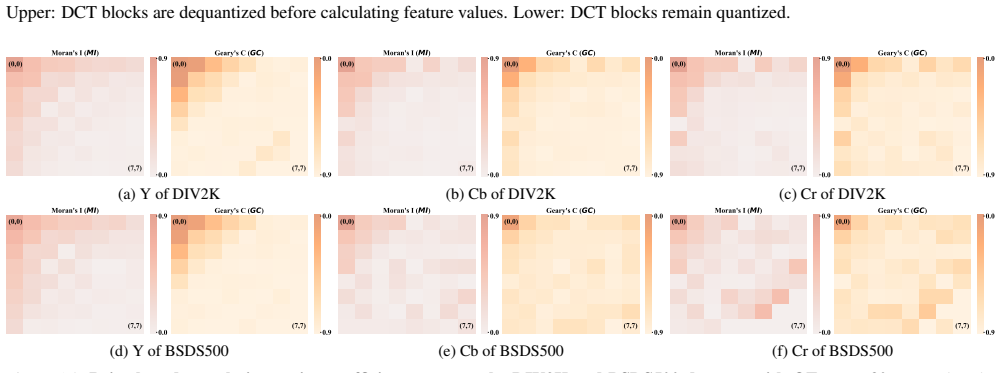
The paper's central claim is that JPEG artifact enhancement can be done wholly in the DCT domain, without fully decoding to pixels, at higher quality than the same models used on pixels. The enabling observation is empirical: raw DCT coefficients show almost no spatial autocorrelation (standard metrics are near the 'no correlation' levels), but two reorganized views of the same coefficients are strongly correlated. Dequantizing each $8\times8$ block and computing weighted sums over the block yields a block-level summary whose neighboring values correlate strongly, while grouping the same frequency position across all blocks into 64 coefficient maps yields maps whose low-frequency entries are spatially smooth. On these two reorganizations the paper builds EMBC and EMPC, which wrap an off-the-shelf pixel-domain network between operations that map DCT blocks to and from these correlated representations and back. Across five pixel-domain models on three color and four grayscale test sets, the DCT-domain versions consistently outperform their pixel-domain versions, with an average of 0.35 dB PSNR gain (color) and 0.39 dB (grayscale), plus a 60.5% throughput increase and 45.9% fewer FLOPs, while also outperforming prior DCT-domain methods such as QGAC and JDEC.
Load-bearing premise
The reported quality gain is credited to the new correlation modules, but the DCT-domain models are also given the JPEG quantization matrix as explicit input while the pixel-domain baselines must estimate or infer it, and that side-information advantage is not ablated in the paper.
Editorial extensions
If this is right
- Any existing pixel-domain JPEG enhancement network can be wrapped by EMBC/EMPC to operate in the DCT domain, yielding higher PSNR/SSIM and lower FLOPs than the same network in pixels.
- Enhancement no longer requires the inverse DCT and YCbCr-to-RGB conversion for storage or transmission; the output can be entropy-coded directly to a smaller JPEG file.
- The improvement holds across quality factors 10 through 40 and for both color and grayscale, so the method is not tuned to a single compression setting.
- DCT-domain models derived this way also beat dedicated DCT-domain methods (QGAC, JDEC) by an average of 0.41 dB color and 0.48 dB grayscale PSNR.
- Training cost drops by 38.0% and enhancement throughput rises 60.5% compared with the pixel-domain counterparts.
Reading between the lines
- If the gain is partly due to explicit access to the quantization matrix, the same wrapper idea could be applied to pixel-domain baselines by feeding them that same side information, which would isolate the correlation modules' true contribution; this ablation is not in the paper.
- The coefficient-map view suggests a direct link to frequency-domain vision transformers: EMPC's compaction to the top $\alpha\%$ low-frequency maps is a hand-designed version of what a learned frequency attention might discover, so the module could be replaced by a learned selection with little loss.
- Since block-based correlation emerges only after dequantization, the gain may shrink for very high quality factors near lossless, where quantized coefficients retain little of that latent structure; the paper's enhancement tables cover only QF 10 through 40.
- The method outputs enhanced DCT coefficients, so it can pair naturally with transcoding pipelines that re-encode with a larger quantization matrix or with downstream JPEG-domain vision models that consume bitstreams directly.
Signed reviews
Editorial analysis
A structured set of objections, weighed in public.
Referee Report
Summary. The paper proposes AJQE, a method for JPEG quality enhancement that operates directly on DCT coefficients. The authors identify two types of latent correlations in DCT data—block-based and point-based correlations—and design two modules, EMBC and EMPC, to exploit them. These modules allow existing pixel-domain enhancement networks (AR-CNN, DCAD, DnCNN, FBCNN, ARCRL) to be adapted to the DCT domain. The paper claims an average 0.35 dB PSNR improvement over the pixel-domain counterparts and a 60.5% increase in enhancement throughput, with experiments on several benchmarks and QF values.
Significance. If the claims hold, the paper offers a practical recipe for moving JPEG enhancement into the compressed domain, with substantial computational savings and a principled justification based on measured correlations. The correlation analysis is a useful empirical contribution, and the UMEP lemma is a clean identity with a proof included in the supplement. The authors retrain all baselines under consistent settings, which is more careful than typical in this area. However, the headline quality gain is not yet fully auditable because of a side-information confound and missing baseline numbers in the main tables.
major comments (3)
- [Sec. 4.1, Fig. 6, Table 4] The block-based convolution in EMBC generates its kernel and bias from the quantization matrices QY and QC (Sec. 4.1, Fig. 6). In the first stage, QY, Cb_DCT, and Cr_DCT are used; in the second stage, QC and Y_DCT are used. The pixel-domain baselines receive no such metadata: FBCNN is QF-blind and must predict QF, and the other pixel-domain models do not even condition on QF. The ablation study in Table 4 does not include an arm that removes QY/QC from EMBC while keeping the block-based convolution and the rest of the method fixed. The BConv-VConv arm replaces block-based convolution with vanilla convolution, which changes both the side information and the convolution structure, so it does not isolate the side-information effect. Therefore the average 0.35 dB improvement attributed to EMBC/EMPC in the Abstract and Sec. 5.2 may be partly or wholly due to explicit access to quantization step sizes, and the claim is not proven by the reported experiments.
- [Tables 2 and 3, Fig. 1] Tables 2 and 3 report only the AJQE variant numbers with parenthetical deltas (e.g., "27.69 (+0.29)"), but they do not print the actual pixel-domain baseline PSNR/SSIM values. The parenthetical improvements can therefore not be independently verified, and the average improvements quoted in Sec. 5.2 are not auditable from the tables. There is a direct inconsistency with Fig. 1: for BSDS500 QF=10, Table 2 lists AJQE w/ FBCNN as 27.69 dB and implies a pixel-domain FBCNN baseline of 27.69 - 0.29 = 27.40 dB, while Fig. 1 reports FBCNN as 26.13 dB and FBCNN w/ Ours as 26.81 dB. The JPEG baseline itself also differs (25.47 dB in Table 2 vs. 23.42 dB in Fig. 1). The authors should print the baseline numbers in the tables and reconcile the figure with the tables.
- [Table 4] The ablation study does not support the attribution of the quality gain to the proposed correlation modules as opposed to the extra side information. A controlled ablation is needed in which the EMBC block-based convolution is retained but QY/QC are removed from the kernel-generation process (e.g., generating the kernel from the DCT coefficients alone, or from a constant). Without such an arm, the 0.35 dB gain over pixel-domain baselines cannot be separated from the quantization-matrix advantage. Adding this experiment is essential to validate the central claim of the paper.
minor comments (5)
- [Sec. 4.2, Sec. 5.1] The EMPC compaction ratio α is a free parameter, but its value is never specified in the paper. The authors should state the α used in the main experiments and whether the learnable or non-learnable compaction strategy was employed.
- [Tables 2 and 3 captions] The table captions say "Performance improvements over the pixel-domain model are shown in parentheses," but the columns are labeled with the AJQE variant, not the corresponding pixel-domain baseline. Each column should explicitly name the baseline model it is adapted from.
- [Fig. 1 caption] The caption states that the comparison includes JDEC and other methods, but the figure as printed appears to show only FBCNN and FBCNN w/ Ours. Confirm that all baselines are actually plotted or adjust the caption.
- [Sec. 5.1] For reproducibility, the authors should provide the kernel sizes and layer counts for the block-based convolution in EMBC and the exact architecture of the kernel-generation network, since these details are only sketched in Fig. 6.
- [Eq. (3)] The ground-truth DCT coefficients are obtained by compressing with QF=100. Please clarify how images whose dimensions are not multiples of 8 are handled in the DCT-domain supervision, since padding or cropping can affect the DCT-domain loss.
Circularity Check
No circular reasoning detected; the derivation chain is empirical and self-contained.
full rationale
The paper's derivation chain is not circular. The two 'correlations' (block-based and point-based) are empirical measurements of Moran's I and Geary's C on JPEG DCT coefficients (Sec. 3, Tab. 1, Figs. 3-4); they are inputs that motivate the EMBC and EMPC module designs, not outputs derived from those modules. The UMEP result is a standard matrix identity proved in the supplementary from the DCT basis orthogonality and the definition of the upsampling matrix (Eq. 4-15), so it is algebraically self-contained rather than assumed. The central quantitative claims (0.35 dB PSNR gain, 60.5% throughput gain) are measured comparisons against retrained baselines in Sec. 5.2, not predictions forced by construction. Ablation studies (Tab. 4) test the modules by replacement, which is the appropriate way to probe their contribution. The fact that EMBC consumes the quantization matrix QY/QC while pixel-domain baselines do not is a fairness or side-information concern, not a circularity: it does not make the reported gain equal to an input by definition. Self-citations in the related work (e.g., refs. [40,41]) are contextual, not load-bearing. No fitted parameter is renamed as a prediction, and no uniqueness theorem or ansatz is imported from the authors' prior work. The paper therefore warrants a score of 0.
Assumptions & free parameters
free parameters (1)
- EMPC compaction ratio alpha
assumptions (4)
- standard math DCT basis matrices are orthogonal (T^T = T^-1)
- domain assumption Chroma upsampling in JPEG is equivalent to nearest-neighbor upsampling
- domain assumption Ground truth DCT coefficients from QF=100 compression are the correct enhancement target
- ad hoc to paper Block-based and point-based correlations are the key structure to exploit
Cite this review
Pith. "Pith review of Uncover Treasures in DCT: Advancing JPEG Quality Enhancement by Exploiting Latent Correlations." pith.science (2026). https://pith.science/paper/AXRJFX6F
@misc{pith2026250621171,
  author       = {Pith},
  title        = {Pith review of: Uncover Treasures in DCT: Advancing JPEG Quality Enhancement by Exploiting Latent Correlations},
  year         = {2026},
  howpublished = {\url{https://pith.science/paper/AXRJFX6F}},
  note         = {Machine review of arXiv:2506.21171}
}
read the original abstract
Joint Photographic Experts Group (JPEG) achieves data compression by quantizing Discrete Cosine Transform (DCT) coefficients, which inevitably introduces compression artifacts. Most existing JPEG quality enhancement methods operate in the pixel domain, suffering from the high computational costs of decoding. Consequently, direct enhancement of JPEG images in the DCT domain has gained increasing attention. However, current DCT-domain methods often exhibit limited performance. To address this challenge, we identify two critical types of correlations within the DCT coefficients of JPEG images. Building on this insight, we propose an Advanced DCT-domain JPEG Quality Enhancement (AJQE) method that fully exploits these correlations. The AJQE method enables the adaptation of numerous well-established pixel-domain models to the DCT domain, achieving superior performance with reduced computational complexity. Compared to the pixel-domain counterparts, the DCT-domain models derived by our method demonstrate a 0.35 dB improvement in PSNR and a 60.5% increase in enhancement throughput on average.
Figures


Figures from the paper (25 more)




Reference graph
Works this paper leans on
-
[1]
Ntire 2017 challenge on single image super-resolution: Dataset and study
Eirikur Agustsson and Radu Timofte. Ntire 2017 challenge on single image super-resolution: Dataset and study. InPro- ceedings of the IEEE Conference on Computer Vision and Pattern Recognition (CVPR) Workshops, 2017. 2, 6
work page 2017
- [2]
-
[3]
Image Compression Benchmark.http:// imagecompression.info/, 2024
Rawzor APP. Image Compression Benchmark.http:// imagecompression.info/, 2024. 6
work page 2024
-
[4]
Pablo Arbel ´aez, Michael Maire, Charless Fowlkes, and Ji- tendra Malik. Contour Detection and Hierarchical Image Segmentation.IEEE Transactions on Pattern Analysis and Machine Intelligence, 33(5):898–916, 2011. 1, 3, 6
work page 2011
-
[5]
G Bradski. The opencv library.Dr. Dobb’s Journal of Soft- ware Tools, 2000. 3, 6
work page 2000
-
[6]
Honggang Chen, Xiaohai He, Linbo Qing, Shuhua Xiong, and Truong Q. Nguyen. Dpw-sdnet: Dual pixel-wavelet do- main deep cnns for soft decoding of jpeg-compressed im- ages. InProceedings of the IEEE Conference on Computer Vision and Pattern Recognition (CVPR) Workshops, 2018. 2
work page 2018
-
[7]
Fast object detection in compressed JPEG Images
Benjamin Deguerre, Cl ´ement Chatelain, and Gilles Gasso. Fast object detection in compressed JPEG Images. In2019 IEEE Intelligent Transportation Systems Conference (ITSC), pages 333–338, 2019. 4
work page 2019
-
[8]
Compression Artifacts Reduction by a Deep Convolu- tional Network
Chao Dong, Yubin Deng, Chen Change Loy, and Xiaoou Tang. Compression Artifacts Reduction by a Deep Convolu- tional Network. In2015 IEEE International Conference on Computer Vision (ICCV), pages 576–584, Santiago, Chile,
Show all 53 references
-
[9]
TorchJPEG.https://github.com/ Queuecumber/torchjpeg/, 2019
Max Ehrlich. TorchJPEG.https://github.com/ Queuecumber/torchjpeg/, 2019. 6
2019
-
[10]
Quantization Guided JPEG Artifact Correction
Max Ehrlich, Larry Davis, Ser-Nam Lim, and Abhinav Shri- vastava. Quantization Guided JPEG Artifact Correction. InComputer Vision – ECCV 2020, pages 293–309, Cham,
2020
-
[11]
Jpeg artifacts reduction via deep convolutional sparse coding
Xueyang Fu, Zheng-Jun Zha, Feng Wu, Xinghao Ding, and John Paisley. Jpeg artifacts reduction via deep convolutional sparse coding. InProceedings of the IEEE/CVF Interna- tional Conference on Computer Vision (ICCV), 2019. 2
2019
-
[12]
Learning dual priors for jpeg compression artifacts removal
Xueyang Fu, Xi Wang, Aiping Liu, Junwei Han, and Zheng- Jun Zha. Learning dual priors for jpeg compression artifacts removal. InProceedings of the IEEE/CVF International Conference on Computer Vision (ICCV), pages 4086–4095,
-
[13]
R. C. Geary. The Contiguity Ratio and Statistical Mapping. The Incorporated Statistician, 5(3):115–146, 1954. 2
1954
-
[14]
Building Dual-Domain Rep- resentations for Compression Artifacts Reduction
Jun Guo and Hongyang Chao. Building Dual-Domain Rep- resentations for Compression Artifacts Reduction. InCom- puter Vision – ECCV 2016, pages 628–644, Cham, 2016. Springer International Publishing. 2
2016
-
[15]
Jdec: Jpeg decoding via enhanced continuous cosine coefficients
Woo Kyoung Han, Sunghoon Im, Jaedeok Kim, and Ky- ong Hwan Jin. Jdec: Jpeg decoding via enhanced continuous cosine coefficients. InProceedings of the IEEE/CVF Confer- ence on Computer Vision and Pattern Recognition (CVPR), pages 2784–2793, 2024. 1, 2, 6
2024
-
[16]
Deep residual learning for image recognition
Kaiming He, Xiangyu Zhang, Shaoqing Ren, and Jian Sun. Deep residual learning for image recognition. InProceed- ings of the IEEE Conference on Computer Vision and Pattern Recognition (CVPR), 2016. 2, 5
2016
-
[17]
Batch Normalization: Accelerating Deep Network Training by Reducing Internal Covariate Shift
Sergey Ioffe and Christian Szegedy. Batch Normalization: Accelerating Deep Network Training by Reducing Internal Covariate Shift. InProceedings of the 32nd International Conference on Machine Learning, pages 448–456. PMLR,
-
[18]
Towards flex- ible blind jpeg artifacts removal
Jiaxi Jiang, Kai Zhang, and Radu Timofte. Towards flex- ible blind jpeg artifacts removal. InProceedings of the IEEE/CVF International Conference on Computer Vision (ICCV), pages 4997–5006, 2021. 1, 2, 6
2021
-
[19]
Learning Parallax Transformer Network for Stereo Im- age JPEG Artifacts Removal
Xuhao Jiang, Weimin Tan, Ri Cheng, Shili Zhou, and Bo Yan. Learning Parallax Transformer Network for Stereo Im- age JPEG Artifacts Removal. InProceedings of the 30th ACM International Conference on Multimedia, pages 6072– 6082, New York, NY , USA, 2022. Association for Comput-...
2022
-
[20]
Kingma and Jimmy Ba
Diederik P. Kingma and Jimmy Ba. Adam: A Method for Stochastic Optimization. In3rd International Conference on Learning Representations, ICLR 2015, San Diego, CA, USA, May 7-9, 2015, Conference Track Proceedings, 2015. 6
2015
-
[21]
Multi-level wavelet-cnn for image restora- tion
Pengju Liu, Hongzhi Zhang, Kai Zhang, Liang Lin, and Wangmeng Zuo. Multi-level wavelet-cnn for image restora- tion. InProceedings of the IEEE Conference on Computer Vision and Pattern Recognition (CVPR) Workshops, 2018. 2
2018
-
[22]
P. A. P. Moran. Notes on Continuous Stochastic Phenomena. Biometrika, 37(1/2):17–23, 1950. 2
1950
-
[23]
JPEG Quantized Coefficient Recovery via DCT Domain Spatial-Frequential Transformer.IEEE Transactions on Image Processing, 33: 3385–3398, 2024
Mingyu Ouyang and Zhenzhong Chen. JPEG Quantized Coefficient Recovery via DCT Domain Spatial-Frequential Transformer.IEEE Transactions on Image Processing, 33: 3385–3398, 2024. 1, 3, 6
2024
-
[24]
Rgb no more: Minimally- decoded jpeg vision transformers
Jeongsoo Park and Justin Johnson. Rgb no more: Minimally- decoded jpeg vision transformers. InProceedings of the IEEE/CVF Conference on Computer Vision and Pattern Recognition (CVPR), pages 22334–22346, 2023. 6, 1
2023
-
[25]
On aliased resizing and surprising subtleties in gan evalua- tion
Gaurav Parmar, Richard Zhang, and Jun-Yan Zhu. On aliased resizing and surprising subtleties in gan evalua- tion. InProceedings of the IEEE/CVF Conference on Com- puter Vision and Pattern Recognition (CVPR), pages 11410– 11420, 2022. 1
2022
-
[26]
PyTorch: An Imperative Style, High-Performance Deep Learning Library
Adam Paszke, Sam Gross, Francisco Massa, Adam Lerer, James Bradbury, Gregory Chanan, Trevor Killeen, Zeming Lin, Natalia Gimelshein, Luca Antiga, Alban Desmaison, Andreas Kopf, Edward Yang, Zachary DeVito, Martin Rai- son, Alykhan Tejani, Sasank Chilamkurthy, Benoit Steiner, L...
2019
-
[27]
Statistics of Natural Images: Scaling in the Woods
Daniel Ruderman and William Bialek. Statistics of Natural Images: Scaling in the Woods. InAdvances in Neural Infor- mation Processing Systems. Morgan-Kaufmann, 1993. 1
1993
-
[28]
Carlos Salazar and Trac D. Tran. A Complexity Scalable Universal DCT Domain Image Resizing Algorithm.IEEE Transactions on Circuits and Systems for Video Technology, 17(4):495–499, 2007. 5, 1 9
2007
-
[29]
Kalpana Seshadrinathan, Rajiv Soundararajan, Alan Conrad Bovik, and Lawrence K. Cormack. Study of Subjective and Objective Quality Assessment of Video.IEEE Transactions on Image Processing, 19(6):1427–1441, 2010. 1
2010
-
[30]
Sheikh, M.F
H.R. Sheikh, M.F. Sabir, and A.C. Bovik. A Statistical Eval- uation of Recent Full Reference Image Quality Assessment Algorithms.IEEE Transactions on Image Processing, 15 (11):3440–3451, 2006. 6
2006
-
[31]
Sullivan
Thiow Keng Tan, Rajitha Weerakkody, Marta Mrak, Naeem Ramzan, Vittorio Baroncini, Jens-Rainer Ohm, and Gary J. Sullivan. Video Quality Evaluation Methodology and Veri- fication Testing of HEVC Compression Performance.IEEE Transactions on Circuits and Systems for Video Technolo...
2016
-
[32]
W. R. Tobler. A Computer Movie Simulating Urban Growth in the Detroit Region.Economic Geography, 46:234, 1970. 2
1970
-
[33]
Usage statistics of image file formats for websites,
W3Techs. Usage statistics of image file formats for websites,
-
[34]
Gregory K. Wallace. The JPEG still picture compression standard.Commun. ACM, 34(4):30–44, 1991. 1
1991
-
[35]
A Novel Deep Learning-Based Method of Improving Coding Efficiency from the Decoder-End for HEVC
Tingting Wang, Mingjin Chen, and Hongyang Chao. A Novel Deep Learning-Based Method of Improving Coding Efficiency from the Decoder-End for HEVC. In2017 Data Compression Conference (DCC), pages 410–419, 2017. 6
2017
-
[36]
JPEG Artifacts Removal via Contrastive Representation Learning
Xi Wang, Xueyang Fu, Yurui Zhu, and Zheng-Jun Zha. JPEG Artifacts Removal via Contrastive Representation Learning. InComputer Vision – ECCV 2022, pages 615– 631, Cham, 2022. Springer Nature Switzerland. 1, 2, 6
2022
-
[37]
Bovik, H.R
Zhou Wang, A.C. Bovik, H.R. Sheikh, and E.P. Simoncelli. Image quality assessment: From error visibility to structural similarity.IEEE Transactions on Image Processing, 13(4): 600–612, 2004. 6
2004
-
[38]
Zhangyang Wang, Ding Liu, Shiyu Chang, Qing Ling, Yingzhen Yang, and Thomas S. Huang. D3: Deep dual- domain based fast restoration of jpeg-compressed images. InProceedings of the IEEE Conference on Computer Vision and Pattern Recognition (CVPR), 2016. 1, 2
2016
-
[39]
Uformer: A General U-Shaped Transformer for Image Restoration
Zhendong Wang, Xiaodong Cun, Jianmin Bao, Wengang Zhou, Jianzhuang Liu, and Houqiang Li. Uformer: A General U-Shaped Transformer for Image Restoration. In 2022 IEEE/CVF Conference on Computer Vision and Pat- tern Recognition (CVPR), pages 17662–17672, New Or- leans, LA, USA, 2...
2022
-
[40]
Early Exit or Not: Resource-Efficient Blind Quality Enhancement for Compressed Images
Qunliang Xing, Mai Xu, Tianyi Li, and Zhenyu Guan. Early Exit or Not: Resource-Efficient Blind Quality Enhancement for Compressed Images. InComputer Vision – ECCV 2020, pages 275–292, Cham, 2020. Springer International Publish- ing. 1, 2
2020
-
[41]
Qunliang Xing, Mai Xu, Xin Deng, and Yichen Guo. DAQE: Enhancing the Quality of Compressed Images by Exploiting the Inherent Characteristic of Defocus.IEEE Transactions on Pattern Analysis and Machine Intelligence, 45(8):9611– 9626, 2023. 1
2023
-
[42]
Learning in the frequency domain
Kai Xu, Minghai Qin, Fei Sun, Yuhao Wang, Yen-Kuang Chen, and Fengbo Ren. Learning in the frequency domain. InProceedings of the IEEE/CVF Conference on Computer Vision and Pattern Recognition (CVPR), 2020. 3
2020
-
[43]
Quality Assess- ment of Deblocked Images.IEEE Transactions on Image Processing, 20(1):88–98, 2011
Changhoon Yim and Alan Conrad Bovik. Quality Assess- ment of Deblocked Images.IEEE Transactions on Image Processing, 20(1):88–98, 2011. 6
2011
-
[44]
On Single Image Scale-Up Using Sparse-Representations
Roman Zeyde, Michael Elad, and Matan Protter. On Single Image Scale-Up Using Sparse-Representations. InCurves and Surfaces, pages 711–730, Berlin, Heidelberg, 2012. Springer. 6
2012
-
[45]
Beyond a Gaussian Denoiser: Residual Learning of Deep CNN for Image Denoising.IEEE Transactions on Image Processing, 26(7):3142–3155, 2017
Kai Zhang, Wangmeng Zuo, Yunjin Chen, Deyu Meng, and Lei Zhang. Beyond a Gaussian Denoiser: Residual Learning of Deep CNN for Image Denoising.IEEE Transactions on Image Processing, 26(7):3142–3155, 2017. 2, 6
2017
-
[46]
Dmcnn: Dual-Domain Multi-Scale Convolutional Neu- ral Network for Compression Artifacts Removal
Xiaoshuai Zhang, Wenhan Yang, Yueyu Hu, and Jiaying Liu. Dmcnn: Dual-Domain Multi-Scale Convolutional Neu- ral Network for Compression Artifacts Removal. In2018 25th IEEE International Conference on Image Processing (ICIP), pages 390–394, 2018. 2
2018
-
[47]
Residual non-local attention networks for image restora- tion
Yulun Zhang, Kunpeng Li, Kai Li, Bineng Zhong, and Yun Fu. Residual non-local attention networks for image restora- tion. In7th International Conference on Learning Represen- tations, ICLR 2019, New Orleans, LA, USA, May 6-9, 2019. OpenReview.net, 2019. 2
2019
-
[48]
Comprehensive and Deli- cate: An Efficient Transformer for Image Restoration
Haiyu Zhao, Yuanbiao Gou, Boyun Li, Dezhong Peng, Jiancheng Lv, and Xi Peng. Comprehensive and Deli- cate: An Efficient Transformer for Image Restoration. In 2023 IEEE/CVF Conference on Computer Vision and Pat- tern Recognition (CVPR), pages 14122–14132, Vancouver, BC, Canada,...
2023
-
[51]
Proof of DCT-domain Upsampling Module Equivalent to Pixel-domain (UMEP) 7.1. Block-based Chroma Upsampling In the main paper, we proposed a DCT-domain Upsampling Module Equivalent to Pixel-domain (UMEP) that achieves equivalent results to pixel-domain upsampling. In this sec- ...
-
[52]
In this section, we provide the PSNR-B results for color JPEG image quality enhancement in Tab
Additional Experimental Results The main paper presents the PSNR and SSIM results for en- hanced color JPEG images, as well as the PSNR results for grayscale JPEG images, with QF values ranging from 10 to 40 for both. In this section, we provide the PSNR-B results for color JP...
-
[53]
This section extends our ob- servations to include both the luminance and chroma com- ponents across QF values ranging from 10 to 100
Additional Finding Results In the main paper, we highlighted two critical correlations within the DCT coefficients of the luminance components of JPEG images at a QF of 50. This section extends our ob- servations to include both the luminance and chroma com- ponents across QF ...
-
[2020]
1, 2, 4, 6
Springer International Publishing. 1, 2, 4, 6
-
[2025]
Accessed: 2025-03-03. 1, 4
2025
Reviewed August 6, 2026 · model on record in the stance chip above.
Discussion (0). Continue with ORCID to comment.