REVIEW 3 major objections 5 minor 20 references
Enhancing Variational Quantum Algorithms for Multicriteria Optimization
T0 review · 3 major / 5 minor · reviewed 2026-08-06 · deepseek-v4-flash
Pith's one-line read Treating a variational quantum algorithm's parameter search as a multiobjective problem, solved by population search, improves hypervolume up to 10 points and can lift Pareto-front coverage 40% with minimal loss.
desk verdict New framing for VQA parameter search as multicriteria optimization, but the QMOOC cost function as written cannot produce the reported coverage gains, and the key equivalence is unproven. read the letter →
The pith
A machine-rendered reading of the paper's core claim, the machinery that carries it, and where it could break.
The reading
What carries the argument
The load-bearing object is the set-valued map $\theta \mapsto X(\theta)$, the $P$ most frequent computational-basis states in the ansatz output, and its vectorization $F(\theta) \in \mathbb{R}^{KP}$ that sorts those states by frequency and then evaluates all objectives. The identity that carries the argument is the claimed equivalence that $X(\theta)$ is minimal under set dominance $\trianglelefteq_f$ if and only if $F(\theta)$ is minimal under ordinary vector dominance; this is what lets NSGA-II treat $\theta$ as a population member and rank parameters by the nondomination of their extracted solution sets. The second mechanism is the averaged cost function $p\,I(Y(\theta)) + (1-p)(-\mathrm{HV}(Y(\theta)))$, where $I$ is one of six coverage indicators, which the paper uses to trade a small amount of hypervolume for a large increase in spread, uniformity, or boundary coverage.
What would settle it
Search for a counterexample to the Section 4.1 equivalence: on a small instance, enumerate all parameter vectors, compute $X(\theta)$ and $F(\theta)$, and check whether every pair with $X(\theta_1) \trianglelefteq_f X(\theta_2)$ also satisfies $F(\theta_1) \leq F(\theta_2)$ and conversely; one violated pair refutes the stated iff. Empirically, running QMOOM against QMOO on a noisy device with the same benchmarks would also settle whether the reported gains survive realistic noise.
Extended reading notes
Core claim
The paper's central claim is that variational parameter optimization for multiobjective VQAs need not be scalarized into a single cost function. By mapping each parameter vector $\theta$ to the $P$ most probable measurement outcomes and arranging their objective values into a vector $F(\theta) \in \mathbb{R}^{KP}$, the search over $\theta$ becomes an ordinary multicriteria problem whose nondominated points correspond to nondominated $P$-element subsets of the decision space. Feeding that vector-valued objective to NSGA-II yields better hypervolume and stability than optimizing a single hypervolume scalar with COBYLA, Nelder-Mead, or Powell. Separately, replacing the pure hypervolume cost with a weighted average of hypervolume and a coverage indicator such as Pareto spread or outer diameter can improve front coverage by up to 40% with near-zero loss, because the tradeoff curve is concave with a steep initial gain.
Load-bearing premise
The reformulation depends on the unproven claim that a set of candidate solutions is nondominated under elementwise set dominance exactly when its frequency-sorted objective vector is nondominated under ordinary vector dominance.
Editorial extensions
If this is right
- Any classical multiobjective metaheuristic can in principle replace NSGA-II inside QMOOM without modifying the quantum circuit, because the framework exposes a vector-valued objective to the classical solver.
- The weighted-average cost function gives users a dial: with a small weight on a coverage indicator, Pareto Spread improves coverage by roughly 40% while hypervolume loss stays under about 2%, and returns diminish after roughly 10% of hypervolume is sacrificed.
- QMOOM's advantage over QMOO is concentrated in average and worst-case behavior, meaning repeated runs are more consistent; the only noted exception is UMOCO-1 with Powell, where the means barely differ.
- Coverage gains come without deeper circuits or more shot counts, so in applications where decision makers need a broad view of tradeoffs, the same quantum resources yield a more useful solution set.
- The improvements appear across both linear and quadratic benchmark types and at both 10 and 13 variables, suggesting the mechanism is not tied to one problem structure.
Reading between the lines
- An inference beyond the paper: if the Section 4.1 equivalence is later shown to be false, QMOOM could still work empirically, but its status would change from a formal reduction to a heuristic analogy, and the experimental comparison would become the main evidence.
- The concave tradeoff curves suggest a practical recipe the paper does not explicitly test: run the baseline first and then post-select or re-weight with a coverage indicator, since most of the coverage gain appears at small weights $p$.
- On noisy hardware, the ranking of most-frequent states that defines $X(\theta)$ becomes noisy; a direct testable extension is whether QMOOC's 40% coverage gain survives finite shot noise with error mitigation.
- For more than two objectives, coverage indicators that rely on pairwise neighbor distances may need renormalization, but the framework predicts the qualitative result, that coverage can be traded for hypervolume at a favorable rate, should still hold.
Signed reviews
Editorial analysis
A structured set of objections, weighed in public.
Referee Report
Summary. The paper proposes two modifications to the variational quantum multicriteria optimization algorithm QMOO of Ekström et al. First, it reformulates the variational parameter search as a multicriteria problem by mapping a parameter vector θ to the objective-value vector of the P most frequent basis states sampled from the ansatz, and then applies NSGA-II to this vector (QMOOM). Second, it augments the hypervolume-based cost with coverage indicators (PS, OD, M*3, DM, Δ*, EV) through a weighted sum pI + (1-p)(-HV) (QMOOC). Experiments on four bicriteria benchmark families with n=10 and n=13 report average hypervolume gains of up to 10 percentage points for QMOOM and coverage increases of up to 40% with at most 2% hypervolume loss for QMOOC.
Significance. If correct, the paper would provide a practical plug-and-play interface between classical multicriteria metaheuristics and variational quantum circuits, and would show that diversity-oriented costs can substantially improve Pareto-front coverage with little hypervolume sacrifice. The experimental study is reasonably broad: four problem families, two problem sizes, 20 instances, and 40 seeds per instance, with hypervolume measured against the true Pareto front and no fitted free parameters used for prediction. However, two load-bearing issues—the sign of the coverage term in the QMOOC cost function and the unproven and in fact false set-to-vector equivalence in Section 4.1—must be resolved before the paper's central claims can be accepted.
major comments (3)
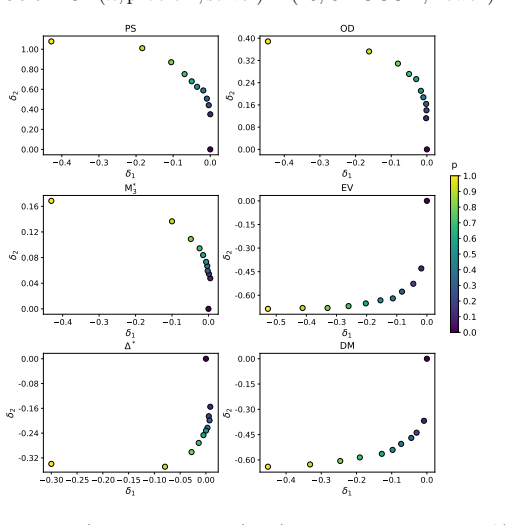
- [Section 5 / Section 6.2] The QMOOC cost function is defined as minimizing p·I(Y(θ)) + (1−p)·(−HV(Y(θ))). Because the optimizer minimizes, the I term rewards small values of I for every p>0. This is coherent for the uniformity-type indicators DM, Δ*, and EV, where smaller values are better. It is not coherent for the extent-type indicators PS, OD, and M*3, which Section 5 itself describes as measuring extent and boundary coverage, so larger values denote better coverage. The reported results in Section 6.2 and Figure 6 nevertheless show positive δ2(I,p) for exactly these indicators, including the statement that Pareto Spread coverage can be increased by 40% with no significant hypervolume loss. A positively weighted I in a minimization cannot produce an increase of a larger-is-better indicator. Thus the experiments as described cannot realize the reported coverage improvements: either the implementation minimized p·(−I)+(1−p)·(−HV) (or equivalently maximized p·I+(1−p)·HV), in which case the published cost function is wrong, or the reported δ2 values are inconsistent with the stated algorithm. The formula, the implementation, and the empirical claims must be reconciled and the tradeoff curves re-derived under one consistent convention.
- [Section 4.1] The claimed equivalence 'X(θ) is minimal in P_P(F_2^n) w.r.t. ⊴_f if and only if F(θ) is minimal in F(R^{KP}) w.r.t. ≦' is stated without proof and is false as stated. A concrete counterexample with K=1 and P=2: take four decision vectors a,b,c,d with objective values f(a)=5, f(b)=0, f(c)=0, f(d)=5. Suppose for parameter θ the two most frequent states are a then b, so F(θ)=(5,0), and for θ' the two most frequent states are c then d, so F(θ')=(0,5). As sets, X(θ')={c,d} dominates X(θ)={a,b} under ⊴_f via the permutation matching c with b and d with a, because 0≤0 and 5≤5. Yet F(θ')=(0,5) is not ≤ F(θ)=(5,0) in R^2, since the second coordinate gives 5≤0. The structural reason is that F fixes the coordinate order by the frequency ranking inside each θ, whereas ⊴_f allows an arbitrary matching permutation. Therefore the reduction of MCO3 to ordinary vector dominance is not established, and the theoretical justification for QMOOM as formulated collapses. The authors should either prove the equivalence under additional assumptions or restate QMOOM as a heuristic whose objectives are the frequency-ordered objective vectors, without claiming the equivalence.
- [Section 6.1 / Section 4.2] The comparison between QMOOM and QMOO does not control for computational effort. QMOOM is given an explicit budget of at most 200 generations and 4000 evaluations, as stated in Section 4.2. No analogous termination criterion or maximum number of function evaluations is reported for COBYLA, Nelder-Mead, or Powell inside QMOO, and the number of quantum circuit executions per run is not stated. The observed average gains of 1 to 10 percentage points, and especially the claims about improved worst-case behavior, could therefore be an artifact of unequal evaluation budgets. The authors should report the total number of cost evaluations or wall-clock time for each configuration and, ideally, run all methods under matched budgets.
minor comments (5)
- [Appendix Figures 8-22] The appendix plots have axes labeled only by the numbers '1' and '2', with no axis titles, so it is not possible to verify the sign conventions of δ1 and δ2 from the figures; please add axis labels and a legend explaining the plotted quantities.
- [References] The reference [SE24] is given as 'https://github.com/username/repo', which is a placeholder; the actual repository link is needed for reproducibility of the benchmark data.
- [Section 5 / Section 2] The Pareto Spread formula uses ~ y^I and ~ y^N in the denominator, but Section 2 defines only the true ideal y^I and the approximate nadir ~ y^N; the approximate ideal ~ y^I is never defined and should be specified or removed.
- [Section 6.2 and Appendix] The statement that 'the other problem types and solvers behave similarly' is too strong: in the appendix, DM shows a positive δ2 in some configurations (e.g., Figure 17), so the sign and magnitude of the effect are indicator- and setting-dependent; the main text should qualify this claim.
- [Throughout] The manuscript contains numerous typographical errors, including 'apporach', 'calld', 'euclidiean', 'intervall', 'NSGSA-II', and 'opzimizer'; a careful proofreading pass is needed.
Circularity Check
No significant circularity: the QMOOM and QMOOC claims are empirical comparisons against external indicators, not fits renamed as predictions.
full rationale
The paper's two contributions are methodological. QMOOM replaces the scalar hypervolume cost with a vector-valued reformulation and uses NSGA-II; the benchmark measures hypervolume relative to the true Pareto front, an external quantity not used in QMOOM's cost or selection. No fitted parameter is later reported as a prediction. QMOOC adds a coverage indicator I to the cost and measures δ2 on the same I; this is a direct tradeoff characterization rather than an independent prediction, and the paper explicitly frames it as 'allowing explicit control over diversity.' The reported 40% coverage gain is an empirical outcome of the optimizer, not a quantity defined to equal its input. There is a sign inconsistency for extent-type indicators (PS, OD, M*3) that would make the published cost function push these indicators down while Section 6.2 reports increases; this is a correctness/reproducibility concern, not circularity. The Section 4.1 equivalence is asserted without proof and may be false for arbitrary frequency-sorted vectors, but it is an unproven lemma, not a circular reduction. Self-citations ([EWS24], [DCL+24], [TAB+24], [SE24]) are used as background or benchmark sources and are not load-bearing. Therefore the circularity score is 0.
Assumptions & free parameters
free parameters (4)
- Number of layers L =
5
- Pareto set size P =
n + K (12 or 15)
- NSGA-II population size =
5
- Coverage weight p =
0.1, 0.2, ..., 1.0
assumptions (4)
- domain assumption The ansatz U(θ) can express states that approximate the Pareto front.
- ad hoc to paper The equivalence between set dominance and vector dominance (Section 4.1) is true.
- domain assumption Statevector simulation and selection of the P most probable bitstrings is representative of quantum execution.
- domain assumption The benchmark instances are representative of practical multicriteria optimization.
Cite this review
Pith. "Pith review of Enhancing Variational Quantum Algorithms for Multicriteria Optimization." pith.science (2026). https://pith.science/paper/DA7ZZZ6P
@misc{pith2026250622159,
  author       = {Pith},
  title        = {Pith review of: Enhancing Variational Quantum Algorithms for Multicriteria Optimization},
  year         = {2026},
  howpublished = {\url{https://pith.science/paper/DA7ZZZ6P}},
  note         = {Machine review of arXiv:2506.22159}
}
read the original abstract
This paper presents methodological improvements to variational quantum algorithms (VQAs) for solving multicriteria optimization problems. We introduce two key contributions. First, we reformulate the parameter optimization task of VQAs as a multicriteria problem, enabling the direct use of classical algorithms from various multicriteria metaheuristics. This hybrid framework outperforms the corresponding single-criteria VQAs in both average and worst-case performance across diverse benchmark problems. Second, we propose a method that augments the hypervolume-based cost function with coverage-oriented indicators, allowing explicit control over the diversity of the resulting Pareto front approximations. Experimental results show that our method can improve coverage by up to 40\% with minimal loss in hypervolume. Our findings highlight the potential of combining quantum variational methods with classical population-based search to advance practical quantum optimization.
Figures


Figures from the paper (19 more)




Reference graph
Works this paper leans on
-
[1]
[AAA+24] Amira Abbas, Andris Ambainis, Brandon Augustino, Andreas B¨ artschi, Harry Buhrman, Carleton Coffrin, Giorgio Cortiana, Vedran Dunjko, Daniel J. Egger, Bruce G. Elmegreen, Nicola Franco, Filippo Fratini, Bryce Fuller, Julien Gacon, Constantin Gonciulea, Sander Gribling, Swati Gupta, Stuart Hadfield, Raoul Heese, Gerhard Kircher, Thomas Kleinert, ...
work page 2024
-
[4]
[BD20a] J. Blank and K. Deb, pymoo: Multi-objective optimization in python , IEEE Access 8 (2020), 89497–89509. [BD20b] Julian Blank and Kalyanmoy Deb, Pymoo: Multi-objective optimization in python, IEEE Access 8 (2020), 89497–89509. [BV16] Benjam ´ ın Bar´ an and Marcos Villagra, Multiobjective optimization in a quantum adiabatic computer, Electronic Not...
work page 2020
-
[9]
[CPM+24] Shao-Hen Chiew, Kilian Poirier, Rajesh Mishra, Ulrike Bornheimer, Ewan Munro, Si Han Foon, Christopher Wanru Chen, Wei Sheng Lim, and Chee Wei Nga, Mul- tiobjective optimization and network routing with near-term quantum computers , IEEE Transactions on Quantum Engineering 5 (2024), 1–19. [DCL+24] Zakaria Abdelmoiz Dahi, Francisco Chicano, Gabrie...
work page 2024
-
[11]
[RB17] Daniel Ruffinelli and Benjam ´ ın Bar´ an, Linear nearest neighbor optimization in quantum circuits: a multiobjective perspective , Quantum Information Processing 16 (2017), no
work page 2017
-
[16]
[SE24] S. Schmitt and L. Ekstrom, qmoo benchmark functions, GitHub repository, 2024, https://github.com/username/repo. [SESS24] Aleksandra Swierkowska, Jorge Echavarria, Laura Schulz, and Martin Schulz, Achieving pareto-optimality in quantum circuit compilation via a multi-objective heuristic optimization approach , 2024 IEEE International Conference on Q...
work page 2024
-
[22]
[TAB+24] Ivica Turkalj, Mohammad Assadsolimani, Markus Braun, Pascal Halffmann, Niklas Hegemann, Sven Kerstan, Janik Maciejewski, Shivam Sharma, and Yuan- heng Zhou, Quadratic unconstrained binary optimization approach for incorpo- rating solvency capital into portfolio optimization , Risks 12 (2024), no. 2,
work page 2024
-
[23]
[UPMGRM22] Helen Urgelles, Pablo Picazo-Martinez, David Garcia-Roger, and Jose F
[TCC+22] Jules Tilly, Hongxiang Chen, Shuxiang Cao, Dario Picozzi, Kanav Setia, Ying Li, Edward Grant, Leonard Wossnig, Ivan Rungger, George Booth, and Jonathan Tennyson, The variational quantum eigensolver: A review of methods and best practices, Physics Reports 986 (2022), 1–128. [UPMGRM22] Helen Urgelles, Pablo Picazo-Martinez, David Garcia-Roger, and ...
work page 2022
-
[102]
[ABC+20] Charles Audet, Jean Bigeon, Dominique Cartier, S´ ebastien Le Digabel, and Lu- dovic Salomon, Performance indicators in multiobjective optimization , European Journal of Operational Research 292 (2020), 397–422. ENHANCING VQAS FOR MULTICRITERIA OPTIMIZATION 25 [AdJP+24] Esteban Aguilera, Jins de Jong, Frank Phillipson, Skander Taamallah, and Misc...
work page 2020
Show all 20 references
-
[284]
[DPAM02] K. Deb, A. Pratap, S. Agarwal, and T. Meyarivan, A fast and elitist multiobjective genetic algorithm: Nsga-ii , IEEE Transactions on Evolutionary Computation 6 (2002), no. 2, 182–197. [DVLHHS+23] Pablo D ´ ıez-Valle, Jorge Luis-Hita, Senaida Hern´ andez-Santana, Ferna...
2002
-
[366]
26 ENHANCING VQAS FOR MULTICRITERIA OPTIMIZATION [HSD+22] Pascal Halffmann, Luca E
[HRT21] Arne Herzel, Stefan Ruzika, and Clemens Thielen, Approximation methods for multiobjective optimization problems: A survey , INFORMS Journal on Comput- ing (2021). 26 ENHANCING VQAS FOR MULTICRITERIA OPTIMIZATION [HSD+22] Pascal Halffmann, Luca E. Sch¨ afer, Kerstin D¨ ...
2021
-
[460]
[EGN06] Michael Emmerich, Kyriakos Giannakoglou, and Boris Naujoks, Single- and multi- objective evolutionary optimization assisted by gaussian random field metamodels, Evolutionary Computation, IEEE Transactions on 10 (2006), 421 –
2006
-
[1291]
[AYCH23] Rhonda Au-Yeung, Nicholas Chancellor, and Pascal Halffmann, Np-hard but no longer hard to solve? using quantum computing to tackle optimization problems , Frontiers in Quantum Science and Technology 2 (2023). [BCV21] Benjam ´ ın Bar´ an, Alejo Carballude, and Marcos V...
2023
-
[1994]
[PUW+24] Niklas Pirnay, Vincent Ulitzsch, Frederik Wilde, Jens Eisert, and Jean-Pierre Seifert, An in-principle super-polynomial quantum advantage for approximating combinatorial optimization problems via computational learning theory , Science Advances 10 (2024), no
2024
-
[1999]
2601–2606
[KKH] Yehoon Kim, Jong-Hwan Kim, and Kuk-Hyun Han, Quantum-inspired multiobjec- tive evolutionary algorithm for multiobjective 0/1 knapsack problems , 2006 IEEE International Conference on Evolutionary Computation, IEEE, pp. 2601–2606. [KPR+25] Ayse Kotil, Elijah Pelofske, Ste...
2006
-
[2002]
[MC25] Linda Mauron and Giuseppe Carleo, Challenging the quantum advantage frontier with large-scale classical simulations of annealing dynamics
[Luc14] Andrew Lucas, Ising formulations of many NP problems , Frontiers in Physics 2 (2014). [MC25] Linda Mauron and Giuseppe Carleo, Challenging the quantum advantage frontier with large-scale classical simulations of annealing dynamics . [MSWB25] Thorge M¨ uller, Ajainderpa...
2014
-
[2005]
[FGG14] Edward Farhi, Jeffrey Goldstone, and Sam Gutmann, A quantum approximate optimization algorithm , 2014, https://arxiv.org/abs/1411.4028
[EWS24] Linus Ekstrom, Hao Wang, and Sebastian Schmitt, Variational quantum multi- objective optimization, 2024, https://arxiv.org/abs/2312.14151. [FGG14] Edward Farhi, Jeffrey Goldstone, and Sam Gutmann, A quantum approximate optimization algorithm , 2014, https://arxiv.org/a...
2014 arXiv
-
[2008]
[ZT98] Eckart Zitzler and Lothar Thiele, Multiobjective optimization using evolutionary algorithms - a comparative case study , Proceedings of the 5th International Con- ference on Parallel Problem Solving from Nature (Berlin, Heidelberg), PPSN V, Springer-Verlag, 1998, p. 292...
2017
-
[2010]
[NM65] J. A. Nelder and R. Mead, A simplex method for function minimization , The Computer Journal 7 (1965), no. 4, 308–313. [PMS+13] Alberto Peruzzo, Jarrod Mcclean, Peter Shadbolt, Man Hong Yung, Xiaoqi Zhou, Peter Love, Al´ an Aspuru-Guzik, and Jeremy O’Brien, A variational...
1965
-
[2018]
Benjamin, Suguru Endo, Keisuke Fujii, Jarrod R
[CdlRAB+21] Marco Vinicio Sebastian Cerezo de la Roca, Andrew Thomas Arrasmith, Ryan Babbush, Simon C. Benjamin, Suguru Endo, Keisuke Fujii, Jarrod R. McClean, Kosuke Mitarai, Xiao Yuan, Lukasz Cincio, et al., Variational quantum algo- rithms, Nature Reviews Physics 3 (2021), no
2021
-
[7570]
Oliphant, Matt Haberland, Tyler Reddy, David Cournapeau, Evgeni Burovski, Pearu Peterson, Warren Weckesser, Jonathan Bright, St´ efan J
[VGO+20] Pauli Virtanen, Ralf Gommers, Travis E. Oliphant, Matt Haberland, Tyler Reddy, David Cournapeau, Evgeni Burovski, Pearu Peterson, Warren Weckesser, Jonathan Bright, St´ efan J. van der Walt, Matthew Brett, Joshua Wilson, K. Jar- rod Millman, Nikolay Mayorov, Andrew R....
2020
Reviewed August 6, 2026 · model on record in the stance chip above.
Discussion (0). Continue with ORCID to comment.