Entropic optimal transport beyond product reference couplings: the Gaussian case on Euclidean space
Pith reviewed 2026-05-19 06:54 UTC · model grok-4.3
The pith
Entropic optimal transport with Gaussian reference couplings reduces to a matrix optimization problem yielding explicit primal and dual solutions.
A machine-rendered reading of the paper's core claim, the machinery that carries it, and where it could break.
Core claim
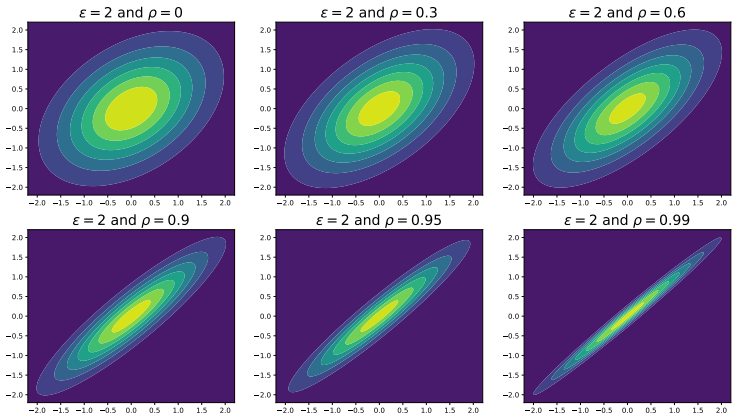
For the entropic optimal transport problem with squared Euclidean cost, replacing the usual product reference coupling by a Gaussian one reduces the variational problem to a matrix optimization. The resulting matrix problem supplies complete characterizations of both the optimal primal coupling and the dual variables. This structure is motivated by the need to assemble finitely many time marginals into coherent continuous-time dynamics, a task that product references cannot accomplish without breaking consistency.
What carries the argument
Reduction of the regularized optimal transport problem to a matrix optimization problem that parameterizes the Gaussian reference coupling and yields explicit solutions for the primal and dual variables.
If this is right
- The optimal coupling and dual potentials are obtained directly from the solution of the matrix problem.
- Transitions induced by the Gaussian reference assemble into a coherent continuous-time process.
- The framework supports reconstruction of trajectory dynamics from a finite collection of time marginals.
Where Pith is reading between the lines
- The matrix reduction may suggest analogous finite-dimensional simplifications when other structured non-product references are used.
- In statistical applications the explicit form could lead to faster algorithms for fitting models with temporal dependence.
Load-bearing premise
The reference coupling must be Gaussian and the cost must be squared Euclidean distance on Euclidean space for the reduction to a matrix problem to hold.
What would settle it
For low-dimensional Gaussian marginals, solve the matrix optimization, construct the implied coupling, and check whether it achieves the minimal value of the entropic objective compared with any other coupling.
Figures



read the original abstract
The Optimal Transport (OT) problem with squared Euclidean cost consists in finding a coupling between two input measures that maximizes correlation. Consequently, the optimal coupling is often singular with respect to the Lebesgue measure. Regularizing the OT problem with an entropy term yields an approximation called entropic optimal transport. Entropic penalties steer the induced coupling toward a reference measure with desired properties. For instance, when seeking a diffuse coupling, the most popular reference measures are the Lebesgue measure and the product of the two input measures. In this work, we study the case where the reference coupling is not a product, focussing on the Gaussian case as a core paradigm. We establish a reduction of such a regularised OT problem to a matrix optimization problem, enabling us to provide a complete description of the solution, both in terms of the primal variable and the dual variables. Beyond its intrinsic interest, allowing non-product references is essential in dynamic statistical settings. As a key motivation, we address the reconstruction of trajectory dynamics from finitely many time marginals where, unlike product references, Gaussian process references produce transitions that assemble into a coherent continuous-time process.
Editorial analysis
A structured set of objections, weighed in public.
Referee Report
Summary. The paper studies entropic optimal transport with squared-Euclidean cost on Euclidean space when the reference coupling is a non-product Gaussian (or Gaussian process). It reduces the regularized problem to a matrix optimization problem and supplies explicit characterizations of both the primal coupling and the dual variables. The construction is motivated by the need to reconstruct coherent continuous-time trajectory dynamics from finitely many time marginals, where product references fail to produce consistent transitions.
Significance. If the reduction and explicit solutions are correct, the work provides a concrete extension of entropic OT beyond the standard product or Lebesgue references. The matrix formulation yields a complete primal-dual description that is directly usable for Gaussian-process references, addressing a practical gap in dynamic statistical settings. The emphasis on assembling transitions into a continuous-time process is a clear strength for applications in trajectory inference.
major comments (2)
- [§3, Theorem 3.2] §3, Theorem 3.2: the claimed reduction of the entropic OT objective to an unconstrained matrix optimization problem is central to the complete description of the solution; the proof sketch relies on the quadratic cost and Gaussian reference to obtain closed-form optimality conditions, but the explicit matrix construction and verification that the resulting kernel satisfies the marginal constraints for arbitrary dimensions should be expanded to confirm no hidden parameter fitting occurs.
- [§4.2, Proposition 4.3] §4.2, Proposition 4.3: the dynamic consistency of the assembled transitions under the Gaussian-process reference is asserted to follow directly from the reference property, yet the argument would benefit from an explicit check that the finite-dimensional marginals remain consistent with a single underlying Gaussian process when the number of time points increases.
minor comments (2)
- [§2 and §3] Notation for the reference covariance matrices is introduced in §2 but reused with different subscripts in §3 without a consolidated table; a single reference table would improve readability.
- [Introduction] The abstract states that the reduction enables a 'complete description' of primal and dual variables; the introduction could more explicitly contrast this with the product-reference case to highlight the novelty.
Simulated Author's Rebuttal
We thank the referee for their thorough review and positive recommendation for minor revision. We address each major comment below and have prepared revisions to incorporate the suggested clarifications.
read point-by-point responses
-
Referee: [§3, Theorem 3.2] §3, Theorem 3.2: the claimed reduction of the entropic OT objective to an unconstrained matrix optimization problem is central to the complete description of the solution; the proof sketch relies on the quadratic cost and Gaussian reference to obtain closed-form optimality conditions, but the explicit matrix construction and verification that the resulting kernel satisfies the marginal constraints for arbitrary dimensions should be expanded to confirm no hidden parameter fitting occurs.
Authors: We appreciate the referee's suggestion to strengthen the presentation of Theorem 3.2. Upon review, we agree that expanding the proof to include the explicit matrix construction and a step-by-step verification of the marginal constraints in general dimensions will improve readability and confirm the absence of any hidden parameters. The derivation is based solely on the closed-form optimality conditions from the quadratic cost and the Gaussian reference covariance. We will include this expanded proof in the revised manuscript. revision: yes
-
Referee: [§4.2, Proposition 4.3] §4.2, Proposition 4.3: the dynamic consistency of the assembled transitions under the Gaussian-process reference is asserted to follow directly from the reference property, yet the argument would benefit from an explicit check that the finite-dimensional marginals remain consistent with a single underlying Gaussian process when the number of time points increases.
Authors: We thank the referee for this observation. While the consistency follows from the defining property of the Gaussian process reference (i.e., its finite-dimensional distributions being multivariate Gaussian with consistent covariances), we acknowledge that an explicit check would be beneficial for readers. In the revised version, we will add a detailed verification, perhaps in a remark following Proposition 4.3, showing that the marginals for any finite set of times are consistent with the underlying process via the Kolmogorov consistency conditions. revision: yes
Circularity Check
No significant circularity in the derivation chain
full rationale
The paper's central reduction of the entropic OT problem with non-product Gaussian reference coupling to a matrix optimization problem is derived directly from the regularized objective, the squared-Euclidean cost, and the Gaussian process reference properties on Euclidean space. Explicit primal and dual solutions follow from this formulation, and the assembly of transitions into a coherent continuous-time process is a direct consequence of the reference measure choice. No load-bearing step reduces by construction to a fitted input, self-definition, or unverified self-citation chain; the argument remains self-contained under the stated modeling assumptions without circular re-expression of inputs as predictions.
Axiom & Free-Parameter Ledger
axioms (2)
- domain assumption The cost function is squared Euclidean distance on Euclidean space.
- domain assumption The reference coupling can be chosen as a non-product Gaussian process whose transitions assemble into a continuous-time process.
Forward citations
Cited by 2 Pith papers
-
Sliced-Regularized Optimal Transport
SROT regularizes the OT plan toward a smoothened sliced OT plan, producing more accurate approximations to exact OT than entropic OT while also improving on the sliced OT reference.
-
Sliced-Regularized Optimal Transport
SROT regularizes the OT transport plan toward a sliced OT reference, yielding better approximations of exact OT than entropic OT and improving on the sliced OT plan itself.
Reference graph
Works this paper leans on
-
[1]
L. Ambrosio, N. Gigli, and G. Savar´ e. Gradient Flows: In Metric Spaces and in the Space of Probability Measures. Lectures in Mathematics ETH Z¨ urich. Birkh¨ auser, Boston, 2005
work page 2005
-
[2]
C. R. Baker. Joint measures and cross-covariance operators. Transactions of the American Mathe- matical Society, 186:273–289, 1973
work page 1973
-
[3]
M. Bakonyi and H. J. Woerdeman. Matrix completions, moments, and sums of Hermitian squares . Princeton University Press, 2011
work page 2011
-
[4]
I. Bengtsson and K. ˙Zyczkowski. Geometry of Quantum States: An Introduction to Quantum En- tanglement. Cambridge University Press, Cambridge, UK, 2006
work page 2006
-
[5]
R. Bhatia. Positive definite matrices. In Positive Definite Matrices. Princeton university press, 2009
work page 2009
- [6]
-
[7]
S. P. Boyd and L. Vandenberghe. Convex optimization. Cambridge university press, 2004
work page 2004
- [8]
- [9]
-
[10]
J. A. Cuesta-Albertos, C. Matr´ an-Bea, and A. Tuero-Diaz. On lower bounds for the l 2-wasserstein metric in a hilbert space. Journal of Theoretical Probability, 9(2):263–283, 1996
work page 1996
-
[11]
M. Cuturi. Sinkhorn distances: Lightspeed computation of optimal transport. Advances in neural information processing systems, 26, 2013
work page 2013
- [12]
-
[13]
C. R. Givens and R. M. Shortt. A class of wasserstein metrics for probability distributions. Michigan Mathematical Journal, 31(2):231–240, 1984
work page 1984
- [14]
- [15]
- [16]
-
[17]
J. R. Magnus and H. Neudecker. Matrix differential calculus with applications in statistics and econometrics. John Wiley & Sons, 2019
work page 2019
-
[18]
A. Mallasto, A. Gerolin, and H. Q. Minh. Entropy-regularized 2-Wasserstein distance between Gaussian measures. Information Geometry, 5(1):289–323, 2022
work page 2022
-
[19]
S. D. Marino and A. Gerolin. An optimal transport approach for the schr¨ odinger bridge problem and convergence of sinkhorn algorithm. Journal of Scientific Computing , 85(2):27, 2020
work page 2020
-
[20]
H. Q. Minh. Entropic regularization of wasserstein distance between infinite-dimensional gaussian measures and gaussian processes. Journal of Theoretical Probability, 36(1):201–296, 2023
work page 2023
-
[21]
M. A. Nielsen and I. L. Chuang. Quantum Computation and Quantum Information . Cambridge University Press, Cambridge, UK, 2000
work page 2000
-
[22]
M. Nutz. Introduction to entropic optimal transport. Lecture notes, Columbia University , 2021
work page 2021
-
[23]
V. M. Panaretos and Y. Zemel. An invitation to statistics in Wasserstein space . Springer Nature, 2020
work page 2020
-
[24]
L. Pardo. Statistical inference based on divergence measures. Chapman and Hall/CRC, 2018
work page 2018
-
[25]
G. Peyr´ e, M. Cuturi, et al. Computational optimal transport: With applications to data science. Foundations and Trends® in Machine Learning, 11(5-6):355–607, 2019
work page 2019
-
[26]
P. Rigollet and A. J. Stromme. On the sample complexity of entropic optimal transport. The Annals of Statistics, 53(1):61–90, 2025
work page 2025
-
[27]
A. Takatsu. Wasserstein geometry of gaussian measures. Osaka J. Math. , 2011
work page 2011
-
[28]
C. Villani. Optimal transport: old and new , volume 338. Springer, 2009
work page 2009
-
[29]
C. Villani. Topics in optimal transportation , volume 58. American Mathematical Soc., 2021. 31 A Auxiliary results On the space of squared matrices Md(R), the Hilbert-Schmidt (also called Frobenius) scalar product is defined by ⟨A, B⟩HS := tr(ABT ); and reduces to ⟨A, B⟩HS = tr(AB) between symmetric matrices. Proposition A.1 (Kullback-Leibler divergence) ...
work page 2021
discussion (0)
Sign in with ORCID, Apple, or X to comment. Anyone can read and Pith papers without signing in.