USIGAN: Unbalanced Self-Information Feature Transport for Weakly Paired Image IHC Virtual Staining
Pith reviewed 2026-05-22 00:00 UTC · model grok-4.3
The pith
Removing weakly paired terms from the joint marginal distribution lets virtual staining models preserve pathological semantics even when H&E and IHC slices come from adjacent but non-identical tissue.
A machine-rendered reading of the paper's core claim, the machinery that carries it, and where it could break.
Core claim
By framing virtual staining as unbalanced self-information feature transport and explicitly removing weakly paired terms from the joint marginal distribution, the method constructs correlation matrices that reflect pathological semantics more accurately than standard paired or unpaired baselines, yielding virtual IHC images with improved content consistency and semantic fidelity to adjacent real slices.
What carries the argument
Unbalanced self-information feature transport, which removes weakly paired terms in the joint marginal distribution and uses UOT-CTM and PC-SCM to form correlation matrices between H&E, generated IHC, and real IHC sets.
If this is right
- Generated virtual IHC images maintain higher structural fidelity to the input H&E morphology.
- Pathological staining patterns in the output align more closely with those observed in real adjacent IHC slices.
- The approach reduces the need for perfectly registered training pairs while still delivering clinically usable consistency.
- Metrics such as IoD and Pearson-R correlation improve relative to prior virtual-staining models on the same data.
Where Pith is reading between the lines
- The same removal of mismatched terms could be tested in other medical image-translation settings where exact spatial correspondence is unavailable, such as multi-modal radiology.
- If the correlation matrices prove robust, the framework might support training on larger but noisier clinical archives without additional registration steps.
- A direct comparison of the learned matrices against expert-marked semantic regions on held-out slides would provide an independent check on whether global semantics suffice.
Load-bearing premise
Global morphological semantics taken without positional correspondence, once processed by the UOT-CTM and PC-SCM mechanisms, will yield correlation matrices that correctly capture pathological semantics across weakly paired adjacent slices.
What would settle it
Running the method on a new set of weakly paired H&E-IHC slides and finding that the resulting correlation matrices fail to align with independent pathologist annotations of semantic features, or that IoD and Pearson-R scores do not exceed strong baselines, would falsify the central claim.
Figures


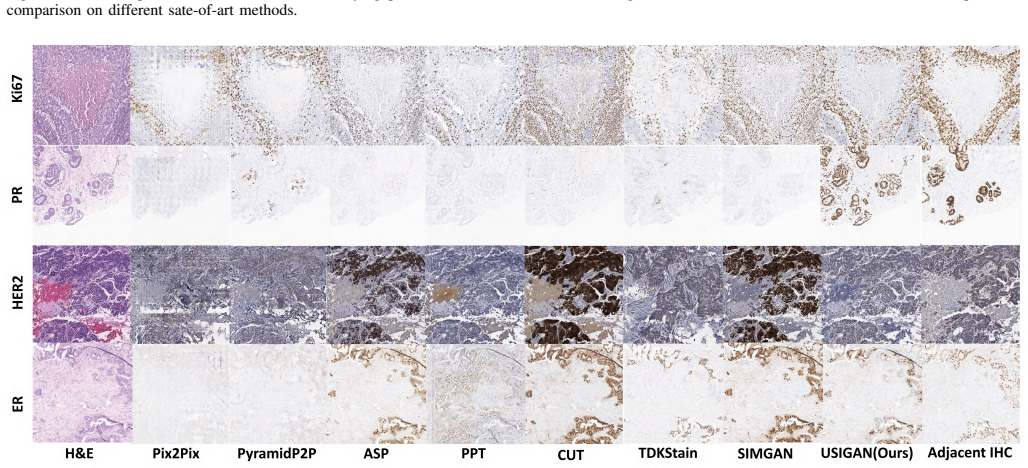


read the original abstract
Immunohistochemical (IHC) virtual staining is a task that generates virtual IHC images from H\&E images while maintaining pathological semantic consistency with adjacent slices. This task aims to achieve cross-domain mapping between morphological structures and staining patterns through generative models, providing an efficient and cost-effective solution for pathological analysis. However, under weakly paired conditions, spatial heterogeneity between adjacent slices presents significant challenges. This can lead to inaccurate one-to-many mappings and generate results that are inconsistent with the pathological semantics of adjacent slices. To address this issue, we propose a novel unbalanced self-information feature transport for IHC virtual staining, named USIGAN, which extracts global morphological semantics without relying on positional correspondence.By removing weakly paired terms in the joint marginal distribution, we effectively mitigate the impact of weak pairing on joint distributions, thereby significantly improving the content consistency and pathological semantic consistency of the generated results. Moreover, we design the Unbalanced Optimal Transport Consistency (UOT-CTM) mechanism and the Pathology Self-Correspondence (PC-SCM) mechanism to construct correlation matrices between H\&E and generated IHC in image-level and real IHC and generated IHC image sets in intra-group level.. Experiments conducted on two publicly available datasets demonstrate that our method achieves superior performance across multiple clinically significant metrics, such as IoD and Pearson-R correlation, demonstrating better clinical relevance.
Editorial analysis
A structured set of objections, weighed in public.
Referee Report
Summary. The manuscript presents USIGAN, a generative model for virtual IHC staining from H&E images under weakly paired conditions. It extracts global morphological semantics without positional correspondence, removes weakly paired terms from the joint marginal distribution to mitigate distribution shift, and introduces the UOT-CTM mechanism for unbalanced optimal transport consistency and the PC-SCM mechanism for pathology self-correspondence to construct image-level and intra-group correlation matrices. Experiments on two public datasets report superior performance on clinical metrics such as IoD and Pearson-R correlation.
Significance. If the central claims hold, the approach could advance virtual staining methods for pathology by handling common spatial heterogeneity in adjacent slices without requiring perfect pairings, potentially improving content and semantic consistency in generated images. The combination of unbalanced transport with self-information features offers a targeted response to weak pairing challenges.
major comments (3)
- Abstract and Method section: The central claim that 'removing weakly paired terms in the joint marginal distribution' mitigates impact and improves pathological semantic consistency lacks an explicit equation or derivation showing the modified joint distribution and the resulting transport plan; without this, it is unclear whether the removal preserves necessary information or simply relaxes the problem by construction.
- Method (UOT-CTM and PC-SCM): The mechanisms are described as constructing correlation matrices between H&E/generated IHC (image-level) and real/generated IHC (intra-group), but no details are given on how global morphological semantics (extracted without positional correspondence) are mapped to local pathological variations; this directly engages the concern that global features may align tissue type while mismatching cellular patterns relevant to IoD.
- Experiments: Superior IoD and Pearson-R results are reported, yet the manuscript does not include ablations isolating the contribution of term removal or the two mechanisms, nor statistical tests confirming that gains exceed those from standard unpaired baselines; this weakens attribution of improvements to the proposed components.
minor comments (2)
- Abstract: the sentence describing PC-SCM ends abruptly ('in intra-group level..'); complete the description for clarity.
- Notation: define acronyms UOT-CTM and PC-SCM at first use and ensure consistent use of 'self-information' versus 'self-correspondence' throughout.
Simulated Author's Rebuttal
We thank the referee for the thorough review and valuable feedback on our manuscript. We address each of the major comments in detail below, providing clarifications and indicating the revisions we plan to make to strengthen the paper.
read point-by-point responses
-
Referee: Abstract and Method section: The central claim that 'removing weakly paired terms in the joint marginal distribution' mitigates impact and improves pathological semantic consistency lacks an explicit equation or derivation showing the modified joint distribution and the resulting transport plan; without this, it is unclear whether the removal preserves necessary information or simply relaxes the problem by construction.
Authors: We appreciate this observation, as it points to a potential gap in the mathematical presentation. The manuscript describes the process of removing weakly paired terms from the joint marginal distribution to mitigate distribution shift caused by spatial heterogeneity. This is achieved by identifying and excluding terms with low correspondence scores computed from the self-information features. However, to make this clearer, we will add an explicit mathematical formulation of the original and modified joint distributions, along with the derivation of the resulting unbalanced transport plan, in the revised Method section. This will demonstrate that the removal selectively filters unreliable pairings while preserving the overall structure necessary for consistent mapping. revision: yes
-
Referee: Method (UOT-CTM and PC-SCM): The mechanisms are described as constructing correlation matrices between H&E/generated IHC (image-level) and real/generated IHC (intra-group), but no details are given on how global morphological semantics (extracted without positional correspondence) are mapped to local pathological variations; this directly engages the concern that global features may align tissue type while mismatching cellular patterns relevant to IoD.
Authors: Thank you for raising this important point regarding the connection between global and local features. In USIGAN, the global morphological semantics are captured through a feature extractor that operates on the entire image without assuming positional alignment. These global features inform the construction of the correlation matrices in UOT-CTM for image-level consistency between H&E and generated IHC, and in PC-SCM for intra-group correspondence between real and generated IHC. The unbalanced optimal transport then allows the model to adaptively align local pathological variations by permitting mass creation or destruction in the transport plan, which helps in handling mismatches at the cellular level while respecting the global semantics. We will revise the Method section to include a more detailed explanation of this mapping process, potentially with an illustrative figure showing the flow from global features to local correlation adjustments. revision: yes
-
Referee: Experiments: Superior IoD and Pearson-R results are reported, yet the manuscript does not include ablations isolating the contribution of term removal or the two mechanisms, nor statistical tests confirming that gains exceed those from standard unpaired baselines; this weakens attribution of improvements to the proposed components.
Authors: We agree that additional experiments would better attribute the performance gains to the specific components of our method. The current evaluation compares USIGAN against several state-of-the-art unpaired and weakly paired baselines on two public datasets, showing improvements in IoD and Pearson-R. To address this, we will conduct ablation studies by disabling the weakly paired term removal, UOT-CTM, and PC-SCM one at a time, and report the resulting metrics. Additionally, we will include statistical tests, such as paired t-tests, to confirm the significance of the improvements over the baselines. These results will be added to the Experiments section in the revised manuscript. revision: yes
Circularity Check
No significant circularity; derivation relies on proposed mechanisms rather than self-referential reduction.
full rationale
The paper introduces USIGAN with novel components UOT-CTM and PC-SCM to address weakly paired IHC staining by extracting global morphological semantics and removing weakly paired terms from the joint marginal distribution. No equations or self-citations are shown that reduce the central consistency claims to fitted inputs or prior author results by construction. The approach is presented as a new transport-based solution with independent content for improving semantic consistency, making the derivation self-contained against external benchmarks like IoD and Pearson-R on public datasets.
Axiom & Free-Parameter Ledger
free parameters (1)
- transport regularization parameter
axioms (1)
- domain assumption Global morphological semantics can be extracted independently of positional correspondence in adjacent tissue slices.
invented entities (3)
-
Unbalanced Self-Information Feature Transport
no independent evidence
-
UOT-CTM mechanism
no independent evidence
-
PC-SCM mechanism
no independent evidence
Reference graph
Works this paper leans on
-
[1]
Pathological semantics-preserving learning for H&E-to-IHC virtual staining
Fuqiang Chen et al. “Pathological semantics-preserving learning for H&E-to-IHC virtual staining”. In: In- ternational Conference on Medical Image Computing and Computer-Assisted Intervention . Springer. 2024, pp. 384–394
work page 2024
-
[2]
Scaling Algorithms for Unbalanced Transport Problems
Lenaic Chizat et al. “Scaling algorithms for un- balanced transport problems”. In: arXiv preprint arXiv:1607.05816 (2016)
work page internal anchor Pith review Pith/arXiv arXiv 2016
-
[3]
Label-free virtual HER2 immunohistochemical staining of breast tissue using deep learning
B DoanNgan, DarrowMorgan Angus, LeeHan Sung, et al. “Label-free virtual HER2 immunohistochemical staining of breast tissue using deep learning”. In: BME frontiers (2022)
work page 2022
-
[4]
Contrastive learning improves model robustness under label noise
Aritra Ghosh and Andrew Lan. “Contrastive learning improves model robustness under label noise”. In: Pro- ceedings of the IEEE/CVF conference on computer vision and pattern recognition . 2021, pp. 2703–2708
work page 2021
-
[5]
Supervised Information Mining from Weakly Paired Images for Breast IHC Virtual Staining
Xianchao Guan et al. “Supervised Information Mining from Weakly Paired Images for Breast IHC Virtual Staining”. In: IEEE Transactions on Medical Imaging (2025)
work page 2025
-
[6]
Deep learning-based transformation of H&E stained tissues into special stains
K de Haan et al. Deep learning-based transformation of H&E stained tissues into special stains. Nat Commun. 2021; 12: 4884
work page 2021
-
[7]
Qs-attn: Query-selected attention for contrastive learning in i2i translation
Xueqi Hu et al. “Qs-attn: Query-selected attention for contrastive learning in i2i translation”. In: Proceedings of the IEEE/CVF Conference on Computer Vision and Pattern Recognition. 2022, pp. 18291–18300
work page 2022
-
[8]
Image-to-image translation with conditional adversarial networks
Phillip Isola et al. “Image-to-image translation with conditional adversarial networks”. In: Proceedings of the IEEE conference on computer vision and pattern recognition. 2017, pp. 1125–1134
work page 2017
-
[9]
Chanyong Jung, Gihyun Kwon, and Jong Chul Ye. “Ex- ploring Patch-Wise Semantic Relation for Contrastive Learning in Image-to-Image Translation Tasks”. In: Proceedings of the IEEE/CVF Conference on Computer Vision and Pattern Recognition (CVPR) . June 2022, pp. 18260–18269
work page 2022
-
[10]
Exploring patch-wise semantic relation for contrastive learning in image-to-image translation tasks
Chanyong Jung, Gihyun Kwon, and Jong Chul Ye. “Exploring patch-wise semantic relation for contrastive learning in image-to-image translation tasks”. In: Pro- ceedings of the IEEE/CVF conference on computer vision and pattern recognition. 2022, pp. 18260–18269
work page 2022
-
[11]
Unpaired Image-to-Image Transla- tion via Neural Schr ¨odinger Bridge
Beomsu Kim et al. Unpaired Image-to-Image Transla- tion via Neural Schr ¨odinger Bridge. 2024. arXiv: 2305. 15086 [cs.CV]. URL: https : / / arxiv. org / abs / 2305 . 15086
work page 2024
-
[12]
Fangda Li et al. “Adaptive supervised patchnce loss for learning h&e-to-ihc stain translation with inconsistent groundtruth image pairs”. In: International Conference on Medical Image Computing and Computer-Assisted Intervention. Springer. 2023, pp. 632–641. JOURNAL OF IEEE TRANS, VOL. 18, NO. 9, JULY 2025 13
work page 2023
-
[13]
Jia-Ren Lin et al. “High-plex immunofluorescence imaging and traditional histology of the same tissue section for discovering image-based biomarkers”. In: Nature cancer 4.7 (2023), pp. 1036–1052
work page 2023
-
[14]
Xiaoqi Lin. “Characteristic morphology and immuno- histochemical patterns of clear cell papillary renal cell tumours may be observed in renal cell carcinomas, a critical pitfall in renal biopsy cytopathology”. In: Cytopathology 35.4 (2024), pp. 481–487
work page 2024
-
[15]
Bci: Breast cancer immunohisto- chemical image generation through pyramid pix2pix
Shengjie Liu et al. “Bci: Breast cancer immunohisto- chemical image generation through pyramid pix2pix”. In: Proceedings of the IEEE/CVF conference on com- puter vision and pattern recognition . 2022, pp. 1815– 1824
work page 2022
-
[16]
Unpaired stain transfer using pathology-consistent constrained generative adversarial networks
Shuting Liu et al. “Unpaired stain transfer using pathology-consistent constrained generative adversarial networks”. In: IEEE transactions on medical imaging 40.8 (2021), pp. 1977–1989
work page 2021
-
[17]
Contrastive learning for unpaired image-to-image translation
Taesung Park et al. “Contrastive learning for unpaired image-to-image translation”. In: Computer Vision– ECCV 2020: 16th European Conference, Glasgow, UK, August 23–28, 2020, Proceedings, Part IX 16. Springer. 2020, pp. 319–345
work page 2020
-
[18]
Advancing H&E-to-IHC Virtual Staining with Task-Specific Domain Knowledge for HER2 Scoring
Qiong Peng et al. “Advancing H&E-to-IHC Virtual Staining with Task-Specific Domain Knowledge for HER2 Scoring”. In: International Conference on Medi- cal Image Computing and Computer-Assisted Interven- tion. Springer. 2024, pp. 3–13
work page 2024
-
[19]
Virtual histological staining of un- labelled tissue-autofluorescence images via deep learn- ing
Yair Rivenson et al. “Virtual histological staining of un- labelled tissue-autofluorescence images via deep learn- ing”. In: Nature biomedical engineering 3.6 (2019), pp. 466–477
work page 2019
-
[20]
Quan- tification of histochemical staining by color deconvo- lution
Arnout C Ruifrok, Dennis A Johnston, et al. “Quan- tification of histochemical staining by color deconvo- lution”. In: Analytical and quantitative cytology and histology 23.4 (2001), pp. 291–299
work page 2001
-
[21]
Tehrani. “Nonlinear imaging histopathology: a pipeline to correlate gold-standard hematoxylin and eosin stain- ing with modern nonlinear microscopy”. In: IEEE Jour- nal of Selected Topics in Quantum Electronics 29.4: Biophotonics (2023), pp. 1–8
work page 2023
-
[22]
Frency Varghese et al. “IHC Profiler: an open source plugin for the quantitative evaluation and automated scoring of immunohistochemistry images of human tissue samples”. In: PloS one 9.5 (2014), e96801
work page 2014
-
[23]
High-resolution image synthe- sis and semantic manipulation with conditional gans
Ting-Chun Wang et al. “High-resolution image synthe- sis and semantic manipulation with conditional gans”. In: Proceedings of the IEEE conference on computer vision and pattern recognition . 2018, pp. 8798–8807
work page 2018
-
[24]
Weilun Wang et al. “Instance-wise hard negative ex- ample generation for contrastive learning in unpaired image-to-image translation”. In: Proceedings of the IEEE/CVF international conference on computer vision. 2021, pp. 14020–14029
work page 2021
-
[25]
Unpaired Multi-Domain Histopathol- ogy Virtual Staining using Dual Path Prompted In- version
Bing Xiong et al. “Unpaired Multi-Domain Histopathol- ogy Virtual Staining using Dual Path Prompted In- version”. In: Proceedings of the AAAI Conference on Artificial Intelligence. V ol. 39. 8. 2025, pp. 8780–8787
work page 2025
-
[26]
Modulated contrast for versatile image synthesis
Fangneng Zhan et al. “Modulated contrast for versatile image synthesis”. In: Proceedings of the IEEE/CVF Conference on Computer Vision and Pattern Recogni- tion. 2022, pp. 18280–18290
work page 2022
-
[27]
Unbalanced feature transport for exemplar-based image translation
Fangneng Zhan et al. “Unbalanced feature transport for exemplar-based image translation”. In: Proceedings of the IEEE/CVF conference on computer vision and pattern recognition. 2021, pp. 15028–15038
work page 2021
-
[28]
Ranran Zhang et al. “MVFStain: multiple virtual func- tional stain histopathology images generation based on specific domain mapping”. In: Medical Image Analysis 80 (2022), p. 102520
work page 2022
-
[29]
Wei Zhang et al. “High-Resolution Medical Image Translation via Patch Alignment-Based Bidirectional Contrastive Learning”. In: International Conference on Medical Image Computing and Computer-Assisted In- tervention. Springer. 2024, pp. 178–188
work page 2024
-
[30]
The Spatially-Correlative Loss for Various Image Transla- tion Tasks
Chuanxia Zheng, Tat-Jen Cham, and Jianfei Cai. The Spatially-Correlative Loss for Various Image Transla- tion Tasks. 2021. arXiv: 2104.00854 [cs.CV]. URL: https://arxiv.org/abs/2104.00854
-
[31]
Unpaired image-to-image transla- tion using cycle-consistent adversarial networks
Jun-Yan Zhu et al. “Unpaired image-to-image transla- tion using cycle-consistent adversarial networks”. In: Proceedings of the IEEE international conference on computer vision. 2017, pp. 2223–2232
work page 2017
discussion (0)
Sign in with ORCID, Apple, or X to comment. Anyone can read and Pith papers without signing in.