REVIEW 3 major objections 5 minor 53 references
Sparse Signal Recovery From Quadratic Systems with Full-Rank Matrices
T0 review · 3 major / 5 minor · reviewed 2026-08-06 · deepseek-v4-flash
Pith's one-line read The paper proves that $s$-sparse signals are uniquely recoverable from $m \geq 2s$ generic quadratic measurements, and that a two-stage Sparse Gauss-Newton algorithm refines an accurate initialization to quadratic convergence using only…
desk verdict The uniqueness results are clean and the refinement claim is promising, but the printed initialization has a real scaling bug and the key uniform concentration lemma is only sketched; worth a serious referee, conditional on fixes. read the letter →
The pith
A machine-rendered reading of the paper's core claim, the machinery that carries it, and where it could break.
The reading
What carries the argument
The engine is the support-restricted Gauss-Newton step of equations (3.7)-(3.8), driven by a uniform concentration lemma for the empirical Jacobian $J(x) = \frac{1}{\sqrt{m}}[(A_1+A_1^{\top})x, \dots, (A_m+A_m^{\top})x]^{\top}$ of the quadratic map. Lemma 7.11 asserts that once $m \geq C(\delta)s\log n$, the sample Jacobian Gram matrix stays within $\delta\|p\|\|q\|$ of its expectation over every support of size at most $4s$ at once; Lemma 7.13 converts that into uniform bounds $(2-\delta)\|p\|^2 \leq \|J_S(p)^{\top}J_S(p)\| \leq (4+\delta)\|p\|^2$ and controls the cross-support term. These bounds make each hard-thresholded Gauss-Newton step (keep the $s$ largest entries, solve the restricted linearized least-squares problem) contract linearly while the support is still being recovered, and quadratically once the support is fixed, because the residual then factors as a product of the current error with itself. A diagonal-marginal thresholding step in Algorithm 1 supplies the required $\delta < 0.01$ starting point.
What would settle it
Run Algorithm 2 on Gaussian problems with $n=500$, $s=10$, $m = C s\log n$ for a constant $C$ at the level required by Lemma 7.11, starting from an initialization with $\mathrm{dist}(x_0,x)=0.005\|x\|$; if the quadratic contraction $\mathrm{dist}(x_{k+1},x) \leq \nu'\,\mathrm{dist}^2(x_k,x)$ has not appeared by iteration $c_1\log(\|x\|/x_{\min}) + c_2$, or if a direct Monte-Carlo evaluation of the uniform sup in (7.7) over randomly sampled supports of size $4s$ exceeds $\delta$ at $m = C s \log n$, then the hypothesis of Theorem 4.2 is violated and the central claim fails.
Extended reading notes
Core claim
The paper's central claim is that sparse quadratic systems are both identifiable and computationally tractable at near-linear-in-sparsity sampling rates. The identifiability result, proved by dimension counting on projective varieties, is that a generic set of $m \geq 2s$ real matrices, or $m \geq 4s-2$ complex Hermitian matrices, makes the measurement map $x \mapsto (x^{\top} A_1 x, \dots, x^{\top} A_m x)$ injective on all $s$-sparse signals up to global phase. The algorithmic claim, Theorem 4.2, is that under i.i.d. Gaussian matrices, an initial estimate with $\mathrm{dist}(x_0, x) \leq \delta\|x\|$, $\delta < 0.01$, and $m \geq C' s \log n$ suffices for Algorithm 2 to satisfy $\mathrm{dist}(x_{k+1}, x) \leq \nu'\,\mathrm{dist}^2(x_k, x)$ for every $k \geq c_1 \log(\|x\|/x_{\min}) + c_2$ in the noise-free case, with a linear contraction phase before that; in the noisy case it attains the minimax error rate $O\big(\frac{\sigma}{\|x\|}\sqrt{\frac{s\log(en/s)}{m}}\big)$. The paper concludes that SGN is the first sparse full-rank quadratic recovery method whose refinement stage reaches quadratic convergence at near-optimal sample complexity without sample splitting.
Load-bearing premise
The load-bearing assumption is a single uniform concentration estimate (Lemma 7.11): with only $m \geq C(\delta)s\log n$ Gaussian matrices, the derivative of the quadratic measurement map is uniformly well behaved on every support of size up to $4s$ at once; the appendix sketches the proof by analogy to a fixed-support lemma from [15], and if that uniform bound fails at this sampling rate, the $O(s\log n)$ refinement and quadratic convergence guarantees do not follow.
Editorial extensions
If this is right
- Refinement of sparse quadratic signals becomes possible with $m = O(s\log n)$ measurements, so the remaining sampling bottleneck is the $O(s^2\log n)$ initialization stage rather than the iteration stage.
- Because no resampling or sample splitting is needed, the same Gaussian measurements can drive both initialization and refinement, simplifying hardware and protocol design in computational imaging and cryo-electron microscopy.
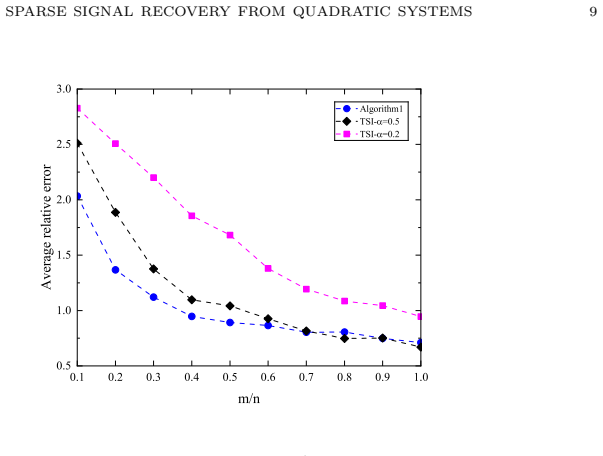
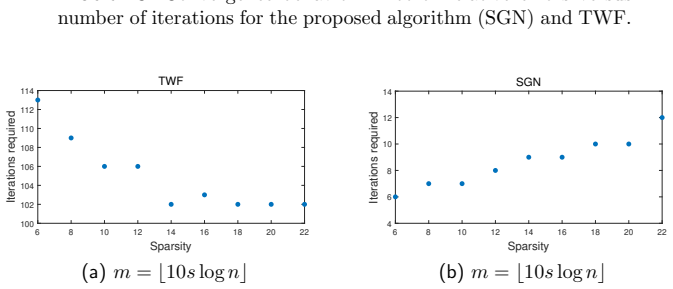
- The corollary iteration count $O(\log\log(1/\epsilon) + \log(\|x\|/x_{\min}))$ means an $\epsilon$-accurate sparse solution is reached in very few passes, matching the experiments where SGN needs roughly a tenth of the iterations of the comparison methods.
- The noisy-case error bound $O\big(\frac{\sigma}{\|x\|}\sqrt{\frac{s\log(en/s)}{m}}\big)$ matches the minimax rate for sparse estimation, so the estimator is statistically optimal in the sparse regime.
- The generic uniqueness theorems put the measurement floor at $2s$ (real) and $4s-2$ (complex), independent of ambient dimension $n$, so the $m \ll n$ regime is information-theoretically viable.
Reading between the lines
- The paper leaves the initialization at $O(s^2\log n)$; a natural next step, not pursued here, would be to redesign the support-restricted spectral step so the whole pipeline runs at $O(s\log n)$ and becomes sample-optimal end to end.
- The same Jacobian concentration machinery should transfer to other structured priors, such as generative models or low-rank matrices, by replacing the sparsity support sets with the corresponding prior tangent sets; running SGN with a generative projection would test this directly.
- The finite linear phase of length $c_1\log(\|x\|/x_{\min}) + c_2$ predicts that signals with very small nonzero entries spend more iterations in linear convergence; this is a testable prediction about how the phase transition shifts with $x_{\min}$.
- One could empirically probe whether keeping $2s$ rather than $s$ entries in the hard-thresholding step accelerates support identification without destroying the quadratic phase; the current theory is restricted to exactly $s$.
Editorial analysis
A structured set of objections, weighed in public.
Referee Report
Summary. The paper studies recovery of an s-sparse signal x from m quadratic measurements y_i = x^T A_i x, where A_i are full-rank Gaussian matrices. It proves generic uniqueness with m >= 2s in the real case and m >= 4s - 2 in the complex case, and proposes a two-stage algorithm: a support-restricted spectral initialization (Algorithm 1) followed by a hard-thresholding Gauss-Newton refinement (Algorithm 2). The main theoretical claims are that the initialization reaches error delta0||x|| with m = O(s^2 log n) measurements, and that the refinement converges linearly and, in the noise-free case, quadratically after O(log(||x||/x_min)) iterations with m = O(s log n), without resampling. Numerical experiments compare the proposed SGN against Wirtinger Flow and Thresholded Wirtinger Flow.
Significance. If the main claims hold, the paper would provide the first sparse full-rank quadratic recovery algorithm with a refinement stage at O(s log n) measurements and quadratic convergence, a clear improvement over the O(s^2 log n) bottleneck of prior work. The algebraic-geometry uniqueness results are clean and appear correct. The paper is generally clearly written and the appendix contains substantial proof detail. However, there is an internal inconsistency in the initialization scaling and a flawed noisy initialization claim; these issues need to be addressed before the results can be accepted as stated.
major comments (3)
- [Algorithm 1 Step 4 and Section 3.1] The printed scaling phi = (1/(2m) sum y_i^2)^{1/4} is inconsistent with the measurement model. For A_i with iid N(0,1) entries, E[y_i^2] = E[(x^T A_i x)^2] = ||x||^4, so phi converges to 2^{-1/4}||x||, not ||x||. Lemma 7.6 and the proof of Theorem 4.1 in Appendix 7.3 use phi = (1/m sum y_i^2)^{1/4}, so the algorithm as stated does not implement the analyzed estimator. Even with perfect directional alignment, dist(x0,x) >= (1 - 2^{-1/4})||x|| ≈ 0.159||x||, which violates the delta < 0.01 hypothesis of Theorem 4.2 and the 'any delta0' claim of Theorem 4.1. Please correct Algorithm 1 and Section 3.1 to use 1/m, or justify the 1/2 factor under a different measurement model.
- [Theorem 4.1 (noisy case)] The noisy initialization guarantee is false for arbitrary sub-exponential noise with large sigma. With y_i = x^T A_i x + epsilon_i, E[y_i^2] = ||x||^4 + E[epsilon_i^2], so the estimator phi = (1/m sum y_i^2)^{1/4} converges to (||x||^4 + E[epsilon^2])^{1/4}, which is not ||x|| when E[epsilon^2] is comparable to ||x||^4. Thus no amount of additional measurements can drive dist(x0,x) below |(1 + E[epsilon^2]/||x||^4)^{1/4} - 1| ||x||, contradicting the 'for any delta0' claim. The proof invokes Lemma 7.6, which is stated only for the noise-free case; the sentence in Lemma 7.10 that Lemma 7.6 'still remains valid' when noise variance is small does not cover the stated regime. Please either restrict Theorem 4.1 to bounded noise (e.g., sigma/||x||^2 below a constant depending on delta0) or modify the norm estimation to be noise-aware.
- [Lemma 7.11, Appendix 7.4] Lemma 7.11 is the probabilistic foundation for the O(s log n) sample complexity and the quadratic convergence in Theorem 4.2, yet its proof is only sketched as 'the proof is similar to that of [15, Lemma 12]'. The extension from a fixed subset S to a uniform bound over all |S| <= 4s with m >= C(delta) s log n involves a nontrivial union bound over (en/s)^{4s} supports; please provide the complete argument, including the net argument for both displays (7.7) and (7.8) and the precise constants and probability exponents.
minor comments (5)
- [Section 7.2, proof of Theorem 2.2] In the proof of Theorem 2.2, the expression dim_R(Y union C^n_I) appears to be a typo; the intended set is likely Z intersect C^n_J. Please fix this and ensure all symbols are defined.
- [Lemma 7.9] The assertion that the estimated support satisfies S^+ subset of S-hat subset of S is not guaranteed by the top-s selection when |S^+| < s, because off-support indices with large Y_jj can enter S-hat. The subsequent error bound only requires S^+ subset of S-hat, so the proof can be corrected by deleting the false inclusion, but the statement as written is inaccurate.
- [Equation (7.24) and surrounding text] The derivation for omega1 includes a spurious mu_k multiplying the noise term; the Gauss-Newton update (3.7)-(3.8) does not contain mu_k, and the sentence 'with the fact F(x) = 0' is inconsistent with the noisy case under consideration. Please clarify the derivation and state the noisy counterpart of F(x) explicitly.
- [Lemma 7.10, equation (7.5)] The denominator sigma_1(E[Y_{S-hat}]) should be ||x_{S-hat}||^2, and its lower bound should use the support approximation from Lemma 7.9; as written, replacing it with ||x||^2 ignores the possible loss of support mass. The constants can be adjusted, but the inequality as printed is not immediate.
- [Theorem 4.1 and Corollary 1] The displayed success probability 1 - 8n^{-5} - 4 exp(-c delta0^2 m) - 2 exp(-c' s) can be negative for small n; please state an assumption such as n >= C to keep the probability meaningful.
Circularity Check
No circularity: the proof chain is self-contained and rests on external lemmas; only non-circular consistency issues are noted.
full rationale
No step in the derivation chain reduces to its own inputs. The algebraic-geometry uniqueness theorems (Theorems 2.1 and 2.2) are proved by dimension counting using the external [24, Cor. 11.13]. The initialization guarantee (Theorem 4.1) is derived from concentration inequalities ([40], [15, Lemma 4], in-paper Lemmas 7.7-7.8) and a Wedin-type sinTheta bound [19], none of which presuppose the conclusion. The refinement analysis (Theorem 4.2 and Lemmas 7.11-7.14) builds on external prior results ([15, Lemma 12], [35, Theorem 1], [19], [53], [9, Lemma A.7]); the cited [15] is by other authors, and the step-size interval and initialization radius are stated as universal hypotheses, not fitted to the target signal. The only self-authored citations ([6] and [25] by M. Huang) are not invoked in the proof chain. Two non-circular caveats are flagged: Lemma 7.11's proof is only sketched ('The proof is similar to that of [15, Lemma 12]', with (7.8) omitted), which is an external-dependency completeness risk rather than circularity; and Algorithm 1 Step 4 prints phi = (1/(2m) sum y_i^2)^{1/4} while the proof's Lemma 7.6 and Section 7.3 use phi = (1/m sum y_i^2)^{1/4}, an internal inconsistency that would preclude the delta<0.01 basin as printed. These are correctness issues outside the circularity definition.
Assumptions & free parameters
free parameters (1)
- step size mu_k
assumptions (4)
- domain assumption The measurement matrices Ai are i.i.d. standard Gaussian, or complex Gaussian in the complex case.
- domain assumption The signal x is exactly s-sparse and the sparsity level s is known.
- domain assumption Noise is centered sub-exponential with max psi1 norm sigma.
- standard math Standard results in algebraic geometry (dimension counts for projective varieties, Harris Cor. 11.13) and probability (Hoeffding, Bernstein, sub-exponential bounds) hold.
Cite this review
Pith. "Pith review of Sparse Signal Recovery From Quadratic Systems with Full-Rank Matrices." pith.science (2026). https://pith.science/paper/STRWFVBV
@misc{pith2026250707557,
  author       = {Pith},
  title        = {Pith review of: Sparse Signal Recovery From Quadratic Systems with Full-Rank Matrices},
  year         = {2026},
  howpublished = {\url{https://pith.science/paper/STRWFVBV}},
  note         = {Machine review of arXiv:2507.07557}
}
abstract
In signal processing and data recovery, reconstructing a signal from quadratic measurements poses a significant challenge, particularly in high-dimensional settings where measurements $m$ is far less than the signal dimension $n$ (i.e., $m \ll n$). This paper addresses this problem by exploiting signal sparsity. Using tools from algebraic geometry, we derive theoretical recovery guarantees for sparse quadratic systems, showing that $m\ge 2s$ (real case) and $m\ge 4s-2$ (complex case) generic measurements suffice to uniquely recover all $s$-sparse signals. Under a Gaussian measurement model, we propose a novel two-stage Sparse Gauss-Newton (SGN) algorithm. The first stage employs a support-restricted spectral initialization, yielding an accurate initial estimate with $m=O(s^2\log{n})$ measurements. The second stage refines this estimate via an iterative hard-thresholding Gauss-Newton method, achieving quadratic convergence to the true signal within finitely many iterations when $m\ge O(s\log{n})$. Compared to existing second-order methods, our algorithm achieves near-optimal sampling complexity for the refinement stage without requiring resampling. Numerical experiments indicate that SGN significantly outperforms state-of-the-art algorithms in both accuracy and computational efficiency. In particular, (1) when sparsity level $s$ is high, compared with existing algorithms, SGN can achieve the same success rate with fewer measurements. (2) SGN converges with only about $1/10$ iterations of the best existing algorithm and reach lower relative error.
Figures


Figures from the paper (2 more)

Reference graph
Works this paper leans on
-
[1]
M. Akccakaya and V. Tarokh , Sparse signal recovery from a mixture of linear and magnitude-only measurements, IEEE Signal Process. Lett., 22 (2015), pp. 1220–1223
work page 2015
-
[2]
S. Basu and Y. Bresler , Uniqueness of tomography with unknown view angles , IEEE Trans. Inform. Theory, 9 (2000), pp. 1094–1106
work page 2000
-
[3]
T. Bendory and D. Edidin , The sample complexity of sparse multireference alignment a nd single-particle cryo-electron microscopy, SIAM J. Math. Data Sci., 6 (2024), pp. 254–282
work page 2024
-
[4]
T. Bendory, Y. Khoo, J. Kileel, O. Mickelin, and A. Singer , Autocorrelation analy- sis for cryo-em with sparsity constraints: improved sample complexity and projection-based algorithms, Proc. Natl. Acad. Sci., 120 (2023), p. e2216507120
work page 2023
-
[5]
T. Blumensath and M. E. Davies , Iterative thresholding for sparse approximations , J. Fourier Anal. Appl., 14 (2008), pp. 629–654
work page 2008
-
[6]
J.-F. Cai, M. Huang, D. Li, and Y. W ang , Solving phase retrieval with random initial guess is nearly as good as by spectral initialization , Appl. Comput. Harmon. Anal., 58 (2022), pp. 60–84
work page 2022
-
[7]
J.-F. Cai, H. Liu, and Y. W ang , Fast rank-one alternating minimization algorithm for phas e retrieval, J. Sci. Comput., 79 (2019), pp. 128–147
work page 2019
-
[8]
J.-F. Cai, Y. Long, R. Wen, and J. Ying , A fast and provable algorithm for sparse phase retrieval, in Proc. Int. Conf. Learn. Represent., (2023)
work page 2023
Show all 53 references
-
[9]
T. T. Cai, X. Li, and Z. Ma , Optimal rates of convergence for noisy sparse phase retriev al via thresholded wirtinger flow , Ann. Stat., 44 (2016), pp. 2221–2251
2016
-
[10]
T. T. CAI and A. ZHANG , ROP: Matrix recovery via rank-one projections , Ann. Stat., 43 (2015), pp. 102–138
2015
-
[11]
E. J. Cand `es and X. Li , Solving quadratic equations via phaselift when there are ab out as many equations as unknowns , Found. Comput. Math., 14 (2014), pp. 1017–1026
2014
-
[12]
E. J. Candes, X. Li, and M. Soltanolkotabi , Phase retrieval via wirtinger flow: Theory and algorithms , IEEE Trans. Inf. Theory, 61 (2015), pp. 1985–2007
2015
-
[13]
E. J. Candes, T. Strohmer, and V. Voroninski , Phaselift: Exact and stable signal recovery from magnitude measurements via convex programming , Commun. Pure Appl. Math., 66 (2013), pp. 1241–1274
2013
-
[14]
Chen and M
J. Chen and M. K. Ng , Error bound of empirical l2 risk minimization for noisy standard and generalized phase retrieval problems , arXiv preprint arXiv:2205.13827, (2022)
2022 arXiv
-
[15]
J. Chen, M. K. Ng, and Z. Liu , Solving quadratic systems with full-rank matrices using sparse or generative priors , IEEE Trans. Signal Process., (2025)
2025
-
[16]
Chen and E
Y. Chen and E. J. Cand `es, Solving random quadratic systems of equations is nearly as e asy as solving linear systems , Commun. Pure Appl. Math., 70 (2017), pp. 822–883
2017
-
[17]
Y. Chen, Y. Chi, J. F an, and C. Ma , Gradient descent with random initialization: Fast global convergence for nonconvex phase retrieval , Math. Program., 176 (2019), pp. 5–37
2019
-
[18]
L. Dai, X. Lu, and J. You , Grahtp: A provable newton-like algorithm for sparse phase retrieval, arXiv preprint arXiv:2410.04034, (2024)
2024 arXiv
-
[19]
F. M. Dopico , A note on sin Θ theorems for singular subspace variations , BIT, 40 (2000), pp. 395–403
2000
-
[20]
J. C. Duchi and F. Ruan , Solving (most) of a set of quadratic equalities: Composite o pti- mization for robust phase retrieval , Inf. Inference, 8 (2019), pp. 471–529
2019
-
[21]
Foucart, Hard thresholding pursuit: an algorithm for compressive se nsing, SIAM J
S. Foucart, Hard thresholding pursuit: an algorithm for compressive se nsing, SIAM J. Nu- mer. Anal., 49 (2011), pp. 2543–2563
2011
-
[22]
Gao and Z
B. Gao and Z. Xu , Phaseless recovery using the Gauss–Newton method , IEEE Trans. Signal Process., 65 (2017), pp. 5885–5896
2017
-
[23]
Gross, Y.-K
D. Gross, Y.-K. Liu, S. T. Flammia, S. Becker, and J. Eisert , Quantum state tomography via compressed sensing , Phys. Rev. Lett., 105 (2010), p. 150401. SPARSE SIGNAL RECOVERY FROM QUADRATIC SYSTEMS 29
2010
-
[24]
Harris , Algebraic Geometry: A First Course , Springer Science & Business Media, 133 (2013)
J. Harris , Algebraic Geometry: A First Course , Springer Science & Business Media, 133 (2013)
2013
-
[25]
Huang and Y
M. Huang and Y. W ang , Linear convergence of randomized kaczmarz method for solvi ng complex-valued phaseless equations , SIAM J. Imaging Sci., 15 (2022), pp. 989–1016
2022
-
[26]
Huang, S
S. Huang, S. Gupta, and I. Dokmani ´c, Solving complex quadratic equations with full-rank random gaussian matrices , in Proc. IEEE Int. Conf. Acoust. Speech Signal Process., (2 019), pp. 5596–5600
-
[27]
Huang, S
S. Huang, S. Gupta, and I. Dokmani ´c, Solving complex quadratic systems with full-rank random matrices, IEEE Trans. Signal Process., 68 (2020), pp. 4782–4796
2020
-
[28]
Jagatap and C
G. Jagatap and C. Hegde , Sample-efficient algorithms for recovering structured sign als from magnitude-only measurements, IEEE Trans. Inf. Theory, 65 (2019), pp. 4434–4456
2019
-
[29]
Jaganathan, Y
K. Jaganathan, Y. C. Eldar, and B. Hassibi , Phase retrieval: An overview of recent developments, Optical Compressive Imaging, (2016), pp. 279–312
2016
-
[30]
C. Ma, K. W ang, Y. Chi, and Y. Chen , Implicit regularization in nonconvex statistical estimation: Gradient descent converges linearly for phase retrieval and matrix completion , Found. Comput. Math., 20 (2020), pp. 451–632
2020
-
[31]
Netrapalli, P
P. Netrapalli, P. Jain, and S. Sanghavi , Phase retrieval using alternating minimization , IEEE Trans. Signal Process., 63 (2015), pp. 4814–4826
2015
-
[32]
Rigollet and A
P. Rigollet and A. Tsybakov , Exponential screening and optimal rates of sparse estima- tion, Ann. Statist., 39 (2011), pp. 731–771
2011
-
[33]
Shechtman, Y
Y. Shechtman, Y. C. Eldar, O. Cohen, H. N. Chapman, J. Miao, and M. S egev, Phase retrieval with application to optical imaging: a contempor ary overview , IEEE Signal Process. Mag., 32 (2015), pp. 87–109
2015
-
[34]
Shechtman, Y
Y. Shechtman, Y. C. Eldar, A. Szameit, and M. Segev , Sparsity based sub-wavelength imaging with partially incoherent light via quadratic comp ressed sensing , Opt. Express, 19 (2011), pp. 14807–14822
2011
-
[35]
Shen and P
J. Shen and P. Li , A tight bound of hard thresholding , J. Mach. Learn. Res., 18 (2018), pp. 1–42
2018
-
[36]
Soltanolkotabi, Structured signal recovery from quadratic measurements: B reaking sam- ple complexity barriers via nonconvex optimization , IEEE Trans
M. Soltanolkotabi, Structured signal recovery from quadratic measurements: B reaking sam- ple complexity barriers via nonconvex optimization , IEEE Trans. Inf. Theory, 65 (2019), pp. 2374–2400
2019
-
[37]
J. Sun, Q. Qu, and J. Wright , A geometric analysis of phase retrieval , Found. Comput. Math., 18 (2018), pp. 1131–1198
2018
-
[38]
Szameit, Y
A. Szameit, Y. Shechtman, E. Osherovich, E. Bullkich, P. Sidor enko, H. Dana, S. Steiner, E. B. Kley, S. Gazit, T. Cohen-Hyams, et al. , Sparsity-based single-shot subwavelength coherent diffractive imaging , Nat. Mater., 11 (2012), pp. 455–459
2012
-
[39]
Y. S. Tan and R. Vershynin , Phase retrieval via randomized kaczmarz: theoretical guar an- tees, Inf. Inference, 8 (2019), pp. 97–123
2019
-
[40]
Vershynin , High-dimensional probability: An introduction with appli cations in data sci- ence, Camb
R. Vershynin , High-dimensional probability: An introduction with appli cations in data sci- ence, Camb. Ser. Stat. Probab. Math. 47, Cambridge University Pr ess, Cambridge, UK, (2018)
2018
-
[41]
W aldspurger, Phase retrieval with random gaussian sensing vectors by alt ernating pro- jections, IEEE Trans
I. W aldspurger, Phase retrieval with random gaussian sensing vectors by alt ernating pro- jections, IEEE Trans. Inf. Theory, 64 (2018), pp. 3301–3312
2018
-
[42]
W aldspurger, A
I. W aldspurger, A. d’Aspremont, and S. Mallat , Phase recovery, maxcut and complex semidefinite programming, Math. Program., 149 (2015), pp. 47–81
2015
-
[43]
W ang, G
G. W ang, G. B. Giannakis, and Y. C. Eldar , Solving systems of random quadratic equations via truncated amplitude flow , IEEE Trans. Inf. Theory, 64 (2018), pp. 773–794
2018
-
[44]
W ang, L
G. W ang, L. Zhang, G. B. Giannakis, M. Akccakaya, and J. Chen , Sparse phase retrieval via truncated amplitude flow , IEEE Trans. Signal Process., 66 (2017), pp. 479–491
2017
-
[45]
W ang and Z
Y. W ang and Z. Xu , Phase retrieval for sparse signals , Appl. Comput. Harmon. Anal., 37 (2014), pp. 531–544
2014
-
[46]
W ang and Z
Y. W ang and Z. Xu , Generalized phase retrieval: measurement number, matrix r ecovery and beyond, Appl. Comput. Harmon. Anal., 47 (2019), pp. 423–446
2019
-
[47]
M. Xu, D. Dong, and J. W ang , Subspace phase retrieval, IEEE Trans. Inf. Theory, 70 (2024)
2024
-
[48]
Ye and C
F. Ye and C. H. Zhang , Rate minimaxity of the Lasso and Dantzig selector for the ℓ1 loss in ℓr balls, J. Mach. Learn. Res., 11 (2010), pp. 3519–3540
2010
-
[49]
X. Yuan, P. Li, and T. Zhang , Exact recovery of hard thresholding pursuit , Adv. Neural Inf. Process. Syst., 29 (2016). 30 JINMING WEN, YI HU, AND MENG HUANG
2016
-
[50]
Zehni, S
M. Zehni, S. Huang, I. Dokmani ´c, and Z. Zhao , 3D unknown view tomography via rotation invariants, in Proc. IEEE Int. Conf. Acoust. Speech Signal Process., (2 020), pp. 1449–1453
-
[51]
Zhang, Y
H. Zhang, Y. Chi, and Y. Liang , Provable non-convex phase retrieval with outliers: Median truncatedwirtinger flow, in Proc. Int. Conf. Mach. Learn., (2016), pp. 1022–1031
2016
-
[52]
Zhang, Y
H. Zhang, Y. Liang, and Y. Chi , A nonconvex approach for phase retrieval: Reshaped wirtinger flow and incremental algorithms , J. Mach. Learn. Res., 18 (2017), pp. 5164–5198
2017
-
[53]
Horn and C
R. Horn and C. Johnson , Topics in matrix analysis , Cambridge university press, (1994). College of Information Science and Technology, Jinan Univer sity, Guangzhou, China Email address : jinming.wen@mail.mcgill.ca College of Information Science and Technology, Jinan Univer si...
1994
Reviewed August 6, 2026 · model on record in the stance chip above.
Discussion (0). Sign in to comment.