REVIEW 4 major objections 5 minor 13 references
AF-XRAY: Visual Explanation and Resolution of Ambiguity in Legal Argumentation Frameworks
T0 review · 4 major / 5 minor · reviewed 2026-08-06 · deepseek-v4-flash
Pith's one-line read AF-Xray claims that every alternative two-valued solution of an ambiguous argumentation framework can be explained by a minimal set of attack edges whose temporary suspension decides every previously undecided argument.
desk verdict The overlay idea is genuinely new, but the central 'systematically generates all critical sets' claim is undefined, and the current definition can misattribute ambiguity. read the letter →
The pith
A machine-rendered reading of the paper's core claim, the machinery that carries it, and where it could break.
The reading
What carries the argument
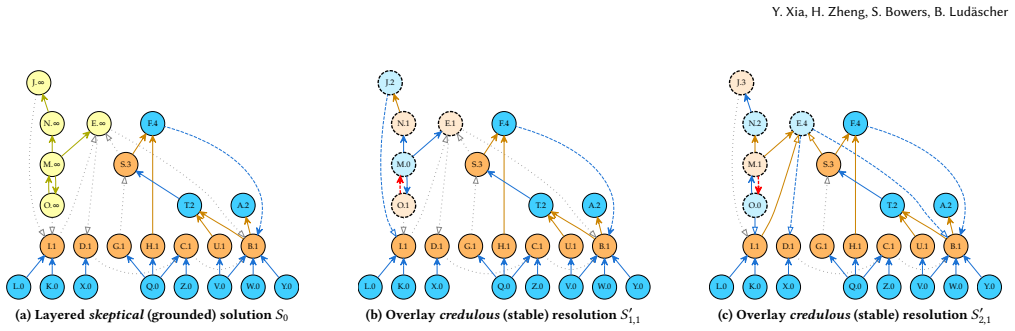
The load-bearing object is the critical attack set $\Delta_{i,j}$, a minimal set of attack edges whose temporary suspension resolves all undecided arguments and turns the 3-valued grounded solution into a 2-valued grounded solution $S'_{i,j}$; each alternative stable solution $S_i$ is paired with such sets. Supporting machinery includes the game-theoretic node length, a min-max numbering related to strong admissibility that organizes the well-founded stratification of arguments, and the classification of attacks into primary, secondary, and blunder edges based on their role in determining argument labels.
What would settle it
Run AF-Xray on a collection of small argumentation frameworks and compare every reported critical attack set against an exhaustive brute-force search over all subsets of attack edges; if any framework has a minimal suspension that the tool does not report, or reports a suspension that does not actually yield a two-valued grounded solution, the completeness and correctness claims are refuted.
Extended reading notes
Core claim
The paper's discovery is a suspension-based explanation of credulous solutions. For an argumentation framework with an ambiguous 3-valued grounded solution $S_0$, AF-Xray computes each alternative stable or preferred solution $S_i$ and, for it, a family $\Delta_i = \{\Delta_{i,1},\dots,\Delta_{i,n_i}\}$ of minimal sets of attack edges such that temporarily deleting the edges in $\Delta_{i,j}$ yields a 2-valued grounded solution $S'_{i,j}$ in which all previously undecided arguments are resolved. The authors state that these critical attack sets are generated systematically and completely, and that this constitutes a deeper semantic analysis than any existing system they know of. The tool displays the suspension choices as overlays on the original grounded labeling, so the well-founded part of the argument graph and the assumption that resolves the ambiguity are visible in a single picture.
Load-bearing premise
The explanation system assumes that for every alternative solution there is at least one minimal set of attack edges whose temporary suspension makes the grounded solution two-valued, and that the tool's enumeration finds every such set.
Editorial extensions
If this is right
- For a disputed argument, users can see which attacks must be suspended to reach a desired outcome; the suspension itself becomes the explanation of the choice.
- Teleological legal arguments can be represented: prioritizing one social value over another corresponds to suspending one critical attack rather than another, as in the mutual M and O attacks.
- Because node lengths are computed as a by-product of the alternating fixpoint procedure for grounded semantics, the layered display and the critical-set analysis build on standard semantics computations.
- The systematic enumeration of critical sets gives a finer-grained analysis than merely listing stable or preferred labelings: it exposes the minimal structural decisions that distinguish one solution from another.
Reading between the lines
- If the enumeration is complete, the same suspension analysis could serve as a general explanation method for nonmonotonic reasoning in other contested domains, such as medical or policy decisions, where a disputed attack corresponds to an unstated assumption.
- The size of the smallest critical attack set could be read as a measure of an argumentation framework's ambiguity depth, ranking frameworks by how many simultaneous assumptions must be made to reach a definite verdict.
- A natural next step would be to test the completeness claim empirically by brute-force enumeration of all edge subsets on random argumentation frameworks, or to extend the method to explain why an argument belongs to some preferred extensions and not others.
Signed reviews
Editorial analysis
A structured set of objections, weighed in public.
Referee Report
Summary. The paper presents AF-XRAY, an open-source toolkit built on PyArg for visualizing and explaining argumentation frameworks in legal reasoning. It introduces layered visualizations based on game-theoretic argument length, classification of attack edges by semantic role, overlay visualizations of alternative 2-valued stable solutions on the 3-valued grounded semantics, and identification of critical attack sets whose temporary suspension resolves undecided arguments. The central claim is that for each alternative stable solution S_i, the tool systematically generates all minimal sets of attacks Δ_i,j whose suspension yields a 2-valued grounded solution, thereby explaining credulous choices and providing a deeper semantic analysis than existing systems. The paper demonstrates the tool on the Wild Animals legal case (Pierson v. Post).
Significance. If the main claim is correct, the toolkit offers a concrete, potentially useful way to explain credulous choices in abstract argumentation and complements value-based and extended argumentation frameworks for legal reasoning. The paper's strengths include making the source code publicly available, building on prior theoretical work on game-theoretic length and attack classification, and presenting a concrete legal example with two stable solutions. However, the central contribution currently rests on an informal definition of critical attack sets and an unproven assertion of completeness; as submitted, the claimed semantic analysis is not yet verifiable. The paper would be strengthened substantially by adding formal definitions, an algorithm with termination and completeness arguments, and a broader evaluation.
major comments (4)
- [Section 1, item (iv) and Figure 1 caption] The definition of Δ_i,j states only that temporarily suspending the attacks in Δ_i,j yields a 2-valued grounded solution S'_i,j for S_i; it does not require that S'_i,j equals S_i. Under the literal definition, any inclusion-minimal deletion that resolves the undecided part qualifies. For example, in the 2-cycle A↔B, for the stable solution S1={A}, both {B→A} (which yields S1) and {A→B} (which yields S2) satisfy the stated condition, but only the first explains S1. The paper must add an explicit condition tying Δ_i,j to S_i and prove that the generated sets satisfy it; otherwise the explanations can overgenerate and misattribute ambiguity to the wrong attacks.
- [Section 2, 'Explaining Credulous Solutions in Xray'] The sentence 'Xray systematically generates all such sets of critical edges, thus providing a deeper semantic analysis than any state-of-the-art system we are aware of' asserts completeness, but the paper gives no enumeration algorithm and no correctness, completeness, or termination argument for the generation of Δ_i,j. Without a formal specification of the algorithm and a proof (or at least a precise statement) of exhaustiveness, the central comparative claim is unsupported. Note that existence alone is trivial: for any stable extension S, suspending all attacks from V\S to S makes S the grounded extension of the modified AF. The paper should state the algorithm, define the search space, and prove that it finds exactly the intended critical attack sets.
- [Section 2, 'Explaining Credulous Solutions in Xray' and 'Demonstration Overview'] The evaluation is limited to a single legal example with only two stable solutions. The paper's central functional claim about systematically enumerating all critical attack sets, and its usefulness for non-experts, requires either a formal proof or a broader empirical assessment (e.g., AFs with larger undec subgraphs, synthetic benchmarks, comparison with other explanation methods, or a user study). As written, the demonstration cannot validate the stronger claims made in the abstract and the final sentence of the 'Explaining Credulous Solutions' section.
- [Section 2, 'Explaining Credulous Solutions in Xray'] The phrase 'for the chosen suspension Δ_i,j, there is now a well-founded derivation of x' assumes that suspending Δ_i,j always yields a 2-valued grounded labeling. No argument is given for why the undecided part can always be resolved by a finite minimal suspension, or why the suspension cannot introduce new undecided cycles. If the enumeration relies on a property that does not hold in general, the explanations may fail on other inputs. Please clarify the underlying existence condition and its scope, and state whether the property is proved elsewhere or assumed.
minor comments (5)
- [Throughout] The abstract uses 'AF-XRAY' while the body uses 'AF-Xray'; please choose one spelling and use it consistently.
- [Figure 1 caption and Section 2] The notation mixes S_i, S'_i,j, S'_1,1, and S'_2,1 without clarifying the relationship between the stable solution S_i and the grounded solution S'_i,j obtained after suspension; add an explicit sentence or table defining S'_i,j.
- [Footnote 3] The claim that the node length 'can be computed as a by-product of computing the well-founded model via the alternating fixpoint procedure' is not derived or cited; please provide a citation to the relevant property in [6,11] or state it explicitly.
- [Section 2, 'Explaining Credulous Solutions in Xray'] The term 'minimal sets' appears without a definition; specify whether minimality is by inclusion or by cardinality when Δ_i,j is first introduced.
- [Figure 1] The numeric suffix in node labels such as F.4 and M.∞ is used in the caption, but the caption does not explicitly state that the suffix denotes the game-theoretic length; please state this for reader clarity.
Circularity Check
No significant circularity: AF-XRAY's explanation chain is a counterfactual visualization tool; the unproven completeness of critical-edge enumeration is a rigor gap, not a circular reduction.
full rationale
The paper does not present a predictive derivation from fitted parameters, nor does it import a load-bearing uniqueness theorem from the authors' prior work. The central explanatory device is a counterfactual: for a chosen 2-valued solution S_i, the tool identifies minimal attack sets whose temporary suspension yields a 2-valued grounded solution. This is a standard abductive/counterfactual explanatory pattern, not a circular prediction: the critical edge set is defined relative to the target solution, but that relation is precisely what makes the explanation informative (it isolates the attacks that need to be ignored to realize S_i). The example in Figure 1 confirms that the suspended edges are the ones that make the shown stable solution become grounded, so no reduction to an arbitrary fit is exhibited. Self-citations [5,6,11,13] support the layered visualization and edge-typing features, but those features are background imports with independently published definitions and are not the load-bearing claim. The assertion that Xray 'systematically generates all such sets of critical edges' is stated without an algorithm, formal definition, or completeness proof, and the definition of critical attack sets is loose (it does not explicitly require S'_i,j = S_i); these are correctness and rigor concerns, not circularity. The paper's derivation chain is therefore self-contained in the sense relevant to circularity, and no specific quantity or theorem reduces to its own input by construction.
Assumptions & free parameters
assumptions (3)
- domain assumption Dung's abstract argumentation frameworks with grounded, stable, and preferred semantics are the formal basis.
- domain assumption Game-theoretic length and edge classifications from the authors' prior work [5,6,13] correctly identify well-founded derivation structures.
- ad hoc to paper For every alternative stable solution S_i there exists a finite minimal set of attack edges whose temporary suspension yields a 2-valued grounded solution.
Cite this review
Pith. "Pith review of AF-XRAY: Visual Explanation and Resolution of Ambiguity in Legal Argumentation Frameworks." pith.science (2026). https://pith.science/paper/J3YF6ZBN
@misc{pith2026250710831,
  author       = {Pith},
  title        = {Pith review of: AF-XRAY: Visual Explanation and Resolution of Ambiguity in Legal Argumentation Frameworks},
  year         = {2026},
  howpublished = {\url{https://pith.science/paper/J3YF6ZBN}},
  note         = {Machine review of arXiv:2507.10831}
}
read the original abstract
Argumentation frameworks (AFs) provide formal approaches for legal reasoning, but identifying sources of ambiguity and explaining argument acceptance remains challenging for non-experts. We present AF-XRAY, an open-source toolkit for exploring, analyzing, and visualizing abstract AFs in legal reasoning. AF-XRAY introduces: (i) layered visualizations based on game-theoretic argument length revealing well-founded derivation structures; (ii) classification of attack edges by semantic roles (primary, secondary, blunders); (iii) overlay visualizations of alternative 2-valued solutions on ambiguous 3-valued grounded semantics; and (iv) identification of critical attack sets whose suspension resolves undecided arguments. Through systematic generation of critical attack sets, AF-XRAY transforms ambiguous scenarios into grounded solutions, enabling users to pinpoint specific causes of ambiguity and explore alternative resolutions. We use real-world legal cases (e.g., Wild Animals as modeled by Bench-Capon) to show that our tool supports teleological legal reasoning by revealing how different assumptions lead to different justified conclusions.
Figures
Reference graph
Works this paper leans on
-
[1]
T. Bench-Capon. 2002. Representation of Case Law as an Argumentation Frame- work. In JURIX. IOS Press, 103–112
work page 2002
-
[2]
T. Bench-Capon. 2020. Before and after Dung: Argumentation in AI and Law. Argument & Computation. 11, 1-2 (2020), 221–238
work page 2020
-
[3]
T. Bench-Capon and S. Modgil. 2009. Case law in extended argumentation frameworks. In 12th Intl. Conf. on AI and Law (ICAIL) . ACM, 118–127
work page 2009
-
[4]
D. Berman and C. Hafner. 1993. Representing Teleological Structure in Case- Based Legal Reasoning: The Missing Link. In4th Intl. Conf. on AI and Law (ICAIL). ACM, 50–59
work page 1993
- [5]
- [6]
-
[7]
M. Caminada and P. Dunne. 2019. Strong admissibility revisited: Theory and applications. Argument & Computation 10, 3 (2019), 277–300
work page 2019
-
[8]
P.M. Dung. 1995. On the Acceptability of Arguments and Its Fundamental Role in Nonmonotonic Reasoning, Logic Programming and n-Person Games. AI 77, 2 (1995), 321–357
work page 1995
Show all 13 references
-
[9]
Odekerken, A.M
D. Odekerken, A.M. Borg, and M. Berthold. 2023. Demonstrating PyArg 2.0. In Advances in Argumentation in AI (AI 3), Vol. 3546. CEUR
2023
-
[10]
C. Smith. 1966. Graphs and Composite Games. Journal of Combinatorial Theory 1, 1 (1966), 51–81
1966
-
[11]
Van Gelder
A. Van Gelder. 1993. The Alternating Fixpoint of Logic Programs with Negation. J. Comput. System Sci. 47, 1 (1993), 185–221
1993
-
[12]
Y. Xia, S. Bowers, and B. Ludäscher. 2025. AF-Xray: Argumentation Framework eXplanation, Reasoning, and AnalYsis. https://github.com/idaks/xray
2025
-
[13]
Y. Xia, D. Odekerken, S. Bowers, and B. Ludäscher. 2024. Layered Visualization of Argumentation Frameworks. In Computational Models of Argument (COMMA), C. Reed, M. Thimm, and T. Rienstra (Eds.). IOS Press, 373–374
2024
Reviewed August 6, 2026 · model on record in the stance chip above.
Discussion (0). Continue with ORCID to comment.