REVIEW 2 major objections 5 minor 43 references
$d+1$ Measurement Bases are Sufficient for Determining $d$-Dimensional Quantum States: Theory and Experiment
T0 review · 2 major / 5 minor · reviewed 2026-08-06 · deepseek-v4-flash
Pith's one-line read d+1 projective measurement bases determine an arbitrary d-dimensional quantum state, with a proof for all d and a d=6 chip demonstration.
desk verdict A correct and clean explicit construction of d+1 tomographic bases, but the sufficiency claim is not new and the phase-existence gap is easy to fix. read the letter →
The pith
A machine-rendered reading of the paper's core claim, the machinery that carries it, and where it could break.
The reading
What carries the argument
The central mechanism is the coefficient matrix $T$ defined elementwise by $T_{(d-1)j+k,\,d(c-1)+a}=\omega^{kc}e^{-i(\theta_a^{(j)}-\theta_{(a+c)\bmod d}^{(j)})}$, which maps the $d(d-1)$ measured quantities $q$ to the off-diagonal density-matrix elements $g$. The proof shows that after fixed full-rank row transformations, $T$ becomes block-diagonal with blocks $N^{(c)}$; under the phase choice $\theta_m^{(j)}=j\theta_m^{(1)}$ each block is a Vandermonde matrix (a matrix whose columns are powers of distinct numbers, invertible exactly when those numbers are distinct). Its determinant is a product of differences $e^{-i(\theta_t^{(1)}-\theta_{(t+c)\bmod d}^{(1)})}-e^{-i(\theta_{t'}^{(1)}-\theta_{(t'+c)\bmod d}^{(1)})}$, so the distinct-difference condition in Eq. (11) is exactly the condition that no Vandermonde determinant vanishes, making $T$ invertible and the reconstruction $g=T^{-1}q$ possible.
What would settle it
A direct falsifier would be to find a dimension $d$ for which no choice of $\theta^{(1)}_0,\ldots,\theta^{(1)}_{d-1}$ makes the differences $\theta^{(1)}_t-\theta^{(1)}_{(t+c)\bmod d}$ pairwise distinct modulo $2\pi$; then some Vandermonde block $N^{(c)}$ in the Supplemental proof has a zero determinant, $T$ is singular, and the $d+1$ bases fail. Checking the determinant for candidate phases at $d=7,8,\ldots$ is a concrete search.
Extended reading notes
Core claim
The paper's central claim is that the $d+1$ projective bases consisting of the computational basis, the Fourier basis $\{|\psi_k^{(0)}\rangle\}_{k=0}^{d-1}$, and the $d-1$ bases obtained by applying diagonal unitaries $R^{(j)}$ with phases $\theta_m^{(j)}$ to the Fourier basis completely determine any $d$-dimensional density matrix $\rho$. The computational basis gives the diagonal elements directly; the remaining $d$ bases produce the linear system $q=T g$, where $g$ collects the $d(d-1)$ off-diagonal elements $g_{a,b}$ and $q$ collects the measured quantities $q_k^{(j)}=d\,p_k^{(j)}-1$. The paper proves that $T$ is invertible whenever $\theta_m^{(j)}=j\theta_m^{(1)}$ and the differences $\theta_t^{(1)}-\theta_{(t+c)\bmod d}^{(1)}$ are all distinct modulo $2\pi$, so the off-diagonal elements are uniquely recovered as $g=T^{-1}q$. It reports a $d=6$ experiment on a silicon photonic chip that reconstructs two pure states and one mixed state with fidelities above $0.96$, in a dimension where no complete set of mutually unbiased bases is known.
Load-bearing premise
The load-bearing premise is that for every dimension $d$ a choice of phases satisfying Eq. (11) exists—the paper gives a numerical example only for $d=6$—and that, experimentally, the chip implements those bases with negligible calibration error.
Editorial extensions
If this is right
- If the construction is correct, full tomography of any $d$-dimensional state needs only $d+1$ projective bases, meeting the parameter-counting lower bound and improving on the previous universal $2d-1$ scheme.
- The scheme applies to dimensions where complete mutually unbiased bases are not known, such as $d=6$, so it removes a long-standing obstacle to minimal-basis tomography.
- The reconstruction is explicit: diagonal elements come from computational-basis probabilities and off-diagonal elements from $g=T^{-1}q$, so no iterative search is required in the ideal case.
- The $d=6$ experiment shows the bases can be realized on a programmable silicon photonic chip, with fidelities above $0.96$.
Reading between the lines
- A generic choice of phases $\theta_m^{(1)}$ satisfies the distinct-difference condition with probability one, so the $d+1$-basis scheme does not depend on fine-tuned values; almost any phases should work.
- The remaining freedom in the phases can be used to control noise: minimizing the condition number of $T$ (extending the paper's one-parameter optimization for $d=6$) would make the reconstruction more stable for larger dimensions.
- For states known to be low-rank, the same measurement design might allow reconstruction with fewer than $d+1$ bases, though this is an extension rather than a claim of the paper.
- When comparing tomography schemes, reporting the condition number of $T$ alongside fidelity would sharpen the practical assessment, since measurement noise is amplified by $T^{-1}$.
Signed reviews
Editorial analysis
A structured set of objections, weighed in public.
Referee Report
Summary. The manuscript proposes a quantum state tomography protocol using d+1 projective measurement bases: the computational basis, the Fourier basis, and d-1 variants obtained by applying diagonal unitary operators R^(j) with phases θ_m^(j)=jθ_m^(1). The authors derive a linear system q = T g that connects the measured basis probabilities to the off-diagonal density-matrix elements and show, in the Supplemental Material, that T decomposes into Vandermonde blocks and is invertible when the first-order phase differences in Eq. (S14) are distinct modulo 2π. The state is then reconstructed as g = T^{-1}q. The paper also reports a silicon-photonic-chip experiment for d=6, reconstructing three states with fidelities above 0.96.
Significance. If the missing existence argument is supplied, the scheme gives an explicit family of d+1 bases saturating the parameter-counting lower bound in every dimension, including composite dimensions such as d=6 where a complete set of MUBs is not known. The algebraic derivation is transparent: the Supplemental Vandermonde reduction is sound, and the conditional invertibility criterion is clearly stated. The experiment is a useful proof-of-principle, though its quantitative claims are weakened by the absence of calibration and systematic-uncertainty analysis. The main theoretical gap is that the paper never proves that phases satisfying Eq. (S14) exist for arbitrary d; this is readily fixable by an explicit construction.
major comments (2)
- [Supplemental Material, Eqs. (S11) and (S14); main text Eq. (11)] The invertibility theorem is conditional: T is invertible only when phases satisfying Eqs. (S11) and (S14) are chosen, but the manuscript never proves that such phases exist for every dimension d. The main text supplies only the numerical d=6 choice θ_m^(1)=0.5671 m^2 in footnote [42]. Since the claim that the protocol 'applies to arbitrary dimension d' rests on this existence, the theorem is incomplete as stated. The gap is easily repaired: take θ_m^(1)=πα m^2 with α irrational; then, for each c, the difference θ_t^(1)-θ_(t+c mod d)^(1) = -πα(2ct+c^2), and equality of two such differences modulo 2π would force α c(t-t') to be an integer, impossible for α irrational and t≠t'. Please add this existence argument explicitly and phrase the theorem as 'for every d there exist phases satisfying Eq. (11)'.
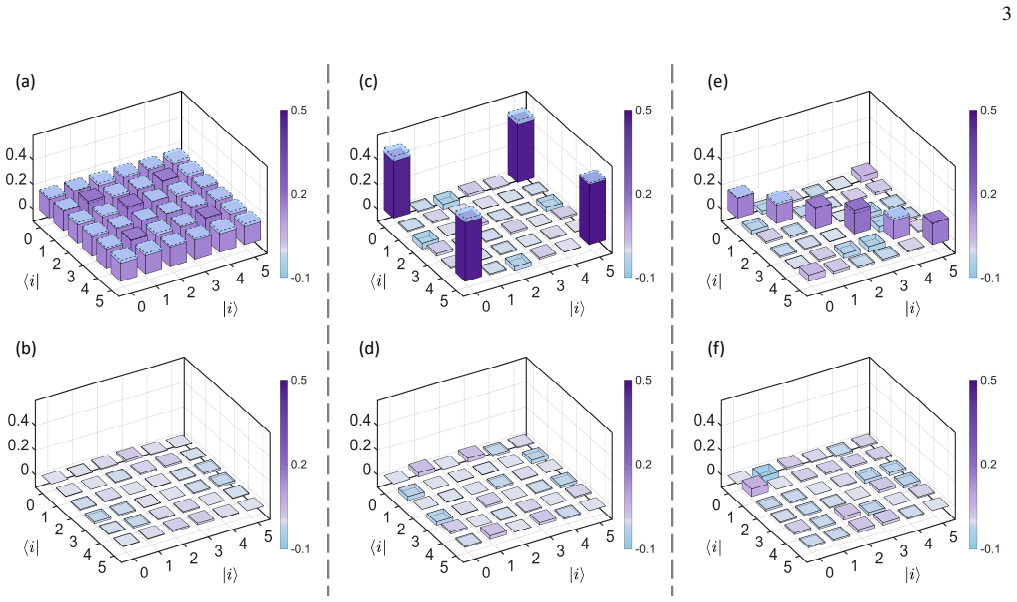
- [Experimental section, Fig. 2 and text near Eq. (14)] The experimental verification does not include a calibration or systematic-uncertainty analysis for the seven implemented unitaries. The reconstruction assumes that the chip realizes exactly the computational basis, the Fourier basis, and the diagonal-phase-varied Fourier bases; residual phase and transmission errors in the MZI network directly bias the inferred density matrices, and this bias is not reflected in the quoted statistical uncertainties. Please characterize the implemented bases (e.g., through interferometric calibration or tomographic characterization of the unitaries) and propagate systematic errors, or explicitly limit the experimental claim to a proof-of-principle demonstration.
minor comments (5)
- [Abstract and Introduction] The abstract states that in d=6 'a complete set of mutually unbiased bases does not exist,' but the introduction correctly says that 'only three MUBs have been found to date' and that the construction remains an open problem. The nonexistence of a complete set of seven MUBs in dimension six is not an established fact; please rephrase the abstract (e.g., 'for which a complete set is not known').
- [Eq. (11) and Eq. (S14)] The condition written as 'θ_t^(1)-θ_(t+c mod d)^(1) ≠ θ_t'^(1)-θ_(t'+c mod d)^(1)+2πn' is clearer as a congruence statement: the two differences should be non-congruent modulo 2π. Please adjust the notation.
- [Experimental section, paragraph before Fig. 2] The maximum-likelihood estimation step is invoked but not described; please specify the likelihood model, the parameterization of the density matrix, and the constraints (e.g., positivity and trace) used to obtain the reconstructed matrices in Fig. 2, so that the reader can separate the effect of the linear inversion from that of the estimator.
- [Fig. 1 caption] The caption defines VOA, FPC, and SNSPD but not DAC; please define the acronym and state the role of the 'Classical Processing' block (e.g., whether it performs only counting or also unitary calibration).
- [Footnote [42]] For the numerical optimization that yielded φ=0.5671, please state the domain of the search and the tolerance, and clarify that exact optimality of the mutual-unbiasedness deviation is not required for invertibility.
Circularity Check
No significant circularity: the d+1-basis reconstruction is a direct linear inversion with basis phases chosen independently of the target states.
full rationale
The derivation is self-contained and does not reduce any prediction to a fitted input. The diagonal elements are taken directly from computational-basis probabilities in Eq. (6), and the off-diagonal elements are obtained by solving the linear system q = T g in Eq. (10), with T defined explicitly from the chosen measurement phases. Invertibility of T is proved in the Supplemental Material by reducing T to block-diagonal Vandermonde matrices N(c); the required phase conditions (S11) and (S14) are state-independent conditions on the measurement design, not conditions on the reconstructed density matrix. The experimental phase phi = 0.5671 for d = 6 is selected by minimizing a state-independent mutual-unbiasedness deviation f (footnote [42]), not by fitting to the prepared states or to the measured fidelities, so no fitted parameter is renamed as a prediction. The measured fidelities are computed against independently chosen known states (Eq. 13), providing an external check rather than an assumed result. Citations to prior tomography and MUB work are contextual or comparative and are not load-bearing for the invertibility proof, which is contained in the paper itself. The only notable caveat is that the paper does not prove the existence of phases satisfying Eq. (S14) for arbitrary dimension d, giving a numerical instance only for d = 6; this is a mathematical completeness or correctness gap, not circularity, since even a generic-phase existence argument would not make the derivation assume the target quantum-state reconstruction.
Assumptions & free parameters
free parameters (2)
- Diagonal phase scale phi =
0.5671
- Diagonal phase set theta_m^(1) =
phi m^2 for d=6; otherwise constrained by Eq. (11)
assumptions (4)
- domain assumption Each projective measurement basis yields d-1 independent probabilities through the Born rule.
- standard math A Vandermonde matrix with distinct nodes is invertible.
- domain assumption The density operator is Hermitian with trace one, so diagonal elements are probabilities and off-diagonal elements carry the remaining information.
- ad hoc to paper A phase choice satisfying Eq. (11) exists in every dimension d.
Cite this review
Pith. "Pith review of $d+1$ Measurement Bases are Sufficient for Determining $d$-Dimensional Quantum States: Theory and Experiment." pith.science (2026). https://pith.science/paper/AQ4WKVCG
@misc{pith2026250711204,
  author       = {Pith},
  title        = {Pith review of: $d+1$ Measurement Bases are Sufficient for Determining $d$-Dimensional Quantum States: Theory and Experiment},
  year         = {2026},
  howpublished = {\url{https://pith.science/paper/AQ4WKVCG}},
  note         = {Machine review of arXiv:2507.11204}
}
abstract
A long-standing problem in quantum physics is to determine the minimal number of measurement bases required for the complete characterization of unknown quantum states, a question of particular relevance to high-dimensional quantum information processing. Here, we propose a quantum state tomography scheme that requires only $d+1$ projective measurement bases to fully reconstruct an arbitrary $d$-dimensional quantum state. As a proof-of-principle, we experimentally verified this scheme on a silicon photonic chip by reconstructing quantum states for $d=6$, in which a complete set of mutually unbiased bases does not exist. This approach offers new perspectives for quantum state characterization and measurement design, and holds promise for future applications in quantum information processing.
Figures

Reference graph
Works this paper leans on
-
[42]
S. Xue, Y . Wang, J. Zhan, Y . Wang, R. Zeng, J. Ding, W. Shi, Y . Liu, Y . Liu, A. Huang, et al. , Physical Review Letters 129, 133601 (2022)
work page 2022
-
[1]
M. Paris and J. Rehacek, Quantum state estimation , V ol. 649 (Springer Science & Business Media, 2004)
work page 2004
-
[2]
The fi- delities between the reconstructed density matrices ρ′ and the ideal statesρ are calculated as F = tr √ ρ1/2ρ′ρ1/2, (14) 4 yielding values of 0 .9654 ± 0.0067, 0.9698 ± 0.0042, and 0.9761 ± 0.0033, respectively. In summary, we have theoretically proposed and exper- imentally demonstrated a QST scheme that reconstructs d- dimensional quantum states ...
-
[3]
H. H ¨affner, W. H ¨ansel, C. Roos, J. Benhelm, D. Chek-al Kar, M. Chwalla, T. K ¨orber, U. Rapol, M. Riebe, P . Schmidt, et al., Nature 438, 643 (2005)
work page 2005
-
[4]
D. P . DiVincenzo, Science 270, 255 (1995)
work page 1995
-
[5]
J. L. O’brien, Science 318, 1567 (2007)
work page 2007
-
[6]
C. H. Bennett, G. Brassard, C. Cr ´epeau, R. Jozsa, A. Peres, and W. K. Wootters, Physical review letters 70, 1895 (1993)
work page 1993
-
[7]
D. Bouwmeester, J.-W. Pan, K. Mattle, M. Eibl, H. Weinfurter, and A. Zeilinger, Nature 390, 575 (1997)
work page 1997
Show all 43 references
-
[8]
Giovannetti, S
V . Giovannetti, S. Lloyd, and L. Maccone, Physical review let- ters 96, 010401 (2006)
2006
-
[9]
Giovannetti, S
V . Giovannetti, S. Lloyd, and L. Maccone, Nature photonics 5, 222 (2011)
2011
-
[10]
D. F. James, P . G. Kwiat, W. J. Munro, and A. G. White, Phys- ical Review A 64, 052312 (2001)
2001
-
[11]
R. T. Thew, K. Nemoto, A. G. White, and W. J. Munro, Physi- cal Review A 66, 012303 (2002)
2002
-
[12]
F. T. Hioe and J. H. Eberly, Physical Review Letters 47, 838 (1981)
1981
-
[13]
R. A. Bertlmann and P . Krammer, Journal of Physics A: Math- ematical and Theoretical 41, 235303 (2008)
2008
-
[14]
Kimura, Physics Letters A 314, 339 (2003)
G. Kimura, Physics Letters A 314, 339 (2003)
2003
-
[15]
I. P . Menda ˇs, Journal of Physics A: Mathematical and General 39, 11313 (2006)
2006
-
[16]
R. G. Newton and B.-L. Y oung, Annals of Physics 49, 393 (1968)
1968
-
[17]
M. A. Perlin, D. Barberena, and A. M. Rey, Physical Review A 104, 062413 (2021)
2021
-
[18]
Y . Wang, H. Jiang, Y . Liu, and K. Li, arXiv preprint arXiv:2409.03435 (2024)
2024 arXiv
-
[19]
Ivonovic, Journal of Physics A: Mathematical and General 14, 3241 (1981)
I. Ivonovic, Journal of Physics A: Mathematical and General 14, 3241 (1981)
1981
-
[20]
W. K. Wootters and B. D. Fields, Annals of Physics 191, 363 (1989)
1989
-
[21]
Zauner, International Journal of Quantum Information 9, 445 (2011)
G. Zauner, International Journal of Quantum Information 9, 445 (2011)
2011
-
[22]
Durt, B.-G
T. Durt, B.-G. Englert, I. Bengtsson, and K. ˙Zyczkowski, In- ternational journal of quantum information 8, 535 (2010)
2010
-
[23]
Horodecki, Ł
P . Horodecki, Ł. Rudnicki, and K. ˙Zyczkowski, PRX Quantum 3, 010101 (2022)
2022
- [24]
-
[25]
Bandyopadhyay, P
S. Bandyopadhyay, P . O. Boykin, V . Roychowdhury, and F. V atan, Algorithmica34, 512 (2002)
2002
-
[26]
Klappenecker and M
A. Klappenecker and M. R ¨otteler, in Finite Fields and Appli- cations: 7th International Conference, Fq7, Toulouse, France, May 5-9, 2003. Revised Papers (Springer, 2004) pp. 137–144
2003
-
[27]
Archer, Journal of mathematical physics 46 (2005)
C. Archer, Journal of mathematical physics 46 (2005)
2005
-
[28]
Brierley, S
S. Brierley, S. Weigert, and I. Bengtsson, arXiv preprint arXiv:0907.4097 (2009)
2009 arXiv
-
[29]
Adamson and A
R. Adamson and A. M. Steinberg, Physical review letters 105, 030406 (2010)
2010
-
[30]
G. Lima, L. Neves, R. Guzm ´an, E. S. G ´omez, W. Nogueira, A. Delgado, A. V argas, and C. Saavedra, Optics Express 19, 3542 (2011)
2011
-
[31]
Giovannini, J
D. Giovannini, J. Romero, J. Leach, A. Dudley, A. Forbes, and M. J. Padgett, Physical review letters 110, 143601 (2013)
2013
-
[32]
Bengtsson, W
I. Bengtsson, W. Bruzda, Å. Ericsson, J.-Å. Larsson, W. Tadej, and K. ˙Zyczkowski, Journal of mathematical physics 48 (2007)
2007
-
[33]
Grassl, arXiv preprint quant-ph /0406175 (2004)
M. Grassl, arXiv preprint quant-ph /0406175 (2004)
2004
-
[34]
Jaming, M
P . Jaming, M. Matolcsi, P . M ´ora, F. Sz ¨oll˝osi, and M. Weiner, Journal of Physics A: Mathematical and Theoretical 42, 245305 (2009)
2009
-
[35]
Butterley and W
P . Butterley and W. Hall, Physics Letters A 369, 5 (2007)
2007
-
[36]
Brierley and S
S. Brierley and S. Weigert, Physical Review A—Atomic, Molecular, and Optical Physics 79, 052316 (2009)
2009
-
[37]
Raynal, X
P . Raynal, X. L ¨u, and B.-G. Englert, Physical Review A—Atomic, Molecular, and Optical Physics 83, 062303 (2011)
2011
-
[38]
Goyeneche, Journal of Physics A: Mathematical and Theo- retical 46, 105301 (2013)
D. Goyeneche, Journal of Physics A: Mathematical and Theo- retical 46, 105301 (2013)
2013
-
[39]
W. R. Clements, P . C. Humphreys, B. J. Metcalf, W. S. Kolthammer, and I. A. Walmsley, Optica 3, 1460 (2016)
2016
-
[40]
Li, G.-F
Z.-H. Li, G.-F. Y u, Y .-X. Wang, Z.-Y . Xing, L.-W. Kong, and X.-Q. Zhou, Science China Physics, Mechanics & Astronomy 66, 290311 (2023)
2023
-
[41]
Peruzzo, J
A. Peruzzo, J. McClean, P . Shadbolt, M.-H. Y ung, X.-Q. Zhou, P . J. Love, A. Aspuru-Guzik, and J. L. O’brien, Nature com- munications 5, 4213 (2014)
2014
-
[43]
d + 1 Measurement Bases Are Su fficient for Determining d-Dimensional Quantum States: Theory and Experiment
To select the diagonal phases, we require that θ( j) m satisfy Eq. ( 11), ensuring T is invertible. To fur- ther optimize the scheme performance [ 28], we min- imize the mutual-unbiasedness deviation function f = ∑ 0≤ j<u≤d−1 ∑d−1 k,v=0 (|⟨ψ( j) k |ψ(u) v ⟩| − d−1/2)2. Accordi...
2025
Reviewed August 6, 2026 · model on record in the stance chip above.
Discussion (0). Continue with ORCID to comment.