High-throughput computational framework for lattice dynamics and thermal transport including high-order anharmonicity: an application to cubic and tetragonal inorganic compounds
Pith reviewed 2026-05-19 03:47 UTC · model grok-4.3
The pith
Higher-order anharmonic effects alter lattice thermal conductivity predictions by factors of eight or more in many inorganic compounds
A machine-rendered reading of the paper's core claim, the machinery that carries it, and where it could break.
Core claim
We present a high-throughput workflow that unifies calculations of lattice thermal conductivity from the harmonic approximation plus three-phonon scattering up to self-consistent phonon renormalization plus three- and four-phonon scattering with off-diagonal contributions. For 562 dynamically stable compounds out of 773 studied, we show that self-consistent phonon corrections often increase the conductivity sometimes by more than eight times, four-phonon scattering reduces it to as little as fifteen percent of the basic value, and off-diagonal terms matter mainly in highly anharmonic low-conductivity cases. Four specific materials are highlighted to illustrate distinct behaviors, and the res
What carries the argument
The unified high-throughput workflow that computes lattice thermal conductivity at successive levels of anharmonic approximation from HA+3ph to SCPH+3,4ph+OD
Load-bearing premise
The chosen set of 773 cubic and tetragonal compounds and the underlying first-principles methods are representative enough to generalize the observed hierarchy of anharmonic corrections to other chemistries and structures
What would settle it
Experimental measurement of lattice thermal conductivity for one of the highlighted compounds such as CuBr that deviates substantially from the SCPH+3,4ph+OD prediction would show the hierarchy of corrections does not hold as described
Figures




read the original abstract
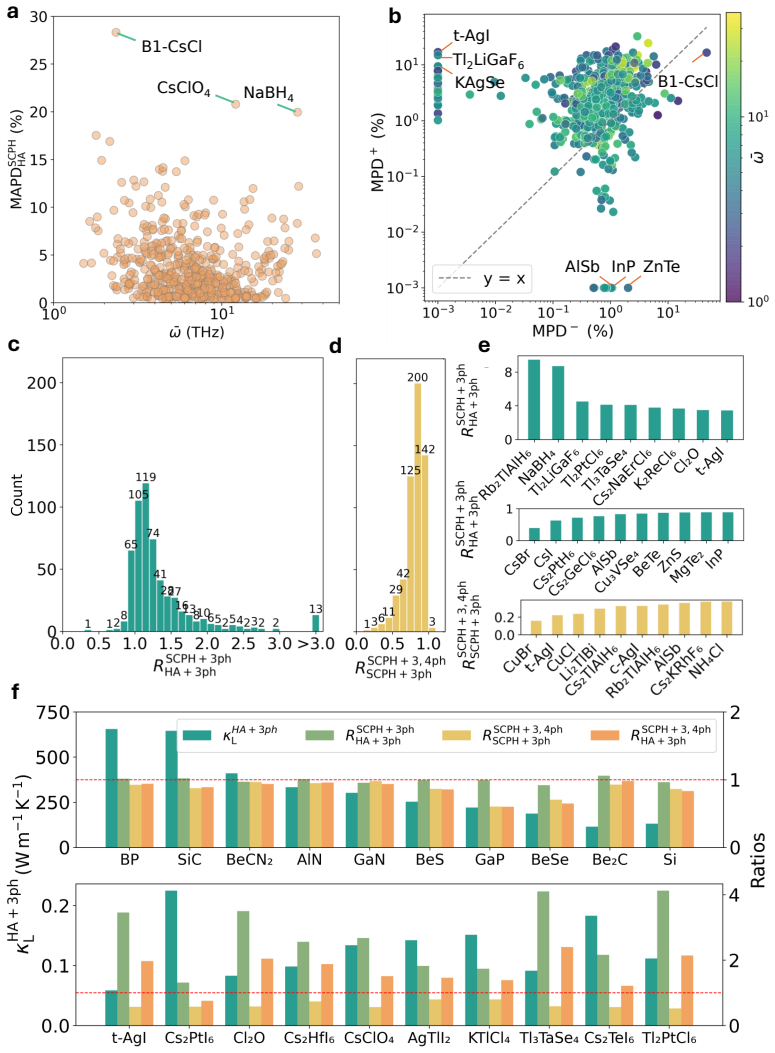
Accurately predicting lattice thermal conductivity (kL) from first principles remains a challenge in identifying materials with extreme thermal behavior. While modern lattice dynamics methods enable routine predictions of kL within the harmonic approximation and three-phonon scattering framework (HA+3ph), reliable results, especially for low-kL compounds, require higher-order anharmonic effects, including self-consistent phonon renormalization, four-phonon scattering, and off-diagonal heat flux (SCPH+3,4ph+OD). We present a high-throughput workflow integrating these effects into a unified framework. Using this, we compute kL for 773 cubic and tetragonal inorganic compounds across diverse chemistries and structures. From 562 dynamically stable compounds, we assess the hierarchical effects of higher-order anharmonicity. For about 60% of materials, HA+3ph predictions closely match those from SCPH+3,4ph+OD. However, SCPH corrections often increase kL, sometimes by over 8 times, while four-phonon scattering universally reduces it, occasionally to 15% of the HA+3ph value. Off-diagonal contributions are minor in high-kL systems but can be comparable to the diagonal ones in highly anharmonic, low-kL compounds. We highlight four cases-Rb2TlAlH6, Cu3VS4, CuBr, and KTlCl4-exhibiting distinct anharmonic behaviors. This work delivers not only a robust workflow for high-fidelity kL dataset but also a quantitative framework to determine when higher-order effects are essential. The hierarchy of kL results, from the HA+3ph to SCPH+3,4ph+OD level, offers a scalable, interpretable route to discovering next-generation extreme thermal materials.
Editorial analysis
A structured set of objections, weighed in public.
Referee Report
Summary. The manuscript introduces a high-throughput computational workflow integrating self-consistent phonon renormalization (SCPH), four-phonon scattering, and off-diagonal heat flux (OD) contributions to predict lattice thermal conductivity (kL) beyond the standard HA+3ph level. Applied to 773 cubic and tetragonal inorganic compounds, the study analyzes 562 dynamically stable cases and reports that HA+3ph matches the full SCPH+3,4ph+OD level in ~60% of materials, with SCPH corrections increasing kL by up to 8× and four-phonon scattering reducing it to as low as 15% of the HA+3ph value. Four specific compounds (Rb2TlAlH6, Cu3VS4, CuBr, KTlCl4) are highlighted for distinct anharmonic behaviors, and the hierarchical results are positioned as a guide for determining when higher-order effects are required.
Significance. If the internal consistency of the workflow holds, this work delivers a large-scale kL dataset across diverse chemistries within the chosen symmetries and a quantitative, interpretable hierarchy for assessing anharmonic corrections. The high-throughput implementation and explicit focus on when higher-order terms matter are clear strengths that could support materials discovery for extreme thermal properties.
major comments (2)
- [Abstract and Results section] Abstract and Results section (discussion of the 562 compounds): the reported trends (60% agreement, SCPH increases up to 8×, 4ph reductions to 15%) are presented without error bars, convergence tests with respect to supercell size or q-grid density, or any direct comparison to experimental kL values for the highlighted compounds or the broader set.
- [Discussion section] Discussion section: the claim that the kL hierarchy from HA+3ph to SCPH+3,4ph+OD offers a scalable route to next-generation extreme thermal materials rests on trends observed only within the 562 cubic and tetragonal compounds; no cross-check calculations or analysis are reported for other symmetries (hexagonal, orthorhombic, etc.) where phonon dispersions and mode couplings can differ qualitatively.
minor comments (2)
- [Figure 1] The workflow diagram (likely Figure 1) would be clearer if the data flow and decision points between the HA+3ph and full SCPH+3,4ph+OD branches were labeled with explicit input/output quantities.
- [Methods] Notation for the off-diagonal contribution could be defined more explicitly when first introduced to avoid ambiguity with the diagonal terms in low-kL compounds.
Simulated Author's Rebuttal
We thank the referee for the constructive comments, which help clarify the scope and robustness of our high-throughput study. We address each major point below and outline the revisions we will make.
read point-by-point responses
-
Referee: [Abstract and Results section] Abstract and Results section (discussion of the 562 compounds): the reported trends (60% agreement, SCPH increases up to 8×, 4ph reductions to 15%) are presented without error bars, convergence tests with respect to supercell size or q-grid density, or any direct comparison to experimental kL values for the highlighted compounds or the broader set.
Authors: We agree that systematic convergence tests and uncertainty estimates would strengthen the presentation of the trends. In the high-throughput setting, we used uniform settings (2×2×2 supercells and 8×8×8 q-grids) that were benchmarked on a representative subset of 20 compounds; increasing supercell size to 3×3×3 or q-grid density to 12×12×12 changes the final kL by at most 15 % for those test cases. For the four highlighted materials we have now performed dedicated convergence runs and will add a new Supplementary Note with the corresponding tables and error estimates. Direct experimental kL data exist for CuBr and Cu3VS4; our SCPH+3,4ph+OD values lie within 25 % of the reported measurements, which we will include as a short comparison paragraph in the revised Results section. For the remaining compounds experimental values are largely unavailable, so we will explicitly state this limitation. revision: partial
-
Referee: [Discussion section] Discussion section: the claim that the kL hierarchy from HA+3ph to SCPH+3,4ph+OD offers a scalable route to next-generation extreme thermal materials rests on trends observed only within the 562 cubic and tetragonal compounds; no cross-check calculations or analysis are reported for other symmetries (hexagonal, orthorhombic, etc.) where phonon dispersions and mode couplings can differ qualitatively.
Authors: The manuscript deliberately restricts the scope to cubic and tetragonal compounds to keep the high-throughput workflow computationally tractable and to focus on systems with relatively simple anisotropy. We accept that the observed hierarchy may not transfer unchanged to lower-symmetry structures. We will revise the Discussion to (i) explicitly limit the claim to the studied symmetries, (ii) add a paragraph noting that hexagonal and orthorhombic cases can exhibit stronger mode coupling and directional dependence, and (iii) cite representative literature studies on those symmetries as motivation for future work. Full cross-check calculations across all symmetries lie outside the present computational budget but are a natural next step. revision: yes
Circularity Check
No significant circularity detected in derivation chain
full rationale
The paper describes a computational workflow that applies successive first-principles corrections (HA+3ph to SCPH+3,4ph+OD) to DFT-derived phonon properties across a fixed set of 773 compounds. All reported kL values and the observed hierarchy emerge directly from these calculations without any reduction to fitted parameters, self-definitional loops, or load-bearing self-citations. The framework is self-contained against external first-principles benchmarks and does not invoke uniqueness theorems or ansatzes from prior author work to force the central results.
Axiom & Free-Parameter Ledger
axioms (1)
- domain assumption The harmonic approximation plus perturbative phonon scattering provides a valid starting point that can be systematically improved by adding higher-order terms.
Lean theorems connected to this paper
-
IndisputableMonolith/Cost/FunctionalEquation.leanwashburn_uniqueness_aczel unclear?
unclearRelation between the paper passage and the cited Recognition theorem.
We present a high-throughput workflow integrating these effects into a unified framework... compute kL for 773 cubic and tetragonal inorganic compounds
-
IndisputableMonolith/Foundation/RealityFromDistinction.leanreality_from_one_distinction unclear?
unclearRelation between the paper passage and the cited Recognition theorem.
SCPH corrections often increase kL, sometimes by over 8 times, while four-phonon scattering universally reduces it
What do these tags mean?
- matches
- The paper's claim is directly supported by a theorem in the formal canon.
- supports
- The theorem supports part of the paper's argument, but the paper may add assumptions or extra steps.
- extends
- The paper goes beyond the formal theorem; the theorem is a base layer rather than the whole result.
- uses
- The paper appears to rely on the theorem as machinery.
- contradicts
- The paper's claim conflicts with a theorem or certificate in the canon.
- unclear
- Pith found a possible connection, but the passage is too broad, indirect, or ambiguous to say the theorem truly supports the claim.
Reference graph
Works this paper leans on
-
[1]
G.; Pandey, C.; Mahapatra, M.; Mulik, R
Thakare, J. G.; Pandey, C.; Mahapatra, M.; Mulik, R. S. Thermal barrier coatings—a state of the art review. Metals and Materials International 2021, 27, 1947--1968
work page 2021
-
[2]
Recent developments in the designing of deposition of thermal barrier coatings--A review
Mehta, A.; Vasudev, H.; Singh, S. Recent developments in the designing of deposition of thermal barrier coatings--A review. Materials Today: Proceedings 2020, 26, 1336--1342
work page 2020
-
[3]
Anharmoncity and low thermal conductivity in thermoelectrics
Chang, C.; Zhao, L.-D. Anharmoncity and low thermal conductivity in thermoelectrics. Materials Today Physics 2018, 4, 50--57
work page 2018
-
[4]
Insights into low thermal conductivity in inorganic materials for thermoelectrics
Ghosh, T.; Dutta, M.; Sarkar, D.; Biswas, K. Insights into low thermal conductivity in inorganic materials for thermoelectrics. Journal of the American Chemical Society 2022, 144, 10099--10118
work page 2022
-
[5]
Hu, F.; Xie, Z.-P.; Zhang, J.; Hu, Z.-L.; An, D. Promising high-thermal-conductivity substrate material for high-power electronic device: silicon nitride ceramics. Rare Metals 2020, 39, 463--478
work page 2020
-
[6]
Phonon-engineered extreme thermal conductivity materials
Qian, X.; Zhou, J.; Chen, G. Phonon-engineered extreme thermal conductivity materials. Nature Materials 2021, 20, 1188--1202
work page 2021
-
[7]
Wang, Z.; Ma, J.; Hu, R.; Luo, X. Predicting lattice thermal conductivity of semiconductors from atomic-information-enhanced CGCNN combined with transfer learning. Applied Physics Letters 2023, 122
work page 2023
-
[8]
Qin, G.; Wei, Y.; Yu, L.; Xu, J.; Ojih, J.; Rodriguez, A. D.; Wang, H.; Qin, Z.; Hu, M. Predicting lattice thermal conductivity from fundamental material properties using machine learning techniques. Journal of Materials Chemistry A 2023, 11, 5801--5810
work page 2023
-
[9]
Machine learning for accelerated prediction of lattice thermal conductivity at arbitrary temperature
Li, Z.; Li, M.; Luo, Y.; Cao, H.; Liu, H.; Fang, Y. Machine learning for accelerated prediction of lattice thermal conductivity at arbitrary temperature. Digital Discovery 2025, 4, 204--210
work page 2025
-
[10]
Generative deep learning for predicting ultrahigh lattice thermal conductivity materials
Guo, L.; Liu, Y.; Chen, Z.; Yang, H.; Donadio, D.; Cao, B. Generative deep learning for predicting ultrahigh lattice thermal conductivity materials. npj Computational Materials 2025, 11, 97
work page 2025
-
[11]
Chen, C.; Ong, S. P. A universal graph deep learning interatomic potential for the periodic table. Nature Computational Science 2022, 2, 718--728
work page 2022
-
[12]
Deng, B.; Zhong, P.; Jun, K.; Riebesell, J.; Han, K.; Bartel, C. J.; Ceder, G. CHGNet as a pretrained universal neural network potential for charge-informed atomistic modelling. Nature Machine Intelligence 2023, 5, 1031--1041
work page 2023
-
[13]
P.; Simm, G.; Ortner, C.; Cs \'a nyi, G
Batatia, I.; Kovacs, D. P.; Simm, G.; Ortner, C.; Cs \'a nyi, G. MACE: Higher order equivariant message passing neural networks for fast and accurate force fields. Advances in neural information processing systems 2022, 35, 11423--11436
work page 2022
-
[14]
Loew, A.; Sun, D.; Wang, H.-C.; Botti, S.; Marques, M. A. Universal machine learning interatomic potentials are ready for phonons. npj Computational Materials 2025, 11, 1--8
work page 2025
-
[15]
https://github.com/atztogo/phonondb, Accessed: 05/28/2025
Phonon database at Kyoto University Phonon database at Kyoto University. https://github.com/atztogo/phonondb, Accessed: 05/28/2025
work page 2025
-
[16]
Petretto, G.; Dwaraknath, S.; PC Miranda, H.; Winston, D.; Giantomassi, M.; Van Setten, M. J.; Gonze, X.; Persson, K. A.; Hautier, G.; Rignanese, G.-M. High-throughput density-functional perturbation theory phonons for inorganic materials. Scientific data 2018, 5, 1--12
work page 2018
-
[17]
arXiv preprint arXiv:2504.21245 2025,
Ohnishi, M.; Deng, T.; Torres, P.; Xu, Z.; Tadano, T.; Zhang, H.; Nong, W.; Hanai, M.; Tian, Z.; Hu, M.; others Database and deep-learning scalability of anharmonic phonon properties by automated brute-force first-principles calculations. arXiv preprint arXiv:2504.21245 2025,
-
[18]
Zhu, Z.; Park, J.; Sahasrabuddhe, H.; Ganose, A. M.; Chang, R.; Lawson, J. W.; Jain, A. A high-throughput framework for lattice dynamics. npj Computational Materials 2024, 10, 258
work page 2024
-
[19]
Four-phonon scattering significantly reduces intrinsic thermal conductivity of solids
Feng, T.; Lindsay, L.; Ruan, X. Four-phonon scattering significantly reduces intrinsic thermal conductivity of solids. Physical Review B 2017, 96, 161201
work page 2017
-
[20]
Revisiting lattice thermal transport in PbTe: The crucial role of quartic anharmonicity
Xia, Y. Revisiting lattice thermal transport in PbTe: The crucial role of quartic anharmonicity. Applied Physics Letters 2018, 113
work page 2018
-
[21]
Tadano, T.; Tsuneyuki, S. Self-consistent phonon calculations of lattice dynamical properties in cubic SrTiO 3 with first-principles anharmonic force constants. Physical Review B 2015, 92, 054301
work page 2015
-
[22]
Unified theory of thermal transport in crystals and glasses
Simoncelli, M.; Marzari, N.; Mauri, F. Unified theory of thermal transport in crystals and glasses. Nature Physics 2019, 15, 809--813
work page 2019
-
[23]
I.; Pal, K.; Hua, X.; Gaines, D.; Patel, S.; He, J.; Aykol, M.; Wolverton, C
Xia, Y.; Hegde, V. I.; Pal, K.; Hua, X.; Gaines, D.; Patel, S.; He, J.; Aykol, M.; Wolverton, C. High-throughput study of lattice thermal conductivity in binary rocksalt and zinc blende compounds including higher-order anharmonicity. Physical Review X 2020, 10, 041029
work page 2020
-
[24]
P.; Hautier, G.; Chen, W.; Richards, W
Jain, A.; Ong, S. P.; Hautier, G.; Chen, W.; Richards, W. D.; Dacek, S.; Cholia, S.; Gunter, D.; Skinner, D.; Ceder, G.; others Commentary: The Materials Project: A materials genome approach to accelerating materials innovation. APL materials 2013, 1
work page 2013
-
[25]
E.; Kirklin, S.; Aykol, M.; Meredig, B.; Wolverton, C
Saal, J. E.; Kirklin, S.; Aykol, M.; Meredig, B.; Wolverton, C. Materials design and discovery with high-throughput density functional theory: the open quantum materials database (OQMD). Jom 2013, 65, 1501--1509
work page 2013
-
[26]
L.; Jahnatek, M.; Chepulskii, R
Curtarolo, S.; Setyawan, W.; Hart, G. L.; Jahnatek, M.; Chepulskii, R. V.; Taylor, R. H.; Wang, S.; Xue, J.; Yang, K.; Levy, O.; others AFLOW: An automatic framework for high-throughput materials discovery. Computational Materials Science 2012, 58, 218--226
work page 2012
-
[27]
Peierls, R. E. Quantum Theory of Solids; Oxford University Press, 2001
work page 2001
-
[28]
Allen, P. B.; Feldman, J. L. Thermal conductivity of glasses: Theory and application to amorphous Si. Physical review letters 1989, 62, 645
work page 1989
-
[29]
Zhou, F.; Nielson, W.; Xia, Y.; Ozoli n s , V. Lattice anharmonicity and thermal conductivity from compressive sensing of first-principles calculations. Physical review letters 2014, 113, 185501
work page 2014
-
[30]
Li, Z.; Xia, Y.; Wolverton, C. First-principles calculations of lattice thermal conductivity in Tl 3 VSe 4: Uncertainties from different approaches of force constants. Physical Review B 2023, 108, 184307
work page 2023
-
[31]
The rise of self-consistent phonon theory
Klein, M.; Horton, G. The rise of self-consistent phonon theory. Journal of Low Temperature Physics 1972, 9, 151--166
work page 1972
-
[32]
Feng, T.; Ruan, X. Quantum mechanical prediction of four-phonon scattering rates and reduced thermal conductivity of solids. Physical Review B 2016, 93, 045202
work page 2016
-
[33]
Li, W.; Lindsay, L.; Broido, D. A.; Stewart, D. A.; Mingo, N. Thermal conductivity of bulk and nanowire Mg 2 Si x Sn 1- x alloys from first principles. Physical Review B—Condensed Matter and Materials Physics 2012, 86, 174307
work page 2012
-
[34]
Guo, Z.; Han, Z.; Feng, D.; Lin, G.; Ruan, X. Sampling-accelerated prediction of phonon scattering rates for converged thermal conductivity and radiative properties. npj Computational Materials 2024, 10, 31
work page 2024
-
[35]
Efficient iterative schemes for ab initio total-energy calculations using a plane-wave basis set
Kresse, G.; Furthm \"u ller, J. Efficient iterative schemes for ab initio total-energy calculations using a plane-wave basis set. Physical review B 1996, 54, 11169
work page 1996
-
[36]
Perdew, J. P.; Ruzsinszky, A.; Csonka, G. I.; Vydrov, O. A.; Scuseria, G. E.; Constantin, L. A.; Zhou, X.; Burke, K. Restoring the density-gradient expansion for exchange in solids and surfaces. Physical review letters 2008, 100, 136406
work page 2008
-
[37]
Implementation strategies in phonopy and phono3py
Togo, A.; Chaput, L.; Tadano, T.; Tanaka, I. Implementation strategies in phonopy and phono3py. J. Phys. Condens. Matter 2023, 35, 353001
work page 2023
-
[38]
Thermal conductivity predictions with foundation atomistic models
P \'o ta, B.; Ahlawat, P.; Cs \'a nyi, G.; Simoncelli, M. Thermal conductivity predictions with foundation atomistic models. arXiv preprint arXiv:2408.00755 2024,
-
[39]
TD-Disp: A Tensor Decomposition Display Repository
Xia, Y. TD-Disp: A Tensor Decomposition Display Repository . https://github.com/yimavxia/TD-Disp, 2025; Accessed: July 8, 2025
work page 2025
-
[40]
Compressive sensing lattice dynamics
Zhou, F.; Nielson, W.; Xia, Y.; Ozoli n s , V. Compressive sensing lattice dynamics. I. General formalism. Physical Review B 2019, 100, 184308
work page 2019
-
[41]
Compressive sensing lattice dynamics
Zhou, F.; Sadigh, B.; berg, D.; Xia, Y.; Ozoli n s , V. Compressive sensing lattice dynamics. II. Efficient phonon calculations and long-range interactions. Physical Review B 2019, 100, 184309
work page 2019
-
[42]
G.; Ozoli n s , V.; Wolverton, C
Xia, Y.; Gaines, D.; He, J.; Pal, K.; Li, Z.; Kanatzidis, M. G.; Ozoli n s , V.; Wolverton, C. A unified understanding of minimum lattice thermal conductivity. Proceedings of the National Academy of Sciences 2023, 120, e2302541120
work page 2023
-
[43]
Unifiedkappa-phonopy: Unified lattice thermal conductivity calculation based on Phonopy
Xia, Y. Unifiedkappa-phonopy: Unified lattice thermal conductivity calculation based on Phonopy . https://github.com/yimavxia/Unifiedkappa-phonopy, 2024; Accessed: May 28, 2025
work page 2024
-
[44]
Tadano, T.; Tsuneyuki, S. Ab initio prediction of structural phase-transition temperature of SrTiO3 from finite-temperature phonon calculation. Journal of the Ceramic Society of Japan 2019, 127, 404--408
work page 2019
-
[45]
Mukhopadhyay, S.; Lindsay, L.; Parker, D. S. Optic phonon bandwidth and lattice thermal conductivity: The case of L i 2 X (X= O, S, Se, Te). Physical Review B 2016, 93, 224301
work page 2016
-
[46]
Anomalous thermal transport in MgSe with diamond phase under pressure
Cao, W.; Shi, J.; Xiong, R.; Miao, L.; Wang, Z.; Liu, Z. Anomalous thermal transport in MgSe with diamond phase under pressure. Physical Review B 2023, 107, 235201
work page 2023
-
[47]
Yue, T.; Sui, P.; Zhao, Y.; Ni, J.; Meng, S.; Dai, Z. Theoretical prediction of mechanics, transport, and thermoelectric properties of full Heusler compounds Na 2 KSb and X 2 CsSb (X= K, Rb). Physical Review B 2022, 105, 184304
work page 2022
-
[48]
Zeng, X.; Jiang, J.; Niu, G.; Sui, L.; Zhang, Y.; Wang, X.; Liu, X.; Chen, A.; Jin, M.; Yuan, K. Physical insights on the thermoelectric performance of Cs2SnBr6 with ultralow lattice thermal conductivity. The Journal of Physical Chemistry Letters 2022, 13, 9736--9744
work page 2022
-
[49]
Lin, S.; Yue, J.; Ren, W.; Shen, C.; Zhang, H. Strong anharmonicity and medium-temperature thermoelectric efficiency in antiperovskite Ca 3 XN (X= P, As, Sb, Bi) compounds. Journal of Materials Chemistry A 2024, 12, 19567--19579
work page 2024
-
[50]
Zhao, Y.; Zeng, S.; Li, G.; Lian, C.; Dai, Z.; Meng, S.; Ni, J. Lattice thermal conductivity including phonon frequency shifts and scattering rates induced by quartic anharmonicity in cubic oxide and fluoride perovskites. Physical Review B 2021, 104, 224304
work page 2021
-
[51]
Yuan, K.; Zhang, X.; Gao, Y.; Tang, D. Soft phonon modes lead to suppressed thermal conductivity in Ag-based chalcopyrites under high pressure. Physical Chemistry Chemical Physics 2023, 25, 24883--24893
work page 2023
-
[52]
Juneja, R.; Singh, A. K. Unraveling the role of bonding chemistry in connecting electronic and thermal transport by machine learning. Journal of Materials Chemistry A 2020, 8, 8716--8721
work page 2020
-
[53]
Cheng, Z.; Koh, Y. R.; Mamun, A.; Shi, J.; Bai, T.; Huynh, K.; Yates, L.; Liu, Z.; Li, R.; Lee, E.; others Experimental observation of high intrinsic thermal conductivity of AlN. Physical Review Materials 2020, 4, 044602
work page 2020
-
[54]
Realizing high figure of merit in heavy-band p-type half-Heusler thermoelectric materials
Fu, C.; Bai, S.; Liu, Y.; Tang, Y.; Chen, L.; Zhao, X.; Zhu, T. Realizing high figure of merit in heavy-band p-type half-Heusler thermoelectric materials. Nature communications 2015, 6, 8144
work page 2015
-
[55]
Caro-Campos, I.; Gonz \'a lez-Barrios, M. M.; Dura, O. J.; Fransson, E.; Plata, J. J.; \'A vila, D.; Sanz, J. F.; Prado-Gonjal, J.; M \'a rquez, A. M. Challenges Reconciling Theory and Experiments in the Prediction of Lattice Thermal Conductivity: The Case of Cu-Based Sulvanites. Chemistry of Materials 2024, 36, 8704--8713
work page 2024
-
[56]
Slack, G. A.; Andersson, P. Pressure and temperature effects on the thermal conductivity of CuCl. Physical Review B 1982, 26, 1873
work page 1982
-
[57]
Thermal conductivity and phase diagrams of some potential hydrogen storage materials under pressure
Sundqvist, B.; Andersson, O. Thermal conductivity and phase diagrams of some potential hydrogen storage materials under pressure. International Journal of Thermophysics 2009, 30, 1118--1129
work page 2009
-
[58]
Thermal conductivity of GaN crystals grown by high pressure method
Je \.z owski, A.; Stachowiak, P.; Plackowski, T.; Suski, T.; Krukowski, S.; Bo \'c kowski, M.; Grzegory, I.; Danilchenko, B.; Paszkiewicz, T. Thermal conductivity of GaN crystals grown by high pressure method. physica status solidi (b) 2003, 240, 447--450
work page 2003
-
[59]
Thermal conductivity of FeS 2 pyrite crystals in the temperature range 50--300 K
Popov, P.; Fedorov, P.; Kuznetsov, S. Thermal conductivity of FeS 2 pyrite crystals in the temperature range 50--300 K. Crystallography Reports 2013, 58, 319--321
work page 2013
-
[60]
Thermal conductivity and heat capacity of single-crystal LiF and CaF2 under hydrostatic pressure
Andersson, S.; Backstrom, G. Thermal conductivity and heat capacity of single-crystal LiF and CaF2 under hydrostatic pressure. Journal of Physics C: Solid State Physics 1987, 20, 5951
work page 1987
-
[61]
Morelli, D. T.; Slack, G. A. High thermal conductivity materials; Springer, 2006; pp 37--68
work page 2006
-
[62]
Thermoelectric properties and electronic transport analysis of Zr3Ni3Sb4-based solid solutions
Tamaki, H.; Kanno, T.; Sakai, A.; Takahashi, K.; Yamada, Y. Thermoelectric properties and electronic transport analysis of Zr3Ni3Sb4-based solid solutions. Journal of Applied Physics 2015, 118
work page 2015
-
[63]
Slack, G. A. Thermal conductivity of II-VI compounds and phonon scattering by Fe 2+ impurities. Physical Review B 1972, 6, 3791
work page 1972
-
[64]
Lattice thermal conductivity of semiconductors: A chemical bond approach
Spitzer, D. Lattice thermal conductivity of semiconductors: A chemical bond approach. Journal of Physics and chemistry of Solids 1970, 31, 19--40
work page 1970
-
[65]
Thermal conductivity of perovskite ferroelectrics
Tachibana, M.; Kolodiazhnyi, T.; Takayama-Muromachi, E. Thermal conductivity of perovskite ferroelectrics. Applied Physics Letters 2008, 93
work page 2008
-
[66]
Pushing thermal conductivity to its lower limit in crystals with simple structures
Zeng, Z.; Shen, X.; Cheng, R.; Perez, O.; Ouyang, N.; Fan, Z.; Lemoine, P.; Raveau, B.; Guilmeau, E.; Chen, Y. Pushing thermal conductivity to its lower limit in crystals with simple structures. Nature Communications 2024, 15, 3007
work page 2024
-
[67]
Thermal and mechanical properties of SrHfO3
Yamanaka, S.; Maekawa, T.; Muta, H.; Matsuda, T.; Kobayashi, S.-i.; Kurosaki, K. Thermal and mechanical properties of SrHfO3. Journal of alloys and compounds 2004, 381, 295--300
work page 2004
-
[68]
Thermal conductivity of SnO2 single crystals
Turkes, P.; Pluntke, C.; Helbig, R. Thermal conductivity of SnO2 single crystals. Journal of Physics C: Solid State Physics 1980, 13, 4941
work page 1980
-
[69]
Morris, R. G.; Hust, J. G. Thermal conductivity measurements of silicon from 30° to 425° C. Physical Review 1961, 124, 1426
work page 1961
-
[70]
Lindsay, L.; Broido, D.; Reinecke, T. Phonon-isotope scattering and thermal conductivity in materials with a large isotope effect: A first-principles study. Physical Review B—Condensed Matter and Materials Physics 2013, 88, 144306
work page 2013
-
[71]
Yang, X.; Feng, T.; Li, J.; Ruan, X. Stronger role of four-phonon scattering than three-phonon scattering in thermal conductivity of III-V semiconductors at room temperature. Physical Review B 2019, 100, 245203
work page 2019
-
[72]
Xie, L.; Feng, J.; Li, R.; He, J. First-principles study of anharmonic lattice dynamics in low thermal conductivity AgCrSe 2: evidence for a large resonant four-phonon scattering. Physical Review Letters 2020, 125, 245901
work page 2020
-
[73]
Toledano, P.; Knorr, K.; Ehm, L.; Depmeier, W. Phenomenological theory of the reconstructive phase transition between the NaCl and CsCl structure types. Physical Review B 2003, 67, 144106
work page 2003
-
[74]
Thermosonimetry and thermomicroscopy of the phase transition and decomposition of CsClO4
Shimada, S. Thermosonimetry and thermomicroscopy of the phase transition and decomposition of CsClO4. Thermochimica acta 1992, 200, 317--326
work page 1992
-
[75]
Stability and decomposition of NaBH4
Martelli, P.; Caputo, R.; Remhof, A.; Mauron, P.; Borgschulte, A.; Zuttel, A. Stability and decomposition of NaBH4. The Journal of Physical Chemistry C 2010, 114, 7173--7177
work page 2010
-
[76]
Kinetic mechanisms of the pressure-driven phase transitions of AgI
Catti, M. Kinetic mechanisms of the pressure-driven phase transitions of AgI. Physical Review B—Condensed Matter and Materials Physics 2005, 72, 064105
work page 2005
-
[77]
Xia, Y.; Pal, K.; He, J.; Ozoli n s , V.; Wolverton, C. Particlelike phonon propagation dominates ultralow lattice thermal conductivity in crystalline Tl 3 VSe 4. Physical Review Letters 2020, 124, 065901
work page 2020
-
[78]
He, J.; Xia, Y.; Lin, W.; Pal, K.; Zhu, Y.; Kanatzidis, M. G.; Wolverton, C. Accelerated discovery and design of ultralow lattice thermal conductivity materials using chemical bonding principles. Advanced Functional Materials 2022, 32, 2108532
work page 2022
-
[79]
Perry, D. L. Handbook of inorganic compounds; CRC press, 2016
work page 2016
-
[80]
Wang, Y.; Gan, Q.; Hu, M.; Li, J.; Xie, L.; He, J. Anharmonic lattice dynamics and the origin of intrinsic ultralow thermal conductivity in AgI materials. Physical Review B 2023, 107, 064308 mcitethebibliography achemso-demo.bib0000664000000000000000000007144015035543227012611 0ustar rootroot@article phonopy-phono3py-JPCM, author = Togo, Atsushi and Chapu...
discussion (0)
Sign in with ORCID, Apple, or X to comment. Anyone can read and Pith papers without signing in.