Trapping absorbing and non-absorbing aqueous particle using a universal 4-arm Laguerre-Gaussian mode light trap
Pith reviewed 2026-05-21 23:46 UTC · model grok-4.3
The pith
A four-beam Laguerre-Gaussian trap confines both absorbing and non-absorbing particles without mechanical realignment.
A machine-rendered reading of the paper's core claim, the machinery that carries it, and where it could break.
Core claim
The authors establish that a fixed four-beam geometry, with each arm controlled by a spatial light modulator and selectable as either a vortex Laguerre-Gaussian or fundamental Gaussian beam, maintains stable three-dimensional confinement for aqueous particles whose absorption strength varies continuously from strong to weak, without loss of the particle or any mechanical realignment of the trap.
What carries the argument
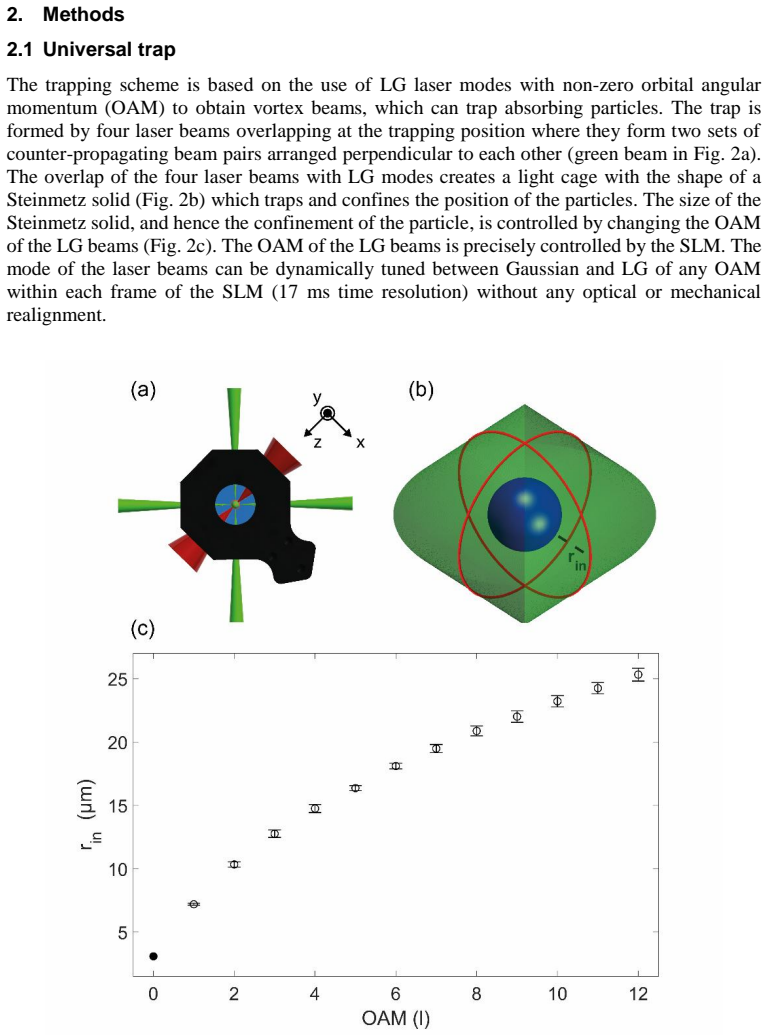
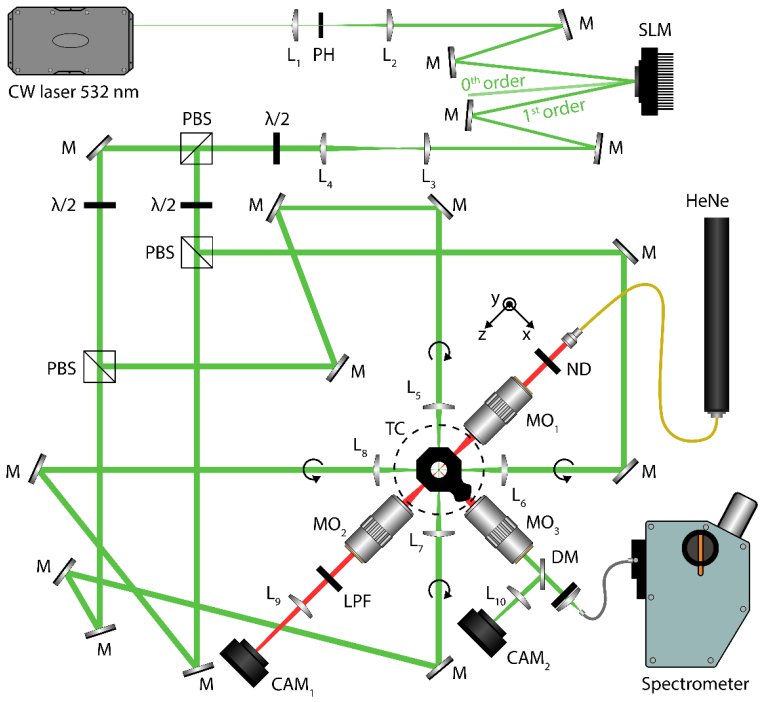
Four-arm SLM-modulated trap using Laguerre-Gaussian or Gaussian beams, where beam type and orbital angular momentum provide absorption-independent three-dimensional confinement.
If this is right
- Particles can be observed continuously while their absorption changes during atmospheric aging or photochemistry.
- Fluorescence and Raman measurements remain possible in every trap configuration.
- Confinement tightness can be tuned by changing the orbital angular momentum of the Laguerre-Gaussian beams.
- Both strongly absorbing brown-carbon-type particles and non-absorbing particles can be studied in the same fixed apparatus.
Where Pith is reading between the lines
- The approach could support real-time single-particle tracking of how absorption evolves during aerosol processing relevant to climate forcing.
- The trap geometry may generalize to other particles whose optical properties change dynamically under illumination.
- Pairing the trap with additional sensors could yield simultaneous multi-property data on individual particles throughout their aging.
Load-bearing premise
The assumption that SLM modulation of a fixed four-beam arrangement can maintain stable three-dimensional confinement as particle absorption changes continuously from strong to weak without particle escape.
What would settle it
An aqueous particle whose absorption is altered in place, for example by continued UV illumination of a fulvic acid droplet, remains stably trapped for an extended period in the identical beam settings with no mechanical adjustment.
Figures
read the original abstract
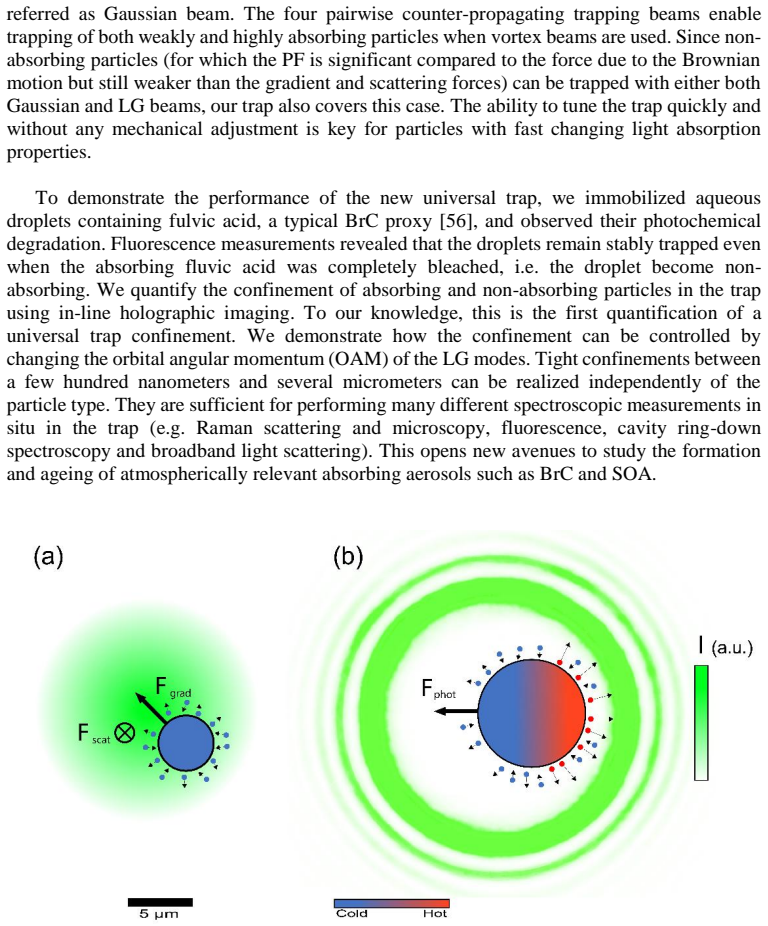
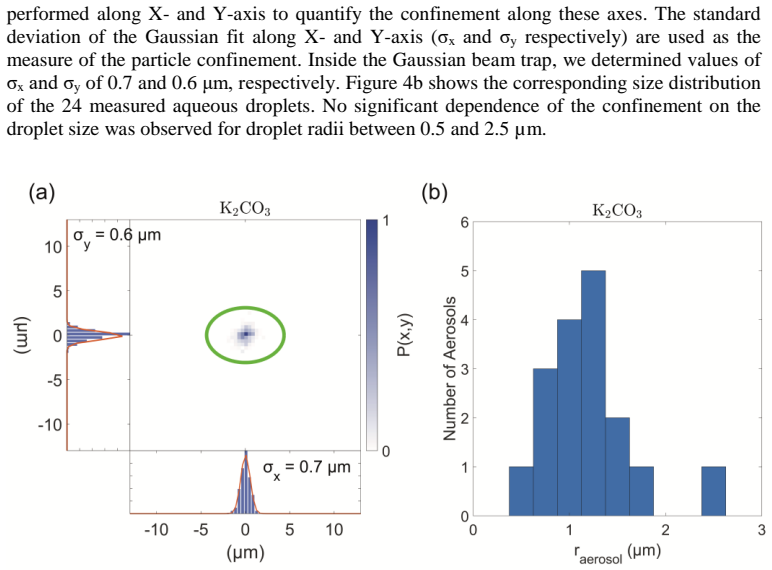
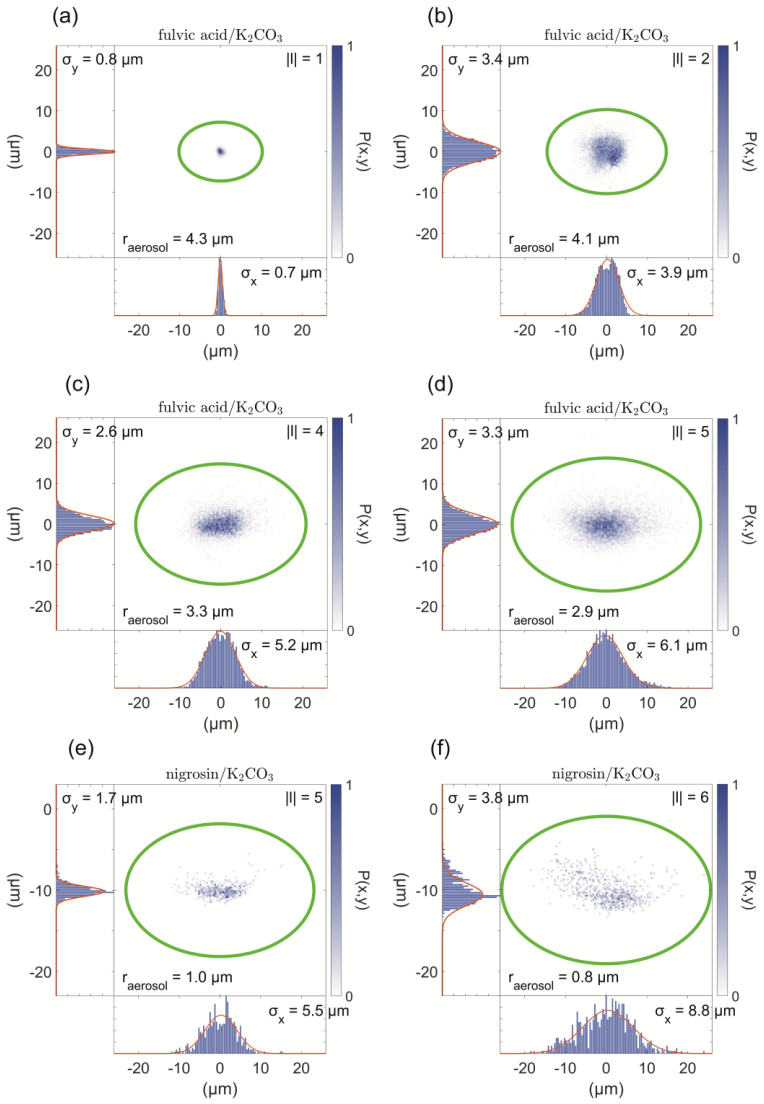
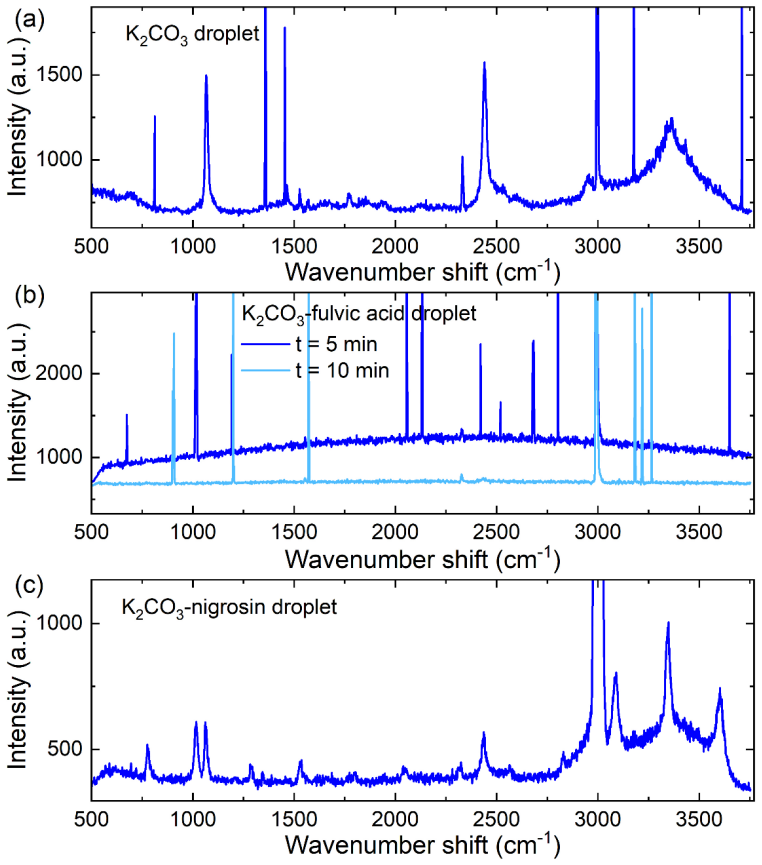
Absorbing aerosols, such as brown carbon (BrC) and absorbing secondary organic aerosols (SOA), has attracted broad interest due to their importance for climate and human health. The pronounced time-dependence of light absorption during aging renders the precise estimation of their impact on global warming difficult. Single particle studies of such aerosols would be very useful to better understand their aging in the atmosphere through processes such as photochemistry. However previously proposed optical traps cannot continuously trap particles whose absorption state changes from strongly absorbing to non-absorbing or vice versa. Some of the traps presented can isolate absorbing and non-absorbing particles, but require mechanical alignment of the trap depending on the strength of particle absorption. However, mechanical realignment is not compatible with continuous trapping and observation. Here, we introduce a flexible optical universal trap which does not require mechanical realignment. The versatility of the trap relies on four trapping beams - either vortex Laguerre- Gaussian (LG) or fundamental Gaussian beams - which are modulated with a spatial light modulator (SLM), The performance of the trap is demonstrated by trapping different types of absorbing and non-absorbing particles. We also show that the trap can be used to observe the photochemical reaction of aqueous droplets containing fulvic acid, a common component of BrC. Digital holography measurements demonstrate that the confinement of the particles in the trap can be controlled by changing the orbital angular momentum (OAM) of the LG beams. The study also shows that spectroscopy measurements, such as fluorescence and Raman scattering, are possible in all configurations of the proposed trap.
Editorial analysis
A structured set of objections, weighed in public.
Referee Report
Summary. The manuscript presents a four-beam optical trap using Laguerre-Gaussian or Gaussian beams modulated via a spatial light modulator (SLM) that enables trapping of both absorbing and non-absorbing aqueous particles without mechanical realignment. It demonstrates the approach on multiple particle types, observes photochemical reactions in fulvic-acid droplets via digital holography, and shows compatibility with fluorescence and Raman spectroscopy while controlling confinement through orbital angular momentum.
Significance. A working universal trap for particles whose absorption varies continuously would enable new single-particle studies of aerosol aging relevant to climate and health. The SLM-based four-arm geometry and OAM control are technically interesting, and the reported demonstrations on separate particle classes plus holography are positive. However, the lack of quantitative stability metrics and time-series data during absorption transitions weakens the central claim of continuous, realignment-free operation.
major comments (2)
- [Results and Discussion (photochemical reaction subsection)] The central claim of continuous 3D trapping across absorption transitions rests on separate demonstrations for absorbing and non-absorbing particles plus a photochemical reaction, but no position or escape-rate time series correlated with an absorption proxy (e.g., fluorescence intensity) during the reaction is shown. This leaves the 'universal' and 'continuous' aspects as extrapolation rather than direct evidence.
- [Experimental Results] Quantitative stability metrics (e.g., trap stiffness, escape rates, or position variance) are not reported for any configuration, making it difficult to assess whether the four-beam setup maintains confinement when absorption strength changes.
minor comments (2)
- [Methods] Methods section lacks full details on SLM phase patterns, beam alignment tolerances, and particle preparation protocols needed for reproducibility.
- [Figures] Figure captions should explicitly state the particle types, absorption states, and OAM values used in each panel.
Simulated Author's Rebuttal
We thank the referee for the positive evaluation of the work's significance and for the constructive major comments. We address each point below and will revise the manuscript to strengthen the evidence for continuous, realignment-free operation.
read point-by-point responses
-
Referee: [Results and Discussion (photochemical reaction subsection)] The central claim of continuous 3D trapping across absorption transitions rests on separate demonstrations for absorbing and non-absorbing particles plus a photochemical reaction, but no position or escape-rate time series correlated with an absorption proxy (e.g., fluorescence intensity) during the reaction is shown. This leaves the 'universal' and 'continuous' aspects as extrapolation rather than direct evidence.
Authors: We agree that a direct time-series correlation between particle position (or escape rate) and an absorption proxy during the photochemical transition would constitute stronger evidence than the current combination of separate demonstrations and reaction observation. The manuscript uses digital holography to show that fulvic-acid droplets remain confined throughout the reaction while absorption changes, but does not explicitly plot position variance against fluorescence intensity over time. In the revised manuscript we will add such time-series analysis extracted from the existing holography recordings, using fluorescence intensity as the absorption proxy where the data permit. revision: yes
-
Referee: [Experimental Results] Quantitative stability metrics (e.g., trap stiffness, escape rates, or position variance) are not reported for any configuration, making it difficult to assess whether the four-beam setup maintains confinement when absorption strength changes.
Authors: We concur that quantitative metrics would allow readers to evaluate confinement strength more rigorously across absorption states. The present manuscript emphasizes qualitative demonstrations of trapping for multiple particle types and OAM-controlled confinement via holography, without reporting numerical values for trap stiffness or position variance. In the revision we will include these metrics, calculated from the digital holography position data for representative absorbing and non-absorbing particles as well as during the fulvic-acid reaction. revision: yes
Circularity Check
No circularity: purely experimental demonstration without derivations or self-referential claims
full rationale
The paper is an experimental optics study that introduces a 4-arm SLM-modulated trap and reports direct observations of stable trapping for separate absorbing and non-absorbing particle types, plus photochemical reaction monitoring via digital holography and spectroscopy. No equations, fitted parameters, predictions, or derivation chains appear in the provided text. Central claims rest on empirical performance rather than any reduction to inputs by construction, self-citation, or ansatz. This is the expected honest outcome for a methods-and-demonstration manuscript.
Axiom & Free-Parameter Ledger
axioms (1)
- domain assumption Standard optical forces from focused LG and Gaussian beams can provide stable trapping for both absorbing and non-absorbing micron-sized aqueous particles in a four-arm geometry.
Reference graph
Works this paper leans on
-
[1]
"Technical Summary," in Climate Change 2021 – The Physical Science Basis: Working Group I Contribution to the Sixth Assessment Report of the Intergovernmental Panel on Climate Change, C. Intergovernmental Panel on Climate, ed. (Cambridge University Press, 2023), pp. 35-144
work page 2021
-
[2]
From Measurements to Models: Toward Accurate Representation of Brown Carbon in Climate Calculations,
R. Saleh, "From Measurements to Models: Toward Accurate Representation of Brown Carbon in Climate Calculations," Curr. Pollut. Rep. 6, 90-104 (2020)
work page 2020
-
[3]
F. Mayyas, H. Aldawod, K. H. Alzoubi et al., "Comparison of the cardiac effects of electronic cigarette aerosol exposure with waterpipe and combustible cigarette smoke exposure in rats," Life Sciences 251, 117644 (2020)
work page 2020
-
[4]
Assessment of the Chemical Evolution of E-Cigarette Droplets,
G. David, E. A. Parmentier, I. Taurino et al., "Assessment of the Chemical Evolution of E-Cigarette Droplets," CHIMIA International Journal for Chemistry 74, 733-733 (2020)
work page 2020
-
[5]
U. Pöschl, and M. Shiraiwa, "Multiphase Chemistry at the Atmosphere–Biosphere Interface Influencing Climate and Public Health in the Anthropocene," Chem. Rev. 115, 4440-4475 (2015)
work page 2015
-
[6]
An overview of atmospheric aerosol and their effects on human health,
T. Arfin, A. M. Pillai, N. Mathew et al., "An overview of atmospheric aerosol and their effects on human health," Environmental Science and Pollution Research 30, 125347-125369 (2023)
work page 2023
-
[7]
Mineral dust aerosol impacts on global climate and climate change,
J. F. Kok, T. Storelvmo, V. A. Karydis et al., "Mineral dust aerosol impacts on global climate and climate change," Nature Reviews Earth & Environment 4, 71-86 (2023)
work page 2023
-
[8]
Molecular insights into the composition, sources, and aging of atmospheric brown carbon,
A. Laskin, C. P. West, and A. P. S. Hettiyadura, "Molecular insights into the composition, sources, and aging of atmospheric brown carbon," Chem. Soc. Rev. 54, 1583-1612 (2025)
work page 2025
-
[9]
J. H. Vincent, Aerosol Science for Industrial Hygienists (Pergamon, 1995)
work page 1995
-
[10]
M. R. Marvin, P. I. Palmer, F. Yao et al., "Uncertainties from biomass burning aerosols in air quality models obscure public health impacts in Southeast Asia," Atmos. Chem. Phys. 24, 3699-3715 (2024)
work page 2024
-
[11]
M. Kahnert, T. Nousiainen, and H. Lindqvist, "Models for integrated and differential scattering optical properties of encapsulated light absorbing carbon aggregates," Opt. Express 21, 7974-7993 (2013)
work page 2013
-
[12]
A Review on Brown Carbon Aerosol in China: From Molecular Composition to Climate Impact,
X. Cao, J. Liu, Y. Wu et al., "A Review on Brown Carbon Aerosol in China: From Molecular Composition to Climate Impact," Curr. Pollut. Rep. 10, 326-343 (2024)
work page 2024
-
[13]
Aging of Atmospheric Brown Carbon Aerosol,
R. F. Hems, E. G. Schnitzler, C. Liu-Kang et al., "Aging of Atmospheric Brown Carbon Aerosol," ACS Earth Space Chem. 5, 722-748 (2021)
work page 2021
-
[14]
Weakened Haze Mitigation Induced by Enhanced Aging of Black Carbon in China,
Y. Zhang, Q. Zhang, N. Wu et al., "Weakened Haze Mitigation Induced by Enhanced Aging of Black Carbon in China," Environ. Sci. Technol. 56, 7629-7636 (2022)
work page 2022
-
[15]
Optical Properties of the Products of α-Dicarbonyl and Amine Reactions in Simulated Cloud Droplets,
K. J. Zarzana, D. O. De Haan, M. A. Freedman et al., "Optical Properties of the Products of α-Dicarbonyl and Amine Reactions in Simulated Cloud Droplets," Environ. Sci. Technol. 46, 4845-4851 (2012)
work page 2012
-
[16]
D. O. De Haan, L. N. Hawkins, H. G. Welsh et al., "Brown Carbon Production in Ammonium- or Amine- Containing Aerosol Particles by Reactive Uptake of Methylglyoxal and Photolytic Cloud Cycling," Environ. Sci. Technol. 51, 7458-7466 (2017)
work page 2017
-
[17]
A. K. Y. Lee, R. Zhao, R. Li et al., "Formation of Light Absorbing Organo-Nitrogen Species from Evaporation of Droplets Containing Glyoxal and Ammonium Sulfate," Environ. Sci. Technol. 47, 12819-12826 (2013)
work page 2013
-
[18]
Chemistry of Atmospheric Brown Carbon,
A. Laskin, J. Laskin, and S. A. Nizkorodov, "Chemistry of Atmospheric Brown Carbon," Chem. Rev. 115, 4335-4382 (2015)
work page 2015
-
[19]
Modeling of carbonaceous aerosols for air pollution health impact studies in Europe,
N. Paisi, J. Kushta, G. Georgiou et al., "Modeling of carbonaceous aerosols for air pollution health impact studies in Europe," Air Quality, Atmosphere & Health 17, 2091-2104 (2024)
work page 2091
-
[20]
Secondary organic aerosol association with cardiorespiratory disease mortality in the United States,
H. O. T. Pye, C. K. Ward-Caviness, B. N. Murphy et al., "Secondary organic aerosol association with cardiorespiratory disease mortality in the United States," Nat. Commun. 12, 7215 (2021)
work page 2021
-
[21]
K. S. Hopstock, Q. Xie, M. A. Alvarado et al., "Molecular Characterization and Photoreactivity of Organic Aerosols Formed from Pyrolysis of Urban Materials during Fires at the Wildland–Urban Interface," ACS ES&T Air 1, 1495-1506 (2024)
work page 2024
-
[22]
Photoinduced Oxidation Reactions at the Air–Water Interface,
J. M. Anglada, M. T. C. Martins-Costa, J. S. Francisco et al., "Photoinduced Oxidation Reactions at the Air–Water Interface," J. Am. Chem. Soc. 142, 16140-16155 (2020)
work page 2020
-
[23]
Dynamic viscosity mapping of the oxidation of squalene aerosol particles,
A. Athanasiadis, C. Fitzgerald, N. M. Davidson et al., "Dynamic viscosity mapping of the oxidation of squalene aerosol particles," Phys. Chem. Chem. Phys. 18, 30385-30393 (2016)
work page 2016
-
[24]
Interaction of SO2 with the Surface of a Water Nanodroplet,
J. Zhong, C. Zhu, L. Li et al., "Interaction of SO2 with the Surface of a Water Nanodroplet," J. Am. Chem. Soc. 139, 17168-17174 (2017)
work page 2017
-
[25]
Can all bulk-phase reactions be accelerated in microdroplets?,
S. Banerjee, E. Gnanamani, X. Yan et al., "Can all bulk-phase reactions be accelerated in microdroplets?," Analyst 142, 1399-1402 (2017)
work page 2017
-
[26]
Chemistry and Photochemistry of Pyruvic Acid at the Air–Water Interface,
K. J. Kappes, A. M. Deal, M. F. Jespersen et al., "Chemistry and Photochemistry of Pyruvic Acid at the Air–Water Interface," J. Phys. Chem. A 125, 1036-1049 (2021)
work page 2021
-
[27]
E. Antonsson, C. Raschpichler, B. Langer et al., "Surface Composition of Free Mixed NaCl/Na2SO4 Nanoscale Aerosols Probed by X-ray Photoelectron Spectroscopy," J. Phys. Chem. A 122, 2695-2702 (2018)
work page 2018
-
[28]
Fluorescence intermittency in single cadmium selenide nanocrystals,
M. Nirmal, B. O. Dabbousi, M. G. Bawendi et al., "Fluorescence intermittency in single cadmium selenide nanocrystals," Nature 383, 802-804 (1996)
work page 1996
-
[29]
Phase transition dynamics of single optically trapped aqueous potassium carbonate particles,
K. Esat, G. David, T. Poulkas et al., "Phase transition dynamics of single optically trapped aqueous potassium carbonate particles," Phys. Chem. Chem. Phys. 20, 11598-11607 (2018)
work page 2018
-
[30]
Review of Progress in Acoustic Levitation,
M. A. B. Andrade, N. Pérez, and J. C. Adamowski, "Review of Progress in Acoustic Levitation," Brazilian Journal of Physics 48, 190-213 (2018)
work page 2018
-
[31]
Single aerosol particle size and mass measurements using an electrodynamic balance,
E. J. Davis, and A. K. Ray, "Single aerosol particle size and mass measurements using an electrodynamic balance," J. Colloid Interface Sci. 75, 566-576 (1980)
work page 1980
-
[32]
A. K. Y. Lee, and C. K. Chan, "Single particle Raman spectroscopy for investigating atmospheric heterogeneous reactions of organic aerosols," Atm. Env. 41, 4611-4621 (2007)
work page 2007
-
[33]
Thermodynamic and optical properties of sea salt aerosols,
I. N. Tang, A. C. Tridico, and K. H. Fung, "Thermodynamic and optical properties of sea salt aerosols," J. Geophys. Res. 102, 23269-23275 (1997)
work page 1997
-
[34]
Acceleration and Trapping of Particles by Radiation Pressure,
A. Ashkin, "Acceleration and Trapping of Particles by Radiation Pressure," Phys. Rev. Lett. 24, 156-159 (1970)
work page 1970
-
[35]
Optical guiding of aerosol droplets,
M. D. Summers, J. P. Reid, and D. McGloin, "Optical guiding of aerosol droplets," Opt. Express 14, 6373-6380 (2006)
work page 2006
-
[36]
Optical trapping and laser-spectroscopy measurements of single particles in air: a review,
C. Wang, Y.-L. Pan, and G. Videen, "Optical trapping and laser-spectroscopy measurements of single particles in air: a review," Measurement Science and Technology 32, 102005 (2021)
work page 2021
-
[37]
G. David, K. Esat, S. Hartweg et al., "Stability of aerosol droplets in Bessel beam optical traps under constant and pulsed external forces," J. Chem. Phys. 142, 154506 (2015)
work page 2015
-
[38]
Ultraviolet broadband light scattering for optically-trapped submicron- sized aerosol particles,
G. David, K. Esat, I. Ritsch et al., "Ultraviolet broadband light scattering for optically-trapped submicron- sized aerosol particles," Phys. Chem. Chem. Phys. 18, 5477-5485 (2016)
work page 2016
-
[39]
Atmospherically relevant core-shell aerosol studied using optical trapping and Mie scattering,
S. H. Jones, M. D. King, and A. D. Ward, "Atmospherically relevant core-shell aerosol studied using optical trapping and Mie scattering," Chem. Commun. 51, 4914-4917 (2015)
work page 2015
-
[40]
Measurement of the Instantaneous Velocity of a Brownian Particle,
T. Li, S. Kheifets, D. Medellin et al., "Measurement of the Instantaneous Velocity of a Brownian Particle," Science 328, 1673-1675 (2010)
work page 2010
-
[41]
Optical trapping with structured light: a review,
Y. Yang, Y. Ren, M. Chen et al., "Optical trapping with structured light: a review," Advanced Photonics 3, 034001 (2021)
work page 2021
-
[42]
Z. Gong, Y.-L. Pan, G. Videen et al., "Optical trapping and manipulation of single particles in air: Principles, technical details, and applications," J. Quant. Spectrosc. Radiat. Transfer 214, 94-119 (2018)
work page 2018
-
[43]
Optical Trapping of Absorbing Particles,
H. Rubinsztein-Dunlop, T. A. Nieminen, M. E. J. Friese et al., "Optical Trapping of Absorbing Particles," in Advances in Quantum Chemistry, P.-O. Löwdin, ed. (Academic Press, 1998), pp. 469-492
work page 1998
-
[44]
H. He, M. E. J. Friese, N. R. Heckenberg et al., "Direct Observation of Transfer of Angular Momentum to Absorptive Particles from a Laser Beam with a Phase Singularity," Phys. Rev. Lett. 75, 826-829 (1995)
work page 1995
-
[45]
Forces of a single-beam gradient laser trap on a dielectric sphere in the ray optics regime,
A. Ashkin, "Forces of a single-beam gradient laser trap on a dielectric sphere in the ray optics regime," Biophysical Journal 61, 569-582 (1992)
work page 1992
-
[46]
S. H. Jones, M. D. King, and A. D. Ward, "Determining the unique refractive index properties of solid polystyrene aerosol using broadband Mie scattering from optically trapped beads," Phys. Chem. Chem. Phys. 15, 20735-20741 (2013)
work page 2013
-
[47]
M. I. Cotterell, T. C. Preston, A. J. Orr-Ewing et al., "Assessing the accuracy of complex refractive index retrievals from single aerosol particle cavity ring-down spectroscopy," Aerosol Sci. Technol. 50, 1077-1095 (2016)
work page 2016
-
[48]
Optical trapping and Raman spectroscopy of solid particles,
L. Rkiouak, M. J. Tang, J. C. J. Camp et al., "Optical trapping and Raman spectroscopy of solid particles," Phys. Chem. Chem. Phys. 16, 11426-11434 (2014)
work page 2014
-
[49]
Photophoresis—Light induced motion of particles suspended in gas,
O. Jovanovic, "Photophoresis—Light induced motion of particles suspended in gas," J. Quant. Spectrosc. Radiat. Transfer 110, 889-901 (2009)
work page 2009
-
[50]
Optical vortex beams for trapping and transport of particles in air,
V. G. Shvedov, A. S. Desyatnikov, A. V. Rode et al., "Optical vortex beams for trapping and transport of particles in air," Applied Physics A 100, 327-331 (2010)
work page 2010
-
[51]
Nitrogen-Containing Compounds Enhance Light Absorption of Aromatic-Derived Brown Carbon,
Z. Yang, N. T. Tsona, C. George et al., "Nitrogen-Containing Compounds Enhance Light Absorption of Aromatic-Derived Brown Carbon," Environ. Sci. Technol. 56, 4005-4016 (2022)
work page 2022
-
[52]
Y. Zhou, C. P. West, A. P. S. Hettiyadura et al., "Molecular Characterization of Water-Soluble Brown Carbon Chromophores in Snowpack from Northern Xinjiang, China," Environ. Sci. Technol. 56, 4173-4186 (2022)
work page 2022
-
[53]
Atmospheric Processing of Particulate Imidazole Compounds Driven by Photochemistry,
X. Hu, Z. Guo, W. Sun et al., "Atmospheric Processing of Particulate Imidazole Compounds Driven by Photochemistry," Environmental Science & Technology Letters 9, 265-271 (2022)
work page 2022
-
[54]
Molecular Chemistry of Atmospheric Brown Carbon Inferred from a Nationwide Biomass Burning Event,
P. Lin, N. Bluvshtein, Y. Rudich et al., "Molecular Chemistry of Atmospheric Brown Carbon Inferred from a Nationwide Biomass Burning Event," Environ. Sci. Technol. 51, 11561-11570 (2017)
work page 2017
-
[55]
X. Lian, G. Zhang, Y. Yang et al., "Evidence for the Formation of Imidazole from Carbonyls and Reduced Nitrogen Species at the Individual Particle Level in the Ambient Atmosphere," Environmental Science & Technology Letters 8, 9-15 (2021)
work page 2021
-
[56]
Brown carbon: An underlying driving force for rapid atmospheric sulfate formation and haze event,
Y. Liu, T. Wang, X. Fang et al., "Brown carbon: An underlying driving force for rapid atmospheric sulfate formation and haze event," Science of The Total Environment 734, 139415 (2020)
work page 2020
-
[57]
Dynamics of submicron aerosol droplets in a robust optical trap formed by multiple Bessel beams,
I. Thanopulos, D. Luckhaus, T. C. Preston et al., "Dynamics of submicron aerosol droplets in a robust optical trap formed by multiple Bessel beams," J. Appl. Phys. 115, 154304 (2014)
work page 2014
-
[58]
Optical guiding of absorbing nanoclusters in air,
V. G. Shvedov, A. S. Desyatnikov, A. V. Rode et al., "Optical guiding of absorbing nanoclusters in air," Opt. Express 17, 5743-5757 (2009)
work page 2009
-
[59]
Practical algorithms for simulation and reconstruction of digital in- line holograms,
T. Latychevskaia, and H.-W. Fink, "Practical algorithms for simulation and reconstruction of digital in- line holograms," Appl. Opt. 54, 2424-2434 (2015)
work page 2015
-
[60]
Digital holographic imaging of aerosol particles in flight,
M. J. Berg, and G. Videen, "Digital holographic imaging of aerosol particles in flight," J. Quant. Spectrosc. Radiat. Transfer 112, 1776-1783 (2011)
work page 2011
-
[61]
Submersible digital in-line holographic microscope,
S. K. Jericho, J. Garcia-Sucerquia, W. Xu et al., "Submersible digital in-line holographic microscope," Rev. Sci. Instrum. 77, 043706 (2006)
work page 2006
-
[62]
Digital holography of optically-trapped aerosol particles,
G. David, K. Esat, I. Thanopulos et al., "Digital holography of optically-trapped aerosol particles," Commun. Chem. 1, 46 (2018)
work page 2018
-
[63]
C. Coelho, G. Guyot, A. ter Halle et al., "Photoreactivity of humic substances: relationship between fluorescence and singlet oxygen production," Environmental Chemistry Letters 9, 447-451 (2011)
work page 2011
discussion (0)
Sign in with ORCID, Apple, or X to comment. Anyone can read and Pith papers without signing in.