Comparing astrophysical models to gravitational-wave data in the observable space
Pith reviewed 2026-05-19 04:32 UTC · model grok-4.3
The pith
Astrophysical models of compact binaries can be compared to gravitational-wave data directly in observable space.
A machine-rendered reading of the paper's core claim, the machinery that carries it, and where it could break.
Core claim
Comparing models to data in the observable space respects the domain of validity of the astrophysical models, and unbiased inference of the observable compact-binary population is possible when selection effects are incorporated in a non-standard manner rather than the usual deconvolution followed by refolding.
What carries the argument
Reconstruction of the observable population by directly modeling detected events while incorporating selection effects differently from the standard hierarchical Bayesian approach.
If this is right
- Only the parameter-space regions actually predicted by a given model enter the comparison.
- Inference targets the population that detectors actually record rather than an extrapolated intrinsic one.
- Model predictions can be tested without first removing and then re-applying selection effects.
- The method has been applied to real O3 data and can be used for future observing runs.
Where Pith is reading between the lines
- The same direct-observable approach could be adapted to other selection-biased datasets such as exoplanet surveys.
- Avoiding the deconvolution step may reduce error propagation in population analyses.
- Extensions could include joint fits across multiple detectors or waveform models.
Load-bearing premise
Selection effects can be incorporated in a non-standard manner that still yields unbiased inference of the observable population.
What would settle it
A simulation test that injects a known observable population into mock data and checks whether this method recovers the injected distribution without bias would confirm or refute the claim.
Figures
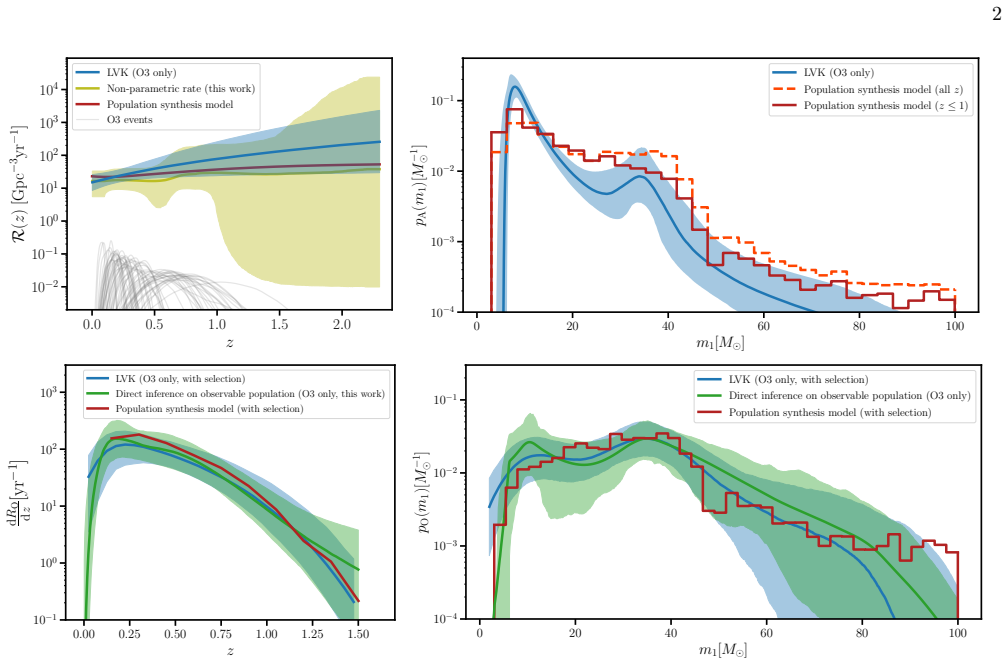

read the original abstract
Comparing population-synthesis models to the results of hierarchical Bayesian inference in gravitational-wave astronomy requires a careful understanding of the domain of validity of the models fitted to data. This comparison is usually done using the inferred astrophysical distribution: from the data that were collected, one deconvolves selection effects to reconstruct the generating population distribution. In this paper, we demonstrate the benefits of instead comparing observable populations directly. In this approach, the domain of validity of the models is trivially respected, such that only the relevant parameter space regions as predicted by the astrophysical models of interest contribute to the comparison. With this in mind, it can be useful to fit the observed population directly, rather than effectively deconvolving the selection effects only to fold them back in when reconstructing the observable population. We clarify that unbiased inference of the observable compact-binary population is indeed possible. Crucially, this approach still requires incorporating selection effects, but in a manner that differs from the standard implementation. We apply our observable-space reconstruction to LIGO-Virgo-KAGRA data from their third observing run and illustrate its potential by comparing the results to the predictions of a fiducial population-synthesis model.
Editorial analysis
A structured set of objections, weighed in public.
Referee Report
Summary. The paper claims that comparing astrophysical population-synthesis models to gravitational-wave data is best performed directly in observable space rather than by first deconvolving selection effects to recover the intrinsic population. It clarifies that unbiased inference of the observable compact-binary population remains possible when selection effects are incorporated via a non-standard route, thereby respecting the domain of validity of the models by construction. The approach is illustrated by applying the observable-space reconstruction to LIGO-Virgo-KAGRA O3 data and comparing the results to a fiducial population-synthesis model.
Significance. If the central clarification holds, the work offers a practical simplification for model comparison in gravitational-wave population studies. By relocating the comparison to the observable domain, it avoids unnecessary inversion steps while still requiring proper treatment of selection effects, which may reduce systematic uncertainties and improve the reliability of assessing which astrophysical models are consistent with the data.
major comments (1)
- Abstract and the section introducing the observable-space approach: the claim that unbiased inference of the observable population is possible with a non-standard incorporation of selection effects is central to the paper, yet the manuscript does not supply an explicit likelihood construction or step-by-step derivation showing how this differs from the standard hierarchical form while preserving unbiasedness; without this, verification of the result is difficult.
minor comments (2)
- The application to O3 data would be strengthened by including a quantitative metric (e.g., posterior predictive checks or overlap integrals) for the agreement between the reconstructed observable distribution and the fiducial model prediction.
- Notation for the observable population distribution and the selection-effect term should be introduced with a clear definition on first use to improve readability for readers unfamiliar with the relocated comparison step.
Simulated Author's Rebuttal
We thank the referee for their careful reading of the manuscript and for recommending minor revision. We appreciate the identification of the need for greater explicitness in the central claim regarding unbiased inference in observable space.
read point-by-point responses
-
Referee: Abstract and the section introducing the observable-space approach: the claim that unbiased inference of the observable population is possible with a non-standard incorporation of selection effects is central to the paper, yet the manuscript does not supply an explicit likelihood construction or step-by-step derivation showing how this differs from the standard hierarchical form while preserving unbiasedness; without this, verification of the result is difficult.
Authors: We agree that an explicit likelihood construction and step-by-step derivation would improve clarity and verifiability. In the revised manuscript we will add a dedicated subsection (or appendix) that presents the likelihood for the observable population, derives it from first principles, and contrasts it with the standard hierarchical form. The derivation will show how selection effects enter via a non-standard route that respects the domain of validity of the models while preserving unbiasedness for the observable distribution. revision: yes
Circularity Check
No significant circularity
full rationale
The paper presents a methodological clarification that unbiased inference of the observable compact-binary population remains possible when selection effects are incorporated via a non-standard route, allowing direct model comparison in observable space. No equations, derivations, or steps in the provided abstract or description reduce the central claim to a fitted input, self-definition, or self-citation chain by construction; the approach relocates the comparison step within existing hierarchical inference frameworks without introducing load-bearing self-referential elements. The result is self-contained and builds on standard selection-effect handling in gravitational-wave astronomy.
Axiom & Free-Parameter Ledger
axioms (1)
- domain assumption Selection effects can be incorporated differently from the standard implementation while still permitting unbiased inference of the observable population.
Forward citations
Cited by 1 Pith paper
-
What You Don't Know Won't Hurt You: Self-Consistent Hierarchical Inference with Unknown Follow-up Selection Strategies
Hierarchical Bayesian inference allows accurate recovery of intrinsic astrophysical source populations even when follow-up selection is unknown and correlated with parameters of interest.
Reference graph
Works this paper leans on
-
[1]
J. Aasiet al.(LIGO Scientific), Class. Quant. Grav.32, 074001 (2015), arXiv:1411.4547 [gr-qc]
work page internal anchor Pith review Pith/arXiv arXiv 2015
-
[2]
Advanced Virgo: a 2nd generation interferometric gravitational wave detector
F. Acerneseet al.(VIRGO), Class. Quant. Grav.32, 024001 (2015), arXiv:1408.3978 [gr-qc]
work page internal anchor Pith review Pith/arXiv arXiv 2015
-
[3]
Akutsuet al.(KAGRA), PTEP2021, 05A101 (2021), arXiv:2005.05574 [physics.ins-det]
T. Akutsuet al.(KAGRA), Prog. Theor. Exp. Phys.2021, 05A101 (2021), arXiv:2005.05574 [physics.ins-det]
-
[4]
R. Abbottet al.(KAGRA, VIRGO, LIGO Scientific), Phys. Rev. X 13, 041039 (2023), arXiv:2111.03606 [gr-qc]
work page internal anchor Pith review Pith/arXiv arXiv 2023
- [5]
-
[6]
I. Mandel and A. Farmer, Phys. Rept. 955, 1 (2022), arXiv:1806.05820 [astro-ph.HE]
-
[7]
Mapelli, inHandbook of Gravitational Wave Astronomy (Springer, 2021) arXiv:2106.00699 [astro-ph.HE]
M. Mapelli, inHandbook of Gravitational Wave Astronomy (Springer, 2021) arXiv:2106.00699 [astro-ph.HE]
-
[8]
Extracting distribution parameters from multiple uncertain observations with selection biases
I. Mandel, W. M. Farr, and J. R. Gair, Mon. Not. R. Astron. Soc. 486, 1086 (2019), arXiv:1809.02063 [physics.data-an]
work page internal anchor Pith review Pith/arXiv arXiv 2019
- [9]
- [10]
- [11]
-
[12]
Y. Bouffanais, M. Mapelli, F. Santoliquido, N. Giacobbo, G. Iorio, and G. Costa, Mon. Not. Roy. Astron. Soc.505, 3873 (2021), arXiv:2010.11220 [astro-ph.HE]
-
[13]
G. Franciolini, V. Baibhav, V. De Luca, K. K. Y. Ng, K. W. K. Wong, E. Berti, P. Pani, A. Riotto, and S. Vitale, 6 Phys. Rev. D105, 083526 (2022), arXiv:2105.03349 [gr-qc]
- [14]
- [15]
-
[16]
S. Colloms, C. P. L. Berry, J. Veitch, and M. Zevin, (2025), arXiv:2503.03819 [astro-ph.HE]
-
[17]
C. Plunkett, M. Mould, and S. Vitale, (2025), arXiv:2504.18615 [gr-qc]
- [18]
-
[19]
J.-Q. Jiang, H.-L. Huang, J. He, Y.-T. Wang, and Y.-S. Piao, (2025), arXiv:2505.15530 [gr-qc]
-
[20]
Measuring the binary black hole mass spectrum with an astrophysically motivated parameterization
C. Talbot and E. Thrane, Astrophys. J.856, 173 (2018), arXiv:1801.02699 [astro-ph.HE]
work page internal anchor Pith review Pith/arXiv arXiv 2018
- [21]
-
[22]
C. Adamcewicz and E. Thrane, Mon. Not. Roy. Astron. Soc. 517, 3928 (2022), arXiv:2208.03405 [astro-ph.HE]
-
[23]
S. Biscoveanu, T. A. Callister, C.-J. Haster, K. K. Y. Ng, S. Vitale, and W. M. Farr, Astrophys. J. Lett.932, L19 (2022), arXiv:2204.01578 [astro-ph.HE]
-
[24]
G. Franciolini and P. Pani, Phys. Rev. D105, 123024 (2022), arXiv:2201.13098 [astro-ph.HE]
-
[25]
Y.-Z. Wang, Y.-J. Li, J. S. Vink, Y.-Z. Fan, S.-P. Tang, Y. Qin, and D.-M. Wei, Astrophys. J. Lett.941, L39 (2022), arXiv:2208.11871 [astro-ph.HE]
- [26]
- [27]
-
[28]
V. Gennari, S. Mastrogiovanni, N. Tamanini, S. Marsat, and G. Pierra, (2025), arXiv:2502.20445 [gr-qc]
-
[29]
A. Hussain, M. Isi, and A. Zimmerman, (2024), arXiv:2411.02252 [astro-ph.HE]
-
[30]
S. Rinaldi and W. Del Pozzo, Mon. Not. R. Astron. Soc. 509, 5454 (2021), arXiv:2109.05960 [astro-ph.IM]
-
[31]
V. Tiwari, Astrophys. J. 928, 155 (2022), arXiv:2111.13991 [astro-ph.HE]
- [32]
-
[33]
B. Edelman, B. Farr, and Z. Doctor, Astrophys. J.946, 16 (2023), arXiv:2210.12834 [astro-ph.HE]
- [34]
- [35]
- [36]
-
[37]
A. Toubiana, M. L. Katz, and J. R. Gair, Mon. Not. R. Astron. Soc. 524, 5844 (2023), arXiv:2305.08909 [gr-qc]
-
[38]
J. Heinzel, M. Mould, S. Álvarez-López, and S. Vitale, Phys. Rev. D111, 063043 (2025), arXiv:2406.16813 [astro- ph.HE]
-
[39]
R. Essick and M. Fishbach, Astrophys. J.962, 169 (2024), arXiv:2310.02017 [gr-qc]
-
[40]
M. Arca Sedda, M. Mapelli, M. Benacquista, and M. Spera, Mon. Not. R. Astron. Soc.520, 5259 (2023), arXiv:2109.12119 [astro-ph.GA]
-
[41]
LIGO/Virgo/KAGRA Collaboration, 10.5281/zen- odo.11254021 (2024)
- [42]
-
[43]
Does the Black Hole Merger Rate Evolve with Redshift?
M. Fishbach, D. E. Holz, and W. M. Farr, Astrophys. J. Lett. 863, L41 (2018), arXiv:1805.10270 [astro-ph.HE]
work page internal anchor Pith review Pith/arXiv arXiv 2018
-
[44]
The population of merging compact binaries inferred using gravitational waves through GWTC-3
R. Abbott et al. (KAGRA, VIRGO, LIGO Scientific), Phys. Rev. X13, 011048 (2023), arXiv:2111.03634 [astro- ph.HE]
work page internal anchor Pith review Pith/arXiv arXiv 2023
-
[45]
Eryn : A multi-purpose sampler for bayesian inference,
N. Karnesis, M. L. Katz, N. Korsakova, J. R. Gair, and N. Stergioulas, Mon. Not. R. Astron. Soc.526, 4814 (2023), arXiv:2303.02164 [astro-ph.IM]
-
[46]
S. M. Gaebel, J. Veitch, T. Dent, and W. M. Farr, Mon. Not. R. Astron. Soc.484, 4008 (2019), arXiv:1809.03815 [astro-ph.IM]
work page internal anchor Pith review Pith/arXiv arXiv 2019
- [47]
-
[48]
T. Callister, M. Fishbach, D. Holz, and W. Farr, Astro- phys. J. Lett.896, L32 (2020), arXiv:2003.12152 [astro- ph.HE]
- [49]
- [50]
-
[51]
B. Cousins, K. Schumacher, A. K.-W. Chung, C. Tal- bot, T. Callister, D. E. Holz, and N. Yunes, (2025), arXiv:2503.01997 [astro-ph.CO]
-
[52]
S. Ferraiuolo, S. Mastrogiovanni, S. Escoffier, and E. Kaj- fasz, (2025), arXiv:2503.14686 [astro-ph.CO]
- [53]
- [54]
-
[55]
C. Talbot and E. Thrane, Astrophys. J.927, 76 (2022), arXiv:2012.01317 [gr-qc]
-
[56]
Rinaldi, (2024), arXiv:2405.06366 [stat.ME]
S. Rinaldi, (2024), arXiv:2405.06366 [stat.ME]
-
[57]
M. Arca Sedda and M. Benacquista, Mon. Not. R. Astron. Soc. 482, 2991 (2019), arXiv:1806.01285 [astro-ph.GA]
work page internal anchor Pith review Pith/arXiv arXiv 2019
-
[58]
M. Arca Sedda, M. Mapelli, M. Spera, M. Benac- quista, and N. Giacobbo, Astrophys. J.894, 133 (2020), arXiv:2003.07409 [astro-ph.GA]
- [59]
-
[60]
R. Essick, Phys. Rev. D 108, 043011 (2023), arXiv:2307.02765 [gr-qc]
-
[61]
D. Gerosa and M. Bellotti, Class. Quant. Grav.41, 125002 (2024), arXiv:2404.16930 [astro-ph.HE]
-
[62]
A. Lorenzo-Medina and T. Dent, Class. Quant. Grav.42, 045008 (2025), arXiv:2408.13383 [gr-qc]
-
[63]
C. Talbot and J. Golomb, Mon. Not. Roy. Astron. Soc. 526, 3495 (2023), arXiv:2304.06138 [astro-ph.IM]
- [64]
-
[65]
W. M. Farr, Research Notes of the AAS3, 66 (2019), arXiv:1904.10879 [astro-ph.IM]
work page internal anchor Pith review Pith/arXiv arXiv 2019
- [66]
-
[67]
S. Rinaldi, A. Toubiana, and J. R. Gair, (2025), arXiv:2506.05153 [gr-qc]
-
[68]
S. Alvarez-Lopez, J. Heinzel, M. Mould, and S. Vitale, (2025), arXiv:2506.20731 [astro-ph.HE]
-
[69]
Radiation Backgrounds at Cosmic Dawn: X-Rays from Compact Binaries
P. Madau and T. Fragos, Astrophys. J.840, 39 (2017), arXiv:1606.07887 [astro-ph.GA]
work page internal anchor Pith review Pith/arXiv arXiv 2017
-
[70]
M. Mapelli, Y. Bouffanais, F. Santoliquido, M. Arca 7 Sedda, and M. C. Artale, Mon. Not. R. Astron. Soc.511, 5797 (2022), arXiv:2109.06222 [astro-ph.HE]
-
[71]
N. Neumayer, A. Seth, and T. Böker, Astron. Astrophys. Rev. 28, 4 (2020), arXiv:2001.03626 [astro-ph.GA]
- [72]
-
[73]
N. Giacobbo, M. Mapelli, and M. Spera, Mon. Not. R. Astron. Soc. 474, 2959 (2018), arXiv:1711.03556 [astro- ph.SR]
work page internal anchor Pith review Pith/arXiv arXiv 2018
-
[74]
The progenitors of compact-object binaries: impact of metallicity, common envelope and natal kicks
N. Giacobbo and M. Mapelli, Mon. Not. R. Astron. Soc. 480, 2011 (2018), arXiv:1806.00001 [astro-ph.HE]
work page internal anchor Pith review Pith/arXiv arXiv 2011
-
[75]
N. Giacobbo and M. Mapelli, Astrophys. J. 891, 141 (2020), arXiv:1909.06385 [astro-ph.HE]. 8 End Matter Population-synthesis model — The astrophysical pop- ulation of BBH mergers is constructed leveraging on an upgraded version of theB-Pop semi-analytic population synthesis tool [40, 57–59]. B-Pop is a flexible tool that permits the user to simulate a het...
discussion (0)
Sign in with ORCID, Apple, or X to comment. Anyone can read and Pith papers without signing in.