A Specialized Simplex Algorithm for Budget-Constrained Total Variation-Regularized Problems
Pith reviewed 2026-05-21 23:31 UTC · model grok-4.3
The pith
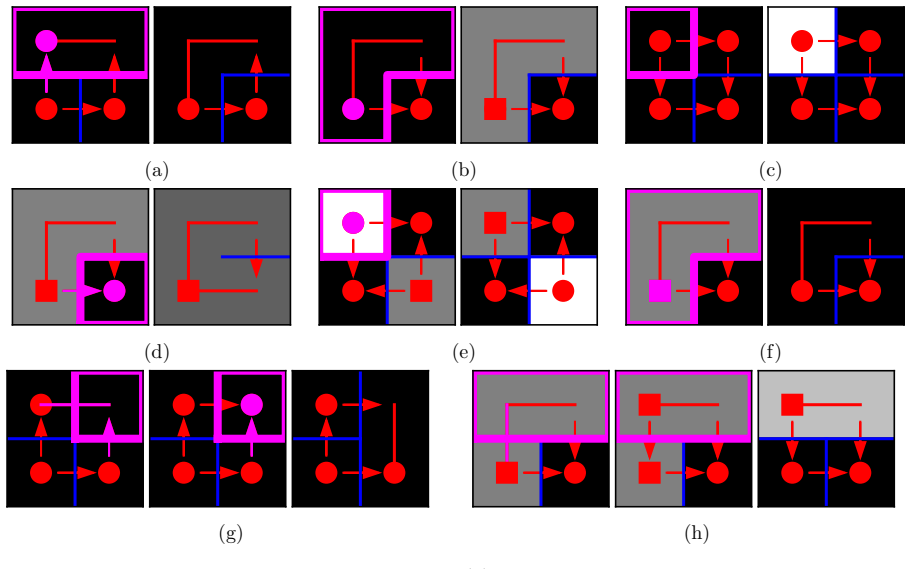
Basic solutions of budget-constrained TV-regularized LPs on graphs are oriented rooted spanning forests.
A machine-rendered reading of the paper's core claim, the machinery that carries it, and where it could break.
Core claim
We characterize basic solutions in terms of rooted spanning forests with orientation on the underlying graph. This characterization permits an interpretation of the simplex method in terms of simple graph operations on these forests, which we use to construct an accelerated simplex algorithm that delivers order-of-magnitude speed improvements over existing solvers.
What carries the argument
The oriented rooted spanning forest representation of basic feasible solutions, which converts simplex pivots into edge addition and deletion operations on the graph.
If this is right
- Simplex steps become simple local graph updates rather than full matrix operations.
- The specialized algorithm runs approximately ten times faster than standard LP solvers on test instances.
- Basic solutions admit a combinatorial description that reveals their support structure directly from the forest.
- The method extends the applicability of simplex techniques to large-scale graph-based regularization problems.
Where Pith is reading between the lines
- If the forest characterization holds, it may be possible to derive similar combinatorial views for related problems such as higher-order total variation or other convex regularizers.
- Implementing the forest updates with efficient data structures like union-find could yield further practical gains.
- Connecting this view to existing graph algorithms for spanning trees might uncover additional theoretical links.
Load-bearing premise
That every basic feasible solution corresponds exactly to an oriented rooted spanning forest without exceptions or extra cases.
What would settle it
A basic feasible solution on a small graph, such as a triangle with specific costs, whose incidence vector does not match the edges of any oriented rooted spanning forest.
Figures

read the original abstract
We consider a class of linear programs on graphs with total variation regularization and a budgetary constraint. For these programs, we give a characterization of basic solutions in terms of rooted spanning forests with orientation on the underlying graph. This leads to an interpretation of the simplex method in terms of simple graph operations on these underlying forests. We exploit this structure to produce an accelerated simplex method and empirically show that such improvements can lead to an order of magnitude improvement in time when compared to state-of-the-art solvers.
Editorial analysis
A structured set of objections, weighed in public.
Referee Report
Summary. The paper develops a specialized simplex algorithm for linear programs on graphs that incorporate total variation regularization subject to a budget constraint. It claims a one-to-one correspondence between basic feasible solutions and oriented rooted spanning forests on the underlying graph, which permits reinterpretation of simplex pivots as local graph operations (edge additions, deletions, and root updates). This structure is exploited to accelerate the simplex method, with empirical results indicating roughly an order-of-magnitude runtime improvement over standard solvers.
Significance. If the forest characterization is rigorously established and the resulting pivots are correctly implemented, the approach would supply a structurally aware, potentially faster solver for a practically relevant class of structured LPs arising in imaging, network flow, and signal processing. The explicit graph-theoretic view of bases and pivots is a conceptual contribution that could be reused beyond the budget-constrained setting, provided the correspondence survives the addition of the global budget row.
major comments (2)
- [§3] §3 (Characterization of basic solutions): The claimed bijection between basic feasible solutions and oriented rooted spanning forests is asserted for the augmented constraint matrix that includes the budget equality. When the budget is binding, the dense summation row can create linear dependencies whose support is not a forest (or whose cardinality deviates from |V| minus the number of components). The manuscript must supply an explicit argument—e.g., via super-root augmentation or slack-variable handling—that shows every basis remains a forest even under a tight budget; without it the central claim is load-bearing and unverified.
- [§4] §4 (Simplex pivot reinterpretation): The local graph operations (edge insertion/deletion with root update) are derived from the forest basis property. If the forest correspondence fails for binding budgets, these operations may produce non-basic or infeasible points; a counter-example or corrected pivot rule for the binding case is required before the accelerated implementation can be trusted.
minor comments (3)
- [Experiments] Experimental section: test instances, graph sizes, budget values, and baseline solver versions are not described in sufficient detail to reproduce the reported order-of-magnitude gains.
- [Experiments] No error bars, multiple runs, or statistical tests accompany the timing tables, making it impossible to assess whether the observed speedups are robust.
- [§2] Notation: the precise linearization of the total-variation term and the exact form of the budget equality (including any slack) should be stated once at the beginning of §2 to avoid ambiguity when reading the basis characterization.
Simulated Author's Rebuttal
We thank the referee for the careful reading and for identifying the need to strengthen the justification of the forest characterization when the budget constraint is binding. We address the two major comments below and will incorporate the requested clarifications and proofs into the revised manuscript.
read point-by-point responses
-
Referee: [§3] §3 (Characterization of basic solutions): The claimed bijection between basic feasible solutions and oriented rooted spanning forests is asserted for the augmented constraint matrix that includes the budget equality. When the budget is binding, the dense summation row can create linear dependencies whose support is not a forest (or whose cardinality deviates from |V| minus the number of components). The manuscript must supply an explicit argument—e.g., via super-root augmentation or slack-variable handling—that shows every basis remains a forest even under a tight budget; without it the central claim is load-bearing and unverified.
Authors: We agree that an explicit argument for the binding-budget case is required to fully substantiate the bijection. The current manuscript states the correspondence for the augmented system but does not spell out the handling of the dense budget row in detail. We will revise Section 3 to include a self-contained proof that employs super-root augmentation: a fictitious super-root is attached to every vertex that can serve as a root, and the budget equality is represented by the single edge from the super-root whose variable is forced into the basis when the constraint is tight. This construction preserves both acyclicity and the exact cardinality |V| minus the number of components, so every basis remains a rooted forest in the augmented graph. The revised section will also treat the non-binding case as a special instance in which the super-root edge is non-basic. revision: yes
-
Referee: [§4] §4 (Simplex pivot reinterpretation): The local graph operations (edge insertion/deletion with root update) are derived from the forest basis property. If the forest correspondence fails for binding budgets, these operations may produce non-basic or infeasible points; a counter-example or corrected pivot rule for the binding case is required before the accelerated implementation can be trusted.
Authors: We concur that the correctness of the local pivot rules depends on the forest property holding uniformly. Once the super-root augmentation is established in the revised Section 3, the same local operations (edge insertion, deletion, and root update) extend directly to the binding case: any pivot that would involve the budget row is reinterpreted as an operation on the super-root edge. We will augment Section 4 with an explicit description of these extended rules, including the bookkeeping for super-root attachments, and will verify that every such operation yields a new basis that remains a valid oriented rooted forest. No counter-example is needed; the revised proof guarantees validity for both binding and non-binding budgets. revision: yes
Circularity Check
No circularity: characterization derived from standard LP theory on augmented incidence matrices
full rationale
The paper's central derivation establishes a 1-1 correspondence between basic feasible solutions of the budget-constrained TV LP and oriented rooted spanning forests by analyzing the structure of bases in the constraint matrix (incidence matrix plus the global budget row). This step is presented as a direct consequence of linear algebra on graphs and does not reduce to any fitted parameter, self-definition, or load-bearing self-citation. The subsequent reinterpretation of simplex pivots as local forest operations follows mechanically from the characterization without feeding any output back into the inputs. The argument remains self-contained against external benchmarks such as standard simplex theory and graph matroid properties.
Axiom & Free-Parameter Ledger
axioms (2)
- domain assumption The problems form a class of linear programs on graphs that include total variation regularization and a budgetary constraint.
- ad hoc to paper Basic solutions of these programs are in one-to-one correspondence with oriented rooted spanning forests.
Lean theorems connected to this paper
-
IndisputableMonolith/Foundation/AlexanderDuality.leanalexander_duality_circle_linking unclear?
unclearRelation between the paper passage and the cited Recognition theorem.
We give a characterization of basic solutions in terms of rooted spanning forests with orientation on the underlying graph. This leads to an interpretation of the simplex method in terms of simple graph operations on these underlying forests.
-
IndisputableMonolith/Foundation/ArithmeticFromLogic.leanembed_injective unclear?
unclearRelation between the paper passage and the cited Recognition theorem.
the constraint matrix for this problem is given by A_TV-B = [A_G^T -I I 0; h^T 0 0 1]
What do these tags mean?
- matches
- The paper's claim is directly supported by a theorem in the formal canon.
- supports
- The theorem supports part of the paper's argument, but the paper may add assumptions or extra steps.
- extends
- The paper goes beyond the formal theorem; the theorem is a base layer rather than the whole result.
- uses
- The paper appears to rely on the theorem as machinery.
- contradicts
- The paper's claim conflicts with a theorem or certificate in the canon.
- unclear
- Pith found a possible connection, but the passage is too broad, indirect, or ambiguous to say the theorem truly supports the claim.
Reference graph
Works this paper leans on
-
[1]
A cut-based algorithm for the nonlinear dual of the minimum cost network flow problem
Ravindra K Ahuja, Dorit S Hochbaum, and James B Orlin. “A cut-based algorithm for the nonlinear dual of the minimum cost network flow problem”. In:Algorithmica39 (2004), pp. 189–208
work page 2004
-
[2]
A capacity scaling algorithm for the constrained maximum flow problem
Ravindra K Ahuja and James B Orlin. “A capacity scaling algorithm for the constrained maximum flow problem”. In:Networks25.2 (1995), pp. 89–98
work page 1995
-
[3]
An experimental comparison of min-cut/max-flow algorithms for energy minimization in vision
Yuri Boykov and Vladimir Kolmogorov. “An experimental comparison of min-cut/max-flow algorithms for energy minimization in vision”. In:IEEE transactions on pattern analysis and machine intelligence26.9 (2004), pp. 1124–1137
work page 2004
-
[4]
Fast approximate energy minimization via graph cuts
Yuri Boykov, Olga Veksler, and Ramin Zabih. “Fast approximate energy minimization via graph cuts”. In:IEEE Transactions on pattern analysis and machine intelligence23.11 (2002), pp. 1222–1239
work page 2002
-
[5]
A faster polynomial algorithm for the constrained maximum flow problem
Cenk C ¸ alı¸ skan. “A faster polynomial algorithm for the constrained maximum flow problem”. In:Computers & operations research39.11 (2012), pp. 2634–2641
work page 2012
-
[6]
A specialized network simplex algorithm for the constrained maximum flow problem
Cenk C ¸ alı¸ skan. “A specialized network simplex algorithm for the constrained maximum flow problem”. In:European Journal of Operational Research210.2 (2011), pp. 137–147
work page 2011
-
[7]
On a capacity scaling algorithm for the constrained maximum flow problem
Cenk C ¸ alı¸ skan. “On a capacity scaling algorithm for the constrained maximum flow problem”. In:Networks53.3 (2009), pp. 229–230
work page 2009
-
[8]
Total variation minimization and a class of binary MRF models
Antonin Chambolle. “Total variation minimization and a class of binary MRF models”. In: International Workshop on Energy Minimization Methods in Computer Vision and Pattern Recognition. Springer. 2005, pp. 136–152
work page 2005
-
[9]
An efficient algorithm for image segmentation, Markov random fields and related problems
Dorit S Hochbaum. “An efficient algorithm for image segmentation, Markov random fields and related problems”. In:Journal of the ACM (JACM)48.4 (2001), pp. 686–701
work page 2001
-
[10]
A network simplex method for the budget-constrained minimum cost flow problem
Michael Holzhauser, Sven O Krumke, and Clemens Thielen. “A network simplex method for the budget-constrained minimum cost flow problem”. In:European journal of operational research259.3 (2017), pp. 864–872
work page 2017
-
[11]
Budget-constrained minimum cost flows
Michael Holzhauser, Sven O Krumke, and Clemens Thielen. “Budget-constrained minimum cost flows”. In:Journal of Combinatorial Optimization31.4 (2016), pp. 1720–1745
work page 2016
-
[12]
On the complexity and approx- imability of budget-constrained minimum cost flows
Michael Holzhauser, Sven O Krumke, and Clemens Thielen. “On the complexity and approx- imability of budget-constrained minimum cost flows”. In:Information Processing Letters126 (2017), pp. 24–29
work page 2017
-
[13]
Global Min-cuts in RNC, and Other Ramifications of a Simple Min-Cut Algorithm
David R Karger. “Global Min-cuts in RNC, and Other Ramifications of a Simple Min-Cut Algorithm.” In:Soda. Vol. 93. 1993, pp. 21–30
work page 1993
-
[14]
Paul Manns and Marvin Severitt. “On discrete subproblems in integer optimal control with to- tal variation regularization in two dimensions”. In:INFORMS Journal on Computing(2024)
work page 2024
-
[15]
Matrix generalizations of some theorems on trees, cycles and cocycles in graphs
Stephen B Maurer. “Matrix generalizations of some theorems on trees, cycles and cocycles in graphs”. In:SIAM Journal on Applied Mathematics30.1 (1976), pp. 143–148
work page 1976
-
[16]
Nonlinear total variation based noise removal algorithms
Leonid I Rudin, Stanley Osher, and Emad Fatemi. “Nonlinear total variation based noise removal algorithms”. In:Physica D: nonlinear phenomena60.1-4 (1992), pp. 259–268
work page 1992
-
[17]
Marvin Severitt and Paul Manns. “Efficient solution of discrete subproblems arising in integer optimal control with total variation regularization”. In:INFORMS Journal on Computing 35.4 (2023), pp. 869–885. 13
work page 2023
-
[18]
Network flow optimization for restoration of images
Boris A Zalesky. “Network flow optimization for restoration of images”. In:Journal of Applied Mathematics2.4 (2002), pp. 199–218. 14
work page 2002
discussion (0)
Sign in with ORCID, Apple, or X to comment. Anyone can read and Pith papers without signing in.