REVIEW 3 major objections 5 minor 50 references
Spin-orbit crossover and the origin of magnetic torque in kagome metals
T0 review · 3 major / 5 minor · reviewed 2026-08-06 · deepseek-v4-flash
Pith's one-line read Interband spin-orbit coupling explains the 130 K torque in CsV3Sb5
desk verdict A genuinely new symmetry-based mechanism for the torque anomaly in kagome metals, with one load-bearing assumption (background strain) that is plausible but unverified on the same crystals. read the letter →
The pith
A machine-rendered reading of the paper's core claim, the machinery that carries it, and where it could break.
The reading
What carries the argument
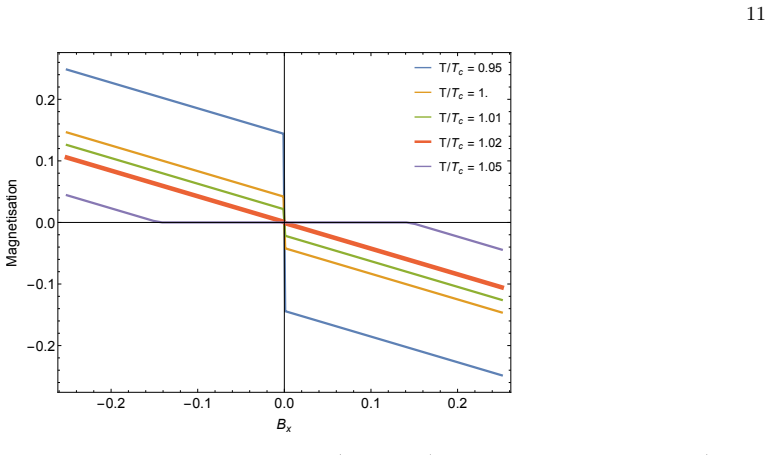
The central object is the interband spin-orbit coupling $g$, a symmetry-preserving term in the Hamiltonian that is allowed because the product of the two near-Fermi-level orbital bands transforms as $A_{2u}$ of $D_{6h}$. Coupled to it is an interband order parameter $d$ that breaks time-reversal and spatial symmetries, and the key identity is the Zeeman coupling $F_B = \sum_{i,j,k} c_i B_i d_j g_k \varepsilon_{ijk}$, which generates a magnetization linear in field and is forbidden if $g$ is absent. A small strain field $\varepsilon_{x^2-y^2}$ then breaks the in-plane rotational symmetry of the susceptibility, giving the $\sin 2\phi$ torque, and couples back to $d$ to produce the $B_z$-induced in-plane magnetization and hysteresis. The crossover at $T_\tau$ comes from the temperature-dependent Landau coefficients $a_2(T) \sim \ln(\Lambda/T)$ and $a_4(T), b_4(T) \sim \ln(\Lambda/T)/T^2$, which sharply enhance $g$ below $T_\tau$ without symmetry breaking.
What would settle it
Measure the torque and magnetization on the same CsV3Sb5 crystal while deliberately controlling strain, from substrate-attached to freely suspended: the model predicts the two-fold torque and the field-induced in-plane magnetization vanish in the zero-strain limit, and that strain versus field shows a first-order jump; observing robust torque in a demonstrably strain-free crystal would falsify the mechanism.
Extended reading notes
Core claim
On the paper's own terms, the central discovery is that the anomalous magnetic torque, the transition-like onset at $T_\tau \simeq 130$ K, and the field-induced in-plane magnetization of CsV3Sb5 are explained by interband rather than intraband physics. The load-bearing coupling is the Zeeman term $F_B = \sum_{i,j,k} c_i B_i d_j g_k \varepsilon_{ijk}$, which exists only because the two low-energy van Hove bands transform as $A_{2u}$ relative to each other, allowing an inversion-symmetric interband spin-orbit coupling $g$. With a small background strain, this coupling produces a susceptibility anisotropy $\chi_{xx} \neq \chi_{yy}$ and hence a two-fold torque; without strain the torque is exactly zero. The sharp onset at $T_\tau$ is not a phase transition but a crossover in the symmetry-preserving coupling $g$, whose thermal renormalization mimics a transition while breaking no symmetry. The paper also rules out fluctuating charge density waves and intraband spin or orbital magnetism as alternative explanations.
Load-bearing premise
The mechanism collapses to exactly zero torque without a nonzero, roughly temperature-independent background strain field, and that strain is inferred from the general observation that strain is common in such samples rather than from the torque experiment itself.
Editorial extensions
If this is right
- The normal state of CsV3Sb5 is shown to host an interband spin-orbit coupling that grows sharply below about 130 K while preserving all symmetries of the crystal.
- The two-fold magnetic torque is a strain-activated piezomagnetic response, not evidence for a nematic phase transition.
- An out-of-plane magnetic field induces in-plane magnetization with hysteresis, a direct consequence of the same interband mechanism.
- Any complete account of the phase diagram must keep both bands near the Fermi level; single-band descriptions miss the interband couplings that control the response.
- Elastoresistance measurements as a function of magnetic field, and strain-controlled magnetization, are predicted to show a first-order jump, providing direct tests.
Reading between the lines
- If the interband spin-orbit crossover is intrinsic to the AV3Sb5 family, the same torque anomaly with a material-dependent $T_\tau$ should appear in KV3Sb5 and RbV3Sb5, and should survive into their CDW phases.
- The explicit reliance on background strain implies the torque magnitude should depend on the sample's mounting; comparing substrate-attached and freely suspended crystals would separate strain effects from intrinsic responses.
- Because the order parameter $d$ is even-parity and breaks time reversal, the mechanism could be probed by detecting field-induced interband coherence directly, for example through its signature in the magneto-optical response.
Editorial analysis
A structured set of objections, weighed in public.
Referee Report
Summary. The manuscript proposes that the torque anomaly in CsV3Sb5 at Tτ ≈ 130 K arises from a symmetry-allowed interband spin-orbit coupling g whose magnitude crosses over at Tτ, together with a field-induced interband order parameter d and a background E2g strain field. The authors derive the Zeeman coupling B·(d×g) in Eq. (11), show in Sec. III A that without strain the torque vanishes identically, and demonstrate in Secs. III B–D that with strain the model produces a two-fold angular torque, a paramagnetic in-plane response, field-induced in-plane magnetization, and hysteresis. They argue in Sec. III F and App. C that fluctuating CDWs and intraband magnetic order cannot explain the data, and they interpret the onset at Tτ as a crossover in g described by Eq. (18).
Significance. If the central scenario is correct, the paper identifies a previously overlooked interband spin-orbit coupling in the normal state of kagome metals and makes concrete, testable predictions for piezomagnetic and strain-controlled responses. The symmetry classification in App. A is careful, and the exclusion analyses of CDW and intraband order in App. C are reasonable and useful. However, the explanatory power of the model rests on an unmeasured background strain field, and the crossover temperature Tτ is inserted by construction rather than predicted, so the claim to have established the origin of the torque is not fully supported. The paper is nevertheless valuable as a symmetry-based scenario with explicit falsifiable predictions.
major comments (3)
- [Sec. III A/B and Eq. (17)] The entire anisotropic response of the model disappears if the background strain vanishes: Sec. III A states that with Fε = 0 the torque τz is zero to all orders in B, and Eq. (17) shows τz ∝ εx2−y2. The strain field εx2−y2 is an extrinsic input whose value on the crystals used in Ref. [34] is not measured; Ref. [35] establishes that strain is common in kagome samples but does not constrain the magnitude or temperature dependence relevant here. Since the elastoresistance measurement shows no E2g response near Tτ, the paper does not provide evidence that the assumed strain is present and roughly constant in the measured sample. As written, the central explanation is not falsifiable by the torque data alone. The authors should either provide an independent estimate or experimental bound on εx2−y2 for the measured crystals, or explicitly reframe the analysis as a scenario whose applicability depends on an unverified strain assumption.
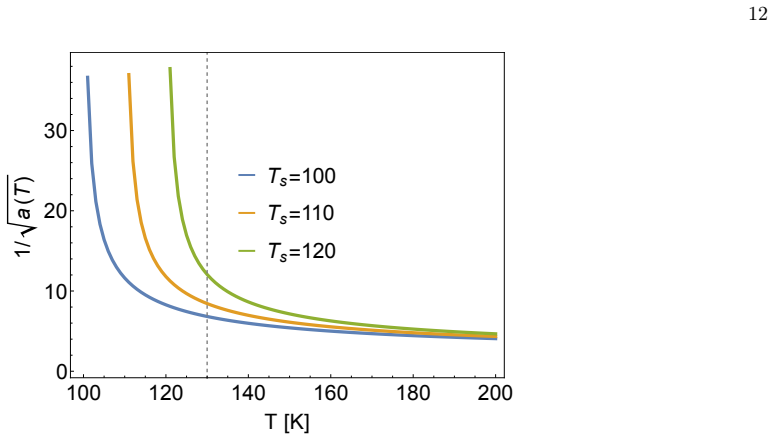
- [Sec. III E and Eq. (18)] The crossover at Tτ is effectively an input rather than a prediction: setting Veff = 1/a2(Tτ) fixes the crossover scale by construction, and a0 is then adjusted to reproduce the experimental curve in Fig. 2. The statement in Sec. III E that 'direct microscopic calculation produces a temperature dependence in agreement with observation' therefore overstates what Eq. (18) demonstrates. The sharp onset at Tτ, one of the three headline observations, is fitted through two free parameters (Veff and a0), leaving the linear-growth-then-plateau shape as the only nontrivial content. To support the claim that the model explains Tτ, the authors should test the robustness of the crossover shape under variation of Veff and a0, or provide a microscopic estimate of the interaction strength that yields Tτ without fitting.
- [App. B and Eq. (11)] The key Zeeman coupling in Eq. (11) is derived under spectral particle-hole symmetry, εv(k) = −εc(k). Without this assumption, the additional terms F_B^(2) and F_B^(3) in App. B contribute, involving d0 and g0. The main text does not quantify these corrections for the tight-binding model of App. A, where the on-site potentials are only approximately opposite (±7.5×10⁻³ eV). If the PHS-breaking terms are not numerically negligible, Eq. (15) and the subsequent torque and hysteresis results could change qualitatively. Please estimate the magnitude of the PHS-breaking contributions in the relevant parameter regime and justify setting them to zero.
minor comments (5)
- [Fig. 1 caption] The caption gives the g and χ coefficients but does not list the strain-sector parameters aε, bε, b0, b1, b2, nor the numerical values of the remaining d-sector coefficients, so the main numerical results are not reproducible from the paper alone.
- [Sec. II B, Eq. (13)] The notation (g2 d3x, −g1 d3y)·(...) is used without defining the dot product of the two two-component vectors; please define the inner product explicitly.
- [Sec. II B] The sentence 'aε > 0 is assumed to be a small constant' is an assumption about the extrinsic strain, not a consequence of the model; it should be explicitly labelled as an assumption in the model setup.
- [References] Reference [42] contains a corrupted symbol in the title; the citation should be cleaned up.
- [Sec. III E] The text 'with a0 ≠ 0 reflects the existence of symmetry allowed g ≠ 0' has a grammatical issue and should be rephrased as a complete statement.
Circularity Check
The onset at Tτ is tuned into the free energy by setting Veff = 1/a2(Tτ), so the headline crossover explanation is a fit rather than a prediction; the remaining model content is independent.
-
fitted input called prediction
[Sec. III E, Eq. (18) and following paragraph; Fig. 2.]
"the interaction enters via Veff; taking Veff = 1 /a2(Tτ ) sets the crossover scale to be T = Tτ. This leaves a0 as a free parameter; adjusting a0, we arrive at Fig. 2."
The paper lists 'the transition-like onset at Tτ' as one of the observations its theory 'accounts for' (abstract and Sec. III E). But in Eq. (18), F[g] = -a0(g1+g2) + (1/Veff - a2(T)) g·g + ..., the quadratic coefficient has exactly one adjustable scale-controlling parameter, Veff. Setting Veff = 1/a2(Tτ) makes 1/Veff - a2(Tτ) = 0 identically, so the renormalisation-driven enhancement of g is forced to occur at the experimental Tτ by construction. The remaining line shape is then obtained by freely adjusting a0. Thus the onset temperature is an input chosen to match the data, not a derived prediction; calling this an account of the onset is a fitted-input-called-prediction step.
full rationale
The central symmetry analysis is not circular. The Zeeman coupling Eq. (11) is obtained from the free-energy expansion and symmetry selection rules, and the paramagnetic linear-in-B response and the Bz-induced in-plane magnetisation follow from that structure rather than from the fitted crossover. The paper also rules out CDW and intraband mechanisms with self-contained calculations in Appendix C. Self-citations are not load-bearing. However, the explanation of the Tτ onset is explicitly constructed: Eq. (18)'s interaction parameter Veff is fixed by the condition Veff = 1/a2(Tτ), pinning the crossover to the experimental temperature, and a0 is adjusted to reproduce the shape in Fig. 2. One of the three headline observations is therefore an input. Separately, the two-fold torque and hysteresis require an assumed, unmeasured background strain field; the paper itself notes that with Fε = 0 the torque vanishes to all orders in B. That strain dependence makes the anisotropic response contingent on an external input, but since the paper explicitly identifies strain as an ingredient rather than deriving it from the interband mechanism, this is an assumption and limitation rather than a circular reduction. Overall, there is partial circularity in the onset claim, with independent content in the rest of the model, giving a score of 6.
Assumptions & free parameters
free parameters (6)
- Veff (interaction strength) =
set by Veff = 1/a2(Tτ)
- a0 (linear g coefficient) =
1e-5 to 5e-5 (varied)
- interband SOC coefficients g = {g0, g1, g2, g3} =
{0.1, 0.5, 0.5, 0.75}
- d-sector quadratic and quartic coefficients χ(2), χ(4) =
χ(2) = 1/16, χ(4) = [χ(2)]²
- strain sector parameters aε, bε, b0, b1, b2 =
values deferred to SM
- d-quadratic coefficient positivity =
positive
assumptions (6)
- domain assumption Low-energy physics of CsV3Sb5 is captured by two van Hove bands (dxz and dz2/x2-y2 orbitals) near the Fermi level.
- ad hoc to paper Spectral particle-hole symmetry εv(k) = -εc(k) is assumed in the Zeeman analysis.
- domain assumption The composite operator c†k vk transforms as A2u of D6h.
- ad hoc to paper A nonzero background strain field εx2-y2 exists, is approximately constant across Tτ, and couples as in Eqs (13)-(14).
- domain assumption The g-sector free energy has the form F[g] = -a0(g1+g2) + (1/Veff - a2(T)) g·g + quartic terms, with a2(T) ~ ln(Λ/T) and quartic coefficients ~ ln(Λ/T)/T².
- standard math Loop integrals (c_i, a2, a4, b4) are evaluated with a specified tight-binding model (t = 1 eV, µ = 1 eV, on-site ±7.5e-3 eV), and the free energy is truncated at eighth order.
invented entities (3)
-
Interband spin-orbit coupling g (symmetry-preserving)
-
Field-induced interband order parameter d (TRS- and space-symmetry-breaking)
-
Background strain field εx2-y2 (treated as constant)
independent evidence
Cite this review
Pith. "Pith review of Spin-orbit crossover and the origin of magnetic torque in kagome metals." pith.science (2026). https://pith.science/paper/JXT2TIWF
@misc{pith2026250715527,
  author       = {Pith},
  title        = {Pith review of: Spin-orbit crossover and the origin of magnetic torque in kagome metals},
  year         = {2026},
  howpublished = {\url{https://pith.science/paper/JXT2TIWF}},
  note         = {Machine review of arXiv:2507.15527}
}
abstract
Recent experiments on the kagome metal CsV$_3$Sb$_5$ reveal a curious phase transition-like feature: a nematic magnetic torque response that abruptly sets in at $T_\tau \approx 130$K, above the known charge density wave transition at $T_\text{CDW} \approx 100$K. Counterintuitively, elastoresistance measurements--a standard probe of nematicity--show no corresponding signal, ruling out a nematic phase transition and placing strong constraints on possible explanations. Beyond nematicity, the torque is paramagnetic for in-plane magnetic field, while above a critical out-of-plane field, an in-plane magnetisation appears, accompanied by hysteresis. We show that this combination of features cannot be accounted for by charge density waves or intraband magnetic order. Instead, we propose that interband ordering--via a symmetry-allowed interband spin-orbit coupling and a time-reversal and spatial symmetry-breaking interband order parameter--together with a background strain field, consistent with typical experimental conditions, provides a natural explanation; in our picture, the behaviour at $T_\tau$ is understood as a crossover in the symmetry-allowed interband spin-orbit coupling strength. Our theory accounts for the nematic magnetic torque, hysteresis, and the transition-like onset at $T_\tau$, while also making testable predictions, including strain-induced magnetisation. In doing so, it challenges the prevailing view of the normal state.
Figures


Figures from the paper (1 more)
Reference graph
Works this paper leans on
-
[34]
Evidence for an odd-parity nematic phase above the charge-density-wave transition in a kagome metal,
T. Asaba, A. Onishi, Y. Kageyama, T. Kiyosue, K. Oht- suka, S. Suetsugu, Y. Kohsaka, T. Gaggl, Y. Kasahara, H.Murayama, K.Hashimoto, R.Tazai, H.Kontani, B.R. Ortiz, S. D. Wilson, Q. Li, H.-H. Wen, T. Shibauchi, and Y. Matsuda, “Evidence for an odd-parity nematic phase above the charge-density-wave transition in a kagome metal,” Nature Physics20, 40 (2024)
work page 2024
-
[35]
Distinct switching of chiral transport in the kagome metals KV3Sb5 and CsV3Sb5,
C. Guo, M. R. van Delft, M. Gutierrez-Amigo, D. Chen, C. Putzke, G. Wagner, M. H. Fischer, T. Neupert, I. Er- rea, M. G. Vergniory, S. Wiedmann, C. Felser, and P. J. W. Moll, “Distinct switching of chiral transport in the kagome metals KV3Sb5 and CsV3Sb5,” npj Quantum Materials 9, 20 (2024)
work page 2024
-
[1]
Quantum states and intertwining phases in kagome materials,
Y. Wang, H. Wu, G. T. McCandless, J. Y. Chan, and M. N. Ali, “Quantum states and intertwining phases in kagome materials,” Nature Reviews Physics 5, 635 (2023)
work page 2023
-
[2]
Topological kagome magnets and superconductors,
J.-X. Yin, B. Lian, and M. Z. Hasan, “Topological kagome magnets and superconductors,” Nature612, 647 (2022)
2022
-
[3]
Charge order and superconductivity in kagome materials,
T. Neupert, M. M. Denner, J.-X. Yin, R. Thomale, and M. Z. Hasan, “Charge order and superconductivity in kagome materials,” Nat. Phys.18, 137 (2022)
work page 2022
-
[4]
New kagome prototype materials: discovery of KV3Sb5,RbV3Sb5, and CsV3Sb5,
B. R. Ortiz, L. C. Gomes, J. R. Morey, M. Winiarski, M. Bordelon, J. S. Mangum, I. W. H. Oswald, J. A. Rodriguez-Rivera, J. R. Neilson, S. D. Wil- son, E. Ertekin, T. M. McQueen, and E. S. To- berer, “New kagome prototype materials: discovery of KV3Sb5,RbV3Sb5, and CsV3Sb5,” Phys. Rev. Mater.3, 094407 (2019)
work page 2019
-
[5]
CsV3Sb5: A Z2 topolog- ical kagome metal with a superconducting ground state,
B. R. Ortiz, S. M. L. Teicher, Y. Hu, J. L. Zuo, P. M. Sarte, E. C. Schueller, A. M. M. Abeykoon, M. J. Krogstad, S. Rosenkranz, R. Osborn, R. Seshadri, L. Ba- lents, J. He, and S. D. Wilson, “CsV3Sb5: A Z2 topolog- ical kagome metal with a superconducting ground state,” Phys. Rev. Lett.125, 247002 (2020)
work page 2020
-
[6]
Giant, unconventional anomalous Hall effect in the metallic frustrated magnet candidate, KV3Sb5,
S.-Y. Yang et al. , “Giant, unconventional anomalous Hall effect in the metallic frustrated magnet candidate, KV3Sb5,” Science Advances6, eabb6003 (2020)
work page 2020
Show all 50 references
-
[7]
Anomalous thermoelectric effects and quantum oscillations in the kagome metal CsV 3Sb5,
D. Chen et al. , “Anomalous thermoelectric effects and quantum oscillations in the kagome metal CsV 3Sb5,” Phys. Rev. B105, L201109 (2022)
2022
-
[8]
Time-reversal symmetry-breaking charge order in a kagome superconductor,
C. Mielke et al. , “Time-reversal symmetry-breaking charge order in a kagome superconductor,” Nature602, 245–250 (2022)
2022
-
[9]
Unconventional chiral charge order in kagome superconductor KV3Sb5,
Y.-X. Jiang, J.-X. Yin, M. M. Denner, N. Shumiya, B. R. Ortiz, G. Xu, Z. Guguchia, J. He, M. S. Hossain, X. Liu, J. Ruff, L. Kautzsch, S. S. Zhang, G. Chang, I. Belopol- ski, Q. Zhang, T. A. Cochran, D. Multer, M. Litskevich, Z.-J. Cheng, X. P. Yang, Z. Wang, R. Thomale, T. Ne...
2021
-
[10]
Three-state nematic- ity and magneto-optical Kerr effect in the charge density waves in kagome superconductors,
Y. Xu, Z. Ni, Y. Liu, B. R. Ortiz, Q. Deng, S. D. Wilson, B. Yan, L. Balents, and L. Wu, “Three-state nematic- ity and magneto-optical Kerr effect in the charge density waves in kagome superconductors,” Nat. Phys.18, 1470 (2022)
2022
-
[11]
Rotation symmetry breaking in the normal state of a kagome superconductor KV3Sb5,
H. Liet al., “Rotation symmetry breaking in the normal state of a kagome superconductor KV3Sb5,” Nat. Phys. 18, 265 (2022)
2022
-
[12]
High resolution polar Kerr effect studies of CsV3Sb5: Tests for time-reversal symmetry breaking below the charge-order transition,
D. R. Saykin et al. , “High resolution polar Kerr effect studies of CsV3Sb5: Tests for time-reversal symmetry breaking below the charge-order transition,” Phys. Rev. Lett. 131, 016901 (2023)
2023
-
[13]
Cascade of correlated electron states in the kagome superconductor CsV3Sb5,
H. Zhao, H. Li, B. R. Ortiz, S. M. Teicher, T. Park, M. Ye, Z. Wang, L. Balents, S. D. Wilson, and I. Zeljkovic, “Cascade of correlated electron states in the kagome superconductor CsV3Sb5,” Nature 599, 216 (2021)
2021
-
[14]
Multiband superconductivity with sign- preserving order parameter in kagome superconductor CsV3Sb5,
H.-S. Xuet al., “Multiband superconductivity with sign- preserving order parameter in kagome superconductor CsV3Sb5,” Phys. Rev. Lett.127, 187004 (2021)
2021
-
[15]
Microscopic evidence for anisotropic multigap superconductivity in the CsV3Sb5 kagome su- perconductor,
R. Gupta et al. , “Microscopic evidence for anisotropic multigap superconductivity in the CsV3Sb5 kagome su- perconductor,” npj Quantum Materials7, 1 (2022)
2022
-
[16]
Nodeless superconductivity in the kagome metal CsV3Sb5,
W. Duan et al. , “Nodeless superconductivity in the kagome metal CsV3Sb5,” Science China Physics, Me- chanics & Astronomy64, 1 (2021)
2021
-
[17]
Ob- servation of unconventional charge density wave with- out acoustic phonon anomaly in kagome superconductors AV3Sb5 (A= Rb, Cs),
H. Li, T. Zhang, T. Yilmaz, Y. Pai, C. Marvinney, A. Said, Q. Yin, C. Gong, Z. Tu, E. Vescovo,et al., “Ob- servation of unconventional charge density wave with- out acoustic phonon anomaly in kagome superconductors AV3Sb5 (A= Rb, Cs),” Physical Review X 11, 031050 (2021)
2021
-
[18]
Intrinsic nature of chiral charge order in the kagome superconductor RbV3Sb5,
N. Shumiyaet al., “Intrinsic nature of chiral charge order in the kagome superconductor RbV3Sb5,” Phys. Rev. B 104, 035131 (2021)
2021
-
[19]
Geometry of the charge density wave in the kagome metal AV3Sb5,
H.Miao, H.X.Li, W.Meier, A.Huon, H.N.Lee, A.Said, H. Lei, B. Ortiz, S. Wilson, J. Yin,et al., “Geometry of the charge density wave in the kagome metal AV3Sb5,” Phys. Rev. B104, 195132 (2021)
2021
-
[20]
Anisotropic superconducting properties of kagome metal CsV3Sb5,
S. Ni et al., “Anisotropic superconducting properties of kagome metal CsV3Sb5,” Chinese Physics Letters 38, 057403 (2021)
2021
-
[21]
Double-dome superconductivity under pressure in the V-based kagome metals AV3Sb5 (A= Rb and K),
C. C. Zhuet al., “Double-dome superconductivity under pressure in the V-based kagome metals AV3Sb5 (A= Rb and K),” Phys. Rev. B105, 094507 (2022)
2022
-
[22]
Double superconducting dome and triple enhancement of Tc in the kagome superconduc- tor CsV3Sb5 under high pressure,
K. Y. Chen et al. , “Double superconducting dome and triple enhancement of Tc in the kagome superconduc- tor CsV3Sb5 under high pressure,” Phys. Rev. Lett.126, 247001 (2021)
2021
-
[23]
Pressure- induced double superconducting domes and charge insta- bility in the kagome metal KV3Sb5,
F. Du, S. Luo, B. R. Ortiz, Y. Chen, W. Duan, D. Zhang, X. Lu, S. D. Wilson, Y. Song, and H. Yuan, “Pressure- induced double superconducting domes and charge insta- bility in the kagome metal KV3Sb5,” Phys. Rev. B103, L220504 (2021)
2021
-
[24]
Pressure- induced reemergence of superconductivity in the topolog- ical kagome metal CsV3Sb5,
Z. Zhang, Z. Chen, Y. Zhou, Y. Yuan, S. Wang, J. Wang, H. Yang, C. An, L. Zhang, X. Zhu, et al. , “Pressure- induced reemergence of superconductivity in the topolog- ical kagome metal CsV3Sb5,” Phys. Rev. B103, 224513 (2021). 8
2021
-
[25]
Three-dimensional charge density wave and surface-dependent vortex-core states in a kagome su- perconductor CsV3Sb5,
Z. Liang et al., “Three-dimensional charge density wave and surface-dependent vortex-core states in a kagome su- perconductor CsV3Sb5,” Physical Review X 11, 031026 (2021)
2021
-
[26]
Fermi surface mapping and the nature of charge-density-wave order in the kagome superconductor CsV3Sb5,
B. R. Ortiz, S. M. Teicher, L. Kautzsch, P. M. Sarte, N. Ratcliff, J. Harter, J. P. Ruff, R. Seshadri, and S. D. Wilson, “Fermi surface mapping and the nature of charge-density-wave order in the kagome superconductor CsV3Sb5,” Physical Review X11, 041030 (2021)
2021
-
[27]
Fermi level tuning and double-dome superconductivity in the kagome metal CsV3Sb5−xSnx,
Y. M. Oey, B. R. Ortiz, F. Kaboudvand, J. Frassineti, E. Garcia, R. Cong, S. Sanna, V. F. Mitrović, R. Se- shadri, and S. D. Wilson, “Fermi level tuning and double-dome superconductivity in the kagome metal CsV3Sb5−xSnx,” Physical Review Materials 6, L041801 (2022)
2022
-
[28]
Charge order landscape and competition with su- perconductivity in kagome metals,
M. Kang, S. Fang, J. Yoo, B. R. Ortiz, Y. M. Oey, J. Choi, S. H. Ryu, J. Kim, C. Jozwiak, A. Bostwick, et al., “Charge order landscape and competition with su- perconductivity in kagome metals,” Nat. Mater.22, 186 (2023)
2023
-
[29]
Revealing the orbital origins of exotic electronic states with ti substi- tution in kagome superconductor CsV3Sb5,
Z. Huang, H. Chen, H. Tan, X. Han, Y. Ye, B. Hu, Z. Zhao, C. Shen, H. Yang, B. Yan,et al., “Revealing the orbital origins of exotic electronic states with ti substi- tution in kagome superconductor CsV3Sb5,” Phys. Rev. Lett. 134, 056001 (2025)
2025
-
[30]
Field induced density wave in a kagome supercon- ductor,
M. S. Hossain, Q. Zhang, J. Ingham, J. Liu, S. Shao, Y.Li, Y.Wang, B.K.Pokharel, Z.-J.Cheng, Y.-X.Jiang, et al., “Field induced density wave in a kagome supercon- ductor,” arXiv preprint arXiv:2501.13260 (2025)
2025 arXiv
-
[31]
Electronic instabili- ties of kagome metals: Saddle points and landau theory,
T. Park, M. Ye, and L. Balents, “Electronic instabili- ties of kagome metals: Saddle points and landau theory,” Phys. Rev. B104, 035142 (2021)
2021
-
[32]
Theory of the charge density wave in AV3Sb5 kagome metals,
M. H. Christensen, T. Birol, B. M. Andersen, and R. M. Fernandes, “Theory of the charge density wave in AV3Sb5 kagome metals,” Phys. Rev. B104, 214513 (2021)
2021
-
[33]
Phenomenology of bond and flux orders in kagome metals,
G. Wagner, C. Guo, P. J. W. Moll, T. Neupert, and M. H. Fischer, “Phenomenology of bond and flux orders in kagome metals,” Phys. Rev. B108, 125136 (2023)
2023
-
[36]
Twofold van Hove singularity and origin of charge order in topo- logical kagome superconductor CsV3Sb5,
M. Kang, S. Fang, J.-K. Kim, B. R. Ortiz, S. H. Ryu, J. Kim, J. Yoo, G. Sangiovanni, D. Di Sante, B.-G. Park, C. Jozwiak, A. Bostwick, E. Rotenberg, E. Kaxi- ras, S. D. Wilson, J.-H. Park, and R. Comin, “Twofold van Hove singularity and origin of charge order in topo- logical ...
2022
-
[37]
Rich nature of van Hove sin- gularities in kagome superconductor CsV3Sb5,
Y. Hu, X. Wu, B. R. Ortiz, S. Ju, X. Han, J. Ma, N. C. Plumb, M. Radovic, R. Thomale, S. D. Wilson, A. P. Schnyder, and M. Shi, “Rich nature of van Hove sin- gularities in kagome superconductor CsV3Sb5,” Nature Communications 13, 2220 (2022)
2022
-
[38]
Nature of unconventional pairing in the kagome superconductors AV3Sb5 (A=K,Kb,Cs),
X. Wu, T. Schwemmer, T. Müller, A. Consiglio, G. San- giovanni, D. Di Sante, Y. Iqbal, W. Hanke, A. P. Schny- der, M. M. Denner, M. H. Fischer, T. Neupert, and R. Thomale, “Nature of unconventional pairing in the kagome superconductors AV3Sb5 (A=K,Kb,Cs),” Phys. Rev. Lett. 127...
2021
-
[39]
Chiral excitonic order from twofold van hove singulari- ties in kagome metals,
H. D. Scammell, J. Ingham, T. Li, and O. P. Sushkov, “Chiral excitonic order from twofold van hove singulari- ties in kagome metals,” Nature Communications14, 605 (2023)
2023
-
[40]
Optical manipulation of the charge-density-wave state in rbv3sb5,
Y. Xing, S. Bae, E. Ritz, F. Yang, T. Birol, A. N. Capa Salinas, B. R. Ortiz, S. D. Wilson, Z. Wang, R. M. Fernandes, and V. Madhavan, “Optical manipulation of the charge-density-wave state in rbv3sb5,” Nature631, 60 (2024)
2024
-
[41]
Itinerant half-metal spin-density-wave state on the hexagonal lattice,
R. Nandkishore, G.-W. Chern, and A. V. Chubukov, “Itinerant half-metal spin-density-wave state on the hexagonal lattice,” Phys. Rev. Lett.108, 227204 (2012)
2012
-
[42]
Csv3sb5: A 𭟋2 topologi- cal kagome metal with a superconducting ground state,
B. R. Ortiz, S. M. L. Teicher, Y. Hu, J. L. Zuo, P. M. Sarte, E. C. Schueller, A. M. M. Abeykoon, M. J. Krogstad, S. Rosenkranz, R. Osborn, R. Seshadri, L. Ba- lents, J. He, and S. D. Wilson, “Csv3sb5: A 𭟋2 topologi- cal kagome metal with a superconducting ground state,” Phys....
2020
-
[43]
Tight binding Hamiltonian A tight binding model describing the situation, generic to the family AV3Sb5, of two oppositely dispersing van Hove bands near the Fermi level has been obtained in Ref. [38]. Specifically, they work withxz and yz orbitals, which is relevant to KV3Sb5....
-
[44]
It has been established in, e.g
Relative band IRs with respect to D2h Considering the band IRs at a givenM-point, the little group isD2h. It has been established in, e.g. Ref. [37], that the IRs of the two vHS bands of interest in terms of the little groupD2h are: the p-type vHS withdz2/x2−y2-orbital belongs...
-
[45]
(1) of the main text is the band-projected version ofH0
T ransformation under C3z The effective Hamiltonian Eq. (1) of the main text is the band-projected version ofH0. Using short-hand notation fkσ = (ck, vk)σ, we have fkσ = X j (ϕkσ)jψkjσ , (A4) where ϕkσ are the associated (three-component) Bloch states. Let us now establish the...
-
[46]
the free energy in absence of external fields, are lengthy
General The expressions for F0, i.e. the free energy in absence of external fields, are lengthy. Instead, we provide the algorithm for generating it. First, F0 = ∞X n=1 (−1)n n Tr h ( ˆG ˆM )n i , (B1) which follows from the expansionF0 = −Trlog(1 + ˆG ˆM ). For the case at ha...
-
[47]
We note that in the case of spectral particle-hole symmetry, i.e
Zeeman T erms Denoting the Greens function for conduction and valence bands asGc k,iωn and Gv k,iωn, and with2 ˆG = Gc k,iωn s0(σ0 + σz) + Gv k,iωn s0(σ0 − σz), then the cubic terms work out to be F (1) B = Tr[ ˆG3 k(dk · s)(gk · s)(B · s)] = X Γ dΓX m=1 Bidj,(Γ,m)gℓεijℓT X n ...
-
[48]
To simplify, we work with respect to point groupC6v, in that case the commensurate CDWs are classified as the IRsFi with i = 1, 2, 3, 4 [33]
Fluctuating CDW s We consider the possibility that nearly critical CDW fluctuations can explain the torque. To simplify, we work with respect to point groupC6v, in that case the commensurate CDWs are classified as the IRsFi with i = 1, 2, 3, 4 [33]. Just briefly: F1 is the tri...
-
[49]
Moreover, to explain the torque measurements, it proves crucial to include strain
These Λµ allow for two-dimensional, translationally invariant IRs to be formed out of the three-dimensional, CDW IRsFi. Moreover, to explain the torque measurements, it proves crucial to include strain. In this case,ΦF1 , ΦF3 couple to strain via Fε = γ2εµΦF2 ΛµΦF2 + γ3εµΦF3 Λ...
-
[50]
Single band magnetisation a. Spin magnetism In a single-band model with spinful electrons, a magnetic field can couple linearly to a spin-1 order parameter, giving rise to a linear-in-B response, FB = g B · Φ (C5) where Φ = ⟨P k c† kσck⟩ represents a uniform spin magnetisation...
Reviewed August 6, 2026 · model on record in the stance chip above.
Discussion (0). Continue with ORCID to comment.