REVIEW 5 major objections 3 minor 58 references
High-fidelity modeling of interface crossing in the diffusion welding process at the polycrystalline scale
T0 review · 5 major / 3 minor · reviewed 2026-08-06 · deepseek-v4-flash
Pith's one-line read A normalized crossing criterion together with level-set grain-growth simulations ranks diffusion-welding configurations, with fine grains and obstacle-free interfaces crossing best.
desk verdict A useful simulation paper with two genuinely new crossing criteria, but the headline rankings rest on an epsilon-sensitive metric that is not convincingly grain-size independent. read the letter →
The pith
A machine-rendered reading of the paper's core claim, the machinery that carries it, and where it could break.
The reading
What carries the argument
The load-bearing object is the level-set description of the polycrystal: each grain is a signed distance function $\phi_i(x,t)$, and grain-boundary motion obeys $\vec{v} = -\mu\gamma\kappa\vec{n}$, so with a distance function the convection equation becomes a heat-type equation $\partial_t\phi_i - \mu\gamma\Delta\phi_i = 0$. A calibrated reduced mobility $\mu\gamma$ is fitted by matching simulated 316L grain growth to Burke-Turnbull data. Obstacles are inserted either as holes in the mesh (static particles) or as an additional level-set population with an evolution law (dissolving pores). The crossing state is read from thresholded images: $C_1(\varepsilon) = L_{int}(\varepsilon)/L_{ref}(\varepsilon)$ counts remaining boundary length in an $\varepsilon = 3$-pixel strip around the interface normalized by a reference line; $C_2$ counts grains crossing the interface relative to a reference line. The criterion and the mobility law together carry the ranking argument.
What would settle it
Take a diffusion-welded 316L or titanium sample with known initial grain size and known particle population at the bond plane, section it after the same thermal cycle, measure $C_1(\varepsilon)$ on several fields of view, and compare with the simulated curves: if the coarse-grain case crosses as fast as the fine-grain case, or if elongated particles are crossed more often than circular ones at equal linear fraction, the central ranking is falsified.
Extended reading notes
Core claim
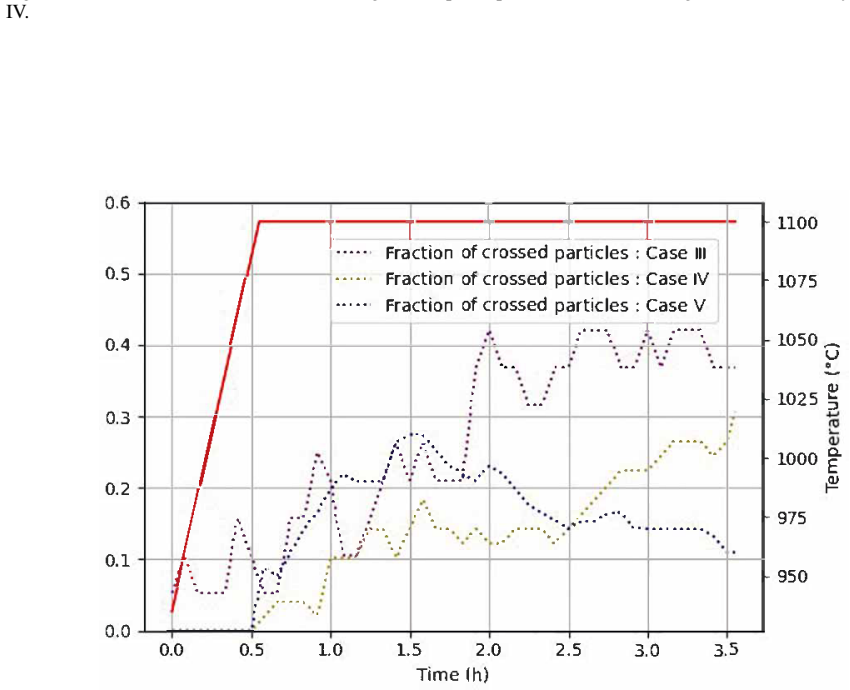
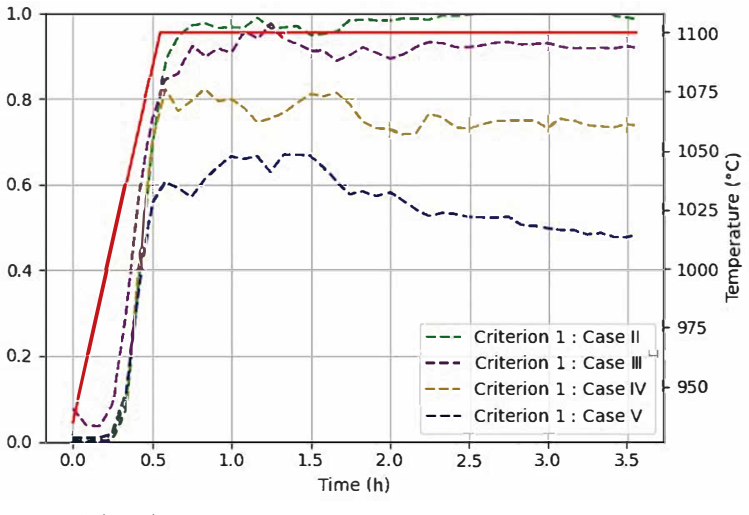
The central claim is that interface crossing during diffusion welding can be captured by coupling the curvature-driven level-set formulation of grain growth with two quantitative criteria. Criterion $C_1(\varepsilon)$ divides the remaining grain-boundary length in a thin strip around the original bonding interface by the same measurement on a reference line far from the interface, removing the dependence on grain size that plagued the earlier criterion $C_{int}$. Criterion $C_2$ compares grain counts at the interface and a reference line, but proved noise-sensitive and was not adopted. The simulation campaign then shows a clear ordering: a fine initial microstructure without obstacles reaches the highest crossing ($C_1 = 1.00$), coarse grains without obstacles lag ($0.91$), circular particles at $2.6\%$, $6.5\%$, and $12.5\%$ linear fraction give $0.92$, $0.74$, and $0.48$, elongated particles at $6.9\%$ give $0.87$, and the same elongated population that dissolves early gives $0.95$.
Load-bearing premise
The whole ranking depends on the assumption that grain boundaries in the welded metal move at a speed proportional to their curvature, with one average boundary energy and a fitted mobility constant—if that is not how these interfaces move, the predicted crossing order could change.
Editorial extensions
If this is right
- The $C_1(\varepsilon)$ criterion gives a grain-size-independent measure of interface crossing that can be applied to both simulated and experimental images.
- Fine initial grain size accelerates crossing before the temperature plateau because smaller boundary curvature radii create higher capillary pressure.
- Higher linear fractions of circular second-phase particles pin grain boundaries and can cause re-pinning, making crossing deteriorate after an initial rise.
- Elongated particles aligned with the interface are harder to bypass, and the number of pinning points matters more than the occupied interface fraction.
- If obstacles dissolve early in the thermal cycle, crossing improves but still does not reach the obstacle-free level.
Reading between the lines
- Editorial extension: an experimentalist could apply the $C_1$ protocol directly to micrographs of welded cross-sections, since it requires only two cut lines and pixel counting; this would test the ranking without needing the simulation.
- Editorial extension: the paper's proposed future parameter—critical grain size as a function of precipitate spacing—could make the crossing results a design rule analogous to the Zener limit for grain growth.
- Editorial extension: because the simulations are 2D and use isotropic curvature flow, the ranking of obstacle shapes may differ in 3D, where particle bypass involves different topology; this is an inference, not the paper's claim.
- Editorial extension: the undisclosed evolution law for dissolving pores is a real reproducibility gap; a public version of that law would let the dynamic-obstacle result be independently checked.
Editorial analysis
A structured set of objections, weighed in public.
Referee Report
Summary. The paper studies grain-boundary crossing of the initial bonding interface during diffusion welding using two-dimensional level-set grain-growth simulations. It introduces two normalized criteria, C1(ε) (interface-boundary length in a strip normalized by a reference line) and C2 (grain-count ratio), and applies them to seven simulated cases varying initial grain size, second-phase particle density, shape, and dissolution behavior. The main conclusions are that fine initial microstructures without obstacles cross most favorably, circular low-density particles are least disruptive, elongated interface-aligned particles are harder to bypass, and high obstacle density can cause re-pinning of grain boundaries.
Significance. If the central claims hold, the paper provides a useful computational framework for ranking diffusion-welding conditions with respect to interface crossing, complementing existing void-closure models. The use of a full-field level-set framework with a reduced mobility calibrated against external 316L heat-treatment data gives the kinetics some experimental anchoring, and the parametric campaign systematically varies grain size, obstacle density, shape, and evolution. The main caveat is that the crossing metric itself is not robustly established and no experimental crossing measurement is used as ground truth, so the quantitative rankings remain simulation-level predictions rather than validated material rankings.
major comments (5)
- [§3.3, Eq. (10), Fig. 6] The central metric C1(ε) is not robust: Fig. 6 shows strong sensitivity to ε with no clear plateau except at ε=1, and §3.3 reports that for Case I the ε=3 curve "hardly reaches 1" (final value 0.91 in Table 1) while C2 still indicates 1.5 times more grains at the interface than at the reference line and the line-pixel profile still shows a residual interface feature (Figs. 8–9). The criterion therefore saturates before crossing is complete, and the choice ε=3 pixels is made post hoc ("this parameter was fixed to ε = 3 pixels") without a physical rule. Because every cross-case comparison in Section 4 and Table 1 is based on final C1(ε=3) values, the rankings (fine grains favorable; elongated particles harder to bypass) may be threshold artifacts rather than material rankings.
- [§3.2, Eq. (10)] The claimed grain-size independence of C1 is not established. ε is fixed in pixels, but the physical width of the analysis strip relative to the initial grain size differs between Case I (105 µm) and Case II (24 µm) unless the pixel calibration is identical, which is not stated; normalizing by Cref does not remove this dependence because both Cint and Cref depend on grain size and ε. The paper should either compute C1 with ε scaled by initial grain size or by a fixed physical length calibrated identically in all RVEs, or show convergence of the relative rankings with respect to ε before using C1 to rank cases with different grain sizes.
- [§3.1, Eq. (8)] The calibration equation is incomplete as written: (µγ)1 = texp/t0 has dimensions of time and cannot by itself yield a reduced mobility; the relation must involve the Burke–Turnbull constant α, the initial and final mean radii, and the reference simulation mobility (µγ)0. Since the reduced mobility sets the absolute time scale for every crossing simulation, the missing formula prevents reproduction of the kinetics; please give the complete least-squares calibration used for the 316L datasets.
- [§4.4] Case VII is not independently checkable: the pore-dissolution kinetics are described only as "a realistic kinetics model—undisclosed here for confidentiality reasons." Since the conclusion that dynamic dissolution improves crossing but does not fully recover the obstacle-free case depends on this model, the governing equation and parameters must be provided or at least benchmarked against a public analytical or experimental case; otherwise this case should be removed from the central claims.
- [§2.1 and §3.1] The entire campaign uses the curvature-flow law v = −µγκn (Eq. 1) with homogeneous γ and a mobility calibrated against grain-growth heat-treatment data (Eq. 8). As the authors acknowledge, this law is a first-order approximation, and welding interfaces may involve anisotropy, torque, stored energy, or solute drag. This is not by itself an error, but it means the predicted crossing kinetics and rankings are conditional on the bulk grain-growth law; a direct experimental check of at least one simulated ranking (e.g., fine vs. coarse initial grain size) is needed before the results can be read as robust predictions of diffusion-welded material behavior.
minor comments (3)
- [§4.4] In the sentence "the same RVE and initial obstacle distribution as in Case VII were used," the case reference should almost certainly be Case VI, since Case VII is the dynamic-obstacle variant of Case VI.
- [§3.2, Eq. (11)] In Eq. (11), the symbol Nint is used both for the interface count and for the reference-line count; the reference-line count should be denoted Nref to match the surrounding text.
- [Throughout] Several typos should be corrected, including "emphazised" (§3.1), "inital" (§1), "thez total number" (§3.3), and "partic les" (Fig. 17 caption).
Circularity Check
No significant circularity: the reduced mobility is calibrated externally and the crossing criteria are explicit post-processing definitions, not fitted predictions.
full rationale
The paper's derivation chain is self-contained. The only fitted parameter is the reduced mobility µγ, calibrated against external 316L grain-growth heat-treatment data (Section 3.1, Eq. 8), and no interface-crossing measurement enters that calibration. The crossing criteria C1(ε) and C2 (Eqs. 9-11) are explicit definitions used to post-process simulation outputs, not quantities fitted to those outputs; C1 normalizes the interface grain-boundary length by a bulk reference line by construction, but this is a stated measurement convention rather than a hidden reuse of the target result. The ε=3 choice is acknowledged as arbitrary and its sensitivity is shown in Fig. 6, which is a robustness limitation, not a circular reduction. The debated curvature-flow law (Eq. 1) and the undisclosed pore-dissolution kinetics in Case VII are modeling assumptions and validity gaps flagged by the authors themselves, but they do not make the simulation output equal to its inputs. The self-citations to the level-set/DIGIMU framework are methodological references backed by equations in the paper and are not used to forbid alternatives or import an unproven uniqueness result. Although no experimental crossing measurement is provided as ground truth, the absence of external validation is a correctness or generalizability concern, not circularity.
Assumptions & free parameters
free parameters (4)
- Reduced mobility mu*gamma =
Not stated numerically; calibrated per temperature via Eq. 8 from 316L grain-growth data
- Analysis thickness epsilon =
3 pixels
- Elliptical particle aspect ratio =
3 (major semi-axis over minor semi-axis)
- Pore dissolution kinetics (Case VII) =
Not disclosed
assumptions (6)
- domain assumption Grain boundary migration obeys curvature flow v = -mu*gamma*kappa*n with homogeneous boundary energy gamma (Eq. 1).
- domain assumption Initial state is fully recrystallized, with no plastic stored energy and a totally bonded interface (Section 2.1).
- domain assumption Grain sizes follow a Rayleigh distribution and equiaxed morphology (Section 2.2).
- domain assumption The reduced mobility calibrated from 316L bulk grain growth also applies at the welding interface (Eqs. 1-2, Section 3.1).
- domain assumption A 2D RVE is representative of the 3D polycrystalline behavior (Section 2.2, Conclusion).
- ad hoc to paper The analysis thickness epsilon = 3 pixels is fixed for all cases (Section 3.3).
Cite this review
Pith. "Pith review of High-fidelity modeling of interface crossing in the diffusion welding process at the polycrystalline scale." pith.science (2026). https://pith.science/paper/QYY4Q4CK
@misc{pith2026250720635,
  author       = {Pith},
  title        = {Pith review of: High-fidelity modeling of interface crossing in the diffusion welding process at the polycrystalline scale},
  year         = {2026},
  howpublished = {\url{https://pith.science/paper/QYY4Q4CK}},
  note         = {Machine review of arXiv:2507.20635}
}
read the original abstract
Controlling the microstructure of a diffusion welded interface is a critical point to ensure optimum mechanical properties and the homogeneity of the joint. Beyond the intimate contact formation between bonded parts studied in the literature, this article focuses on the grain boundary crossing of the interface during this process and its measurement. Following this perspective, a Level-Set method has been used for full-field microstructure simulations in 2D with various interface parameters. Two crossing measurement models have been formulated, tested and discussed over the simulations.
Figures


Figures from the paper (14 more)




Reference graph
Works this paper leans on
-
[1]
P. D. Funkenbusch, E. K. H. Li, Hip of bi modal powder mixtures: Modeling and experiment, in: M. Koizumi (Ed.), Hot Isostatic Pressing— Theory and Applications, Springer Netherlands, 1992, pp. 17–22
work page 1992
-
[2]
H. Ona, S. Ichikawa, T. Anndou, A. Nishioka, HIPPing Effects for Steel′s Mechanical Properties, in: M. Koizumi (Ed.), Hot Isostatic Pressing— Theory and Applications, Springer Netherlands, Dordrecht, , 1992, pp. 275–280
work page 1992
-
[3]
H. V . Atkinson, S. Davies, Fundamental aspects of hot isostatic pressing: An overview, Metall and Mat Trans A 31 (12) (2000) 2981–3000. doi:10.1007/s11661-000-0078-2
- [4]
- [5]
-
[6]
O. D. Sherby, E. M. Taleff, Influence of grain size, solute atoms and second-phase particles on creep behav- ior of polycrystalline solids, Materials Science and Engineering: A 322 (1) (2002) 89–99. doi:10.1016/ S0921-5093(01)01121-2
work page 2002
-
[7]
W. H. King, W. A. Owczarski, Additional Studies on the Diffusion Welding of Titanium, Welding research (Miami) 47 (10) (1968) 444–450
work page 1968
-
[8]
C. Zener, Theory of growth of spherical precipitates from solid solution, Journal of Applied Physics 20 (10) (1949) 950–953
work page 1949
Show all 58 references
-
[9]
C. S. Smith, Introduction to grains, phases, and interfaces—an interpretation of microstructure, Transactions of the American Institute of Mining and Metallurgical Engineers 175 (2) (1948) 15–51
1948
-
[10]
C. H. Hamilton, Pressure Requirements for Diffusion Bonding Titanium, in: Titanium Science and Technology, Springer, Boston, MA, 1973, pp. 625–648
1973
-
[11]
Garmong, N
G. Garmong, N. E. Paton, A. S. Argon, Attainment of full interfacial contact during diffusion bonding, MTA 6 (6) (1975) 1269–1279. doi:10.1007/BF02658537
1975 doi
-
[12]
R. L. Coble, Diffusion Models for Hot Pressing with Surface Energy and Pressure Effects as Driving Forces, Journal of Applied Physics 41 (12) (1970) 4798–4807. doi:10.1063/1.1658543
1970 doi
-
[13]
Z. X. Guo, N. Ridley, Modelling of diffusion bonding of metals, Materials Science and Technology 3 (11) (1987) 945–953. doi:10.1179/mst.1987.3.11.945. 18
1987 doi
-
[14]
I.-W. Chen, A. S. Argon, Diffusive growth of grain-boundary cavities, Acta Metallurgica 29 (10) (1981) 1759–1768. doi:10.1016/0001-6160(81)90009-2
1981 doi
-
[15]
Takahashi, K
Y . Takahashi, K. Inoue, Recent void shrinkage models and their applicability to diffusion bonding, Materials Science and Technology 8 (11) (1992) 953–964. doi:10.1179/mst.1992.8.11.953
1992 doi
-
[16]
Orhan, M
N. Orhan, M. Aksoy, M. Eroglu, A new model for diffusion bonding and its application to duplex alloys, Materials Science and Engineering: A 271 (1) (1999) 458–468. doi:10.1016/S0921-5093(99)00315-9
1999 doi
-
[17]
Derby, E
B. Derby, E. R. Wallach, Theoretical model for diffusion bonding, Metal Science 16 (1) (1982) 49–56. doi: 10.1179/030634582790427028
1982 doi
-
[18]
A. Hill, E. R. Wallach, Modelling solid-state diffusion bonding, Acta Metallurgica 37 (9) (1989) 2425–2437. doi:10.1016/0001-6160(89)90040-0
1989 doi
-
[19]
Bouquet, Etude de la formation des joints soudés par diffusion : application aux échangeurs de chaleur compacts, Ph.D
N. Bouquet, Etude de la formation des joints soudés par diffusion : application aux échangeurs de chaleur compacts, Ph.D. thesis, Université de Bourgogne (Nov. 2014)
2014
-
[20]
Nürnberg, G
G. Nürnberg, G. Rosinski, P. M. Gonçalves, M. V . V . Mortean, R. H. G. e Silva, A. Monteiro, M. B. H. Mantelli, L. Mateus, 316L Stainless Steel Diffusion Bonding Optimized Parameters, in: 24th ABCM International Congress of Mechanical Engineering, 2017. doi:10.26678/abcm.cobe...
2017 doi
-
[21]
Weygand, Y
D. Weygand, Y . Bréchet, J. Lépinoux, Zener pinning and grain growth: A two-dimensional vertex computer simulation, Acta Materialia 47 (3) (1999) 961–970. doi:10.1016/S1359-6454(98)00383-8
1999 doi
-
[22]
Couturier, C
G. Couturier, C. Maurice, R. Fortunier, Three-dimensional finite-element simulation of Zener pinning dynamics, Philosophical Magazine 83 (30) (2003) 3387–3405. doi:10.1080/1478643031000152771
2003 doi
-
[23]
Florez, K
S. Florez, K. Alvarado, D. P. Muñoz, M. Bernacki, A novel highly efficient lagrangian model for massively multidomain simulation applied to microstructural evolutions, Computer Methods in Applied Mechanics and Engineering 367 (2020) 113107
2020
-
[24]
Florez, K
S. Florez, K. Alvarado, B. Murgas, N. Bozzolo, D. Chatain, C. E. Krill, M. Wang, G. S. Rohrer, M. Bernacki, Statistical behaviour of interfaces subjected to curvature flow and torque effects applied to microstructural evolutions, Acta Materialia 222 (2022) 117459
2022
-
[25]
Florez, M
S. Florez, M. Bernacki, Efficient and accurate simulation of the smith–zener pinning mechanism during grain growth using a front-tracking numerical framework, Computational Materials Science 256 (2025) 113958. doi:https://doi.org/10.1016/j.commatsci.2025.113958
2025
-
[26]
D. J. Srolovitz, M. P. Anderson, G. S. Grest, P. S. Sahni, Computer simulation of grain growth-III. Influence of a particle dispersion, Acta Metallurgica 32 (9) (1984) 1429–1438. doi:10.1016/0001-6160(84)90089-0
1984 doi
-
[27]
Hassold, E
G. Hassold, E. Holm, D. Srolovitz, Effects of particle size on inhibited grain growth, Scripta Metallurgica et Materialia 24 (1) (1990) 101–106
1990
-
[28]
J. Gao, R. G. Thompson, B. R. Patterson, Computer simulation of grain growth with second phase particle pinning, Acta Materialia 45 (9) (1997) 3653–3658
1997
-
[29]
B. K. Kad, P. M. Hazzledine, Monte carlo simulations of grain growth and zener pinning, Materials Science and Engineering: A 238 (1) (1997) 70–77
1997
-
[30]
K. R. Phaneesh, A. Bhat, P. Mukherjee, K. T. Kashyap, On the zener limit of grain growth through 2D Monte Carlo simulation, Computational Materials Science 58 (2012) 188–191
2012
-
[31]
Villaret, B
F. Villaret, B. Hary, Y . de Carlan, T. Baudin, R. Logé, L. Maire, M. Bernacki, Probabilistic and deterministic full field approaches to simulate recrystallization in ODS steels, Computational Materials Science 179 (2020) 109646
2020
-
[32]
Agnoli, M
A. Agnoli, M. Bernacki, R. Logé, J. Franchet, J. Laigo, N. Bozzolo, Understanding and modeling of grain boundary pinning in Inconel 718, in: Superalloys 2012 : The 12th international symposium on superalloys, Pennsylvania : United States, 2012
2012
-
[33]
Agnoli, N
A. Agnoli, N. Bozzolo, R. Logé, J.-M. Franchet, J. Laigo, M. Bernacki, Development of a level set methodology to simulate grain growth in the presence of real secondary phase particles and stored energy – Application to a nickel-base superalloy, Computational Materials Science...
2014
-
[34]
Scholtes, D
B. Scholtes, D. Ilin, A. Settefrati, N. Bozzolo, A. Agnoli, M. Bernacki, Full field modeling of the Zener pinning phenomenon in a level set framework - discussion of classical limiting mean grain size equation, Proceedings of the 13th International Symposium on Superalloys (2016)
2016
-
[35]
Alvarado, S
K. Alvarado, S. Florez, B. Flipon, N. Bozzolo, M. Bernacki, A level set approach to simulate grain growth with an evolving population of second phase particles, Modelling and Simulation in Materials Science and Engineering 29 (3) (2021) 035009. 19
2021
-
[36]
Alvarado, I
K. Alvarado, I. Janeiro, S. Florez, B. Flipon, J.-M. Franchet, D. Locq, C. Dumont, N. Bozzolo, M. Bernacki, Dissolution of the primary γ′ precipitates and grain growth during solution treatment of three nickel base superalloys, Metals 11 (12) (2021)
2021
-
[37]
M. Bernacki, Kinetic equations and level-set approach for simulating solid-state microstructure evolutions at the mesoscopic scale: State of the art, limitations, and prospects, Progress in Materials Science 142 (2024) 101224. doi:https://doi.org/10.1016/j.pmatsci.2023.101224
2024
-
[38]
Chang, W
K. Chang, W. Feng, L. Chen, Effect of second-phase particle morphology on grain growth kinetics, Acta Materialia 57 (17) (2009) 5229–5236
2009
-
[39]
Tonks, Y
M. Tonks, Y . Zhang, A. Butterfield, X. Bai, Development of a grain boundary pinning model that considers particle size distribution using the phase field method, Modelling and Simulation in Materials Science and Engineering 23 (4) (2015) 045009
2015
-
[40]
Moelans, B
N. Moelans, B. Blanpain, P. Wollants, Phase field simulations of grain growth in two-dimensional systems containing finely dispersed second-phase particles, Acta Materialia 54 (4) (2006) 1175–1184
2006
-
[41]
Chang, N
K. Chang, N. Moelans, Effect of grain boundary energy anisotropy on highly textured grain structures studied by phase-field simulations, Acta Materialia 64 (2014) 443–454
2014
-
[42]
K. Chen, J. Han, X. Pan, D. J. Srolovitz, The grain boundary mobility tensor, Proceedings of the National Academy of Sciences 117 (9) (2020) 4533–4538. doi:10.1073/pnas.1920504117
2020 doi
-
[43]
Bhattacharya, Y .-F
A. Bhattacharya, Y .-F. Shen, C. M. Hefferan, S. F. Li, J. Lind, R. M. Suter, C. E. Krill, G. S. Rohrer, Grain boundary velocity and curvature are not correlated in ni polycrystals, Science 374 (6564) (2021) 189–193. doi:10.1126/science.abj3210
2021 doi
-
[44]
C. Qiu, D. J. Srolovitz, G. S. Rohrer, J. Han, M. Salvalaglio, Why is grain growth not curvature flow?, arXiv preprint arXiv:2411.15983 (2024)
2024 arXiv
-
[45]
Elsey, S
M. Elsey, S. Esedoglu, P. Smereka, Diffusion generated motion for grain growth in two and three dimensions, Journal of Computational Physics (21) (2009) 8015–8033
2009
-
[46]
Scholtes, M
B. Scholtes, M. Shakoor, A. Settefrati, P.-O. Bouchard, N. Bozzolo, M. Bernacki, New finite element developments for the full field modeling of microstructural evolutions using the level-set method, Computational Materials Science 109 (2015) 388–398
2015
-
[47]
Shakoor, B
M. Shakoor, B. Scholtes, P.-O. Bouchard, M. Bernacki, An efficient and parallel level set reinitialization method – application to micromechanics and microstructural evolutions, Applied Mathematical Modelling 39 (23) (2015) 7291–7302
2015
-
[48]
Shakoor, Review of level-set reinitialization methods in computational mechanics and materials science, Modelling and Simulation in Materials Science and Engineering 33 (5) (2025)
M. Shakoor, Review of level-set reinitialization methods in computational mechanics and materials science, Modelling and Simulation in Materials Science and Engineering 33 (5) (2025)
2025
-
[49]
H.-K. Zhao, T. Chan, B. Merriman, S. Osher, A variational level set approach to multiphase motion, Journal of Computational Physics 127 (1) (1996) 179–195. doi:10.1006/jcph.1996.0167
1996
-
[50]
Merriman, J
B. Merriman, J. K. Bence, S. J. Osher, Motion of multiple junctions: A level set approach, Journal of Computational Physics 112 (2) (1994) 334–363. doi:10.1006/jcph.1994.1105
1994
-
[51]
T. Li, M. Bernacki, An accurate and robust level-set formulation for multiple junction kinetics (2025). arXiv: 2503.02061. URL https://arxiv.org/abs/2503.02061
2025 arXiv
-
[52]
Hitti, P
K. Hitti, P. Laure, T. Coupez, L. Silva, M. Bernacki, Precise generation of complex statistical Representative V olume Elements (RVEs) in a finite element context, Computational Materials Science 61 (2012) 224–238
2012
-
[53]
Hitti, M
K. Hitti, M. Bernacki, Optimized dropping and rolling (odr) method for packing of poly-disperse spheres, Applied Mathematical Modelling 37 (8) (2013) 5715–5722
2013
-
[54]
Grand, B
V . Grand, B. Flipon, A. Gaillac, M. Bernacki, Simulation of continuous dynamic recrystallization using a level-set method, Materials 15 (23) (2022) 8547
2022
-
[55]
Burke, D
J. Burke, D. Turnbull, Recrystallization and grain growth, Progress in Metal Physics 3 (C) (1952) 220–292. doi:10.1016/0502-8205(52)90009-9
1952 doi
-
[56]
De Micheli, L
P. De Micheli, L. Maire, D. Cardinaux, C. Moussa, N. Bozzolo, M. Bernacki, Digimu®: Full field recrystallization simulations for optimization of multi-pass processes, in: AIP Conference Proceedings, V ol. 2113, AIP Publishing LLC, 2019, p. 040014. 20
2019
-
[57]
De Micheli, K
P. De Micheli, K. Alvarado, V . Grand, M. Bernacki, Full field grain size prediction considering precipitates evolution and continuous dynamic recrystallization with digimu® solution, in: International Conference on the Technology of Plasticity, Springer, 2023, pp. 563–574
2023
-
[58]
C. Herring, Surface tension as a motivation for sintering, Fundamental contributions to the continuum theory of evolving phase interfaces in solids: a collection of reprints of 14 seminal papers (1999) 33–69. 21
1999
Reviewed August 6, 2026 · model on record in the stance chip above.
Discussion (0). Continue with ORCID to comment.