REVIEW 4 major objections 5 minor 61 references
Zone-sectored organic crystals with spatially resolved exciton dynamics
T0 review · 4 major / 5 minor · reviewed 2026-08-06 · deepseek-v4-flash
Pith's one-line read In a newly grown type of zone-sectored rubrene microcrystal, the redshifted 646 nm photoluminescence band is strongly c-polarised, decays with a single 3.7 ns lifetime, and is assigned to direct emission from a geminate coherent triplet…
desk verdict Zone-sectored rubrene crystals are a real, potentially useful new platform with solid microscopy and kinetics data, but the abstract overstates a tentative triplet-pair interpretation that the paper's own cited literature contradicts. read the letter →
The pith
A machine-rendered reading of the paper's core claim, the machinery that carries it, and where it could break.
The reading
What carries the argument
The load-bearing object is the geminate coherent triplet pair (TT) state with total spin zero, formed within picoseconds by singlet fission and living about 3.7 ns before separating into uncorrelated triplet excitons. The paper treats direct radiative decay of this TT state, red-shifted by Herzberg-Teller coupling, as the source of the 646 nm band. The quantitative engine is the three-term rate equation $\text{Signal} = A_0 e^{-t/\tau} + A_1 t^n + A_2 (1+T_0\gamma)^{-2} + \text{offset}$, whose terms respectively capture mono-exponential triplet-pair emission, geminate fusion with power-law exponent $n \approx -1.5$ (three-dimensional diffusion), and non-geminate bimolecular fusion with parameter $T_0\gamma$. Sector orientation is tracked through the polarisation ratio $\theta = \arccos(\sqrt{I_D^{max}/I_T^{max}})$.
What would settle it
A decisive test is to record the 646 nm band from a fresh b-oriented triangular sector under c-polarised detection while sweeping an external magnetic field: the triplet-pair assignment predicts a strictly mono-exponential 3.7 ns decay that responds to the field with quantum beats or a field-dependent lifetime, so seeing a non-exponential decay or no field response would overturn the central claim.
Extended reading notes
Core claim
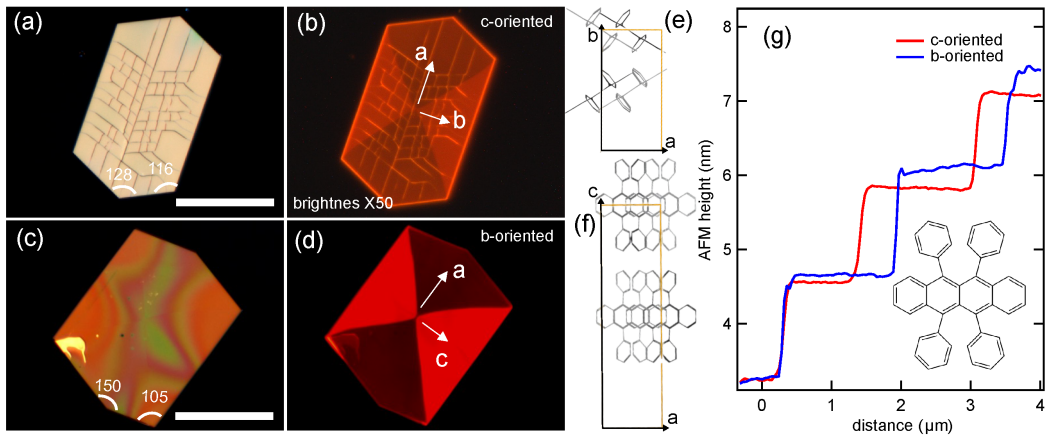
The paper's central discovery is that the anomalous 646 nm band in rubrene is not a defect or trap emission but direct radiative recombination of a spin-zero geminate coherent triplet pair, or of its fusion product, with a decay time of about 3.7 ns. The evidence is that the band is strongly polarised along the c-axis, its early decay is purely mono-exponential with $\tau \approx 3.7$ ns, and its later time evolution follows the same geminate and non-geminate triplet-fusion kinetics as the ordinary singlet bands. The authors also report that hourglass-shaped crystals grow in two orientations, a weakly emitting c-oriented type and a bright b-oriented type, and that within a single crystal the diamond and triangular sectors correspond to slightly rotated orthorhombic unit cells, so exciton dynamics can be resolved sector by sector. They infer rotation angles up to about $45^\circ$ from the ratio of sector fluorescence maxima and find that triangular sectors of b-oriented crystals show stronger non-geminate fusion rates, which they interpret as shorter triplet migration pathways.
Load-bearing premise
Everything hinges on the claim that the visible sectors are just different rotations of the same crystal lattice, an inference drawn from crystal shape, step heights, and brightness rather than from directly measuring the atomic arrangement; if that rotation is wrong, the sector-dependent exciton dynamics have no explained cause.
Editorial extensions
If this is right
- The 646 nm band becomes a direct, spectrally isolated clock for the coherent triplet-pair state in rubrene, since its 3.7 ns mono-exponential decay measures the pair lifetime without interference from ordinary singlet emission.
- Conventional c-oriented rubrene crystals hide this band because the c-axis points out of the surface; the b-oriented crystals presented here bring the c-polarised triplet-pair emission into the detection plane, making the previously 'anomalous' band a routine observable.
- The power-law exponent $n \approx -1.5$ measured in both sectors indicates that triplet excitons explore the crystal in three dimensions, even in a tabular microcrystal whose macroscopic shape is two-dimensional.
- The sector-dependent $T_0\gamma$ values indicate different effective triplet migration or initial triplet densities in diamond versus triangular sectors, connecting crystal microstructure to exciton kinetics.
Reading between the lines
- Editorial inference: If the 646 nm assignment is correct, magnetic-field-dependent measurements on these b-oriented hourglass crystals should show quantum beats or a field-sensitive 3.7 ns component; the paper reports prior quantum-beat work on rubrene but does not apply a field here.
- Editorial inference: The inferred sector rotation angles rest on comparing fluorescence maxima rather than on direct structure, so a diffraction map of a single hourglass crystal would settle whether the sectors really are rotated domains or instead differ in thickness, strain, or local packing.
- Editorial inference: Since both sectors show the same power-law exponent but different $T_0\gamma$, the sector contrast in kinetics may reflect differences in initial exciton density from polarisation-dependent absorption rather than differences in diffusion dimensionality; comparing sector kinetics at matched excitation densities would test this.
- Editorial inference: The hourglass sectoring mechanism, borrowed from mineralogy, may be a general growth phenomenon in flat organic crystals; if so, similar zone-sector patterns could be induced in other singlet-fission materials by tuning anisotropic growth speeds.
Signed reviews
Editorial analysis
A structured set of objections, weighed in public.
Referee Report
Summary. The paper reports a growth method for orthorhombic rubrene microcrystals that exhibit "hourglass" sector-zoned domains (diamond and triangular) visible in fluorescence but not in morphology. Using polarized optical microscopy, spectrally resolved PL, FLIM, and AFM, the authors classify two crystal types (c-oriented and b-oriented), attribute the sector contrast to slight rotations of the orthorhombic unit cell, and claim that a redshifted 646 nm band is strongly c-polarized, decays mono-exponentially with a 3.7 ns lifetime, and originates from direct emission of a geminate coherent triplet pair or from its fusion. The PL kinetics are fitted with a three-term model (exponential, power-law, bimolecular, plus offset) to extract sector-dependent parameters.
Significance. If the central claims hold, the paper introduces a new type of rubrene crystal platform with spatially resolved exciton dynamics that could be useful for studying triplet-pair states and triplet transport. The sector-dependent optical contrast and the apparent c-polarized red band are interesting observations. The paper is honest in places, e.g., it states that SAED was cumbersome and that the sector-rotation angles are estimated from the same fluorescence contrast they are meant to explain. However, the two load-bearing claims—the structural rotation between sectors and the triplet-pair origin of the 646 nm band—are not independently confirmed, and the latter is presented in a disjunctive way that is difficult to falsify. The paper would benefit from direct structural evidence (e.g., single-crystal XRD or improved SAED) and a more cautious framing of the band assignment, including an explicit discussion of ref. 55, which directly contradicts the triplet-pair emission interpretation.
major comments (4)
- [§4.2, Eq. (2), Table 1, Fig. 5] The abstract and Section 4.2 state that the 646 nm band exhibits "pure mono-exponential dynamics" with a 3.7 ns lifetime. This is contradicted by the fitting function in Eq. (2), which includes an exponential plus a power-law term plus a bimolecular term plus an offset. The exponential term is only one component of a multi-term fit, and Table 1 reports no uncertainties on τ, n, or T0γ. Without error bars or goodness-of-fit measures, the claim of a specific mono-exponential lifetime for this band is not established. Please provide confidence intervals or a statistical justification for separating the exponential from the overlapping power-law and bimolecular contributions.
- [§4.2, Eq. for θ, Section 4.1] The sector rotation angle is derived from the fluorescence intensity ratio via θ = arccos(sqrt(IDmax/ITmax)) and is then used to explain the sector-dependent spectra and the intensity variation of the 646 nm band. This is a self-consistency loop rather than an independent measurement of the lattice orientation. The paper admits that SAED was cumbersome, but the structural interpretation—a rotation of the orthorhombic unit cell around the a- or b-axis—is a load-bearing element of the sector-resolved exciton-dynamics story. Without direct crystallographic confirmation, the rotation angles and the resulting explanation of the sector-dependent 646 nm intensity remain speculative. Please provide independent structural evidence (e.g., XRD on a single crystal, or at least a clearer statement that the rotation is a hypothesis) or soften the claims accordingly.
- [§4.2, last paragraph; ref. [55]] The attribution of the 646 nm band to direct emission of a geminate coherent triplet pair or to its fusion is presented as the central mechanistic claim, but the supporting evidence is circumstantial: strong c-polarisation, a ~3.7 ns exponential component, and agreement with the 4 ns lifetime in ref. [13]. The paper cites ref. [55] (Bossanyi et al.), which explicitly concludes "no evidence of triplet-pair emission" in pristine orthorhombic rubrene, but does not address this contrary result. Moreover, the disjunctive phrasing "direct emission ... or from its fusion" makes the claim unfalsifiable, because any delayed fluorescence from triplet-triplet fusion would be consistent with the second branch. The alternative explanation of a trap state or an extrinsic band is dismissed only with a weak argument (the long-time kinetics match the other bands), which is expected if the same fitting function with a shared power-law/bimolecular part is applied. Please either provide a direct test that distinguishes triplet-pair emission from fusion-mediated delayed fluorescence, or substantially weaken the abstract's claim.
- [Section 4.2 and Conclusion] The conclusion states that the detected photons "originate either from direct emission of geminate coherent triplet pairs or upon fusion of it, exhibiting pure mono-exponential dynamics with 3.7 ns lifetime." This sentence conflates the two sub-processes and overstates the mono-exponential attribute. The paper's own data show a multi-exponential/functional decay for the λ>600 nm window, and the 646 nm band is only one peak in that window. Please revise the abstract and conclusion to describe the observed kinetics accurately, e.g., as a decay that includes a fast ~3.7 ns component followed by power-law and bimolecular phases.
minor comments (5)
- [Title/Abstract] The phrase "high photon absorption due to the alignment of excitation polarisation and transition dipole moment" is redundant and could be simplified to "strong absorption when the excitation polarisation aligns with the transition dipole moment."
- [Section 4.2, Table 1] Table 1 lists fit parameters without uncertainties or the fit range used. Please add error estimates and state the time window over which each fit was performed (e.g., t>2 ns for λ>600 nm, t>3 ns for λ<600 nm).
- [Section 4.1, Eq. (1)] Eq. (1) includes an offset term, but the text refers to it as "Equation 2" in places (e.g., "See Equation 2"). Please correct the cross-reference.
- [Section 4.2, Fig. 4] In the caption of Fig. 4, the sentence "For the detection along the a-axis, the acquisition time is 50 times longer than along the c-axis" is clear, but the figure itself does not visibly mark which panel uses the longer acquisition time; consider adding a note in the figure or caption for clarity.
- [Introduction/References] Reference [47] is cited for the (101) facets and step heights, but the same reference is not listed in the bibliography; please check the numbering and ensure all cited works appear in the reference list.
Circularity Check
The sector-rotation angle is computed from the same fluorescence intensity contrast it is then used to explain, making the structural interpretation of the sectors a self-consistency loop.
-
self definitional
[Section 4.2, rotation-angle equation preceding Fig. 4, and the sector-spectra interpretation following Fig. 4]
"The rotation angle in the diamond zones can be estimated using θ = arccos( q ( IDmax IT max ), where θ is the angle between the polarisation and transition dipole moment in the diamond sectors and IT max and IDmax are maximum fluorescence yields in the triangular and diamond zones, respectively. We obtain varying angles ranging from 12 ◦ to 45 ◦ for different samples. ... In the diamond sectors the rotation around the a-axis results in a projection of this transition dipole onto the detected polarisation axis. Accordingly, the 600 nm band gains intensity with increasing rotation angle θ."
θ is not measured by an independent structural probe; it is defined from the maximum fluorescence yields in the diamond and triangular sectors (IDmax and ITmax). The paper then invokes θ as the causal variable for the sector-resolved spectra, asserting that the 600 nm band gains intensity and the 646 nm band loses intensity with increasing θ. Since those intensity differences are the same observable from which θ was computed, the explanation is a self-consistency loop: the fitted rotation angle is constructed from the sector contrast and then presented as its origin. No diffraction or other independent check of θ is provided, so the sector-rotation explanation is equivalent to restating the input intensity ratio in the form of an angle.
full rationale
The only place where the derivation reduces to its own input is the sector-rotation angle. In Section 4.2, θ is defined by θ = arccos(sqrt(IDmax/ITmax)) using the maximum fluorescence yields of the two sector types, and the same θ is then used to explain why the 600 nm band gains and the 646 nm band loses intensity across sectors. Because θ is constructed from the very intensity contrast it is invoked to explain, that part of the structural interpretation is a self-consistency loop rather than an independent measurement. Nothing else in the paper is circular. The previous self-citation [30] is used as growth-method background and is not the sole support for the orthorhombic-phase claim, which also relies on SAED spot patterns, crystal habit, and AFM step-height comparison. The 646 nm band assignment is grounded in an external lifetime comparison (3.7 ns vs Wolf et al.'s 4 ns) and is presented in the body as tentative, though the abstract upgrades it to a definite statement; that overstatement is a correctness or evidential concern, not a circular reduction. The statement 'pure mono-exponential dynamics' also overstates the four-term fit in Eq. (2), but this is an interpretation issue rather than a circular derivation. The unresolved contradiction with ref. [55], which finds no triplet-pair emission in pristine orthorhombic rubrene, is an external-evidence conflict, not circularity. Overall, the measurement effort is substantial and most kinetics fits are standard, but the load-bearing sector-rotation explanation reduces one of the paper's central claims to a restatement of the measured intensity ratio.
Assumptions & free parameters
free parameters (6)
- power-law exponent n =
-1.48 to -1.52 (Table 1)
- T0γ (initial triplet density times bimolecular rate) =
0.61 to 1.92 µs^-1 in Table 1; up to 4-10 µs^-1 at higher intensity
- mono-exponential lifetime τ of 646 nm band =
3.7-3.8 ns
- sector rotation angle θ =
12° to 45° across samples
- offset =
a few counts
- amplitudes A0, A1, A2 =
not reported
assumptions (6)
- domain assumption The crystals are in the orthorhombic phase and the two types are c-oriented and b-oriented based on crystal habit and AFM step heights.
- ad hoc to paper Sector contrast arises from slight rotations of the orthorhombic unit cell around the b-axis (c-oriented) or a-axis (b-oriented).
- domain assumption The emission intensity ratio IDmax/ITmax is related to the rotation angle by θ = arccos(sqrt(IDmax/ITmax)).
- domain assumption The power-law exponent n of delayed fluorescence maps to diffusion dimensionality (n = -1 for 2D, -1.5 for 3D) as derived in refs [49,51,52].
- standard math The non-geminate fusion term follows dT/dt = -γT^2, giving emission ∝ (1 + T0γ t)^-2 (ref 53).
- domain assumption The 646 nm band is not due to trap states because its kinetics after 10 ns match the other bands.
Cite this review
Pith. "Pith review of Zone-sectored organic crystals with spatially resolved exciton dynamics." pith.science (2026). https://pith.science/paper/2VYVCRTD
@misc{pith2026250721294,
  author       = {Pith},
  title        = {Pith review of: Zone-sectored organic crystals with spatially resolved exciton dynamics},
  year         = {2026},
  howpublished = {\url{https://pith.science/paper/2VYVCRTD}},
  note         = {Machine review of arXiv:2507.21294}
}
read the original abstract
Among the organic semiconductors, rubrene stands out in terms of hole mobility, luminescence yield and exciton migration distance. A novel type of rubrene microcrystal is prepared in the orthorhombic phase, exhibiting zone-sectored tabular domains with distinct photoluminescence (PL) characteristics. These sectors exhibit distinct PL spectra and time-evolution, arising from differences in the in-plane orientation of the orthorhombic unit cell relative to the crystal surface. A combination of polarised optical microscopy, fluorescence lifetime imaging microscopy (FLIM), and atomic force microscopy (AFM) is used to characterise the samples in terms of crystal orientation, fluorescence lifetime, and photoluminescence spectra. Spatially resolved PL spectroscopy reveals that the redshifted 650 nm emission band has polarisation along the transition dipole moment and is associated with high photon absorption due to the alignment of excitation polarisation and transition dipole moment and selectively localized within specific sectors of the crystal. The detected photon originates from direct emission of a geminate coherent triplet pair, or from its fusion. This band exhibits pure mono-exponential dynamics with 3.7 ns lifetime. The triplet fusion behaviour in the succeeding time regimes can be treated in the framework of power law scaling and random walk. The emission kinetics are modelled using rate equations describing geminate and non-geminate exciton fusion processes, enabling a quantitative interpretation of the spatially resolved PL kinetics. These findings introduce a material-based strategy, opening novel routes for photonic applications and light harvesting.
Figures


Figures from the paper (1 more)

Reference graph
Works this paper leans on
-
[13]
Eric A. Wolf, Drew M. Finton, Vincent Zoutenbier, and Ivan Biaggio. Quantum beats of a multiexciton state in rubrene single crystals. Applied Physics Letters, 112(8), February 2018
work page 2018
-
[55]
David G. Bossanyi, Maik Matthiesen, Rahul Jayaprakash, Sayantan Bhattacharya, Jana Za- umseil, and Jenny Clark. Singlet fission is incoherent in pristine orthorhombic single crystals of rubrene: no evidence of triplet-pair emission. Faraday Discussions, 250:162–180, 2024
work page 2024
-
[1]
Yost, Eric Hontz, Sina Yeganeh, and Troy Van Voorhis
Shane R. Yost, Eric Hontz, Sina Yeganeh, and Troy Van Voorhis. Triplet vs singlet energy trans- fer in organic semiconductors: The tortoise and the hare. The Journal of Physical Chemistry C , 116(33):17369–17377, August 2012
work page 2012
-
[2]
McGarry, Wei Xie, Christopher Sutton, Chad Risko, Yanfei Wu, Victor G
Kathryn A. McGarry, Wei Xie, Christopher Sutton, Chad Risko, Yanfei Wu, Victor G. Young, Jean-Luc Br´ edas, C. Daniel Frisbie, and Christopher J. Douglas. Rubrene-based single-crystal organic semiconductors: Synthesis, electronic structure, and charge-transport properties. Chemistry of Materials , 25(11):2254–2263, May 2013
work page 2013
-
[3]
New growth method of rubrene single crystal for organic field-effect transistor
Kihyun Kim, Min Ki Kim, Han Saem Kang, Mi Yeon Cho, Jinsoo Joo, Ju Hee Kim, Kyung Hwan Kim, Chang Seop Hong, and Dong Hoon Choi. New growth method of rubrene single crystal for organic field-effect transistor. Synthetic Metals, 157(10-12):481–484, June 2007
work page 2007
-
[4]
Highly crystalline rubrene light-emitting diodes with epitaxial growth
Shu-Jen Wang, Anton Kirch, Michael Sawatzki, Tim Achenbach, Hans Kleemann, Sebastian Reineke, and Karl Leo. Highly crystalline rubrene light-emitting diodes with epitaxial growth. Advanced Functional Ma- terials, 33(14), January 2023
work page 2023
-
[5]
Arie van der Lee, Maurizio Polentarutti, Gilles H. Roche, Olivier J. Dautel, Guillaume Wantz, Fr´ ed´ eric Castet, and Luca Muccioli. Temperature-dependent structural phase transition in rubrene single crystals: 8 The missing piece from the charge mobility puzzle? The Journal of Physical Chemistry Letters , 13(1):406– 411, January 2022
work page 2022
-
[6]
Zhang, Kejie Tan, Changji Zou, Magnus Wik- berg, Laurie E
Keke K. Zhang, Kejie Tan, Changji Zou, Magnus Wik- berg, Laurie E. McNeil, Subodh G. Mhaisalkar, and C. Kloc. Control of charge mobility in single-crystal rubrene through surface chemistry. Organic Electron- ics, 11(12):1928–1934, December 2010
work page 1928
Show all 61 references
-
[7]
The actual electronic band structure of a rubrene single crystal
Jun Nitta, Kazumoto Miwa, Naoki Komiya, Emilia An- nese, Jun Fujii, Shimpei Ono, and Kazuyuki Sakamoto. The actual electronic band structure of a rubrene single crystal. Scientific Reports, 9(1), July 2019
2019
-
[8]
Gurzadyan, and Licheng Sun
Tong Wu, Wenjun Ni, Gagik G. Gurzadyan, and Licheng Sun. Singlet fission from upper excited sin- glet states and polaron formation in rubrene film. RSC Advances, 11(8):4639–4645, 2021
2021
-
[9]
Bizimana, Benedikt Kloss, David R
Ilana Breen, Roel Tempelaar, Laurie A. Bizimana, Benedikt Kloss, David R. Reichman, and Daniel B. Turner. Triplet separation drives singlet fission af- ter femtosecond correlated triplet pair production in rubrene. Journal of the American Chemical Society , 139(34):11745–11751...
2017
-
[10]
Finton, Eric A
Drew M. Finton, Eric A. Wolf, Vincent S. Zoutenbier, Kebra A. Ward, and Ivan Biaggio. Routes to singlet exciton fission in rubrene crystals and amorphous films. AIP Advances, 9(9), September 2019
2019
-
[11]
Baronas, G
P. Baronas, G. Kreiza, L. Naimoviˇ cius, E. Radiunas, K. Kazlauskas, E. Orentas, and S. Jurˇ s˙ enas. Sweet spot of intermolecular coupling in crystalline rubrene: Inter- molecular separation to minimize singlet fission and re- tain triplet–triplet annihilation. The Journal of...
2022
-
[12]
Barito, Emily G
Sebastian Engmann, Adam J. Barito, Emily G. Bittle, Noel C. Giebink, Lee J. Richter, and David J. Gund- lach. Higher order effects in organic LEDs with sub- bandgap turn-on. Nature Communications, 10(1), Jan- uary 2019
2019
-
[14]
Burdett and Christopher J
Jonathan J. Burdett and Christopher J. Bardeen. Quantum beats in crystalline tetracene delayed fluo- rescence due to triplet pair coherences produced by di- rect singlet fission. Journal of the American Chemical Society, 134(20):8597–8607, May 2012
2012
-
[15]
Michel-Beyerle, and Gagik G
Lin Ma, Keke Zhang, Christian Kloc, Handong Sun, Maria E. Michel-Beyerle, and Gagik G. Gurzadyan. Singlet fission in rubrene single crystal: direct observa- tion by femtosecond pump–probe spectroscopy. Phys- ical Chemistry Chemical Physics , 14(23):8307, 2012
2012
-
[16]
Bardeen, Tien-Lung Chiu, Juen-Kai Wang, and Jiun-Haw Lee
Chia-Hsun Chen, Pin-Hao Sher, Cheng-Pin Chen, Wing-Kit Choi, Christopher J. Bardeen, Tien-Lung Chiu, Juen-Kai Wang, and Jiun-Haw Lee. Thickness- dependent exciton dynamics in thermally evaporated rubrene thin films. The Journal of Physical Chemistry C, 124(47):25729–25737, Nov...
2020
-
[18]
Wolf and Ivan Biaggio
Eric A. Wolf and Ivan Biaggio. Geminate exciton fusion fluorescence as a probe of triplet exciton transport after singlet fission. Physical Review B , 103(20), May 2021
2021
-
[19]
Tunable self-trapped excitons in 2d layered rubrene
Shaopeng Feng, Yutian Yang, Lei Gao, Kenji Watan- abe, Takashi Taniguchi, Zhenliang Hu, Junpeng Lu, and Zhenhua Ni. Tunable self-trapped excitons in 2d layered rubrene. Applied Physics Letters, 118(25), June 2021
2021
-
[20]
Michel-Beyerle, and Gagik G
Lin Ma, Keke Zhang, Christian Kloc, Handong Sun, Cesare Soci, Maria E. Michel-Beyerle, and Gagik G. Gurzadyan. Fluorescence from rubrene single crystals: Interplay of singlet fission and energy trapping. Phys- ical Review B , 87(20), May 2013
2013
-
[21]
Morphology and fluorescence spectra of rubrene single crystals grown by physical vapor transport
Xionghui Zeng, Deqiang Zhang, Lian Duan, Liduo Wang, Guifang Dong, and Yong Qiu. Morphology and fluorescence spectra of rubrene single crystals grown by physical vapor transport. Applied Surface Science , 253(14):6047–6051, May 2007
2007
-
[22]
Physical vapor growth of organic semiconductors
R.A Laudise, Ch Kloc, P.G Simpkins, and T Siegrist. Physical vapor growth of organic semiconductors. Journal of Crystal Growth , 187(3–4):449–454, May 1998
1998
-
[23]
High performance of rubrene thin film transistor by weak epitaxy growth method
Hao Chang, Weili Li, Hongkun Tian, Yanhou Geng, Haibo Wang, Donghang Yan, and Tong Wang. High performance of rubrene thin film transistor by weak epitaxy growth method. Organic Electronics, 20:43– 48, May 2015
2015
-
[24]
Growth behavior of rubrene thin films on hexagonal boron nitride in the early stage
Yujia Wei, Di Xue, Lianlian Ji, Jie Lu, Qi Wang, Xingyu Jiang, Yinghui Sun, Zi Wang, Lizhen Huang, and Lifeng Chi. Growth behavior of rubrene thin films on hexagonal boron nitride in the early stage. Chinese Journal of Chemistry , 40(11):1298–1304, March 2022
2022
-
[25]
Burnett, Koray Kara, Ozlem Usluer, Benjamin P
Duygu Akin Kara, Edmund K. Burnett, Koray Kara, Ozlem Usluer, Benjamin P. Cherniawski, Edward J. Barron, Burak Gultekin, Mahmut Kus, and Alejan- dro L. Briseno. Rubrene single crystal solar cells and the effect of crystallinity on interfacial recombination. Physical Chemistry ...
2022
-
[26]
Y. Luo, M. Brun, P. Rannou, and B. Grevin. Growth of rubrene thin film, spherulites and nanowires on SiO2. physica status solidi (a) , 204(6):1851–1855, May 2007
2007
-
[27]
Se-W. Park, S. H. Jeong, Jeong-M. Choi, Jung Min Hwang, Jae Hoon Kim, and Seongil Im. Rubrene poly- crystalline transistor channel achieved through in situ vacuum annealing. Applied Physics Letters, 91(3), July 2007
2007
-
[28]
Abrupt heating-induced high-quality crystalline rubrene thin films for organic thin-film transistors
Hyeok Moo Lee, Hanul Moon, Hyo-Sik Kim, Yong Nam Kim, Sung-Min Choi, Seunghyup Yoo, and Sung Oh Cho. Abrupt heating-induced high-quality crystalline rubrene thin films for organic thin-film transistors. Or- ganic Electronics, 12(8):1446–1453, August 2011. 9
2011
-
[29]
Microspacing in-air sublimation growth of organic crys- tals
Xin Ye, Yang Liu, Quanxiang Han, Chao Ge, Shuangyue Cui, Leilei Zhang, Xiaoxin Zheng, Guangfeng Liu, Jie Liu, Duo Liu, and Xutang Tao. Microspacing in-air sublimation growth of organic crys- tals. Chemistry of Materials , 30(2):412–420, January 2018
2018
-
[30]
Morphology and structural properties of thin rubrene crystallites grown on graphite
Moha Naeimi, Katharina Engster, Ingo Barke, and Sylvia Speller. Morphology and structural properties of thin rubrene crystallites grown on graphite. Physica Scripta, 100(1):015406, December 2024
2024
-
[31]
Bregt Verreet, Paul Heremans, Andre Stesmans, and Barry P. Rand. Microcrystalline organic thin-film solar cells. Advanced Materials, 25(38):5504–5507, August 2013
2013
-
[32]
Tan, Jordan T
Jenna A. Tan, Jordan T. Dull, Steven E. Zeltmann, Jakhangirkhodja A. Tulyagankhodjaev, Holly M. John- son, Alex Liebman-Pel´ aez, Brendan D. Folie, Sven A. D¨ onges, Omar Khatib, Jonathan G. Raybin, Trevor D. Roberts, Leo M. Hamerlynck, Christian P. N. Tanner, Jina Lee, Colin ...
2023
-
[33]
Fusella, Frank Schreiber, Kevin Abbasi, Jae Joon Kim, Alejandro L
Michael A. Fusella, Frank Schreiber, Kevin Abbasi, Jae Joon Kim, Alejandro L. Briseno, and Barry P. Rand. Homoepitaxy of crystalline rubrene thin films. Nano Letters, 17(5):3040–3046, April 2017
2017
-
[34]
Foggiatto, Yasuo Takeichi, Kanta Ono, Hiroki Suga, Yoshio Takahashi, Michael A
Alexandre L. Foggiatto, Yasuo Takeichi, Kanta Ono, Hiroki Suga, Yoshio Takahashi, Michael A. Fusella, Jordan T. Dull, Barry P. Rand, Kentaro Kutsukake, and Takeaki Sakurai. Study of local structure at crys- talline rubrene grain boundaries via scanning transmis- sion x-ray mic...
2019
-
[35]
Gwyddion user guide
Petr Klapetek, David Neˇ cas, and Christopher Ander- son. Gwyddion user guide. http://gwyddion.net/, 2004–2009
2004
-
[36]
Fielitz and Russell J
Thomas R. Fielitz and Russell J. Holmes. Crystal mor- phology and growth in annealed rubrene thin films. Crystal Growth & Design , 16(8):4720–4726, July 2016
2016
-
[37]
Pap, P´ eter Petrik, Katalin Kamar´ as, Levente Tapaszt´ o, and P´ eter Nemes-Incze
Andr´ as P´ alink´ as, Gy¨ orgy K´ alvin, P´ eter Vancs´ o, Konr´ ad Kandrai, M´ arton Szendr˝ o, Gergely N´ emeth, Mikl´ os N´ emeth,´Aron Pekker, J´ ozsef S. Pap, P´ eter Petrik, Katalin Kamar´ as, Levente Tapaszt´ o, and P´ eter Nemes-Incze. The composition and structure of...
2022
-
[38]
Rotator phases in alkane systems: In bulk, surface layers and micro/nano-confinements
Diana Cholakova and Nikolai Denkov. Rotator phases in alkane systems: In bulk, surface layers and micro/nano-confinements. Advances in Colloid and In- terface Science, 269:7–42, July 2019
2019
-
[39]
Microspacing in-air sublimation growth of ultra- thin organic single crystals
Qing Guo, Xin Ye, Qinglian Lin, Quanxiang Han, Chao Ge, Xiaoxin Zheng, Leilei Zhang, Shuangyue Cui, Yukun Wu, Cuicui Li, Yang Liu, and Xutang Tao. Microspacing in-air sublimation growth of ultra- thin organic single crystals. Chemistry of Materials , 32(18):7618–7629, August 2020
2020
-
[40]
The crystalline state of rubrene materials: intermolecular recognition, isomorphism, polymorphism, and periodic bond-chain analysis of morphologies
Massimo Moret and Angelo Gavezzotti. The crystalline state of rubrene materials: intermolecular recognition, isomorphism, polymorphism, and periodic bond-chain analysis of morphologies. New Journal of Chemistry , 46(16):7626–7637, 2022
2022
-
[41]
Dye Inclusion Crystals , page 497–504
Bart Kahr and Sei-Hum Jang. Dye Inclusion Crystals , page 497–504. CRC Press, May 2004
2004
-
[42]
Vetter, Hirono Totsuka, Michael Dudley, and Bart Kahr
William M. Vetter, Hirono Totsuka, Michael Dudley, and Bart Kahr. The perfection and defect structure of organic hourglass inclusion k2so4 crystals. Journal of Crystal Growth, 241(4):498–506, June 2002
2002
-
[43]
Hexagonal sin- gle crystals of perylene with patterned heterogeneous domains
Ken Takazawa and Jun-ichi Inoue. Hexagonal sin- gle crystals of perylene with patterned heterogeneous domains. Chemical Physics Letters , 843:141232, May 2024
2024
-
[44]
Beno, John R
Carl J. Beno, John R. Bowman, Patrick C. Loury, Lor- raine M. Tapanila, and Diego P. Fernandez. Evidence for dendritic crystallization of forsterite olivine dur- ing contact metamorphism of siliceous dolostones, alta stock aureole, utah. Contributions to Mineralogy and Petrolo...
2020
-
[45]
Sector-zoned clinopyroxene as a recorder of magma history, eruption triggers, and ascent rates
Teresa Ubide, Silvio Mollo, Jian-xin Zhao, Manuela Nazzari, and Piergiorgio Scarlato. Sector-zoned clinopyroxene as a recorder of magma history, eruption triggers, and ascent rates. Geochimica et Cosmochim- ica Acta, 251:265–283, April 2019
2019
-
[46]
Absorption and photo- luminescence spectroscopy of rubrene single crystals
Pavel Irkhin, Aleksandr Ryasnyanskiy, Marlus Koehler, and Ivan Biaggio. Absorption and photo- luminescence spectroscopy of rubrene single crystals. Physical Review B , 86(8), August 2012
2012
-
[47]
Rubrene microcrystals: A route to investigate surface morphology and bulk anisotropies of organic semicon- ductors
Mira El Helou, Olaf Medenbach, and Gregor Witte. Rubrene microcrystals: A route to investigate surface morphology and bulk anisotropies of organic semicon- ductors. Crystal Growth & Design , 10(8):3496–3501, June 2010
2010
-
[48]
Diffusion-mediated delayed fluorescence by singlet fission and geminate fusion of correlated triplets
Kazuhiko Seki, Yoriko Sonoda, and Ryuzi Ka- toh. Diffusion-mediated delayed fluorescence by singlet fission and geminate fusion of correlated triplets. The Journal of Physical Chemistry C , 122(22):11659–11670, May 2018
2018
-
[49]
Geminate de- layed fluorescence by anisotropic diffusion-mediated re- versible singlet fission and triplet fusion
Kazuhiko Seki, Tomomi Yoshida, Tomoaki Yago, Masanobu Wakasa, and Ryuzi Katoh. Geminate de- layed fluorescence by anisotropic diffusion-mediated re- versible singlet fission and triplet fusion. The Journal of Physical Chemistry C , 125(6):3295–3304, February 2021
2021
-
[50]
Akselrod, Parag B
Gleb M. Akselrod, Parag B. Deotare, Nicholas J. Thompson, Jiye Lee, William A. Tisdale, Marc A. Baldo, Vinod M. Menon, and Vladimir Bulovi´ c. Vi- sualization of exciton transport in ordered and disor- dered molecular solids. Nature Communications, 5(1), April 2014. 10
2014
-
[51]
Complementing graphenes: 1d interplanar charge transport in poly- meric graphitic carbon nitrides
Christoph Merschjann, Stefanie Tschierlei, Tobias Tyborski, Kamalakannan Kailasam, Steven Orth- mann, Dirk Hollmann, Thomas Schedel-Niedrig, Arne Thomas, and Stefan Lochbrunner. Complementing graphenes: 1d interplanar charge transport in poly- meric graphitic carbon nitrides. ...
2015
-
[52]
Wolfgang Pfluegl and Robert J. Silbey. Long-time properties of random walks with a single trap. Physical Review E, 58(4):4128–4133, October 1998
1998
-
[53]
Triplet ex- citon dynamics in rubrene single crystals
Aleksandr Ryasnyanskiy and Ivan Biaggio. Triplet ex- citon dynamics in rubrene single crystals. Physical Re- view B , 84(19), November 2011
2011
-
[54]
Excited state dynamics in solid and monomeric tetracene: The roles of superra- diance and exciton fission
Jonathan J Burdett, Astrid M M¨ uller, David Gosztola, and Christopher J Bardeen. Excited state dynamics in solid and monomeric tetracene: The roles of superra- diance and exciton fission. The Journal of chemical physics, 133(14), 2010
2010
-
[56]
The origin of a 650 nm photolu- minescence band in rubrene
Yuanzhen Chen, Bumsu Lee, Danni Fu, and Vi- taly Podzorov. The origin of a 650 nm photolu- minescence band in rubrene. Advanced Materials , 23(45):5370–5375, October 2011
2011
-
[57]
Piland and Christopher J
Geoffrey B. Piland and Christopher J. Bardeen. Photo- luminescence dynamics in singlet fission chromophore liquid melts. Chemical Physics Letters , 669:99–103, February 2017
2017
-
[58]
Musser, Sam L
Chaw Keong Yong, Andrew J. Musser, Sam L. Bayliss, Steven Lukman, Hiroyuki Tamura, Olga Bubnova, Rawad K. Hallani, Aur´ elie Meneau, Roland Resel, Munetaka Maruyama, Shu Hotta, Laura M. Herz, David Beljonne, John E. Anthony, Jenny Clark, and Henning Sirringhaus. The entangled ...
2017
-
[59]
Thermal narrowing of the electronic bandwidths in or- ganic molecular semiconductors: Impact of the crystal thermal expansion
Yuan Li, Veaceslav Coropceanu, and Jean-Luc Br´ edas. Thermal narrowing of the electronic bandwidths in or- ganic molecular semiconductors: Impact of the crystal thermal expansion. The Journal of Physical Chemistry Letters, 3(22):3325–3329, October 2012
2012
-
[60]
Highest-occupied- molecular-orbital band dispersion of rubrene single crystals as observed by angle-resolved ultraviolet pho- toelectron spectroscopy
Shin-ichi Machida, Yasuo Nakayama, Steffen Duhm, Qian Xin, Akihiro Funakoshi, Naoki Ogawa, Satoshi Kera, Nobuo Ueno, and Hisao Ishii. Highest-occupied- molecular-orbital band dispersion of rubrene single crystals as observed by angle-resolved ultraviolet pho- toelectron spectr...
2010
-
[61]
Mansour, Thorsten Schultz, Dongguen Shin, Sebastian Hammer, Jens Pflaum, Yadong Zhang, Stephen Barlow, Seth R
Christos Gatsios, Andreas Opitz, Dominique Lung- witz, Ahmed E. Mansour, Thorsten Schultz, Dongguen Shin, Sebastian Hammer, Jens Pflaum, Yadong Zhang, Stephen Barlow, Seth R. Marder, and Norbert Koch. Surface doping of rubrene single crystals by molecu- lar electron donors and...
2023
-
[62]
The actual electronic band structure of a rubrene single crystal
Jun Nitta, Kazumoto Miwa, Naoki Komiya, Emilia An- nese, Jun Fujii, Shimpei Ono, and Kazuyuki Sakamoto. The actual electronic band structure of a rubrene single crystal. Scientific Reports, 9(1), July 2019. 11
2019
Reviewed August 6, 2026 · model on record in the stance chip above.
Discussion (0). Continue with ORCID to comment.