REVIEW 3 major objections 5 minor 1 cited by
Long-distance free-space quantum key distribution with continuous variables
T0 review · 3 major / 5 minor · reviewed 2026-08-06 · deepseek-v4-flash
Pith's one-line read Long-distance free-space quantum key distribution now works over a 9.6-km daylight link.
desk verdict A real record-distance free-space CVQKD field test with clever engineering, but the title and abstract overclaim secure key distribution when only asymptotic key rates are shown. read the letter →
The pith
A machine-rendered reading of the paper's core claim, the machinery that carries it, and where it could break.
The reading
What carries the argument
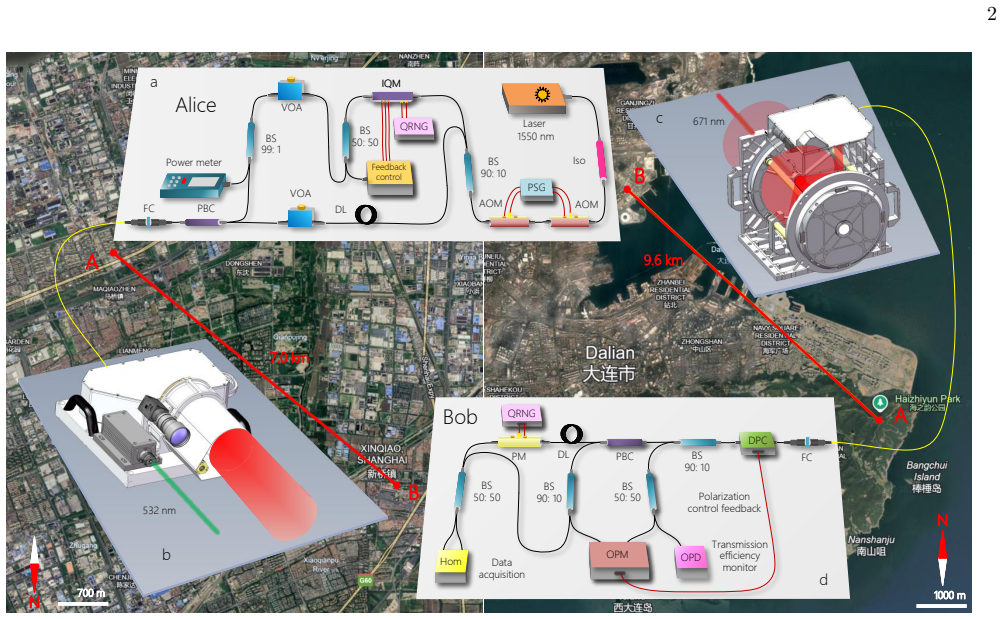
The load-bearing mechanism is a chain of channel-fluctuation-independent controls followed by grouped parameter estimation. Alice and Bob monitor each pulse's transmission efficiency in real time by sampling the 5% local-oscillator branch at 1 GS/s, then sort the sifted key data into 0.2 dB-wide loss intervals, the probability distribution of transmission efficiency (PDTE) grouping. Within a group the channel is treated as stationary, so the standard Gaussian-modulated coherent-state (GMCS) security proof applies and the total secret key rate is the probability-weighted sum of per-group rates. Two supporting controls carry the system: a polarization feedback that uses the ratio of leaked signal and local-oscillator light, making it independent of loss fluctuations, and two adjacent QPSK pilot pulses that calibrate the phase of each quantum signal. A coarse-fine acquisition, tracking, and pointing (ATP) stage keeps the link inside the regime where these corrections operate.
What would settle it
Recompute the grouped secret key rates from the same field data with the bin width changed to 0.1 dB and to 0.4 dB. If the estimated rates change substantially, or if the fading excess noise measured inside a 0.2 dB bin is not negligible compared with the roughly $10^{-5}$ shot-noise-unit averages reported in Fig. 2(b), the stationarity assumption behind Eq. (2) would be falsified and the claimed rates would need revision.
Extended reading notes
Core claim
The system prepares 1550-nm Gaussian-modulated coherent states, transmits them with a polarization-division and time-division multiplexed local oscillator, and detects one quadrature per pulse with homodyne detection. After each pulse's transmission efficiency is monitored in real time, the sifted raw keys are sorted into 0.2 dB loss groups; the secret key rate is then the probability-weighted sum of per-group rates from the reverse-reconciliation rate bound. The reported average secret key rates range from 0.0560 to 2.3545 bps over the 7-km inland link and from 0.0379 to 0.4768 bps over the 9.6-km maritime link, with the best subchannel rate exceeding 700 bps. The paper states this is the first long-distance free-space CVQKD demonstration and that the 9.6-km maritime distance exceeds the atmosphere's effective thickness, making daylight satellite-based quantum cryptography a proposed next application. A stated limitation is that the rates are asymptotic, not finite-size secure.
Load-bearing premise
The security analysis assumes that sorting received key data into 0.2 dB-wide loss groups makes the leftover noise from atmospheric fading negligible, so each group can be treated as a stationary channel for rate calculation; if that residual fading noise is not negligible, the reported secret key rates could be overestimated.
Editorial extensions
If this is right
- The previous outdoor distance ceiling of about 1.6 km is broken by roughly half an order of magnitude in a single field demonstration.
- Daylight operation without wavelength conversion or extra spectral filtering removes a major practical obstacle to round-the-clock free-space quantum key distribution.
- Because the system uses telecom-band coherent optical components, the same terminal could in principle interconnect with existing ground fiber quantum networks.
- All reported rates are asymptotic; converting the demonstration into finite-size secure keys will require more accumulated data and an optimized grouping interval, which the authors identify as the next step.
Reading between the lines
- A direct test of the 0.2 dB binning assumption would be to recompute rates at 0.1 dB and 0.4 dB bin widths on the same field data; a rate that barely moves would support stationarity, while a strong dependence would mean residual fading noise is still present.
- The maritime link's night-time difficulty points to fog and humidity, not the quantum protocol, as the practical availability limit; link-availability modeling would be a natural extension.
- A satellite version of this architecture would face platform vibration, Doppler shifts, and faster pointing dynamics that a ground-to-ground field test cannot fully exercise, so the ATP design would need separate validation.
Signed reviews
Editorial analysis
A structured set of objections, weighed in public.
Referee Report
Summary. The paper reports field tests of Gaussian-modulated coherent-state CVQKD over a 7-km inland atmospheric link and a 9.6-km maritime atmospheric link, using transmitted local oscillator, dynamic polarization and phase compensation, transmission-efficiency monitoring, and grouping of raw data into 0.2-dB channel-loss bins. The authors compute asymptotic secret key rates from the Devetak-Winter bound, report positive rates for selected 'optimal' groups in Table I, and claim the first long-distance free-space CVQKD demonstration beyond the previous 1.6-km record. The manuscript explicitly acknowledges that the analysis is asymptotic and that finite-size security remains future work.
Significance. If the claims are accepted with appropriate security qualifications, the work would be a notable experimental advance: it extends outdoor free-space CVQKD from 1.6 km to 7 km and 9.6 km, demonstrates operation in daylight without additional spectral filtering or wavelength conversion, and uses measured noise and loss parameters rather than fitted key rates. The core reported quantities, positive asymptotic secret key rates from Eq. (2), are supported by the standard Devetak-Winter formula applied to measured parameters. The main weakness is that the manuscript's language repeatedly asserts actual 'secure key distribution,' whereas the evidence establishes only positive asymptotic rates under an i.i.d./stationary-channel assumption, with no finite-size or composable security analysis, no error bars, and no raw data. The grouping approximation appears reasonable for the reported data because the measured residual fading noise in Fig. 2b is orders of magnitude below the reported excess noise, but the absence of finite-size corrections and full data reporting is load-bearing for the central claim.
major comments (3)
- [Field-test results and Eq. (1)-(2)] The central claim that secure keys were distributed over 7 km and 9.6 km is supported only by asymptotic rates computed from Eq. (1) and aggregated by Eq. (2). Eq. (1) is the N→∞ Devetak-Winter bound, and Eq. (2) applies it to finite grouped data blocks without finite-size corrections or composable security bounds. This is quantitatively serious: Table I lists group probabilities P as low as 0.05% and secure-key-generation proportions αG as low as 5.88%, so the number of raw symbols in many groups is far below what the 2.5-MHz symbol rate alone would suggest, especially at SNRs near 0.006 with FER up to 90%. The authors themselves state that 'transitioning from the asymptotic regime to the finite-length regime poses a significant challenge,' yet the abstract and introduction assert that secure quantum secret keys were demonstrated. The manuscript must either provide a finite-size/composable key-rate analysis with explicit block lengths and parameter-estimation confidence intervals, or clearly restrict all claims of 'secure key distribution' to asymptotic secret-key-rate estimation.
- [Table I] Table I reports only the 'optimal group' for each experiment and gives no uncertainties on the dynamical parameters (L, ε, SNR, R) and no information about the other groups used in Eq. (2). The 'achieved average secret key rates' of 0.0560-2.3545 bps over 7 km and 0.0379-0.4768 bps over 9.6 km therefore cannot be independently reconstructed or checked. To support the experimental claims, the authors should provide the full distribution of group rates, the number of raw key symbols per group, a description of how the average over Eq. (2) is computed, and error bars or confidence intervals reflecting measurement uncertainty and statistical fluctuations.
- [Scheme description, Eq. (2), and Fig. 2b] The grouping procedure in Eq. (2) assumes that within each 0.2-dB transmission-efficiency bin the channel is sufficiently stationary for the standard GMCS CVQKD security proof to apply. The measured fading excess noise in Fig. 2b is about 10^-5 SNU, roughly three orders of magnitude below the excess-noise values of 0.0035-0.0487 SNU in Table I, so for the reported runs this assumption appears plausible. However, the manuscript provides no formal criterion for choosing ΔT = 0.2 dB, no validation that residual fading noise is negligible for every run, and no finite-size parameter-estimation bounds within each group. Since the key rate is sensitive to excess noise, a quantitative argument (or at least a sensitivity analysis) is needed to justify the grouping procedure as a general method rather than a case-specific heuristic.
minor comments (5)
- [Abstract and Conclusion] The abstract claims 'high-rate' and 'secure quantum secret keys,' but the reported average rates are below 2.4 bps and the security is asymptotic. The wording should be qualified to match the actual evidence, e.g., 'positive asymptotic secret-key-rate estimates' and 'high-rate relative to previous free-space CVQKD demonstrations.'
- [References [32]-[33]] The reference lists for [32] and [33] appear corrupted or duplicated, with repeated author names and incomplete titles. These should be corrected to the standard bibliographic entries.
- [Scheme description] In the second paragraph of 'Scheme description,' 'to significantly relive the extra fading excess noise' should read 'relieve,' and later in 'Implementation setup' 'the polarization states of the received pules' should read 'pulses.'
- [Fig. 2b] The fading-noise values in Fig. 2b are plotted for different 0.2-dB channel-loss intervals but no error bars or sample counts are shown; adding these would help assess the statistical significance of the difference between the two links.
- [Conclusion and discussion] The statement that the achieved distance is 'well beyond the atmosphere's effective thickness' is overstated, since 9.6 km is comparable to the cited ~10-km effective thickness and 7 km is below it. 'Approaching or exceeding' would be more accurate.
Circularity Check
No circular derivation; key rates follow from measured channel parameters and a standard security bound.
full rationale
The key-rate chain is self-contained: Alice and Bob monitor per-pulse transmission efficiency, group data into 0.2-dB bins, estimate excess noise, modulation variance, SNR, reconciliation efficiency, and FER per group, and insert these measured values into the asymptotic Devetak-Winter bound, Eq. (1), aggregated by Eq. (2). Nothing in Eqs. (1)-(2) is fitted to force positive rates: the rates in Table I vary with measured excess noise, loss probabilities, and FER in a non-tautological way, and the reconciliation parameters are reported from actual LDPC decoding. The grouping method is attributed to prior work by overlapping authors, especially refs. [24] and [26], but the paper independently validates the 0.2-dB binning with measured fading excess noise (Fig. 2b shows values near 10^-5 SNU, orders of magnitude below the reported excess noise), so the self-citation is not load-bearing and no premise is defined in terms of the conclusion. The serious caveat is not circularity: the authors explicitly concede, in the Conclusion and discussion, that "transitioning from the asymptotic regime to the finite-length regime poses a significant challenge." Thus the reported rates are asymptotic upper bounds rather than proven finite-size secure key rates, which weakens the strength of the claim but does not make the derivation circular. No equation reduces to its own input, and no fitted parameter is relabeled as a prediction.
Assumptions & free parameters
free parameters (3)
- Grouping interval width ΔT =
0.2 dB
- Modulation variance V_A =
4.27 to 9.15 SNU (Table I)
- Reconciliation efficiency β and frame error rate FER =
β = 95.0-96.5%; FER = 43-90%
assumptions (4)
- standard math Standard asymptotic GMCS CVQKD security analysis applies, including optimality of Gaussian collective attacks and the Devetak-Winter bound.
- domain assumption The free-space channel is a phase-insensitive Gaussian channel with slowly varying transmittance, and within each 0.2 dB group the channel is stationary.
- domain assumption All excess noise is untrusted and attributed to Eve; measured quadrature noise statistics bound Eve's information.
- domain assumption The monitored 5% LO output provides an unbiased per-pulse estimate of transmission efficiency.
Cite this review
Pith. "Pith review of Long-distance free-space quantum key distribution with continuous variables." pith.science (2026). https://pith.science/paper/6JU5FGUB
@misc{pith2026250721546,
  author       = {Pith},
  title        = {Pith review of: Long-distance free-space quantum key distribution with continuous variables},
  year         = {2026},
  howpublished = {\url{https://pith.science/paper/6JU5FGUB}},
  note         = {Machine review of arXiv:2507.21546}
}
read the original abstract
Continuous-variable quantum key distribution (CVQKD) enables remote users to share high-rate and unconditionally secure secret keys while maintaining compatibility with classical optical communication networks and effective resistance against background noise. However, CVQKD experiments have only been demonstrated indoors or over short outdoor distances. Here, by developing channel-fluctuation-independent high-precision manipulation of continuous-variable quantum states, high-accuracy quantum signal acquisition and processing, and high-efficiency free-space acquisition, tracking, and pointing technology, we overcome the excess noise due to atmospheric effects especially in daylight without extra wavelength conversion and spectral filtering, and demonstrate for the first time long-distance free-space quantum key distribution over 7-km inland and 9.6-km maritime atmospheric channels with Gaussian-modulated coherent states. This achieved distribution distance of secure quantum secret keys is well beyond the atmosphere's effective thickness, offering a promising alternative for realizing satellite-based quantum cryptography communication in daylight. Moreover, given that the CVQKD system is naturally compatible with existing ground fiber telecommunication networks, it marks an essential step for realizing integrated air-ground quantum access networks with cross-domain applications.
Figures

Forward citations
Cited by 1 Pith paper
-
Characterisation of a satellite-to-ground channel for continuous variable quantum key distribution protocol
Satellite-to-ground CV-QKD channel losses for SPOQC are characterized across turbulence, weather and wavelength; positive key rates exist under restricted-Eve bypass-channel assumptions.
Reference graph
Works this paper leans on
- [27]
-
[30]
I. D. Derkach, P. Huang, D. Lin, and G. Zeng, Proc. SPIE 6 9996, 999605 (2016)
work page 2016
-
[1]
T. C. Ralph, Physical Review A 61, 010303(R) (1999)
work page 1999
-
[2]
F. Grosshans and P. Grangier, Physical Review Letters 88, 057902 (2002)
work page 2002
-
[3]
F. Grosshans, N. J. Cerf, J. Wenger, R. Tualle-Brouri, and P. Grangier, Nature 421, 238 (2003)
work page 2003
-
[4]
C. Weedbrook, S. Pirandola, R. Garc ´ ıa-Patr´ on, N. J. Cerf, T. C. Ralph, J. H. Shapiro, and S. Lloyd, Reviews of Modern Physics 84, 621 (2012)
work page 2012
- [5]
-
[6]
S. Pirandola, S. Mancini, S. Lloyd, and S. L. Braunstein, Nature Physics 4, 726 (2008)
work page 2008
Show all 37 references
-
[7]
Leverrier and P
A. Leverrier and P. Grangier, Physical Review Letters 102, 180504 (2009)
2009
-
[8]
Matsuura, K
T. Matsuura, K. Maeda, T. Sasaki, and M. Koashi, Na- ture Communications 12, 252 (2021)
2021
-
[9]
Pirandola, R
S. Pirandola, R. Laurenza, C. Ottaviani, and L. Banchi, Nature Communications 8, 15043 (2017)
2017
-
[10]
Navascu´ es, F
M. Navascu´ es, F. Grosshans, and A. Ac ´ ın, Physical Re- view Letters 97, 190502 (2006)
2006
-
[11]
Renner and J
R. Renner and J. I. Cirac, Physical Review Letters 102, 110504 (2009)
2009
-
[12]
Leverrier, F
A. Leverrier, F. Grosshans, and P. Grangier, Physical Review A 81, 062343 (2010)
2010
-
[13]
Furrer, T
F. Furrer, T. Franz, M. Berta, M. Tomamichel, V. B. Scholz, and S. Wehner, Physical Review Letters 109, 100502 (2012)
2012
-
[14]
Leverrier, R
A. Leverrier, R. Garc ´ ıa-Patr´ on, R. Renner, and N. J. Cerf, Physical Review Letters 110, 030502 (2013)
2013
-
[15]
Leverrier, Physical Review Letters 118, 200501 (2017)
A. Leverrier, Physical Review Letters 118, 200501 (2017)
2017
-
[16]
Leverrier, Physical Review Letters 114, 070501 (2015)
A. Leverrier, Physical Review Letters 114, 070501 (2015)
2015
-
[17]
C. Lupo, C. Ottaviani, P. Papanastasiou, and S. Piran- dola, Physical Review A 97, 052327 (2018)
2018
-
[18]
V. C. Usenko, R. Filip, and H. A. Haus, New Journal of Physics 14, 093048 (2012)
2012
-
[19]
D. Y. Vasylyev, A. A. Semenov, and W. Vogel, Physical Review Letters 108, 220501 (2012)
2012
-
[20]
A. A. Semenov, F. T¨ oppel, D. Y. Vasylyev, H. V. Gomonay, and W. Vogel, Physical Review A 85, 013826 (2012)
2012
-
[21]
S. Wang, P. Huang, T. Wang, and G. Zeng, New Journal of Physics 20, 083037 (2018)
2018
-
[22]
Papanastasiou, C
P. Papanastasiou, C. Weedbrook, and S. Pirandola, Phys- ical Review A 97, 032311 (2018)
2018
-
[23]
S. Wang, P. Huang, T. Wang, and G. Zeng, Physical Review Applied 12, 024041 (2019)
2019
-
[24]
Ruppert, P
L. Ruppert, P. Huang, D. Lin, and G. Zeng, New Journal of Physics 21, 123036 (2019)
2019
-
[25]
Hosseinidehaj, Z
N. Hosseinidehaj, Z. Babar, R. Malaney, S. X. Ng, and L. Hanzo, IEEE Communications Surveys & Tutorials 21, 881 (2019)
2019
-
[26]
Dequal, P
D. Dequal, P. Huang, D. Lin, and G. Zeng, npj Quantum Information 7, 3 (2021)
2021
-
[28]
S. Shen, P. Huang, T. Wang, and G. Zeng, Physical Re- view A 100, 012325 (2019)
2019
-
[29]
Zheng, Q
X. Zheng, Q. Zhang, J. Ling, G. Guo, and Z. Han, npj Quantum Information 11, 52 (2025)
2025
-
[31]
Devetak and A
I. Devetak and A. Winter, Proceedings of the Royal Soci- ety A: Mathematical, Physical and Engineering Sciences 461, 207 (2005)
2005
-
[32]
Laudenbach, C
F. Laudenbach, C. Pacher, C.-H. F. Fung, A. Poppe, M. Peev, B. Schrenk, H. H¨ ubel, M. Hentschel, C. Pacher, A. Poppe, M. Peev, B. Schrenk, H. H¨ ubel, and M. Hentschel, Advanced Quantum Technologies 1, 1800011 (2018)
2018
-
[33]
day” or “night
(see Supplementary Material for more details). 15 20 25 30 35 40 45 Channel loss interval (dB) 0 1 2 3 4Proportion (%) (a) -23 -22 -21 -20 -19 -18 -17 -16 -15 Channel Transmittance (dB) 0 0.2 0.4 0.6 0.8 1 1.2Fading Noise (SNU) 10-5 (b) 7 km 7 km Avg: 7.39×10⁻⁶ SNU 9.6 km 9.6 ...
1972
-
[34]
Laudenbach, P
F. Laudenbach, P. Huang, D. Lin, and G. Zeng, Ad- vanced Quantum Technologies 1, 1800011 (2018)
2018
-
[35]
Leverrier, R
A. Leverrier, R. All´ eaume, J. Boutros, G. Zemor, and P. Grangier, Physical Review A 77, 042325 (2008)
2008
-
[36]
Jouguet, S
P. Jouguet, S. Kunz-Jacques, and A. Leverrier, Physical Review A 84, 062317 (2011)
2011
-
[37]
Liao, W.-Q
S.-K. Liao, W.-Q. Cai, W.-Y. Liu, L. Zhang, Y. Li, J.-G. Ren, J. Yin, Q. Shen, C.-Z. Peng, and J.-W. Pan, Nature 549, 43 (2017)
2017
Reviewed August 6, 2026 · model on record in the stance chip above.
Discussion (0). Continue with ORCID to comment.