REVIEW 3 major objections 6 minor 85 references
Why do women pursue a PhD in Computer Science?
T0 review · 3 major / 6 minor · reviewed 2026-08-06 · deepseek-v4-flash
Pith's one-line read An international survey of 587 respondents identifies statistically significant differences in what encourages and deters computer science master's students from pursuing a PhD, and shows how those factors differ by gender.
desk verdict A transparent, useful survey of the master's-to-PhD transition in CS, but the headline predictors are partly an artifact of how the 'PhD' group is defined. read the letter →
The pith
A machine-rendered reading of the paper's core claim, the machinery that carries it, and where it could break.
The reading
What carries the argument
The central instrument is a 58-question survey, with 39 five-point Likert items, five yes/no questions, four single-choice, two multi-select, and eight open-text questions, distributed internationally and yielding 587 valid responses after cleaning. Two non-parametric procedures carry the quantitative analysis: the Chi-Square test of independence for nominal questions and the Mann-Whitney U test for ordinal Likert responses, with effect sizes reported as Cramér's V ($\varphi_c$) and eta-squared ($\eta^2$), and significance re-checked against Bonferroni and Holm-Bonferroni corrections because dozens of hypotheses are tested together. On top of the statistics, thematic analysis of two open questions codes the encouraging and discouraging factors into named themes, and those themes map onto a question catalogue with three parts (basic information and practical issues, career opportunities, and emotional support) that structures the eight-module 'Women Career Lunch' program, one hour per module over lunchtime.
What would settle it
Re-analyse the published dataset with the 'plans to do a PhD' respondents removed, keeping only completed and current PhD students against the no-PhD group: if the significant differences on research involvement, encouragement, and process awareness disappear, the Section 4.3 grouping is carrying the result. Alternatively, a longitudinal study that enrols master's students at survey time and records actual PhD uptake would settle whether the encouraging factors predict behaviour.
Extended reading notes
Core claim
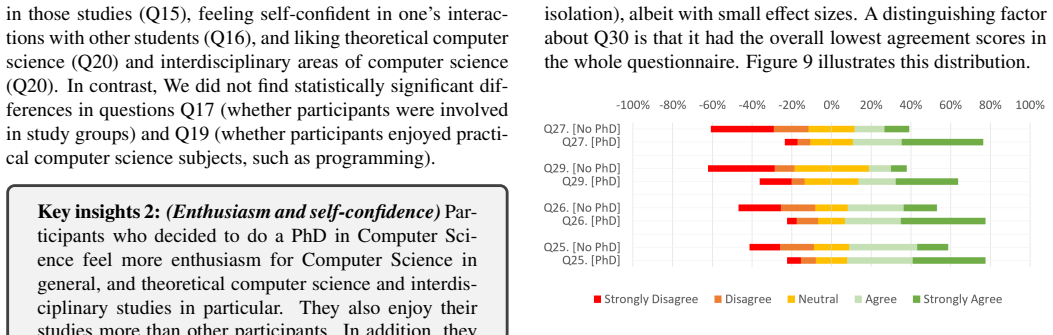
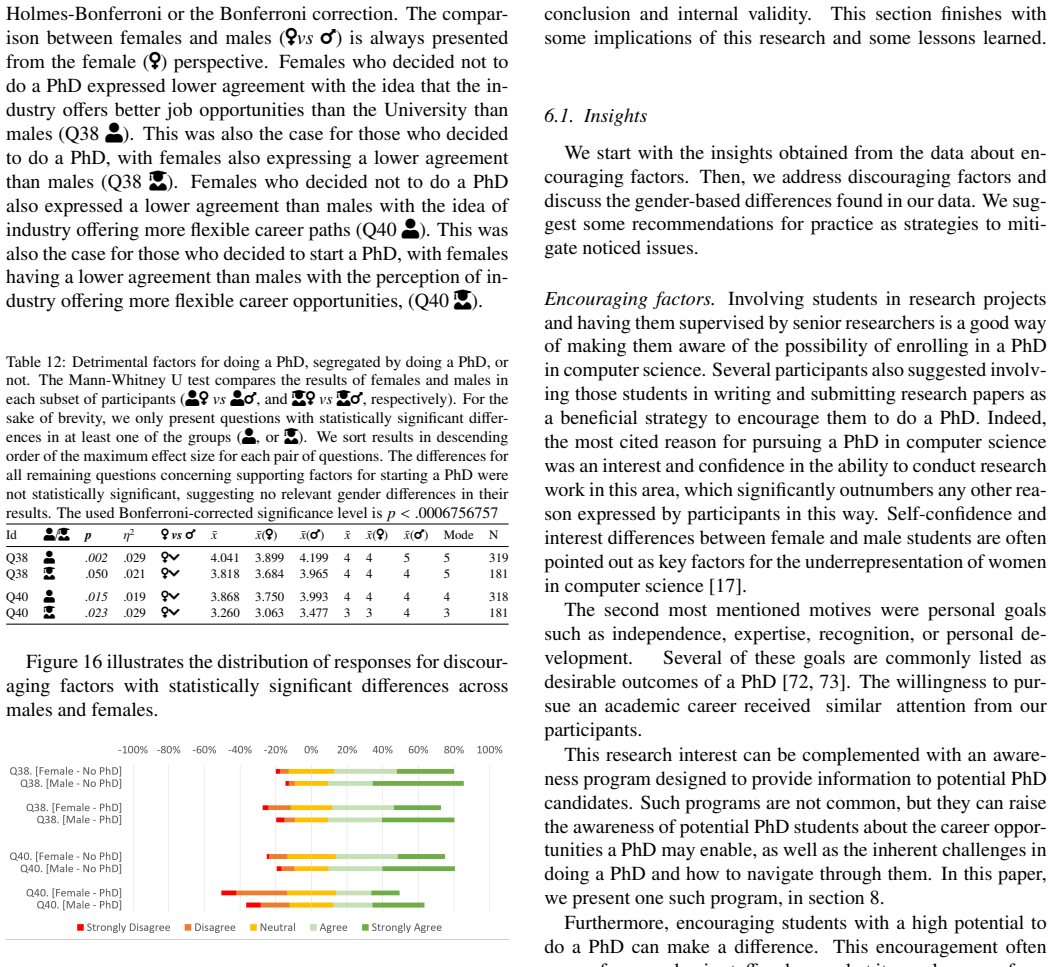
The paper's central claim is that the master's-to-PhD decision in computer science is shaped by a handful of measurable factors, and that these factors differ systematically between women and men. Participants who had completed, were enrolled in, or planned a PhD differed significantly from those who had not on research involvement during earlier studies ($\chi^2(1) = 68.68$, $p < .001$, medium effect size), on having been supervised by a senior researcher, on having been encouraged to do a PhD (large effect), on awareness of PhD aims and requirements (medium effects), and on seeing a PhD as fitting their needs and improving their career (large effects). The strongest deterrents were uncertainty about the PhD process (medium effect), the perception of lower job flexibility, and reservations about long-term commitment (small effects). On gender, women who pursued a PhD scored lower than men on self-perceived programming skills (medium effect) but higher on liking interdisciplinary areas (medium effect), and women in both the PhD and no-PhD groups were less likely than men to agree that industry offers better job opportunities or more flexible career paths than academia (small effects). The authors are explicit that the statistical tests demonstrate association, not causation.
Load-bearing premise
The analysis treats 'plans to do a PhD' the same as being enrolled in or having completed one; if stated intentions are a weak proxy for actually enrolling, the identified factors describe PhD aspirants rather than the real master's-to-PhD transition the paper aims to improve.
Editorial extensions
If this is right
- Involving bachelor's and master's students in real research projects under senior supervision is the strongest measurable predictor of later PhD pursuit, making research exposure a concrete recruitment lever for departments.
- Students who skip a PhD most often report not knowing what the PhD process involves, so information programs that explain aims, requirements, applications, and daily life could attract capable candidates and reduce enrolment made by mistake.
- Because women who pursue a PhD are less confident in their technical skills than men despite comparable outcomes, countering impostor syndrome with evidence of female success rates is a direct, testable intervention.
- The higher female preference for interdisciplinary computer science suggests that offering multidisciplinary PhD topics could widen the pipeline without displacing traditional ones.
- The 'Women Career Lunch' format, eight one-hour lunchtime discussions with female PhD-holding guests from academia and industry, documented in eight languages, gives departments a low-cost way to put the findings into practice.
Reading between the lines
- A longitudinal follow-up that tracks whether respondents' stated PhD intentions convert into actual enrolment would test whether these factors predict behaviour or only aspiration; the paper itself calls for such monitoring.
- Most significant differences carry small effect sizes, which implies single-factor fixes will move enrolment little; the data point to combining research exposure, encouragement, and information as the realistic lever.
- The gender gap in seeing industry as offering better jobs looks like a perception gap that hard salary data for PhD-holders could correct, a testable extension of the discussion's own suggestion.
- With Serbia, Germany, and Denmark contributing most responses, the gender findings are best read as European patterns until replicated in regions the paper notes have different participation dynamics.
Editorial analysis
A structured set of objections, weighed in public.
Referee Report
Summary. This manuscript reports a survey-based study of factors associated with computer science students' decisions to pursue a PhD, with a focus on gender differences. The authors collected 587 valid responses, compared a 'PhD' group (respondents who have, are currently doing, or plan to do a PhD) with a 'No PhD' group, and used chi-square and Mann-Whitney U tests with Bonferroni and Holm-Bonferroni corrections and effect sizes. They also performed thematic analysis of two open-ended questions. The paper derives a catalogue of questions and a 'Women Career Lunch' intervention program, available in eight languages. The central claims are that research involvement, encouragement from academic staff, awareness of PhD requirements, and self-confidence are associated with choosing a PhD, while uncertainty, perceived lower job flexibility, and long-term commitment are deterrents, with additional gender differences in technical confidence and preferences for interdisciplinary work.
Significance. If the results hold, the paper offers useful, actionable evidence for an important transition point in the computer science pipeline, and the intervention materials are a practical contribution. The manuscript has notable strengths: a large multi-country sample (within the limits of convenience sampling), an appropriate non-parametric statistical toolkit with multiple-comparison corrections, effect sizes reported throughout, a replication package with the anonymous dataset on Zenodo, and a candid limitations section. The central inference, however, depends on how the 'PhD' group is defined, and the current definition threatens the interpretation of some headline predictors. This is fixable with re-analysis rather than new data collection, which is why I recommend major revision rather than rejection.
major comments (3)
- [Section 4.3 and Table 3] The 'PhD' group is defined in Section 4.3 as respondents who have a PhD, are currently enrolled in a PhD, or plan to do a PhD, with no restriction of items Q10/Q11 to the pre-PhD period. A currently enrolled doctoral student will almost automatically answer 'yes' to 'Are/Have you been involved in research projects during your studies?' and to 'Are/Have you been personally supervised by a research leader?', so the large effects for Q10 and Q11 (phi_c = .346 and .303) may partly reflect reverse causation rather than factors that encourage the transition from master's to PhD. Please re-run the analyses excluding currently enrolled PhD students (and ideally separating completers from planners), and report whether the associations for Q10/Q11 and the derived Key Insight 1 remain significant.
- [Section 4.3 and Section 5.3] Because 'plans to do a PhD' is included in the 'PhD' group, the comparisons in Tables 3-7 partly contrast intending respondents with non-intending respondents. The abstract and conclusions speak of 'those who undertook PhD studies' and of factors that 'encourage enrolment', but the data as currently analysed cannot distinguish actual transition from stated aspiration. Please disaggregate the three subgroups (completed, currently enrolled, planning) and present their sizes; if sample sizes permit, treat planned enrolment as a separate outcome. This is load-bearing for the paper's practical conclusions about the master's-to-PhD transition.
- [Conclusions and Key Insights (e.g., Key Insights 1, 3, 4; Section 9)] The manuscript repeatedly labels the significant predictors as 'encouraging factors' for enrolling in a PhD, while Section 6.2.6 correctly states that the statistical tests show correlations but not precedence. Given that the group definition conflates plans with actual enrolment, the causal-sounding summary statements outrun the design. Please either temper the wording throughout the abstract, key insights, and conclusions, or provide an explicit argument for why the temporal ordering is credible for each factor (e.g., for Q27, retrospective reporting may be influenced by current PhD status).
minor comments (6)
- [Section 5.3(ii), Key Insights 2] The sentence 'liking theoretical computer science (Q20) and interdisciplinary areas of computer science (Q20)' should refer to Q18 for theoretical computer science and Q20 for interdisciplinary areas.
- [Section 5.3(vi)] The sentence starting 'Similarly, 71% of the respondents mentioned the theme...' is garbled; it appears that the percentages refer to the share of female/other-gender respondents within each theme, but the current wording does not say that.
- [Section 5.5] The in-text references to 'Table 5.5' should be to Table 11 and Table 12; the same issue appears in the gender-differences-in-detrimental-factors subsection.
- [Table 11, row Q54] The columns for the No-PhD and PhD subgroups appear to be interchanged in the Q54 row (the p-value .526 is shown with a female chevron symbol in the '/user' column); please check the data alignment.
- [Table 12 caption] The phrase 'The differences for all remaining questions concerning supporting factors...' should read 'detrimental factors', since the table reports factors against pursuing a PhD.
- [Section 6.2.6] The claim that participants were asked to answer from their perceptions 'when they were deciding whether to start (or not) a PhD' is not evident from the instrument shown in Table 2; either add the retrospective instruction to the survey description or temper the claim.
Circularity Check
No circularity: the survey-based associations are computed from the same dataset with no fitted-parameter prediction loop, and the PhD-group definition issue is a construct-validity concern rather than a derivation that reduces to its own inputs.
full rationale
The paper's central claim is that a survey identified statistically significant associations between career factors and the decision to pursue a PhD, plus gender differences. There is no derivation chain in which a fitted parameter is later renamed as a prediction: the survey data are used to compute chi-square and Mann-Whitney tests, and the WoCa Lunch program is designed from those results but its effectiveness is not used as evidence for the survey claims. The most plausible concern is that Section 4.3 defines the 'PhD' group as including current doctoral students ('has a PhD, is in the process of studying for a PhD, or plans to do a PhD'), while Q10 and Q11 ask about research involvement and senior supervision without restricting the reference period to pre-PhD studies. This could inflate the association between current PhD enrolment and answers of 'yes' to Q10/Q11. However, this is a reverse-causation and measurement-validity threat, not a circular derivation: the paper does not define research involvement in terms of PhD-group membership, and it does not use the WoCa program outcome to 'predict' the survey findings. The paper also acknowledges in Section 6.2.3 that many respondents have already completed or are currently enrolled in a PhD, and it frames all results as correlational rather than causal. Self-citations (e.g., EUGAIN/WIRE context, prior work by some authors) are contextual and not load-bearing for the statistical analysis. Therefore, under the strict definition of circularity used here, no step reduces by construction or by self-citation to its own inputs, and the appropriate score is 0.
Assumptions & free parameters
assumptions (5)
- domain assumption Self-reported perceptions (e.g., of programming skills, encouragement, awareness) are valid measures of the factors influencing PhD decisions.
- domain assumption The combined 'PhD' category (completed, ongoing, or planned PhD) is a meaningful proxy for the decision to pursue doctoral studies.
- domain assumption The convenience and snowball sample, despite country overrepresentation and female oversampling, supports generalizations to the European CS master's population.
- domain assumption Thematic coding of open-ended answers is reliable despite a single primary coder and 10% second-checking.
- standard math Non-parametric statistical procedures (chi-square, Mann-Whitney U) and their assumptions are appropriate for this ordinal and nominal data.
Cite this review
Pith. "Pith review of Why do women pursue a PhD in Computer Science?." pith.science (2026). https://pith.science/paper/HG73SBCZ
@misc{pith2026250722161,
  author       = {Pith},
  title        = {Pith review of: Why do women pursue a PhD in Computer Science?},
  year         = {2026},
  howpublished = {\url{https://pith.science/paper/HG73SBCZ}},
  note         = {Machine review of arXiv:2507.22161}
}
read the original abstract
Computer science attracts few women, and their proportion decreases through advancing career stages. Few women progress to PhD studies in CS after completing master's studies. Empowering women at this stage in their careers is essential to unlock untapped potential for society, industry and academia. This paper identifies students' career assumptions and information related to PhD studies focused on gender-based differences. We propose a Women Career Lunch program to inform female master students about PhD studies that explains the process, clarifies misconceptions, and alleviates concerns. An extensive survey was conducted to identify factors that encourage and discourage students from undertaking PhD studies. We identified statistically significant differences between those who undertook PhD studies and those who didn't, as well as gender differences. A catalogue of questions to initiate discussions with potential PhD students which allowed them to explore these factors was developed and translated to 8 languages. Encouraging factors toward PhD study include interest and confidence in research arising from a research involvement during earlier studies; enthusiasm for and self-confidence in CS in addition to an interest in an academic career; encouragement from external sources; and a positive perception towards PhD studies which can involve achieving personal goals. Discouraging factors include uncertainty and lack of knowledge of the PhD process, a perception of lower job flexibility, and the requirement for long-term commitment. Gender differences highlighted that female students who pursue a PhD have less confidence in their technical skills than males but a higher preference for interdisciplinary areas. Female students are less inclined than males to perceive the industry as offering better job opportunities and more flexible career paths than academia.
Figures


Figures from the paper (13 more)




Reference graph
Works this paper leans on
-
[1]
Di Nitto, I
E. Di Nitto, I. Garc ´ıa-Varea, M. Jazayeri, D. A. Tamburri, S. Tikho- nenko, Informatics Higher Education in Europe: A Data Portal and Case Study, Communications of the ACM 66 (2023) 61–67. doi:10.1145/ 3591107
2023
-
[2]
C. Hill, C. Corbett, A. St. Rose, Why so few? - aauw (Feb 2010). URL https://www.aauw.org/app/uploads/2020/03/ why-so-few-research.pdf
2010
-
[3]
C. Funk, K. Parker, Women and men in stem often at odds over workplace equity (Aug 2020). URL https://www.pewresearch.org/social-trends/2018/01/ 09/women-and-men-in-stem-often-at-odds-over-workplace-equity/
2020
-
[4]
Corbett, C
C. Corbett, C. Hill, Solving the equation - aauw (Mar 2015). URL https://www.aauw.org/app/uploads/2020/03/ Solving-the-Equation-report-nsa.pdf
2015
-
[5]
S. Corallo, M. Mazkatli, M. Rapp, H. Hajiabadi, A. Kaplan, R. Kuehn, L. Schmid, S. Singh, Toward awareness creation of common challenges women are facing in academia: A study from a german perspective, in: 27 P. Scandurra, M. Galster, R. Mirandola, D. Weyns (Eds.), Software Ar- chitecture, Springer International Publishing, Cham, 2022, pp. 47–62. doi:10.1...
-
[6]
B. F. Andr ´e, Gender balance in computer science: How do women view the transition into a phd?, Master’s thesis, Universidade Nova de Lis- boa, Lisbon, Portugal, available at https://run.unl.pt/bitstream/ 10362/155510/1/Andre_2022.pdf (June 2022)
2022
-
[7]
N. Rowe, The Realities of Completing a PhD: How to Plan for Success, Routledge Research in Education, Taylor & Francis, 2021. URL https://books.google.pt/books?id=Id0NEAAAQBAJ
work page 2021
-
[8]
S. Wagner, D. Mendez, M. Felderer, D. Graziotin, M. Kalinowski, Chal- lenges in survey research, Contemporary Empirical Methods in Software Engineering (2020) 93–125doi:10.1007/978-3-030-32489-6_4
Show all 85 references
-
[9]
Cronin, A
C. Cronin, A. Roger, Theorizing progress: Women in science, en- gineering, and technology in higher education, Journal of Research in Science Teaching 36 (1999) 637 – 661. doi:10.1002/(SICI) 1098-2736(199908)36:6<637::AID-TEA4>3.0.CO;2-9
1999 doi
-
[10]
Miliszewska, G
I. Miliszewska, G. Barker, F. Henderson, E. Sztendur, The issue of gender equity in computer science – what students say, Journal of Information Technology Education: Research 5 (1) (2006) 107–120. URL https://www.learntechlib.org/p/111535
2006
-
[11]
Vitores, A
A. Vitores, A. Gil-Ju ´arez, The trouble with ‘women in computing’: a critical examination of the deployment of research on the gender gap in computer science, Journal of Gender Studies 25 (6) (2016) 666–680. doi:10.1080/09589236.2015.1087309
2016
-
[12]
L. Soe, E. K. Yakura, What’s wrong with the pipeline? Assumptions about gender and culture in IT work, Women’s Studies 37 (3) (2008) 176–
2008
-
[13]
Bizot, S
B. Bizot, S. Zweben, 2020 taulbee survey (2020). URL https://cra.org/wp-content/uploads/2021/05/ 2020-CRA-Taulbee-Survey.pdf
2020
-
[14]
Varma, Computing self-e fficacy among women in india, Journal of Women and Minorities in Science and Engineering 16 (3) (2010) 257–
R. Varma, Computing self-e fficacy among women in india, Journal of Women and Minorities in Science and Engineering 16 (3) (2010) 257–
2010
-
[15]
V . A. Lagesen, A cyberfeminist utopia?: Perceptions of gender and com- puter science among malaysian women computer science students and faculty, Science, Technology, & Human Values 33 (1) (2008) 5–27. doi:10.1177/0162243907306192
2008 doi
-
[16]
Yates, A
J. Yates, A. C. Plagnol, Female computer science students: A qualitative exploration of women’s experiences studying computer science at uni- versity in the uk, Education and Information Technologies 27 (3) (2022) 3079–3105. doi:10.1007/s10639-021-10743-5
2022 doi
-
[17]
S. Beyer, Why are women underrepresented in computer science? gender differences in stereotypes, self-e fficacy, values, and interests and predic- tors of future cs course-taking and grades, Computer Science Education 24 (2-3) (2014) 153–192. doi:10.1080/08993408.2014.963363
2014
-
[18]
Beyer, K
S. Beyer, K. Rynes, J. Perrault, K. Hay, S. Haller, Gender di fferences in computer science students, in: Proceedings of the 34th SIGCSE technical symposium on Computer science education, 2003, pp. 49–53. doi:10. 1145/611892.611930
2003
-
[19]
Pantic, Retention of women in computer science: Why women persist in their computer science majors, Ph.D
K. Pantic, Retention of women in computer science: Why women persist in their computer science majors, Ph.D. thesis, Utah State University (2020). URL https://www.proquest.com/dissertations-theses/ retention-women-computer-science-why-persist/docview/ 2454679255/se-2?accountid=10673
2020
-
[20]
Pantic, J
K. Pantic, J. Clarke-Midura, Factors that influence retention of women in the computer science major: A systematic literature review, Journal of Women and Minorities in Science and Engineering 25 (2) (2019). doi: 10.1615/JWomenMinorScienEng.2019024384
2019 doi
-
[21]
Genut, B
S. Genut, B. Ori, Y . B.-D. Kolikant, Factors influencing women’s deci- sion to study computer science: Is it context dependent?, Issues in In- forming Science and Information Technology 16 (2019) 127–141. doi: 10.28945/4296
2019 doi
-
[22]
Beaubouef, J
T. Beaubouef, J. Mason, Why the high attrition rate for computer science students: some thoughts and observations, ACM SIGCSE Bulletin 37 (2) (2005) 103–106
2005
-
[23]
I. O. Pappas, M. N. Giannakos, L. Jaccheri, Investigating factors influ- encing students’ intention to dropout computer science studies, in: Pro- ceedings of the 2016 ACM Conference on Innovation and Technology in Computer Science Education, 2016, pp. 198–203
2016
-
[24]
E. S. Roberts, M. Kassianidou, L. Irani, Encouraging women in computer science, ACM SIGCSE Bulletin 34 (2) (2002) 84–88
2002
-
[25]
Cohoon, Must there be so few? including women in cs, in: 25th Inter- national Conference on Software Engineering, 2003
J. Cohoon, Must there be so few? including women in cs, in: 25th Inter- national Conference on Software Engineering, 2003. Proceedings., IEEE, 2003, pp. 668–674
2003
-
[26]
V . A. Lagesen, The strength of numbers: Strategies to include women into computer science, Social Studies of Science 37 (1) (2007) 67–92
2007
-
[27]
Alfermann, C
D. Alfermann, C. Holl, S. Reimann, ” should i stay or should i go?” in- dicators of dropout thoughts of doctoral students in computer science., International Journal of Higher Education 10 (3) (2021) 246–258
2021
-
[28]
Wollast, C
R. Wollast, C. Aelenei, J. Cheval `ere, N. Van der Linden, B. Galand, A. Azzi, M. Frenay, O. Klein, Facing the dropout crisis among phd candi- dates: the role of supervisor support in emotional well-being and intended doctoral persistence among men and women, Studies in Higher...
2023
-
[29]
Diogo, A
S. Diogo, A. Gonc ¸alves, S. Cardoso, T. Carvalho, Tales of doctoral stu- dents: Motivations and expectations on the route to the unknown, Educa- tion Sciences 12 (4) (2022) 286
2022
-
[30]
London, M
J. London, M. F. Cox, B. Ahn, S. Branch, T. Zephirin, A. Torres-Ayala, J. Zhu, Motivations for pursuing an engineering phd and perceptions of its added value: A us-based study, International Journal of Doctoral Studies 9 (2014) 205
2014
-
[31]
Tarvid, Motivation to study for phd degree: Case of latvia, Procedia Economics and Finance 14 (2014) 585–594
A. Tarvid, Motivation to study for phd degree: Case of latvia, Procedia Economics and Finance 14 (2014) 585–594
2014
-
[32]
M. d. C. C. Moreno, S. Kollanus, On the motivations to enroll in doctoral studies in computer science—a comparison of phd program models, in: 2013 12th International Conference on Information Technology Based Higher Education and Training (ITHET), IEEE, 2013, pp. 1–8
2013
-
[33]
Motogna, L
S. Motogna, L. Alboaie, I. A. Todericiu, C. Zaharia, Retaining women in computer science: the good, the bad and the ugly sides, in: Proceedings of the Third Workshop on Gender Equality, Diversity, and Inclusion in Software Engineering, 2022, pp. 35–42
2022
-
[34]
R. M. Ryan, E. L. Deci, Self-determination theory and the facilitation of intrinsic motivation, social development, and well-being., American psychologist 55 (1) (2000) 68
2000
-
[35]
R. M. Ryan, E. L. Deci, Intrinsic and extrinsic motivations: Classic defi- nitions and new directions, Contemporary educational psychology 25 (1) (2000) 54–67
2000
-
[36]
C. M. McCallum, Understanding the relationships and experiences that contribute to african americans’ decision to enrol in doctoral education, Ph.D. thesis, University of Michigan (2012)
2012
-
[37]
A. L. Mullen, K. A. Goyette, J. A. Soares, Who goes to graduate school? social and academic correlates of educational continuation after college, Sociology of education (2003) 143–169doi:10.2307/3090274
2003 doi
-
[38]
Denisco, The state of women in computer science: An investigative report, Tech Republic (2017)
A. Denisco, The state of women in computer science: An investigative report, Tech Republic (2017)
2017
-
[39]
Moskal, Female computer science doctorates: what does the survey of earned doctorates reveal?, ACM SIGCSE Bulletin 34 (2) (2002) 105–111
B. Moskal, Female computer science doctorates: what does the survey of earned doctorates reveal?, ACM SIGCSE Bulletin 34 (2) (2002) 105–111. doi:10.1145/543812.543841
2002
-
[40]
S. M. Hyrynsalmi, The underrepresentation of women in the software in- dustry: Thoughts from career-changing women, 2019 IEEE/ACM 2nd In- ternational Workshop on Gender Equality in Software Engineering (GE) (2019) 1–4doi:10.1109/GE.2019.00008
2019
-
[41]
Happe, B
L. Happe, B. Buhnova, Frustrations steering women away from software engineering, IEEE Software 39 (4) (2021) 63–69
2021
-
[42]
Adamecz-V ¨olgyi, J
A. Adamecz-V ¨olgyi, J. Jerrim, J.-B. Pingault, D. Shure, Overconfident boys: The gender gap in mathematics self-assessment, IZA Discussion Paper (2023). doi:10.2139/ssrn.4464593
2023 doi
-
[43]
Y . Wang, D. Redmiles, Implicit gender biases in professional software development: An empirical study, 2019 IEEE /ACM 41st International Conference on Software Engineering: Software Engineering in Society (ICSE-SEIS) (2019) 1–10doi:10.1109/ICSE-SEIS.2019.00009
2019
-
[44]
Stross, What has driven women out of computer science, New York Times 15 (2008)
R. Stross, What has driven women out of computer science, New York Times 15 (2008). URL https://www.nytimes.com/2008/11/16/business/ 16digi.html
2008
-
[45]
J. M. Cohoon, Z. Wu, J. Chao, Sexism: toxic to women’s persistence in cse doctoral programs, acm sigcse Bulletin 41 (1) (2009) 158–162. doi:10.1145/1539024.1508924
2009
-
[46]
Lockett, Supporting women in phd programs: Scholarships and resources to optimize success, https://www.phds.me/ 28 financial-aid/scholarships-and-grants/women/ (30.03.2023)
V . Lockett, Supporting women in phd programs: Scholarships and resources to optimize success, https://www.phds.me/ 28 financial-aid/scholarships-and-grants/women/ (30.03.2023)
2023
-
[47]
Europe, Best practices in supporting women (2023) [cited 10.10.2023]
I. Europe, Best practices in supporting women (2023) [cited 10.10.2023]. URL https://www.informatics-europe.org/ society/minerva-informatics-equality-award/ best-practices-in-supporting-women.html
2023
-
[48]
Grad cohort workshop for women, https://cra.org/cra-wp/ grad-cohort-for-women , 10.10.2023 (2023)
2023
-
[49]
C. S. at Brown University, Helping students from under- represented groups apply to cs phd programs, https: //cs.brown.edu/degrees/doctoral/applications/ helpful-resources-applying-computer-science-phd-programs/ (2023)
2023
-
[50]
computerscience.org, Celebrating the success of women phd students in computer science, https://www.computerscience.org/degrees/ phd/online/information-technology/ (2023)
2023
-
[51]
Munoz-Hernandez, I
S. Munoz-Hernandez, I. Osman, Using a productive distance phd program to empower women in academia, in: 2016 IST-Africa Week Conference, IEEE, 2016, pp. 1–7. doi:10.1109/ISTAFRICA.2016.7530698
2016
-
[52]
Rubegni, B
E. Rubegni, B. Penzenstadler, M. Landoni, L. Jaccheri, G. Dodig- Crnkovic, Owning your career paths: Storytelling to engage women in computer science, in: Gender in AI and Robotics: The Gender Chal- lenges from an Interdisciplinary Perspective, Springer, 2023, pp. 1–25. doi:10...
2023 doi
-
[53]
Jaccheri, C
L. Jaccheri, C. Pereira, S. Fast, Gender issues in computer science: lessons learnt and reflections for the future, in: 2020 22nd International Symposium on Symbolic and Numeric Algorithms for Scientific Comput- ing (SYNASC), IEEE, 2020, pp. 9–16. doi:10.1109/SYNASC51798. 2020.00014
2020
-
[54]
Lindner, Barriers to doctoral education, equality, diversity and inclu- sion for postgraduate research students at ucl, https://www.grad
R. Lindner, Barriers to doctoral education, equality, diversity and inclu- sion for postgraduate research students at ucl, https://www.grad. ucl.ac.uk/strategy/barriers-to-doctoral-education.pdf (2020)
2020
-
[55]
Horta, M
H. Horta, M. Cattaneo, M. Meoli, Phd funding as a determinant of phd and career research performance, Studies in Higher Education 43 (3) (2018) 542–570. doi:10.1080/03075079.2016.1185406
2018
-
[56]
A. J. Fisher, R. Mendoza-Denton, C. Patt, I. Young, A. Eppig, R. L. Gar- rell, D. C. Rees, T. W. Nelson, M. A. Richards, Structure and belonging: Pathways to success for underrepresented minority and women phd stu- dents in stem fields, PloS one 14 (1) (2019) e0209279
2019
-
[57]
S. B. U. Department of Computer Science, Celebrat- ing the success of women phd students in computer sci- ence, https://www.cs.stonybrook.edu/about-us/News/ Celebrating-Success-Women-PhD-Students-Computer-Science (2023)
2023
-
[58]
C. S. Stanford Engineering, Incoming cs phd students, https: //www.cs.stanford.edu/student-services-overview/ new-student-orientation/incoming-cs-phd-students (2023)
2023
-
[59]
N. U. of Science, Technology, Gender equality and diversity at ntnu, https://www.ntnu.edu/genderequality (2023)
2023
-
[60]
G. E. O. Koc University, Teaching, https://geo.ku.edu.tr/ teaching/ (2023)
2023
-
[61]
E. N. F. G. B. in Informatics, 1st international eugain summer train- ing school (eugain-sts 2022), https://sites.google.com/view/ eugain-training-schools/eugain-sts-2022 (2022)
2022
-
[62]
E. N. F. G. B. in Informatics, 2nd international eugain summer training school: Research recharge (june 14-15, 2023 – rome, italy), https:// eugain.training/ (2023)
2023
-
[63]
L. L. de Aguiar Gomes, J. R. H. Carvalho, T. Lauschner, F. G. Nakamura, R. de Freitas, Encouraging women to pursue a computer science career in the context of a third world country, in: 2018 IEEE Frontiers in Education Conference (FIE), IEEE, 2018, pp. 1–5
2018
-
[64]
Yamane, Statistics: An introductory analysis, Harper & Row New York, 1973
T. Yamane, Statistics: An introductory analysis, Harper & Row New York, 1973
1973
-
[65]
rep., QBIT Labs (2023)
QBIT, How many programmers are there in the world and in the us? [2023], Tech. rep., QBIT Labs (2023). URL https://qubit-labs.com/how-many-programmers-in-the-world/
2023
-
[66]
Bonferroni, Teoria statistica delle classi e calcolo delle probabilita, Pubblicazioni del R Istituto Superiore di Scienze Economiche e Com- mericiali di Firenze 8 (1936) 3–62
C. Bonferroni, Teoria statistica delle classi e calcolo delle probabilita, Pubblicazioni del R Istituto Superiore di Scienze Economiche e Com- mericiali di Firenze 8 (1936) 3–62
1936
-
[67]
T. V . Perneger, What’s wrong with bonferroni adjustments, BMJ 316 (7139) (1998) 1236–1238. doi:10.1136/bmj.316.7139.1236
1998
-
[68]
Holm, A simple sequentially rejective multiple test procedure, Scan- dinavian journal of statistics (1979) 65–70 https://www.jstor.org/ stable/4615733
S. Holm, A simple sequentially rejective multiple test procedure, Scan- dinavian journal of statistics (1979) 65–70 https://www.jstor.org/ stable/4615733
1979
-
[69]
Cram ´er, Mathematical Methods of Statistics, Princeton University Press, 1946
H. Cram ´er, Mathematical Methods of Statistics, Princeton University Press, 1946
1946
-
[70]
Braun, V
V . Braun, V . Clarke, Using thematic analysis in psychology, Quali- tative research in psychology 3 (2) (2006) 77–101. doi:10.1191/ 1478088706qp063oa
2006
-
[71]
Cunningham, M
M. Cunningham, M. Wells, Qualitative analysis of 6961 free-text comments from the first National Cancer Patient Experience Sur- vey in Scotland, BMJ open 7 (6) (2017) e015726. doi:10.1136/ bmjopen-2016-015726
2017
-
[72]
Lovitts, Being a good course-taker is not enough: a theoretical perspec- tive on the transition to independent research, Studies in Higher Education 30 (2005) 137–154
B. Lovitts, Being a good course-taker is not enough: a theoretical perspec- tive on the transition to independent research, Studies in Higher Education 30 (2005) 137–154. doi:10.1080/03075070500043093
2005 doi
-
[73]
C. J. Waaijer, Perceived career prospects and their influence on the sector of employment of recent phd graduates, Science and Public Policy 44 (1) (2017) 1–12. doi:10.1093/scipol/scw007
2017 doi
-
[74]
Steele, Salary outlook with phd in computer science (2023) [cited 2023/10/30]
H. Steele, Salary outlook with phd in computer science (2023) [cited 2023/10/30]. URL https://www.businessstudent.com/careers/ salary-outlook-phd-computer-science/
2023
-
[75]
D. M. Bravata, S. A. Watts, A. L. Keefer, D. K. Madhusudhan, K. T. Taylor, D. M. Clark, R. S. Nelson, K. O. Cokley, H. K. Hagg, Prevalence, Predictors, and Treatment of Impostor Syndrome: a Systematic Review, Journal of General Internal Medicine 35 (4) (2020) 1252–1275. doi: 1...
2020 doi
-
[76]
Alvarado, Z
C. Alvarado, Z. Dodds, R. Libeskind-Hadas, Increasing women’s partic- ipation in computing at harvey mudd college, acm Inroads 3 (4) (2012) 55–64. doi:10.1145/2381083.2381100
2012
-
[77]
Webber, H
L. Webber, H. Dismore, Mothers and higher education: Balancing time, study and space, Journal of Further and Higher Education 45 (6) (2021) 803–817. doi:10.1080/0309877X.2020.1820458
2021
-
[78]
B. Amir, P. Ralph, There is no random sampling in software engineering research, in: Proceedings of the 40th international conference on soft- ware engineering: companion proceeedings, 2018, pp. 344–345. doi: 10.1145/3183440.3195001
2018
-
[79]
Baltes, P
S. Baltes, P. Ralph, Sampling in software engineering research: A critical review and guidelines, Empirical Software Engineering 27 (4) (2022) 94. doi:10.1007/s10664-021-10072-8
2022 doi
-
[80]
Abraham, M
E. Abraham, M. Goul ˜ao, M. Vujo ˇsevi´c Jani ˇci´c, S. J. Delany, A. Mer- sni, O. Yeremenko, L. Schmid, A. Nebot, O. Buyukdagli, K. Boudaoud, D. Sunar Cerci, Women’s Career Lunch — Catalog of questions for the speakers (Nov. 2023). doi:10.5281/zenodo.10079419
2023 doi
-
[81]
Armstrong, A
J. Armstrong, A. Sullivan, A critical analysis of athena swan as a policy- scoring scheme, British Educational Research Journal (2024)
2024
-
[82]
Farrell, Z
L. Farrell, Z. W. Petzel, T. McCormack, R. N. Turner, K. Ra fferty, I. M. Latu, When you put it that way: Framing gender equality initiatives to improve engagement among stem academics, BioScience 71 (3) (2021) 292–304
2021
-
[83]
Abraham, M
E. Abraham, M. Goul ˜ao, M. Vujoˇsevi´c Janiˇci´c, S. J. Delany, A. Mersni, O. Yeremenko, L. Schmid, O. Buyukdagli, K. Boudaoud, C. Oehlhorn, U. Schmid, C. B ¨using, H. Bolke-Hermanns, M. P ´os-de Mina Pato, D. Sunar Cerci, L. Schmid, Why do women pursue a PhD in Computer Scie...
2025 doi
-
[201]
doi:10.1080/00497870801917028
-
[274]
doi:10.1615/JWomenMinorScienEng.v16.i3.40
Reviewed August 6, 2026 · model on record in the stance chip above.
Discussion (0). Continue with ORCID to comment.