REVIEW 4 major objections 6 minor 5 cited by
Viser: Imperative, Web-based 3D Visualization in Python
T0 review · 4 major / 6 minor · reviewed 2026-08-06 · deepseek-v4-flash
Pith's one-line read Viser claims that one Python library can cover both quick 3D debugging and specialized interactive tools by combining an imperative API with a web-based viewer, and backs the claim with a broad primitive set and a four-layer implementation.
desk verdict A genuinely useful, honestly written technical report for a widely adopted 3D visualization library; the lack of quantitative evaluation is real but minor for this genre. read the letter →
The pith
A machine-rendered reading of the paper's core claim, the machinery that carries it, and where it could break.
The reading
What carries the argument
The load-bearing mechanism is the imperative, side-effect-driven handle API: each scene.add_* or gui.add_* call returns a handle that owns the primitive's lifecycle, property state, and event callbacks. Assignment-style updates on handles immediately propagate through a transport layer that batches, deduplicates, and serializes messages via msgpack, with a client-side state mirror rendering in the browser. This design makes the Python program the single source of truth while hiding synchronization details.
What would settle it
A user study or benchmark implementing the same set of typical visualization tasks (streaming point clouds, plotting camera trajectories, building a control panel) in Viser, a declarative framework, and an immediate-mode library would test the ease-of-use claim directly: if the alternatives require less code or produce fewer errors on the majority of tasks, the central claim weakens. Separately, streaming a scene with millions of points over a real network and measuring frame rate and input latency would test whether the WebSocket transport actually delivers smooth real-time visualization at scale.
Extended reading notes
Core claim
Viser's claim is that a single library can bridge lightweight debugging tools and domain-specific packages by exposing a comprehensive set of primitives through an imperative API. Scene and GUI elements are created by single function calls, manipulated through handle attributes, and removed explicitly; property assignments synchronize automatically to a web client over a WebSocket transport with batching and deduplication. The result is that users keep control of program flow, as they would in a normal Python script, while still getting interactive 3D and 2D interfaces in a browser. The paper supports the claim by listing the primitive set, describing the four-layer architecture, and citing a wide range of published projects that use Viser in released code.
Load-bearing premise
The paper assumes an imperative, side-effect-driven API and a WebSocket-based web viewer deliver the claimed ease-of-use and flexibility, without a comparative user study or benchmark against declarative or immediate-mode alternatives.
Editorial extensions
If this is right
- Users can go from a Python script to an interactive browser scene with essentially no setup, including on headless servers and mobile clients.
- The same primitives and programming pattern cover both 3D scene content and 2D GUI controls, so custom interfaces can be composed from the same building blocks.
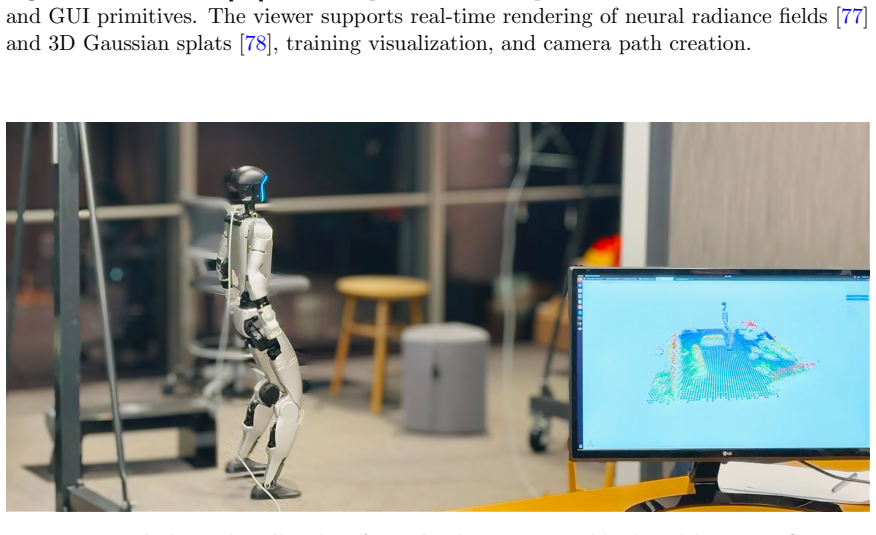
- Domain-specific tools, such as neural radiance field viewers and robot control panels, can be built on top of Viser rather than written from scratch.
- Because state mirrors are persisted and deduplicated, new clients can attach to an active session and see a consistent view; offline visualizations can be embedded in static web pages.
- The imperative model aligns with notebooks, step-through debuggers, and REPL workflows, where the program flow stays in user control.
Reading between the lines
- The paper does not run a controlled comparison, but a head-to-head study against a declarative UI framework would likely show that Viser's imperative style reduces boilerplate for stateful, multi-step interactions while trading away some automatic client-state management.
- The WebSocket-based transport, though simple and cross-platform, may become a bottleneck for scenes with millions of points or very high update rates; the batching and deduplication mitigations are described but not benchmarked in the paper.
- The same handle-based pattern could extend to other languages or to alternative transports (such as WebRTC data channels) if the Python-server model proves limiting in production robotics systems, since the core abstraction is not tied to a specific web stack.
Editorial analysis
A structured set of objections, weighed in public.
Referee Report
Summary. The paper introduces Viser, an open-source Python library for web-based 3D visualization targeting computer vision and robotics. Its central claims are that (1) a comprehensive set of 3D scene primitives and 2D GUI primitives can be used independently with minimal setup or composed into specialized interfaces; (2) an imperative, side-effect-driven API improves compatibility with interactive Python workflows compared with declarative frameworks; (3) a locally hosted web viewer accessed through WebSocket transport supports low-friction setup, sharing, and real-time bidirectional state synchronization. The technical report covers the feature set (Sections 2.1–2.3), API design rationale with a comparison against declarative frameworks such as Gradio (Section 3, Figure 7), the layered architecture (Core API, Handles, Transport, Client; Section 4, Figure 8), and a list of acknowledged limitations including WebSocket overhead, statefulness, Python-only bindings, single-process servers, missing temporal structure, and limited serialization support (Section 5). The claimed evidence base is the released code at viser.studio, the API documentation, and a list of published works that use Viser in released code.
Significance. If the library works as claimed, this is a useful contribution to the practical infrastructure of computer vision and robotics research: it fills a real niche between lightweight point-and-plot tools and domain-specific GUI-heavy front ends, it is already used by a broad set of published systems (Sections 1 and references [11,21,25–74]), and it is open source with reproducible installation and documentation. Strengths of the paper include the honest disclosure of six concrete limitations in Section 5, the explicit design comparison showing code-level differences with a declarative baseline (Figure 7), the description of the transport layer's batching/deduplication and latency-aware buffering (Section 4), and the demonstration of adoption as evidence of practicality. The central claim is an existence/usability claim about a shipped artifact, not a derived quantitative result, so the relevant standard is whether the feature set, API design, and documented limitations align with the claimed value proposition; on that standard the paper is convincing.
major comments (4)
- [Section 2.2 and Section 5] The claim in Section 2.2 that "Batched rendering and level-of-detail optimizations maintain performance for large scenes" and the related claim of "smooth visualization of dynamic data" are not quantitatively supported: no latency, throughput, frame-rate, or asset-size benchmarks are reported, and Section 5 concedes that WebSocket transfer introduces overhead. Since the central claim is about ease of use and composability rather than extreme scale, this is not a fatal flaw, but the performance wording should be softened or backed by at least one representative measurement (e.g., update rate for a scene with N primitives or a mesh of M vertices).
- [Section 3, Figure 7] The comparison with declarative APIs such as Gradio is presented only through a single small code example and asserts that imperative style "simplifies integration into complex programs." The manuscript does not define how integration complexity is measured, nor does it discuss scenarios where declarative APIs are preferable despite the acknowledged cost in Section 5 ("can also result in more duplicated or error-prone state management"). A brief discussion of the actual tradeoff, with at least one concrete example where the imperative model complicates rather than simplifies (e.g., multi-client state isolation), would make the design claim more balanced and falsifiable.
- [Section 4, Transport] The transport layer description mentions that commands are "buffered, batched, and deduplicated" and that "latency-aware buffering enables smooth framerates, even on unreliable network connections," but no details are given about the batching window, the deduplication granularity, or the latency-adaptation mechanism. Without such details, the performance architecture cannot be reproduced or independently assessed; adding precise parameters or pseudocode would strengthen the technical-report value of the paper.
- [Section 1 and Section 5] The adoption list in Section 1 is evidence of usefulness, but the reader cannot verify the claimed "published works that have used Viser—for example, in released code" because no explicit link or table maps each reference to the Viser usage. A table with reference numbers and the specific Viser feature used (e.g., "[21]: point tracks, scene primitives") would make the adoption evidence concrete and verifiable.
minor comments (6)
- [Abstract and Section 2.2] The phrase "comprehensive set of 3D scene and 2D GUI primitives" is repeated in the abstract and Section 2.2 without a precise catalog; listing the exact primitive types (e.g., point cloud, mesh, image, Gaussian splat, frame, frustum, grid, spline, line) in one place would improve clarity.
- [Section 2.1] The bullet "(1) Low setup effort: a web-based viewer makes Viser simple to install and run across platforms, including on headless servers and mobile clients" could be sharpened by stating whether the server can be accessed from a remote browser without additional tunneling; this is currently implicit.
- [Figure 5] The figure caption and code show an example from a multiview reconstruction pipeline [48], but the code block in (b) uses placeholder comments like "# Add other camera frustums, meshes"; replacing placeholders with at least one concrete additional call would make the example self-contained.
- [Section 5] The limitations list would benefit from a one-sentence summary of which of the listed limitations are inherent to the design (WebSocket, stateful API, single process) versus which are implementation choices that could be addressed in future work (serialization, timestamps, non-Python bindings).
- [References] Some references are cited informally (e.g., the MeshCat reference in [2] uses a GitHub URL with an "Accessed 21 May 2025" note while other references use formal venue information); standardizing citation format for software packages would improve consistency.
- [Throughout] There are minor formatting inconsistencies in the author list and email addresses (e.g., "Justin kerr@berkeley.edu" has no space before the email, and some author names are split across lines in the author block); these should be cleaned in the camera-ready version.
Circularity Check
No significant circularity: Viser is a software description whose claims are supported by code, examples, and disclosed limitations; no fitted parameter, prediction, or self-citation chain is load-bearing.
full rationale
Viser is a technical report describing a software artifact; it contains no fitted parameters, no predictive equations, and no derivation that reduces to its own inputs. The central claims, namely that the primitive set is comprehensive, that primitives compose, and that an imperative/web-based design fits modern Python workflows, are supported by code, documentation, screenshots, downstream examples, and explicit design reasoning. These are evaluative design claims rather than derivations. The Section 5 limitations (WebSocket overhead, stateful API, Python-only, single process, timestamps, serialization) are stated honestly and qualify, rather than conceal, the tradeoffs. Some references are self-citations to projects built with Viser, and Nerfstudio is cited as an example built by overlapping authors; however, these function as existence evidence of downstream adoption, not as an external theorem that forces the design choice. The API comparison with Gradio in Figure 7 is illustrative rather than an empirical benchmark, so no result is claimed to follow from the comparison. No circular step can be exhibited under the required standard of quoting an equation or fitted parameter that is equivalent by construction to the claimed output.
Assumptions & free parameters
assumptions (2)
- domain assumption WebSocket transfer of all assets and state updates is sufficient for real-time interactive visualization.
- ad hoc to paper Imperative, side-effect-driven API design improves integration flexibility and remains easy to use.
Cite this review
Pith. "Pith review of Viser: Imperative, Web-based 3D Visualization in Python." pith.science (2026). https://pith.science/paper/YE4UOKKX
@misc{pith2026250722885,
  author       = {Pith},
  title        = {Pith review of: Viser: Imperative, Web-based 3D Visualization in Python},
  year         = {2026},
  howpublished = {\url{https://pith.science/paper/YE4UOKKX}},
  note         = {Machine review of arXiv:2507.22885}
}
read the original abstract
We present Viser, a 3D visualization library for computer vision and robotics. Viser aims to bring easy and extensible 3D visualization to Python: we provide a comprehensive set of 3D scene and 2D GUI primitives, which can be used independently with minimal setup or composed to build specialized interfaces. This technical report describes Viser's features, interface, and implementation. Key design choices include an imperative-style API and a web-based viewer, which improve compatibility with modern programming patterns and workflows.
Figures
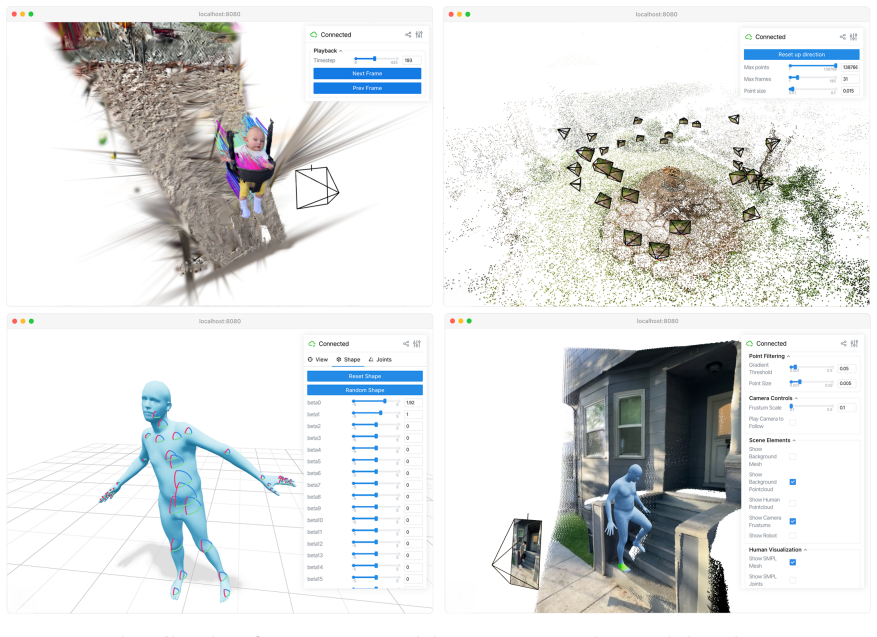


Figures from the paper (5 more)


Forward citations
Cited by 5 Pith papers
-
ARDY: Autoregressive Diffusion with Hybrid Representation for Interactive Human Motion Generation
An autoregressive diffusion model with a hybrid explicit-root/latent-body representation generates real-time, controllable 3D human motion from text and spatial constraints.
-
FARM: Find Anything using Relational Spatial Memory
FARM creates an open-vocabulary relational spatial memory that improves object retrieval recall by 164-224% over prior methods on 44k language queries across 67 scenes while running at 5-10 Hz.
-
SoRoMoX: Fast, Differentiable, and Parallelizable Soft Robot Models
A JAX framework that makes strain-based soft robot models differentiable, JIT-compiled, and GPU-batchable, with demonstration case studies in identification, control, and RL.
-
EVA-Client: A Unified Data Collection, Inference, and Deployment Framework for Embodied Policies on Real Robots
EVA-Client unifies robot backends, inference strategies, and transports so trained manipulation policies can be deployed, debugged, collected from, and evaluated on real hardware with training-ready logs.
-
SOMA: From Surface Observations to Muscle Anatomy
SOMA recovers spatio-temporal muscle behavior from multi-view RGB surface data and introduces the SKIM soft-tissue deformation dataset as the first such method from RGB observations.
Reference graph
Works this paper leans on
-
[21]
Shape of motion: 4d reconstruction from a single video, 2024
Qianqian Wang, Vickie Ye, Hang Gao, Jake Austin, Zhengqi Li, and Angjoo Kanazawa. Shape of motion: 4d reconstruction from a single video, 2024
work page 2024
-
[1]
Open3D: A modern library for 3D data processing
Qian-Yi Zhou, Jaesik Park, and Vladlen Koltun. Open3D: A modern library for 3D data processing. arXiv preprint arXiv:1801.09847 , 2018
arXiv 2018
-
[2]
MeshCat: Web-based 3-d visualization, 2021
Robin Deits, Jeremy Nimmer, Russ Tedrake, and the MeshCat Development Team. MeshCat: Web-based 3-d visualization, 2021. URL https://github.com/ meshcat-dev/meshcat. MIT License. Accessed 21 May 2025
2021
-
[3]
J. D. Hunter. Matplotlib: A 2d graphics environment. Computing in Science & Engi- neering, 9(3):90–95, 2007. doi: 10.1109/MCSE.2007.55
-
[4]
pyrender
Matthew Matl. pyrender. https://github.com/mmatl/pyrender, 2021. URL https: //github.com/mmatl/pyrender. Version 0.1.45
2021
-
[5]
Pangolin: A lightweight portable rapid development library for managing opengl display and interaction
Steven Lovegrove. Pangolin: A lightweight portable rapid development library for managing opengl display and interaction. https://github.com/stevenlovegrove/ Pangolin, 2013
2013
-
[6]
Foxglove studio, 2025
Foxglove Technologies Inc. Foxglove studio, 2025. URL https://foxglove.dev. A visualization and observability platform for robotics developers
2025
-
[7]
Isaac gym: High performance gpu-based physics simulation for robot learning
Viktor Makoviychuk, Lukasz Wawrzyniak, Yunrong Guo, Michelle Lu, Kier Storey, Miles Macklin, David Hoeller, Nikita Rudin, Arthur Allshire, Ankur Handa, and Gavriel State. Isaac gym: High performance gpu-based physics simulation for robot learning. arXiv preprint arXiv:2108.10470 , 2021
arXiv 2021
Show all 91 references
-
[8]
Ros: an open-source robot operating system
Morgan Quigley, Ken Conley, Brian Gerkey, Josh Faust, Tully Foote, Jeremy Leibs, Rob Wheeler, Andrew Y Ng, et al. Ros: an open-source robot operating system. In ICRA workshop on open source software , volume 3, page 5. Kobe, Japan, 2009
2009
-
[9]
Mujoco: A physics engine for model- based control
Emanuel Todorov, Tom Erez, and Yuval Tassa. Mujoco: A physics engine for model- based control. In Proc. IEEE/RSJ Int. Conf. on Intelligent Robots and Systems (IROS), pages 5026–5033. IEEE, 2012
2012
-
[10]
Nvidia isaac sim
NVIDIA Corporation. Nvidia isaac sim. https://developer.nvidia.com/ isaac-sim, 2024. Version 2024.1.0, accessed May 2025
2024
-
[11]
Nerfstudio: A modular framework for neural radi- ance field development
Matthew Tancik, Ethan Weber, Evonne Ng, Ruilong Li, Brent Yi, Justin Kerr, Ter- rance Wang, Alexander Kristoffersen, Jake Austin, Kamyar Salahi, Abhik Ahuja, David McAllister, and Angjoo Kanazawa. Nerfstudio: A modular framework for neural radi- ance field development. arXiv p...
2023 arXiv
-
[12]
Pybullet, a python module for physics simulation for games, robotics and machine learning
Erwin Coumans and Yunfei Bai. Pybullet, a python module for physics simulation for games, robotics and machine learning. http://pybullet.org, 2016–2023
2016
-
[13]
Anyteleop: A general vision-based dexterous robot arm-hand teleoperation system
Yuzhe Qin, Wei Yang, Binghao Huang, Karl Van Wyk, Hao Su, Xiaolong Wang, Yu-Wei Chao, and Dieter Fox. Anyteleop: A general vision-based dexterous robot arm-hand teleoperation system. In Robotics: Science and Systems , 2023. 11
2023
-
[14]
Rerun: A visualization sdk for multimodal data, 2025
Rerun Team. Rerun: A visualization sdk for multimodal data, 2025. URL https:// www.rerun.io. Available from https://www.rerun.io/ and https://github.com/rerun- io/rerun
2025
-
[15]
Gradio: Hassle-free sharing and testing of ml models in the wild
Abubakar Abid, Ali Abdalla, Ali Abid, Dawood Khan, Abdulrahman Alfozan, and James Zou. Gradio: Hassle-free sharing and testing of ml models in the wild. arXiv preprint arXiv:1906.02569, 2019
1906 arXiv
-
[16]
SIBR: A system for image-based rendering
Sebastien Bonopera, Peter Hedman, Jerome Esnault, Siddhant Prakash, Simon Ro- driguez, Theo Thonat, Mehdi Benadel, Gaurav Chaurasia, Julien Philip, and George Drettakis. SIBR: A system for image-based rendering. https://sibr.gitlabpages. inria.fr/, 2020. Accessed 2025-05-05
2020
-
[17]
Petrov, and Gerard Pons-Moll
Vladimir Guzov, Ilya A. Petrov, and Gerard Pons-Moll. Blendify – python rendering framework for blender. arXiv preprint arXiv:2410.17858 , 2024
2024 arXiv
-
[18]
Dear imgui: Bloat-free immediate mode graphical user interface for c++ with minimal dependencies
Omar Cornut. Dear imgui: Bloat-free immediate mode graphical user interface for c++ with minimal dependencies. https://github.com/ocornut/imgui, 2014
2014
-
[19]
Instant neural graphics primitives with a multiresolution hash encoding
Thomas M¨ uller, Alex Evans, Christoph Schied, and Alexander Keller. Instant neural graphics primitives with a multiresolution hash encoding. ACM Trans. Graph., 41(4): 102:1–102:15, July 2022. doi: 10.1145/3528223.3530127. URL https://arxiv.org/ abs/2201.05989
2022
-
[20]
Kaolin wisp: A pytorch li- brary and engine for neural fields research
Towaki Takikawa, Or Perel, Clement Fuji Tsang, Charles Loop, Joey Litalien, Jonathan Tremblay, Sanja Fidler, and Maria Shugrina. Kaolin wisp: A pytorch li- brary and engine for neural fields research. https://github.com/NVIDIAGameWorks/ kaolin-wisp, 2022
2022
-
[22]
Barron, Ben Mildenhall, Dor Verbin, Pratul P
Jonathan T. Barron, Ben Mildenhall, Dor Verbin, Pratul P. Srinivasan, and Peter Hedman. Mip-nerf 360: Unbounded anti-aliased neural radiance fields. Conference on Computer Vision and Pattern Recognition (CVPR) , 2022
2022
-
[23]
Sch¨ onberger and Jan-Michael Frahm
Johannes L. Sch¨ onberger and Jan-Michael Frahm. Structure-from-motion revisited. In Proceedings of the IEEE Conference on Computer Vision and Pattern Recognition (CVPR), pages 4104–4113, 2016
2016
-
[24]
Matthew Loper, Naureen Mahmood, Javier Romero, Gerard Pons-Moll, and Michael J. Black. Smpl: A skinned multi-person linear model. volume 34, pages 1–16. ACM, 2015
2015
-
[25]
Videomimic: Visual imitation enables contextual humanoid control, 2025
Arthur Allshire, Hongsuk Choi, Junyi Zhang, David McAllister, Anthony Zhang, Chung Min Kim, Trevor Darrell, Pieter Abbeel, Jitendra Malik, and Angjoo Kanazawa. Videomimic: Visual imitation enables contextual humanoid control, 2025
2025
-
[26]
Canonical factors for hybrid neural fields
Brent Yi, Weijia Zeng, Sam Buchanan, and Yi Ma. Canonical factors for hybrid neural fields. In ICCV, pages 3414–3426, 2023. 12
2023
-
[27]
Lighting every darkness with 3dgs: Fast training and real-time rendering for hdr view synthesis, 2024
Xin Jin, Pengyi Jiao, Zheng-Peng Duan, Xingchao Yang, Chun-Le Guo, Bo Ren, and Chongyi Li. Lighting every darkness with 3dgs: Fast training and real-time rendering for hdr view synthesis, 2024
2024
-
[28]
NerfBaselines: Consistent and reproducible eval- uation of novel view synthesis methods, 2024
Jonas Kulhanek and Torsten Sattler. NerfBaselines: Consistent and reproducible eval- uation of novel view synthesis methods, 2024
2024
-
[29]
Novel view extrapolation with video diffusion priors, 2024
Kunhao Liu, Ling Shao, and Shijian Lu. Novel view extrapolation with video diffusion priors, 2024
2024
-
[30]
Scube: Instant large-scale scene recon- struction using voxsplats, 2024
Xuanchi Ren, Yifan Lu, Hanxue Liang, Zhangjie Wu, Huan Ling, Mike Chen, Sanja Fidler, Francis Williams, and Jiahui Huang. Scube: Instant large-scale scene recon- struction using voxsplats, 2024
2024
-
[31]
Spectral- splatsviewer: An interactive web-based tool for visualizing cross-spectral gaussian splats
Saptarshi Neil Sinha, Julius K¨ uhn, Holger Graf, and Michael Weinmann. Spectral- splatsviewer: An interactive web-based tool for visualizing cross-spectral gaussian splats. In Web3D ’24 , 2024
2024
-
[32]
NeRFiller: Completing scenes via generative 3d inpainting
Ethan Weber, Aleksander Ho ly´ nski, Varun Jampani, Saurabh Saxena, Noah Snavely, Abhishek Kar, and Angjoo Kanazawa. NeRFiller: Completing scenes via generative 3d inpainting. In CVPR, pages 20731–20741, 2024
2024
-
[33]
Efros, and Angjoo Kanazawa
Ethan Weber, Riley Peterlinz, Rohan Mathur, Frederik Warburg, Alexei A. Efros, and Angjoo Kanazawa. Toon3d: Seeing cartoons from a new perspective, 2024
2024
-
[34]
Splatfacto-w: Wide-baseline fac- torized gaussian splatting, 2024
Congrong Xu, Justin Kerr, and Angjoo Kanazawa. Splatfacto-w: Wide-baseline fac- torized gaussian splatting, 2024
2024
-
[35]
gsplat: An open-source library for gaussian splatting, 2024
Vickie Ye, Ruilong Li, Justin Kerr, Matias Turkulainen, Brent Yi, Zhuoyang Pan, Otto Seiskari, Jianbo Ye, Jeffrey Hu, Matthew Tancik, and Angjoo Kanazawa. gsplat: An open-source library for gaussian splatting, 2024
2024
-
[36]
Gaussianeditor: Editing 3d gaussians delicately with text instructions
Junjie Wang, Jiemin Fang, Xiaopeng Zhang, Lingxi Xie, and Qi Tian. Gaussianeditor: Editing 3d gaussians delicately with text instructions. In Proceedings of the IEEE/CVF conference on computer vision and pattern recognition , pages 20902–20911, 2024
2024
-
[37]
BG-Triangle: B´ ezier gaussian triangle for 3d vectorization and rendering, 2025
Minye Wu, Haizhao Dai, Kaixin Yao, Tinne Tuytelaars, and Jingyi Yu. BG-Triangle: B´ ezier gaussian triangle for 3d vectorization and rendering, 2025
2025
-
[38]
Neurad: Neural rendering for autonomous driving
Adam Tonderski, Carl Lindstr¨ om, Georg Hess, William Ljungbergh, Lennart Svensson, and Christoffer Petersson. Neurad: Neural rendering for autonomous driving. arXiv preprint arXiv:2311.15260, 2023
2023 arXiv
-
[39]
Depthcrafter: Generating consistent long depth sequences for open-world videos, 2024
Wenbo Hu, Xiangjun Gao, Xiaoyu Li, Sijie Zhao, Xiaodong Cun, Yong Zhang, Long Quan, and Ying Shan. Depthcrafter: Generating consistent long depth sequences for open-world videos, 2024
2024
-
[40]
Infinicube: Un- bounded and controllable dynamic 3d driving scene generation with world-guided video models, 2024
Yifan Lu, Xuanchi Ren, Jiawei Yang, Tianchang Shen, Zhangjie Wu, Jun Gao, Yue Wang, Siheng Chen, Mike Chen, Sanja Fidler, and Jiahui Huang. Infinicube: Un- bounded and controllable dynamic 3d driving scene generation with world-guided video models, 2024. 13
2024
-
[41]
Geo4d: Leveraging video generators for geometric 4d scene reconstruction, 2025
Zeren Jiang, Chuanxia Zheng, Iro Laina, Diane Larlus, and Andrea Vedaldi. Geo4d: Leveraging video generators for geometric 4d scene reconstruction, 2025
2025
-
[42]
Fillerbuster: Multi-view scene completion for casual captures, 2025
Ethan Weber, Norman M¨ uller, Yash Kant, Vasu Agrawal, Michael Zollh¨ ofer, Angjoo Kanazawa, and Christian Richardt. Fillerbuster: Multi-view scene completion for casual captures, 2025. URL https://arxiv.org/abs/2502.05175
2025
-
[43]
Stable virtual camera: Generative view synthesis with diffusion models, 2025
Jensen Zhou, Hang Gao, Vikram Voleti, Aaryaman Vasishta, Chun-Han Yao, Mark Boss, Philip Torr, Christian Rupprecht, and Varun Jampani. Stable virtual camera: Generative view synthesis with diffusion models, 2025
2025
-
[44]
Feature splatting for better novel view synthesis with low overlap, 2024
Thales Berriel and Javier Civera. Feature splatting for better novel view synthesis with low overlap, 2024
2024
-
[45]
Egolifter: Open-world 3d segmentation for egocentric perception, 2024
Qiao Gu, Zhaoyang Lv, Duncan Frost, Simon Green, Julian Straub, and Chris Sweeney. Egolifter: Open-world 3d segmentation for egocentric perception, 2024
2024
-
[46]
GARField: Group anything with radiance fields
Chung Min Kim, Mingxuan Wu, Justin Kerr, Ken Goldberg, Matthew Tancik, and Angjoo Kanazawa. GARField: Group anything with radiance fields. In CVPR, pages 21530–21539, 2024
2024
-
[47]
van Marrewijk, Mieke van Vlaardingen, Tim van Daalen, Robert van Loo, Jose-Luis Susa Rincon, Eugen Solowjow, Rick van de Zedde, and Ken Goldberg
Simeon Adebola, Shuangyu Xie, Chung Min Kim, Justin Kerr, Bart M. van Marrewijk, Mieke van Vlaardingen, Tim van Daalen, Robert van Loo, Jose-Luis Susa Rincon, Eugen Solowjow, Rick van de Zedde, and Ken Goldberg. Growsplat: Constructing temporal digital twins of plants with gau...
2025
-
[48]
Reconstructing people, places, and cameras, 2025
Lea M¨ uller, Hongsuk Choi, Anthony Zhang, Brent Yi, Jitendra Malik, and Angjoo Kanazawa. Reconstructing people, places, and cameras, 2025
2025
-
[49]
Agent-to-sim: Learning interactive behavior models from casual longitudinal videos, 2024
Gengshan Yang, Andrea Bajcsy, Shunsuke Saito, and Angjoo Kanazawa. Agent-to-sim: Learning interactive behavior models from casual longitudinal videos, 2024
2024
-
[50]
Storm: Spatio-temporal reconstruction model for large-scale outdoor scenes, 2024
Jiawei Yang, Jiahui Huang, Yuxiao Chen, Yan Wang, Boyi Li, Yurong You, Apoorva Sharma, Maximilian Igl, Peter Karkus, Danfei Xu, Boris Ivanovic, Yue Wang, and Marco Pavone. Storm: Spatio-temporal reconstruction model for large-scale outdoor scenes, 2024
2024
-
[51]
Estimating body and hand motion in an ego-sensed world
Brent Yi, Vickie Ye, Maya Zheng, Yunqi Li, Lea M¨ uller, Georgios Pavlakos, Yi Ma, Jitendra Malik, and Angjoo Kanazawa. Estimating body and hand motion in an ego-sensed world. In Proceedings of the Computer Vision and Pattern Recognition Conference, pages 7072–7084, 2025
2025
-
[52]
Black, Trevor Darrell, and Angjoo Kanazawa
Haiwen Feng, Junyi Zhang, Qianqian Wang, Yufei Ye, Pengcheng Yu, Michael J. Black, Trevor Darrell, and Angjoo Kanazawa. St4rtrack: Simultaneous 4d reconstruction and tracking in the world, 2025
2025
-
[53]
Efros, and Angjoo Kanazawa
Qianqian Wang, Yifei Zhang, Aleksander Ho ly´ nski, Alexei A. Efros, and Angjoo Kanazawa. Cut3r: Continuous 3d perception model with persistent state, 2025. 14
2025
-
[54]
Predict-optimize-distill: A self-improving cycle for 4d object understanding, 2025
Mingxuan Wu, Huang Huang, Justin Kerr, Chung Min Kim, Anthony Zhang, Brent Yi, and Angjoo Kanazawa. Predict-optimize-distill: A self-improving cycle for 4d object understanding, 2025
2025
-
[55]
MonST3R: A simple approach for estimating geometry in the presence of motion, 2025
Junyi Zhang, Charles Herrmann, Junhwa Hur, Varun Jampani, Trevor Darrell, For- rester Cole, Deqing Sun, and Ming-Hsuan Yang. MonST3R: A simple approach for estimating geometry in the presence of motion, 2025
2025
-
[56]
Uni4d: Unifying visual foun- dation models for 4d modeling from a single video
David Yifan Yao, Albert J Zhai, and Shenlong Wang. Uni4d: Unifying visual foun- dation models for 4d modeling from a single video. arXiv preprint arXiv:2503.21761 , 2025
2025 arXiv
-
[57]
Black, and Muhammed Kocabas
Yufu Wang, Yu Sun, Priyanka Patel, Kostas Daniilidis, Michael J. Black, and Muhammed Kocabas. Prompthmr: Promptable human mesh recovery. arXiv preprint arXiv:2504.06397, April 2025. submitted Apr 8, 2025
2025 arXiv
-
[58]
Liang, Mikael Henaff, Hao Tang, Ang Cao, Joyce Chai, Franziska Meier, and Matt Feiszli
Jianing Yang, Alexander Sax, Kevin J. Liang, Mikael Henaff, Hao Tang, Ang Cao, Joyce Chai, Franziska Meier, and Matt Feiszli. Fast3r: Towards 3d reconstruction of 1000+ images in one forward pass. In Proceedings of the IEEE/CVF Conference on Computer Vision and Pattern Recogni...
2025
-
[59]
Vggt: Visual geometry grounded transformer
Jianyuan Wang, Minghao Chen, Nikita Karaev, Andrea Vedaldi, Christian Rupprecht, and David Novotny. Vggt: Visual geometry grounded transformer. In Proceedings of the IEEE/CVF Conference on Computer Vision and Pattern Recognition (CVPR) , pages 5294–5306, June 2025
2025
-
[60]
VGGT-SLAM: Dense rgb slam optimized on the SL(4) manifold, 2025
Dominic Maggio, Hyungtae Lim, and Luca Carlone. VGGT-SLAM: Dense rgb slam optimized on the SL(4) manifold, 2025. URL https://arxiv.org/abs/2505.12549
2025 arXiv
-
[61]
Estimating the diameter at breast height of trees in a forest with a single 360 camera, 2025
Siming He, Zachary Osman, Fernando Cladera, Dexter Ong, Nitant Rai, Patrick Corey Green, Vijay Kumar, and Pratik Chaudhari. Estimating the diameter at breast height of trees in a forest with a single 360 camera, 2025. URL https://arxiv.org/abs/ 2505.03093
2025 arXiv
-
[62]
Pygemini: Unified software development towards maritime autonomy systems, 2025
Kjetil Vasstein, Christian Le, Simon Lerv ˚ ag Breivik, Trygve Maukon Myhr, Annette Stahl, and Edmund Førland Brekke. Pygemini: Unified software development towards maritime autonomy systems, 2025. URL https://arxiv.org/abs/2506.06262
2025 arXiv
-
[63]
Motion blender gaussian splatting for dynamic scene reconstruction, 2025
Xinyu Zhang, Haonan Chang, Yuhan Liu, and Abdeslam Boularias. Motion blender gaussian splatting for dynamic scene reconstruction, 2025. URL https://arxiv.org/ abs/2503.09040
2025
-
[64]
General in-hand object rotation with vision and touch, 2023
Haozhi Qi, Brent Yi, Sudharshan Suresh, Mike Lambeta, Yi Ma, Roberto Calandra, and Jitendra Malik. General in-hand object rotation with vision and touch, 2023
2023
-
[65]
LERF-TOGO: Language embedded radiance fields for zero-shot task-oriented grasping
Adam Rashid, Satvik Sharma, Chung Min Kim, Justin Kerr, Lawrence Chen, Angjoo Kanazawa, and Ken Goldberg. LERF-TOGO: Language embedded radiance fields for zero-shot task-oriented grasping. In CoRL, 2023. 15
2023
-
[66]
Robot see robot do: Imitating articulated object manipulation with monocular 4d reconstruction
Justin Kerr, Chung Min Kim, Mingxuan Wu, Brent Yi, Qianqian Wang, Ken Goldberg, and Angjoo Kanazawa. Robot see robot do: Imitating articulated object manipulation with monocular 4d reconstruction. In CoRL, 2024
2024
-
[67]
Language-embedded gaussian splats (legs): Incre- mentally building room-scale representations with a mobile robot, 2024
Justin Yu, Kush Hari, Kishore Srinivas, Karim El-Refai, Adam Rashid, Chung Min Kim, Justin Kerr, Richard Cheng, Muhammad Zubair Irshad, Ashwin Balakrishna, Thomas Kollar, and Ken Goldberg. Language-embedded gaussian splats (legs): Incre- mentally building room-scale representa...
2024
-
[68]
Pyroki: A modular toolkit for robot kinematic optimization, 2025
Chung Min Kim, Brent Yi, Hongsuk Choi, Yi Ma, Ken Goldberg, and Angjoo Kanazawa. Pyroki: A modular toolkit for robot kinematic optimization, 2025
2025
-
[69]
From simple to complex skills: The case of in-hand object reorientation, 2025
Haozhi Qi, Brent Yi, Mike Lambeta, Yi Ma, Roberto Calandra, and Jitendra Malik. From simple to complex skills: The case of in-hand object reorientation, 2025
2025
-
[70]
Persistent object gaus- sian splat (pogs) for tracking human and robot manipulation of irregularly-shaped objects, 2025
Justin Yu, Kush Hari, Karim El-Refai, Arnav Dalal, Justin Kerr, Chung Min Kim, Richard Cheng, Muhammad Zubair Irshad, and Ken Goldberg. Persistent object gaus- sian splat (pogs) for tracking human and robot manipulation of irregularly-shaped objects, 2025
2025
-
[71]
Real2render2real: Scaling robot data without dynamics simulation or robot hardware, 2025
Justin Yu, Letian Fu, Huang Huang, Karim El-Refai, Rares Ambrus, Richard Cheng, Muhammad Zubair Irshad, and Ken Goldberg. Real2render2real: Scaling robot data without dynamics simulation or robot hardware, 2025
2025
-
[72]
D(r,o) grasp: A unified representation of robot and object interaction for cross-embodiment dexterous grasping
Zhenyu Wei, Zhixuan Xu, Jingxiang Guo, Yiwen Hou, Chongkai Gao, Zhehao Cai, Jiayu Luo, and Lin Shao. D(r,o) grasp: A unified representation of robot and object interaction for cross-embodiment dexterous grasping. arXiv preprint arXiv:2410.01702, 2024
-
[73]
Jacta: A versatile planner for learning dexterous and whole-body manipulation
Jan Br¨ udigam, Ali-Adeeb Abbas, Maks Sorokin, Kuan Fang, Brandon Hung, Maya Guru, Stefan Georg Sosnowski, Jiuguang Wang, Sandra Hirche, and Simon Le Cleac’h. Jacta: A versatile planner for learning dexterous and whole-body manipulation. In Proceedings of the 8th Conference on...
2024 arXiv
-
[74]
Robocup@home 2024 opl winner nimbro: Anthropo- morphic service robots using foundation models for perception and planning, 2024
Raphael Memmesheimer, Jan Nogga, Bastian P¨ atzold, Evgenii Kruzhkov, Simon Bultmann, Michael Schreiber, Jonas Bode, Bertan Karacora, Juhui Park, Alena Savinykh, and Sven Behnke. Robocup@home 2024 opl winner nimbro: Anthropo- morphic service robots using foundation models for ...
2024 arXiv
-
[75]
Mujoco playground
Kevin Zakka, Baruch Tabanpour, Qiayuan Liao, Mustafa Haiderbhai, Samuel Holt, Jing Yuan Luo, Arthur Allshire, Erik Frey, Koushil Sreenath, Lueder A Kahrs, et al. Mujoco playground. arXiv preprint arXiv:2502.08844 , 2025
2025 arXiv
-
[76]
React: A javascript library for building user interfaces
Meta Platforms, Inc. React: A javascript library for building user interfaces. https: //react.dev, 2013. Accessed 2025-05-05. 16
2013
-
[77]
Srinivasan, Matthew Tancik, Jonathan T
Ben Mildenhall, Pratul P. Srinivasan, Matthew Tancik, Jonathan T. Barron, Ravi Ramamoorthi, and Ren Ng. Nerf: Representing scenes as neural radiance fields for view synthesis. In Proceedings of the European Conference on Computer Vision (ECCV) , pages 405–421, 2020
2020
-
[78]
3d gaussian splatting for real-time radiance field rendering
Bernhard Kerbl, Georgios Kopanas, Thomas Leimk¨ uhler, and George Drettakis. 3d gaussian splatting for real-time radiance field rendering. ACM Transactions on Graph- ics (TOG) , 42(4), 2023
2023
-
[79]
Collaborative data science, 2015
Plotly Technologies Inc. Collaborative data science, 2015. URL https://plot.ly
2015
-
[80]
uPlot: A small, fast charting library for time-series data
Leon Sorokin. uPlot: A small, fast charting library for time-series data. URL https: //github.com/leeoniya/uPlot. Accessed 2025-06-24
2025
-
[81]
Jupyter notebooks–a publishing format for reproducible computational workflows
Thomas Kluyver, Benjamin Ragan-Kelley, Fernando P´ erez, Brian Granger, Matthias Bussonnier, Jonathan Frederic, Kyle Kelley, Jessica Hamrick, Jason Grout, Sylvain Corlay, et al. Jupyter notebooks–a publishing format for reproducible computational workflows. In Positioning and ...
2016
-
[82]
Python tutorial , volume 620
Guido Van Rossum and Fred L Drake Jr. Python tutorial , volume 620. Centrum voor Wiskunde en Informatica Amsterdam, The Netherlands, 1995
1995
-
[83]
Fernando P´ erez and Brian E. Granger. IPython: A system for interactive scientific computing. Computing in Science and Engineering , 9(3):21–29, May 2007. ISSN 1521-
2007
-
[84]
Streamlit: An app framework for machine learning and data science
Streamlit Inc. Streamlit: An app framework for machine learning and data science. https://streamlit.io, 2020. Accessed 2025-05-05
2020
-
[85]
NiceGUI: Web-based user interfaces with python
Falko Schindler and Rodja Trappe. NiceGUI: Web-based user interfaces with python. the nice way. URL https://doi.org/10.5281/zenodo.15346216
-
[86]
Vega-Lite: A grammar of interactive graphics
Arvind Satyanarayan, Dominik Moritz, Kanit Wongsuphasawat, and Jeffrey Heer. Vega-Lite: A grammar of interactive graphics. IEEE Transactions on Visualiza- tion & Computer Graphics , 2017. doi: 10.1109/TVCG.2016.2599030. URL http: //vis.csail.mit.edu/pubs/vega-lite
2017
-
[87]
Granger, Jeffrey Heer, Dominik Moritz, Kanit Wongsupha- sawat, Arvind Satyanarayan, Eitan Lees, Ilia Timofeev, Ben Welsh, and Scott Sievert
Jacob VanderPlas, Brian E. Granger, Jeffrey Heer, Dominik Moritz, Kanit Wongsupha- sawat, Arvind Satyanarayan, Eitan Lees, Ilia Timofeev, Ben Welsh, and Scott Sievert. Altair: Interactive statistical visualizations for python. Journal of Open Source Soft- ware, 3(32):1057, 201...
2018 doi
-
[88]
Messagepack: It’s like json, but fast and small, 2008
Sadayuki Furuhashi. Messagepack: It’s like json, but fast and small, 2008. URL https://msgpack.org/
2008
-
[89]
Cascaded shadow maps
Rouslan Dimitrov. Cascaded shadow maps. Technical white paper, NVIDIA Cor- poration, August 2007. URL https://developer.download.nvidia.com/SDK/10.5/ opengl/src/cascaded_shadow_maps/doc/cascaded_shadow_maps.pdf. Version 1.1, NVIDIA OpenGL SDK. 17
2007
-
[90]
Deep patch visual odometry
Zachary Teed, Lahav Lipson, and Jia Deng. Deep patch visual odometry. Advances in Neural Information Processing Systems , 36:39033–39051, 2023. 18
2023
- [9615]
Reviewed August 6, 2026 · model on record in the stance chip above.
Discussion (0). Continue with ORCID to comment.