REVIEW 5 major objections 4 minor 15 references
Edge-Assisted Collaborative Fine-Tuning for Multi-User Personalized Artificial Intelligence Generated Content (AIGC)
T0 review · 5 major / 4 minor · reviewed 2026-08-06 · deepseek-v4-flash
Pith's one-line read The paper claims that cluster-aware hierarchical federated aggregation lets a single pre-trained diffusion model plus one global LoRA adapter and per-user local LoRAs serve many personalized edge users in parallel; on sketch generation it r
desk verdict A plausible design sketch whose central performance claim is untested by its own experiments; the architecture is worth discussing, but the current evidence does not support the abstract. read the letter →
The pith
A machine-rendered reading of the paper's core claim, the machinery that carries it, and where it could break.
The reading
What carries the argument
The load-bearing object is the LoRA-enhanced diffusion model under hierarchical federated aggregation. LoRA—low-rank additive updates to the attention layers of the text encoder and U-Net, with the base model frozen—is what makes per-user fine-tuning cheap enough to keep on devices (about 1.18M text-encoder and 3.19M U-Net parameters per client in the case study). The aggregation machinery has three parts: dynamic median-aligned padding to reconcile LoRAs of different ranks, intra-cluster weighted averaging for domain-specific personalization, and inter-cluster stacking whose coefficients are chosen by domain embedding distance (CLIP-space semantic filtering) and SVD normalized trace (layer-
What would settle it
Reproduce the PACS setup and use the server's pre-aggregation view to train a four-way style classifier on the encoded '<user-specific>' token embeddings and the intermediate latent at the 10-step split. If held-out classification accuracy is well above 25%, the privacy-respecting representation is not semantically opaque; if the FID=145 figure also fails to reproduce under the stated mixLoras=1.0 and local scale=0.95, the performance half of the claim fails as well.
Extended reading notes
Core claim
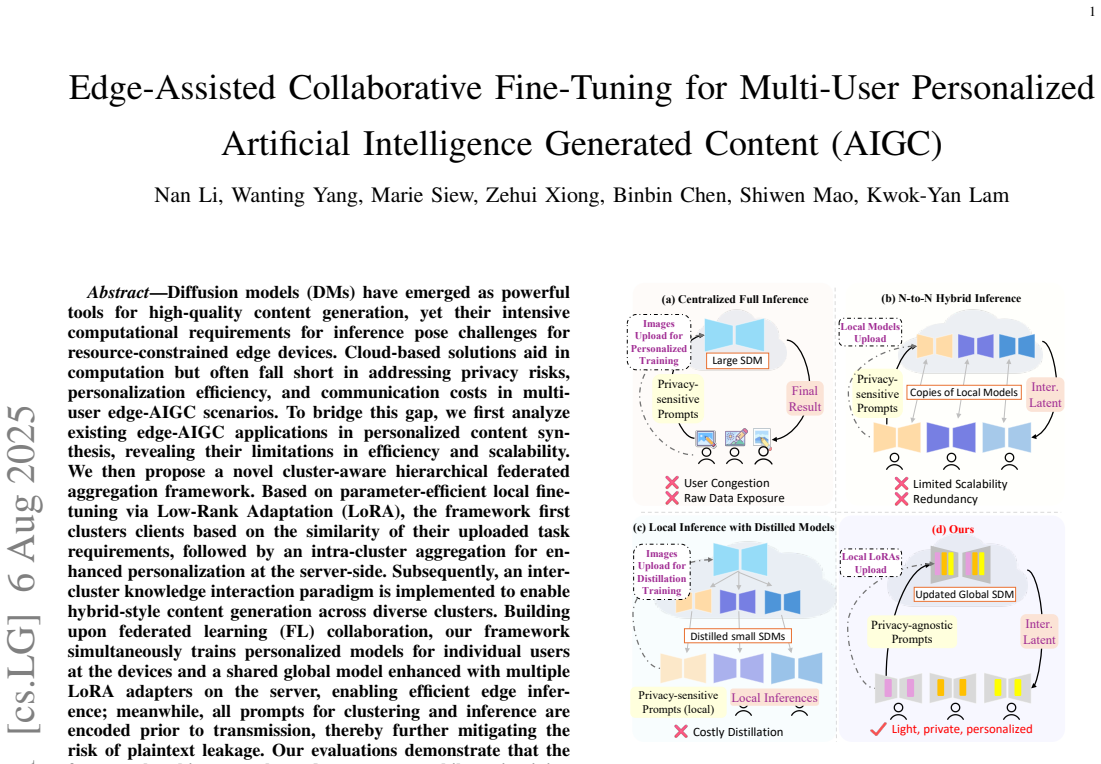
The central claim is that a single pre-trained diffusion model can host a multi-user personalized service if personalization is expressed as a small set of LoRA adapters and coordinated by a cluster-aware hierarchical aggregation. On the client side each user trains rank-adaptive LoRA updates on the attention layers of the text encoder and U-Net. The training edge server groups these LoRAs into style clusters using encoded embeddings, applies intra-cluster weighted averaging to sharpen domain features, then combines clusters using a stacking strategy whose coefficients are set by domain embedding distance and SVD normalized trace; dynamic median-aligned padding keeps rank-heterogeneous LoRAs
Load-bearing premise
The load-bearing premise is that replacing plaintext style words with learned tokens such as '<user-specific>' makes prompts semantically opaque to the server, and that the non-colluding split between the training edge server and the inference edge server blocks attribute leakage; if either fails, the privacy motivation collapses even if generation quality remains improved.
Editorial extensions
If this is right
- A single server can host one global diffusion model plus a global LoRA and still give each user a distinct style, because personalization lives in the small local adapters rather than in per-user full model copies.
- Users can run a large fraction of the generation locally after only 10–15 server denoising steps, shifting the heaviest compute away from resource-constrained edges with low communication cost.
- Encoded clustering embeddings and textual-inversion tokens reduce the amount of plaintext style and preference information the server sees during both training and inference, compared with FedBip-style plaintext prompt sharing.
- The reported FID=145 versus baseline FID=240 on sketch indicates the global LoRA is not a stylistic compromise; the shared representation can actually improve alignment with a target style while preserving diversity.
- The 32-versus-120 epoch gap between explicit-style and token-based prompts means privacy-preserving tokenization is viable but slower to converge; the framework does not get that cost for free.
Reading between the lines
- If the privacy assumption is tested rather than asserted, a property-inference attack on '<user-specific>' token embeddings or on the server's intermediate latent would be the natural stress test; the paper's future-work discussion of adversarial attacks does not cover this.
- The same cluster-aware LoRA aggregation could be applied to other generative backbones—text-to-video, audio, or multimodal assistants—where style/content separation plays the same role; the paper only demonstrates image diffusion.
- The simplified one-user-per-style evaluation leaves open whether the intra-cluster aggregation stage behaves as claimed when several clients share a style with different data; scaling the PACS setup to multiple users per cluster would test that.
- A practical deployment would need a policy for dynamic arrivals: the paper lists this as future work, but if new users arrive with unseen styles, re-clustering and LoRA reuse decisions become the main operational cost.
Editorial analysis
A structured set of objections, weighed in public.
Referee Report
Summary. The paper proposes a cluster-aware hierarchical federated aggregation framework for personalized edge-AIGC, combining client-side LoRA fine-tuning, server-side intra- and inter-cluster aggregation, and a hybrid inference pipeline with encoded prompts. The authors claim accelerated convergence, reduced privacy leakage, and practical scalability for multi-user personalized content generation. A case study on the PACS dataset using two Stable Diffusion models reports a FID improvement (145 vs 240) for sketch style, but explicitly omits the cluster-aware intra-cluster aggregation from the evaluation.
Significance. If fully realized, the framework addresses a timely problem: serving multiple users with personalized diffusion models on edge devices while limiting server-side storage and prompt exposure. The paper identifies relevant challenges (dual heterogeneity, limitations of standard PFL, privacy risks) and offers a sensible high-level architecture. However, the central claims are not backed by the reported experiments. The paper ships no code, no formal derivations, and no attack evaluation; the main quantitative result is a single FID number from a simplified setup that bypasses the proposed clustering mechanism. The significance is therefore conditional: the idea is promising, but the evidence provided is far from the claimed contributions.
major comments (5)
- [Section IV-A] The case study states: "we simplify the whole process with rank-16 LoRA for all clients, bypassing intra-cluster entirely and directly performing the inter-cluster aggregation across three LoRAs; the FL simulation follows a zero-shot setting, where each unique style is assigned to a single user." This means the evaluated system omits the defining steps of the proposed framework—client clustering, intra-cluster aggregation, multiple users per style, and rank heterogeneity. The abstract's central claim that the "cluster-aware hierarchical federated aggregation framework" achieves accelerated convergence and scalability is therefore unsupported by the evidence. This is an internal admission, not an external critique.
- [Abstract / Section IV-B] The abstract promises "accelerated convergence," but no convergence curves, training loss dynamics, or FID-vs-epoch plots are shown anywhere. The only epoch-related observation (Ours w style at 32 vs Ours w/o style at 120) is not a comparison against baselines and does not demonstrate acceleration. The convergence claim is load-bearing for the paper's value proposition and is entirely unsubstantiated.
- [Section III-B] The inter-cluster aggregation mechanism is described only narratively. DED and SNT are introduced as "dual similarity metrics" that "jointly guide coefficient generation," but no formulas, pseudocode, or algorithmic definitions are provided. Similarly, "dynamic median-aligned padding" is mentioned but not formally specified. Without these details, the core aggregation method is not reproducible, and the claim that it "precisely controls" style mixing cannot be verified.
- [Section IV-B] The quantitative result "FID=145 vs 240" (a 40% improvement) is reported once, for a single style (sketch), with no error bars, confidence intervals, or multiple random seeds. Furthermore, the comparison is made only against the pre-trained baseline; no quantitative comparison against FedAvg, FedGeoMed, or other federated baselines is provided under the same FID protocol. A single number cannot support the general claims of improved alignment and scalability across styles and users.
- [Section III-A] The privacy claim that textual-inversion tokens such as '<user-specific>' are "semantically opaque to servers" is asserted without any evaluation against inversion attacks, membership inference, or property inference. The assumption of non-colluding TES/IES is also stated but not analyzed. Privacy is a primary motivation of the paper, and this unsupported assertion is load-bearing; if the token obfuscation fails under attack, the privacy contribution collapses.
minor comments (4)
- [General] Figure 5 is low-resolution and the text labels are difficult to read; the qualitative comparisons would be much more convincing with zoomed panels or higher-resolution images.
- [Section IV-B] The hyperparameters 'mixLoras' and 'local scale' are never formally defined with equations; Figure 6 shows their values but lacks precise mathematical definitions or a sensitivity table.
- [Section III-A] The notation '<user-specific>' contains a hyphen and is used interchangeably with '<user-specif ic>' in Figure 6; this is confusing and should be unified.
- [References] Reference [13] (Flora) is cited as a NeurIPS 2024 paper; if this is a preprint, the citation should indicate the correct venue and version. Also, the paper does not mention code availability or reproducibility instructions.
Circularity Check
No significant circularity: the quantitative claim is an empirical FID comparison on an external benchmark, and the only self-citation is a non-load-bearing related-work reference.
full rationale
The paper does not present a formal derivation that could reduce to its own inputs. Its central quantitative claim (FID=145 vs. baseline FID=240, a 40% improvement) is an empirical measurement on the public PACS dataset using the standard FID metric, with hyperparameters (mixLoras, local scale) chosen by search rather than fitted to force the reported value. The method is compared against pre-trained SDMs and classic FL aggregators, so the result is externally anchored. The self-citation [7] appears only in a list of related hybrid-inference works ([4]–[7]) and is not used to justify any load-bearing step. Two limitations are noted but are not circularity: (1) Section IV-A explicitly states 'we simplify the whole process with rank-16 LoRA for all clients, bypassing intra-cluster entirely and directly performing the inter-cluster aggregation across three LoRAs; the FL simulation follows a zero-shot setting, where each unique style is assigned to a single user', which means the experiment does not test the cluster-aware hierarchical aggregation claimed in the abstract—a scope/evidence gap, not a reduction-by-construction. (2) Section III-A asserts that encoded tokens such as '<user-specific>' are 'semantically opaque to servers' without testing inversion or property-inference attacks; this is an unsupported privacy assumption rather than a derived result. Neither limitation involves a prediction equivalent to its input by definition, so the circularity score is 0.
Assumptions & free parameters
free parameters (4)
- LoRA rank r (experiment) =
16 (fixed for all clients)
- mixLoras =
1.0 (best)
- local LoRA scale =
0.95 (best)
- server split ratio =
0.2 or 0.3
assumptions (5)
- domain assumption Servers are semi-trusted and TES and IES do not collude.
- domain assumption Textual-inversion tokens such as '<user-specific>' are semantically opaque to the server.
- domain assumption Shared intermediate latents produced by the global LoRA are style-neutral and do not leak user-specific features.
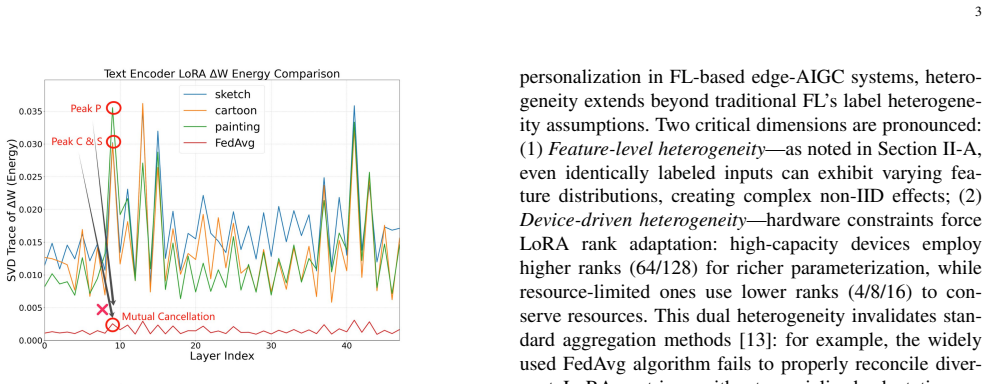
- ad hoc to paper SVD trace measures style representation energy, and DED/SNT are valid aggregation signals.
- domain assumption FID over 100 PACS images is a reliable proxy for style alignment.
invented entities (1)
-
Obfuscated style token '<user-specific>'
Cite this review
Pith. "Pith review of Edge-Assisted Collaborative Fine-Tuning for Multi-User Personalized Artificial Intelligence Generated Content (AIGC)." pith.science (2026). https://pith.science/paper/FAL7JE3I
@misc{pith2026250804745,
  author       = {Pith},
  title        = {Pith review of: Edge-Assisted Collaborative Fine-Tuning for Multi-User Personalized Artificial Intelligence Generated Content (AIGC)},
  year         = {2026},
  howpublished = {\url{https://pith.science/paper/FAL7JE3I}},
  note         = {Machine review of arXiv:2508.04745}
}
read the original abstract
Diffusion models (DMs) have emerged as powerful tools for high-quality content generation, yet their intensive computational requirements for inference pose challenges for resource-constrained edge devices. Cloud-based solutions aid in computation but often fall short in addressing privacy risks, personalization efficiency, and communication costs in multi-user edge-AIGC scenarios. To bridge this gap, we first analyze existing edge-AIGC applications in personalized content synthesis, revealing their limitations in efficiency and scalability. We then propose a novel cluster-aware hierarchical federated aggregation framework. Based on parameter-efficient local fine-tuning via Low-Rank Adaptation (LoRA), the framework first clusters clients based on the similarity of their uploaded task requirements, followed by an intra-cluster aggregation for enhanced personalization at the server-side. Subsequently, an inter-cluster knowledge interaction paradigm is implemented to enable hybrid-style content generation across diverse clusters.Building upon federated learning (FL) collaboration, our framework simultaneously trains personalized models for individual users at the devices and a shared global model enhanced with multiple LoRA adapters on the server,enabling efficient edge inference; meanwhile, all prompts for clustering and inference are encoded prior to transmission, thereby further mitigating the risk of plaintext leakage. Our evaluations demonstrate that the framework achieves accelerated convergence while maintaining practical viability for scalable multi-user personalized AIGC services under edge constraints.
Figures

Figures from the paper (3 more)


Reference graph
Works this paper leans on
-
[1]
Dreamstyler: Paint by style inversion with text-to-image diffusion models,
N. Ahn, J. Lee, C. Lee, K. Kim, D. Kim, S.-H. Nam, and K. Hong, “Dreamstyler: Paint by style inversion with text-to-image diffusion models,” inProc. AAAI Conf. Artif. Intell., vol. 38, no. 2, 2024, pp. 674–681
work page 2024
-
[2]
Implicit style- content separation using b-lora,
Y . Frenkel, Y . Vinker, A. Shamir, and D. Cohen-Or, “Implicit style- content separation using b-lora,” inECCV. Springer, 2024, pp. 181– 198
work page 2024
-
[3]
Areas of research focus and trends in the research on the application of aigc in healthcare,
C. Wang, Y . Zhu, X. Zhang, X. Chen, Y . Li, Y . Tan, and H. Qi, “Areas of research focus and trends in the research on the application of aigc in healthcare,”J. Health Popul. Nutr., vol. 44, no. 1, p. 195, 2025
work page 2025
-
[4]
H. Du, R. Zhang, D. Niyato, J. Kang, Z. Xiong, D. I. Kim, X. Shen, and H. V . Poor, “Exploring collaborative distributed diffusion-based ai- generated content (aigc) in wireless networks,”IEEE Netw., vol. 38, no. 3, pp. 178–186, 2023
work page 2023
-
[5]
Ec-diff: Fast and high- quality edge-cloud collaborative inference for diffusion models,
J. Xie, S. Zhang, Z. Zhao, F. Wu, and F. Wu, “Ec-diff: Fast and high- quality edge-cloud collaborative inference for diffusion models,”arXiv preprint arXiv:2507.11980, 2025
arXiv 2025
-
[6]
Hybrid sd: Edge-cloud collaborative inference for stable diffusion models,
C. Yan, S. Liu, H. Liu, X. Peng, X. Wang, F. Chen, L. Fu, and X. Mei, “Hybrid sd: Edge-cloud collaborative inference for stable diffusion models,”arXiv preprint arXiv:2408.06646, 2024
arXiv 2024
-
[7]
Efficient multi-user offloading of personalized diffusion models: A drl- convex hybrid solution,
W. Yang, Z. Xiong, S. Guo, S. Mao, D. I. Kim, and M. Debbah, “Efficient multi-user offloading of personalized diffusion models: A drl- convex hybrid solution,”IEEE Trans. Mob. Comput., 2025
work page 2025
-
[8]
Fedbip: Heterogeneous one-shot federated learning with personalized latent diffusion models,
H. Chen, H. Li, Y . Zhang, J. Bi, G. Zhang, Y . Zhang, P. Torr, J. Gu, D. Krompass, and V . Tresp, “Fedbip: Heterogeneous one-shot federated learning with personalized latent diffusion models,” inProc. IEEE CVPR ’25, 2025, pp. 30 440–30 450
work page 2025
Show all 15 references
-
[9]
Lora: Low-rank adaptation of large language models
E. J. Hu, Y . Shen, P. Wallis, Z. Allen-Zhu, Y . Li, S. Wang, L. Wang, W. Chenet al., “Lora: Low-rank adaptation of large language models.” ICLR, vol. 1, no. 2, p. 3, 2022
2022
-
[10]
The role of federated learning in a wireless world with foundation models,
Z. Chen, H. H. Yang, Y . C. Tay, K. F. E. Chong, and T. Q. S. Quek, “The role of federated learning in a wireless world with foundation models,” IEEE Wirel. Commun., 2023
2023
-
[11]
An image is worth one word: Person- alizing text-to-image generation using textual inversion,
R. Gal, Y . Alaluf, Y . Atzmon, O. Patashnik, A. H. Bermano, G. Chechik, and D. Cohen-Or, “An image is worth one word: Person- alizing text-to-image generation using textual inversion,”arXiv preprint arXiv:2208.01618, 2022
2022 arXiv
-
[12]
Dreambooth: Fine tuning text-to-image diffusion models for subject- driven generation,
N. Ruiz, Y . Li, V . Jampani, Y . Pritch, M. Rubinstein, and K. Aberman, “Dreambooth: Fine tuning text-to-image diffusion models for subject- driven generation,” inProc. IEEE CVPR ’23, 2023, pp. 22 500–22 510
2023
-
[13]
Flora: Federated fine-tuning large language models with heterogeneous low- rank adaptations,
Z. Wang, Z. Shen, Y . He, G. Sun, H. Wang, L. Lyu, and A. Li, “Flora: Federated fine-tuning large language models with heterogeneous low- rank adaptations,” inNeurIPS, vol. 37, 2024
2024
-
[14]
Towards personalized federated learning,
A. Z. Tan, H. Yu, L. Cui, and Q. Yang, “Towards personalized federated learning,”IEEE Trans. Neural Netw. Learn. Syst., vol. 34, no. 12, pp. 9587–9603, 2022
2022
-
[15]
Phoenix: A federated gen- erative diffusion model,
F. V . Stanley Jothiraj and A. Mashhadi, “Phoenix: A federated gen- erative diffusion model,” inCompanion Proceedings of the ACM Web Conference 2024, 2024, pp. 1568–1577. BIOGRAPHIES NAN LI(nan li@mymail.sutd.edu.sg) is currently a Ph.D. student in the Information Systems Tech...
2024
Reviewed August 6, 2026 · model on record in the stance chip above.
Discussion (0). Sign in to comment.