Efficient Quantum Implementation of Dynamical Mean Field Theory for Correlated Materials
Pith reviewed 2026-05-21 22:47 UTC · model grok-4.3
The pith
Low-rank Gaussian subspaces combined with compressed circuits make impurity Green's function calculations practical for DMFT on near-term quantum hardware.
A machine-rendered reading of the paper's core claim, the machinery that carries it, and where it could break.
Core claim
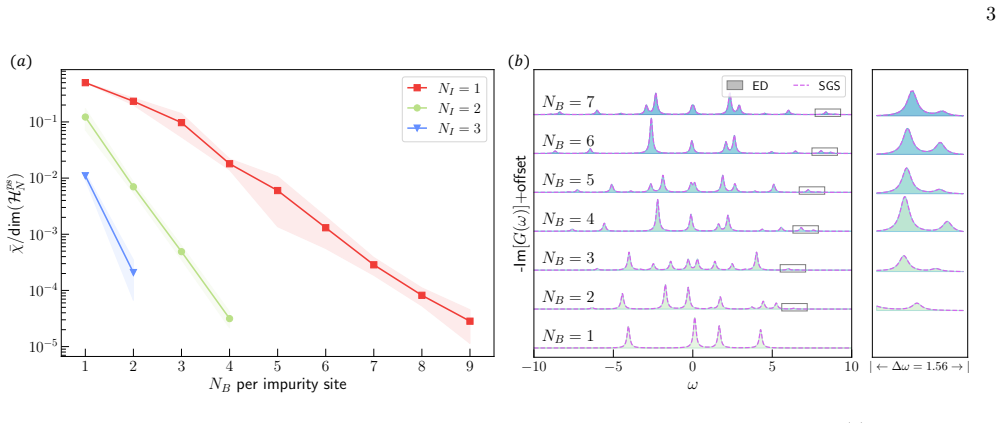
A framework that combines a low-rank Gaussian subspace representation of the ground state with a compressed short-depth quantum circuit joining state preparation and time evolution enables efficient computation of the impurity Green's function for DMFT on near-term quantum computers.
What carries the argument
The low-rank Gaussian subspace representation of the impurity ground state, used together with circuit compression that joins state preparation and time evolution into one short-depth circuit.
If this is right
- DMFT calculations for larger bath sizes become feasible on current quantum processors without requiring full state tomography.
- The self-consistency loop of DMFT retains its convergence properties when the impurity solver is replaced by the low-rank Gaussian approximation.
- Green's functions for an eight-qubit impurity problem can be measured directly on superconducting hardware with one ancilla qubit.
- Materials-science applications of DMFT move closer to execution on devices available today rather than waiting for fault-tolerant machines.
Where Pith is reading between the lines
- The same subspace-plus-compression pattern could be tested on other quantum embedding methods that also reduce to an impurity problem.
- Further compression of the time-evolution segment might allow the same accuracy at even shallower circuit depths on noisy hardware.
- Scaling the bath size while keeping the Gaussian rank fixed would reveal how far the low-rank assumption can be pushed before DMFT accuracy degrades.
Load-bearing premise
The impurity model that appears inside DMFT has a ground state that can be captured accurately enough by a low-rank Gaussian subspace to keep the overall self-consistency loop convergent.
What would settle it
Running the DMFT self-consistency loop with the Gaussian-subspace solver on a solvable test impurity model and finding that the loop fails to reach the same fixed point as a conventional solver.
Figures




read the original abstract
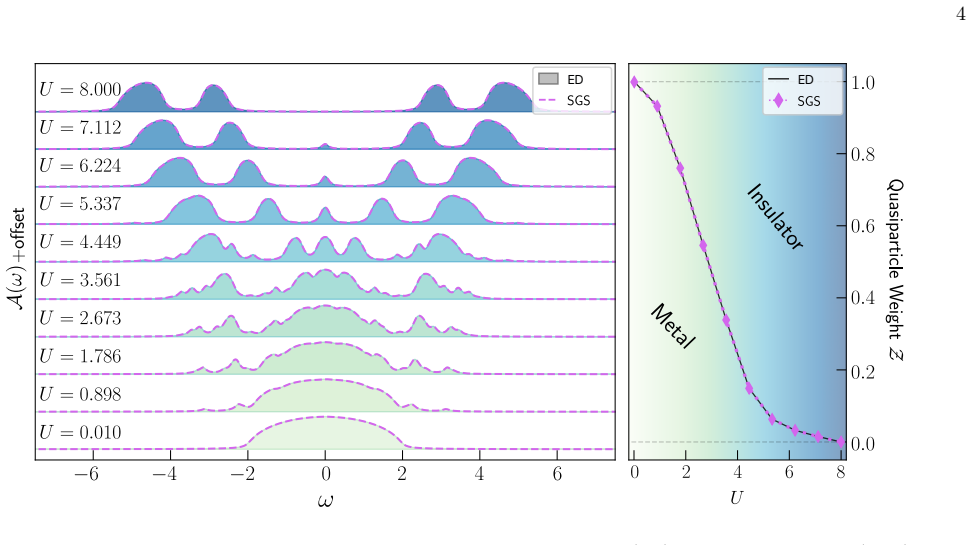
The accurate theoretical description of materials with strongly correlated electrons is a formidable challenge in condensed matter physics and computational chemistry. Dynamical Mean Field Theory (DMFT) is a successful approach that predicts behaviors of such systems by incorporating some of the correlated behavior using an impurity model, but it is limited by the need to calculate the impurity Green's function. This work proposes a framework for DMFT calculations on quantum computers, focusing on near-term applications. It leverages the structure of the impurity problem, combining a low-rank Gaussian subspace representation of the ground state and a compressed, short-depth quantum circuit that joins state preparation with time evolution to compute Green's functions. We demonstrate the convergence of the DMFT algorithm using the Gaussian subspace in a noise-free setting, and show the hardware viability of circuit compression by extracting the impurity Green's function on IBM quantum processors for a single impurity coupled to three bath orbitals (8 qubits, 1 ancilla). We discuss potential paths toward realizing this quantum computing use case in materials science.
Editorial analysis
A structured set of objections, weighed in public.
Referee Report
Summary. The manuscript proposes a quantum framework for Dynamical Mean Field Theory (DMFT) that represents the impurity ground state via a low-rank Gaussian subspace and employs a compressed short-depth circuit combining state preparation and time evolution to evaluate the impurity Green's function. It reports DMFT self-consistency convergence in a noise-free setting and demonstrates extraction of the Green's function on IBM hardware for a single-impurity plus three-bath-orbital model (8 qubits plus 1 ancilla).
Significance. If the low-rank representation preserves DMFT fixed-point accuracy, the approach could reduce the classical bottleneck of impurity solvers for strongly correlated materials on near-term devices. The explicit hardware extraction on 8 qubits and the circuit-compression technique constitute concrete, reproducible steps toward NISQ materials applications.
major comments (2)
- [Results / demonstration of DMFT convergence] The DMFT convergence demonstration is restricted to the 1-impurity + 3-bath (8-qubit) case in a noise-free setting. Because the central claim requires that the low-rank Gaussian truncation does not shift the self-consistent fixed point, the absence of scaling tests or error-propagation analysis for larger bath sizes or stronger correlations leaves the robustness of the outer DMFT loop unverified.
- [Method description of low-rank Gaussian subspace] No quantitative bound is given on how the truncation error in the Gaussian subspace propagates into the Green's function or the self-energy; such a bound is needed to confirm that the method remains parameter-free with respect to the DMFT loop.
minor comments (2)
- [Abstract] The abstract states that the method 'leverages the structure of the impurity problem' but does not specify which structural properties (e.g., particle-hole symmetry, locality) are exploited; a short clarifying sentence would improve readability.
- [Hardware results figure] Figure captions and axis labels for the hardware data should explicitly state the number of shots, error-mitigation protocol, and post-processing steps used to obtain the reported Green's function.
Simulated Author's Rebuttal
We thank the referee for the constructive report and the opportunity to clarify our work. We address the two major comments point by point below, indicating where revisions will be incorporated.
read point-by-point responses
-
Referee: The DMFT convergence demonstration is restricted to the 1-impurity + 3-bath (8-qubit) case in a noise-free setting. Because the central claim requires that the low-rank Gaussian truncation does not shift the self-consistent fixed point, the absence of scaling tests or error-propagation analysis for larger bath sizes or stronger correlations leaves the robustness of the outer DMFT loop unverified.
Authors: We agree that the primary numerical demonstration uses the 8-qubit instance. This choice reflects the hardware demonstration and the focus on near-term feasibility. In the revised manuscript we will add noise-free DMFT convergence results for a 1-impurity + 5-bath model (10 qubits) that confirm the low-rank Gaussian subspace yields the same fixed point as the exact solver within the chosen tolerance. We will also include a short error-propagation discussion showing how truncation error in the impurity Green's function maps to the self-energy update. revision: yes
-
Referee: No quantitative bound is given on how the truncation error in the Gaussian subspace propagates into the Green's function or the self-energy; such a bound is needed to confirm that the method remains parameter-free with respect to the DMFT loop.
Authors: We concur that an explicit propagation bound would be valuable. A general analytical bound for arbitrary correlation strength is non-trivial and lies outside the present scope. In the revision we supply numerical quantification: for the systems examined the truncation-induced error in the Green's function stays below 5e-4, which is smaller than the DMFT convergence threshold and does not alter the fixed point. We clarify in the methods that the subspace rank is chosen by an internal convergence criterion independent of the DMFT self-consistency parameters, thereby preserving the parameter-free character of the outer loop. revision: partial
Circularity Check
No significant circularity; framework validated by explicit toy-model convergence and hardware benchmark
full rationale
The paper proposes a quantum DMFT implementation that combines a low-rank Gaussian subspace representation of the impurity ground state with compressed circuits for Green's function evaluation. This representation is introduced as an approximation whose fidelity is checked by direct numerical convergence of the DMFT loop on the 8-qubit (1+3 bath) instance and by hardware execution; it is not defined in terms of the target Green's function or self-energy. No step reduces a prediction to a fitted parameter by construction, nor does any load-bearing claim rest solely on a self-citation chain. The central assumption is therefore externally falsifiable and the derivation remains self-contained against the provided benchmarks.
Axiom & Free-Parameter Ledger
axioms (1)
- domain assumption The impurity problem in DMFT admits an accurate low-rank Gaussian subspace representation of the ground state.
Lean theorems connected to this paper
-
IndisputableMonolith/Cost/FunctionalEquation.leanwashburn_uniqueness_aczel unclear?
unclearRelation between the paper passage and the cited Recognition theorem.
low-rank Gaussian subspace representation of the ground state ... compressed short-depth quantum circuit ... partial compression of Trotter evolution ... matchgates
-
IndisputableMonolith/Foundation/RealityFromDistinction.leanreality_from_one_distinction unclear?
unclearRelation between the paper passage and the cited Recognition theorem.
DMFT self-consistency loop ... impurity Green's function
What do these tags mean?
- matches
- The paper's claim is directly supported by a theorem in the formal canon.
- supports
- The theorem supports part of the paper's argument, but the paper may add assumptions or extra steps.
- extends
- The paper goes beyond the formal theorem; the theorem is a base layer rather than the whole result.
- uses
- The paper appears to rely on the theorem as machinery.
- contradicts
- The paper's claim conflicts with a theorem or certificate in the canon.
- unclear
- Pith found a possible connection, but the passage is too broad, indirect, or ambiguous to say the theorem truly supports the claim.
Reference graph
Works this paper leans on
-
[1]
Each term in this summation can be obtained via a Hadamard test. Typically, time evolution on quantum devices is done using Trotter product methods. The schematic structure of the Hadamard test trotterized time evolution circuit for the evaluation of a correlation function ⟨ϕi|ˆγa(t)ˆγb|ϕj⟩=⟨0|U iei bHtˆγae−i bHtˆγbU † j |0⟩,(6) where ˆγa(t) is the time e...
-
[2]
A. Georges, G. Kotliar, W. Krauth, and M. J. Rozen- berg, Rev. Mod. Phys.68, 13 (1996)
work page 1996
- [3]
- [4]
-
[5]
T. N. Lan and D. Zgid, J. Phys. Chem. Lett.8, 2200 (2017)
work page 2017
-
[6]
E. Gull, P. Werner, S. Fuchs, B. Surer, T. Pruschke, and M. Troyer, Computer Physics Communications182, 1078–1082 (2011)
work page 2011
-
[7]
A. N. Rubtsov, V. V. Savkin, and A. I. Lichtenstein, Phys. Rev. B72, 035122 (2005)
work page 2005
- [8]
- [9]
-
[10]
A. Liebsch and H. Ishida, Journal of Physics: Condensed Matter24, 053201 (2011)
work page 2011
-
[11]
T. Keen, T. Maier, S. Johnston, and P. Lougovski, Quan- tum Science and Technology5, 035001 (2020)
work page 2020
-
[12]
T. Steckmann, T. Keen, E. K¨ okc¨ u, A. F. Kemper, E. F. Dumitrescu, and Y. Wang, Phys. Rev. Res.5, 023198 (2023)
work page 2023
-
[13]
X. Nie, X. Zhu, Y.-a. Fan, X. Long, H. Liu, K. Huang, C. Xi, L. Che, Y. Zheng, Y. Feng, X. Yang, and D. Lu, Phys. Rev. Lett.133, 140602 (2024)
work page 2024
- [14]
-
[15]
I. Rungger, N. Fitzpatrick, H. Chen, C. H. Alderete, H. Apel, A. Cowtan, A. Patterson, D. M. Ramo, Y. Zhu, N. H. Nguyen, E. Grant, S. Chretien, L. Wossnig, N. M. Linke, and R. Duncan, arXiv preprint (2020), arXiv:1910.04735 [quant-ph]
-
[16]
Dynamical meanfieldtheoryforrealmaterialsonaquantum computer
J. Selisko, M. Amsler, C. Wever, Y. Kawashima, G. Sam- sonidze, R. U. Haq, F. Tacchino, I. Tavernelli, and T. Eckl, arXiv preprint (2024), arXiv:2404.09527 [cond- mat.str-el]
-
[17]
G. Greene-Diniz, D. Z. Manrique, K. Yamamoto, E. Plekhanov, N. Fitzpatrick, M. Krompiec, R. Sakuma, and D. M. Ramo, Quantum8, 1383 (2024)
work page 2024
- [18]
- [19]
-
[20]
F. Jamet, C. Lenihan, L. P. Lindoy, A. Agarwal, E. Fontana, B. A. Martin, and I. Rungger, APL Quan- tum2(2025), 10.1063/5.0245488
-
[21]
J. Ehrlich, D. F. Urban, and C. Els¨ asser, J. Phys.: Con- dens. Matter37, 225901 (2025)
work page 2025
-
[22]
G. Kotliar, S. Y. Savrasov, K. Haule, V. S. Oudovenko, O. Parcollet, and C. Marianetti, Rev. Mod. Phys.78, 865 (2006)
work page 2006
- [23]
-
[24]
G. Kotliar, S. Y. Savrasov, G. Palsson, and G. Biroli, Phys. Rev. Lett.87, 186401 (2001)
work page 2001
- [25]
-
[26]
A. Georges, L. d. Medici, and J. Mravlje, Annu. Rev. Condens. Matter Phys.4, 137 (2013)
work page 2013
- [27]
-
[28]
Y. N´ u˜ nez Fern´ andez and K. Hallberg, Frontiers in Physics6, 13 (2018)
work page 2018
-
[29]
M. Grundner, P. Westhoff, F. B. Kugler, O. Parcollet, and U. Schollw¨ ock, Phys. Rev. B109, 155124 (2024), publisher: American Physical Society
work page 2024
-
[30]
D. Zgid, E. Gull, and G. K.-L. Chan, Phys. Rev. B86, 165128 (2012)
work page 2012
- [31]
-
[32]
C. Mejuto-Zaera, N. M. Tubman, and K. B. Whaley, Physical Review B100, 125165 (2019)
work page 2019
-
[33]
A. Mukherjee, N. F. Berthusen, J. C. Getelina, P. P. Orth, and Y.-X. Yao, Communications Physics6, 4 (2023)
work page 2023
-
[34]
M. Ragone, B. N. Bakalov, F. Sauvage, A. F. Kemper, C. Ortiz Marrero, M. Larocca, and M. Cerezo, Nature Communications15(2024), 10.1038/s41467-024-49909- 3
- [35]
-
[36]
S. Bravyi and D. Gosset, Communications in Mathemat- ical Physics356, 451 (2017)
work page 2017
- [37]
-
[38]
E. K¨ okc¨ u, D. Camps, L. Bassman Oftelie, J. K. Freericks, W. A. de Jong, R. Van Beeumen, and A. F. Kemper, Phys. Rev. A105, 032420 (2022)
work page 2022
-
[39]
E. K¨ okc¨ u, R. Wiersema, A. F. Kemper, and B. N. Bakalov, arXiv preprint (2024)
work page 2024
- [40]
-
[41]
A. F. Kemper, C. Yang, and E. Gull, Phys. Rev. Lett. 132, 160403 (2024)
work page 2024
-
[42]
A. N. Tikhonov, Proceedings of the USSR Academy of Sciences39, 195 (1943)
work page 1943
-
[43]
A. Francis, A. A. Agrawal, J. H. Howard, E. K¨ okc¨ u, and A. F. Kemper, arXiv preprint (2022)
work page 2022
-
[44]
C. Mejuto-Zaera and A. F. Kemper, Electronic Structure 5, 045007 (2023)
work page 2023
- [45]
- [46]
-
[47]
C. Drischler, M. Quinonez, P. G. Giuliani, A. E. Lovell, and F. M. Nunes, Phys. Lett. B823, 136777 (2021)
work page 2021
-
[48]
E. K¨ okc¨ u, D. Camps, L. B. Oftelie, W. A. de Jong, R. Van Beeumen, and A. Kemper, arXiv preprint (2025)
work page 2025
- [49]
- [50]
-
[51]
M. F. Herbst, B. Stamm, S. Wessel, and M. Rizzi, Phys. Rev. E105, 045303 (2022)
work page 2022
-
[52]
M. Schiro and O. Scarlatella, The Jour- nal of Chemical Physics151, 044102 13 (2019), https://pubs.aip.org/aip/jcp/article- pdf/doi/10.1063/1.5100157/15562486/044102 1 online.pdf
-
[53]
O. Scarlatella, A. A. Clerk, R. Fazio, and M. Schir´ o, Phys. Rev. X11(2021), 10.1103/physrevx.11.031018
-
[54]
G. D. Mahan,Many Particle Physics(Springer, New York, NY10013, USA, 2010)
work page 2010
-
[55]
H. Bruus and K. Flensberg,Many-body quantum theory in condensed matter physics: an introduction(OUP Ox- ford, 2004)
work page 2004
- [56]
- [57]
- [58]
- [59]
- [60]
- [61]
-
[62]
T. Q. R. developers and contributors, “Qiskit research (v0.0.2),” (2023)
work page 2023
-
[63]
J. J. Wallman and J. Emerson, Phys. Rev. A94, 052325 (2016)
work page 2016
-
[64]
Quantum processing units, IBM Quantum Platform, https://quantum.ibm.com/services/resources
-
[65]
D. C. McKay, I. Hincks, E. J. Pritchett, M. Carroll, L. C. Govia, and S. T. Merkel, arXiv preprint (2023). 14 Appendix A: Extended discussion of DMFT Using DMFT, the correlated behavior of the lattice model that describes a real material is related to an impurity model. In our study, we performed DMFT for the half-filled Hubbard model in the Bethe lattice...
work page 2023
-
[66]
C6 by half in depth foranyHamiltonianH, andany unitariesU i,U j, ˆγa and ˆγb
Controlled unitary simplification First, we will show how to simplify the circuit given in Eq. C6 by half in depth foranyHamiltonianH, andany unitariesU i,U j, ˆγa and ˆγb. We will frequently use the following equality: ... ... V ... ... V= (C7) To see that these two circuits are equal, let us follow what they implement for each state of the ancilla qubit...
-
[67]
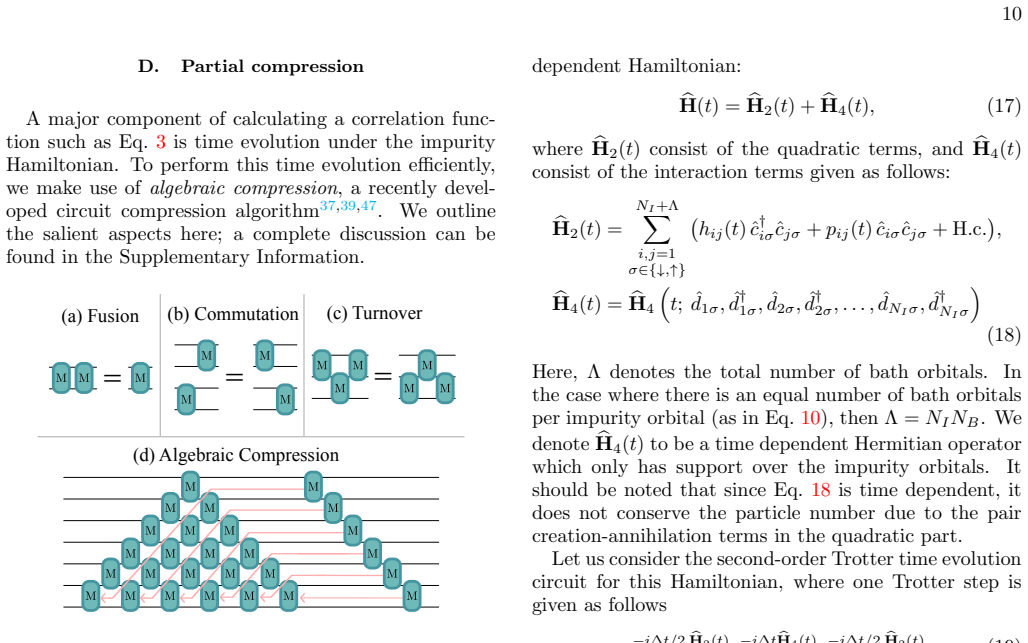
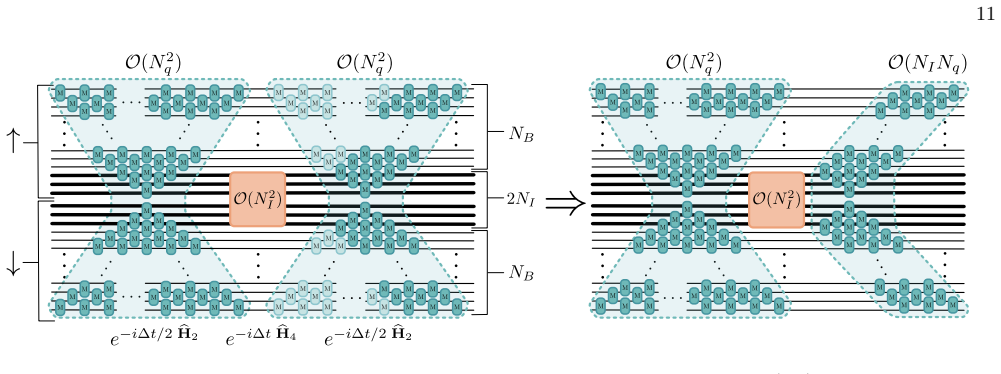
Partial compression of the second-order Trotter time evolution In this subsection, we will focus on the time evolution operatore−it bHimp for the impurity Hamiltonian given in Eq. 10. Let us separate the Hamiltonian into two parts as follows: bHimp = bH2 +bH4,(C13) 19 where bH2 = NIX ijσ νij ˆd† iσ ˆdjσ + NIX i NBX bσ ϵibˆc† ibσˆcibσ + NIX i NBX bσ V i b ...
-
[68]
In this work, we are representing the ground state as a linear combination of FGS
Controlled state preparation and further compression In this subsection, we will show how to build the state preparation circuit at the beginning of the time evolution circuit, i.e., the controlledU j and anti-controlledU j. In this work, we are representing the ground state as a linear combination of FGS. This means that the unitariesU i can be written a...
-
[69]
Quantum resource estimation Using the basic structure of the circuits in this work, we compute the two-qubit gate costs per circuit as a function of the total number of bath orbitals Λ, the total number of impurity orbitalsN I, and the number of Trotter stepsr. We also make use ofN q = 2(NI + Λ), which is the number of qubits, neglecting the ancilla. The ...
-
[70]
To mitigate some of that dephasing, we employed dynamical decoupling (DD)60
Gate-based error mitigation Once the measurement of our quantum circuits occurs, the information lost to qubit dephasing during runtime cannot be fully recovered with classical post-processing techniques. To mitigate some of that dephasing, we employed dynamical decoupling (DD)60. At the cost of a few single-qubit Pauli operations, DD acts as a deterrent ...
-
[71]
Post-selection and rescaling Conveniently, the impurity HamiltonianbHimp is particle-conserving, which allows us to filter out the measurements received in error in a procedure called post-selection. For our hardware runs in Fig. 7, we used a half-filled impurity model withN I = 1 andN B = 3, meaning any shots that did not obey this particle content were ...
discussion (0)
Sign in with ORCID, Apple, or X to comment. Anyone can read and Pith papers without signing in.